


The most repeated advice about mainland company setup dubai is also the most outdated: start in a Free Zone because mainland is restrictive, sponsor-heavy, and harder to manage.
That was once reasonable advice. It isn't reliable advice for 2026.
The practical question today isn't “How do I get the cheapest licence?” It's “Which setup gives me market access, ownership control, visa flexibility, banking credibility, and manageable compliance without unpleasant surprises six months later?” For many founders, especially service firms, trading businesses, and SMEs entering the local UAE market, mainland now wins that comparison.
The shift is visible in the market. In the first half of 2025, Dubai's key business hubs recorded a 32% year-on-year increase in new company registrations, a rise tied to reforms allowing 100% foreign ownership on the mainland and attracting large numbers of new businesses from markets including India and Pakistan, according to Dubai business registration data for H1 2025. That matters because it confirms something consultants on the ground have seen for a while: founders are no longer choosing mainland only when forced to. They're choosing it because it fits growth.
What most guides still miss is the essential decision layer. The licence fee is only one line item. Office structure, visa planning, external approvals, bank readiness, and post-licence compliance decide whether your setup stays efficient or becomes expensive. A cheap first quote can turn into a poor market-entry decision.
Table of Contents
- The End of Business as Usual in Dubai
- Why Dubai Mainland is the New Gold Standard for Growth
- The Mainland Formation Roadmap
- Finalizing Your Legal and Physical Presence
- Activating Your Business Operations
- Budgeting Your Mainland Setup Real Costs and Timelines
The End of Business as Usual in Dubai
Dubai mainland used to carry three assumptions. You needed a local sponsor. You had less control than you wanted. And unless your business absolutely required local market access, a Free Zone was the easier answer.
Those assumptions don't hold in the same way now. The market has moved, the law has moved, and founder expectations have moved with it. If you're still relying on pre-2021 guidance, you're making a 2026 decision with old constraints in mind.
The important shift isn't just legal ownership. It's strategic posture. Mainland has become the setup for founders who want to sell across the UAE without structural workarounds, choose office locations based on operations rather than zone rules, and keep the option of public and government-related opportunities open. That's why the conversation has changed from “Can foreigners even own mainland businesses properly?” to “Does a Free Zone still make sense for this model?”
Old advice still creates bad decisions
A lot of low-cost setup advice focuses on speed to licence issuance. That's too narrow. A licence that leaves you boxed into the wrong geography, the wrong activity, or the wrong office model isn't efficient. It's just fast.
Founders usually run into problems when they optimise for the first invoice instead of the first year of operation. The better approach is to look at the company the way a bank, regulator, landlord, customer, and immigration authority will look at it. Mainland performs well on that test when the business is built for actual UAE trading, consulting, contracting, or service delivery.
Most setup mistakes don't begin at the compliance stage. They begin when a founder chooses a structure that doesn't match how the business will really earn money.
Why the market is treating mainland differently
The rise in new registrations isn't random. It reflects confidence in a structure that now offers more direct control and broader commercial access. Founders from overseas markets aren't entering Dubai only to hold a certificate. They're entering to trade, hire, invoice locally, and build regional operations.
That's the practical significance behind the registration growth cited earlier. It isn't just momentum. It's evidence that mainland is no longer the complicated fallback. For many businesses, it's the primary route.
A founder opening a design consultancy with local clients, a trading company serving distributors across the UAE, or a technical services firm pursuing larger contracts often ends up in the same place after comparing options carefully: mainland is more work to plan, but often less friction to operate.
Why Dubai Mainland is the New Gold Standard for Growth
The strongest case for mainland isn't that it suits everyone. It doesn't. The strongest case is that it suits growth businesses better than many founders realise.
A Free Zone can still be the right fit for narrowly defined activities, international-only models, or founders who want a simpler packaged launch. But if your plan includes local sales, broader commercial flexibility, or future tender participation, mainland usually gives you a cleaner operating base.
The ownership shift changed the risk equation
The legal change that mattered most was the removal of the old ownership barrier. The 2021 Commercial Companies Law amendments removed the requirement for a UAE national to hold 51% ownership for over 1,000 business activities, shifting mainland from a sponsor-dependent structure into an investor-controlled one, according to analysis of Dubai mainland formation rules and costs.
That changed more than cap tables. It changed founder psychology.
Before that, many foreign owners treated mainland as something to use only when market access outweighed control concerns. Now, for a large number of activities, the founder can evaluate mainland on business merit rather than ownership compromise. That's a major difference.
Practical rule: If your revenue will depend on the UAE domestic market, assess mainland first and only rule it out for a clear reason.
Mainland vs Free Zone at a glance
| Factor | Dubai Mainland (DET) | Free Zone |
|---|---|---|
| Ownership | 100% foreign ownership for many activities | 100% foreign ownership |
| UAE market access | Can trade across the UAE market | Often structured around zone activity and may require added arrangements for some mainland-facing operations |
| Government contracts | Eligible to pursue government opportunities | Usually more limited in this area |
| Office flexibility | Can choose office location based on operational needs, subject to compliance | Office options are usually tied to the Free Zone's own framework |
| Activity range | Broad and practical for local commercial activity | Often better when the business fits the zone's model and scope |
| Regulator | Department of Economy and Tourism framework | Free Zone authority framework |
The trade-off is straightforward. Mainland usually gives you more commercial freedom, but it also demands better planning. You can't treat it like a templated licence purchase.
Where mainland tends to outperform
Mainland tends to be the better choice when your business needs one or more of these:
- Local client access: You want to invoice and serve customers across Dubai and the wider UAE without structural detours.
- Tender readiness: You want the option to work with public-sector or government-linked entities.
- Location control: You need to choose premises based on staff, logistics, or customers instead of a zone package.
- Broader commercial positioning: You want the company to look and function like a local operating business, not just a regional holding shell.
That doesn't make Free Zones inferior. It makes them specific. Mainland is stronger when the business needs room to operate without jurisdictional friction.
A common mistake is comparing a Free Zone's packaged setup fee to a mainland entry quote and concluding that mainland is “more expensive”. Sometimes it is. Sometimes it isn't. But even when the starting cost is higher, the better question is whether mainland removes downstream constraints that would cost more later.
The Mainland Formation Roadmap
The setup process looks simple on paper. In practice, the early decisions determine almost everything that follows. If the activity is wrong, the licence is wrong. If the licence is wrong, approvals, office needs, visas, banking posture, and tax treatment all become harder.
That's why the smartest mainland company setup dubai process starts with classification, not paperwork.
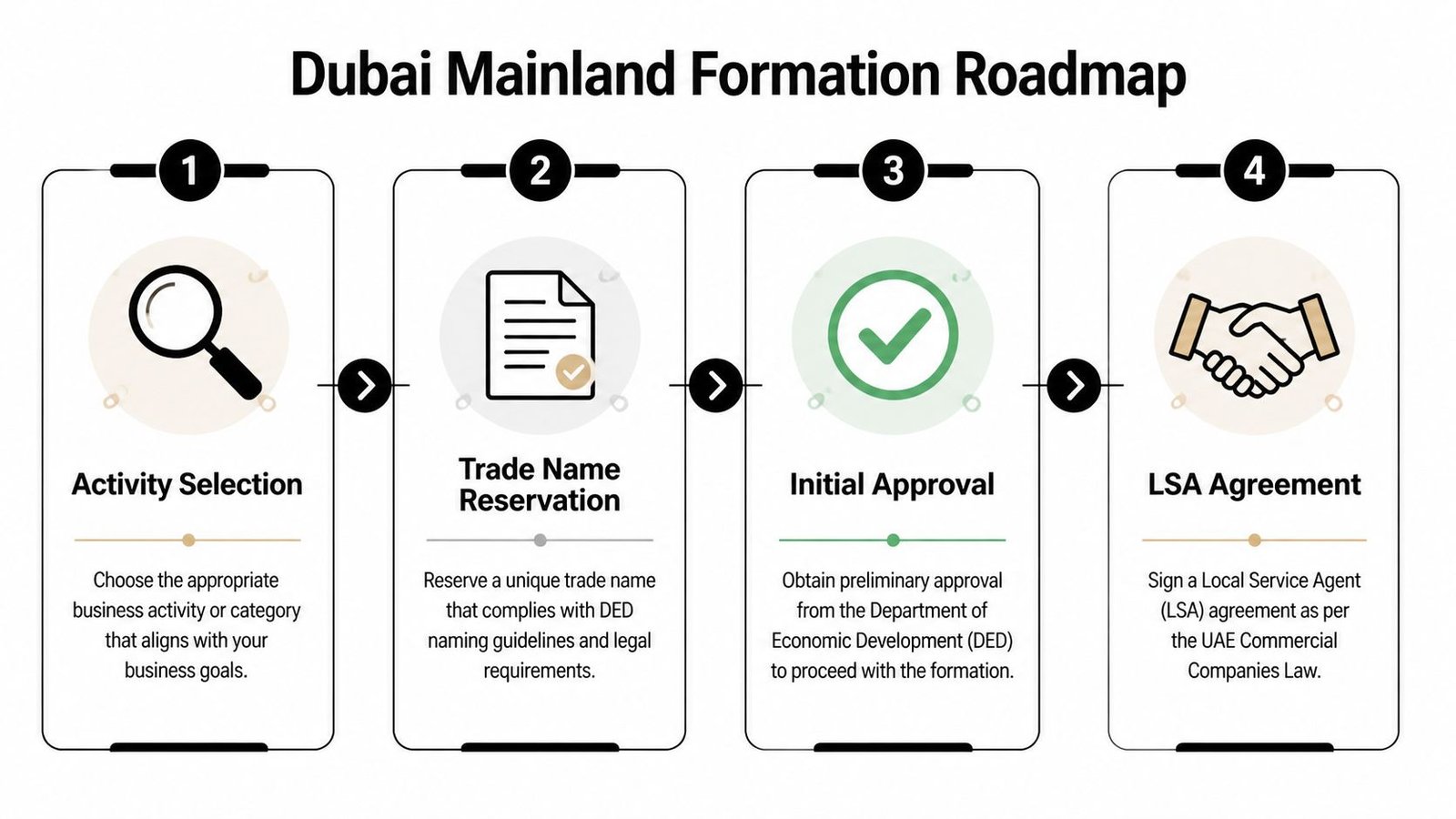
Start with the activity, not the trade name
Many founders lead with branding. Regulators lead with activity. The regulator's coded activity list determines what kind of licence you need, what approvals may be required, and which legal form fits.
Many applications go wrong in this phase. Misclassifying the activity is a leading cause of initial rejection, and using a professional PRO firm can raise first-pass approval success for trade names and initial approvals to over 95%, according to guidance on the mainland setup process in Dubai.
A practical way to handle activity selection is to work backwards from revenue. Ask:
- What exactly will the company invoice for?
- Who is the buyer?
- Will the work be advisory, commercial trading, technical execution, or manufacturing-related?
- Will any regulated third party need to approve the activity?
The answer usually points toward a commercial, professional, or industrial licence path. It also shapes whether an LLC or another form is appropriate.
Reserve the name and secure initial approval properly
Once the activity is clear, the trade name comes next. Founders often underestimate how often names fail because they are too generic, too close to existing registrations, or inconsistent with the activity.
Initial approval is not final licensing, but it matters because it confirms that the authorities don't object in principle to the proposed company structure. If there's confusion at this stage, later stages become slower and more expensive.
Use a naming approach that is practical rather than sentimental:
- Match the business logic: The name should fit the licence activity and legal structure.
- Keep spelling consistent: Passport names, shareholder documents, and application details must align.
- Avoid future amendments: If your name is too narrow, you may need changes later when the business expands.
A trade name is not marketing copy. It is a legal identifier that has to survive approval, banking review, and contract use.
Know when external approvals apply
Some activities move through the DET process with little resistance. Others require outside approvals before the licence can be issued. Health-related, education-related, telecom-related, and certain specialised technical activities often need more than standard company formation documents.
That's why founders should separate “setup timeline” from “approval timeline”. The company file may be ready, but the activity may still depend on another authority's sign-off.
A sensible roadmap usually follows this sequence:
| Step | What happens | Why it matters |
|---|---|---|
| Activity selection | Choose the exact coded activity | Sets the licence path and approval burden |
| Trade name reservation | Lock in an acceptable company name | Avoids naming conflicts later |
| Initial approval | Obtain preliminary regulator consent | Confirms the setup can proceed |
| Drafting and document prep | Prepare constitutional and shareholder documents | Creates the legal basis for the company |
| Office and lease registration | Secure compliant premises | Supports licensing and visa processing |
| Final licence issuance | Submit final file for trade licence | Turns the application into an operating entity |
What works best here is disciplined sequencing. What doesn't work is trying to rush all steps in parallel without understanding dependencies. That's where founders end up paying amendment fees, re-submitting documents, or changing office plans after the fact.
Finalizing Your Legal and Physical Presence
This is the stage where a mainland company stops being an approved concept and becomes a compliant legal entity with a real footprint. Two items matter most here: the premises and the founding documents.
Both are often treated too casually. They shouldn't be.

Your office is a compliance document, not just a workplace
For mainland businesses, the office isn't merely where your team sits. It is part of the licensing file. The lease has to be suitable, and the tenancy arrangement has to be properly registered through Ejari.
That changes how you should choose a space. A founder may prefer a stylish unit in a convenient area, but if the lease structure is wrong or the premises don't support the intended activity, the office becomes a problem instead of an asset.
The smartest office decision is usually the one that balances four variables:
- Compliance fit: The premises must match mainland licensing expectations.
- Visa planning: Office setup can affect staffing flexibility.
- Bank perception: A credible office setup can support the overall company profile.
- Operating cost: The cheapest office is rarely the cheapest solution if it leads to amendments or limitations.
Startups often do well with a modest compliant arrangement rather than overcommitting to a premium lease too early. Larger teams, trading firms, and businesses with inventory or client traffic have a different set of needs and should choose accordingly.
MOA and LSA are not the same thing
Founders still mix up the Memorandum of Association (MOA) and the Local Service Agent (LSA) concept because old sponsor-era terminology continues to float around.
They are not interchangeable.
For an LLC, the MOA is the constitutional document that sets out ownership and company governance. It is central. It needs to be drafted carefully, checked against passports and shareholder details, and aligned with the approved activity.
An LSA arrangement is different. It applies in specific professional licence contexts and does not mean the old 51% ownership model is back. That confusion causes unnecessary anxiety. In current practice, the modern LSA role is administrative in nature and should be understood on those terms, not through the lens of outdated sponsor structures.
If someone explains your setup using pre-reform sponsor language without distinguishing ownership from representation, stop and clarify the structure before signing anything.
What founders should verify before signing
Before documents are notarised or submitted, check these points closely:
- Shareholder names: Passport spellings and legal names must match exactly.
- Activity wording: The wording in the legal documents must align with the approved activity.
- Office details: Premises information must be accurate and current.
- Authority scope: If an authorised signatory is appointed, the powers granted should be deliberate, not broad by default.
This stage rewards precision. It punishes assumptions. A lot of later trouble traces back to documents signed too quickly because the founder was focused on speed.
Activating Your Business Operations
Getting the trade licence issued feels like the finish line. It isn't. It's the point where the company becomes capable of activation, not the point where everything is live.
The gap between “licensed” and “fully operational” is where many founders lose time and money.

Licence issued does not mean operational
After licensing, the company still needs the right immigration and administrative steps to function smoothly. That usually includes the establishment file, investor visa processing where relevant, employee visas when hiring begins, and document handling across several authorities.
Visa quota planning becomes important. Underestimating visa allocation can trigger expensive rework. A common post-licence pitfall is misjudging visa quotas, which can lead to over AED 20,000 in rework costs, according to guidance on common mainland setup pitfalls and compliance failures.
That problem usually starts earlier than founders think. They choose an office based on price, then discover the staffing plan doesn't fit the premises or supporting file.
A cleaner activation approach looks like this:
- Align staffing plans with office strategy before finalising the premises.
- Confirm who needs residence status first, founder or employees.
- Prepare immigration documents in parallel with post-licence paperwork.
- Treat visa capacity as part of business planning, not just HR administration.
Banking is a documentation test
Opening the corporate bank account is often the most underestimated part of the process. Founders assume the licence guarantees an account. It doesn't.
Banks evaluate the company as an operating proposition. They look for a coherent business activity, a credible shareholder story, clean documentation, consistency across forms, and a business model that makes sense. If your file looks assembled rather than planned, scrutiny rises quickly.
What tends to help:
- Consistent documents: Shareholder information, activity, office details, and supporting records should tell the same story.
- A clear business model: Banks respond better when the revenue path is specific and understandable.
- Orderly shareholding records: Complex ownership chains require more care, not less.
- Real operating evidence: Contracts, profiles, invoices, or pipeline materials can help show substance where appropriate.
What usually hurts is mismatch. A broad activity, weak office logic, unclear source of funds narrative, and poorly organised file create friction fast.
A useful overview of the activation journey is below.
Tax registration starts earlier than most founders expect
Compliance begins on day one, not at year end. Founders who delay tax thinking until the company has already started trading often end up correcting avoidable issues.
The same source notes that non-compliance with VAT and Corporate Tax rules can result in fines ranging from AED 10,000 to AED 50,000. That's why post-formation tax assessment should be handled as part of setup, not as an afterthought.
The practical mindset is simple: if the company will trade, invoice, hire, and bank locally, its tax and bookkeeping posture must be clean from the start.
The trade licence gets you into the market. Compliance determines whether you stay there without friction.
Budgeting Your Mainland Setup Real Costs and Timelines
The biggest budgeting mistake in mainland setup is assuming the quoted incorporation fee represents the true launch cost. It doesn't.
The market is full of headline prices that leave out the items founders discover later. Office upgrades. Additional visa processing. Amendments. Banking support. Extra attestations. Tax registrations. Annual renewals. None of these are unusual. They're part of the actual cost base.
A useful benchmark from a detailed review of hidden costs in Dubai mainland setup is that hidden expenses in office leases, visa processing, and bank account remediation can increase the initial budget by 30% to 50% if they aren't planned from the start.
What your first quote usually leaves out
The initial quote often captures the visible legal mechanics. It may not capture the operational consequences of your decisions.
Typical blind spots include:
- Office escalation: You start with a minimal lease, then discover the premises don't suit visas, banking posture, or business activity.
- Visa-related extras: Medicals, status changes, typing, and related admin can add up if the staffing plan wasn't mapped properly.
- Bank remediation: If the account opening file is weak, the business may spend more time and money gathering additional support.
- Amendments: A poorly chosen activity or trade name can create change costs after submission.
- Ongoing compliance: Renewal, accounting, VAT or tax registration, and recurring admin need to be budgeted, not improvised.
The point isn't that mainland is hidden-cost heavy by nature. The point is that poor planning makes it look that way.
A practical way to build your budget
The cleanest budget model separates costs into three buckets.
| Cost bucket | What belongs here | Budgeting mindset |
|---|---|---|
| Formation costs | Licence issuance, registrations, legal drafting, document processing | These get you incorporated |
| Operational activation costs | Office, visas, banking support, immigration processing, attestations | These get you functioning |
| Ongoing compliance costs | Renewals, accounting support, tax registrations and filings, amendments if needed | These keep you viable |
If you're planning a solo consultancy, your budget logic should prioritise compliant simplicity. Keep the office lean but valid. Avoid over-licensing activities you won't use. Prepare for banking carefully.
If you're planning a small trading company, don't model costs as if you were launching a single-founder advisory firm. Trading usually demands more attention to office credibility, banking readiness, documentation flow, and practical staffing needs.
Cheap setup and low total cost of ownership are not the same thing. The second one matters more.
How to think about timelines realistically
Founders ask for one number: “How long will it take?” The honest answer is that there are several timelines, not one.
There is the licensing timeline. Then there is the office finalisation timeline. Then visas. Then banking. Then the point when the business is fully ready to trade with minimal friction.
A realistic planning method is to think in stages:
- Stage one: approvals and licence path
- Stage two: premises and legal documentation
- Stage three: immigration and activation
- Stage four: banking and routine compliance readiness
This avoids the common mistake of treating licence issuance as full launch. A company can be licensed and still not be commercially ready. It can also be operationally ready but delayed by preventable banking or immigration issues if the file was assembled too late.
The strongest mainland setups in 2026 usually share the same traits. The activity is chosen carefully. The office fits the real business. The shareholder file is clean. The visa plan is tied to staffing. Tax and banking are considered from the start. And the founder budgets for ownership, access, and longevity instead of just the first payment.
If you want a clear plan instead of a rough quote, Inpro Corporate Services L.L.C. helps founders structure UAE setups around real market access, ownership, visas, banking readiness, and ongoing compliance. The team handles mainland formation, PRO workflows, visas, bank account support, and tax-related setup with transparent pricing and clear timelines, so you can budget for the full operating picture instead of just the licence.