


The licence is only one decision. The outcome that matters is whether the company you set up can sell where you want, open a bank account without delay, support the right visa capacity, and hold up under UAE tax and compliance rules.
That is why starting a business in the UAE should be treated as a series of strategic choices, not an admin exercise. Since 1 June 2021, the UAE has allowed 100% foreign ownership of onshore companies in most sectors. Entry is easier than it used to be. Structure selection now carries more weight because the wrong setup often shows up later, in banking questions, restricted client access, or avoidable restructuring costs.
The strategic takeaway: the first form you submit matters less than the assumptions you lock in before you submit anything.
Founders usually arrive focused on speed and price. Those matter. But in practice, the better question is whether the setup fits your revenue model. A free zone licence can be efficient for some businesses and limiting for others. A mainland company can give broader market access, but it may bring different approval, office, and compliance requirements. The right choice depends on who you sell to, where you operate, and how you plan to grow.
If you are searching for how to start business in uae, start with the decisions that shape market access, tax efficiency, and operational freedom over the next two to three years. That is where strong setups separate from expensive short-term fixes.
Table of Contents
- Your 2026 UAE Business Blueprint
- The First Critical Decision Mainland vs Free Zone
- Navigating Mainland Company Formation
- Mastering the Free Zone Setup Workflow
- Securing Your Documents and Visas
- Activating Your Business for Operations
- Your Pre-Launch Checklist and Avoiding Common Pitfalls
Your 2026 UAE Business Blueprint
Setting up in the UAE is not a paperwork exercise. It is a series of early decisions that shape how you sell, bank, hire, and manage tax from day one.

The founders who get this right do not start with forms. They start with operating reality. Where will revenue come from? Which authority fits the activity? Will the business need visas, office space, import permissions, or a lighter structure that keeps fixed costs under control? Those choices affect far more than approval speed.
I have seen the same pattern repeatedly. A founder picks a low-cost licence because it looks fast and simple. Six months later, the business needs a bank account profile that does not match the activity, a visa allocation the package cannot support, or customer access the structure never allowed in the first place. Rebuilding the setup costs more than choosing properly at the start.
Structure determines freedom
A trade licence only proves the company exists. It does not guarantee the company is positioned to operate well.
The stronger setup is the one that matches the business you intend to run over the next year, not the version that is easiest to approve this week. That means judging each option by commercial fit, compliance exposure, and operating flexibility, not just by setup price.
What matters in 2026
A sound UAE setup usually comes down to four decisions:
- Market access: Are you selling inside the UAE, outside it, or across both?
- Regulatory fit: Does the business activity align with the right licensing authority and approval route?
- Operational model: Will you need staff visas, physical premises, warehousing, or a lean service base?
- Tax readiness: Can the company support proper accounting, registration, and filing from the start?
The strategic takeaway: how to start business in uae is a design decision with long-term consequences. Choose the structure around how the business will operate, and you gain room to grow. Choose it around convenience alone, and the restrictions usually show up later, when changing course is slower and more expensive.
The First Critical Decision Mainland vs Free Zone
The biggest UAE setup mistake is choosing a licence structure for approval speed instead of business fit. That decision shapes where you can sell, how easily you can bank, what visa capacity you can support, and how expensive it becomes to fix mistakes later.
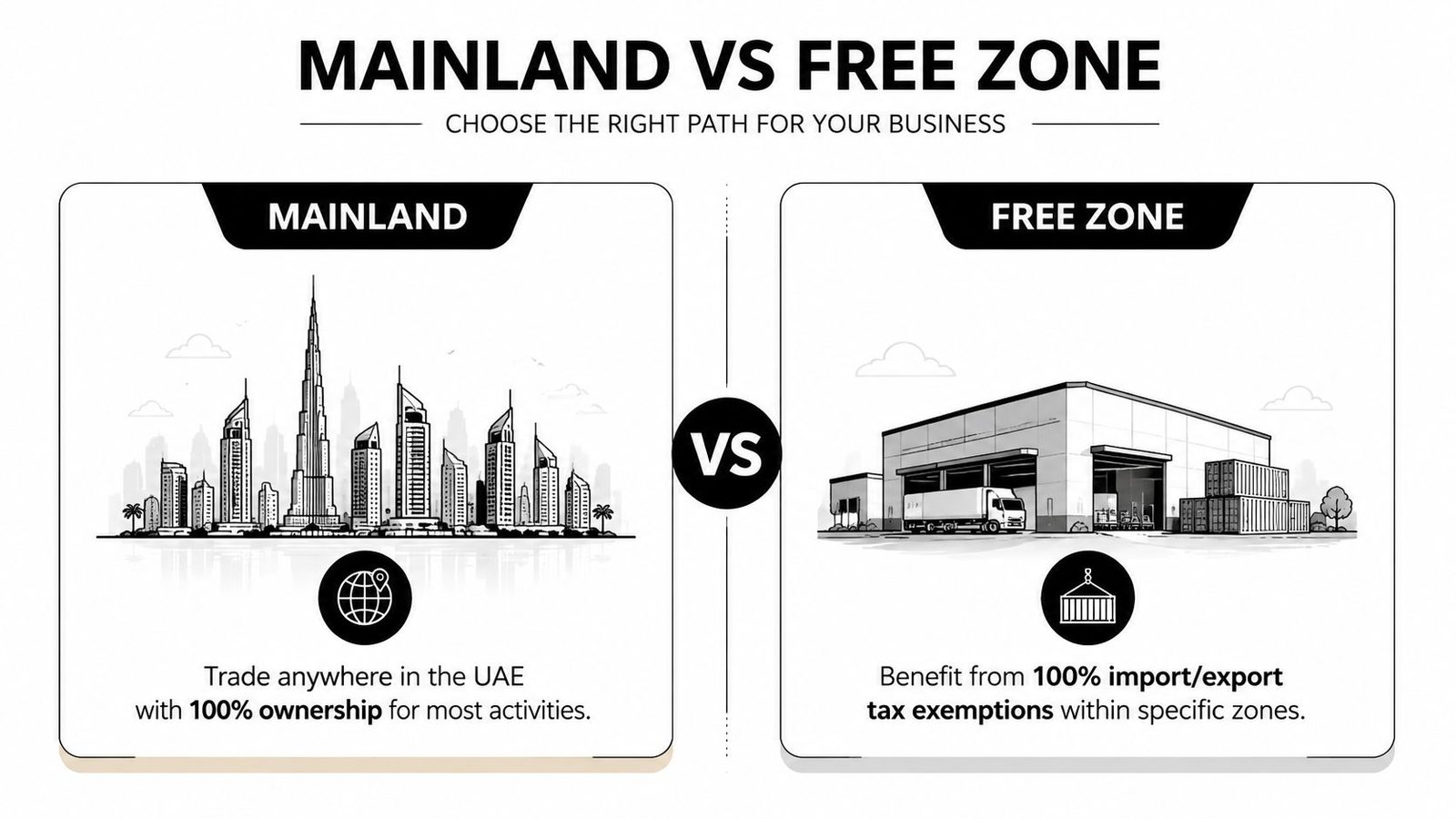
Start with commercial access, not setup cost
Mainland works best when the business needs direct access to the UAE market. That usually means local client work, retail presence, tenders, domestic trading, or a sales team operating across the Emirates without structural limitations getting in the way.
Free Zone works best when the company is built around cross-border trade, exported services, digital delivery, holding activity, or a sector-specific ecosystem inside a particular zone. In practice, many founders are not choosing between two equivalent options. They are choosing between local market freedom and a more packaged operating base.
That is why I advise founders to answer one question before comparing quotes: where will revenue come from in the next 12 to 24 months?
Offshore structures exist, but they serve a narrower purpose such as asset holding or ownership planning. For an operating SME, the decision that matters is usually Mainland versus Free Zone.
Speed matters less than operating freedom
According to the UAE Ministry of Economy's guidance on establishing companies, setup in the UAE has become faster and more digital, with Basher supporting very fast formation in some cases, while free zone formations are often processed within a matter of business days. The same guidance also makes the cost gap clear. Mainland setup often starts higher, while some free zone packages enter at a lower price point.
Those facts matter. They should not be the basis for the decision.
A lower entry quote can create a more expensive operating model if the company later needs local customer access, stronger banking positioning, more visas, or a licence activity the original structure does not support cleanly. A higher-cost setup can be the cheaper decision over two years if it removes the need for restructuring.
Saving on incorporation fees and losing commercial freedom is a poor trade.
What each option gives you
Mainland usually gives broader flexibility inside the UAE. It suits businesses that expect to build local relationships, hire steadily, and operate without relying on workarounds for domestic activity.
Free Zones usually give a cleaner entry process, predefined packages, and infrastructure built around certain business types. That can be efficient for consultants, digital firms, exporters, and founders who want a controlled starting point with clear administrative boundaries.
Both structures support 100% foreign ownership in many cases. The primary difference is not ownership. It is operating condition.
A practical filter:
- Choose Mainland if UAE-based revenue is central to the plan, especially for local services, trading, tenders, or broad market presence.
- Choose Free Zone if the company is designed for international business, remote delivery, zone-based operations, or a lighter initial footprint.
- Rework the plan if the deciding factor is only the cheapest licence quote.
Mainland vs. Free Zone At a Glance
| Factor | Mainland Company | Free Zone Company |
|---|---|---|
| Core advantage | Direct UAE market access | Structured entry point for international or zone-based models |
| Ownership | 100% foreign ownership in most sectors | 100% foreign ownership |
| Approval path | More authority coordination | More standardised setup flow |
| Cost profile | Usually higher starting cost | Often lower starting package cost |
| Office and visas | Premises choice often affects operations and visa capacity | Package terms often shape space and visa allocation |
| Best fit | UAE-facing trading and service businesses | Export, consulting, digital, holding, specialised activity |
The strategic takeaway: choose the structure that matches how the business will sell, hire, bank, and comply after incorporation. The right setup gives you room to operate. The wrong one stays cheap only until the business starts working.
Navigating Mainland Company Formation
Mainland company formation is a market-access decision first and an admin process second. Founders who treat it like form-filling usually end up with a licence that is technically approved but commercially restrictive. The cost of that mistake shows up later, when contracts, banking, staffing, or government approvals do not line up with how the business operates.
The official route includes 9 steps, and the early decisions carry most of the risk. According to the UAE government's mainland business setup guidance, misaligned business activities cause 35% of initial rejections, and improper trade name selection accounts for another 20%. The same guidance notes that using a PRO service can improve first-time success from 65% to 88%.
Start with the commercial model, then map the licence
The activity selection determines far more than the wording on the licence. It shapes which authority approvals may apply, what contracts you can sign with confidence, and whether your company structure supports the actual work being sold.
I see the same problem often. A founder chooses an activity that sounds close enough, then tries to stretch it across consulting, trading, software, project management, or marketing support. Mainland authorities do not assess those as interchangeable. Banks and counterparties often do not either.
Use a strict order:
- Business activity first. Match the licence to the actual revenue-generating service or product.
- Legal form second. Choose the entity structure that fits ownership, liability, and governance needs.
- Trade name third. Keep it compliant, clear, and likely to pass without revisions.
That sequence saves time because each decision supports the next one. Reversing it usually creates rework.
Treat approvals, documents, and premises as one strategy
Initial Approval matters, but it should not be handled in isolation. On mainland setups, the approval path, constitutional documents, tenancy arrangement, and any sector-specific permissions need to support the same operating plan.
Premises are part of that strategy. As noted in the Ministry of Economy guidance mentioned earlier, mainland setup requirements can tie office space to licence validity and practical operating capacity. The point is not the square footage itself. The point is that premises affect more than rent. They can influence how the business scales, how it presents to banks, and how cleanly it can support later applications.
A better workflow looks like this:
- confirm the exact activity scope
- reserve a compliant trade name
- prepare the incorporation documents to match that scope
- secure premises that fit the model, not just the lowest available lease
- submit only when the full file is internally consistent
Experienced process support offers a practical advantage in this context. Firms such as Inpro Corporate Services L.L.C. handle mainland licensing, document submission, PRO workflows, visas, attestations, and compliance coordination for founders who want one accountable process instead of several disconnected providers.
The strategic takeaway: mainland formation works best when every element supports the same commercial goal. Choose the licence, legal form, approvals, and premises as one coordinated setup decision, and the company will be easier to operate after incorporation.
Mastering the Free Zone Setup Workflow
Free Zone formation is usually faster than Mainland. That speed can hide weak planning. Founders assume a package-based process is automatically simpler, then submit an application that fits the portal but not the business.
According to the RAKEZ guide to starting a business in the UAE, Free Zone setups typically complete in 3 to 7 days, with a 96% success rate for complete applications. The same source also warns that 28% of initial applications fail because the business plan is inadequate and lacks proper 12-month cash flow projections, while costs typically range from AED 12,000 to AED 35,000.
Choose the zone for fit, not just price
Not all Free Zones are interchangeable. Each has its own operating culture, activity list, package model, and tolerance for certain business profiles.
The wrong way to choose a zone is by headline cost alone. The right way is to match the zone to the business you're building. If you need credibility with a regulated client base, logistics support, a specific industry ecosystem, or room for future staffing, that fit matters more than a cheap first-year quote.
Three filters help:
- Commercial fit: Does the zone support your exact activity cleanly?
- Operational fit: Is the package aligned with your office, visa, and staffing reality?
- Compliance fit: Can you evidence enough substance for your planned tax position and banking profile?
Build the application around the package
Free Zone applications revolve around packages more than founders expect. The package often determines office type, visa allocation, and practical operating limits.
That means the application isn't just a licensing file. It's a statement about how the company will exist in practice. A flexi-desk can be fine for some businesses. It can also become restrictive if the company quickly needs more people, more visible substance, or a stronger profile for counterparties.
A strong Free Zone file usually includes:
- A precise activity description: not a vague summary
- A business plan with real operating logic: especially where the zone requests projections
- A package that matches your near-term team structure: not your cheapest possible entry point
- Clean shareholder documents: consistent names, dates, and supporting paperwork
A Free Zone licence is easy to obtain when the file is coherent. It becomes difficult when the company story changes halfway through the application.
The strategic takeaway: Free Zone setup works best when you treat the package as an operating decision, not a promotional offer.
Securing Your Documents and Visas
Visa processing is where weak setup decisions start to cost time.
A UAE company can hold a licence and still be operationally stuck if its immigration file is incomplete, inconsistent, or poorly sequenced. Founders often treat residency as paperwork that follows incorporation. In practice, it is part of the company design. The structure you chose, the shareholder records you submitted, and the premises you secured all shape how quickly the business can place people on the ground.
Documents drive immigration outcomes
Immigration authorities do not review documents in isolation. They review whether the file tells one coherent story.
Names must match across passports, shareholder resolutions, licence records, and constitutional documents. Dates need to line up. Attestation requirements need to be handled before the file reaches the stage where they can delay approvals. A small mismatch can force resubmissions, and resubmissions slow everything behind them, including Emirates ID steps, medical testing, and visa stamping.
The clean sequence is usually straightforward:
- Company documents issued first: licence, incorporation papers, and registered address records
- Immigration file opened next: Establishment Card and the related company immigration profile
- Individual applications submitted after that: investor, partner, or employee visas based on the actual structure and role
This is an administrative process, but it is also a strategic one. A founder who expects to hire quickly should build a file that supports multiple visa applications without needing corrections halfway through.
Residency planning should start at incorporation
The right visa route depends on who needs residency and why. An owner-manager, a passive shareholder, and an employee do not sit in the same category, and treating them as interchangeable creates avoidable friction.
This matters early. If the business will need co-founders in-country, operational staff, or sponsored dependants, the company file should be prepared with those later applications in mind. That includes getting personal documents in order, confirming role titles make sense, and avoiding licence activity descriptions that create confusion once banks, immigration, and counterparties start reviewing the same business.
For a quick visual overview of the broader formation journey, this walkthrough is useful:
A common mistake is to optimise for the fastest incorporation outcome, then discover the residency plan does not fit the business that was formed. Fixing that later usually means amendments, extra approvals, and lost time.
The strategic takeaway: visas are not an afterthought. They are one of the clearest tests of whether your UAE setup was designed for long-term operating freedom or just fast initial approval.
Activating Your Business for Operations
Obtaining the licence is not the launch. It is permission to begin the work. Two items decide whether the company can function: banking and tax readiness.

Banking starts before you apply
Corporate bank account opening is easier when the business model, shareholder profile, and supporting documents were structured with banking in mind. It becomes difficult when the company was formed quickly but can't explain its activity, counterparties, or commercial logic clearly.
Banks don't review only the licence. They review the business behind the licence. That means your activity description, office profile, contracts, ownership story, and commercial substance need to make sense together.
What works in practice:
- Consistent documentation: the licence, business plan, and supporting papers tell the same story
- Clear commercial rationale: the bank can understand who pays you and why
- A sensible structure: the jurisdiction and package match the activity
Tax registration belongs in setup, not after launch
Tax is where the old “set up first, organise later” mindset breaks down. The UAE now applies 9% corporate tax on profits over AED 375,000, and the post-2025 compliance burden is no longer something to bolt on later.
According to the Hawksford guide to starting a business in the UAE, that 9% tax affects an estimated 70% of mainland startups within 18 months, and 25% of new entities face penalties in their first filing because tax registration was overlooked during formation.
Banking and tax aren't post-launch admin. They are part of the launch decision itself.
The strategic takeaway: if you wait until after incorporation to think about bankability and tax registration, you've already made the risky version of the setup.
Your Pre-Launch Checklist and Avoiding Common Pitfalls
A solid UAE launch isn't about completing more tasks. It's about checking whether the decisions underneath those tasks are coherent. That's the difference between a company that starts cleanly and one that keeps needing repair work.
A founder's final self-audit
Before you submit anything, confirm these points:
- Jurisdiction fit: Does your chosen Mainland or Free Zone structure match where revenue will come from?
- Activity accuracy: Does the licence activity describe the actual business, not a rough approximation?
- Package or premises fit: Will your office arrangement support visas, credibility, and daily operations?
- Document integrity: Are names, dates, signatures, and supporting records consistent across the file?
- Operations readiness: Can the company open a bank account and support tax registration without restructuring?
The mistakes that cost time later
The most expensive errors usually look harmless at the start.
- Buying on setup price alone: a cheaper package can limit how the business trades or scales.
- Treating business plans casually: weak applications fail because the financial logic is thin or missing.
- Ignoring immigration logic: founders secure a company, then realise the people side wasn't planned.
- Deferring tax thinking: registration and filing problems often begin at formation, not at first return.
- Assuming approval equals usability: a licence can be valid and still be the wrong vehicle for your model.
The strategic takeaway: the best setup is the one you don't have to fix six months later.
If you want a second pair of eyes on your structure before you commit, Inpro Corporate Services L.L.C. helps founders compare Mainland, Free Zone, and Offshore options, coordinate licensing and visa workflows, and align setup decisions with banking and tax compliance from the start.