


You've finished the company setup. The trade licence is issued, the incorporation papers are in order, and you're ready to invoice customers. Then the primary friction starts. The bank asks for more documents than expected, wants to understand your ownership structure, questions your business model, and may still not give a clear timeline.
That surprises a lot of founders. In the UAE, a corporate bank account isn't treated like a simple product you switch on after incorporation. It sits inside a formal compliance process. Banks want to see that the company is properly formed, the owners are transparent, the signers are authorised, and the activity makes sense on paper and in practice.
That approach has become even more important since the UAE introduced a corporate tax regime effective for financial years starting on or after 1 June 2023, which raised the importance of clean entity records and bank-ready compliance for founders across mainland, free zone, and offshore structures, as noted in the UAE-relevant business bank account guidance. If your licensing, UBO records, or signatory authority documents are incomplete, delays are common because the bank has to verify the entity before activation.
Table of Contents
- The Final Hurdle in Your UAE Business Launch
- Choosing Your Banking Path by Jurisdiction
- Your Essential Document Checklist for Approval
- Navigating the Bank Application and KYC Interview
- Common Rejection Reasons and How to Avoid Them
- Banking Alternatives and Final Takeaways
The Final Hurdle in Your UAE Business Launch
A founder usually reaches this stage thinking the difficult part is over. It often isn't. For many UAE companies, opening the account becomes the final hurdle because the bank isn't only checking whether the company exists. It's deciding whether the business fits its risk appetite and whether the documents tell a coherent story.

The practical implication is simple. Founders who treat banking as an afterthought usually lose time. Founders who prepare for it during formation move faster because their licence, ownership records, and signer authorities are already aligned.
Why UAE banks are strict
UAE banks operate in a compliance-first environment. They have to verify who owns the company, what the company will do, where money will come from, and whether the structure makes sense for the activity.
That's why the process feels less like opening a utility account and more like presenting a file for approval.
Practical rule: A bank account application succeeds when your legal documents, ownership trail, and operating story all match.
Three things matter early:
- Clean incorporation records: Your trade name, licence activity, shareholder documents, and constitutional papers need to match exactly.
- Clear ownership disclosure: If there's a UBO declaration issue, a layered holding structure, or missing authority, the file slows down quickly.
- Real operating intent: Banks want more than a licence. They want to see how the business will trade.
Founders asking how to open company bank account in the UAE should start with that mindset. You are not only opening an account. You are passing a risk review.
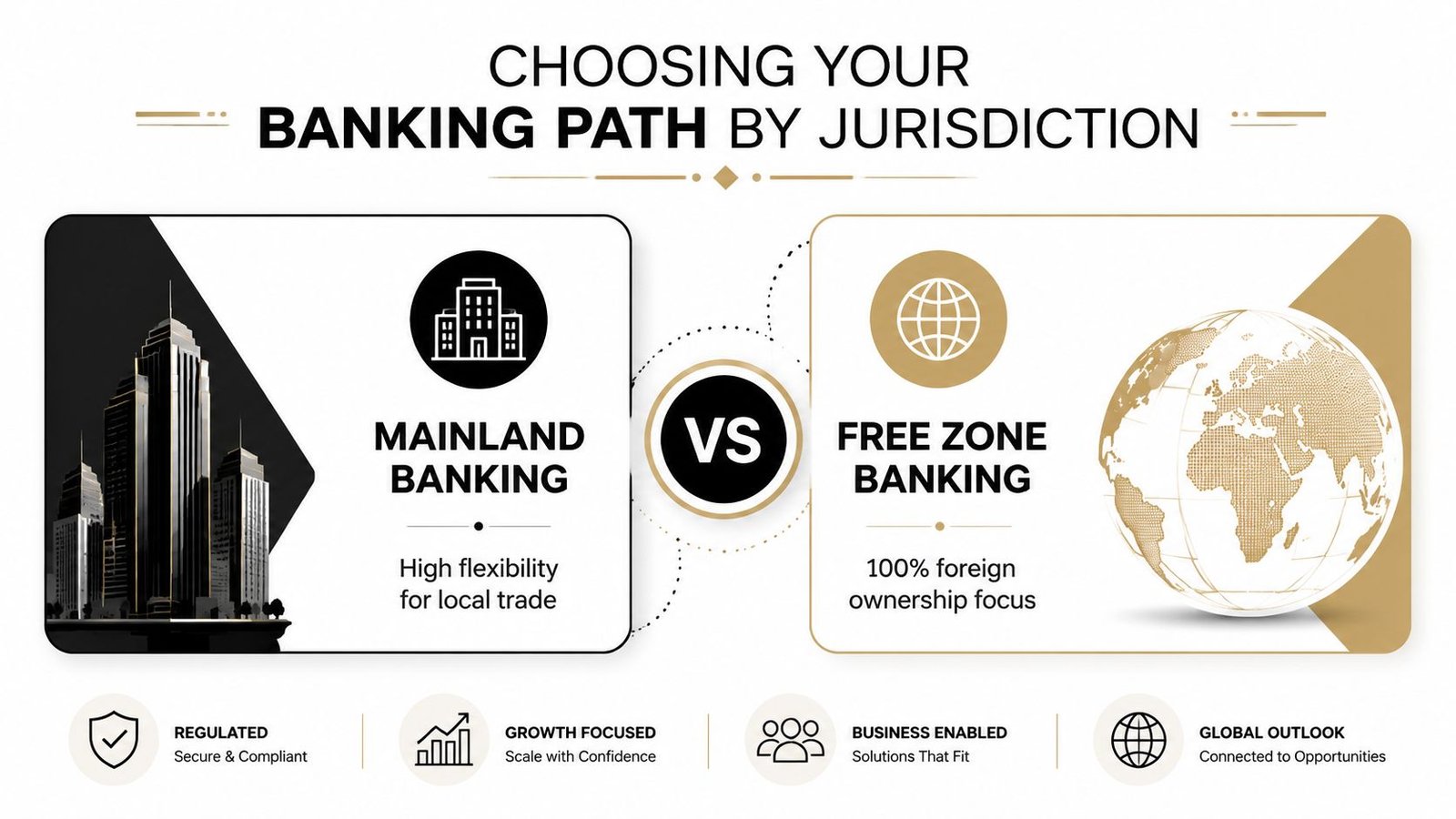
Choosing Your Banking Path by Jurisdiction
The biggest mistake I see is assuming all UAE company types are treated the same by banks. They aren't. A mainland entity, a free zone company, and an offshore structure can all be valid legal vehicles, but banks read them very differently.
Why jurisdiction changes the conversation
Your jurisdiction affects what the bank expects to see. It shapes how easily the bank can verify your activity, whether there's local substance, and how comfortable the bank feels with your transaction profile.
For UAE founders, a key pitfall is underestimating AML/CFT screening and UBO transparency requirements. Banks are also sensitive to economic-substance and activity mismatch issues, so a free zone licence alone isn't enough. They want proof of real operating intent such as an office lease, website, and invoices. That matters even more for international founders, where outcomes improve when the company can demonstrate clear revenue pathways and local presence, according to the UAE-focused bank compliance guidance.
Mainland, Free Zone, and Offshore compared
Here is the practical version.
| Structure | How banks often view it | What usually gets attention | Typical challenge |
|---|---|---|---|
| Mainland | Easier to connect to local trading activity and UAE market presence | Trade licence activity, office proof, local contracts, authorised signers | Weak documentation around ownership or inconsistent business description |
| Free Zone | Common and acceptable, but banks look closely at actual operations | Free zone documents, lease or flexi-desk proof, website, invoices, counterparties | Activity on the licence doesn't match the real business or there's no local nexus |
| Offshore | Highest scrutiny because the structure can look detached from UAE operations | Source of funds, source of wealth, group structure, reason for UAE banking | Limited substance, unclear purpose, or purely cross-border flows with no convincing rationale |
Mainland companies usually have the simplest story if they plan to operate inside the UAE market. The bank can understand the local footprint more quickly. If the company has staff, premises, and supplier or client relationships in the UAE, that often supports the file.
Free zone companies are common for international founders, especially where foreign ownership and operational flexibility matter. But many applications show inconsistencies. A founder may hold a free zone licence for consultancy, while the actual business looks like trading, holding, or payment intermediation. Banks notice that immediately.
Offshore structures face the toughest questions. The issue isn't that offshore is invalid. The issue is that the bank needs a stronger explanation for why that company needs a UAE account, who ultimately controls it, and what underlying business the account will support.
A well-documented free zone company will usually outperform a poorly explained mainland company.
What usually works better
A few judgement calls improve the process.
- Match the bank to the structure: Some banks are more comfortable with trading businesses. Others are more open to holding companies, consultants, or cross-border models.
- Use the jurisdiction's strengths: Mainland works well when you need local market access. Free zone works well when the activity and geography are clearly defined. Offshore needs a very clean rationale.
- Don't apply too early: If formation is still in motion, the bank can't complete verification cleanly.
A practical blind spot in global content is that it rarely explains the UAE-specific differences between free zone, mainland, and offshore banking. It also rarely addresses how visa status and local onboarding realities can affect the process for international founders, as noted in this gap analysis on UAE bank account requirements by jurisdiction.
If you're choosing jurisdiction and banking strategy at the same time, decide them together. That saves far more time than fixing a mismatched structure later.
Your Essential Document Checklist for Approval
Most banking delays aren't caused by one missing paper. They happen because the file doesn't work as a complete set. A passport is there but the shareholder name appears differently in the incorporation papers. The trade licence is active but the authorised signer isn't clearly appointed. The office lease exists but doesn't support the activity story.
Across major banking guides, the recurring minimum items are a tax identifier, business formation documents, a business licence, proof of address, and government-issued ID. In UAE practice, founders should prepare notarised or attested incorporation papers, shareholder passports, Emirates ID where available, lease or office proof, and a clear description of expected transactions before applying, as outlined in the document checklist for business bank account opening.

Company documents banks usually expect
Start with the corporate side of the file.
- Trade licence: This tells the bank what the company is allowed to do. If the licence activity is broad or vague, expect follow-up questions.
- Certificate of incorporation or registration: Banks use this to confirm the legal existence of the entity.
- Memorandum and Articles of Association: These documents show ownership, powers, and governance. They matter especially when there are several shareholders or one corporate shareholder.
- UBO declaration: This identifies the natural persons who ultimately own or control the company.
- Share register or ownership agreement: Useful when the constitutional documents don't present the ownership position clearly.
- Proof of business address: Lease, office agreement, or other location evidence that supports the operating footprint.
- Business plan or transaction profile: This should explain what the company sells, who it sells to, where those counterparties are based, and how money will move.
The transaction profile is often the most underprepared document. Founders spend time collecting legal papers, then submit one vague paragraph about expected activity. That's rarely enough.
Shareholder and signatory documents
The personal side of the file matters just as much.
- Passport copies for shareholders and directors: Clear, current, and consistent with the company records.
- Emirates ID where available: Particularly useful where a founder already has UAE residency.
- Visa page where relevant: This helps establish immigration status and local presence.
- Proof of residential address: Banks may ask for utility bills, bank statements, or similar documents depending on their policy.
- Board resolution or authority document: If a manager, director, or third party will sign, the authority must be explicit.
- Source of funds or source of wealth evidence: More likely when the structure is offshore, the ownership is layered, or the transaction profile is international.
One operational tip matters here. If a shareholder is another company, prepare the parent company's corporate papers in an attested or apostilled form where needed. Many applications stall because founders assume the bank only needs documents from the UAE entity.
A short explainer is helpful before you assemble the pack:
What banks are actually checking in your file
Banks don't read documents the way a founder does. They are checking for consistency, authority, and plausibility.
If the licence says consultancy, the website says trading, and the expected transactions look like payment aggregation, the file won't feel credible.
Review your pack against these questions:
- Does the company legally exist and hold the right licence?
- Can the bank identify the owners and controllers?
- Does the signer have authority to act?
- Does the stated business model match the documents and online presence?
- Can the bank understand where funds come from and where they'll go?
If the answer to any one of those is unclear, the bank asks for more. If several are unclear, the file usually goes quiet or gets declined.
Navigating the Bank Application and KYC Interview
A founder can submit a clean file on Monday and still be answering compliance follow-up questions two weeks later because the interview exposed gaps the documents did not settle. That happens often in the UAE, especially where the company structure and banking profile do not sit neatly together.

From submission to compliance review
Banks review UAE Mainland, Free Zone, and Offshore applications differently, even when the shareholders and business activity look similar on paper.
A Mainland company usually has the clearest case for local operations if the file shows a real UAE business presence, local contracts, staff, or office use. A Free Zone company can still open a strong operating account, but the bank will look closely at whether the activity, client base, and place of operations make sense for that zone and licence. An Offshore company faces the hardest review. The bank will want a sharper explanation of why the structure exists, where management happens, and why the account should be held in the UAE at all.
That is why the application stage is not just form-filling. It is a risk review.
A sensible process is to complete the company setup first, prepare a clean KYC pack, write a short transaction summary, and then approach banks whose risk appetite matches the company profile. General guidance from this step-by-step business bank application framework is useful, but in the UAE the jurisdiction of incorporation changes the questions you will get and the documents that matter most.
Once the file is submitted, the bank usually checks three things in sequence. First, whether the entity and signatories are valid. Second, whether the ownership chain is clear. Third, whether the expected account activity fits the licence, jurisdiction, and business story. If the bank calls you for a KYC interview, they are usually trying to close specific risk points before deciding whether to proceed.
How to answer KYC questions well
The strongest interviews are precise, consistent, and slightly dull. That is a good sign.
Expect questions such as:
- What does the company do, in one clear sentence?
- Why was this company set up in the UAE, and why in this jurisdiction?
- Who are the main customers and suppliers?
- Which countries will send money to the account, and which countries will receive payments?
- What monthly transaction volumes do you expect at the start?
- Who is the ultimate beneficial owner, and who controls day-to-day decisions?
- Where will the first incoming funds come from?
- Will cash, third-party payments, crypto-related activity, or payment collection for others be involved?
The key is to answer as the bank assesses risk. A Free Zone consultancy should sound like a Free Zone consultancy. An Offshore holding structure should be explained as a holding structure, not dressed up as a local trading business. If the licence says technical services, the website, invoices, and interview answers should all point to the same operating model.
Founders often hurt their own file by talking too broadly. “We do consulting, trading, software, and market expansion” tells the banker very little. A better answer is specific: the company provides software implementation services to UAE and GCC clients, invoices against signed service agreements, receives payments by bank transfer, and pays staff, contractors, and software vendors from the account.
Jurisdiction questions deserve extra care. For a Mainland company, the bank may ask where the business is physically carried out and who in the UAE manages it. For a Free Zone company, they may ask whether clients are inside or outside the UAE and whether the chosen zone fits the activity. For an Offshore company, expect questions about beneficial ownership, source of wealth, foreign counterparties, and commercial purpose. The more international the flow of funds, the less tolerance there is for vague answers.
Bring a one-page business profile to the meeting or video call. Include the activity, ownership chain, top expected counterparties, countries involved, payment routes, and estimated monthly flow. Relationship managers use that summary when they present the case to compliance, and a clear summary can save several rounds of email.
If a formation provider is helping with the process, coordination matters here. Inpro Corporate Services L.L.C. supports UAE company formation, compliance paperwork, visa processing, and bank account opening assistance, which can help founders present a file that matches the bank's KYC expectations.
Common Rejection Reasons and How to Avoid Them
A valid trade licence does not guarantee a bank account. Founders often assume the bank must accept the company once it is legally incorporated. That isn't how the process works.
The licence is valid but the file still fails
Banks decline applications when the company is lawful but the risk case is weak.
Common reasons include:
- Unclear UBO disclosure: The bank can't identify the natural persons who ultimately own or control the entity.
- Activity mismatch: The licence, website, contracts, and interview answers point in different directions.
- Thin UAE substance: The company says it will operate in the UAE but shows little evidence of local presence.
- Cross-border profile with no narrative: Money is expected to move internationally, but the rationale is vague.
- High-risk business model: Certain activities draw extra scrutiny, especially where money flows are harder to verify.
- Weak signer authority: The person applying cannot clearly prove they are authorised to open and operate the account.
One of the most common failures is simple inconsistency. A founder submits a free zone consultancy licence, but the business plan describes general trading, the website advertises multiple unrelated services, and there are no supporting contracts. The bank doesn't know what the account will really be used for, so it steps back.
Fixes that improve approval odds
The solution is usually not more paperwork. It is better alignment.
- Map the ownership clearly: If the structure is layered, provide a simple ownership chart and a plain-English explanation of who controls what.
- Tighten the activity story: Make sure the licence, website, invoices, deck, and KYC answers all describe the same business.
- Show operating intent: Add office proof, a working website, draft or signed contracts, and supplier or customer evidence where available.
- Explain international flows: If the business is cross-border by design, say so directly and explain why the UAE entity is the commercial centre.
- Prepare corporate shareholder documents properly: If another company owns shares, use notarised, attested, or apostilled documents where required.
- Pre-screen banks: Don't send the same file to every bank without checking whether the model fits that institution's appetite.
A lot of founders ask how to open company bank account after a rejection. The answer is usually to rebuild the application logic, not just resubmit the same pack elsewhere.
Banks don't reject only because something is missing. They reject when they can't get comfortable with the story.
That distinction matters. Missing documents can be fixed quickly. A weak commercial narrative takes more work.
Banking Alternatives and Final Takeaways
Traditional banks are not the only route. Some founders also look at digital banks and fintech platforms in the UAE, especially when they want faster onboarding, cleaner interfaces, or simpler day-to-day account management. Those options can be useful, but the trade-off is that product scope, eligibility, and account functionality may differ from a conventional bank. Founders should check whether the provider supports their business model, payment needs, and compliance profile before relying on it as the main operating account.
A separate gap in the market is the lack of practical guidance for embedded or API-enabled banking workflows, particularly for B2B service providers and formation platforms trying to integrate account opening into their own client journeys. That gap is especially relevant for firms handling non-resident founders and regulated onboarding, as noted in this analysis of fintech and embedded banking compliance blind spots.
The core lessons are straightforward:
- Choose jurisdiction with banking in mind: Mainland, free zone, and offshore structures don't face the same review profile.
- Build a full file, not a loose stack of papers: Documents must support one coherent ownership and business story.
- Treat KYC as a commercial explanation exercise: The bank wants to understand the activity, counterparties, geography, and fund flows.
- Expect bank appetite to vary: One rejection doesn't always mean the company is unbankable.
- Show substance early: Local presence, clear revenue pathways, and documentary consistency make a real difference.
If you approach the process that way, bank opening becomes manageable. Not easy, but manageable.
If you're setting up in the UAE and need help coordinating formation, licensing, compliance documents, visas, and the bank application itself, Inpro Corporate Services L.L.C. can support the process from entity setup through account-opening readiness so your file reaches the bank organised, consistent, and easier to review.