

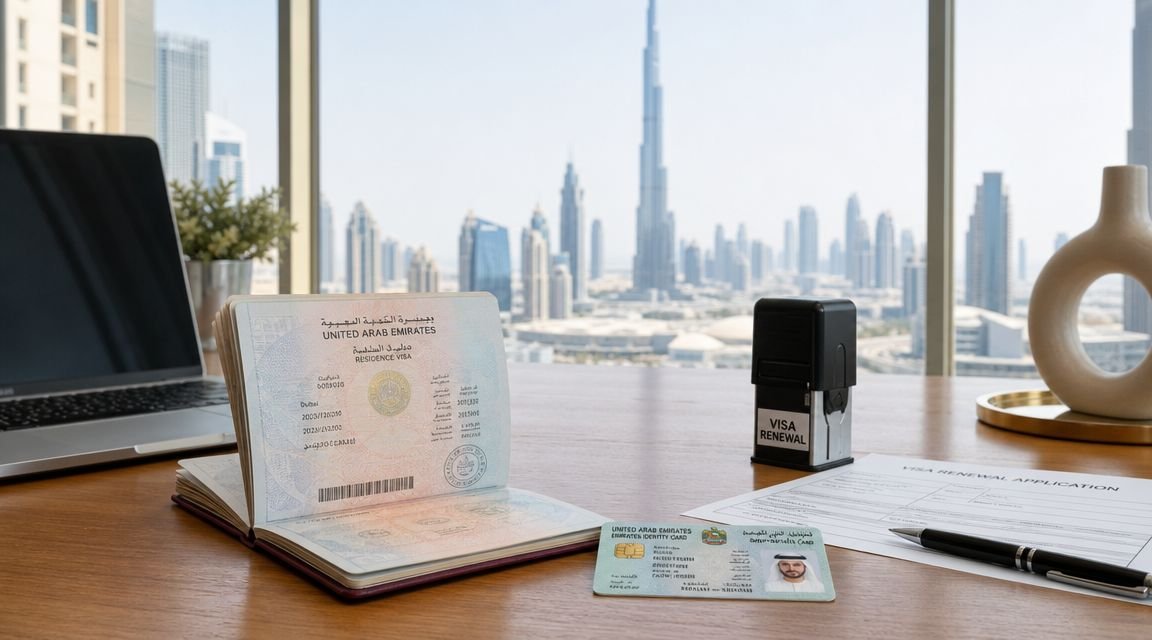
A visa expiry alert rarely arrives at a convenient time. It shows up when payroll is due, a founder is travelling, or HR is already juggling onboarding, leave records, and licence renewals. That's why visa renewal dubai often gets treated as a routine admin task until something small turns into a compliance problem.
In practice, renewal works better when you treat it like an operational dependency, not a form submission. The application itself is only one part of the job. Passport validity, Emirates ID timing, medical screening, sponsor category, and the right filing channel all sit upstream. Miss one dependency and the whole file can stall.
Table of Contents
- Your Visa Renewal Starts Before the Application
- The Pre-Renewal Audit Your Company Must Complete
- Executing the Core Renewal Workflow Step by Step
- Decoding Renewal Fees Fines and Timelines
- Troubleshooting Common Visa Renewal Problems
- The Smart Decision DIY vs Professional PRO Services
Your Visa Renewal Starts Before the Application
When an employee or founder has only a short window left on a residence visa, the instinct is to gather documents and submit quickly. That instinct causes problems. A rushed filing into the wrong sequence usually creates more delay than a short planning check at the start.

Dubai's residency system operates at scale. The Dubai government residency portal states that a residence visa can only be issued when the candidate is already inside Dubai on an employment entry permit. The same official source shows 12,116,843 entry permits and 6,998,414 residence records, alongside 61,530,701 passengers and 26,374,304 Smart Gates transactions. Those numbers matter because they explain how the system behaves. It rewards complete, accurate files and has very little tolerance for avoidable mistakes.
Why the submit first mindset fails
Most renewal delays are not mysterious. They usually begin earlier:
- Passport validity was ignored, so the file can't move cleanly through the digital process.
- The Emirates ID status wasn't checked, which breaks the sequencing.
- Medical timing was left too late, especially where the applicant has role-specific testing requirements.
- The wrong sponsor logic was used, such as handling a self-sponsored profile like a standard employee renewal.
Practical rule: Renewal is rarely delayed by the final click. It's delayed by an issue that should have been identified before the application started.
The other point busy teams miss is that renewal sits inside a larger residency lifecycle. It connects to entry status, sponsor status, identity records, medical clearance, and digital verification. That's why official channels also push residents to verify visa validity through the GDRFA website rather than relying on assumptions or screenshots.
Think in terms of business continuity
For founders, a stalled visa can affect travel, banking, signing authority, and simple peace of mind. For HR managers, one late renewal can spill into payroll queries, employee anxiety, dependent renewals, and unnecessary back-and-forth with document providers.
What works is a controlled process with one owner, a clear document list, and a decision made early about who is handling what. What doesn't work is treating expiry as the starting point.
The Pre-Renewal Audit Your Company Must Complete
A good renewal file starts with a pre-flight check. Before anyone books a medical test or opens a portal, review the file as if you're trying to find the reason it might fail. That mindset saves time.
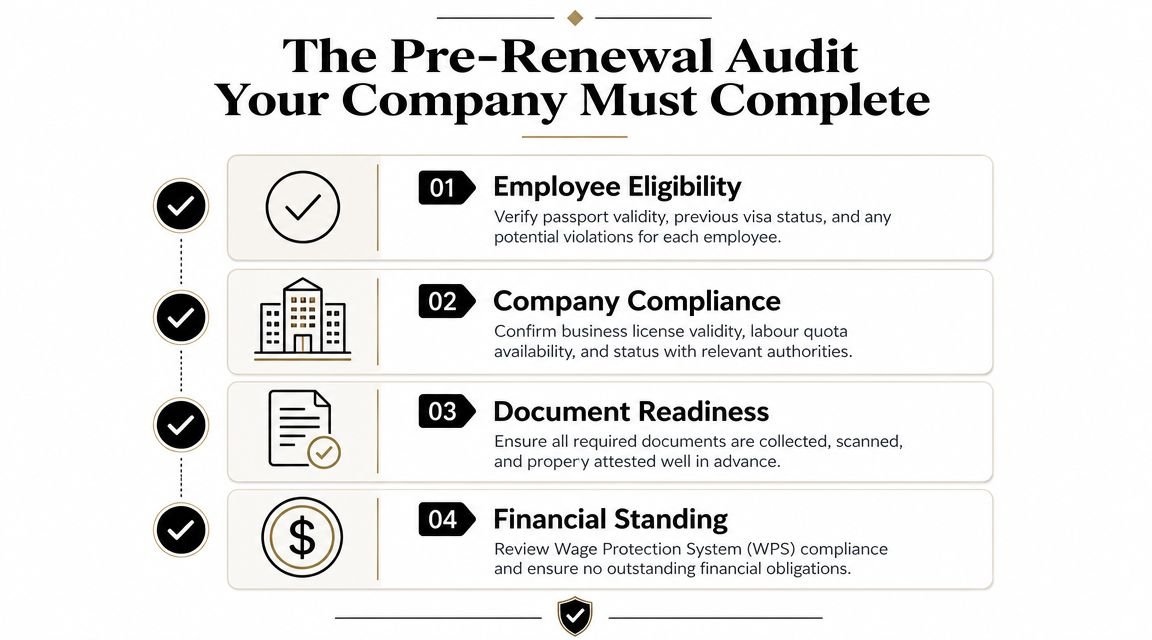
Check the basics before you open any portal
Start with the simplest gate first. Passport validity is mandatory. Official UAE guidance used in renewal practice requires at least 6 months of passport validity for residency renewal, as outlined in this UAE residence visa renewal guide. If the passport is too close to expiry, renew it first. Don't try to “get through the system” and hope the short validity is overlooked.
Then review the practical document chain. For most files, that includes the passport copy, photograph, Emirates ID, medical certificate, and sponsor-related records. Depending on the case, tenancy or Ejari, employment papers, or sponsor documents may also be needed.
A simple pre-renewal checklist should cover:
- Passport position: Confirm the expiry date and whether a renewed passport must be issued before any visa step.
- Identity status: Check whether the Emirates ID renewal needs to be initiated first or in parallel.
- Document quality: Make sure scans are readable, current, and consistent across names, passport numbers, and personal details.
- Sponsor readiness: Confirm that the employer, investor, or family sponsor documentation matches the actual residency route being used.
Visa category changes the renewal strategy
One of the biggest mistakes in visa renewal dubai work is assuming every file follows the same logic. It doesn't. Employer-sponsored employees, investor visa holders, Golden Visa residents, and dependants all move through different practical checks even when the submission screens may look familiar.
The direction of the market makes this more important. The ICP service information on visa extensions and residency categories notes broader flexibility across several categories. It also sits alongside a clear shift in long-term residency: Dubai's GDRFA issued 158,000 golden visas in 2023, up from 79,617 in 2022 and 47,150 in 2021. That matters because self-sponsored and long-term residency creates a different renewal planning model from a standard employee file.
If your team still uses one checklist for employees, founders, investors, and family dependants, the process is already too loose.
For example, a founder on a self-sponsored route may have fewer employer dependencies but more attention on category-specific eligibility and supporting records. A dependant's file may look straightforward until a sponsor document or housing document causes a stop. An employee file may be document-ready but still stall because the company started with the wrong sequence.
The strongest audit is not just “do we have the papers?” It's “are we using the right pathway for this person?”
Executing the Core Renewal Workflow Step by Step
The core workflow is where many articles become too simplistic. In live cases, order matters. Filing steps in the wrong order creates rework, duplicate appointments, and preventable stress.
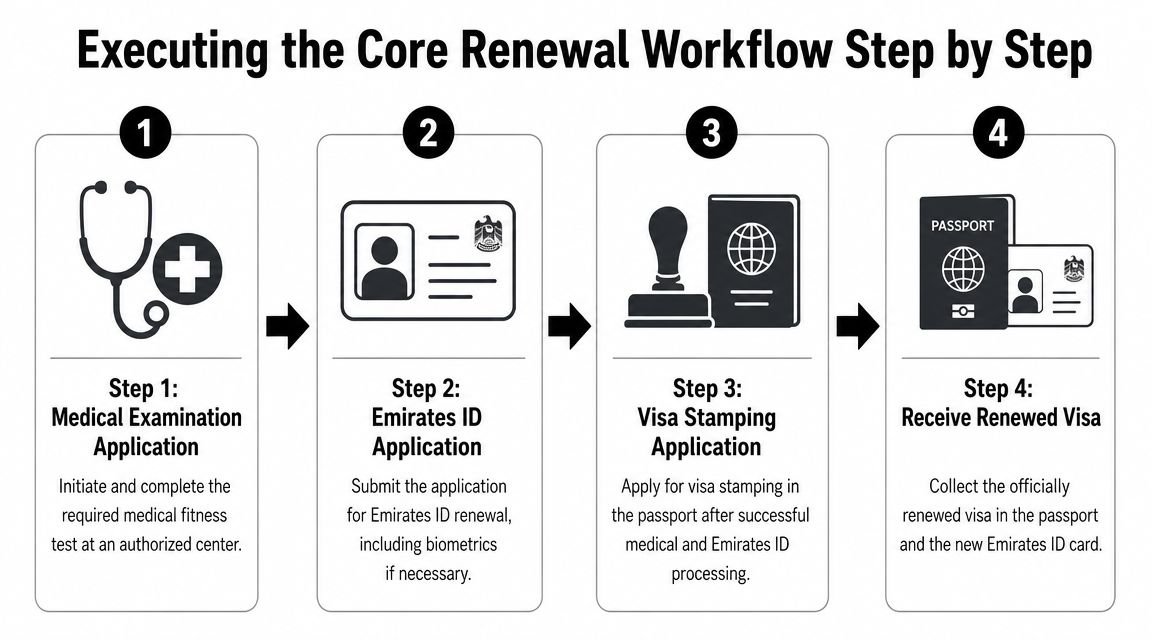
Follow the sequence that actually works
The practical renewal chain used across UAE residence renewals is straightforward when handled properly:
Confirm the file is eligible to move
Check passport validity, sponsor status, and document completeness before any booking or submission. Many service guides also recommend starting 3 to 4 months before expiry, which is useful because it leaves room for document corrections and scheduling issues.
Complete the medical fitness step
For most adult residency renewals, this is a mandatory checkpoint. In Dubai, this is especially important for dependants aged 18 and above and for employees in regulated roles.
Renew the Emirates ID first or in parallel
This isn't just a side task. It's part of the renewal chain. If the Emirates ID piece is ignored, the visa renewal can become fragmented and harder to track.
Submit the residence renewal through the correct government channel
The route depends on whether the case sits with federal channels or Dubai-specific processing. In practice, that usually means using ICP for federal channels or GDRFA Dubai for Dubai cases.
A short explainer can help if your team wants a quick visual walkthrough before handling documents:
Medical screening is a real approval gate
The medical stage is where “simple renewal” assumptions often break down. The UAE official health conditions guidance for residence visas states that resident expatriates renewing residence visas must undergo TB screening. It also states that those with scars or active TB, or drug-resistant TB, may receive only a conditional one-year fitness certificate. Certain worker categories must also test negative for syphilis and Hepatitis B, and female domestic workers must test negative for pregnancy.
That has real operational impact:
- For HR teams: A medically sensitive file may not align with your internal target date.
- For household sponsors: A domestic worker renewal can involve role-specific medical requirements that generic checklists miss.
- For employees and dependants: A complete document pack doesn't guarantee a smooth result if medical clearance introduces conditions.
Medical fitness is not a box-ticking exercise. It's a compliance decision point.
Choose the filing channel based on control not convenience
Applicants usually have a few practical ways to file, including direct government channels and assisted service points such as typing or AMER-style support centres. The right choice depends on the file.
A simple comparison helps:
| Filing route | Best used when | Main trade-off |
|---|---|---|
| Direct digital filing | The case is clean, the sponsor type is clear, and documents are already validated | Efficient, but less forgiving if the preparatory work is weak |
| Assisted service centre | The applicant needs help assembling or inputting the file | Easier for non-specialists, but quality still depends on the documents provided |
| Managed handling by a specialist | The case has multiple dependencies, timing pressure, or unusual facts | More controlled, especially where sequencing and issue-spotting matter |
What works is choosing the channel after reviewing the file. What doesn't work is picking the nearest centre first and trying to solve passport, sponsor, or medical issues halfway through.
Decoding Renewal Fees Fines and Timelines
Many people often ask for a neat single number. In reality, a Dubai residence renewal is a bundle of costs. The government component is only one part. Medical testing, Emirates ID charges, service-centre handling, courier steps, and document correction costs can all sit around it.
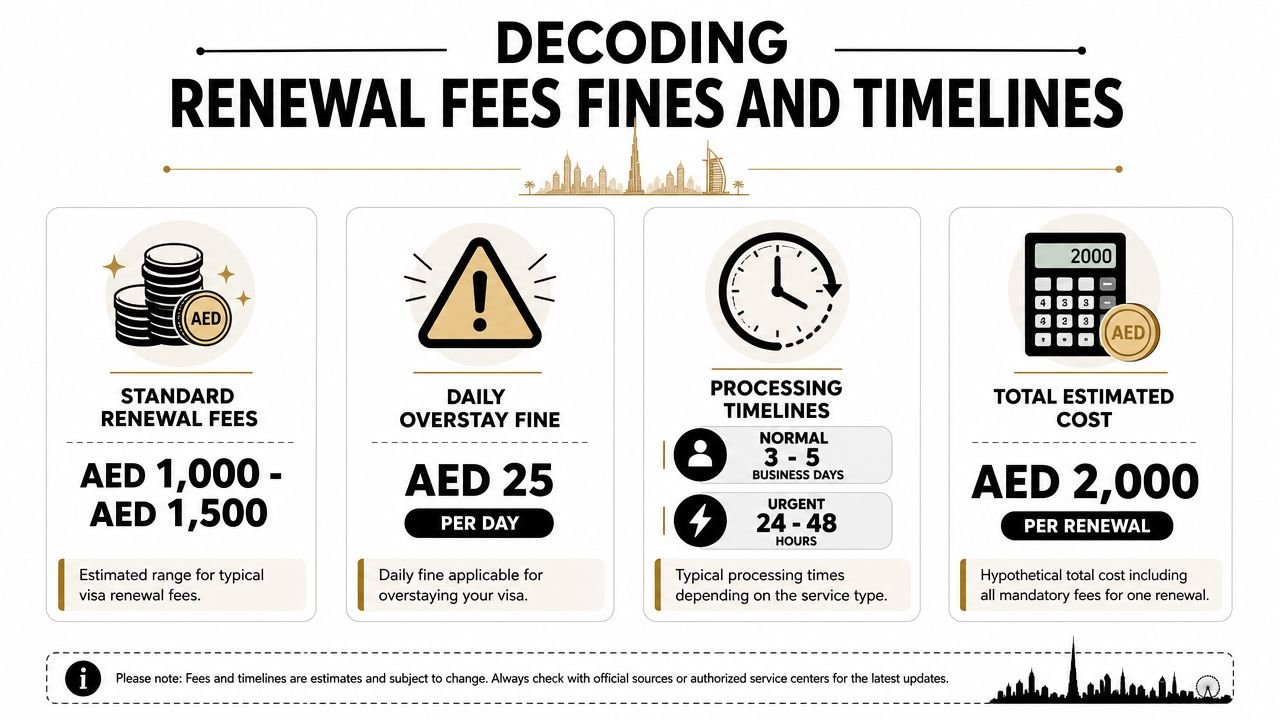
What you can quantify and what you should budget for qualitatively
The one figure that should get everyone's attention is the overstay penalty. The ICP overstay and cancellation guidance states that a fine of AED 50 per day applies after the visa has expired or been cancelled. That changes the economics of delay. A file that sits unresolved because a passport wasn't renewed first or a medical appointment was booked too late can become unnecessarily expensive.
Beyond that, the exact total cost varies by file. It depends on:
- Visa category
- Sponsor type
- Medical route chosen
- Whether service support is used
- Whether corrections or re-submissions are needed
So the smart way to budget is not to ask for a universal headline price. It's to identify the mandatory components of your specific case and add a margin for corrections or timing issues.
Budgeting rule: The cheapest renewal is usually the one that moves once, in the right order, with the right documents.
Timelines fail when dependencies are ignored
People often think processing time starts when they decide to act. It doesn't. The real timeline begins much earlier, with document readiness and appointment availability.
A realistic schedule should account for:
- Passport renewal first, if validity is too short
- Medical testing and result availability
- Emirates ID application timing
- Final visa submission and approval
- Any sponsor-side documents that need updating
That's why experienced teams start early. Practical guidance used in the market often recommends initiating the process 3 to 4 months before expiry, not because the government needs that much time for every clean file, but because real-world files rarely stay perfectly clean from start to finish.
When clients say, “The visa only expires next month,” that usually means the safe window has already narrowed.
Troubleshooting Common Visa Renewal Problems
A renewal file can look fine on paper and still stop moving. The usual reason is not complexity. It's that one hidden dependency was missed until the application was already in motion.
When the passport is the problem
Scenario: your employee's passport has less than six months left.
This is one of the most common avoidable issues. Official guidance used in UAE renewal practice requires at least 6 months of passport validity for residency renewal, and trying to renew on a nearly expired passport can stall the process. The immediate fix is to renew the passport first, then restart the renewal sequence using the updated passport details.
If you keep pushing the visa file forward instead, you create two risks at once. The application may not proceed cleanly, and the employee may edge closer to overstay exposure.
When the medical result changes the timeline
Scenario: a dependant or employee attends the medical centre and the result is not routine.
This catches many sponsors off guard because they assumed the medical appointment was only administrative. In reality, some renewals become conditional or delayed because the medical step is a substantive review, not just an attendance requirement.
The practical response is to stop making promises based on the old timeline. Rebuild the schedule around the medical outcome, confirm what additional steps apply to that category, and avoid booking travel or internal deadlines on assumptions.
A delayed medical result is not the time to improvise. It's the time to pause, verify the requirement, and re-sequence the file properly.
When the file is rejected for paperwork reasons
Scenario: the portal or service centre flags a mismatch, missing document, or incorrect supporting record.
This usually happens for ordinary reasons. A passport scan is unclear, a sponsor document is outdated, a tenancy-related document was required and not included, or the applicant used the wrong renewal logic for the visa category. The mistake isn't always serious, but repeated re-submissions waste time and can become expensive if expiry is near.
Use this order to recover:
Read the rejection note carefully
Don't guess. Identify whether the problem is document quality, missing support, or category mismatch.
Correct the root issue
Replace the weak document or update the sponsor paperwork. Don't just upload the same file again.
Review the whole sequence
If one issue slipped through, check whether passport, ID, and medical timing were also handled properly.
Resubmit only when the file is clean
Speed helps only after accuracy is restored.
In visa renewal dubai work, the fastest fix is often a disciplined reset, not a rushed retry.
The Smart Decision DIY vs Professional PRO Services
Some renewals are simple enough to manage internally. If the applicant has a clean file, a clear sponsor type, a valid passport, and enough lead time, a capable HR or operations team can handle it. The savings are obvious, but so is the trade-off. Your team takes on the sequencing risk, the document review burden, and the responsibility for fixing anything that stalls.
That calculation changes when the file has multiple moving parts. Founders with travel schedules, family sponsorship chains, long-term residency categories, expiring passports, and medically sensitive renewals usually benefit from tighter handling. In those cases, professional support is less about convenience and more about reducing avoidable risk.
Here's the practical comparison.
| Factor | DIY Approach | Inpro PRO Services Approach |
|---|---|---|
| Time investment | Internal staff must gather documents, track sequence, and follow up manually | A dedicated team manages the workflow and chases dependencies |
| Process accuracy | Depends on the in-house team's familiarity with the exact visa category | Stronger control over sequencing, documentation, and filing logic |
| Risk of delay | Higher if passport, medical, or sponsor issues appear mid-process | Issues are usually spotted earlier and managed before submission |
| Internal distraction | HR and founders lose time to follow-ups and corrections | Internal teams stay focused on hiring, payroll, and operations |
| Best fit | Clean, low-complexity renewals with enough lead time | Time-sensitive, higher-stakes, or multi-person renewal portfolios |
DIY works when the facts are simple and the owner is organised. Professional handling works better when one delay could affect travel, employee status, or management time. Most companies don't need help because the form is impossible. They need help because the hidden dependencies are easy to underestimate until the file stops moving.
If you'd rather treat visa renewals as a controlled compliance workflow instead of a last-minute admin scramble, Inpro Corporate Services L.L.C. can help you manage the process from document review through submission support. That's especially useful for founders, HR teams, and growing companies that need clear timelines, fewer avoidable errors, and a renewal plan that fits the actual visa category involved.