

The reminder usually appears at the wrong time. You're chasing a client payment, fixing a banking query, onboarding a hire, and then the message lands. Trade license renewal due.
A lot of founders still treat that reminder like an annual admin errand. In practice, it's one of the most important compliance events in the UAE operating cycle. If you handle it early and cleanly, the business keeps moving. If you handle it late, or with mismatched records, other parts of the company can stall with it.
That's the fundamental point. Trade license renewal isn't just about paying a fee and downloading a PDF. It's the yearly point at which the authorities, the licensing system, immigration files, and your underlying company records have to line up properly. In a digitised environment, small inconsistencies don't stay hidden for long.
Table of Contents
- More Than Paperwork Your Annual Business Lifeline
- The Renewal Blueprint Mainland versus Free Zone
- Your Essential Renewal Checklist Documents and Deadlines
- Navigating the Renewal Process on Digital Portals
- Common Pitfalls and Advanced Renewal Scenarios
- Beyond the Deadline Streamlining Your 2027 Renewal
More Than Paperwork Your Annual Business Lifeline
In the UAE, a trade licence isn't a framed certificate you collect once and forget. It's the core legal document that supports ongoing commercial activity. The annual cycle matters because trade license renewal is tied to staying legally operational, and it typically connects with the visa and establishment-card lifecycle through the country's licensing ecosystem, as noted in the UAE business licensing reference.
That annual cadence changes how smart founders should think about renewal. It's not a one-time registration memory. It's a recurring legal checkpoint.
Why the licence sits at the centre
If the licence lapses, the damage usually spreads sideways. Banking interactions become harder. Immigration processing can stall. Routine government transactions can stop moving. Even when the business is commercially healthy, a compliance lapse can make it look unstable to the systems around it.
That's why experienced operators don't leave trade license renewal to the final week. The legal document may be one file, but the consequences reach far beyond one file.
Practical rule: Treat the licence expiry date like an operating deadline, not an admin deadline.
The mistake I see most often is psychological. Founders assume renewal will be simple because the company hasn't changed much over the year. But authorities aren't validating your memory of the business. They're validating the current record set attached to it.
What renewal really tests
At renewal time, the system is effectively asking a series of practical questions.
- Is the company still properly housed? Your tenancy record often answers that.
- Are linked government files clear? Unresolved issues elsewhere can hold up the licence.
- Do the activity, ownership and approvals still align? If they don't, renewal turns into a sequencing problem.
- Can the company continue operating without interruption? That's the real commercial test.
A founder who understands that logic makes better decisions. They collect documents earlier, check linked records before submission, and spot conflicts before the portal does.
The UAE environment has become more structured, more digital, and less tolerant of stale information. That's good for organised businesses. It's punishing for businesses that rely on last-minute fixes. The licence renewal reminder isn't a nuisance. It's the annual signal to confirm that the company is still clean, current, and safe to operate.
The Renewal Blueprint Mainland versus Free Zone
Not every UAE renewal follows the same path. The broad logic is similar, but mainland and free zone renewals differ in who controls the file, what supporting records matter most, and how much of the process can be handled inside one system.
Where authority sits
For a mainland company, the renewal path usually runs through the relevant economic department or equivalent authority. In Dubai, founders often think in terms of DET or the older DED naming. The licence sits inside a wider local authority framework, so tenancy evidence, municipal alignment, and linked approvals tend to matter more.
For a free zone company, the process is often more self-contained within that zone's authority. That can make the workflow feel tidier. It doesn't always make it easier. A free zone may still require internal compliance checks, office-related conditions, or activity-specific approvals before it issues the renewed licence.
Mainland vs Free Zone Renewal at a Glance
| Aspect | Mainland Renewal (e.g., Dubai DET) | Free Zone Renewal (e.g., DMCC, ADGM) |
|---|---|---|
| Primary authority | Local economic department or emirate authority | Individual free zone authority |
| Tenancy dependence | Usually heavily tied to Ejari or equivalent tenancy validity | Often tied to zone lease or facility record |
| External approvals | More likely to involve linked approvals outside one portal | Often managed more centrally inside the zone |
| Process feel | Can involve multiple authority checks | Usually more contained, but zone-specific |
| Flexibility during changes | Often stricter if amendments are pending | Depends on zone rules and activity type |
| Risk pattern | Tenancy mismatch and cross-authority issues | Internal record mismatch and zone compliance gaps |
What changes the workload
For mainland entities, the renewal workload often increases when the company has touched multiple systems during the year. Office move, labour file issue, immigration hold, municipal fine, activity permit update. None of these feels like “licence renewal” when it happens. At renewal time, they all become renewal issues.
For free zone entities, the pressure is different. The authority may hold more of the file in one place, but that also means mismatches are easier to detect. If your licence activity, shareholder record, lease position, or internal approvals haven't been updated properly, the free zone system tends to surface the inconsistency quickly.
Mainland renewals usually fail at the edges. Free zone renewals usually fail at the centre.
That's a useful way to think about it.
Mainland founders should watch for
- Ejari timing: If the tenancy record is near expiry, renewal planning becomes fragile.
- Linked approvals: Certain activities depend on valid supporting permissions.
- Cross-system liabilities: Fines or unresolved matters in labour, immigration, or municipality channels can create friction.
Free zone companies should watch for
- Portal record accuracy: Contact details, company particulars, and authorised signatory details should be current.
- Lease or facility status: Some zones won't renew cleanly if the occupancy record has a problem.
- Activity-specific compliance: Regulated or specialised activities often carry extra review.
The trade-off is straightforward. Mainland gives many businesses direct market access and broader operational flexibility, but the renewal path can involve more moving parts. Free zones often provide a cleaner administrative environment, but each zone has its own internal logic, and businesses get into trouble when they assume all free zones behave the same way.
The safest approach is to stop thinking in categories alone. Think in jurisdiction, authority, tenancy status, and linked approvals. That's what determines whether your renewal will be smooth or messy.
Your Essential Renewal Checklist Documents and Deadlines
Most renewal problems start before the application starts. The portal isn't usually the main obstacle. The underlying file is.
Trade license renewal in the UAE is a multi-step workflow. Businesses typically need to confirm tenancy validity, clear outstanding fines, submit the application, upload documents, pay the fees, and then download the renewed licence after approval. The most common technical blockers are expiring tenancy documentation and unresolved government liabilities, as outlined in this UAE trade licence renewal workflow guide.
The documents to assemble before you log in
This checklist is where disciplined renewals are won.
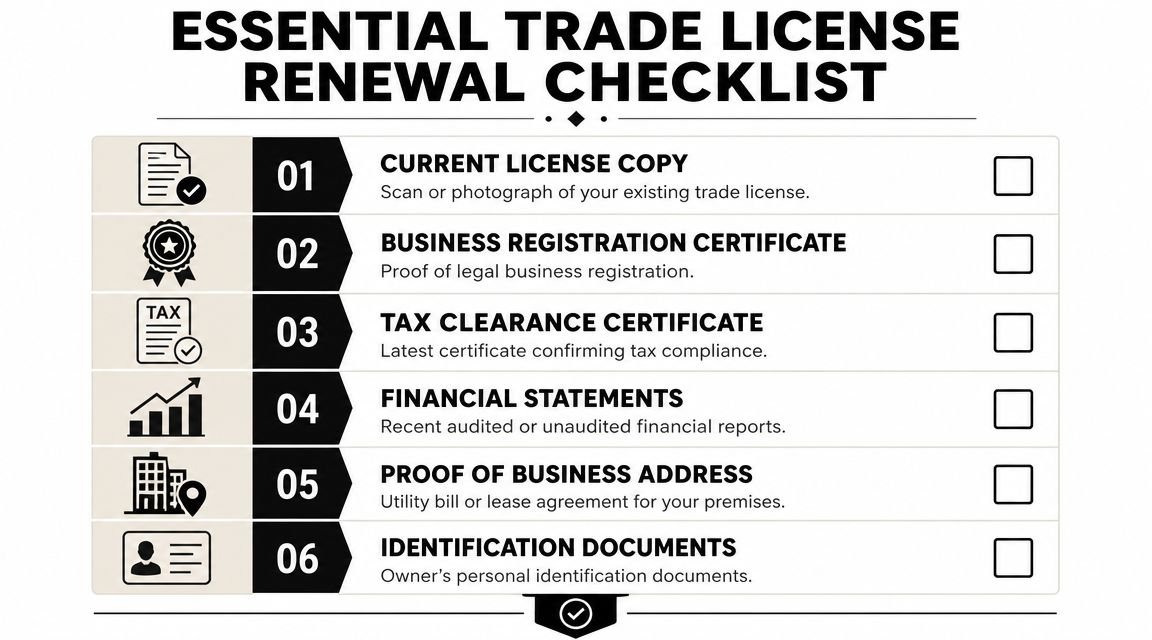
Start with the documents that define the company's current legal profile, then move to the documents that prove the business is still in good standing.
- Current trade licence copy: Keep the latest issued licence ready in a clear digital format. Many founders search for it only after opening the portal.
- Tenancy record or lease evidence: For mainland companies, this often means a valid Ejari-linked record. For free zones, it may be the current lease or facility agreement recognised by the zone.
- Shareholder and authorised signatory identification: Passport copies, visa copies where relevant, and Emirates ID copies if applicable should match the current company record.
- Constitutional or registration documents: Depending on jurisdiction, that may include the registration certificate, incorporation papers, or core company documents already on file.
- Supporting permits or approvals: If your activity requires an external or specialised approval, confirm it hasn't expired.
- Internal compliance records: If there has been any change in ownership, management, activities, or office address, check whether the file reflects it properly before renewal.
What to verify before submission
Documents alone aren't enough. The file must also be clean.
Use this pre-flight check:
- Check tenancy validity first. If the tenancy document is expired or close to expiry, fix that before anything else.
- Review fines and liabilities. A surprisingly large share of delayed renewals comes from unresolved items outside the licensing screen.
- Confirm contact details and authorised persons. Wrong email addresses and outdated mobile numbers create avoidable delays.
- Match names and records. Shareholder names, company names, and activity labels should be consistent across uploaded documents.
- Review linked approvals. If the business relies on a regulated activity approval, don't assume it rolls over automatically.
If the tenancy is weak, the renewal file is weak. That's true even when every other document looks perfect.
A practical point founders often miss is timing. Don't gather documents in the order they seem easiest to collect. Gather them in the order most likely to block the file. That usually means tenancy first, liabilities second, approvals third, then identity and company documents after that.
What doesn't work is opening the portal to “see what's needed” and hoping the system will guide you through the gaps. By the time the portal shows a blocker, you've already lost time. What works is assembling a clean renewal pack first, then using the portal as the final submission tool rather than the discovery tool.
Navigating the Renewal Process on Digital Portals
Once the file is ready, the digital part is usually straightforward. The interface changes by authority, but the logic stays similar across most UAE licensing systems.
What the online flow usually looks like
A typical renewal moves through a short chain of actions. You access the relevant portal, locate the licence renewal service, review the company details, upload documents where required, generate or receive the payment request, settle the fees, and then download the renewed licence once issued.
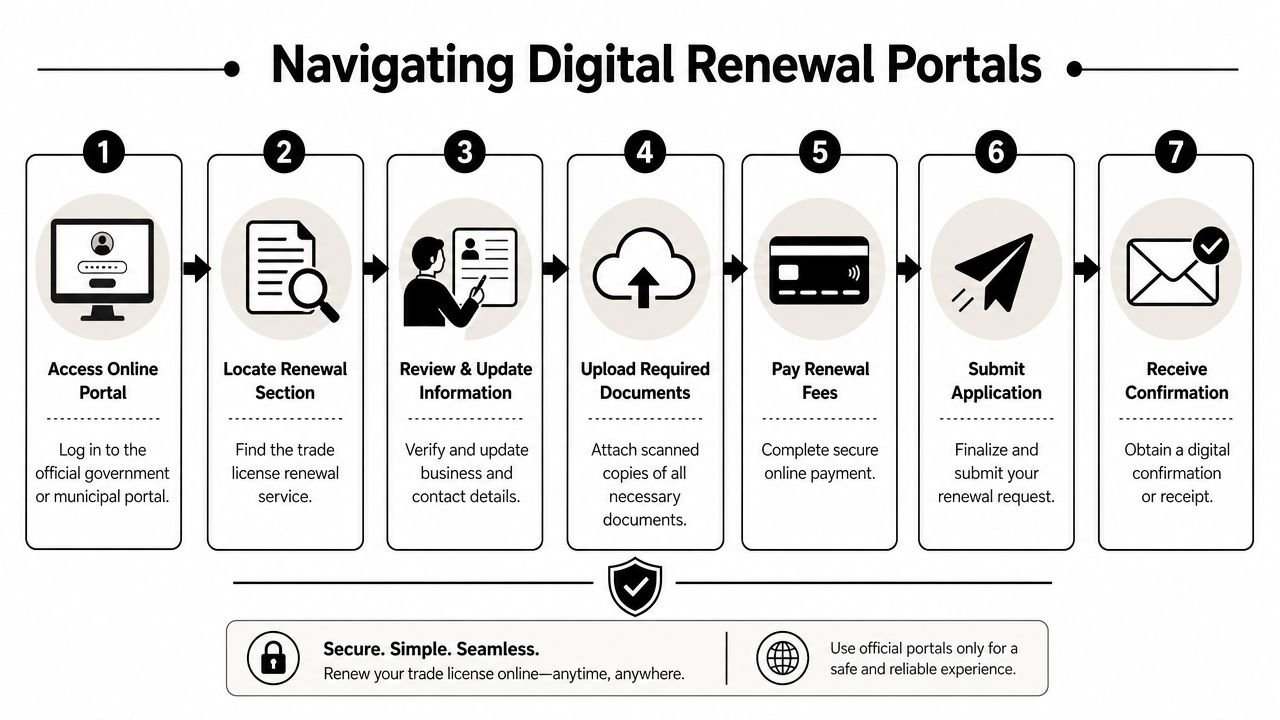
That sounds simple because, at surface level, it is. The difficulty comes from what the portal checks behind the screen.
What works on digital systems and what does not
Digital systems reward businesses that prepare offline before they submit online. If your documents are current, your tenancy record is valid, your permissions are aligned, and your signatory details are accurate, the portal does exactly what founders want. It compresses time and reduces physical paperwork.
What doesn't work is using the portal to test whether the company record is healthy. A portal is not a consultant. It won't explain the background logic of every rejection or hold. It will stop the file at the point where the mismatch appears.
A useful operating rhythm looks like this:
- Log in with the correct authority account: Many delays come from using old credentials or the wrong authorised user.
- Read the licence details before uploading anything: Small record errors are easier to correct before submission than after payment.
- Upload clean files with clear labels: Poor scans, partial pages, and mismatched filenames slow down reviews.
- Pause before paying if something looks off: Once payment is made, changing the underlying record can become more awkward.
- Download and store the renewed licence immediately: Don't leave the issued document sitting in one person's inbox.
Digital renewal is fast when the record is clean. It's unforgiving when the record is stale.
Founders sometimes ask whether online renewal means they can stop worrying about physical document discipline. The opposite is true. Digital systems increase the importance of document discipline because authorities can compare records more quickly across connected channels.
The best practice is simple. Keep one renewal folder for the year, not one folder created the week of expiry. Store the current licence, tenancy evidence, shareholder ID copies, permit renewals, and any amendment approvals in one place. Then the portal becomes the last mile, not the whole journey.
Common Pitfalls and Advanced Renewal Scenarios
The official version of renewal is tidy. Real life usually isn't. Companies move office, add activities, replace shareholders, update managers, or restructure while the expiry date keeps approaching.
That's where most painful renewals happen.

A major gap in public guidance is the business that needs to renew while also changing legal structure, activities, or ownership-related details. That problem affects a large operating base, especially because the UAE Ministry of Economy reported more than 1.1 million registered companies by 2024, as referenced in this discussion of renewal edge cases and operating scale.
The edge cases that delay approvals
The common assumption is that renewal and amendment can be handled together without much thought. Sometimes that works. Often it doesn't.
These are the situations that usually need extra care:
- Activity change close to expiry: If the business wants to add, remove, or revise activities, the authority may require approvals that aren't ready yet.
- Ownership or partner changes: A pending shareholder amendment can affect signatory status, document requirements, and portal permissions.
- Office relocation: If the company is moving premises around the same period, tenancy alignment becomes the deciding factor.
- Legal form adjustments: A change in legal structure can reshape the entire filing sequence.
The direct risk isn't just “delay” in an abstract sense. A lapse can interrupt immigration-related processing, complicate government transactions, and create wider operational headaches because the licence sits so close to the company's legal standing.
How to sequence a renewal with amendments
In practice, the key question is usually this: renew first, or amend first?
There isn't one answer for every jurisdiction. But there is a useful decision test.
Renew first when
- the current licence can still be renewed cleanly;
- the amendment isn't legally urgent;
- the supporting approvals for the amendment are not ready;
- the bigger risk is letting the existing licence lapse.
Amend first when
- the current company record is no longer valid enough to support renewal;
- the authority requires the amendment before renewal can proceed;
- the tenancy, activity, or ownership record has changed in a way that directly affects eligibility.
When expiry is close, preserving continuity usually matters more than perfect sequencing.
That doesn't mean “always renew first”. It means founders should evaluate which step protects legal continuity with the least friction. Too many businesses try to solve every corporate housekeeping issue at the same moment. That looks efficient on paper. In the portal, it often creates a deadlock.
A more practical approach is to separate changes into two categories:
| Category | Better approach |
|---|---|
| Changes that block legal continuity | Resolve before or with renewal |
| Changes that improve the file but don't block renewal | Renew first, then process the amendment |
What does not work is assuming one authority officer, one service desk response, or one old precedent applies universally. Renewal outcomes depend on jurisdiction, activity type, linked approvals, and the current state of the file. If your company is changing shape near expiry, the right move is to map the sequence before submitting anything.
Beyond the Deadline Streamlining Your 2027 Renewal
The most useful shift a founder can make is to stop treating renewal as a date and start treating it as a system. That's where good renewals become repeatable.
Renewal is becoming year-round compliance
UAE licence renewal is increasingly part of a continuous-compliance model rather than a once-a-year administrative task. Corporate tax, VAT, and economic substance obligations all contribute to whether a business stays in good standing, while digital government systems make clean files faster to process and outdated files harder to hide. That matters even more in a market with over 1.1 million companies, as noted in this continuous-compliance overview.
The practical takeaway is simple. If your records drift during the year, renewal won't fix that drift. It will expose it.
What disciplined companies do differently
The companies that renew smoothly usually follow a quiet operating routine.
- They maintain records monthly, not annually. When the office lease changes, they deal with it then. When ownership details shift, they update them then.
- They keep one compliance calendar. Licence expiry, tenancy expiry, permit reviews, tax deadlines, and immigration-related milestones sit in one place.
- They assign ownership internally. One person monitors the file, even if external advisers support the process.
- They review dependencies early. If the licence touches visas, establishment records, approvals, or tax registrations, those links are checked before the pressure period.
That discipline frees management attention. Founders should spend their time on revenue, hiring, market entry, and execution. They shouldn't spend it chasing expired lease documents, reconciling old portal records, or guessing whether an amendment should have gone in before renewal.
For businesses with lean internal teams, external oversight often becomes the most efficient option. Not because the steps are mysterious, but because the cost of getting the sequence wrong is usually higher than the cost of handling it properly from the start.
If you'd rather keep your team focused on growth while a specialist manages the renewal calendar, document checks, portal submissions, and broader compliance workload, Inpro Corporate Services L.L.C. can support your UAE business across licensing, PRO, visa, banking, and tax-related operations with a practical, end-to-end approach.