


The cheapest free zone in UAE often isn't the one with the lowest advertised licence fee. That sounds backwards until you compare the actual first-year spend. Market comparisons show entry prices as low as AED 5,000 to AED 5,750 for some zones, but those same comparisons note that total setup cost changes materially once you add visas, facility needs, and business activity scope, which is why a low sticker price can become a more expensive first-year outcome for the wrong founder as noted in this UAE cost comparison.
That gap is where most founders make the wrong decision. They compare brochure prices, not operating models. A zero-visa freelance package and a consulting firm that needs staff visas, banking support, and a broader activity scope are not buying the same thing, even if both are called a “free zone licence”.
Early on, the right question isn't “Which free zone is cheapest?” It's “Which setup gives me the lowest total cost of ownership without forcing a costly change six months later?”
Table of Contents
- Why the Cheapest UAE Free Zone Is Rarely the Cheapest
- Decoding the Real Cost of a Free Zone Company
- The 2026 Contenders for Lowest-Cost Free Zone
- Matching the Cheapest Zone to Your Business Model
- Hidden Costs That Make a Cheap Zone Expensive
- Our Verdict The Smartest Budget-Friendly Choice for 2026
- Get a Transparent Cost Breakdown and Fast-Track Your Setup
Why the Cheapest UAE Free Zone Is Rarely the Cheapest
A cheap licence can be a smart move. It can also be an expensive shortcut.
The problem is simple. Founders tend to compare the first invoice, while the actual business cost sits across the first year. Visa eligibility, office rules, establishment paperwork, compliance expectations, and activity restrictions all shape the actual number. If the package only works on paper, it isn't cheap.
A founder with no visa requirement and a narrow service activity can often use a leaner setup well. A founder who needs team visas, client-facing credibility, or a wider operating scope usually pays later if they buy the absolute minimum package first.
Practical rule: If a free zone package looks dramatically cheaper than everything else, check what has been excluded before you compare it.
There's also a structural reason this confusion persists. The UAE doesn't operate as one flat free zone market. It has a competitive ecosystem built over decades. The free zone system dates back to 1985, when Jebel Ali Free Zone was established as the country's first free zone, and the UAE now has more than 40 free zones, with guidance often referring to around 45 operational zones. The government also notes that setup costs vary by free zone, licence type, business activity, and office space, and that approvals in many cases can be issued in as little as 14 working days according to this UAE free zone industry overview.
That competition is good for founders because it creates genuine low-cost options. It also creates misleading comparisons when people treat every package as interchangeable.
What works is a total cost mindset. Start with your activity, then your visa plan, then your workspace reality, then your tax and compliance fit. Price follows structure, not the other way around.
Decoding the Real Cost of a Free Zone Company
The licence fee is the least reliable number in a free zone quote.
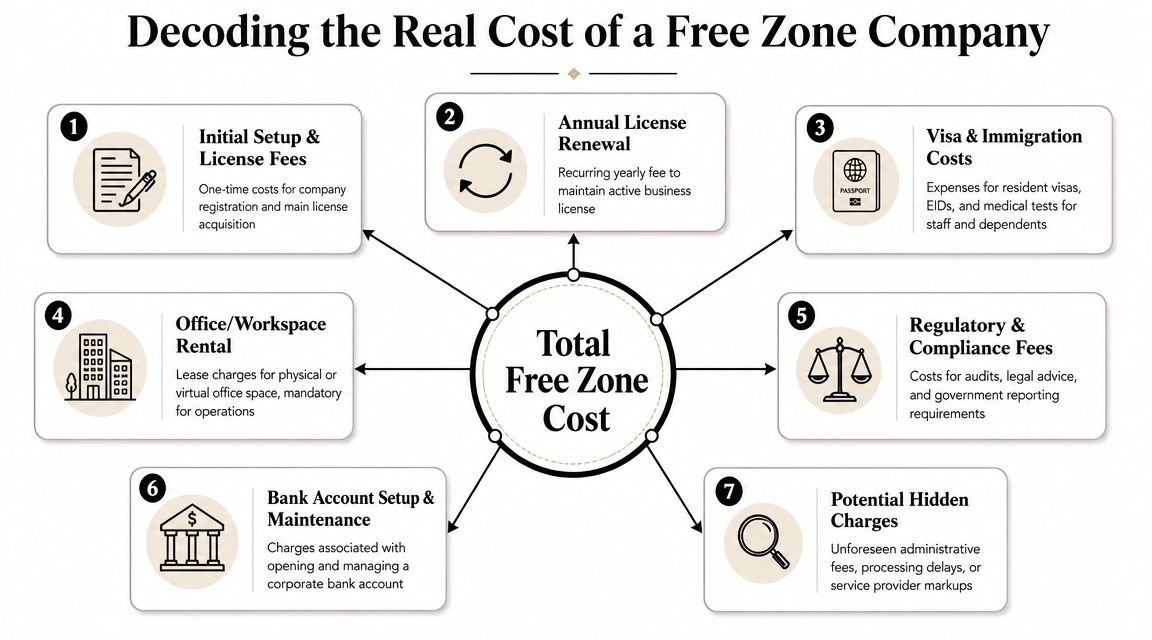
What matters is total cost of ownership over the first year, and often over the first two. A package can look inexpensive at the point of sale, then become one of the costlier choices once visas, establishment card fees, medicals, Emirates ID, workspace upgrades, renewals, and compliance admin are added back in. Founders who compare only the headline licence price usually end up comparing incomplete products.
Why costs differ so much between zones
Free zones are not pricing the same thing in the same way. One authority may advertise a low entry fee built around a single activity, no visa allocation, and a basic desk arrangement. Another may charge more upfront because the package includes broader activity options, stronger visa capacity, or a facility type that creates fewer restrictions later.
That is why low-cost names such as SRTIP and Ajman Free Zone appear on founder shortlists so often. They are known for entry-level packages that can suit solo operators and service businesses, especially where a flexi-desk or shared workspace model is acceptable. Ajman Free Zone outlines different licence and facility structures on its official setup pages, while Sharjah Research, Technology and Innovation Park presents startup-focused formation options on its official site. Those details matter more than the marketing headline because they determine what the company can do after incorporation.
The cost components founders should price before signing
A proper cost review should separate the quote into operating parts, not one bundled total:
- Base licence fee. This covers company registration and the licence itself. It often excludes the parts that change the economics.
- Visa and immigration costs. Owner visas, employee visas, establishment card fees, status change, medical testing, and Emirates ID charges can quickly overtake the licence fee.
- Workspace requirement. A virtual or flexi-desk setup can keep entry cost low, but visa eligibility and future headcount often depend on upgrading the facility.
- Renewal cost. Some zones are cheap to enter and less attractive to renew. Renewal pricing needs the same scrutiny as the first-year quote.
- Compliance and tax admin. Corporate tax registration, bookkeeping expectations, audit requirements in some zones, and UBO or ESR-related admin can create recurring cost even for a small company.
- Banking practicality. If the activity, shareholder profile, or zone triggers more questions from banks, the hidden cost is delay. Delay means stalled invoicing, delayed payroll setup, and more time spent producing documents.
- Amendments later. Adding activities, changing shareholding, increasing visa quota, or moving to a different facility type is rarely free.
Cheap setups usually fail; they are often priced for a founder with one shareholder, no immediate staff, a narrow activity, and no need for physical client meetings.
Once the business plan includes hiring, dependants, frequent banking transactions, or a broader commercial scope, the low headline price stops being a useful decision tool.
I advise founders to ask for an itemised written quote that separates licence, immigration, facility, government fees, and annual renewal obligations. If a provider cannot show where each dirham goes, the package is too opaque to judge properly.
The 2026 Contenders for Lowest-Cost Free Zone
The cheapest free zone in the UAE is often the one that stays cheap after visa allocation, facility upgrades, and renewal. On opening price alone, three names keep coming up in founder discussions for 2026: Ajman Free Zone, SHAMS, and SRTIP. Each can work. Each can also become expensive if the business model does not match the package.
Early comparison table
| Free Zone | Starting License Fee | Included Visas | Office Requirement | Best For |
|---|---|---|---|---|
| Ajman Free Zone | Low entry pricing in basic packages | Package-dependent | Depends on package and visa need | Solo service businesses, founders focused on minimum launch spend |
| Sharjah Media City (SHAMS) | Low entry pricing for selected activities | Package-dependent | Light facility requirement for certain setups | Media, digital, creator, and remote-first businesses |
| SRTIP | Slightly above the very lowest entry tier in some packages | Package-dependent | Often flexible at entry stage | Consultants, tech-led firms, and founders who want a more scale-ready profile |
Sharjah Media City SHAMS
SHAMS stays on low-cost shortlists because it strips out one of the biggest early expenses. A founder with a digital or creative activity can often avoid taking traditional office space at launch, which keeps first-year cash burn under control. That is the primary advantage, not the headline licence number by itself.
I usually rate SHAMS well for businesses that invoice for skills rather than stock. Content studios, marketing consultants, designers, trainers, and solo operators can start lean without paying for space they will not use.
The trade-off shows up later. If the company needs more visas, wants a broader activity mix, or expects a bank to see a more conventional operating setup, the low opening cost stops being the full story. Founders should check what the second-year structure looks like before treating SHAMS as the cheapest option.
Ajman Free Zone
Ajman Free Zone appeals to founders who want the lowest possible entry point and are comfortable giving up some prestige in return. That is often a sensible decision. For a simple service company with one shareholder and a narrow activity, Ajman can be one of the cleanest ways to get established without overpaying in year one.
The reason Ajman works is straightforward. It can keep the fixed setup light for businesses that do not need much from the zone beyond a licence, basic immigration support, and a compliant legal presence.
The risk is fit. If the founder expects frequent client-facing meetings, a higher-credibility address, or complex bank onboarding, the savings can disappear into delays, upgrades, and amendments. Ajman works best when the company is deliberately simple.
Sharjah Research Technology and Innovation Park SRTIP
SRTIP is not always the absolute cheapest at entry, but it often gives better value over a two-year view for the right founder. The zone tends to attract consultancy, technology, education, and innovation-linked businesses that want to start lean without looking like a temporary freelance setup. You can review its setup framework and business categories on the official SRTIP website.
That positioning matters. Some founders need low cost, but they also need a company profile that will age well as they hire, add services, or present the business to investors and institutional clients. In those cases, paying slightly more at formation can reduce restructuring later.
I often tell founders to compare SRTIP against the cheapest package on a total ownership basis, not a licence basis. If the business is likely to grow beyond a solo operator model, SRTIP can be the cheaper decision overall.
How these contenders differ in practice
Ajman usually wins on bare-minimum entry cost.
SHAMS usually wins for remote-first media and service businesses that want to avoid unnecessary facility spend.
SRTIP often wins when the founder wants low cost with a stronger long-term business profile.
That is the comparison to make. The right zone is not the one with the smallest number in the sales quote. It is the one that keeps renewals, immigration, banking, and operating changes from turning a cheap setup into an expensive correction.
Matching the Cheapest Zone to Your Business Model
A cheap licence only stays cheap if the company structure matches how the business will operate over the next 12 to 24 months.
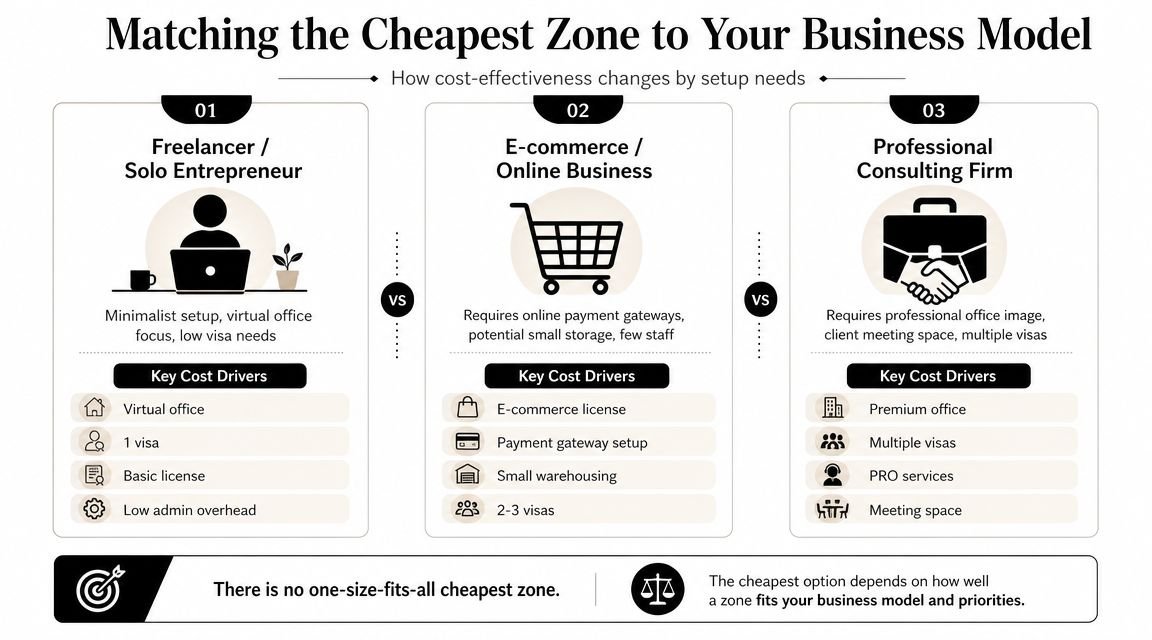
Founders usually compare free zones by the first invoice. The better comparison is total ownership cost. That means asking what happens when you add a visa, need a desk or office allocation, open a bank account, amend activities, or move from one-person trading to a small team. The cheapest zone for a solo operator is often not the cheapest zone for a business that plans to grow.
Solo freelancer with minimal overhead
For a true one-person business, the lowest entry package can still be the right decision.
That usually applies where the founder does not need staff visas, does not need physical office space beyond the minimum package requirement, and has a straightforward service, consulting, or media activity. In that case, Ajman and certain Sharjah options are often the first zones to compare. Ajman Free Zone outlines its current licence routes and package structures on the official Ajman Free Zone site.
The trade-off is simple. You save money upfront, but only if the business stays simple.
Best fit in practice:
- SHAMS for content, marketing, design, and digital media work
- Ajman for founders prioritising the lowest possible setup cost for a basic service model
- SRTIP for solo founders who want a lean setup with a stronger profile for tech, education, or advisory work
Lean startup planning to hire
A founder expecting to hire should choose for expansion cost, not launch cost.
The problem with ultra-cheap packages is that they often price only the licence attractively. The moment the company needs another visa, a larger facility allocation, more activities, or a cleaner structure for clients and banks, the setup starts getting expensive. I have seen founders save a small amount on incorporation, then spend far more fixing the structure in year one.
For this model, the right free zone is the one that scales without repeated amendments and forced upgrades. That is why SRTIP often makes more sense than the cheapest quote suggests. The company profile tends to hold up better as the business adds staff, broadens services, and starts dealing with larger counterparties.
Choose the zone that still makes financial sense after your second visa and your first operational change.
International holding or IP structure
Holding companies and IP-led structures need a different kind of cost discipline.
If the company will not run a local team immediately, a low-cost licence can work. But the key cost drivers shift fast. Banking scrutiny, legal form, substance expectations, and tax treatment matter more than the initial registration fee. A cheap package that looks efficient on paper can create delays or restructuring costs later if the activity, facility arrangement, or corporate profile does not support the intended use.
For this model, focus on three questions:
- Does the legal structure fit the asset-holding or IP ownership plan?
- Will the zone support the level of documentation and compliance the bank or adviser is likely to request?
- Can the company keep operating as intended without a future migration or major amendment?
Founders who get this right usually spend slightly more time choosing, and less money correcting.
Hidden Costs That Make a Cheap Zone Expensive
A budget setup becomes expensive when the founder has to rebuild it.
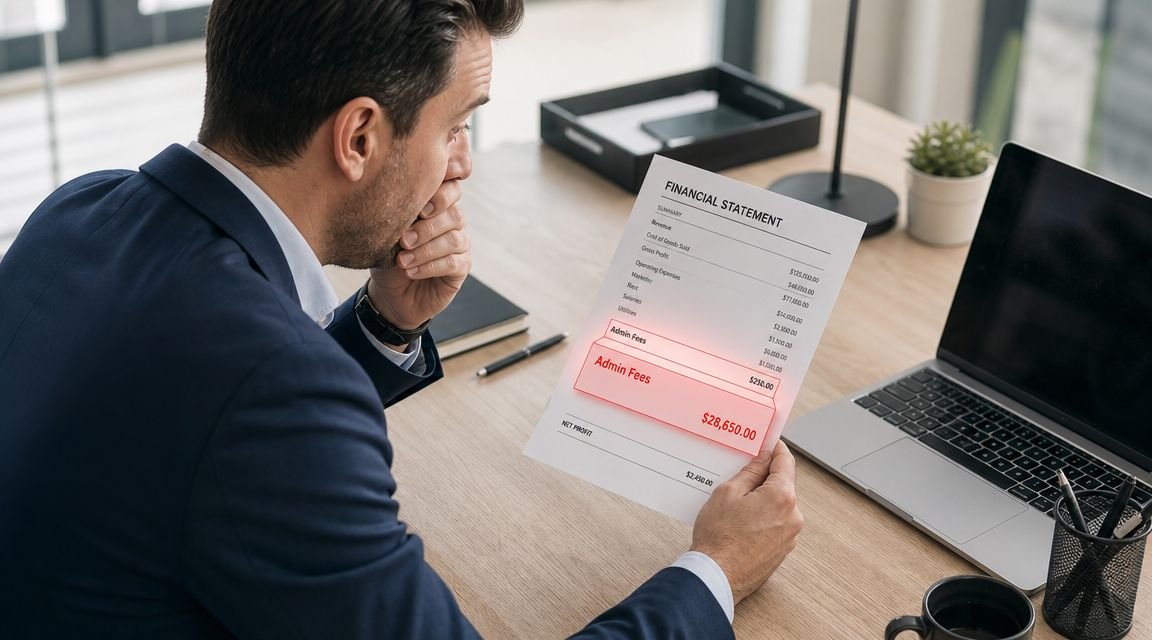
Activity mismatch creates expensive rework
The first trap is choosing a cheap licence that doesn't properly match what the company will do. Founders often pick a narrow activity because it appears in a low-cost package. Later, they discover they need additional activities, a different licence type, or a revised structure to support contracts, invoicing, or a payment provider review.
That kind of correction costs more than choosing accurately at the start. It also slows banking, immigration, and internal planning.
Common warning signs:
- The activity description is too broad to be clear.
- The package is cheap because it is highly restrictive.
- The founder is relying on future amendments already visible at launch.
Tax treatment depends on more than the licence
The second trap is assuming every free zone company automatically gets the same tax outcome. It doesn't.
UAE sources note that free zones offer 0% personal income tax, while corporate tax is 9% only above AED 375,000 of taxable profit. They also warn that qualifying free-zone tax treatment depends on activity, substance, and compliance, so a cheaper zone can become more expensive if the structure later needs to be changed to meet those requirements as explained in this review of low-cost UAE free zone options and tax treatment.
If your company's future depends on a particular tax position, don't buy the licence first and ask the technical questions later.
Banking and substance can change the economics
The third trap is practical rather than legal. A company can be fully incorporated and still struggle operationally if the structure creates friction with banking or counterparties.
This doesn't mean low-cost zones are bad choices. It means founders should measure cost the way operators do. If a company saves on licence fees but loses time to preventable restructuring, extra documentation, office upgrades, or repeated clarifications, the total cost rises anyway.
The cheapest setup is the one you don't have to fix.
Our Verdict The Smartest Budget-Friendly Choice for 2026
There isn't one universal winner for the cheapest free zone in UAE. There is only the cheapest correct fit.
If the brief is absolute entry-level affordability for a solo founder with a narrow media or digital activity, SHAMS is one of the strongest options because of its low starting licence price and no-office structure. If the founder is trying to enter the market on the lowest possible setup spend, Ajman Free Zone stays near the front of the shortlist.
If the company may grow beyond a minimalist setup, SRTIP often becomes more interesting than the raw headline number suggests. It may not always be the lowest brochure price, but it can be the better value decision when growth, positioning, and flexibility matter.
Use this framework before deciding:
- Pick the lowest-cost option if you are a solo operator, your activity is straightforward, and you don't expect immediate visa or office needs.
- Pick the cleanest scaling option if you expect hiring, banking scrutiny, or licence amendments.
- Pick the most compliant long-term fit if the structure is for holding, IP, or cross-border ownership rather than day-to-day local operations.
That's the practical answer most founders need. Cheap is good. Rework is not.
Get a Transparent Cost Breakdown and Fast-Track Your Setup
Most founders don't need another generic list of free zones. They need a real quote that shows what the setup will cost for their activity, visa plan, and operating model.
That means checking the licence scope, understanding whether office space is optional, confirming what immigration and compliance steps are included, and making sure the chosen zone won't create avoidable banking or tax friction later. The headline fee only helps when it reflects the company you're really forming.
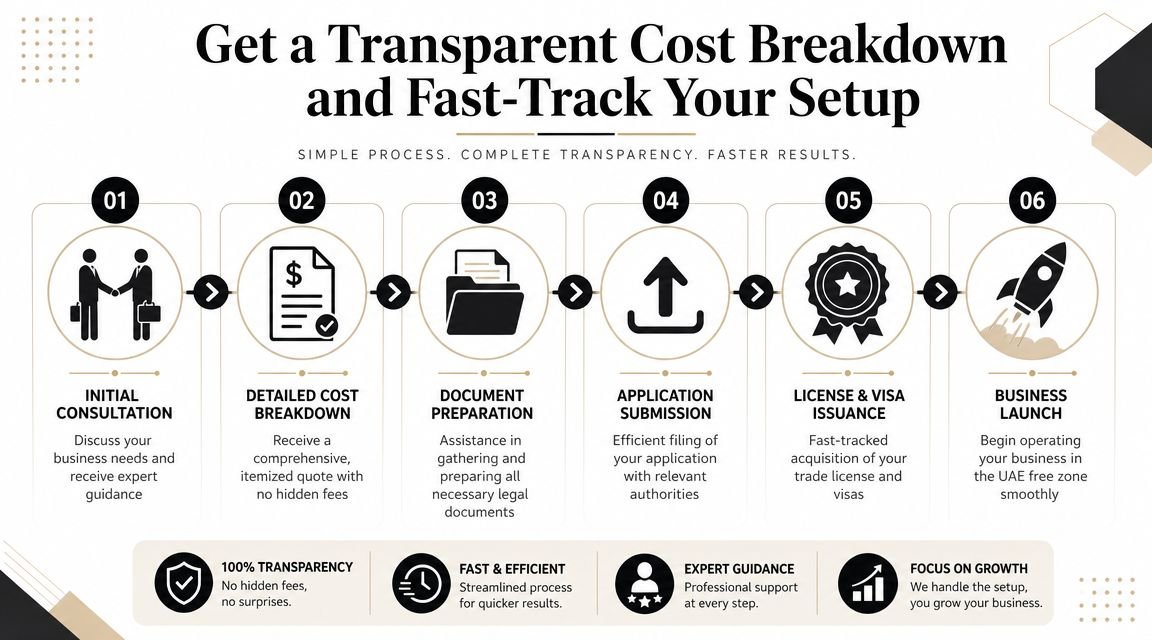
A solid setup process should give you four things from the start:
- An itemised cost view so you can separate licence cost from immigration, workspace, and recurring obligations.
- A jurisdiction recommendation tied to your business model rather than whichever free zone has the loudest promotion.
- A realistic launch path covering approvals, documents, and operational readiness.
- A structure that doesn't need fixing after incorporation.
The right advisor doesn't just find a cheap licence. They prevent an expensive mismatch.
If you want a clear, itemised quote instead of a headline price, Inpro Corporate Services L.L.C. can help you compare UAE free zone options based on your activity, visa needs, banking plans, and compliance requirements. Their team handles company formation, PRO support, visa processing, banking assistance, and ongoing tax and accounting coordination, so you can choose the right structure quickly and avoid hidden setup costs from day one.