


Shams Free Zone Sharjah is one of the lowest-cost UAE company setup options, with licence packages starting from about AED 5,750 and some structures allowing up to 6 visas depending on the package and facility choice. That sounds simple, but the key decision isn't whether Shams is cheap. It's whether its low-cost model fits how your business will operate in the United Arab Emirates.
That's the counterintuitive part. The cheapest entry point can become the wrong structure if you need frequent hiring, stronger onshore customer access, or a banking profile that matches a broader commercial business. Shams works best when you treat it for what it is: a media-focused, digitally driven Sharjah free zone designed for startups, freelancers, and remote-friendly businesses that want a fast, organised setup.
Table of Contents
- Understanding Shams in the UAE Free Zone Landscape
- License Types and Business Activities
- The Company Setup Process Step by Step
- Costs and Fees in 2026
- Visas and Office Space Options
- Shams Compared to Other UAE Jurisdictions
- Common Pitfalls and How Inpro Can Help
Understanding Shams in the UAE Free Zone Landscape
What is Shams Free Zone Sharjah
Shams is one of the UAE's lowest-cost entry points for setting up a company, and that is both its strength and its limit. Founders often notice the price first. The better question is whether the model fits how the business will operate after the licence is issued.
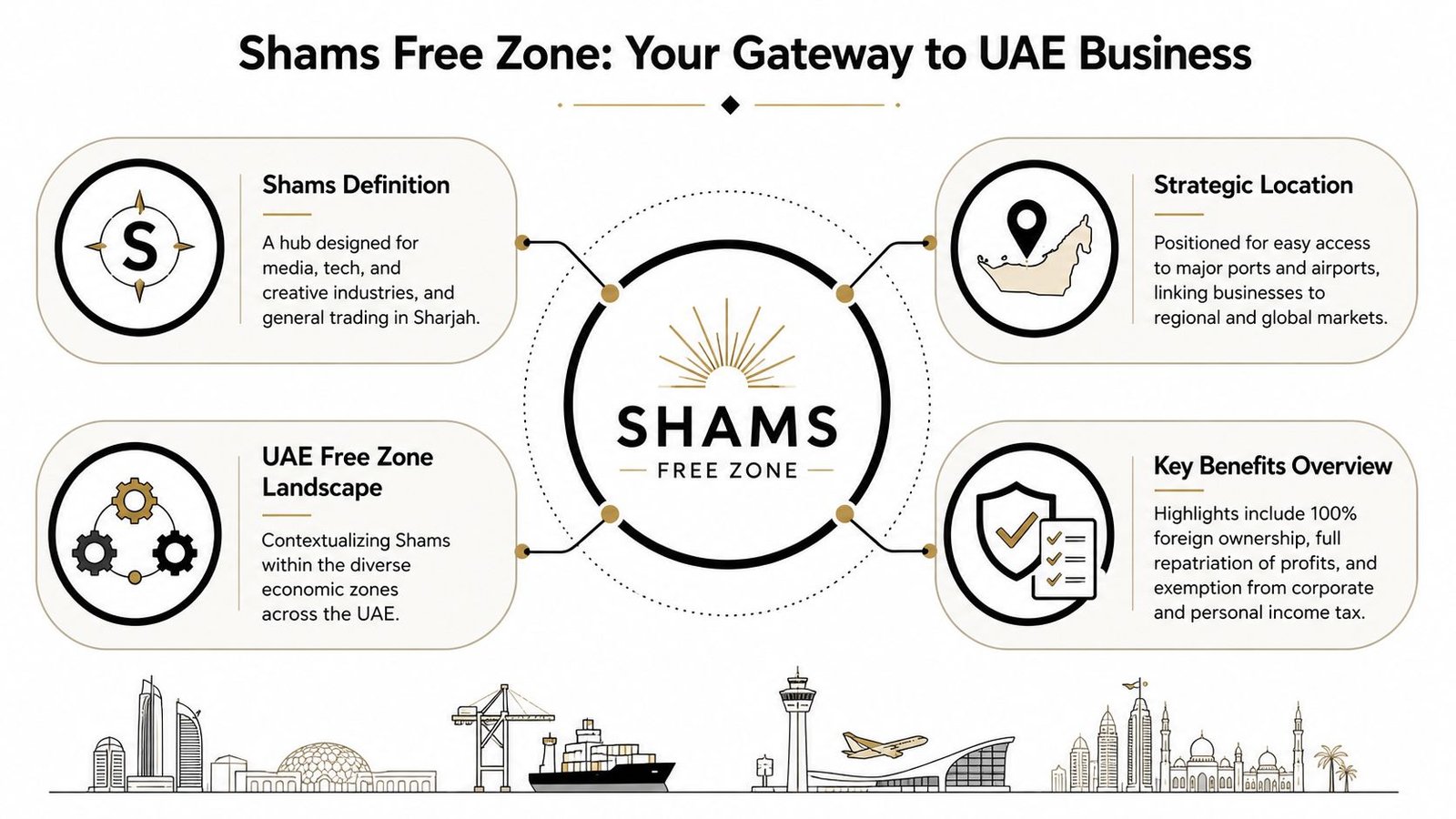
Shams is a free zone authority in Sharjah built to serve media, creative, and digital-first businesses. Official UAE material notes that Sharjah Media City was established in January 2017 by Emiri Decree and covers more than 2 million m² in Al Messaned, Sharjah (UAE Ministry of Economy profile on Shams). In practice, that newer setup shows in the way the zone is packaged. The process is built for founders who want speed, remote handling, and a lighter physical setup than older, infrastructure-heavy zones.
That matters because Shams is not trying to be everything for everyone.
It works well for founders who want a recognised UAE company without paying for prestige office inventory, large facility commitments, or a jurisdiction designed around logistics and industrial use. That low-cost model makes sense for many online and service-led businesses. It can become a constraint if the company later needs more visas, stronger physical presence, or a setup that sends a different signal to banks, partners, or enterprise clients.
Who is Shams best suited to
Shams usually fits founders running lean, location-flexible businesses. That includes consultants, digital service providers, e-commerce support businesses, content producers, and small teams that do not depend on warehouse operations, retail footfall, or regular mainland client meetings from a branded office.
A key advantage is efficiency. You get a UAE legal entity in Sharjah, a setup path that is usually lighter than premium Dubai options, and reasonable access to the Sharjah-Dubai business corridor. For a solo founder or an early-stage team, that can be the right balance of cost and speed.
The trade-off is long-term fit.
I usually tell founders to choose Shams only if their operating model is light by design, not just light for the first six months. A company that sells remotely, keeps headcount controlled, and does not need much physical infrastructure can stay comfortable in Shams for a long time. A business planning field sales, larger hiring, frequent in-person client work, or a stronger on-the-ground presence may save money at entry and then pay for that decision later through restructuring, upgrades, or a move to another jurisdiction.
License Types and Business Activities
What licence categories matter in practice
Most founders should think in three practical licence buckets: service, trading, and industrial. Service is for businesses selling expertise or deliverables, such as consulting, marketing, design, technology support, or management services. Trading is for buying and selling goods. Industrial is for businesses linked to production or manufacturing-related activity.
In real life, the label matters less than the activity wording under it. Your licence is not just a certificate. It's the legal description of what the company is allowed to do. If that description is too broad, too vague, or mismatched to how you'll invoice clients, it can create friction later.
Shams is known for flexibility here. Third-party coverage focused on Sharjah setup explains that Shams is popular not only for media work, but also for consultancy, e-commerce, and digital service businesses, and that it allows multiple activities on one licence (Shams business activity overview).
Why activity selection affects more than licensing
Founders often treat activity selection as admin. It isn't. It affects banking, visa planning, contracts, and how your business reads on paper to compliance teams.
A useful way to think about it is this: your business activity is like the label on a shipment box. If the label says one thing and the contents suggest something else, someone will stop and ask questions. Banks do this. Counterparties do this. Government reviewers can do this too.
A better approach is to choose activities that match your first-year revenue model, not your five-year ambition. If you are launching as a marketing consultancy with some e-commerce advisory work, describe that accurately. Don't pick a generic umbrella activity because it sounds broad and safe.
If your invoices, website, and licence activity tell three different stories, expect delays somewhere in the process.
That doesn't mean you should overcomplicate the licence. It means you should align it. A clean, believable activity mix usually works better than an overstuffed list that tries to cover every possible pivot.
The Company Setup Process Step by Step
A lot of the appeal of Shams comes from process design. It is a digitally driven setup route, and that reduces some of the friction people usually associate with UAE company formation.
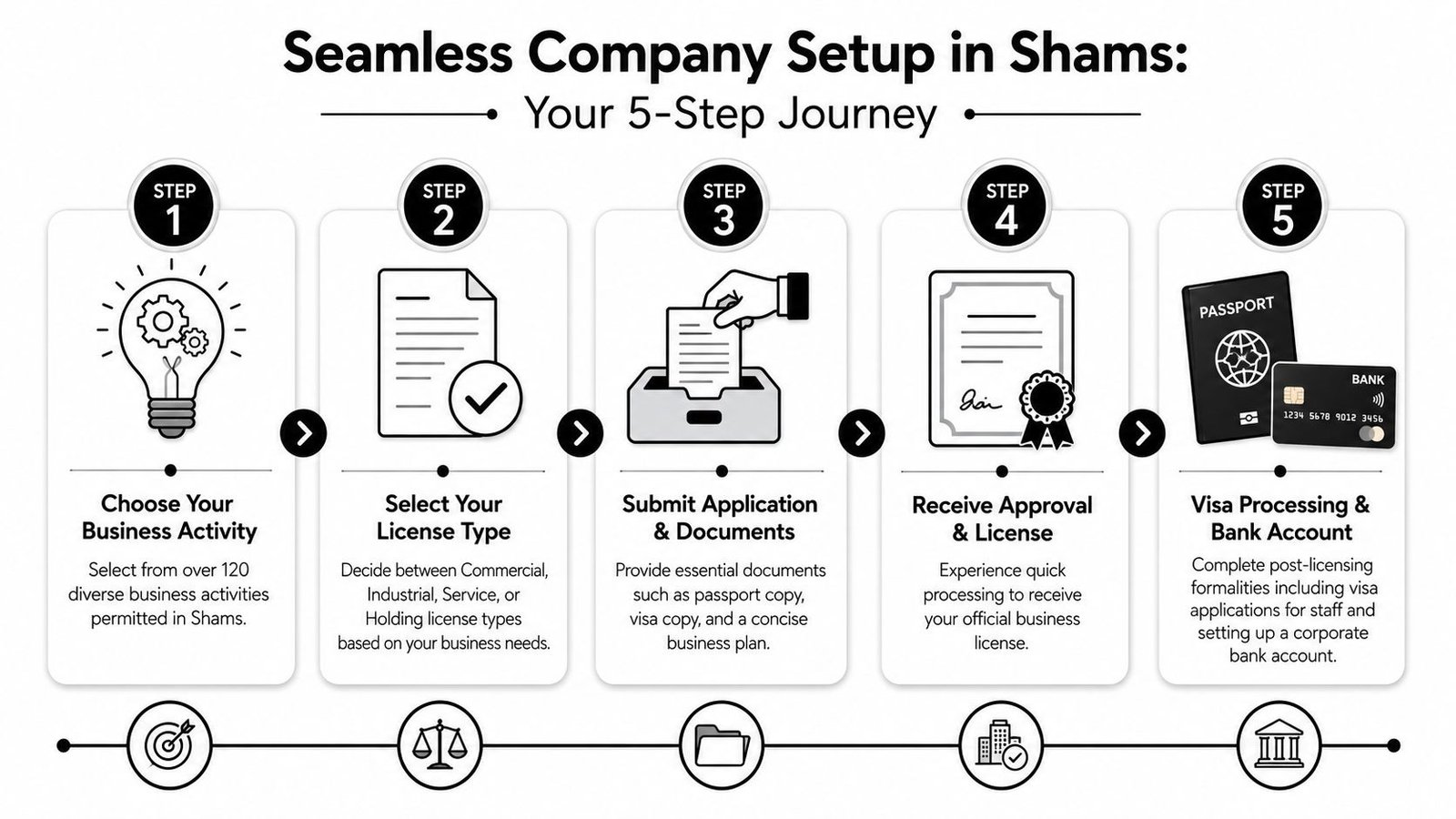
For a visual overview, this setup flow is useful:
How does the setup usually unfold
The process usually starts with four decisions:
- Choose the business activities that match what you will sell.
- Select the licence structure based on whether you need a simple setup, visa allocation, or room to grow.
- Reserve the trade name if required.
- Prepare the application pack with personal and corporate documents.
After that, the authority reviews the application, checks compliance details, and issues the company documents once approved. Shams is often described as a low-friction option because much of this can be handled without the founder building a large physical presence on day one.
This short video gives a basic view of the process environment:
What documents and checks usually slow founders down
The slow part usually isn't the authority. It's incomplete paperwork. Independent setup guidance notes that Shams onboarding includes compliance declarations, ultimate beneficial owner documentation, and know your customer checks. Ultimate beneficial owner means the individual who ultimately owns or controls the business. Know your customer means identity and due diligence checks used across regulated business processes (SHAMS setup compliance overview).
Founders should expect to prepare documents such as:
- Passport copies for shareholders and managers
- Personal details and contact records for application forms
- Ownership information showing who controls the company
- Supporting corporate papers if an existing company is the shareholder
- Compliance declarations requested during onboarding
The practical reason for these checks is simple. A low-cost setup still sits inside the UAE's formal regulatory framework. Cheap doesn't mean loose.
The fastest approvals usually go to founders who submit a neat, consistent file the first time.
Once the licence is issued, post-licensing steps begin. Those can include establishment records, visa processing, and then bank account onboarding. That's why it helps to think of setup as two phases: getting incorporated, then becoming operational.
Costs and Fees in 2026
What does the starting price actually mean
The package entry price is often the first number observed. Independent 2026 market coverage says SHAMS licence packages start from about AED 5,750, but that figure is only the base layer of the decision (2026 comparison of Shams package pricing).
Many founders often make a budgeting mistake in this area. They compare a base package against another jurisdiction's fuller package and assume they are comparing like for like. They usually aren't.
Your first-year spend is shaped by a few practical variables:
- Licence duration affects the upfront package structure.
- Activity scope affects how simple or layered the licence becomes.
- Workspace type affects substance and visa planning.
- Immigration needs affect how much the operating model costs after incorporation.
How should you budget for the first year
A better budgeting method is to separate the setup into two columns: what gets the company formed, and what gets the company usable. The first is the licence. The second is everything attached to how you plan to work.
| Cost Item | Basic 'Freelancer' Package (0 Visa) | SME Growth' Package (2 Visas) |
|---|---|---|
| Licence package | Starting point usually based on entry-level licence pricing | Higher than entry-level package once visa-linked structure is added |
| Business activities | Simpler activity mix is easier to budget | Broader activity mix may increase total package cost |
| Workspace | Minimal facility requirement may suit remote operation | Shared or larger facility choice may be needed |
| Immigration | No visa allocation built into the model | Visa-related costs become part of the first-year budget |
| Compliance and documentation | Standard onboarding and due diligence still apply | Same core checks, often with more post-licensing steps |
| Banking readiness | Depends on how clear the business model is on paper | Depends on business profile and supporting documents |
That table is deliberate. It avoids pretending there is one universal total. There isn't. The right question is not “What is the Shams fee?” It's “What combination of licence, activities, facility, and visas matches my operating plan?”
A solo consultant serving overseas clients may be well served by a lean package. A growing agency hiring staff in the UAE needs to model visas, workspace, and post-licence admin from the start. If you don't do that, the setup looks cheap on day one and awkward by month six.
Visas and Office Space Options
How do visas connect to office requirements
Shams stays affordable because it is built for light-footprint businesses. That low-cost model works well for founders who can operate remotely, hire slowly, and keep UAE overhead under control. It becomes less attractive once visa demand, team size, or client-facing requirements start to grow.
In practice, visa eligibility and workspace are linked. A company that needs only one founder visa can usually work within a simpler facility structure. A company planning multiple employees should check the visa allocation against the office arrangement before choosing a package. That is the point many founders miss. They buy for entry cost, then discover the setup no longer fits once hiring starts.
Shams is well suited to businesses serving overseas clients, running lean teams, or testing the UAE market before committing to a heavier setup. The trade-off is straightforward. Lower facility costs usually mean less physical presence on paper, and that can matter later for staffing plans, client perception, and some bank compliance reviews.
What works for lean teams and what does not
For a solo consultant, designer, marketer, or small online services firm, Shams can be a sensible choice. The company gets formed quickly, fixed costs stay modest, and there is no pressure to pay for office capacity that will sit unused.
That same structure can become restrictive for a business with a different plan.
If the goal is to hire several people in the UAE, hold regular client meetings, or build a stronger operational profile from day one, office choice should be treated as part of the commercial model. It is not just an admin item after incorporation. It affects how far the company can scale inside the same setup without restructuring.
A practical way to assess fit:
- Remote founder model. Usually suited to lighter facility options and limited visa needs.
- Small team build-out. Works if visa allocations and workspace terms are checked early, not after the licence is issued.
- Client-facing operating company. Often needs a stronger physical setup, whether in Shams or in another jurisdiction better matched to that profile.
Office space in the UAE does more than give you a place to work. It also supports the company's operational credibility.
The visa process usually starts after incorporation and establishment card formalities. From there, the sequence may include entry permit steps if the applicant is outside the UAE, status adjustment if the applicant is already inside the country, then medical testing and Emirates ID processing. Timelines depend on the applicant's status and document readiness, so founders should plan this early if travel, onboarding, or revenue timing depends on residency being in place.
Shams Compared to Other UAE Jurisdictions
When is Shams the right choice
Shams makes sense when the main goal is to get operational in the UAE at a lower entry cost without committing early to heavier office overhead or a premium address.
That usually fits founders selling services across borders, running remote teams, building a consultancy, or testing demand before investing in a larger UAE setup. In practice, Shams works best for businesses that do not need the jurisdiction itself to do the selling for them. If clients care more about delivery, pricing, and speed than about having a well-known Dubai free zone on the licence, the lower-cost model can be a rational choice.
The trade-off is straightforward. You save on setup cost and often move faster, but you accept a lighter operating profile at the start. For many early-stage companies, that is a sensible exchange. For others, it becomes a limitation within 12 to 24 months.
When should you choose another jurisdiction
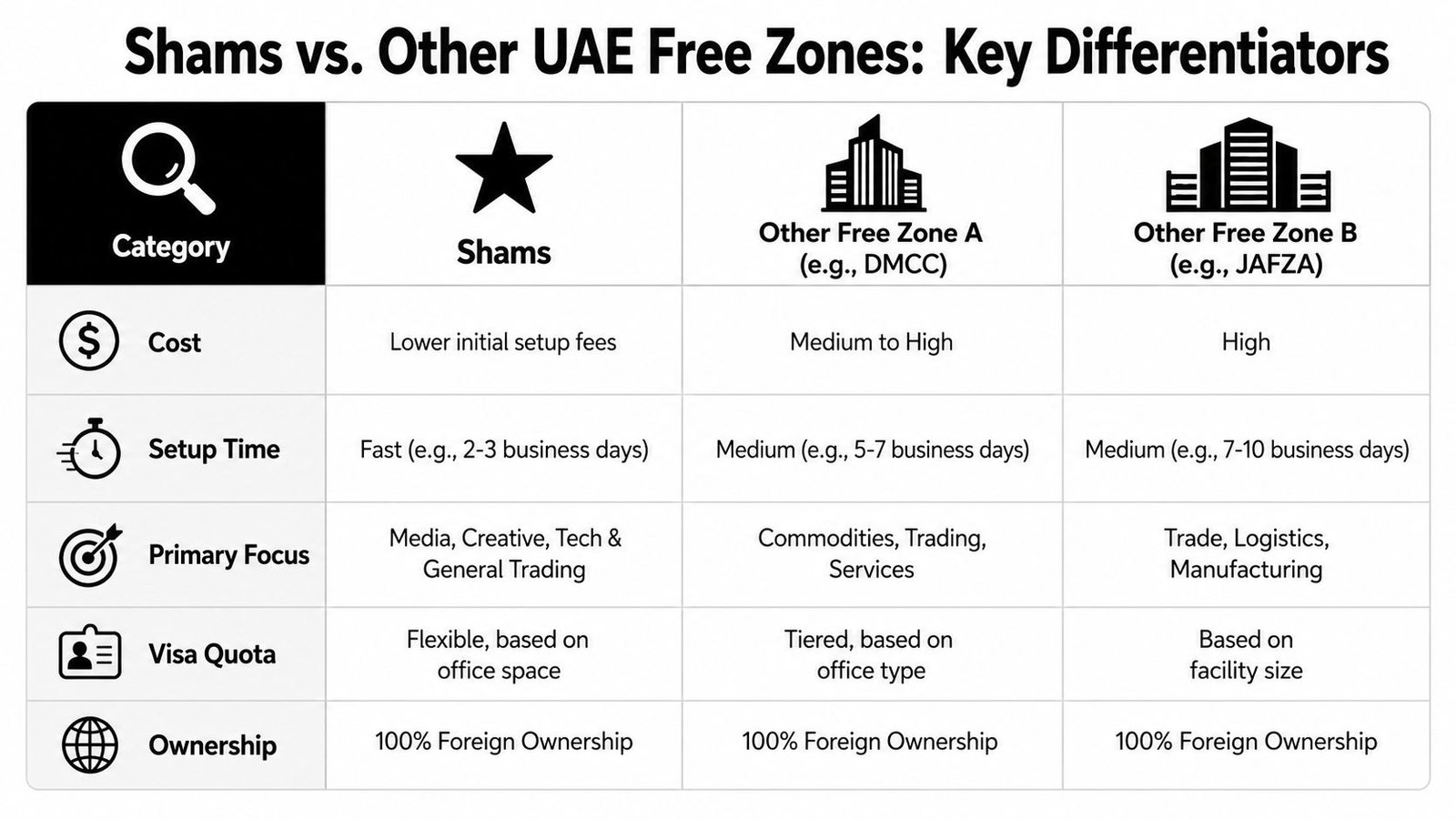
The better question is not whether Shams is cheaper. It usually is. The better question is what the business will need after incorporation.
| Decision area | Shams | Premium Dubai free zone | Sharjah mainland |
|---|---|---|---|
| Entry cost | Usually attractive for budget-sensitive setups | Usually higher | Varies by activity and structure |
| Setup style | Digital-first and founder-friendly | More formal and often more premium | Can involve different approval paths depending on activity |
| Best fit | Remote-friendly, creative, consultancy, digital | Businesses that want stronger premium positioning | Businesses that need broader direct local market operation |
| Office expectation | Can be lighter at entry stage | Often more structured | Depends on activity and local requirements |
| Onshore access | More limited than a mainland-first structure | Still a free zone model | Better suited where direct local trading presence is central |
| Growth profile | Good for lean starts | Good for businesses wanting stronger market signalling | Good where the UAE domestic market is the main play |
A premium Dubai free zone is often chosen for market signalling as much as administration. That can matter if the company is pitching enterprise clients, raising capital, hiring senior staff, or building a brand that benefits from a stronger Dubai commercial profile. The licence cost is higher, but sometimes the jurisdiction supports the sales narrative.
Sharjah mainland is a different decision. It is usually more relevant where direct UAE market access sits at the centre of the model, especially for businesses that expect local trading activity, operational staffing, or customer interactions tied closely to the domestic market. The setup path may be less simple, but the structure can suit the business better if local execution is the priority.
My advice to founders is simple. Choose Shams if the company needs a lean starting point and the business model can operate comfortably within that framework for the next phase of growth. Choose another jurisdiction if you already know the company will need stronger local access, a more established market position, or a physical operating setup that goes beyond a cost-efficient entry point.
Common Pitfalls and How Inpro Can Help
What usually goes wrong after the licence is issued
The easy part is often getting the company formed. The harder part is making it function cleanly. Bank account opening can take longer than founders expect if the activity wording, business model, website, contracts, or shareholder profile don't line up properly.
Renewals, amendments, visa administration, and regulatory paperwork also catch founders off guard. A simple change such as adding an activity, updating shareholder information, or adjusting a visa plan can become time-consuming if the original setup was rushed.
Why expert support matters after setup
Professional support saves time and avoids rework. A good advisor doesn't just file the initial application. They pressure-test whether the chosen structure will hold up for banking, staffing, and yearly compliance in the UAE.
For many businesses, the best result isn't the lowest setup quote. It's the setup that still makes sense after the first client contracts, the first bank review, and the first employee visa application.
A free zone company should be easy to maintain, not only easy to buy.
If you're comparing Shams with other UAE options and want a practical answer based on your business model, Inpro Corporate Services L.L.C. can help you assess setup, visas, banking readiness, and long-term fit before you commit.