


A UAE business visa is not a single permit but a category of residency options for foreign entrepreneurs, investors, and professionals who want to establish a presence in the United Arab Emirates. To get one, you generally need to start a company, make a significant investment, or be recognized as exceptional talent.
Table of Contents
- Understanding Your Path to UAE Residency
- Which Visa Option Is Right for You?
- Mainland vs. Free Zone: Where You Set Up Shop Dictates Your Visa Path
- Your UAE Business Visa Document Checklist
- The 5 Steps of the UAE Business Visa Process
- What Does a UAE Business Visa Cost?
- Your UAE Visa Questions Answered
Understanding Your Path to UAE Residency
The phrase “business visa” covers several types of long-term residence permits, each for a specific purpose. Unlike a standard employment visa that ties you to a single employer, these visas link directly to your own investment or business venture. They are the primary route for founders and business owners who want to live and work in the UAE on their own terms.
The UAE government has made this process efficient. A 2024 report on visa processing trends showed a 97.2% approval rate for business-related visas, according to UAE visa processing statistics. This rate surpasses other popular routes like standard work permits.
What are the main types of business visas?
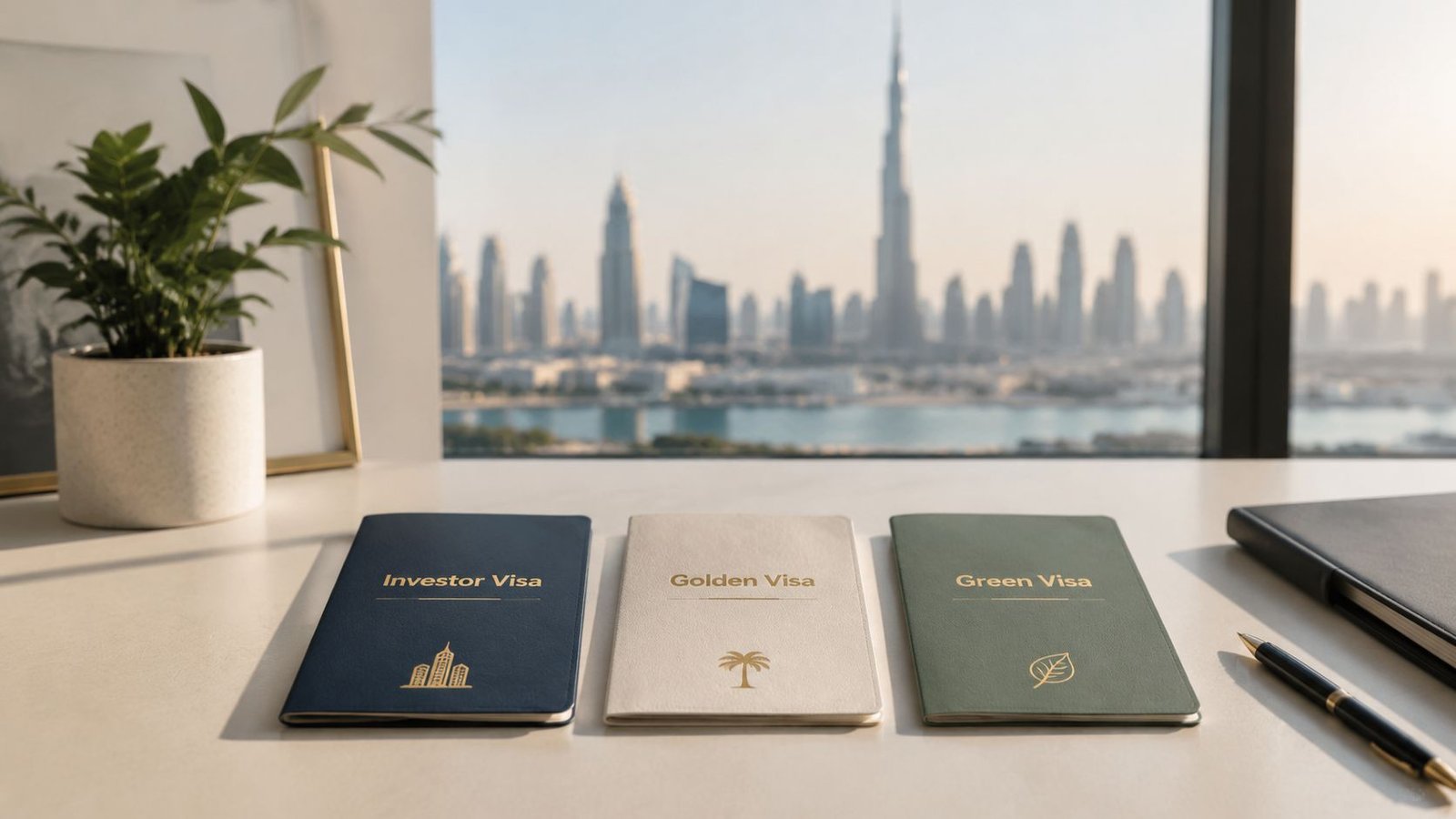
The main options for business-focused individuals are the Investor Visa, the Golden Visa, and the Green Visa. Each is tailored to a different type of applicant and has its own set of requirements and benefits.
Who qualifies for these visas?
The Investor Visa is for individuals who own shares in a UAE company. The Golden Visa is a 10-year residency for major investors, property owners, and successful entrepreneurs. The Green Visa is a 5-year, self-sponsored residency for skilled professionals, freelancers, and smaller-scale investors.
Which Visa Option Is Right for You?
Think of your UAE business visa as the foundation of your corporate structure. The visa you choose will influence your flexibility, your ability to sponsor family, and how you interact with the local market. It is a strategic decision that goes beyond just getting a residency permit.
Making the right choice means matching a visa's specific purpose to your personal and professional goals. The path for a startup founder is different from that of a real estate investor, and the UAE has a visa for each.
What is the Investor Visa?
The Investor Visa is the most direct route for anyone owning part of a UAE company. This 2-year residence permit officially designates you as a partner or owner, not an employee, and is tied to your business's legitimacy. To qualify, your name must appear on the company’s official documents, such as the Memorandum of Association.
What is the Golden Visa?
The Golden Visa is the UAE’s 10-year, self-sponsored residency, offering stability and benefits like staying outside the UAE for more than six months without visa cancellation. Its popularity grew significantly, with the General Directorate of Residency and Foreigners Affairs (GDRFA) issuing around 158,000 Golden Visas in 2023, according to official numbers on the Golden Visa surge. Common pathways include purchasing property worth at least AED 2 million, having a startup with annual revenues of at least AED 1 million, or making a public investment of AED 2 million.
What is the Green Visa?
The Green Visa is a 5-year, self-sponsored residency that sits between the standard Investor Visa and the Golden Visa. It is aimed at skilled professionals, freelancers, and smaller-scale investors who want independence without needing an employer sponsor. Key paths include being a skilled professional with a bachelor’s degree and a minimum monthly salary of AED 15,000, or a freelancer with a permit from the Ministry of Human Resources and Emiratisation (MOHRE) and proof of at least AED 360,000 in annual earnings for the past two years.
UAE Business Visa Types at a Glance
| Visa Type | Typical Validity | Best For | Key Requirement Example |
|---|---|---|---|
| Investor Visa | 2 Years | Business owners actively running a UAE company. | Owning shares in a registered UAE Mainland or Free Zone company. |
| Golden Visa | 10 Years | High-net-worth individuals, significant investors, and successful entrepreneurs. | Purchasing real estate worth at least AED 2 million. |
| Green Visa | 5 Years | Skilled professionals, freelancers, and small-scale investors seeking self-sponsorship. | Showing an annual self-employment income of at least AED 360,000. |
The right visa aligns with your five or ten-year plan. Answering whether you are building an active business, parking capital, or establishing a flexible professional base is the first step to your future in the UAE.
Mainland vs. Free Zone: Where You Set Up Shop Dictates Your Visa Path
When setting up a business in the United Arab Emirates, your company's location is a critical decision. It directly controls which government body issues your visa and the rules you must follow. Choosing between a Mainland and a Free Zone company is about selecting your regulator, market access, and visa framework.
How does this choice change your visa application?
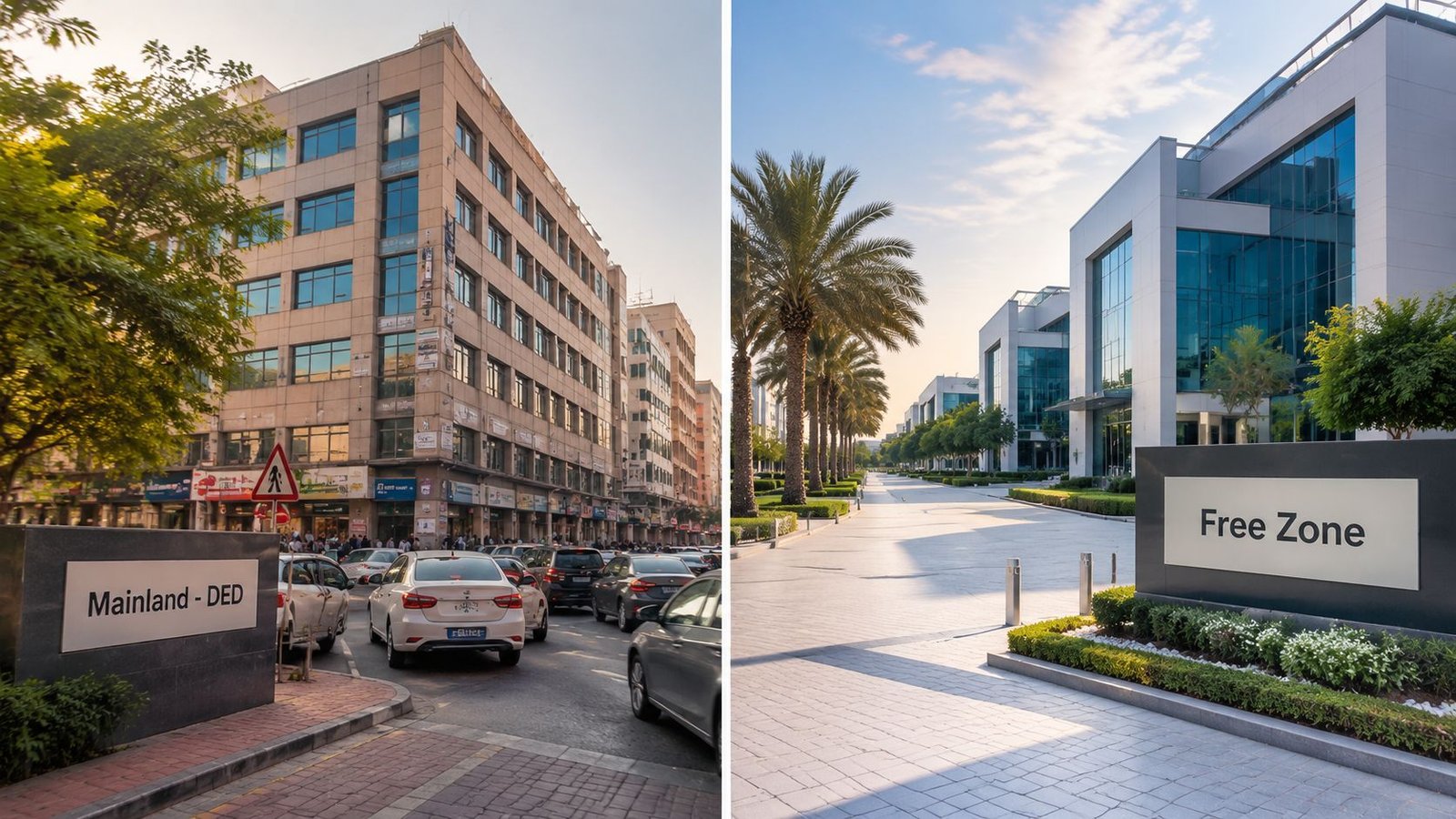
A Mainland company is licensed by an emirate's Department of Economic Development (DED), such as Dubai's Department of Economy and Tourism (DET). This setup allows you to trade anywhere in the UAE, and your visa application is processed through the main federal immigration authority. A Free Zone company is registered in one of the UAE's 40+ designated economic zones, like Dubai Multi Commodities Centre (DMCC) or Abu Dhabi Global Market (ADGM), each with its own immigration department that handles visas for companies within its jurisdiction.
This choice has real-world consequences:
- Processing Speeds: Many Free Zones have faster and more predictable visa processing timelines.
- Paperwork and Procedures: Specific requirements and administrative steps vary between Free Zones and the Mainland.
- Visa Quotas: On the Mainland, your employee visa quota is often tied to your office size. In a Free Zone, it’s usually linked to your business package.
Use our free cost estimator to compare the setup and visa expenses for different Mainland and Free Zone options.
Your UAE Business Visa Document Checklist
Getting your paperwork in order is the most important step in securing a UAE business visa. A small error can stop the process. The required documents fall into three categories: personal, company, and financial.
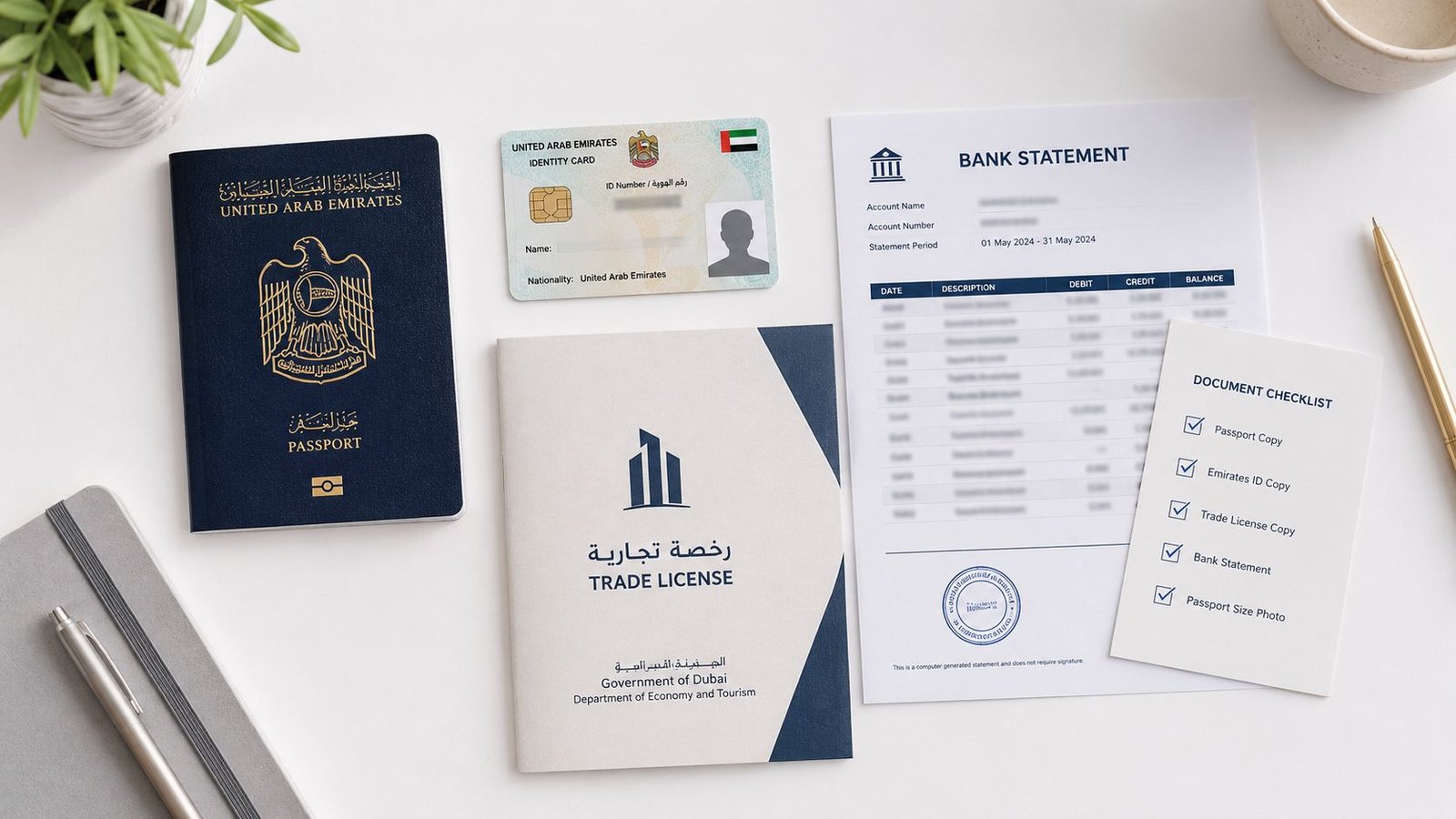
While this checklist covers the basics, the final list depends on your jurisdiction and visa type.
What personal documents are needed?
These documents verify your identity. You will need a clear, colored copy of your passport with at least six months of validity, recent passport-sized photographs against a plain white background, and a copy of your current visa or entry stamp if you are already in the UAE. Precision is important, as every detail will be checked.
What company documents are required?
These documents prove your business is legitimate and you are a legal partner. Key documents include a copy of your company’s trade license, the Memorandum of Association (MOA) showing you as a shareholder, a copy of the company's Immigration Card (also called an Establishment Card), and your registered tenancy contract (Ejari).
What is document attestation?
Document attestation is the process by which the UAE government verifies that documents from another country, like university degrees, are authentic. It involves a chain of stamps starting from the UAE Embassy in your home country and ending with the Ministry of Foreign Affairs (MOFA) in the UAE. It is a mandatory step for certain visas.
The 5 Steps of the UAE Business Visa Process
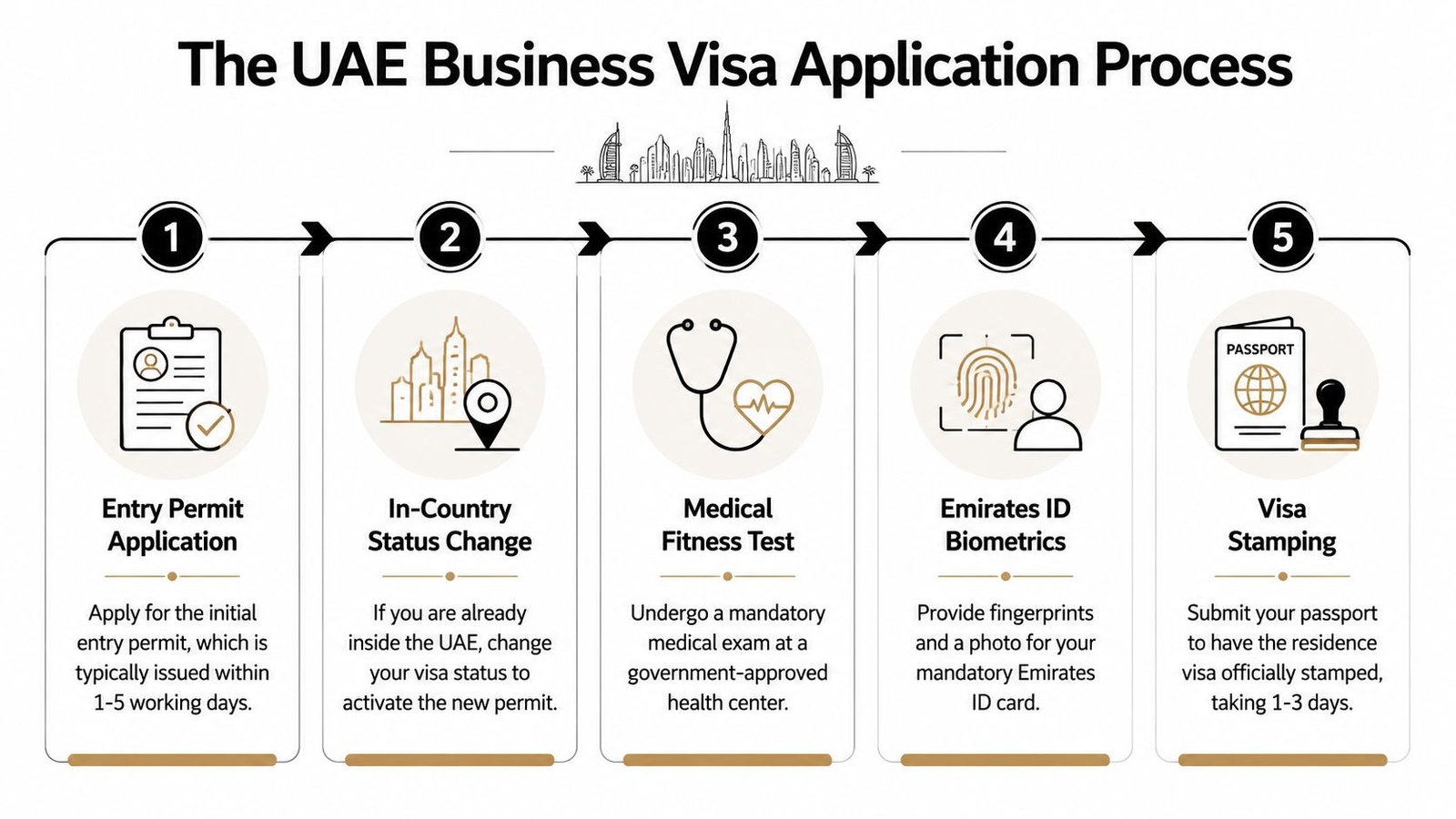
The visa application process is a series of defined milestones. While the exact route can differ between Mainland and Free Zone businesses, the path from applicant to resident involves five main stages.
1. Secure Your Entry Permit
The Entry Permit is a temporary document allowing you to enter the UAE to finalize your residency. Your company, as your sponsor, applies for this permit. It is typically issued electronically within one to five working days.
2. Enter the UAE and Activate Your Status
If you applied from abroad, present your Entry Permit upon arrival. If you are already in the UAE on a tourist visa, you will complete an in-country "status change." A status change is the administrative step that switches your legal status from visitor to potential resident, activating your new Entry Permit without you having to leave the country.
3. Complete the Medical Fitness Test
Every applicant for a UAE residence visa must pass a mandatory medical fitness test at a government-approved center. The test includes a blood test and a chest X-ray to screen for specific communicable diseases. Results are typically available within 24 hours.
4. Provide Your Emirates ID Biometrics
The Emirates ID is your official identity card in the UAE. After your medical results are issued, you will visit a Federal Authority for Identity, Citizenship, Customs & Port Security (ICP) service center for a biometrics appointment. They will take your fingerprints and a digital photo.
5. Get the Visa Stamped in Your Passport
This is the final step. Your passport is submitted to the immigration authority—either the General Directorate of Residency and Foreigners Affairs (GDRFA) for a Mainland company or the specific Free Zone’s immigration department. They will place the residence visa sticker in your passport, usually within one to three working days, officially making you a resident of the UAE.
What Does a UAE Business Visa Cost?
One of the first questions every entrepreneur asks is about the cost. While there is no single price, the costs are predictable and consist of a series of government fees paid at each stage. The total cost includes charges for the entry permit, medical screening, Emirates ID card, and visa stamp, plus mandatory health insurance and any document translations.
How much are the government fees?
The exact fees vary by jurisdiction but you can use these ballpark figures for planning:
- Entry Permit: AED 1,000 to AED 1,500
- Medical Fitness Test: AED 300 to AED 500
- Emirates ID (2-year): Around AED 370
- Visa Stamping: AED 500 to AED 900
How are fees different from investment amounts?
Administrative fees are separate from the capital requirements for certain visas. For example, the Golden Visa for investors requires showing a share capital of AED 2 million in a UAE company. This is an investment in the economy, not a fee paid to the government. You can find current details on the official government residency services page.
Your UAE Visa Questions Answered
As you get closer to launching in the UAE, practical questions arise. Here are answers to some of the most common ones.
Can I start the visa process from my home country?
Yes, this is the standard method. Your new UAE company sponsors your Entry Permit, which you use to enter the country. If you are already in the UAE on a tourist visa, you can perform an "in-country status change" to convert your status without leaving.
How long can I be outside the UAE before my visa is canceled?
For most standard residence visas, you cannot be outside the UAE for more than 180 consecutive days. Exceeding this limit automatically cancels your residency. Golden Visa holders are exempt from this rule and can stay outside the UAE for extended periods.
Can I bring my family with me on a business visa?
Yes. As a residence visa holder, you can sponsor your spouse and children. You will need to meet a minimum salary requirement and provide attested documents like your marriage and birth certificates. Your family members will then follow a similar process to obtain their own residency visas.
Not sure where to start? Book a free strategy call with the inpro.me team.