

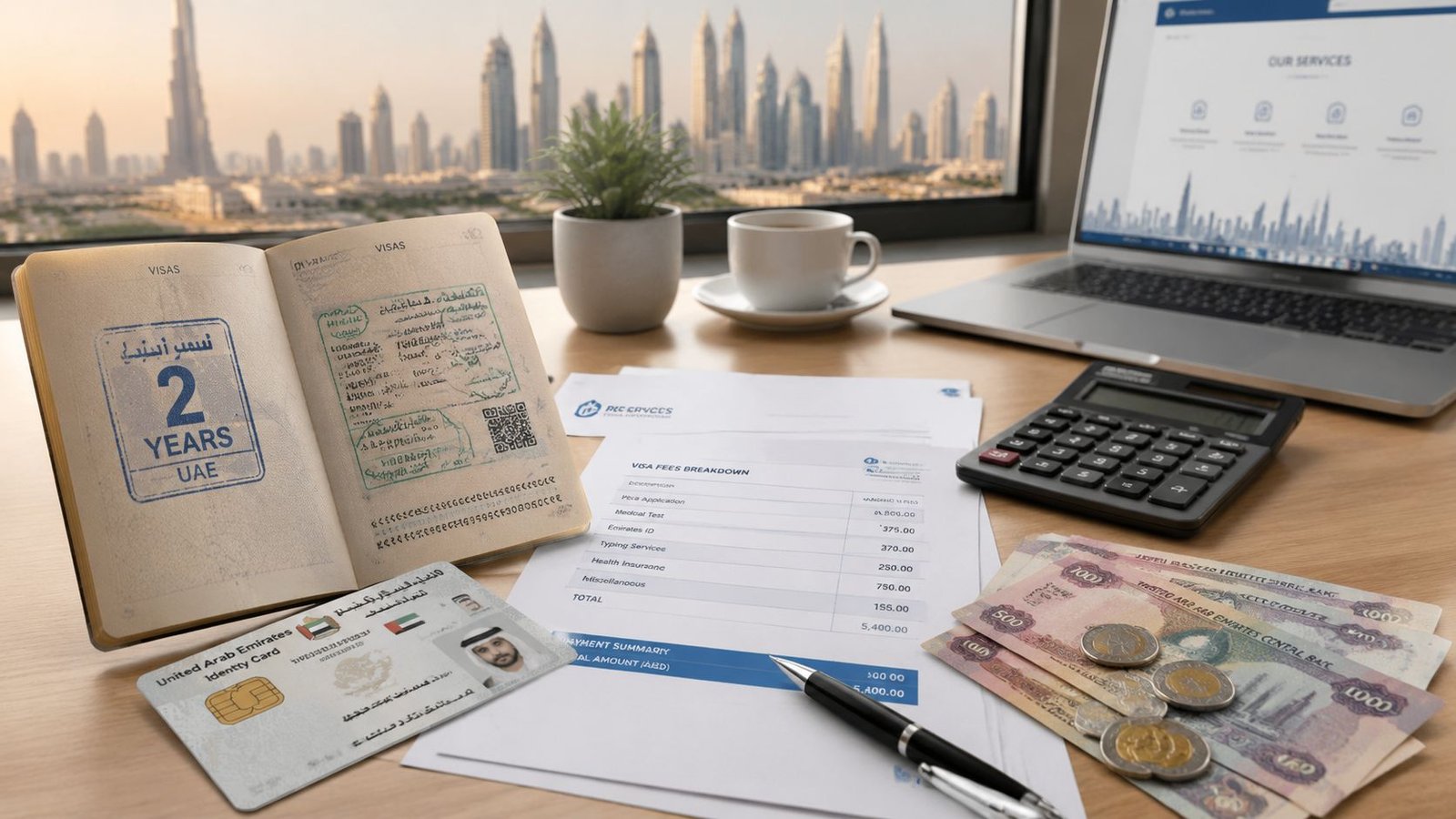
A 2-year family visa in Dubai usually lands at AED 4,500 to AED 6,500 per person, not as one flat visa fee but as a bundle of separate government and compliance costs. That's the part that catches people out: the headline “visa price” is really the total of several steps, and the final number changes based on where the dependant is applying from, which documents need processing, and the health insurance choice.
That bundled structure is why two families can both be applying for the same residence outcome in Dubai and still pay different totals. In practice, the cleanest way to budget isn't to ask, “What's the visa fee?” It's to treat the move like a relocation project with checkpoints, document dependencies, and a realistic all-in cost per person.
Table of Contents
- What Is the Total Price for a 2-Year Family Visa in Dubai
- Who Qualifies to Sponsor Their Family in the UAE
- What Are the Individual Costs That Make Up the Total Price
- What Is the Step-by-Step Family Visa Application Process
- How Do Family Visa Costs Change by Sponsor Type
- How Can You Simplify the Family Visa Process
What Is the Total Price for a 2-Year Family Visa in Dubai
Budget AED 4,500 to AED 6,500 per person for a standard 2 years family visa price in Dubai if you want a number that reflects the full job, not just one line on a government portal. That working range usually covers the residence permit, status processing, medical fitness steps, Emirates ID, visa stamping or issuance, and health insurance.
The planning mistake I see most often is simple. Sponsors budget for the permit fee, then get hit by the rest of the file in stages. That is why family relocation should be priced like a project. Each dependant has a predictable cost stack, a document sequence, and a timeline that can slip if one item is missing.
The official Dubai service details list the inside-country residence permit fee at AED 500, plus Knowledge Dirham AED 10, Innovation Dirham AED 10, and delivery AED 20 on the General Directorate of Residency and Foreigners Affairs service page. Useful number. It is not the full budget.
Why there isn't one single visa price
A family residence visa is processed in layers, not as one bundled purchase. Part of the file sits with immigration. Other parts sit with medical testing, identity registration, insurance, and entry or status adjustment requirements.
In practice, the total usually includes:
- Government processing fees for the residence file
- Emirates ID charges linked to the residency term
- Medical fitness testing for adult dependants
- Health insurance required in Dubai
- Inside-country or outside-country processing costs, depending on where the dependant is when the file starts
This is why two families can both ask for the price of a 2-year family visa and get different answers.
How to budget for it properly
Use an all-in figure per dependant, then add a contingency for document corrections, typing centre charges, express processing, or insurance upgrades. That gives founders and HR teams a number they can approve.
A spouse file is often straightforward if the marriage certificate is properly attested and the sponsor's documents are clean. A child file may be cheaper on medical requirements but can still slow down if the birth certificate is not in the right format. A parent file usually needs a wider budget and more time because scrutiny is higher and supporting documents are heavier.
The key difference by sponsor type isn't just the fee. It is how much friction sits inside the file before submission. Clean records, correct attestations, and the right entry status often save more time and money than chasing the lowest headline price.
Who Qualifies to Sponsor Their Family in the UAE
Before price matters, eligibility matters. A sponsor is the UAE resident whose legal status and income allow family members to be placed under that residence file.

What does sponsor mean in practice
In day-to-day PRO work, the sponsor is the person the authorities assess first. The dependant's application only moves smoothly if the sponsor's residency, salary support, and documents are in order.
For a founder, that may mean making sure the personal residence status is active before starting the family file. For an employee, it often means checking whether the labour and residence records align cleanly before the application starts.
What salary rule applies
The formal threshold is clear on the UAE government side. The official United Arab Emirates platform states that a sponsor must earn a minimum salary of AED 4,000 or AED 3,000 plus accommodation to sponsor family members, and it also notes a minimum monthly salary of AED 4,000 for first-degree relatives through the UAE family residence visa guidance.
That rule matters because it separates eligibility from payment. A person can be ready to pay every filing cost and still not qualify if the salary requirement or supporting records don't match the rule.
Which family members can usually be sponsored
In practical terms, the standard conversation usually starts with these categories:
- Spouse: usually the most common sponsorship case, provided the marriage documents are acceptable for filing.
- Children: often straightforward, but document consistency matters. Names, dates, and passport details need to align across the file.
- Parents: this category tends to require more planning and supporting paperwork than a spouse or child file.
The approval logic is simple. The government first looks at whether the sponsor qualifies, then whether the relationship documents support the application.
A lot of delays happen because people assume family relationship alone is enough. It isn't. The sponsor must satisfy the rule, and the file must show a clear legal relationship using the right documents in the right format.
What founders and HR teams should check first
If you're relocating as a business owner in Dubai, Abu Dhabi, or a free zone setup elsewhere in the UAE, confirm these points before paying for anything:
- Sponsor status: the residence record should already be valid and usable for sponsorship.
- Salary evidence: the amount and accommodation basis should match what the rules require.
- Document readiness: passport copies and family certificates should be consistent and ready for submission.
- Adult dependant compliance: adults should be prepared for medical examination requirements.
That early check saves time. It also stops the most common mistake, which is spending on partial processing before confirming the sponsor can legally carry the file.
What Are the Individual Costs That Make Up the Total Price
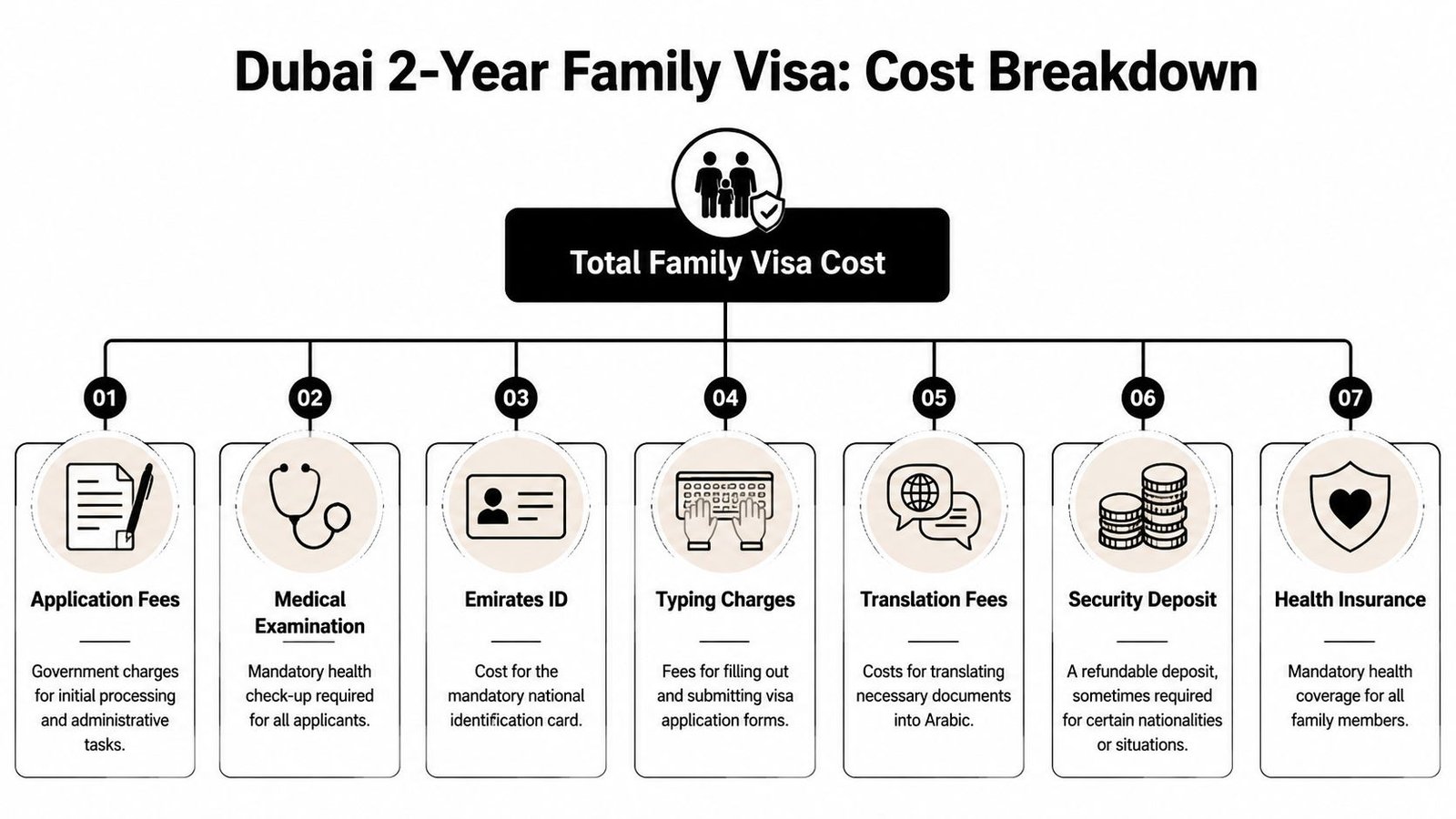
The visa price only becomes useful once it is broken into cost lines you can plan around. That is the difference between a realistic relocation budget and a quote that looks fine at the start but keeps growing during processing.
Which charges are fixed and official
Start with the government core. In Dubai, the residence permit component is one published part of the file, and as noted earlier, the official service breakdown includes the permit fee plus small service-related additions such as knowledge, innovation, and delivery charges.
That matters for one reason. It shows that the permit itself is only one line in the budget, not the full family visa cost.
There is also a practical planning point here. Longer residence durations can carry extra issuance cost, so a 2-year family visa should be budgeted as its own category rather than treated as interchangeable with longer-term residence options.
Which costs usually sit around the permit fee
The all-in number changes because the residence permit is only the middle of the process. A standard family file often includes several separate charges, depending on where the dependant is applying from and how clean the paperwork is.
Typical cost buckets include:
- Entry permit: usually applies if the dependant is outside the UAE and needs to enter on the correct immigration route.
- Status adjustment: often comes up when the dependant is already inside the UAE and the file needs to be converted correctly.
- Medical fitness test: required for adult dependants.
- Emirates ID application: part of the residence process, not a side task.
- Residence issuance and final approval steps: the file still needs to be completed after medicals and identity processing.
- Health insurance: one of the biggest variables, especially in Dubai.
- Admin handling: typing, attestations, translations, courier charges, or service-centre support.
Weak budgeting usually starts when someone prices only the immigration line and calls it the visa cost. Then insurance, medicals, ID fees, and document work appear later as if they were unexpected, even though they were always part of the project.
Why two families can get different totals
Two applications can look similar on paper and still produce different totals.
A spouse and child applying from outside the UAE will often follow a different fee path from a spouse already inside the country on another status. An adult child, a parent sponsorship file, or a case with documents that need translation and attestation will usually cost more to complete than a straightforward spouse file. Insurance also changes the number fast. Basic cover and broader cover are not priced the same, and that gap can matter more than the immigration fee itself.
That is why I tell founders and HR managers to stop asking only, "What is the 2-year family visa price?" The better question is, "Which stage costs are included, which are variable, and when do they fall due?"
A budgeting model that works in practice
Use three cost groups and budget them separately.
| Cost group | What it usually includes | Budget approach |
|---|---|---|
| Government core | Permit and official issuance-related charges | Treat this as the fixed base |
| Compliance steps | Medical fitness, Emirates ID, insurance | Allow for variation by dependant age, location, and insurance choice |
| Admin support | Typing, translation, attestation, courier, service handling | Keep a buffer because these depend on document quality and filing route |
This structure helps with cash flow as much as total cost. The fees do not all land on day one. Some are paid at file opening, some after entry or status adjustment, some after medical testing, and some at the final residence stage.
Where budgets usually go wrong
The mistake is not usually the headline number. It is the scope behind the number.
One provider may quote only filing fees. Another may include medicals, ID processing, insurance support, and document handling. Both can present a price as if it covers the same thing. It does not.
For a family relocation, treat the visa as a staged project with known cost categories, variable items, and payment points. Once you do that, the process stops feeling unpredictable, and the total price becomes something you can manage.
What Is the Step-by-Step Family Visa Application Process
The family visa process is manageable once you stop seeing it as one application and start seeing it as a sequence. Each stage leads to the next one.
A lot of confusion comes from the number of authorities involved. In Dubai, GDRFA means the General Directorate of Residency and Foreigners Affairs, which handles immigration and residence matters in the emirate. ICP means the Federal Authority for Identity, Citizenship, Customs & Port Security, which handles federal identity and related systems across the UAE.
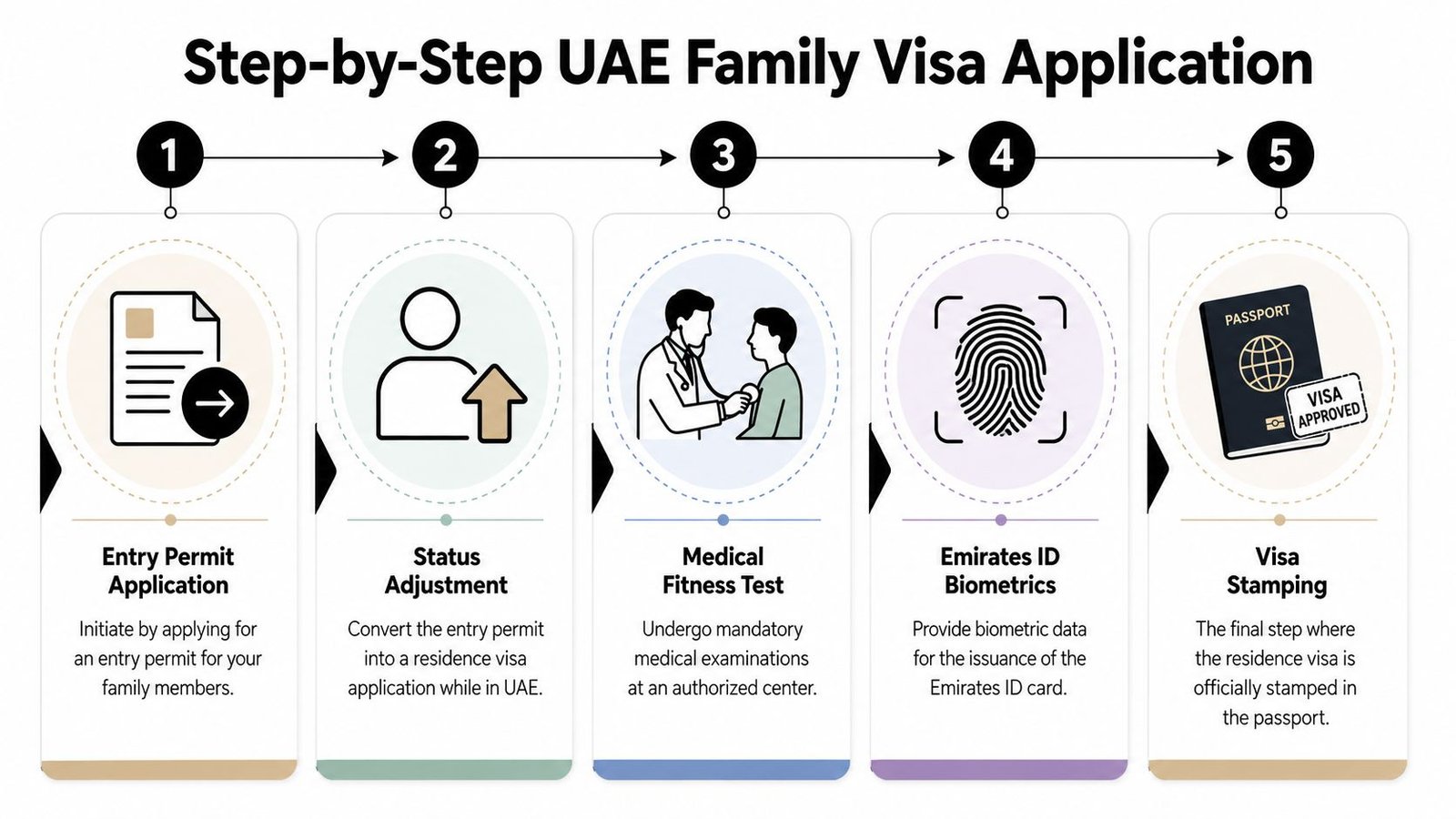
To make the sequence easier to visualise, here is the standard flow used for most family files.
Which authority handles what
In plain terms, GDRFA handles the Dubai immigration side of the residence file. ICP is the federal identity authority you'll hear about when the process touches Emirates ID and connected records.
That doesn't always feel neat from the applicant side because the file moves through multiple checkpoints. But once the roles are clear, the process stops looking random and starts looking like an organised chain.
What order should you follow
The usual family residence sequence works like this:
Prepare the sponsor file
The sponsor's residence status, salary support, and core documents need to be ready first. If that foundation is weak, the rest of the file stalls.Apply for the entry-related approval
Depending on where the dependant is located, the process may begin with an entry permit or a related opening step in the residence file.Complete status adjustment if needed
If the family member is already in the UAE, the immigration status may need to be adjusted before the residence permit moves forward.Book and complete the medical fitness stage
Adult dependants generally need medical testing before the residence process can finish.
A short explainer helps many applicants at this point.
Apply for Emirates ID
The Emirates ID is the national identification card linked to the residence record.Finalise the residence issuance
Once the prior steps are cleared, the visa issuance and final residence formalities are completed.
Working advice: Book each step only after the previous one is clean in the system. Trying to rush overlapping stages is where avoidable rework starts.
What usually causes delays
Delays are rarely mysterious. They usually come from file quality issues.
Common examples include:
- Mismatch in names: passport spelling and certificate spelling don't align
- Wrong sequence: medicals or ID steps booked before the file is ready
- Incomplete supporting papers: missing sponsor evidence or relationship documents
- Assumptions about location: the process differs depending on whether the dependant is inside or outside the UAE
For HR teams, the fix is process discipline. For founders doing this around company setup, the fix is even simpler. Don't let family visa work become an after-hours admin task. It needs one owner, one checklist, and one clear order of operations.
How Do Family Visa Costs Change by Sponsor Type
The published all-in range gives you a planning baseline, but the file shape changes depending on who the sponsor is and who the dependant is. That affects how predictable the process feels and which cost items become the pressure points.
Founder sponsoring a spouse and child
A founder who has just set up in a Dubai free zone often has one extra challenge. Personal immigration, company documentation, and family relocation are all happening close together.
In that case, the spouse and child files may be simple in principle but still feel expensive because several expenses land in the same window. The sponsor isn't just paying for family residency. They're often paying for the broader move into the United Arab Emirates at the same time.
Employee sponsoring parents
A salaried employee can sometimes have a cleaner sponsor file because the employment record is already settled. But parent sponsorship usually needs more careful preparation than a spouse or child case.
That doesn't always mean the government charges are different in their basic structure. It means the file can carry more paperwork, more review, and more back-and-forth if anything is unclear.
Freelancer sponsoring family
Freelancers often underestimate the importance of document presentation. A freelancer may be earning enough and still face friction if the residency and supporting records don't present the case neatly.
Budgeting should stay practical. The same broad all-in planning logic still applies, but freelancers should expect less room for sloppy paperwork than someone with a straightforward corporate salary file.
Here's a simple planning view.
| Sponsor Type | Dependant | Key Cost Factors | Estimated Total (AED) |
|---|---|---|---|
| Founder | Spouse | Residence processing, medical steps for adult dependant, Emirates ID, insurance, admin coordination during business setup | AED 4,500–6,500 per person |
| Founder | Child | Residence processing, Emirates ID, insurance, supporting family documents | AED 4,500–6,500 per person |
| Employee | Parents | Residence processing, insurance, heavier document scrutiny, possible added admin work | AED 4,500–6,500 per person |
| Freelancer | Spouse or child | Same core immigration steps, but file quality and supporting records matter more | AED 4,500–6,500 per person |
The real difference by sponsor type isn't just the fee. It's how much coordination the file needs before the government file can move smoothly.
For a business owner in Dubai, Abu Dhabi, or Sharjah, that distinction matters. A clean sponsor file reduces stress. A messy sponsor file turns even a normal family application into a stop-start project.
How Can You Simplify the Family Visa Process
The easiest way to simplify a family visa file is to stop treating it like casual admin. It works better when one person owns the checklist, the document pack is verified before submission, and every payment is mapped against a specific step.
What works best for busy founders and HR teams
A structured approach usually looks like this:
- Create one master file per dependant: keep passport copy, relationship documents, sponsor papers, and status notes together.
- Check document consistency early: small spelling differences can slow an otherwise standard application.
- Budget by stage, not by headline fee: this keeps the all-in cost realistic.
- Use one point of coordination: someone should track what's submitted, what's pending, and what can't move yet.
That approach saves more stress than people expect. It replaces guesswork with sequence, and sequence is what immigration processing responds to best.
When handling it yourself usually goes wrong
Self-managed family visa files tend to fail in familiar ways. People start with the wrong step, underestimate paperwork, or assume a residence permit fee equals the total cost.
The practical trade-off is straightforward. Doing it yourself can work if you have time, patience, and someone detail-oriented managing the file. If you're a founder juggling company setup, or an HR manager handling multiple family relocations, professional support often makes sense because it reduces avoidable back-and-forth and gives you one clean process instead of scattered tasks.
If you want a clear, staged plan for your family relocation in the UAE, Inpro Corporate Services L.L.C. can help you assess eligibility, map the true all-in cost per dependant, and organise the visa process without the usual confusion. Not sure where to start? Book a free strategy call with the team.