


Overtime in the UAE is calculated on your employee's basic salary, with a 25% premium for standard overtime hours and a 50% premium for work between 10 pm and 4 am, for any time worked beyond the standard 8-hour day or 48-hour week. In practice, that means payroll starts by turning the employee's monthly basic salary into an hourly basic rate, then applying the correct statutory uplift to the overtime hours.
If you're setting up payroll in Dubai, Abu Dhabi, Sharjah, or another part of the United Arab Emirates, this is one of the first places small employers get caught out. The rule itself is clear. The difficult part is applying it cleanly in payroll, especially when you have split shifts, late-night work, handwritten timesheets, or contracts that don't clearly separate basic salary from allowances.
Table of Contents
- What Is the Legal Basis for Overtime Pay
- How Do I Calculate Standard Overtime
- What Are the Rates for Nights Weekends and Holidays
- How Should I Handle Common Overtime Edge Cases
- What Does a Payroll Entry for Overtime Look Like
- How Can I Ensure My Business Is Compliant
What Is the Legal Basis for Overtime Pay
What law governs overtime in the UAE private sector
A common payroll problem starts like this. A supervisor asks an employee to stay late for stock counting, finance adds extra hours at month end, and nobody checks whether the payment should be based on full salary or basic salary. That is where small overtime errors begin.
For private sector employers, overtime is governed by Federal Decree Law No. 33 of 2021 and the implementing rules applied through MOHRE. In practical terms, the legal framework gives payroll three points to work from: the employee's normal working hours, the cap on daily overtime, and the premium rate that applies once those normal hours are exceeded.
Official guidance sets the standard working time in the private sector at 8 hours per day or 48 hours per week. It also states that overtime should not exceed 2 hours in a day, and that extra hours are paid on the employee's basic salary with a statutory premium. For standard overtime, that means basic salary plus 25%. If the overtime falls between 10 pm and 4 am, the premium rises to 50%, subject to the recognised exceptions under the law.
That legal base is simple. Applying it in payroll is where employers usually slip.
Practical rule: If your records do not show the employee's basic salary, actual hours worked, and the timing of those extra hours, you do not have enough information to calculate overtime correctly.
Why basic salary matters more than total package
In UAE payroll, basic salary is the statutory base for overtime. Allowances such as housing, transport, or other fixed monthly benefits may matter for other employment calculations, but they are not the figure used to price overtime hours.
New business owners often get caught here because the employee's total monthly pay feels like the obvious base. Payroll teams then apply the overtime factor to gross salary, especially if the contract shows one combined number or the payroll sheet pulls from the wrong column. The error usually looks minor on one payslip. Across a team, it creates inconsistent costing, harder reconciliations, and avoidable disputes.
The safer setup is operational, not theoretical:
- State basic salary and allowances separately in the offer letter and employment contract.
- Map overtime formulas only to the basic salary field in your spreadsheet or payroll system.
- Check time records against actual shift patterns, especially where staff work split shifts, late call-backs, or irregular schedules.
- Require line-manager approval for hours, then let payroll verify the legal rate.
This matters most in businesses with manual rostering. Retail, hospitality, clinics, warehouses, and service teams often record attendance in one place and process payroll in another. If those two records do not match, overtime errors usually follow.
Clean drafting at hiring stage saves time later. Clean timekeeping saves money every month.
How Do I Calculate Standard Overtime
What is the practical payroll formula
A common month-end problem looks like this. A supervisor approves two extra hours after closing, payroll sees the note, but nobody has converted those hours into a rate the same way every time. The clean fix is a standard formula that your team can apply line by line.
For ordinary overtime on a normal working day, calculate from the employee's monthly basic salary, then work down to an hourly rate before adding the statutory overtime premium.
Use this sequence:
- Monthly basic salary
- Daily basic rate = monthly basic salary ÷ 30
- Hourly basic rate = daily basic rate ÷ 8
- Standard overtime hourly rate = hourly basic rate × 1.25
- Total overtime pay = standard overtime hourly rate × overtime hours
This is the formula payroll teams usually build into spreadsheets and payroll systems for standard overtime hours. The arithmetic is straightforward. Accuracy depends on using the correct basic salary field and matching it to the correct overtime hours.
What does the calculation look like in a worked example
Take an employee with a monthly basic salary of AED 10,000.
The calculation works like this:
| Step | Calculation | Result |
|---|---|---|
| Monthly basic salary | Given | AED 10,000 |
| Daily basic rate | 10,000 ÷ 30 | AED 333.33 |
| Hourly basic rate | 333.33 ÷ 8 | AED 41.67 |
| Standard overtime hourly rate | 41.67 × 1.25 | AED 52.08 |
If that employee worked 1 hour of standard overtime, the payment for that hour would be AED 52.08. For 2 hours, multiply the overtime hourly rate by 2.
In practice, businesses rarely get into trouble because someone divided by 30 incorrectly. Problems usually start earlier. Payroll may pull the total salary instead of basic salary, or a manager may submit a rough total of extra hours without separating approved overtime from schedule changes, split shifts, or unpaid breaks.
That distinction matters in day-to-day payroll. If an employee clocks out for a long gap between shifts and returns later, that gap is not automatically overtime. If a team member starts early, leaves site, then comes back for a call-back shift, payroll should price only the actual qualifying extra hours. I advise employers to check the attendance record against the rota before finalising overtime, especially in retail, hospitality, clinics, logistics, and field service.
A workable monthly process is:
- Confirm the raw hours from timesheets, rota records, or attendance logs.
- Remove non-working gaps such as long unpaid breaks or split-shift intervals.
- Separate standard overtime hours from hours that may fall into night, weekend, or public holiday treatment.
- Apply one locked formula in the spreadsheet or payroll system.
- Keep the approval record with the payroll file in case the employee queries the payslip later.
Informal approvals create avoidable cleanup work. A WhatsApp message saying “approved 3 extra hours” is not enough if payroll cannot see the date, the timing, or whether part of the shift crossed into a different rate category.
This is the core method to build into your payroll process.
What Are the Rates for Nights Weekends and Holidays
A common payroll problem looks like this. A supervisor approves four extra hours, but two were worked before 10 pm and two after. If payroll prices all four at one rate, the payslip is wrong before anyone notices.

How does night overtime work
Under the UAE private sector rules, the statutory night window is 10 pm to 4 am. Overtime worked in that window is paid at a 50% premium on the employee's normal remuneration calculated from basic salary. Ordinary overtime outside that window usually carries a 25% premium.
The payroll implication is simple in theory and easy to mishandle in practice. Use the hourly rate derived from basic salary, then apply the correct premium to the qualifying hours only.
Three checks keep the calculation clean:
- Standard overtime: apply the normal overtime premium to extra hours outside the night window.
- Night overtime: apply the higher premium only to overtime hours worked between 10 pm and 4 am.
- Mixed overtime blocks: split the hours by time band. Do not use one average rate for the full period.
That split matters in shift-based businesses. If an employee works from 8:30 pm to 12:30 am, only the portion from 10 pm onward should usually receive the night overtime premium. I regularly see payroll teams overpay or underpay here because the attendance system exports one block and no one separates it before processing.
What should employers do for weekends and holidays
Weekend and public holiday work needs more than a quick formula. The legal treatment can depend on whether the day is the employee's weekly rest day, whether a substitute day off is given, and how the company records the assignment and approval.
For payroll, the first question is not "what multiplier do I want to use?" It is "what type of day was this, and what compensation method applies under the law and our policy?"
| Situation | Payroll question |
|---|---|
| Employee works extra time on a normal day | Which hours are ordinary overtime, and which fall in the night window? |
| Employee works on a rest day | Is the employee receiving pay, a substitute rest day, or both, based on the applicable rule and company record? |
| Employee works on a public holiday | Did the business record the holiday assignment clearly, and how will compensation be shown on the payslip? |
In practice, rest day and public holiday errors often come from weak coding in the timesheet. A manager marks the shift as "OT" and leaves payroll to guess whether it was a normal workday extension, rest day attendance, or holiday coverage. That guesswork causes disputes later.
This video from a payroll training channel gives a useful visual explanation of how scheduling changes can affect night and weekend treatment, which can help when training line managers before payroll cutoff:
The trade-off is straightforward. A single catch-all overtime rule is easier for supervisors to remember, but a segmented approach is easier to defend if an employee challenges the payslip or if records are reviewed.
If your business runs rotating shifts in malls, warehouses, clinics, or transport, code the hours by day type and time band before payroll closes. That is usually where calculation errors begin.
How Should I Handle Common Overtime Edge Cases
The law gives a structure. Real scheduling doesn't always fit neatly inside it. That's why overtime issues usually appear in operations-heavy businesses first, especially where staff work broken shifts, start early, finish late, or move between sites.
What happens with split shifts
A split shift is a working day broken into separate blocks with a non-working gap in between. Think of a retail worker doing a morning block, going off duty, then returning for an evening block.
This is one of the weakest spots in generic overtime guidance. A published UAE overtime guide notes that existing explanations usually assume one continuous block and don't resolve what happens when an employee works fragmented hours across the same day. The same guidance also points out that while the law says overtime cannot exceed two hours in one day unless necessary, it does not specify whether that cap applies to the sum of split shifts or the continuous duration of a single block. That ambiguity is discussed in this analysis of UAE overtime calculation and split-shift gaps.
For employers, the conservative approach is usually the safest one:
- Aggregate the day's worked hours: Treat all worked blocks in the day as part of the same daily total.
- Flag excess time early: If the aggregated total goes beyond normal hours, review it as potential overtime.
- Escalate unusual patterns: If repeated split-shift arrangements push staff close to the daily cap, get legal or specialist HR advice before making that your standard model.
That approach may feel stricter than necessary, but it's easier to defend than pretending each block stands alone when the employee has plainly worked a longer day overall.
Working rule for SMEs: If a schedule looks clever on paper but feels hard to explain to an inspector or employee, it probably needs a stricter payroll treatment.
What other situations need extra caution
Not every extra hour should be handled the same way. Some situations need judgement before payroll touches the numbers.
A few examples:
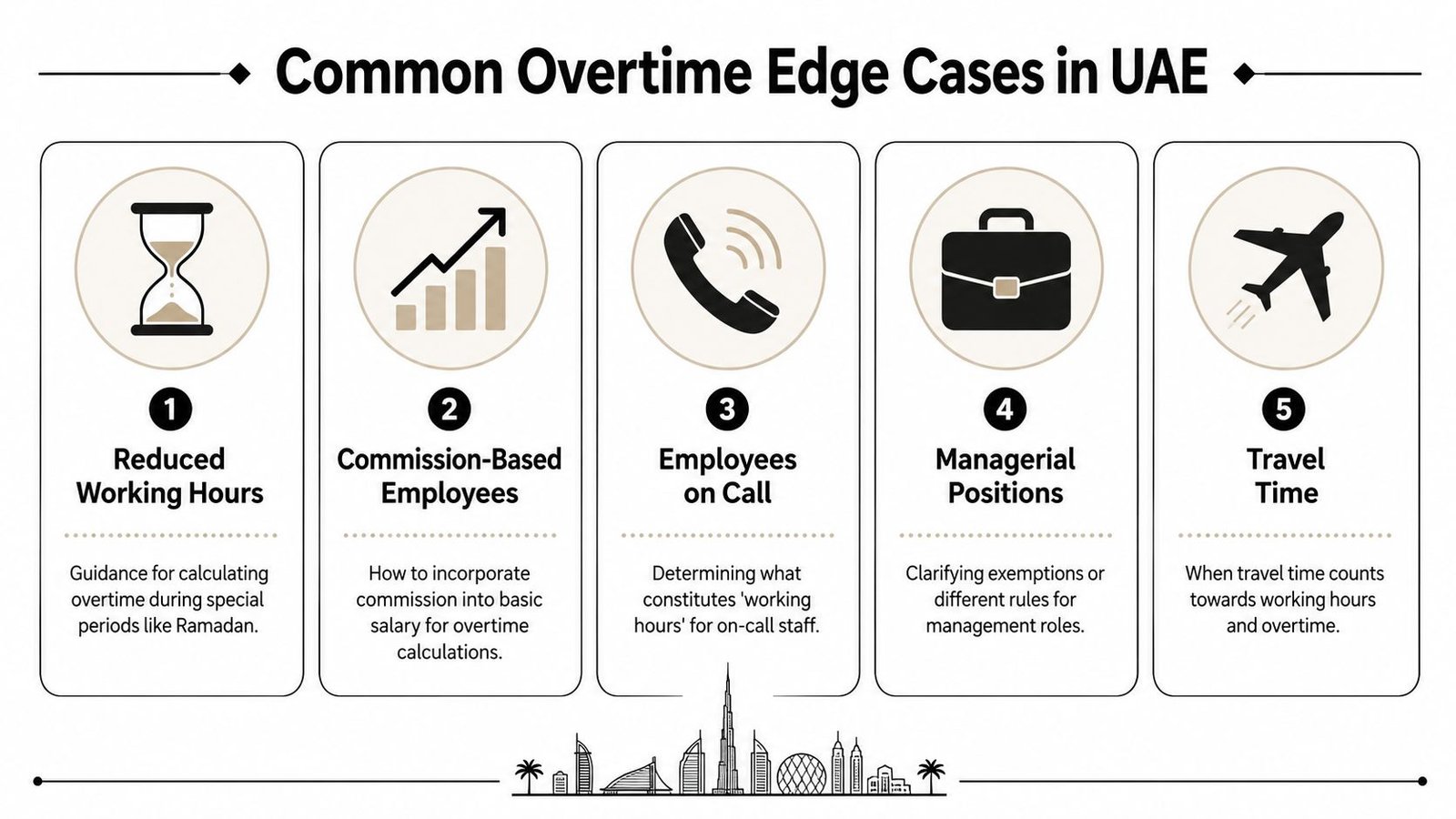
- Managerial roles: Some senior employees may be treated differently in practice, but don't assume a job title alone makes someone overtime-exempt. Review the role, authority, and contract wording.
- Reduced working hours periods: If working-hour rules change for a special period, don't recycle your ordinary monthly overtime template without checking whether the normal-hours baseline also changed for that period.
- On-call time: Being available isn't always the same as actively working. Your policy should define what counts as work and what evidence payroll needs.
- Travel time: Site travel, client visits, and inter-emirate movement can create disputes if nobody records when work started and ended.
What doesn't work is letting line managers decide these issues informally after the fact. What works is a written policy that says who approves exceptional hours, what documents count as evidence, and when HR must review a schedule before payroll closes.
What Does a Payroll Entry for Overtime Look Like
A good overtime record should let someone else understand the payment without asking follow-up questions. If finance, HR, the employee, or an auditor reads the line, they should be able to trace the overtime back to the employee's basic salary and approved hours.
Which columns should a payroll sheet include
For a small company, a spreadsheet is often enough if it is structured properly. For a larger employer, the same logic should sit inside payroll software.
Keep the columns separate. Don't merge all overtime into one amount. That hides the reason for the payment and makes checking harder.
A simple structure is:
- Employee: Full name or employee ID
- Basic Salary (AED): Contractual basic salary only
- Hourly Rate (AED): Derived from the basic salary
- Standard OT Hours: Approved ordinary overtime hours
- Standard OT Pay (AED): Overtime paid at the standard uplift
- Night OT Hours: Approved overtime hours falling in the late-night window
- Night OT Pay (AED): Overtime paid at the higher night uplift
What does a simple payroll table look like
Here is a clean template you can reproduce in Excel, Google Sheets, or your payroll platform.
| Employee | Basic Salary (AED) | Hourly Rate (AED) | Standard OT Hours | Standard OT Pay (AED) | Night OT Hours | Night OT Pay (AED) |
|---|---|---|---|---|---|---|
| Employee A | ||||||
| Employee B | ||||||
| Employee C |
The point of this layout isn't design. It's control. Separate columns force the person preparing payroll to think about classification before payment.
If you want one extra safeguard, add an internal notes column outside the employee payslip view. Use it for manager approval references, shift records, or the reason overtime was required. That small habit saves time when someone asks questions months later.
How Can I Ensure My Business Is Compliant
Compliance isn't just about avoiding a payroll argument. It's about building a system that still works when your team grows from a few employees to a real operation across the UAE.
What should I audit first
Start with the documents that drive the calculation. If they're unclear, every payroll run after that carries risk.
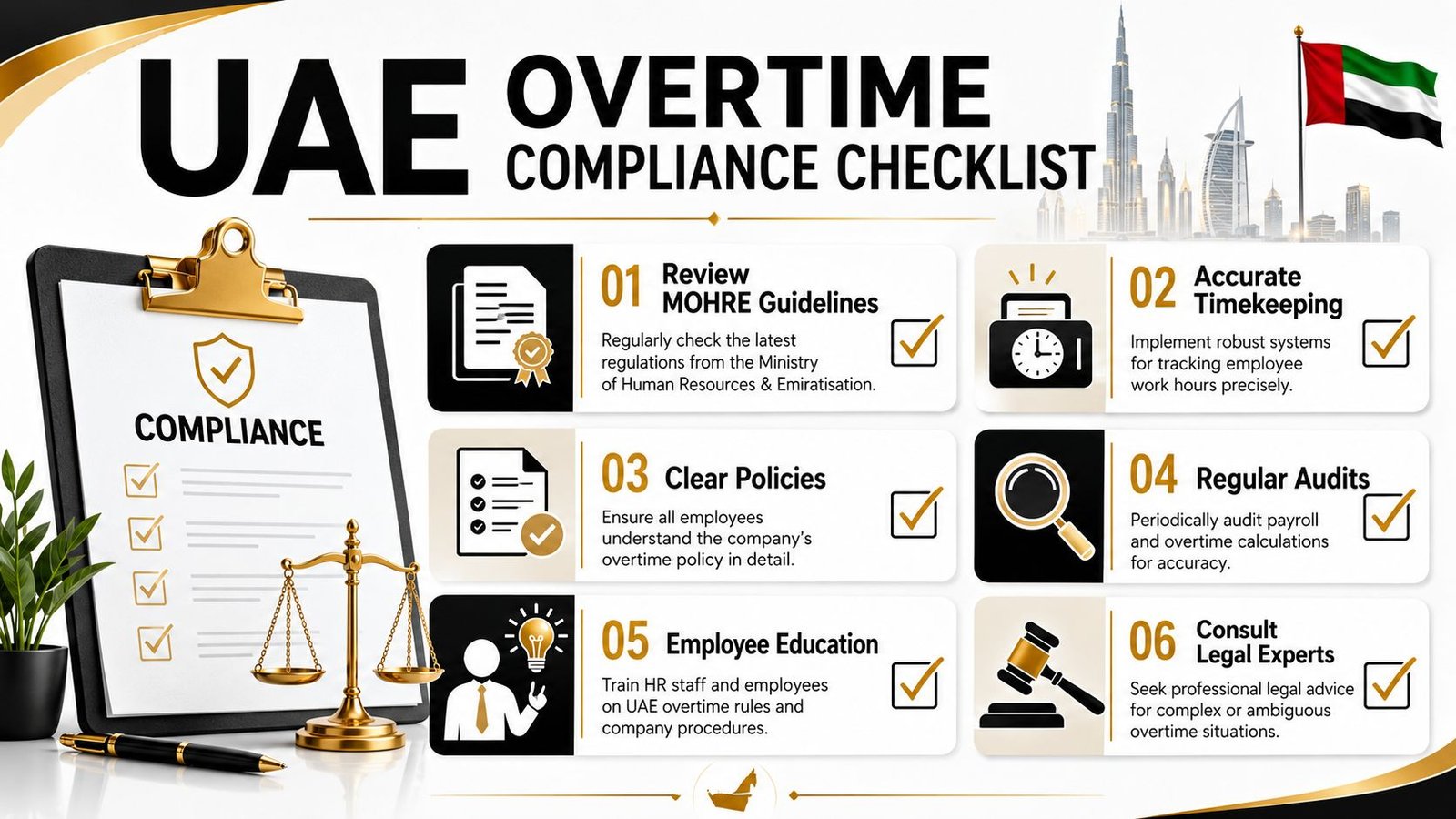
Use this checklist:
- Check contracts: Is basic salary clearly separated from allowances in every employment contract?
- Check timekeeping: Are actual working hours recorded in a way HR can verify?
- Check approvals: Does someone approve overtime before payroll is processed?
- Check rate logic: Does payroll separate standard overtime from late-night overtime?
- Check exceptions: Are split shifts, unusual schedules, and rest-day work reviewed instead of guessed?
If one of those answers is “not always”, that's the problem to fix first.
What habits keep payroll clean over time
The strongest payroll systems are repetitive by design. Same form. Same approval path. Same calculation logic every month.
A few habits make a real difference:
| Habit | Why it helps |
|---|---|
| Written overtime policy | Managers stop inventing their own rules |
| Clean salary structure | Payroll uses the correct base automatically |
| Monthly reconciliation | Errors are caught before they become a pattern |
| Central record storage | HR can answer disputes quickly |
Good compliance feels dull. That's usually the sign it's working.
For founders, this is often the right mindset shift. Overtime isn't only an HR issue. It sits at the intersection of contracts, attendance, payroll, and labour compliance. If one piece is weak, the rest won't stay tidy for long.
If you're setting up a team in Dubai, Abu Dhabi, Sharjah, or anywhere else in the United Arab Emirates and want a second pair of eyes on contracts, payroll setup, or employee compliance, speak with Inpro Corporate Services L.L.C.. The team can help you build a cleaner setup from the start so overtime, visas, and HR administration don't become bigger problems later.