


Overtime pay in the UAE is calculated from an employee's basic salary, not total salary. Regular overtime is paid at 125% of the normal hourly rate, while work on a rest day or public holiday is generally paid at 150% of the normal hourly rate, depending on whether substitute leave is given.
If you're a founder or HR manager, this usually becomes urgent at the worst time. Payroll is due, someone stayed late to finish a client deliverable, another team member worked on a weekly off-day, and now you need to know what must be paid, what can be given as time off, and how to record it properly. The good news is that how to calculate overtime in UAE payroll is manageable once you separate the legal rule, the math, and the record-keeping.
Table of Contents
- The Legal Foundation for UAE Overtime Pay
- The Core Overtime Calculation Formula
- Calculating Different Overtime Scenarios with Examples
- Integrating Overtime into Your Payroll and Records
- An Employer's Compliance Checklist for Overtime
- Need Help with Your UAE Payroll and Compliance
The Legal Foundation for UAE Overtime Pay
A common problem starts on payroll day. An employee says they stayed late all week, the line manager approved it on WhatsApp, and finance is unsure which rate applies or even which salary figure to use. At that point, overtime stops being an HR admin task and becomes a compliance issue.
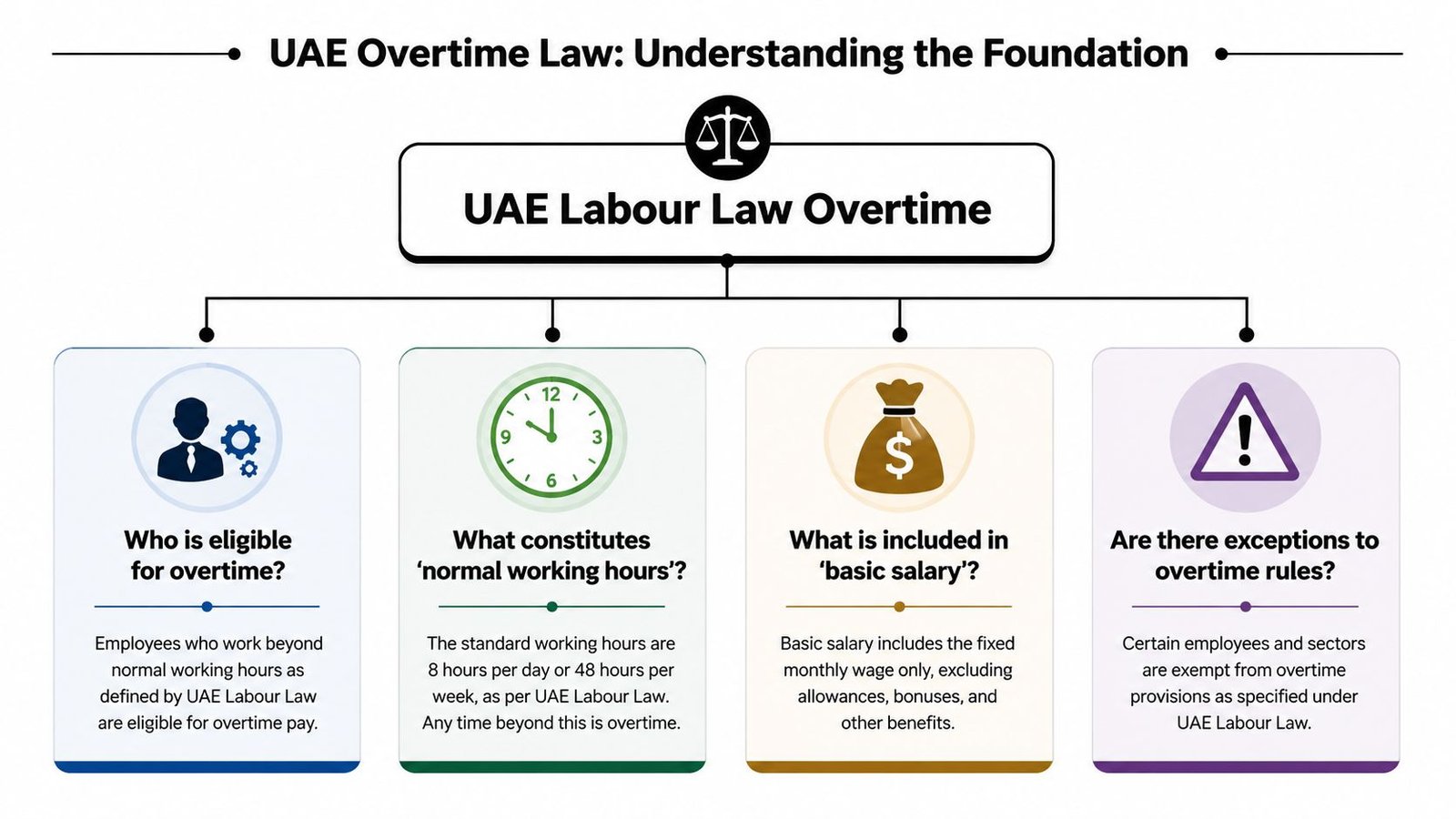
In the UAE private sector, overtime is governed by labour law. It should be handled through a clear policy, accurate attendance records, and payroll settings that use the correct salary base. As noted earlier, the legal baseline is standard daily and weekly working hours, limits on extra hours in normal circumstances, and higher pay rates for specific overtime situations.
Standard Working Hours in the UAE
The starting point is the employee's normal working schedule. For most private-sector roles, the legal standard is 8 hours per day or 48 hours per week. Overtime only begins after the employee passes that threshold, subject to the rules that apply to their role and work pattern.
Many employers create avoidable disputes. The contract says one thing, the shift roster shows another, and the attendance system is set up a third way. If those three records do not match, payroll errors follow.
Set one clear standard and use it everywhere:
- Employment contract: State the normal working hours clearly.
- Attendance system: Match the contracted schedule exactly.
- Manager approvals: Require overtime approval against the same daily threshold.
- Payroll rules: Trigger overtime only after the recorded standard hours are exceeded.
That setup sounds basic, but it prevents most of the problems I see in first-time payroll reviews.
The Main Regulatory Body for Labour Issues
The Ministry of Human Resources and Emiratisation, or MOHRE, is the main labour authority for most mainland private-sector employers in the UAE. If a dispute arises over hours, pay, or recordkeeping, your process needs to stand up to scrutiny.
In practice, that means overtime should never rely on memory, informal chat approvals, or a spreadsheet maintained by one person. A defensible process usually includes attendance logs, manager approval, payroll calculation logic, and payslips that show overtime as a separate item. If one part is missing, the whole record looks weak.
Free zone employers may have separate frameworks in some jurisdictions, but mainland employers should build their process with MOHRE expectations in mind from the start.
Defining Basic Salary in the UAE
For overtime purposes, basic salary is the figure that matters. It does not mean full gross salary, total package value, or cost to company. Allowances such as housing, transport, and similar benefits are treated separately unless a specific rule says otherwise.
This point causes more payroll mistakes than the formula itself. A founder sees an employee earning a monthly package, asks finance to apply overtime to the full amount, and the business either overpays or applies inconsistent logic across the team. Both create risk.
The practical fix is straightforward:
- Check the contract: Basic salary must be listed separately from allowances.
- Check payroll mapping: The overtime calculation should pull from the basic salary field only.
- Check the payslip: Overtime should appear as a distinct line item, not buried inside gross earnings.
If your current contracts do not separate basic salary cleanly, correct that first. It is much easier to fix the contract and payroll setup now than to recalculate months of overtime later.
The Core Overtime Calculation Formula
A common payroll problem starts like this. HR approves extra hours, finance pulls the wrong salary field, and the payslip shows an overtime figure that no one can explain later. The formula itself is simple. Applying it correctly, every time, is where employers usually slip.
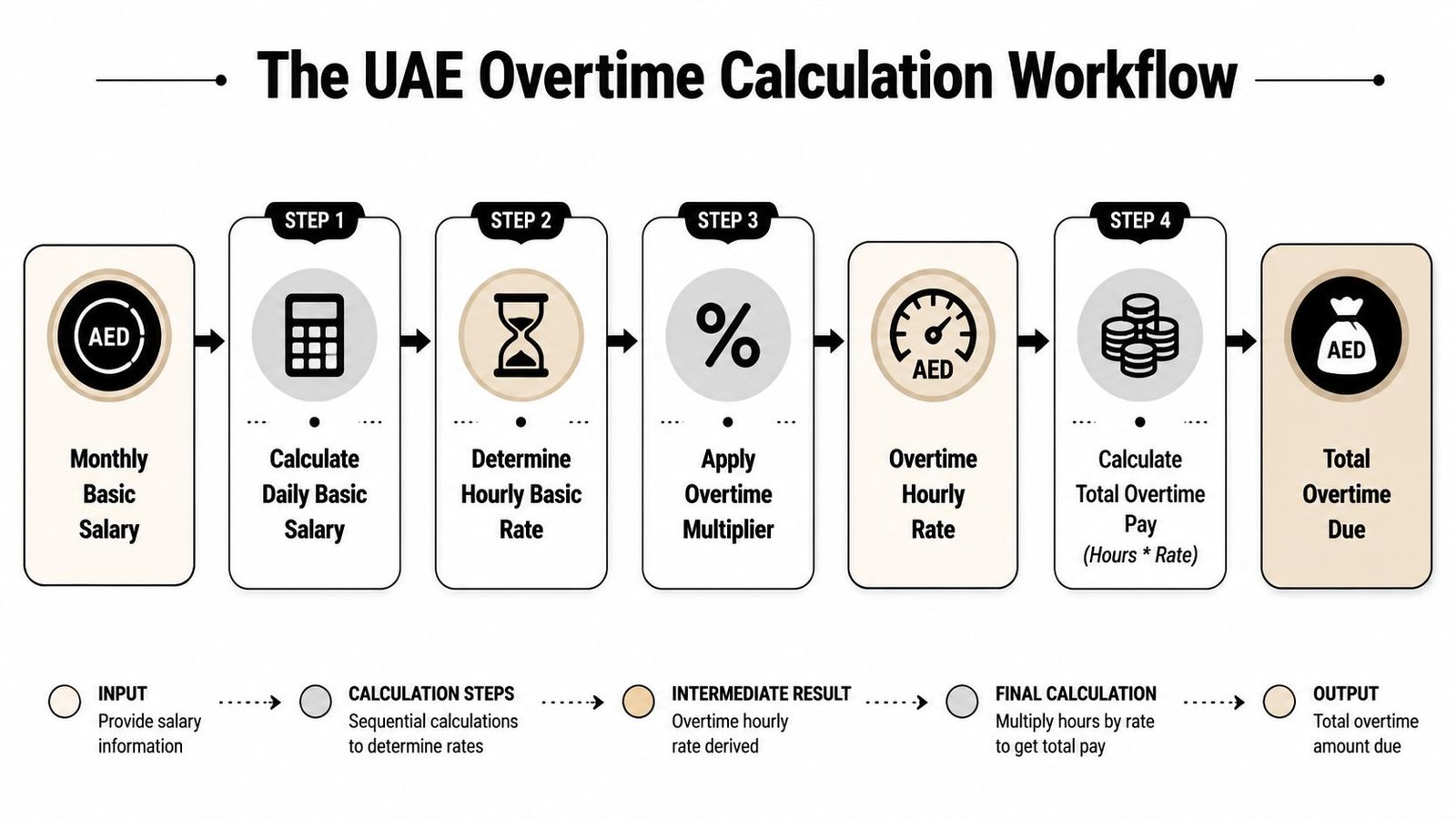
For UAE payroll, the working method is to convert the employee's basic monthly salary into a daily rate, then an hourly rate, and then apply the correct overtime multiplier for the type of overtime worked. That is the structure reflected in this UAE overtime calculation guide.
The Standard Hourly Rate Formula
Use this sequence in payroll:
- Basic monthly salary ÷ 30 = daily basic salary
- Daily basic salary ÷ 8 = basic hourly rate
- Basic hourly rate × overtime multiplier = overtime hourly rate
- Overtime hourly rate × approved overtime hours = total overtime due
This method gives payroll a repeatable rule. It also makes audit checks easier because each step can be traced back to the employee's contract, attendance record, approval trail, and payslip.
The practical point is consistency. If one employee's overtime is calculated from basic salary and another employee's is calculated from gross package, the issue is not just overpayment or underpayment. It is an inconsistent payroll rule that becomes difficult to defend.
Using Basic Salary vs. Total Salary
Use the basic salary only.
That sounds obvious until payroll is under pressure at month-end. A founder sees a total monthly package, finance exports gross earnings from the system, and overtime gets applied to the wrong base. I see this mistake often in smaller businesses that set up payroll quickly and only review the structure after the first staff dispute.
A simple control helps. Check whether your payroll formula is mapped to the employee's basic salary field, not total salary, gross salary, or cost-to-company. If the formula depends on allowances being included, the setup needs to be corrected.
A Worked Basic Hourly Rate Example
Take an employee with a basic salary of AED 3,500.
Using the standard formula:
| Item | Calculation |
|---|---|
| Daily basic salary | AED 3,500 ÷ 30 = AED 116.67 |
| Basic hourly rate | AED 116.67 ÷ 8 = AED 14.58 |
| Regular overtime rate | AED 14.58 × 1.25 = AED 18.23 |
| Off-day or holiday rate | AED 14.58 × 1.5 = AED 21.88 |
This is the kind of table I recommend building directly into your payroll sheet or system rule. It reduces manual edits and gives HR a clean figure to verify before payroll is released.
Two implementation points matter here. First, only count approved overtime hours. Second, keep the multiplier separate from the base rate in your payroll setup so finance can apply the right rate for each overtime category without rewriting the formula each month.
Here's a short explainer if your team wants a visual walkthrough before building the formula into payroll.
Calculating Different Overtime Scenarios with Examples
A common payroll problem starts like this. An employee stays late on Thursday, another covers a public holiday event, and a third works part of a night shift. Finance receives three extra-hour entries and applies one overtime rate to all of them.
That is how errors happen.
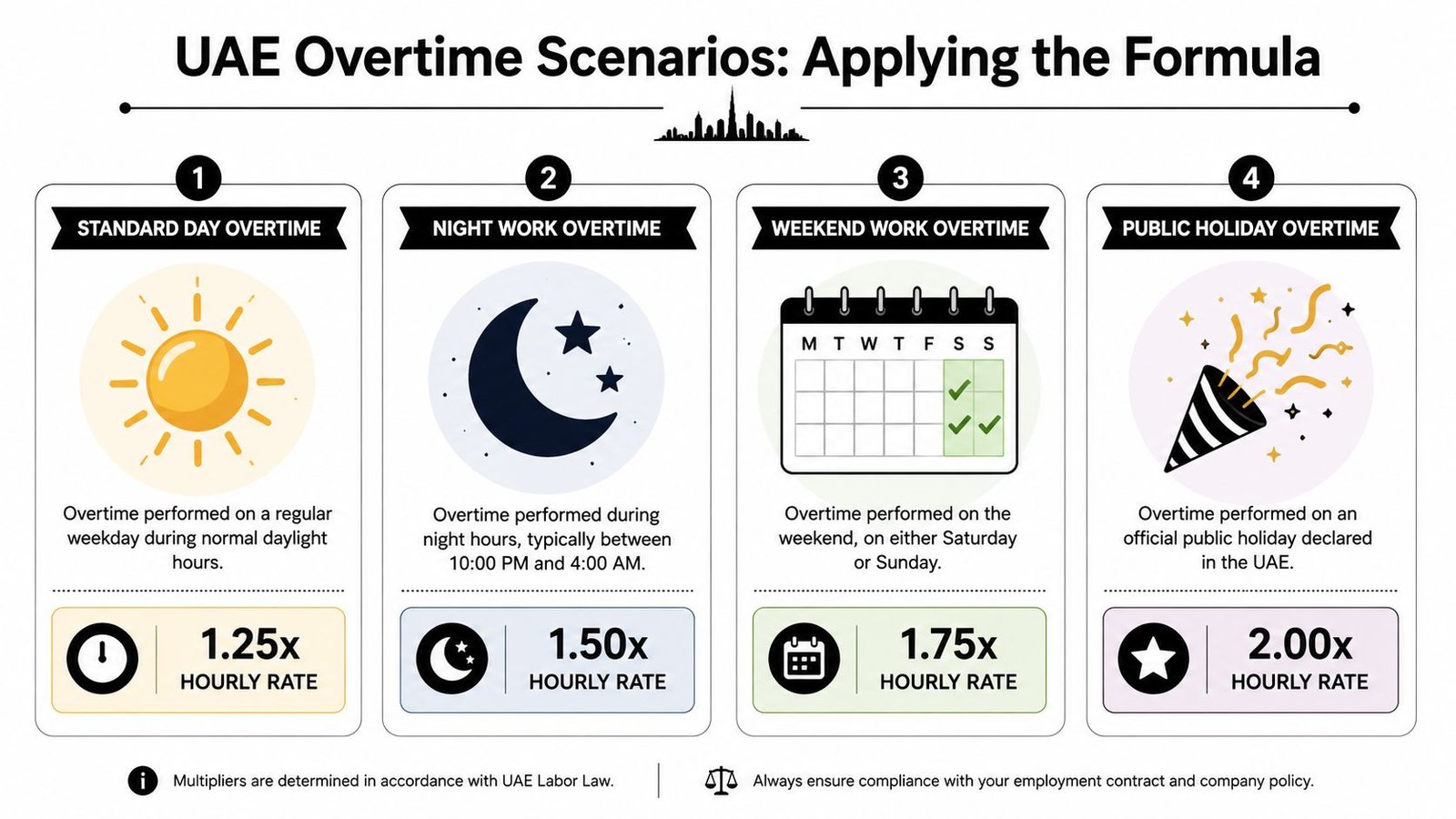
Overtime in the UAE is straightforward only after the hours are classified correctly. The practical rule for employers is simple: identify the overtime type first, then apply the rate, then keep the approval record with the payroll entry. If you reverse that order, payroll teams end up fixing disputes after salaries are released.
Standard Daytime Overtime
This is the overtime category businesses use most. It applies when an employee works beyond normal working hours on a regular working day.
The payroll treatment is direct:
- Use the employee's basic hourly rate.
- Apply the ordinary overtime multiplier of 1.25.
- Multiply that figure by the approved overtime hours.
Using the earlier worked example, if the employee's basic hourly rate is already on file, payroll only needs to apply the multiplier and the approved hours. For 2 hours of standard overtime:
| Item | Calculation |
|---|---|
| Basic hourly rate | AED 14.58 |
| Overtime rate | AED 14.58 × 1.25 = AED 18.23 |
| Total overtime pay | AED 18.23 × 2 = AED 36.46 |
The formula is usually not the problem. Approval is. I see disputes more often from missing manager sign-off, unclear attendance records, or overtime entered under the wrong category.
Night Work Overtime
Night overtime needs closer review because the timing and employee category both matter. Where the overtime falls between 10 pm and 4 am, the rate may rise to 150% of the basic hourly rate. That treatment does not apply in the same way to shift workers, so employers should not assume every late-hour record gets the higher multiplier.
For payroll control, line managers should label night overtime before the file reaches finance. Do not leave payroll staff to infer it from check-in and check-out times.
For example, with the same basic hourly rate of AED 14.58, 3 hours of qualifying night overtime would be calculated like this:
| Item | Calculation |
|---|---|
| Basic hourly rate | AED 14.58 |
| Night overtime rate | AED 14.58 × 1.5 = AED 21.87 |
| Total night overtime pay | AED 21.87 × 3 = AED 65.61 |
The trade-off here is speed versus accuracy. A fast manual process may get payroll closed on time, but if your business runs late operations, warehousing, support, or hospitality functions, a separate night-overtime code in the payroll system saves rework later.
Working on a Rest Day
A rest day is the employee's scheduled off-day under the contract, roster, or approved work pattern. If the employee works on that day, the employer generally needs to provide either a substitute rest day or pay at the applicable enhanced rate.
Smaller companies often face problems here. The manager approves the work, but nobody confirms whether a replacement day off will be given. HR expects time off in lieu. Finance expects overtime pay. The employee expects both unless the record is clear.
Use a decision process like this:
| Situation | Practical handling |
|---|---|
| Employee works on official rest day and will receive substitute leave | Record both the worked day and the replacement rest day in the same approval trail |
| Employee works on official rest day and no substitute leave is planned | Apply the off-day overtime rate in payroll |
| Roster, schedule, or contract is unclear | Resolve the employee's actual rest day before payroll is processed |
For 2 hours worked on a rest day, using the earlier hourly rate:
| Item | Calculation |
|---|---|
| Basic hourly rate | AED 14.58 |
| Rest-day rate | AED 14.58 × 1.5 = AED 21.87 |
| Total pay for 2 hours | AED 21.87 × 2 = AED 43.74 |
From an operational perspective, substitute leave can reduce immediate payroll cost, but it creates a second scheduling obligation. For lean teams, paying correctly and documenting it cleanly is sometimes the lower-risk option.
Public Holiday Work
Public holiday work should be treated with the same discipline as rest-day work, but with tighter documentation. Holiday work tends to create complaints because employees remember it clearly and expect the payroll result to match what was discussed.
A clean process includes three checks:
- confirm the employee worked on the public holiday
- confirm whether a substitute day off will be granted
- confirm the payroll treatment before salary processing
For a practical example, if an employee with a AED 14.58 basic hourly rate works 4 hours on a public holiday and the enhanced rate applies, payroll would calculate:
| Item | Calculation |
|---|---|
| Basic hourly rate | AED 14.58 |
| Holiday work rate | AED 14.58 × 1.5 = AED 21.87 |
| Total holiday pay | AED 21.87 × 4 = AED 87.48 |
The safest control is one approval form for both rest-day and holiday work. Include a mandatory field asking whether substitute leave will be provided. Without that field, payroll is guessing, and guessing is what creates avoidable disputes.
Ramadan Hours and Overtime Thresholds
Ramadan changes the working-hours threshold, so overtime can begin earlier than your system usually expects. That is where payroll errors appear. The formula may still be correct, but the trigger point for overtime is different.
As noted earlier, reduced Ramadan working hours affect when extra time becomes payable. Employers should update attendance rules, shift patterns, and manager approval guidance before Ramadan starts. If the attendance system keeps the normal daily threshold, the overtime report can be wrong for the whole month.
This matters most for businesses with fixed schedules in retail, customer support, clinics, and onsite operations. A short pre-Ramadan payroll check usually prevents a long correction exercise after salaries are issued.
Integrating Overtime into Your Payroll and Records
A correct overtime figure is only half the job. The other half is being able to show how you reached it.
Many otherwise organised businesses in the UAE encounter difficulties with information silos. The founder understands the law, HR understands attendance, and finance understands payroll, but each team stores its part in a different place. When an employee asks a question, nobody has one clean record.
What should an overtime entry in my payroll system include
A proper overtime entry is a payroll record that shows the reason, timing, and rate used for overtime pay. Keep it simple and auditable.
Your payroll entry should include:
- Employee identity: Use the employee name or internal employee number exactly as it appears in payroll.
- Work date: Record the actual date the overtime happened.
- Approved hours: Enter only the hours that were approved after attendance review.
- Overtime type: Mark whether it was regular overtime, night work, or rest-day or holiday work.
- Calculation basis: Show that the rate came from the employee's basic salary.
- Approval trail: Keep the manager or authorised approver attached to the record.
This doesn't need expensive software to work. A well-structured payroll system or even a tightly controlled workflow in your HR platform can do the job if the fields are mandatory and consistent.
How should overtime be reflected on a payslip
A payslip is the employee-facing record of what was paid in that payroll cycle. If overtime is buried inside a generic earnings line, employees won't understand it and finance will spend time answering avoidable questions.
A cleaner payslip shows:
- Basic salary as a separate line
- Overtime pay as a separate line
- Any substitute leave arrangement handled in attendance and leave records so the payroll treatment matches
The point isn't cosmetic. It's transparency. When staff can see that overtime was calculated from the correct pay component and listed separately, disputes usually become easier to resolve because the discussion starts with visible records, not assumptions.
Good payroll records don't just satisfy compliance. They reduce friction between HR, finance, and employees.
What records do I need to keep for MOHRE
For most mainland private-sector employers, MOHRE is the authority that matters for labour records. You should keep documents that show the employee's agreed salary structure, the normal working schedule, the attendance data, the overtime approval, and the final payroll output.
In practical terms, keep these records aligned:
| Record type | Why it matters |
|---|---|
| Employment contract | Confirms the basic salary and employment terms |
| Attendance logs | Shows whether extra hours were actually worked |
| Overtime approvals | Proves the overtime was authorised |
| Payroll register | Shows how the pay was processed |
| Payslip copy | Shows what the employee received |
If one of these says one thing and the others say something else, that mismatch is where problems start. Most overtime disputes aren't caused by the formula. They're caused by inconsistent records.
An Employer's Compliance Checklist for Overtime
Once payroll is running, the main risk isn't forgetting the formula. It's drifting into habits that seem reasonable but don't hold up under scrutiny.
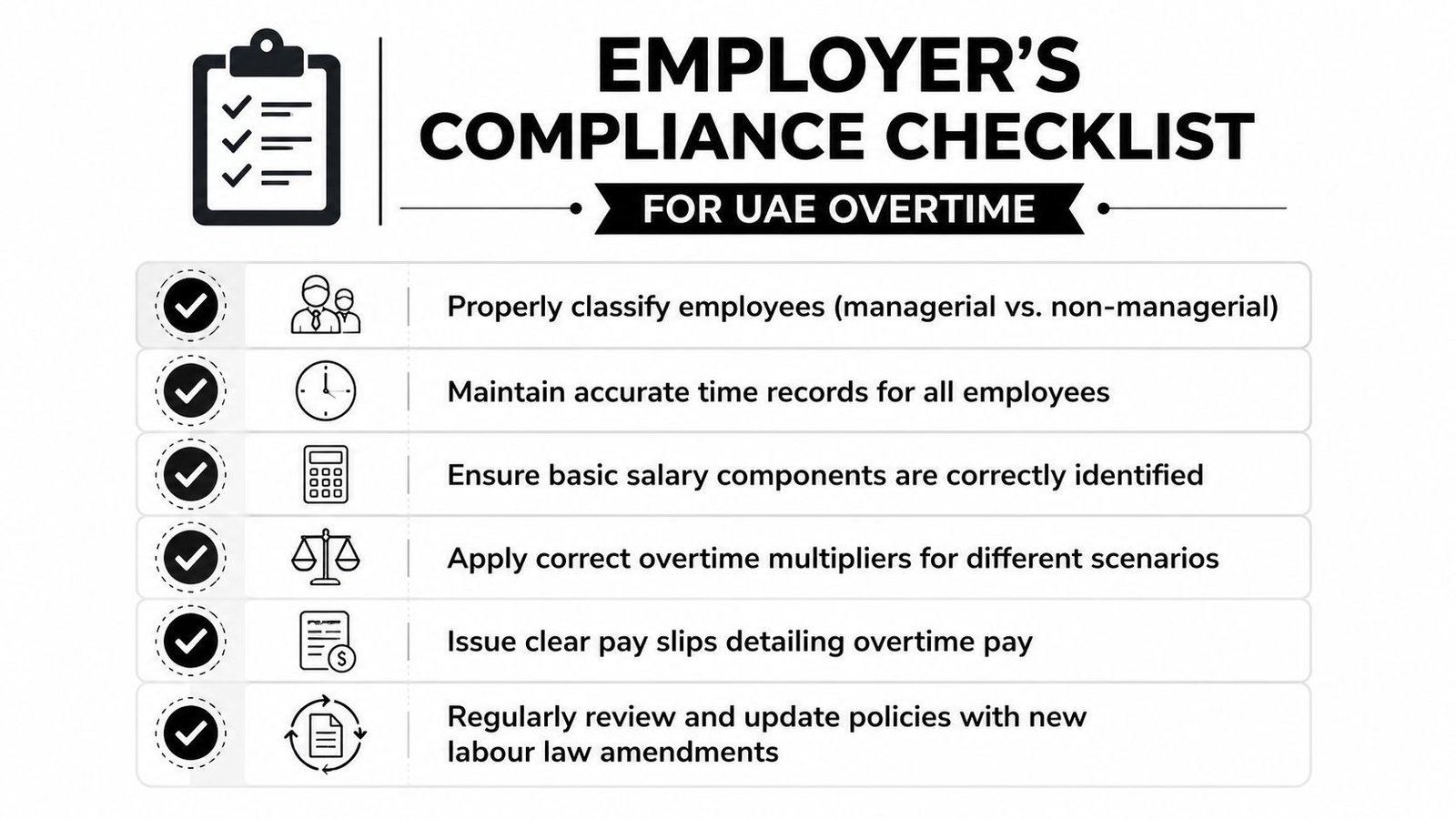
The businesses that stay out of trouble usually do three things well. They classify employees carefully, they decide in advance how time off in lieu will work, and they don't assume every UAE jurisdiction follows the same labour framework.
Are all employees eligible for overtime pay
Not every role is always treated the same way in practice. Some senior or supervisory positions may be treated differently depending on the employee's role, authority, contract structure, and the applicable legal framework.
That's why a founder shouldn't make overtime decisions purely from job titles. “Manager” on a business card doesn't settle the issue. What matters is the actual nature of the role and the rules that apply to that business setup.
A cautious approach is better than an optimistic one:
- Check the employment contract: It should match the actual function of the role.
- Review the reporting authority: Real managerial authority matters more than a title.
- Document your rationale: If you treat a role differently, record why.
Can I offer a day off instead of payment
Yes, in some cases the law allows a substitute rest day instead of the cash treatment that would otherwise apply for work on an official off-day. The key issue is consistency and documentation.
What doesn't work is an informal promise such as “take a day sometime next month.” That creates confusion for leave tracking, payroll, and team planning. If you're going to give a substitute day off, record it with the worked day, the approved replacement day, and the manager approval in one place.
What are the rules in free zones like DIFC or ADGM
The Dubai International Financial Centre and the Abu Dhabi Global Market are financial free zones with their own legal frameworks. If your company is based there, or if the employee is employed under those frameworks, don't assume the mainland private-sector rule applies in exactly the same way.
This is one of the biggest practical traps for international founders. They hear “UAE labour law” and assume one uniform system across every setup in the United Arab Emirates. In reality, jurisdiction matters. If your company sits in a free zone, check the employment framework that governs that zone before copying a mainland payroll rule.
If your company has staff across mainland and free-zone entities, don't force one overtime policy onto everyone without checking the governing employment framework first.
The Employer's Quick Compliance Checklist
Run through this list before each payroll cycle that includes overtime:
- Have you identified the employee's basic salary correctly
- Have you confirmed the employee's normal working schedule
- Have you classified the overtime by type before payroll processing
- Have you checked whether substitute leave applies
- Have you recorded manager approval for the extra hours
- Have you shown overtime separately on the payslip
- Have you kept attendance, approval, and payroll records aligned
- Have you checked whether the employee falls under a different jurisdiction or framework
If you can answer yes to each point, your process is usually in good shape. If you hesitate on even one, pause and fix it before payroll is finalised.
Need Help with Your UAE Payroll and Compliance
Overtime isn't hard once the structure is in place, but getting there takes discipline. You need the right salary basis, the right overtime category, a clear approval trail, and payroll records that all say the same thing.
That matters whether you're setting up a new company in Dubai, hiring your first employees in Abu Dhabi, or cleaning up payroll processes across a growing team in the UAE. If you get the basics right early, overtime stays routine instead of becoming a monthly compliance problem.
Not sure where to start? Inpro Corporate Services L.L.C. can help you set up compliant HR, payroll, PRO, and company formation processes in the UAE so your business runs cleanly from day one.