

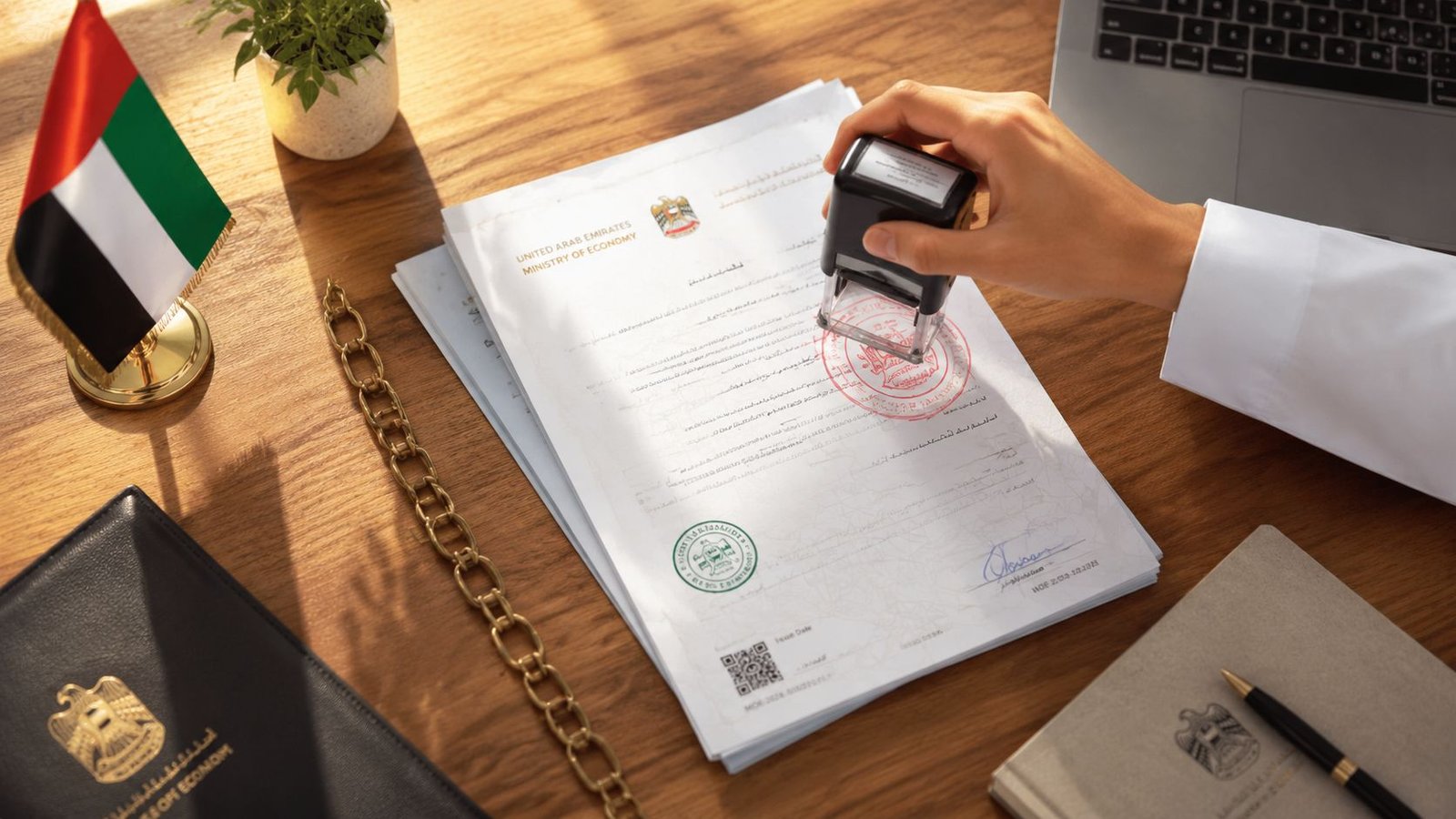
UAE attestation is the mandatory government process of verifying that your foreign documents, like degrees or company papers, are authentic, so they can be legally used in the United Arab Emirates for visas, business setup, or contracts. In practice, it's a multi-stage chain that often starts in your home country and ends with final UAE validation, and the last UAE fee alone is AED 150 per personal or educational document or AED 2,000 per commercial document.
If you're reading this because someone in Dubai, Abu Dhabi, Sharjah, or a free zone just told you your document must be “attested”, you're not dealing with a small admin task. You're dealing with a cross-border compliance workflow. For founders, HR teams, freelancers, and Golden Visa applicants, the core challenge isn't just getting a stamp. It's managing sequence, timing, couriers, and document quality without losing weeks to preventable rejection.
Table of Contents
- What Are UAE Attestation Services
- The Attestation Workflow Explained
- Which Documents Require Attestation
- Estimating Your Timeline and Costs
- Common Attestation Pitfalls and Delays
- How PRO Services Streamline Your Attestation
- Frequently Asked Questions About UAE Attestation
What Are UAE Attestation Services
UAE attestation services are the steps used to confirm that a document issued in one country is genuine before authorities in the United Arab Emirates accept it. That usually means a government body in the origin country checks it, the UAE Embassy or Consulate abroad legalises it, and then the Ministry of Foreign Affairs inside the UAE gives the final acceptance.
UAE authorities don't rely on your word or on a scanned copy. If you're applying for an employment visa, sponsoring family, registering a company, using a Power of Attorney, or proving qualifications to a regulator, the receiving authority needs a document that has passed through the approved legal chain.
Why does the UAE ask for attested documents
Attestation is a fraud-control system. The Ministry of Human Resources and Emiratisation, known as MOHRE, handles labour regulation and work permit matters. A Department of Economic Development, often shortened to DED, is the local authority that regulates many mainland business licensing activities in each emirate. Bodies like these need documents they can legally trust.
The scale of this work isn't unique to the UAE. In 2025, the global attestation services market was valued at $14.8 billion, and Document Attestation held the largest service share at 34.2%, reflecting how widely this process is used across immigration, legal, and business workflows worldwide, according to Dataintelo's 2025 attestation services market report.
Practical rule: If a UAE authority says a document must be attested, that usually means photocopies, email chains, and self-certified copies won't move your case forward.
When does this become a business problem
For a founder, attestation becomes a project management issue the moment it touches a launch date. One missing university transcript can delay an employee visa. One unlegalised board resolution can slow a banking or licensing step. One mismatch between a passport name and a degree name can send the whole file back for correction.
That's why experienced operators treat attestation as an early workstream, not an end-stage errand.
A calm way to think about it is this:
- For hiring: education and personal records often affect visas, profession-based approvals, and family sponsorship.
- For company setup: commercial documents often sit behind ownership proof, branch registration, and authorised signatory powers.
- For relocation: personal status documents can shape dependent visas, school admissions, and other life-admin tasks in the UAE and United Arab Emirates system.
The Attestation Workflow Explained
A founder usually feels the attestation process when a hire is ready to travel, the visa file is almost complete, and one document is still stuck in its home country. At that point, this is not admin. It is timeline control.
How does the chain of trust work
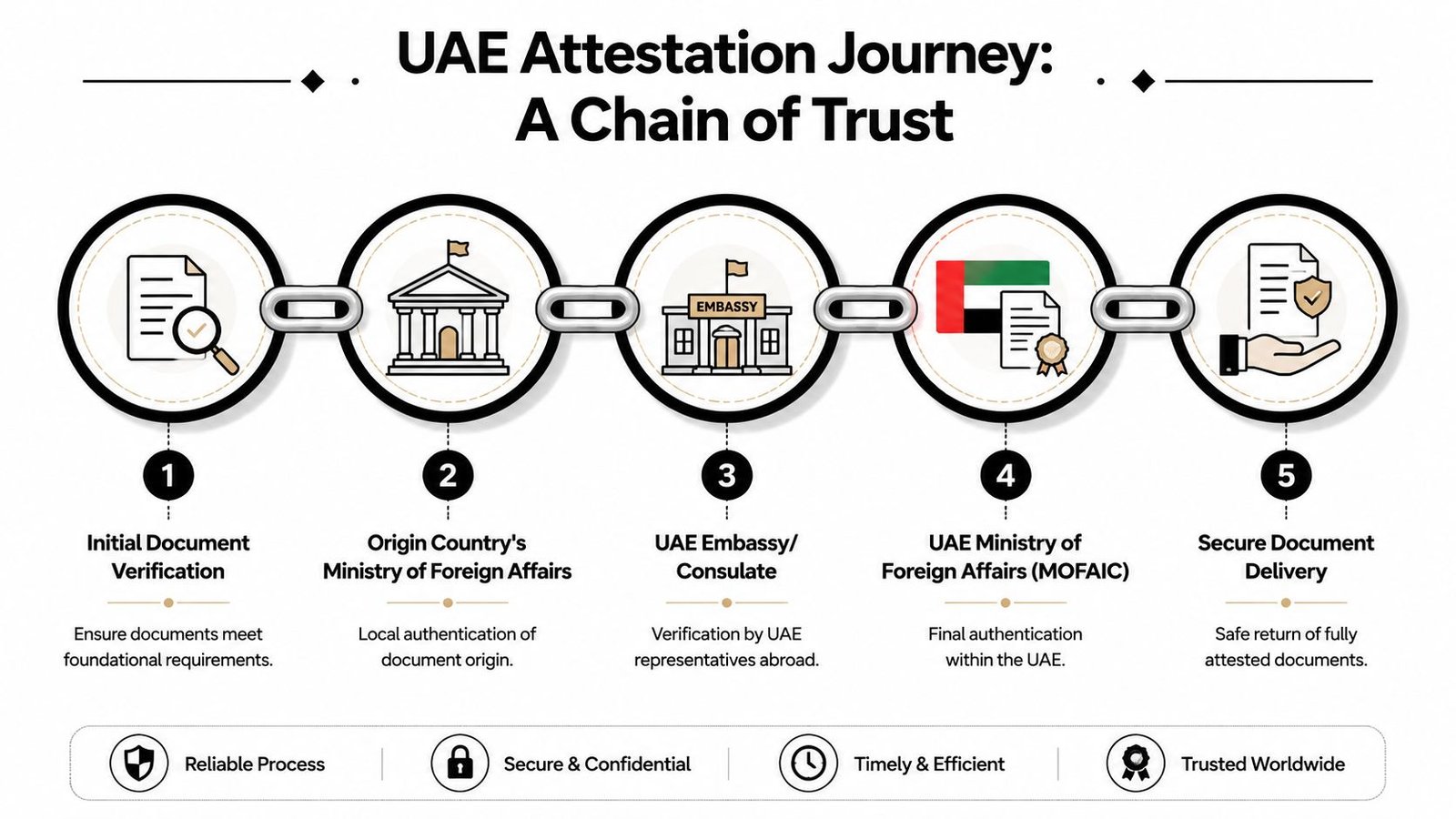
UAE attestation works as a chain of trust. Each office confirms the stamp or signature that came before it. It does not investigate the original event from scratch. If an earlier approval is missing, the next authority usually rejects the file.
The UAE follows a fixed order, and the UAE Ministry of Foreign Affairs attestation service guidance makes that sequence clear. In practice, the path usually looks like this:
Notary or first local certification
Some documents need notarisation or an equivalent first check in the place where they were issued.State or regional authentication
This can be a state department, education authority, court authority, or another competent local body, depending on the document type and country.National foreign affairs authentication
This is usually the national ministry responsible for external affairs or legalisation.UAE Embassy or Consulate legalisation abroad
The UAE mission verifies the government authentication that came before it.Final Ministry of Foreign Affairs attestation in the UAE
This is the last step before many UAE authorities accept the document for official use.
Miss step 3, and step 4 usually becomes wasted time and courier cost.
What does the full end-to-end path look like
From the applicant's side, the process starts well before anything reaches Dubai or Abu Dhabi. The UAE stamp is the final mile. The longer part is often upstream, in the country where the document was issued.
That is the part many founders underestimate.
A degree certificate may first need to be reissued because the old copy is laminated, damaged, or missing a registrar signature. A marriage certificate may need a fresh civil extract because the older version is not accepted for legalisation. If the passport name and certificate name do not match, correction documents may need to travel with the main certificate from the start. Those are not edge cases. They are common delay points.
A practical way to manage the workflow is to treat it like a mini cross-border project:
- Confirm the end use first so you know which documents the UAE authority will ask for.
- Check the origin-country sequence before booking couriers or paying for embassy legalisation.
- Verify name consistency across passport, certificate, and supporting records.
- Allow for physical handling time because many files still move by courier between authorities.
- Keep the UAE step for last because UAE missions usually rely on prior domestic authentication being complete.
Country rules also change. In some jurisdictions, applications move through outsourced centres or revised submission channels rather than directly through the old office route. That is why I tell clients not to rely on forum advice or a process someone used two years ago. Check the current route before the file starts moving.
If you manage attestation this way, the work becomes easier to control. You can spot dependencies early, run document collection in parallel, and avoid the common mistake of treating UAE MOFA as the beginning of the process when it is usually the end.
Which Documents Require Attestation
The short answer is that any foreign document you want to use officially in the UAE may need attestation if a government body, employer, university, bank, court, or licensing authority asks for legal proof of authenticity. The need depends on the purpose, not just the document itself.
Which personal and education papers come up most often
For individuals, two groups appear most often.
Educational documents are common when someone is applying for a job, proving professional qualifications, or supporting a visa file. Typical examples include degrees, diplomas, school certificates, and academic transcripts.
Personal and legal documents usually come up for family and civil status matters. Birth certificates, marriage certificates, divorce papers, police clearances, adoption records, and some medical or guardianship documents can all fall into this category depending on the case.
A frequent mistake is assuming only the “main” certificate matters. In practice, supporting records can matter too. If an authority asks for transcripts, name-change evidence, or an authorisation letter, those supporting papers may become part of the attestation file.
Which commercial documents matter for founders
Commercial documents are the category founders often underestimate. If you're expanding an overseas company into Dubai or Abu Dhabi, appointing a representative, proving corporate ownership, or authorising a signatory, you may need attestation on corporate records issued abroad.
Common examples include:
- Certificate of Incorporation: Used to prove the company exists in its home jurisdiction.
- Memorandum or Articles documents: Used when authorities or counterparties need to review ownership and governance.
- Board Resolution: Often requested when a company authorises a person or a transaction.
- Power of Attorney: Used when one person or entity is authorised to sign or act on behalf of another.
- Commercial invoices or contracts: Sometimes required in cross-border trade and compliance matters.
Commercial papers usually attract closer review because they can create legal authority, financial exposure, or ownership consequences inside the United Arab Emirates.
Common Document Types for UAE Attestation
| Document Category | Primary Purpose | Common Examples |
|---|---|---|
| Educational | Employment, licensing, qualification proof | Degree certificate, diploma, transcript, school certificate |
| Personal and legal | Family visas, civil status, legal use | Birth certificate, marriage certificate, divorce certificate, police clearance, adoption papers |
| Commercial | Business setup, authority, corporate transactions | Certificate of Incorporation, Board Resolution, Power of Attorney, constitutional documents, commercial agreements |
A useful test is simple. Ask yourself, “Will a UAE authority rely on this document to grant a right, issue an approval, or accept a legal fact?” If the answer is yes, attestation may be required.
Estimating Your Timeline and Costs
A founder often starts this process after a deal is already moving. The contract is ready, the visa file is open, or the bank has asked for proof of authority. At that point, the critical question is not merely the UAE step, but how long the document will take to move from the issuing country, through the required home-country certifications, to UAE acceptance without a reset halfway through.
How long should you realistically expect
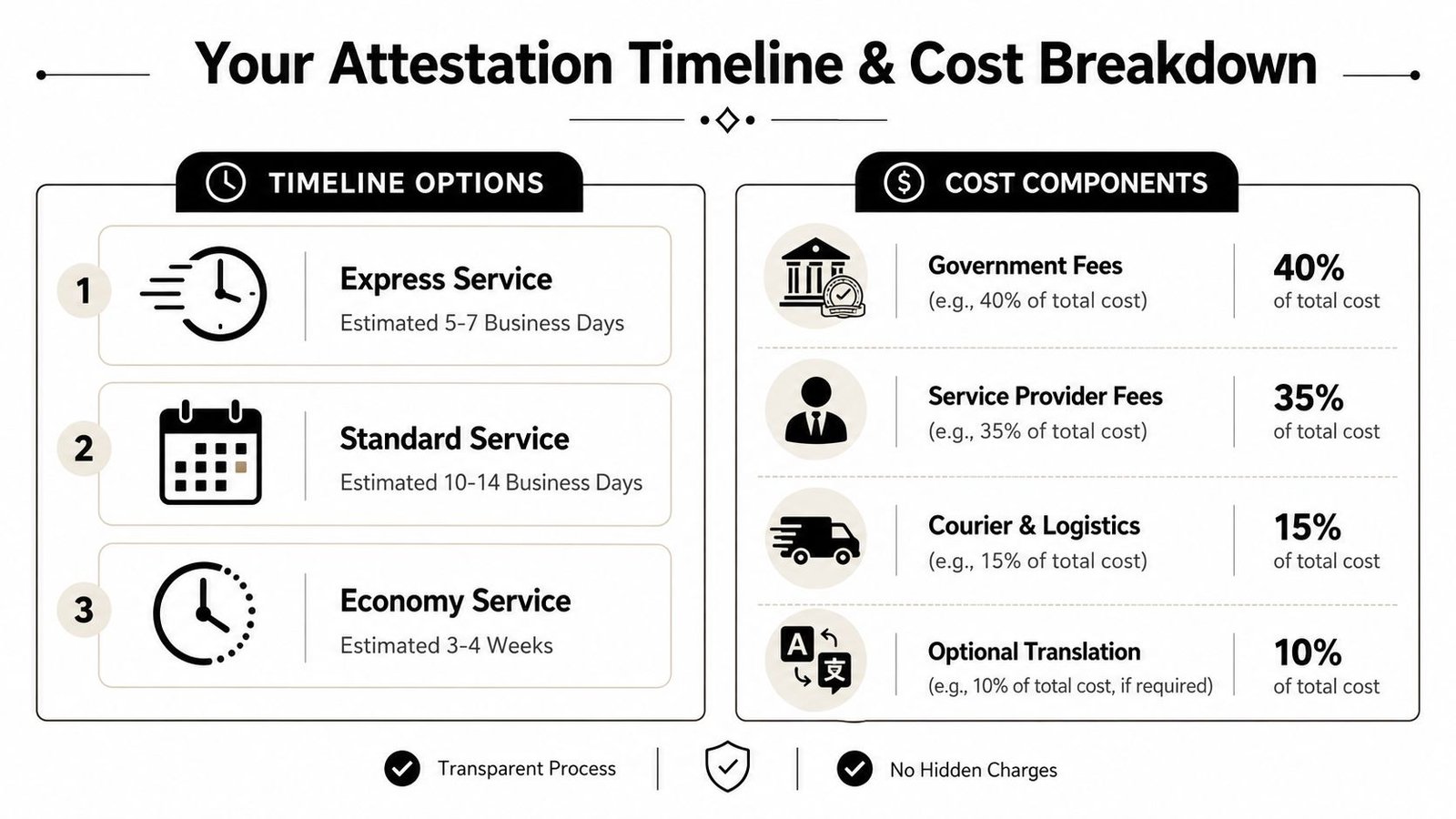
A practical timeline has two parts. First, the origin country work. Second, the UAE finalisation stage.
For U.S. personal and educational documents, official UAE mission guidance puts the full chain at roughly 3 to 6 weeks, as noted earlier in this article. That is a useful benchmark because it reflects the full route, not just the last stamp. In practice, the home-country leg usually takes longer than applicants expect, especially if a notary, state authentication, federal authentication, and embassy legalisation all sit in sequence.
Inside the UAE, the final Ministry of Foreign Affairs stage is often the shortest part if the file arrives properly prepared. One industry summary of current embassy and MOFA handling rules says the standard MOFA channel for foreign-issued documents is usually 3 to 7 working days, assuming the origin-country steps were completed correctly, as outlined in Alhind Attestation's summary of UAE Embassy and MOFA attestation rules.
The service route also changes the clock. Verified service guidance notes that courier-based attestation inside the UAE typically processes in 3 to 5 business days, while courier-based attestation for documents originating outside the UAE can take 10 to 15 business days because documents may need inter-mission checks before final acceptance. The same guidance also distinguishes between digital attestation and courier-based processing, with different operational requirements such as UAE Pass for digital submissions.
From a project management standpoint, the safest way to plan is simple. Treat the origin country stage as the critical path, then add transit time, UAE intake time, and a buffer for rechecks. If the document is tied to a start date, licence issuance, tender submission, or visa appointment, build your schedule backwards from that deadline.
What are you actually paying for
Applicants usually focus on the last UAE fee because it is the easiest number to find. It is only one line in the budget.
According to MOFA fee guidance in the referenced attestation explainer video, the final MOFA fee is AED 150 per personal or educational document and AED 2,000 per commercial document.
The total spend depends on the full chain:
- Origin-country government fees: Notary, state, federal, or ministry authentication charges before the document can even reach the UAE mission.
- UAE Embassy legalisation fees abroad: A separate cost in the issuing country before UAE final attestation.
- Courier and handling costs: International shipping, secure return of originals, and collection charges if a service provider is coordinating the file.
- Translation costs if needed: Some authorities will ask for approved Arabic translation before the document can be used locally.
- Service provider fees: You are paying for coordination, queue management, document review, follow-up, and fixing preventable errors before they become delays.
One trade-off matters here. A cheaper route can cost more if it misses a filing date and forces rebooking, resubmission, or another courier cycle. For straightforward files with flexible timing, standard processing is often fine. For business-critical documents, the better decision is usually the route with fewer handoffs and tighter document checks before submission.
The MOFA fee is fixed. The total project cost changes because the earlier steps depend on the issuing country, document category, shipping route, and whether the file passes cleanly the first time.
Common Attestation Pitfalls and Delays
Most delays don't come from the final stamp. They come from bad inputs. A document that looks fine to the applicant can still fail because the sequence is wrong, the supporting paper is missing, or the authority can't match signatures and seals.

Why do applications get rejected
A verified benchmark from official service guidance is blunt. Approximately 15 to 20% of attestation applications are rejected on initial submission due to insufficient supporting documentation or procedural errors. That figure comes from the validated MOFA service information referenced in the brief's verified data.
The practical causes are familiar:
- Broken sequence: Someone tries to skip a required origin-country step and goes straight to the UAE Embassy or the UAE final stage.
- Name mismatch: The passport says one thing, the degree says another, and there's no supporting legal link between them.
- Missing support documents: Transcripts, authorisation letters, or identity copies are omitted when the file requires them.
- Poor document condition: Laminated, altered, damaged, or unclear originals often trigger refusal or recheck.
- Wrong document version: Applicants submit an old copy when a fresh certificate or reissued extract is required.
One of the harder lessons in this process is that “almost correct” is still rejected.
A file can fail even when the main certificate is genuine. The issue is often the paperwork around it, not the document itself.
What happens if your country has no UAE mission
This is one of the least well-explained problems in public guidance. If your document comes from a country without a UAE Embassy or Consulate, the standard chain becomes less obvious. Applicants are then pushed into “equivalent attestation” questions, and the right route can depend on what MOFA accepts for that document and jurisdiction.
The official direction in the verified data is that MOFA's Call Center at +97180044444 is the official channel for resolving this type of issue. The pain point is that public explanations often stop short of spelling out the exact alternative route, which leaves founders from parts of Southeast Asia, Africa, and Eastern Europe uncertain about the next lawful step.
That's why this situation needs early escalation, not guesswork. If there is no UAE mission in the issuing country, get the route confirmed before you spend time on couriers.
A few checks that save time:
- Confirm mission availability early: Don't assume every country has a direct UAE legalisation path.
- Ask about equivalent attestation: Use official channels first when the standard embassy route isn't available.
- Check supporting documents twice: Rejection often follows from incomplete backup paperwork rather than the main certificate itself.
How PRO Services Streamline Your Attestation
A good PRO service turns attestation from a stressful scavenger hunt into a managed workflow. PRO stands for Public Relations Officer in the UAE business context, but the practical role is government process handling, document coordination, and deadline control.
What does a professional service actually take off your plate
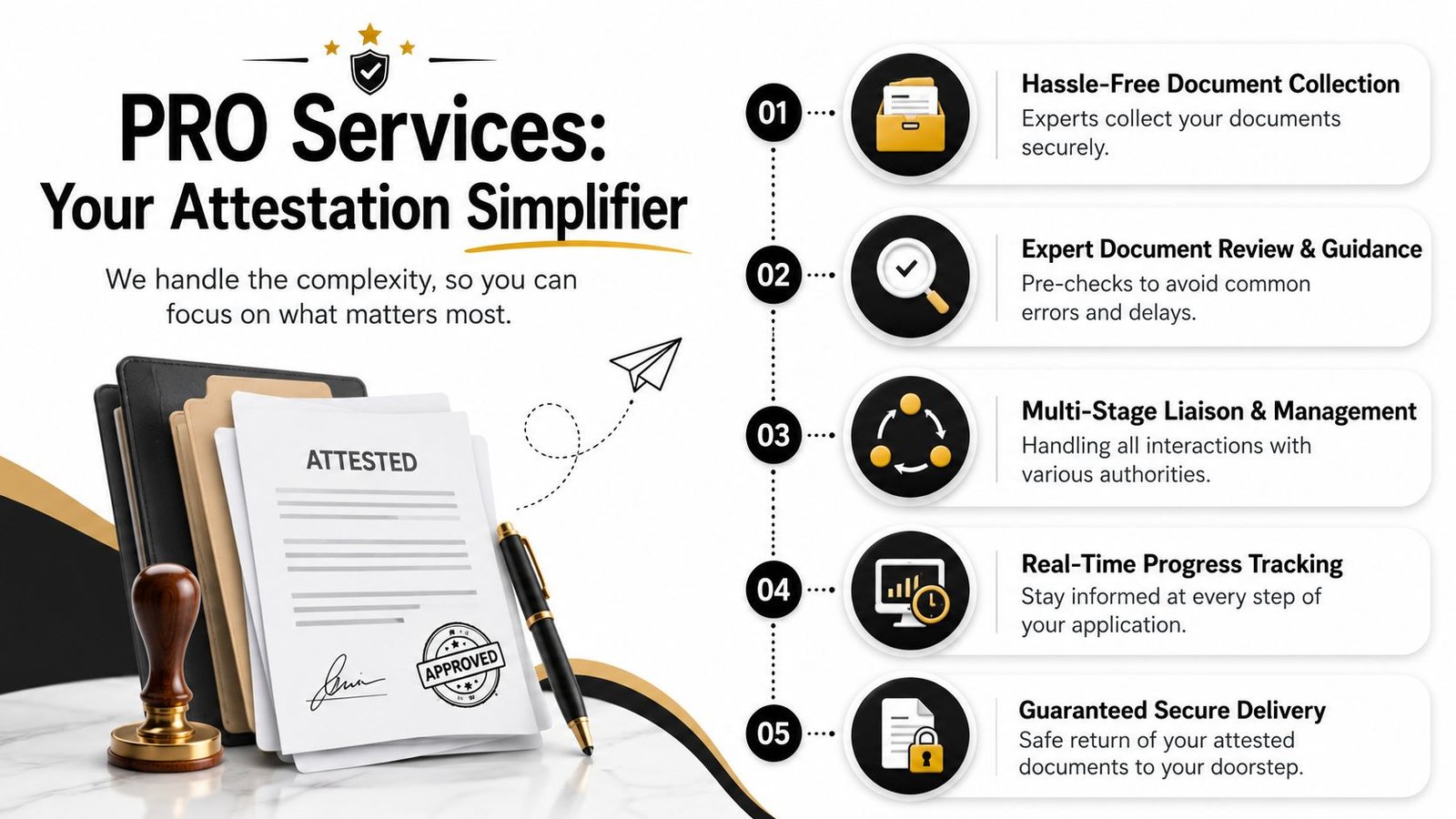
The biggest win is pre-checking. An experienced team reviews the document type, issuing country, intended UAE use, and sequence before anything gets submitted. That reduces the risk of paying courier fees and government fees on a file that wasn't ready.
They also manage the moving parts that consume founder time:
- Document audit: Checking whether the certificate is acceptable in its current form.
- Route planning: Confirming which authority must stamp first in the origin country.
- Courier coordination: Managing physical originals securely between countries and within the UAE.
- Submission handling: Dealing with counters, portals, appointment systems, and collection points.
- Status chasing: Following up when a file stalls at one stage.
For busy HR teams, the value is consistency. Instead of every employee trying to decode a different country process, one managed system keeps records, next steps, and expected handoffs organised.
A short explainer can help if you're comparing DIY and managed support:
When is it smarter to outsource the process
If your file is simple, your timeline is loose, and you're familiar with the issuing country's legalisation system, you may prefer to handle parts of it yourself. That can work.
Outsourcing makes more sense when the document is commercial, the applicant is abroad, multiple employees are involved, or the paperwork has a complication such as a name discrepancy, missing UAE mission, or urgent visa dependency. In those cases, the service isn't just convenience. It's error control.
The best attestation service isn't the one that promises magic speed. It's the one that spots problems before your original documents start travelling.
Frequently Asked Questions About UAE Attestation
Is attestation the same as an apostille
No. Attestation is the legalisation chain used for acceptance in the UAE. An apostille is a different form of international certification used under the Hague Convention system. The UAE process usually requires attestation rather than relying on apostille alone, so applicants shouldn't assume one automatically replaces the other.
Do you need to be in the UAE in person
Usually, no. Many applicants complete large parts of the process from abroad through authorised representatives, couriers, embassies, or service providers. What matters is that the document follows the right legal path and reaches the correct authority in original form when required.
Can you attest laminated or damaged documents
Often, no. Laminated, altered, torn, or unclear originals create problems because authorities need to inspect seals, signatures, and paper integrity. If a certificate has been laminated or damaged, it's often safer to obtain a fresh original or official replacement before you begin.
What should you do first if you're under time pressure
Start with the origin country step, not the UAE final step. Confirm which version of the document is required, whether support papers like transcripts are needed, and which authority must legalise it first. The earlier you catch a sequence issue, the less time you lose.
If you're not sure where your document chain starts, or you need help with business, visa, or commercial paperwork in Dubai, Abu Dhabi, Sharjah, or any UAE free zone, Inpro Corporate Services L.L.C. can help you plan the attestation route before delays stack up. Book a free strategy call and get clear next steps.