


If you're looking into business setup in Dubai right now, you're probably balancing speed, cost, visas, and bank account access all at once. The right path isn't the cheapest licence on day one. It's the structure that still works when you need to invoice clients, hire staff, and pass bank checks a few weeks later.
Table of Contents
- Mainland Free Zone or Offshore Your First Big Decision
- Choosing Your License Activity and Legal Structure
- Your Document Checklist and Setup Timeline
- Securing Visas for Investors Employees and Your Family
- Opening a Corporate Bank Account in the UAE
- Understanding Costs and Ongoing Compliance
Mainland Free Zone or Offshore Your First Big Decision
The first decision in business setup in Dubai is where the company will sit legally. That choice affects market access, ownership, office rules, visa flexibility, banking expectations, and what you can sell inside the UAE.
In 2023, Dubai issued over 100,000 new business licences, which shows how active the market is. The same shift also shows a split in founder priorities: Free Zones remain popular for 100% ownership, while Mainland companies licensed by the Dubai Department of Economy and Tourism (DET) still lead in activities that need direct trade inside the UAE domestic market (verified Dubai licensing data).
What does each jurisdiction actually let you do
Mainland is a company registered to trade in the local UAE market. If you want to open a shop in Dubai, sign local service contracts, or bid for government work, Mainland is usually the cleanest route.
Free Zone is a company registered inside a designated economic zone such as Dubai Multi Commodities Centre (DMCC) or Dubai International Financial Centre (DIFC). Free Zones are often a strong fit for founders serving overseas clients, running consultancy or digital services, or building export-led businesses that want 100% ownership and a simpler launch.
Offshore is a structure for holding assets or carrying out business outside the United Arab Emirates. It isn't built for day-to-day trading inside the UAE, and it often isn't the right choice for founders who need visas, office presence, or a local operating footprint.
| Feature | Mainland | Free Zone | Offshore |
|---|---|---|---|
| Market access | Direct UAE local market access | Usually suited to business within the zone or international activity | Outside-UAE activity |
| Ownership | Depends on activity and structure | Commonly allows 100% foreign ownership | Commonly used for non-operating international structures |
| Office rules | Physical office is normally required | Flexi-desk or office depends on the zone and activity | Not designed as a local operating office setup |
| Best fit | Local trade, retail, contracts, government work | Services, exports, e-commerce, international operations | Holding structures, asset ownership, non-UAE trading |
| Visa pathway | Yes | Yes | Often limited or not suitable for an operating team |
| Banking practicality | Often stronger for local operations | Strong if structure and office choice match the business model | Can be harder for local banking |
How should you choose based on your real business model
Founders often choose a jurisdiction based on the headline price. That's where mistakes start. A low-cost Free Zone package can look perfect until you need more visas, a stronger bank profile, or direct billing into the local market.
Practical rule: Choose the jurisdiction based on where your revenue will come from in the next 12 months, not just where incorporation feels easiest this week.
A few simple patterns usually hold:
- If you're selling inside Dubai or across the UAE, Mainland is usually the safer route.
- If you're serving clients abroad, a Free Zone often makes more sense.
- If you're setting up a holding vehicle, Offshore may fit, but only if you don't need a local operating company.
- If you're building a hybrid model, check the compliance and banking impact before you register anything.
There's also a legal nuance on the Mainland side that many founders miss. For some activities, newer rules allow full foreign ownership. For others, a local sponsor or local service arrangement still matters, especially in older or regulated categories. That isn't a reason to avoid Mainland. It just means the activity list has to be checked properly before anyone drafts documents.
A good setup in Dubai starts with an honest answer to one question: Where will you trade? Get that right, and the rest of the process becomes easier.
Choosing Your License Activity and Legal Structure
Once the jurisdiction is clear, the next step is deciding what the company is legally allowed to do. At this stage, founders often pick a broad label like “consultancy” or “trading” and assume they can sort out the detail later. In the UAE, that approach causes avoidable delays.

What is a licence activity and why does it matter so much
A licence activity is the approved description of what your company can sell, make, advise on, or trade in. Authorities don't license a vague business idea. They license a defined activity list, and your visas, approvals, and bank review often depend on whether that list matches what your company really does.
A legal structure is the legal form of the company itself. Common examples include a Limited Liability Company (LLC), a sole establishment, a branch, or a Free Zone entity structure specific to the authority issuing the licence.
A licence type is the category under which your activities sit, such as commercial, professional, or industrial. If the activity, legal form, and office package don't match each other, the file can move slowly even when the documents look complete.
One issue matters more than most founders expect. In Dubai Free Zones, the choice between a Flexi-Desk and a physical office directly affects licence eligibility and visa allocation. Some zones allow Flexi-Desk options but limit visas to 2 to 3 per licence, and misalignment at this stage causes a visa application rejection rate as high as 50% during medical and biometrics (verified Free Zone visa quota data).
What legal structure usually fits each founder type
If you're a solo consultant, freelancer, or service provider, a professional structure can work well if the activity list is narrow and accurate. If you're launching with partners, planning to hire, or expecting to onboard investors later, an LLC-style structure is often more practical because governance is cleaner.
The appeal of cheap packages can quickly turn into unexpected costs. A founder buys a low-entry Free Zone licence with one desk allocation, then realises the team needs more residency visas, a larger office, or a different activity code. The fix is possible, but it's slower and usually costs more than setting it up properly at the start.
A licence should match your operating model, not your mood on registration day.
Use this filter before you choose:
- Service business with one or two people: A professional or service-led structure may be enough.
- Trading business with stock, suppliers, or local buyers: Check whether commercial activities and Mainland access are required.
- Growing SME: Make sure the office package supports future visa quotas.
- Founder relocating family: Confirm the company can support the residency route you need.
The office decision deserves more attention than it usually gets. In some zones, a Flexi-Desk is fine for a lean start. In others, especially for more established commercial activities, a physical office gives you a cleaner path for visas and later banking. The right answer depends less on what is legally possible and more on what your business will need after the licence is issued.
Your Document Checklist and Setup Timeline
Business setup in Dubai feels manageable once you can see the sequence. Most delays don't happen because the government process is impossible. They happen because founders submit the right documents in the wrong order, or because an office lease, local service paperwork, or legal draft is still pending when the licence application goes in.
What documents do most founders need
For most setups, authorities will ask for a core set of documents early in the process. The exact list changes by activity and jurisdiction, but the working file usually includes:
- Passport copy: A clear valid passport copy for each shareholder or manager.
- Visa or entry status documents: If you're already in the UAE, the file may need your current visa page, entry stamp, or Emirates ID details.
- Business activity details: A short and accurate description of what the company will do.
- Trade name options: Authorities need compliant company name choices for reservation.
- Business plan or summary: Some Free Zones and banks ask for this, especially for regulated or higher-risk activities.
- Proof of address or shareholder details: This can depend on the authority and the nationality mix of the shareholders.
For Mainland files, the legal paperwork usually goes deeper. A Memorandum of Association (MOA) is the constitutional document that sets out ownership and internal rules. Where required, the local service or sponsor documentation also has to be drafted properly and attested at the right point in the sequence.
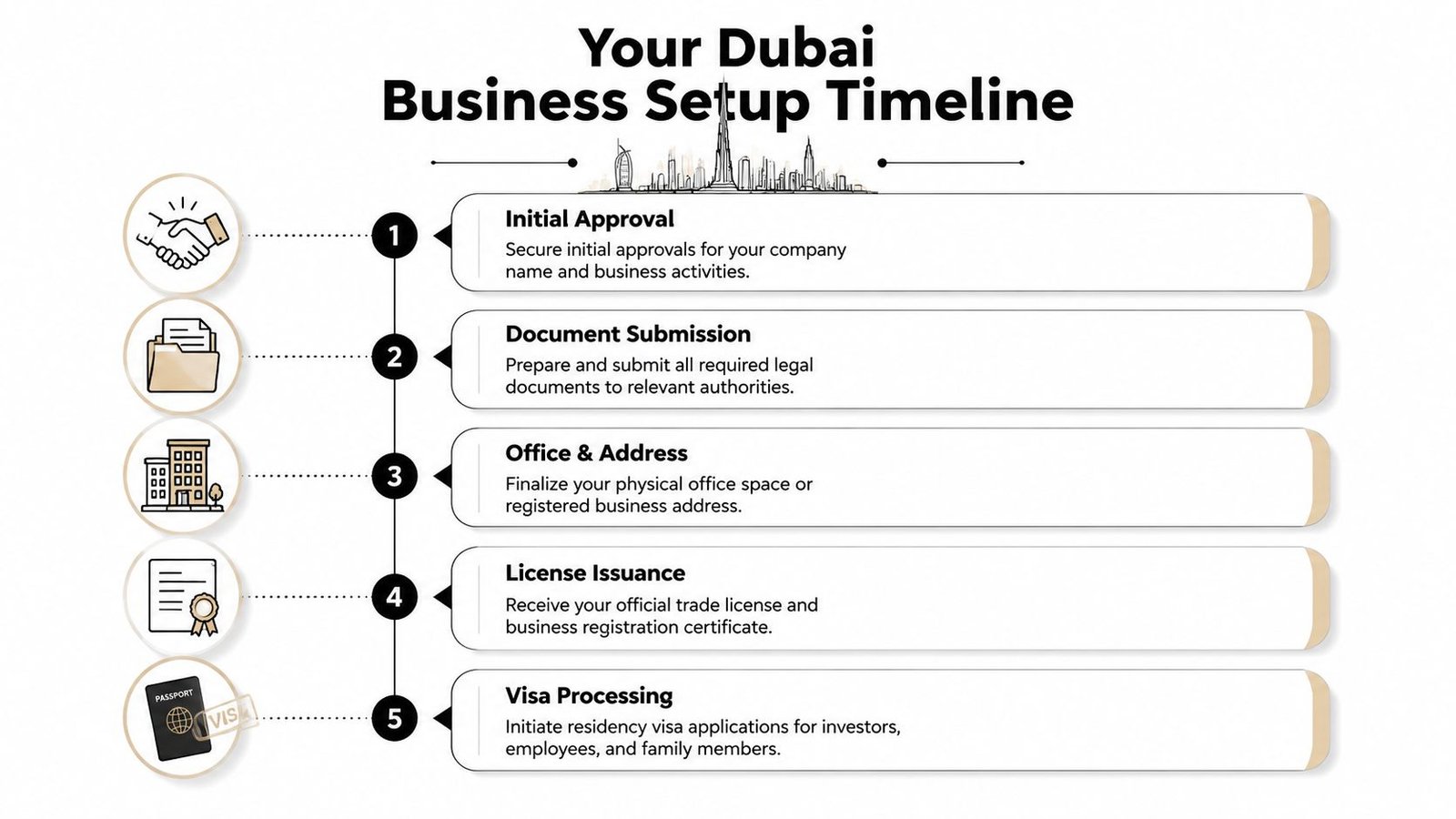
How does the setup sequence usually run
The normal flow looks simple on paper:
- Choose the activity and legal form
- Reserve the trade name
- Obtain initial approval
- Prepare constitutional and support documents
- Finalise office space or registered address
- Submit for licence issuance
- Start establishment card and visa steps
The timing depends on the jurisdiction. For many Free Zones, the licence can be issued in 5 to 10 working days. Mainland setups usually take 14 to 28 days, reflecting the extra legal and lease steps involved (verified setup timing data).
The common Mainland failure point is the office lease and local service paperwork. For Mainland setups, a missing Local Service Agent (LSA) agreement or a missing RERA-attested lease can slow everything down. Data shows that failing to secure the attested lease before the licence application triggers an average 45-day rejection cycle, while success rates rise to 92% when professional services process the documents concurrently (verified Mainland lease and LSA workflow data).
Get the lease and the legal agreement aligned before filing. A fast submission with one missing attestation is usually slower than waiting two extra days and filing cleanly.
If you want a realistic expectation, think in milestones rather than one final approval. Name reservation is one milestone. Initial approval is another. Licence issuance is another. Then visas and banking begin. Founders who treat setup as a chain of linked approvals tend to move faster because they don't assume the licence is the end of the process.
Securing Visas for Investors Employees and Your Family
A company becomes practical once it can support residency. For most founders in the United Arab Emirates, that means sorting out an investor visa for themselves, employee visas for staff, and family sponsorship once their own residency is active.

What visa types do founders usually deal with
An Investor Visa is a residency visa linked to ownership in the company. It is usually the first route founders use after licence issuance and establishment registration.
An Employee Visa is a residency visa sponsored by the company for a staff member. In practice, the number of employee visas available often depends on the office package and the authority's quota rules.
A Golden Visa is a long-term residency route for qualifying investors and professionals. For business owners, the route mentioned in current setup practice requires fully paid-up capital of AED 2 million and a physical office in the UAE, and many first-time applicants fall short because the capital structure or premises don't meet the requirement (verified Golden Visa threshold data).
A PRO service is a Public Relations Officer service that handles government-facing paperwork and submissions. In the UAE, that usually means dealing with bodies such as the General Directorate of Residency and Foreigners Affairs (GDRFA) for immigration matters and the Ministry of Human Resources and Emiratisation (MOHRE) for labour-related processes.
How does the visa workflow actually move
The visa sequence usually starts after the company receives its licence and establishment records. From there, the workflow typically includes entry permit or status adjustment steps, a medical fitness test, biometrics for the Emirates ID, and visa stamping or digital residency issuance depending on the current process.
One practical point often improves the overall timeline. In Free Zone cases, bank account opening moves more smoothly when the Establishment Card is issued before medical biometrics. Verified operational data shows that 95% of Free Zone businesses open corporate bank accounts within 14 days if the Establishment Card is issued first, while delays in card issuance can stretch the process to 30+ days (verified Establishment Card and bank timing data).
This short explainer helps if you're planning staff or dependants after setup:
For families, the founder's own residency usually needs to be active before spouse or child sponsorship can move. For employees, the labour and immigration sequence has to match the licence quota and office capacity already approved for the company.
If the company can only sponsor a small number of visas on paper, no amount of urgency later will fix that quickly. Visa planning starts when you choose the office package, not when HR needs a work permit.
A calm approach works best here. Get the company file clean, match the office package to the actual team plan, and treat residency as an operational workflow rather than an afterthought.
Opening a Corporate Bank Account in the UAE
Many founders think the hard part is over once the trade licence arrives. In practice, opening a corporate bank account in the UAE is often the stage that exposes weak setup decisions made earlier.
Why do founders get stuck at the banking stage
Banks in Dubai, Abu Dhabi, and across the UAE review more than the licence itself. They want to understand the business model, expected transaction flow, client geography, supplier relationships, and whether the company has a real operating presence.
That last point matters more than most low-cost setup guides admit. Many authorities legally allow a Flexi-Desk or virtual-style office arrangement for licensing. Banks may still decide that the same setup doesn't give enough comfort for onboarding.
Existing guides often sell Flexi-Desk solutions as the easy answer, but the trade-off is real. Data from 2025 banking compliance reports indicates that 45% of new Free Zone entities with virtual licences face account freezing or rejection due to “lack of physical presence” risk scoring (verified banking compliance reference).
What improves your chances of approval
A clean bank file usually has three things. First, the activity on the licence matches what the company does. Second, the founder can explain the business in plain English. Third, the company can show an operating footprint that makes sense for the scale and sector.
These steps usually help:
- Prepare a real business summary: Explain services, customer types, expected markets, and payment flows clearly.
- Show office logic: If you started with a desk package, be ready to explain why it fits the present stage of the business.
- Keep documents consistent: Licence activity, invoices, website messaging, shareholder profile, and onboarding forms should all tell the same story.
- Attend the meeting ready for compliance questions: Banks often ask who pays you, who you pay, and why the UAE entity is needed.
Banking also varies by business model. A small consultancy with overseas clients may be approved on a leaner setup than a trading company expecting larger transaction volumes or regular local counterparties. The issue isn't whether your structure is legal. The issue is whether the compliance team sees it as credible.
Some founders don't have a banking problem. They have a setup-design problem that only becomes visible when the bank asks for proof of operations.
If your model depends on local contracts, regular incoming payments, or larger account activity, a stronger office and documentation package often saves time later. Cheap entry structures can still work, but only if they match the reality of the business.
Understanding Costs and Ongoing Compliance
The setup fee is only the visible part of the budget. The full cost of business setup in Dubai includes the licence, office package, visas, renewals, and the compliance work that starts after incorporation.
What should you budget for in the first year
The headline ranges are straightforward. For Free Zones, entry-level packages with a visa can be secured from AED 12,500 to AED 30,000, while Mainland setups commonly start higher once office and immigration requirements are added. Verified market data also notes that packages without a visa can start as low as $1,500, and those including a visa start from $3,000 (verified Dubai setup cost range).
For Mainland companies, a separate benchmark shows that total first-year costs start from approximately EUR 8,950, around AED 35,000, including licence, virtual office, and one residence visa, with extra charges for some activities such as general trading (Mainland first-year cost reference). The same cost pattern explains why many founders underestimate year-one spend. The licence fee is only one part of the number.
A more realistic first-year budget often includes:
- Licence fee: This depends on jurisdiction, activity, and office package.
- Visa processing: Verified figures place visa processing at AED 3,500 to AED 7,000 per visa in many cases.
- Office cost: Flexi-desk, serviced office, or physical leased office, depending on the authority and visa plan.
- Renewal uplift: Annual renewals can be 20% to 40% higher than the first year in some setups.
- Corporate tax planning: The UAE corporate tax rate is 9% on profits exceeding AED 375,000.
What ongoing compliance catches founders off guard
After licence issuance, the company enters its operating phase. That means tax registrations where applicable, record-keeping, renewals, visa maintenance, and in some structures, extra reporting linked to substance or qualifying income.
The hidden issue for hybrid businesses is compliance across more than one reality. A company that looks like a simple Free Zone consultancy on paper may begin serving local UAE clients, hiring staff, or moving into a more operational setup. At that point, the original low-cost structure can trigger extra work and extra spend that wasn't obvious during incorporation.
The cheapest setup is often the most expensive one to operate if your real business model changes in the first year.
Here are the questions founders usually ask once the licence is issued:
| Question | Answer |
|---|---|
| Do renewal costs stay the same? | Not always. Verified market data shows renewals can be higher than the first year, especially once immigration, office, and admin costs are added. |
| Is VAT always required? | VAT depends on your revenue position and taxable activity. It isn't automatic for every new company. |
| Does Free Zone always mean lower operating cost? | Not necessarily. Free Zone entry pricing can be attractive, but visa limits, office upgrades, and banking requirements can change the total cost. |
| Is Corporate Tax relevant for small businesses? | The UAE corporate tax benchmark in this context is 9% on profits above AED 375,000. That makes accounting and planning relevant early, even for younger businesses. |
| Are there hidden costs after setup? | Often yes. Common examples include visa processing, office upgrades, annual renewals, attestations, and extra compliance for more complex operating models. |
The founders who handle compliance well usually do one thing early. They stop treating setup as a one-time filing exercise and start treating it as the first stage of operating a business in the United Arab Emirates.
Not sure which route fits your plan in Dubai, Abu Dhabi, Sharjah, or another part of the UAE? Inpro Corporate Services L.L.C. can help you compare Mainland, Free Zone, and Offshore options, understand the setup sequence, and choose a structure that works for licensing, visas, banking, and compliance.