


Free zone setup goes wrong in two predictable places. Founders pick a zone that does not match how the business will sell, and they assume the bank account will open shortly after the licence is issued.
That is why a free zone company setup should be treated as a five-part build. Choose the right zone and activity first. Prepare the file properly. Complete registration and visas in the right order. Then deal with banking as a separate workstream, not an afterthought.
The licence itself is often the fastest milestone. The harder part is making sure the company can operate the way the founder expects once the licence is in hand. A low-cost package can look sensible at the start, then create expensive friction later if the business needs regular mainland client access, a regulated activity, extra visas, or a bank that wants clearer proof of substance and source of funds.
In practice, the best free zone is rarely the cheapest one. It is the one that fits the revenue model, customer geography, staffing plan, and banking profile. A consultant billing overseas clients has one set of priorities. An e-commerce operator storing stock in the UAE has another. A founder who will need local contracts, resident staff, and quick account activation needs to screen zones differently from day one.
Banking deserves the same level of planning. Many founders are surprised that corporate account opening can take longer than incorporation and involve repeated questions about business activity, counterparties, expected volumes, and the founder's background. If the company file, licence wording, office arrangement, and transaction story do not line up, the process slows down quickly.
Handled properly, free zones in Dubai, Abu Dhabi, Sharjah, and the other emirates can work very well for consulting, technology, trading, holding structures, and cross-border services. The founders who have the smoothest setup are usually the ones who make two decisions early: where the company needs to trade in practice, and what the bank will need to get comfortable saying yes.
Table of Contents
- Choosing the Right Foundation Your Free Zone and License
- Assembling Your Application Documents and Attestation
- The Registration and Visa Workflow
- Activating Your Business Corporate Bank Account Opening
- Life After Setup Ongoing Compliance and Renewals
- Your Free Zone Setup Questions Answered
Choosing the Right Foundation Your Free Zone and License
Choose the wrong free zone at the start and you usually pay for it twice. First in restructuring costs, then in lost time when mainland sales or bank onboarding do not work the way the founder assumed.
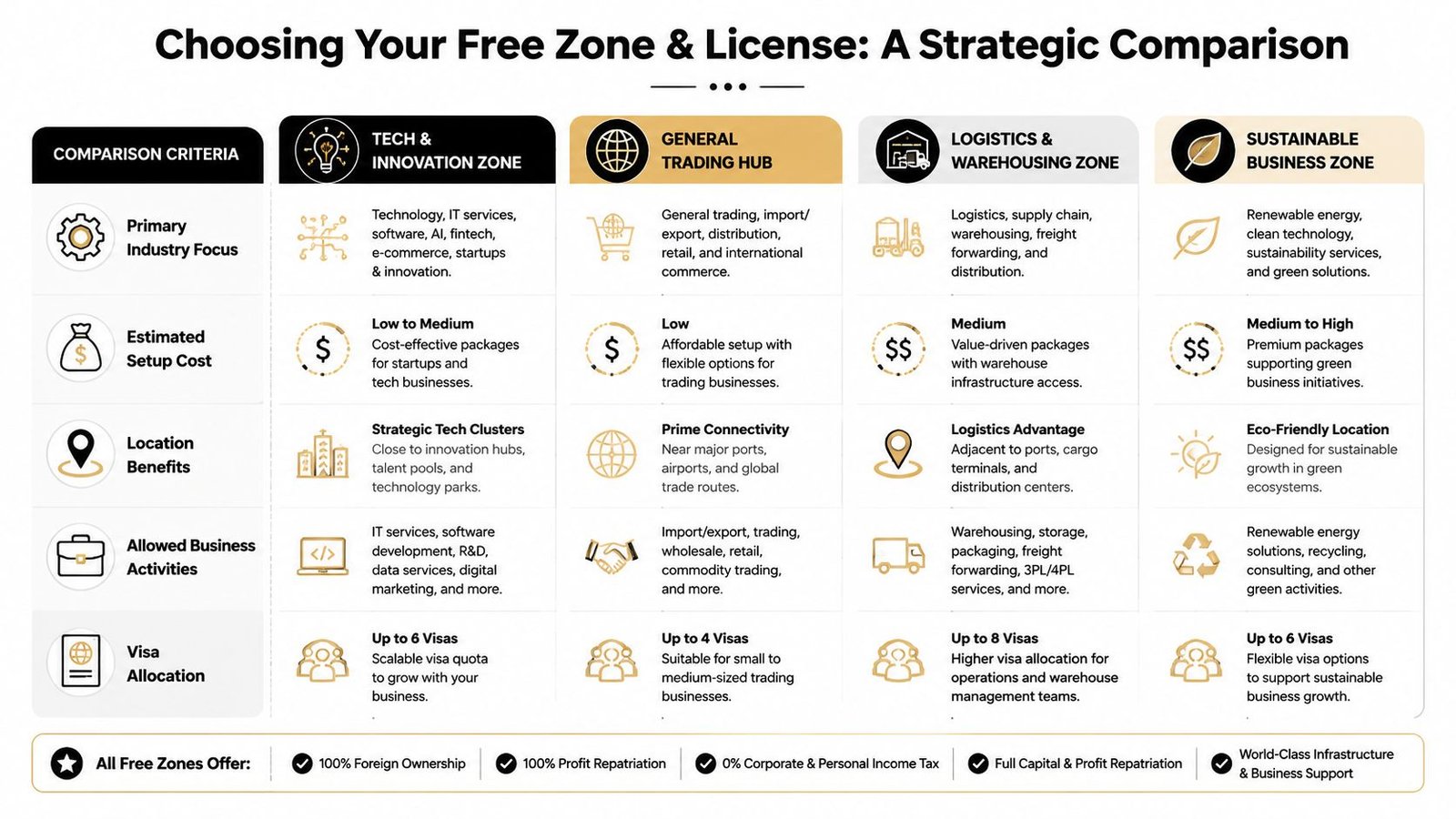
A free zone is a separate business jurisdiction in the UAE with its own regulator, licensing rules, office requirements, and visa policies. For many foreign founders, it is an efficient entry point because it offers full foreign ownership and a defined setup path. The mistake is treating all free zones as interchangeable.
What is a free zone
Each free zone is its own operating environment. Fees vary. Approved activities vary. Some zones are better for consulting and digital services. Others suit logistics, media, commodities, manufacturing, or holding structures.
That difference matters early.
A software founder selling subscriptions overseas can often operate comfortably from a service-focused free zone. A company planning to hold stock, deliver goods across the UAE, or pitch government and mainland contracts every week needs a harder review of access rules before incorporating. I have seen founders choose a low-cost licence and only later realise their actual sales model does not fit the permissions, office package, or compliance expectations of that zone.
A good free zone is not the cheapest one. It is the one that matches how revenue will be earned in the first year.
Practical rule: Choose the zone based on customers, activity approval, office requirement, visa capacity, and likely banking profile. Package price comes after that.
Which legal structure should you choose
The legal form should reflect who owns the company now and how ownership may change later.
An FZE usually suits a single shareholder. An FZ Co. is generally used where there are multiple shareholders. A branch works for an existing company that wants to extend the same activity into the UAE under the parent structure. The official UAE government guidance on starting a business in a free zone explains these broad formats, although naming conventions can differ by free zone.
Here is the practical view:
| Structure | Best for | Ownership pattern |
|---|---|---|
| FZE | Solo founder, single-owner consultancy, personal holding structure | One shareholder |
| FZ Co. | Co-founders, partner-led businesses, family-owned ventures | Two or more shareholders |
| Branch | Foreign or UAE company expanding under the same parent | Parent company ownership |
Founders often rush this choice because it looks administrative. It is not. If a solo founder expects to add an investor within months, the amendment path matters. If two partners are funding and operating the business together, forcing one into nominee-style workarounds to keep a single-shareholder structure usually creates avoidable legal and banking questions later.
How do you avoid choosing the wrong zone
This is the first common failure point for new founders.
The core question is simple. Where will the customer sit, and how will money come in? If the answer is overseas clients, regional service contracts, remote delivery, or IP holding, a free zone can be a strong fit. If the answer is frequent UAE mainland sales, local distribution, retail, or recurring domestic procurement, you need to test the operating model much more carefully before selecting the zone.
Masdar City Free Zone discusses this problem clearly in its article on business setup challenges in the UAE and how to overcome them. New founders often misunderstand what a free zone licence does and does not allow in the mainland market. The same source also notes that distributor arrangements can add significant commercial friction and materially reduce margins.
That does not rule out a free zone structure. It means the founder should decide with eyes open.
Use these questions before you commit:
- Who pays you? Overseas clients, UAE mainland companies, government buyers, consumers, or distributors.
- What are you selling? Services, software, physical goods, regulated products, or professional advice.
- How do you deliver? Remotely, from inventory, through field staff, through a distributor, or through a mainland counterparty.
- Do you need warehouse space, client-facing premises, or only a desk package?
- How many visas do you need in year one, not year three?
- Will your proposed activity and free zone profile make bank account opening easier or harder?
That last point gets missed too often. Banks do not only review incorporation documents. They review substance. A founder who forms a company in a zone that looks disconnected from the business model, with vague activity wording and no clear client geography, often faces more friction at the banking stage. Free zone selection and bankability are linked from day one.
Office package choice also needs realism. Founders are often attracted to the smallest desk package available, then discover the visa allocation is too limited for the team they intend to hire. Upgrading later is possible, but it adds cost, paperwork, and delay. Set the office package against your actual hiring plan, not the lowest advertised entry price.
Free zone setup works well when the structure matches the business model. It becomes expensive when founders buy speed first and discover operational limits later.
Assembling Your Application Documents and Attestation
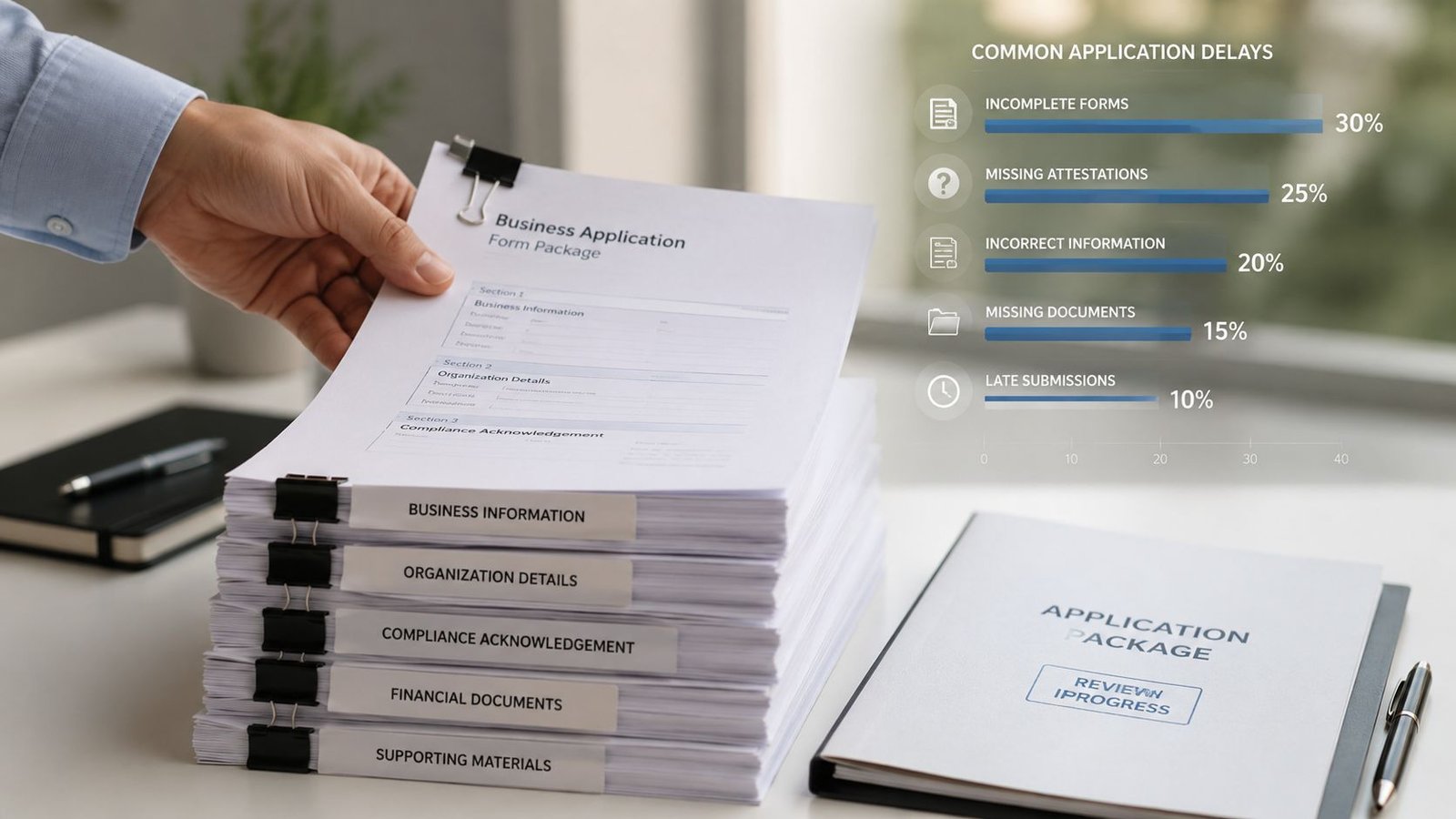
Many free zone setups lose their early momentum during the document stage. Founders often assume the hard part was choosing the zone and licence. In practice, avoidable delays often begin here, especially if the file does not clearly explain the business, the ownership chain, and the source of funds in a way that will satisfy both the authority and a future bank.
Why do applications get rejected so often
KYC is not a box-ticking exercise. It is the first real compliance review of the people behind the company and the commercial logic of the business itself. If the activity says one thing, the business plan suggests another, and the shareholder profile points somewhere else, the authority will usually stop the file and ask questions.
According to Consult Kumar's free zone setup process article, incomplete KYC or business plans cause 30–50% of initial approval rejections. The exact percentage matters less than the pattern. Weak files get delayed, queried, or sent back for revision.
This matters for banking too. A vague application file can follow you long after the licence is issued. If your stated activity, client profile, or ownership story looks unclear at setup stage, the same weakness often resurfaces during corporate bank account review.
What documents should be ready before submission
The exact list depends on the free zone, the activity, and whether any shareholder is an individual or a corporate entity. Still, the core package is usually predictable.
A clean pre-submission file usually includes:
- Passport copies: Clear, valid copies for each shareholder, director, manager, and authorised signatory.
- Business plan: A short, specific explanation of what the company will do, who it will sell to, where clients are based, and how revenue will be generated.
- Application forms and specimen signatures: These need to match the passport spelling and authorised signatory details exactly.
- Corporate documents: If a shareholder is another company, prepare the certificate of incorporation, constitutional documents, board resolution, and register extracts if required.
- Proof of address or occupancy documents: Some authorities request a lease, title deed, or office package evidence depending on the licence structure.
- NOC where applicable: This is often requested if the founder already has UAE residency under an employer or another sponsor.
The business plan deserves more care than founders expect. A generic two-page summary copied from an old template creates problems. Free zones may still ask questions, but the bigger risk is later. Banks want to see a business they can understand quickly. They look for client geography, expected transaction flows, supplier locations, and a credible reason for using a UAE free zone company in the first place.
A practical test helps here. If a compliance officer reads your file for three minutes, can they tell what you sell, who pays you, and why the chosen structure makes sense?
What is attestation and when is a no-objection letter needed
Attestation is the process that makes foreign-issued documents acceptable to UAE authorities. For overseas corporate shareholders, this is often the slowest part of the file. Documents may need notarisation in the home country, legalisation through the relevant authorities, and UAE attestation before the free zone will accept them.
Timelines vary widely. That is the point founders often underestimate.
If an individual shareholder is applying directly, document collection can be fairly quick. If a foreign holding company is involved, the file can slow down sharply because one missing legalisation stamp or an outdated board resolution can halt the submission. I usually advise founders to confirm the attestation standard with the free zone before collecting documents, not after. Different authorities can ask for slightly different forms, validity periods, or signing formats.
A No-Objection Certificate, or NOC, is simpler. It is a letter confirming that an existing sponsor or employer does not object to the person forming the company. It is commonly relevant for UAE residents sponsored by an employer or family member, but it is not required in every case. The right approach is to confirm this early with the authority handling the licence, because assumptions here create unnecessary back-and-forth.
A few habits prevent most document-stage stress:
- Prepare the shareholder structure early, including any parent company documents.
- Keep names, signatures, and passport numbers identical across every form.
- Ask the free zone which foreign documents need notarisation, attestation, or legal translation before submission.
- Write a business plan that matches the licence activity and would also make sense to a bank reviewer.
- Check document validity dates. Some corporate papers expire for filing purposes faster than founders expect.
The file should do more than get initial approval. It should also support the bank account process that comes after incorporation. Founders who prepare documents with both stages in mind usually face fewer compliance questions and fewer expensive delays.
The Registration and Visa Workflow
A free zone setup does not become low-risk once the documents are ready. This is the stage where founders feel progress, make assumptions, and lose time on details that looked minor at the start.
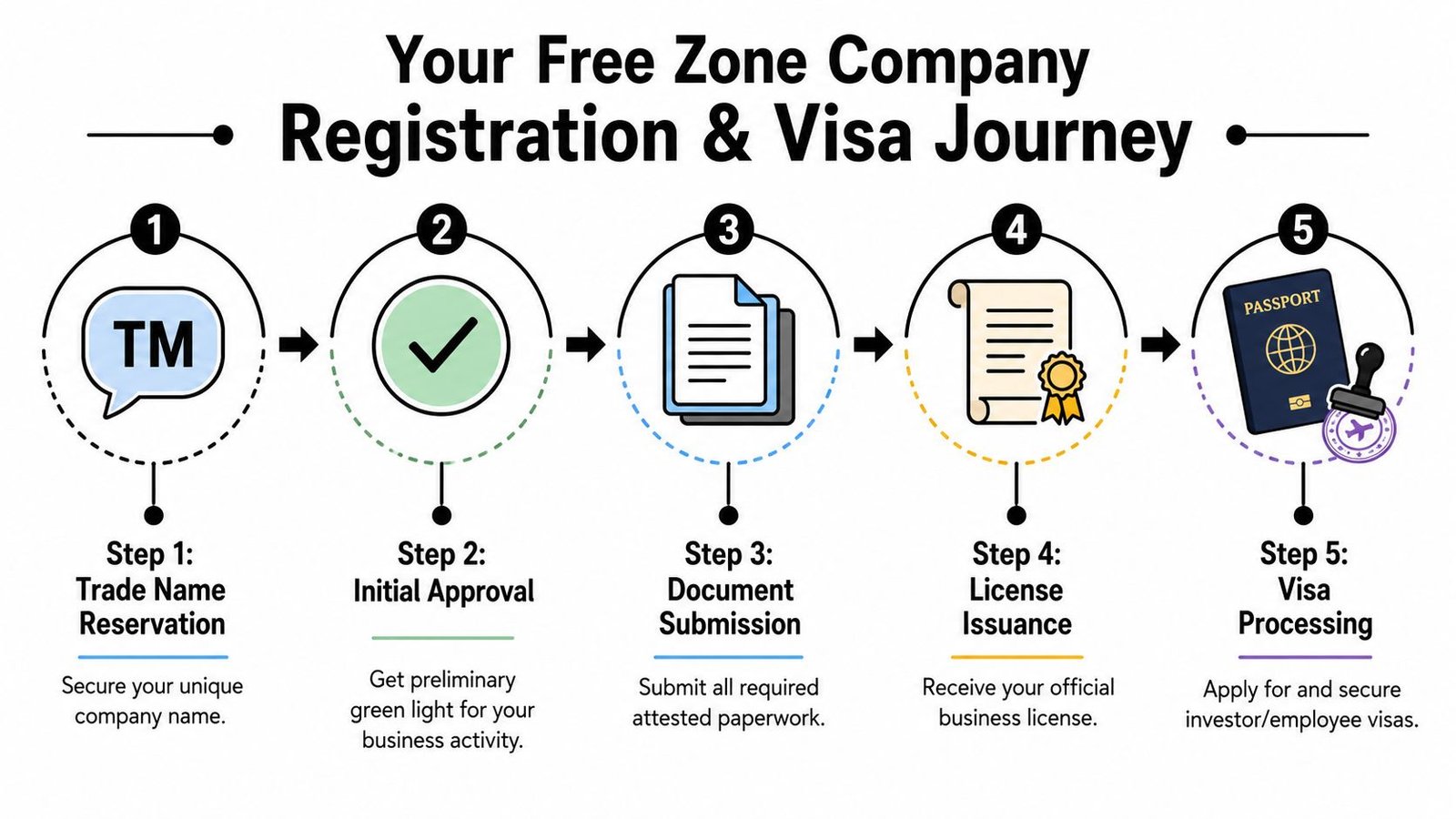
The order matters because each approval enables the next administrative step. In practice, the sequence usually runs like this: trade name reservation, initial approval, signing the incorporation documents, licence issuance, establishment card processing where applicable, and then visa steps for the shareholder or employees. The exact order shifts slightly by free zone, activity, and whether the founder is already inside the UAE.
What happens after you submit the file
The authority reviews the application against the approved activity, shareholder profile, and document set. If the file is clean, the founder moves from initial approval to signing and payment, then to licence issuance. Straightforward cases can move quickly. Files involving regulated activities, corporate shareholders, or cross-border documents usually do not.
The practical mistake here is treating the licence as the finish line. It is only one checkpoint.
Founders also need to watch for a more expensive issue. If the chosen free zone does not fit the actual business model, the registration may complete smoothly but the company becomes awkward to use. I see this with firms that need direct mainland client access, frequent government contracting, or larger visa allocations than a flexi-desk package can support. The company gets formed, but the operating model starts fighting the legal structure from day one.
What does a public relations officer do
A Public Relations Officer, or PRO, handles the government process around the company and visas. That can include establishment card applications, immigration submissions, status changes, medical booking, Emirates ID coordination, and follow-up with the relevant counters or portals.
A capable PRO saves time in very specific ways. They spot mismatched names, missing signatures, expired entry permits, and booking errors before those issues trigger rejection or force a resubmission. That matters most when the founder is outside the UAE, working on a tight travel window, or managing several shareholders at once.
Here's a useful visual if you want to see the sequence in a more linear format:
How does the visa process actually move
The visa process is a chain of approvals and appointments. After incorporation, the applicant usually completes entry permit or in-country status adjustment, medical fitness testing, Emirates ID biometrics, and residency stamping or digital issuance, depending on the current procedure used by the authority.
Timelines vary more than founders expect. A clean case can move quickly. Delays are common when the applicant is changing status inside the UAE, when health insurance must be arranged before a later step, or when appointment availability becomes the bottleneck rather than the company file itself.
Office selection affects this stage more than many founders realise. A low-cost desk package may be perfectly adequate for a solo consultant. It becomes restrictive for a business planning to sponsor several employees soon after setup. Visa quotas, facility rules, and immigration capacity are tied to the package, not just the licence.
The second common failure point starts here, even before the bank application formally begins. Banks often ask where the business will operate, who will hold residence visas, and whether the company has a real commercial presence that matches its activity. If the founder chose the free zone only for a lower headline setup cost, those answers can be harder to defend. A setup that is cheap to register can be slow to operationalise.
The calmest way to run this stage is to treat licence issuance, visa processing, and bank readiness as one connected workflow. Founders who plan them separately usually spend more time correcting avoidable problems.
Activating Your Business Corporate Bank Account Opening
Bank account opening is often the point where a free zone setup stops feeling simple.
A founder can have the licence issued, the immigration file progressing, and a clear go-to-market plan, then lose weeks because the bank is not persuaded by the company profile. In practice, this is one of the two mistakes that cause the most frustration after setup. The first is choosing a free zone that does not fit the business model. The second is assuming the bank account is a routine admin step.
Why is bank account opening harder than founders expect
UAE banks do not open a corporate account because incorporation is complete. They review the business as a risk case. That means they look at ownership, nationality mix, business activity, customer geography, expected payment flows, and whether the company's operating model makes sense for the licence and jurisdiction.
The timeline is often longer than founders budget for. Two to six weeks is common for a straightforward case, and longer is not unusual if the bank asks follow-up questions or the file reaches compliance review.
The hardest cases usually share the same pattern. The company was set up in the cheapest or fastest free zone option, but the actual business depends on clients, staff, warehousing, or regular trading activity that the structure does not explain well. Banks notice that gap quickly. If the licence says one thing, the website suggests another, and the expected transactions point to something broader, the application slows down.
For overseas founders, that does not automatically signal a problem. It usually means the bank needs a cleaner file and a more coherent commercial explanation.
What do banks usually want to see
Enhanced KYC means the bank wants to understand how the business will operate in practice, not only on the incorporation documents.
Expect questions on:
- Business model: What the company sells, who buys it, and where those customers are based
- Ownership: Shareholders, ultimate beneficial owners, and any parent or sister entities
- Transaction profile: Expected volumes, currencies, countries, payment routes, and typical counterparties
- Commercial proof: Signed contracts, proposals, invoices, a live website, pitch deck, or evidence of an existing client pipeline
- Source of funds: How the company will be capitalised and where the money comes from
Banks also look for consistency. A broad activity such as “consultancy” may be acceptable for licensing purposes, but it often creates extra questions at bank stage if the founder cannot explain the exact service line, target market, and reason transactions will flow through the UAE entity.
How can you improve your chances of approval
The strongest applications are easy to review. They tell one clear story across every document.
Use this approach:
- Make the licence and business narrative match. The stated activity, website wording, business plan, and expected account usage should align.
- Prepare the banking file before incorporation finishes. Gather shareholder CVs, group structure charts, draft contracts, proof of address, and source-of-funds support early.
- Explain the UAE rationale clearly. Banks want a sensible reason for the company being in that free zone and in the UAE more broadly.
- Budget time for follow-up. Approval often depends on how quickly and clearly the founder answers compliance questions.
- Keep ownership simple where possible. Multi-layer holding structures, nominee arrangements, and poorly documented related parties tend to create delays.
One practical point matters more than many founders expect. If the business will need mainland customers, a warehouse, local staff expansion, or frequent cash-flow movement tied to UAE operations, the wrong free zone choice can weaken the bank file before it is even submitted. That is why free zone selection and bank readiness should be assessed together, not as separate decisions made weeks apart.
Banks assess whether the company's activity, ownership, and money flows make sense on paper and in practice.
Founders who treat banking as a standalone workstream usually end up reacting to questions. Founders who prepare for it during setup usually move faster, with fewer document chases and less pressure on launch dates.
Life After Setup Ongoing Compliance and Renewals
Significant administrative work starts after incorporation. Founders usually feel relief once the licence is issued, then get caught by renewals, tax filings, visa deadlines, and bank requests that arrive months later with little warning.
What needs attention after the company is formed
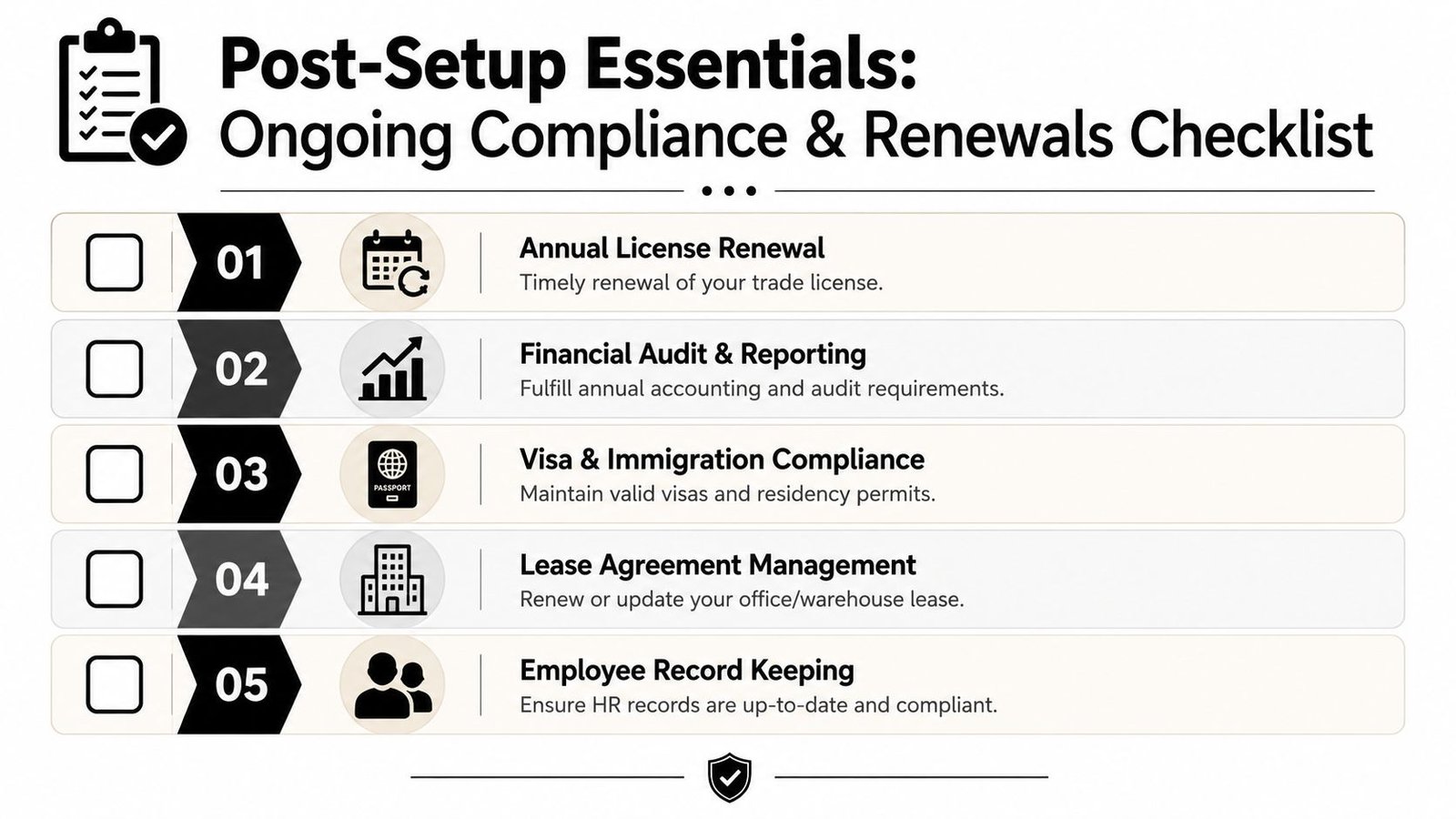
Free zone companies run on expiry dates. If one item lapses, the problem rarely stays isolated. A delayed licence renewal can affect immigration records, freeze visa processing, create friction with the bank, and raise questions from clients doing routine compliance checks.
The recurring items are straightforward, but they need active tracking:
- Licence renewal: Renew the trade licence before expiry each year.
- Office or flexi-desk renewal: The lease, desk package, or facility agreement usually supports the licence and visa allocation.
- Establishment card management: This immigration record must remain valid for visa processing and employee administration.
- Visa tracking: Monitor residency expiry, Emirates ID status, medical steps where applicable, and employee file updates.
- Corporate records: Keep shareholder resolutions, UBO records, specimen signatures, and internal registers current.
One missed renewal often creates two or three follow-up issues. That is why I recommend a simple compliance calendar with alerts set well before the due date, not on it.
How does corporate tax work for free zone companies
This is one of the areas founders misread because the headline sounds simpler than the actual rule.
A free zone company may qualify for a 0% corporate tax rate on qualifying income. That does not remove the obligation to register for Corporate Tax and meet the filing and compliance requirements. The tax position depends on what the company earns, how it operates, and whether it continues to meet the conditions for free zone treatment.
The practical reading is simple:
| Statement | Is it true |
|---|---|
| A free zone company may benefit from 0% corporate tax on qualifying income | Yes |
| A free zone company can ignore Corporate Tax registration | No |
The common mistake is assuming "0%" means "nothing to do." It usually means the company still needs records, timely registration, and a filing process that supports the position being claimed.
What operational habits keep a company in good standing
Good standing is mostly administrative discipline. The founders who handle this well are not doing anything complicated. They are keeping records clean, watching dates, and fixing changes before they turn into approval problems.
A few habits reduce stress significantly:
- Keep one controlled document set: Store licence copies, incorporation documents, immigration records, tax certificates, insurance, and bank KYC files in one shared folder with the latest version clearly marked.
- Check the licensed activity before taking new work: This matters if the company starts serving mainland customers, adds a regulated service, or changes its revenue model. The wrong activity mix can create problems at renewal and questions from the bank later.
- Record ownership and management changes early: New shareholders, managers, authorised signatories, or related-party arrangements often require amendments with both the free zone and the bank.
- Support the company's actual operating model: If the business depends on free zone tax treatment or a specific market position, contracts, invoices, staff arrangements, and internal records should reflect that reality.
The two failure points from setup still matter here. A founder who chose the wrong free zone for the business model often discovers it during renewal, when office needs, visa allocation, or mainland activity no longer fit the original structure. A founder who treated banking as a one-time task often sees the issue return when the bank asks for updated KYC, tax registration proof, or evidence of genuine operations.
Renewal season is much easier when the company has been run cleanly all year.
Your Free Zone Setup Questions Answered
Founders usually ask the most useful questions after they've already started the process. These are the ones that tend to matter once the company is real and business decisions start moving.
Can you change your business activity later
Yes, usually you can. A business activity is the licensed description of what the company is allowed to do, and free zones generally allow amendments subject to approval.
The practical issue isn't whether change is possible. It's whether the new activity affects your office requirement, approvals, regulatory classification, or banking position. If the new activity moves closer to regulated work, domestic trading, or a different client type, review the impact before filing the amendment.
How do you add a shareholder or partner
You'll usually need an amendment process through the free zone authority. That often means updated constitutional documents, shareholder resolutions, revised registers, passport and KYC documents for the new owner, and sometimes fresh due diligence from your bank.
If the company started as an FZE and you want to bring in a second owner, the structure itself may need to change. That's why ownership planning at formation stage saves time later.
What does it take to close a free zone company
Closure is an orderly compliance process, not just a decision by the owner. The company usually needs to settle outstanding fees, cancel visas and immigration records, close the bank account, clear utility or lease commitments, and complete the authority's deregistration requirements.
The hidden difficulty is sequencing. If you close the wrong item first, another cancellation step may stall. This is one reason founders should keep full records from the start.
Is a free zone still the right choice if you want UAE customers
Sometimes yes, sometimes no. The answer depends on whether you need direct domestic trading, what kind of customers you serve, and whether your activity can operate through the available legal route.
For many service businesses, a free zone remains workable if the operating model is structured properly. For some trading businesses focused on the UAE market, the better answer may be mainland from day one. The mistake isn't choosing free zone. The mistake is choosing it without matching the jurisdiction to the actual revenue model.
If you're unsure, test your plan against four questions:
- Where will revenue come from in the first year?
- Do you need direct mainland access or not?
- How many visas will the business really need?
- What will the bank see when it reviews the file?
Those four questions catch most setup problems before they become expensive.
Not sure where to start? Book a free strategy call with Inpro Corporate Services L.L.C. to map out the right UAE setup, visa path, and banking approach for your business.