

A business credit card in the UAE is a company expense tool tied to your business, not your personal wallet. If you're setting up in Dubai, Abu Dhabi, or a free zone and paying for licences, visas, software, flights, and supplier bills from your own card, it's usually a sign that your structure and banking setup need tightening.
In practice, many founders often get stuck at this point. The company is formed, the trade licence is live, staff or investor visas are in motion, and the spending starts immediately. But access to a proper credit card for business doesn't come first. It usually comes after the harder part: getting the company set up correctly in the right jurisdiction and opening a corporate bank account that shows the bank how your business operates.
Table of Contents
- Your Guide to Business Credit Cards in the UAE
- What Is a Business Credit Card and Why Do You Need One
- Which Type of Business Credit Card Is Right for You
- Who Is Eligible for a Business Credit Card in the UAE
- How to Apply for a Business Credit Card
- What Fees and Limits to Expect
- Using Your Card and How Inpro Can Help
Your Guide to Business Credit Cards in the UAE
A business credit card is a payment card issued to a company for business spending, bookkeeping, and short-term cash flow management. In the United Arab Emirates, that sounds simple, but the primary issue isn't understanding the card. It's qualifying for one in a way that matches how your company is licensed and banked.
A founder in Dubai Mainland often faces a different banking conversation from a founder in Dubai Multi Commodities Centre or Ras Al Khaimah Economic Zone free zone. The expenses may look similar: government fees, employee onboarding, Meta or Google ads, Zoom, Microsoft 365, flights, and client entertainment. But the bank reviews the legal structure behind those expenses first.
A business credit card is usually a downstream result of good company formation and clean banking records, not a product you pick up casually after incorporation.
That's why the jurisdiction point matters so much. Many generic guides treat all companies the same. In the UAE, a Mainland company, a Free Zone company, and an Offshore company can face different levels of access, scrutiny, and product choice.
What Is a Business Credit Card and Why Do You Need One
What is a corporate credit card
A corporate credit card is a line of credit issued in the company's name for approved business expenses. The bank looks at the business entity, its licence, its bank activity, and its financial profile before deciding whether to issue the card.
For a small company, the terms business credit card and corporate credit card are often used loosely in conversation. In day-to-day use, what matters is that the card sits inside the company's financial records rather than the founder's personal finances.
How is it different from a personal card
A personal card follows you as an individual. A credit card for business is meant to support company spending, internal controls, and accounting records tied to the business.
That difference becomes practical fast. If you pay supplier invoices, visa charges, office costs, and recurring software subscriptions from your own personal card, your accountant has to untangle mixed transactions later. That creates confusion over what was company spend, what was reimbursement, and what should never have hit the company books in the first place.
A business card also helps when more than one person needs controlled access to spend. A founder can keep the master facility under the company while assigning cards or permissions for operations, sales, or travel.
What are the main benefits
The first benefit is separation. Your business expenses stay in one lane, which makes bookkeeping cleaner and month-end reviews less painful.
The second is working capital. A card gives breathing room between purchase date and payment date, which is useful when clients pay on terms but your suppliers don't.
The third is visibility. When every recurring payment sits on one company card, patterns become obvious. You can spot duplicate software subscriptions, old vendor charges, and spending that should move to purchase order approval.
A few practical wins stand out:
- Cleaner accounting: Xero, QuickBooks, and Zoho Books are easier to reconcile when business spend stays on business instruments.
- Better policy control: Employee cards or approved spending rules are easier to manage than staff paying personally and asking for reimbursement.
- Stronger audit trail: Trade activity, vendor relationships, and monthly spend are easier to demonstrate to bankers, accountants, and internal stakeholders.
- Less personal exposure: Founders avoid turning personal cards into unofficial company finance tools.
Practical rule: If a spend item appears on your company's profit and loss statement, it should ideally be paid from a company bank account or a company card.
Not every business needs the same type of card from day one. A consultancy with low overhead may care most about low fixed fees. A trading company may care more about limit size and foreign use. A founder flying often between Dubai, Abu Dhabi, Riyadh, London, and Singapore may care more about travel benefits than cashback.
Which Type of Business Credit Card Is Right for You
The right card depends less on marketing and more on how money moves through your company. A startup that spends mostly on SaaS, ads, and local service providers needs something different from a business that books frequent travel or manages many staff purchases.
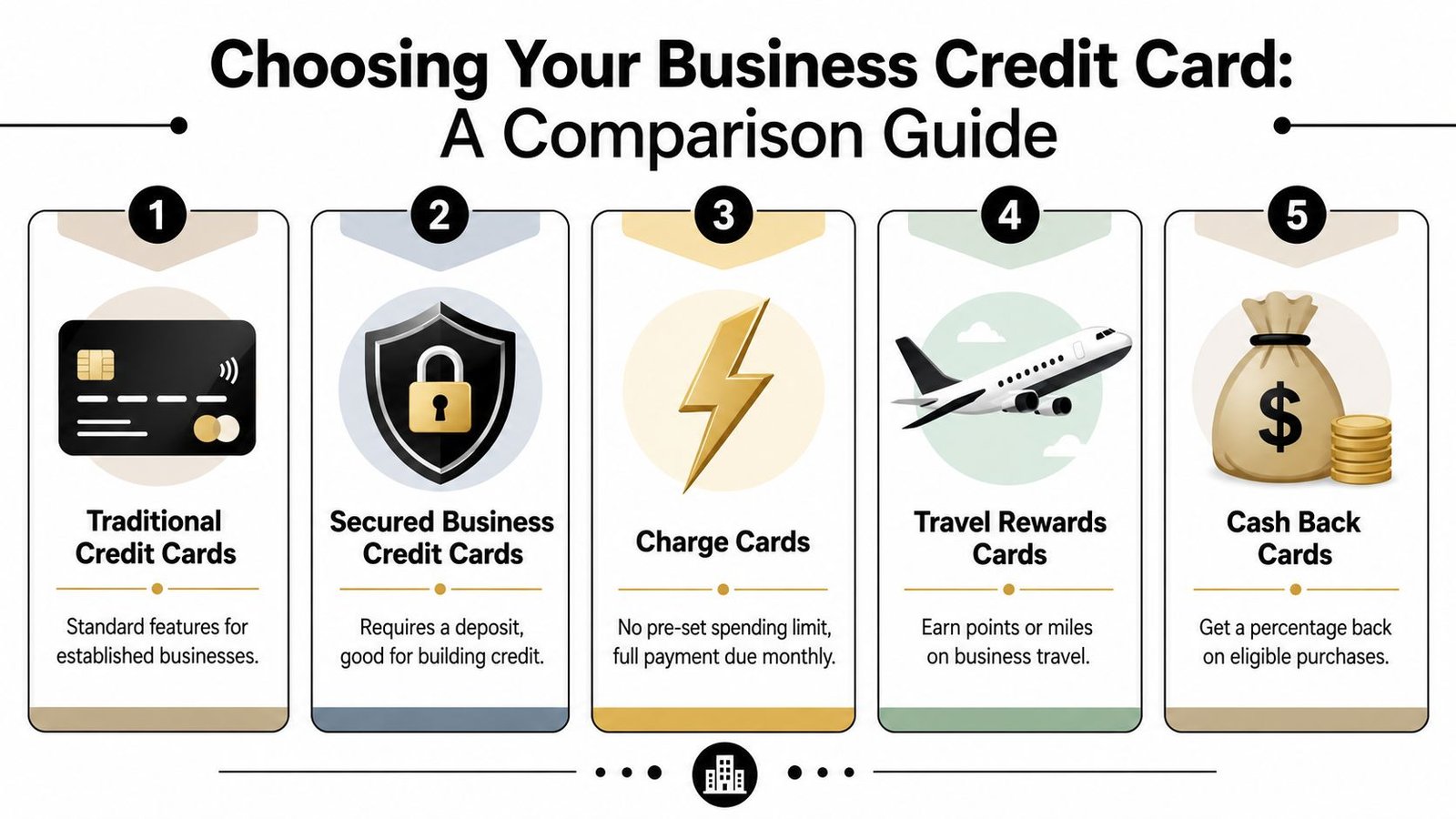
How do the main card types compare
Some broad categories appear again and again in the UAE market and in founder conversations.
| Card Type | Primary Benefit | Typical Annual Fee | Best For |
|---|---|---|---|
| Traditional Credit Cards | Familiar banking features and broad acceptance | Paid annual fee in many cases | Established companies with stable banking history |
| Secured Business Credit Cards | Easier risk profile for the issuer because of a deposit structure | Varies by provider | Newer businesses building a payment track record |
| Charge Cards | Spending flexibility with full monthly repayment discipline | Varies by provider | Companies with strong monthly cash collection |
| Travel Rewards Cards | Airline miles, lounge access, and travel-related benefits | Often better value if travel is frequent | Founders and teams who fly often |
| Cash Back Cards | Return on routine operational spending | Can suit daily spend if terms are sensible | Businesses with predictable recurring expenses |
Traditional bank cards suit companies that already have established corporate accounts, regular inflows, and enough transaction history for a bank to get comfortable. They are often the simplest fit for mature SMEs.
Secured cards can help where the bank wants extra comfort. They aren't always the first choice, but they can make sense for a younger company that needs card functionality before it qualifies for a broader unsecured facility.
Charge cards are useful when the business wants spending control without revolving debt. They work best when finance teams are disciplined and cash is collected reliably.
Travel rewards cards are popular with consulting, trading, and founder-led sales businesses. If much of your spend is flights, hotels, and cross-border meetings, travel perks can beat generic rewards.
Cash back cards tend to suit companies with heavy monthly operational spending. Think digital ads, software subscriptions, telecoms, couriers, and recurring vendor payments.
How does your spending pattern change the right choice
The wrong way to choose a credit card for business is to start with the headline perk. The right way is to review your last few months of real spending and ask where the card will be used.
If most spend is local and routine, a low-fee or no-fee card can be more sensible than a premium rewards card. If your team travels from Dubai or Abu Dhabi every month, travel features become more relevant. If you need tighter department-level controls, some fintech-style business card products can be operationally easier than a traditional bank card, though founders should still weigh reliability, limits, and repayment model carefully.
A simple selection checklist helps:
- Look at transaction reality: List your top expense categories before comparing benefits.
- Check admin burden: Some products are easy for employee spend controls, receipt capture, and approval trails.
- Review repayment style: If the facility expects full monthly repayment, make sure your receivables cycle supports that.
- Match the card to the company stage: A newly formed Free Zone consultancy and a long-running Mainland trading company usually won't have the same options.
Some founders chase lounge access and points too early. In the first phase, lower admin friction and clean approvals usually matter more.
Who Is Eligible for a Business Credit Card in the UAE
Eligibility in the UAE is not just about whether your company exists. It's about whether the bank understands the company, trusts its activity, and can verify where it sits in the local system.
Why does jurisdiction matter so much
A jurisdiction is the legal framework under which your company is registered. In the UAE, the main practical choices are usually Mainland, Free Zone, or Offshore.
Banks don't read all three the same way. A Mainland company is licensed to operate in the wider onshore economy under the relevant emirate framework, such as Dubai's Department of Economy and Tourism. A Free Zone company is licensed inside a specific economic zone with its own authority, such as Dubai Multi Commodities Centre, Dubai International Financial Centre, Abu Dhabi Global Market, or Sharjah Media City. An Offshore structure usually has narrower operational use and often faces more limits for day-to-day banking products.
This is the detail generic guides often miss. Your jurisdiction influences how easily the bank can verify business substance, review office presence, understand client activity, and decide which card products fit your profile.
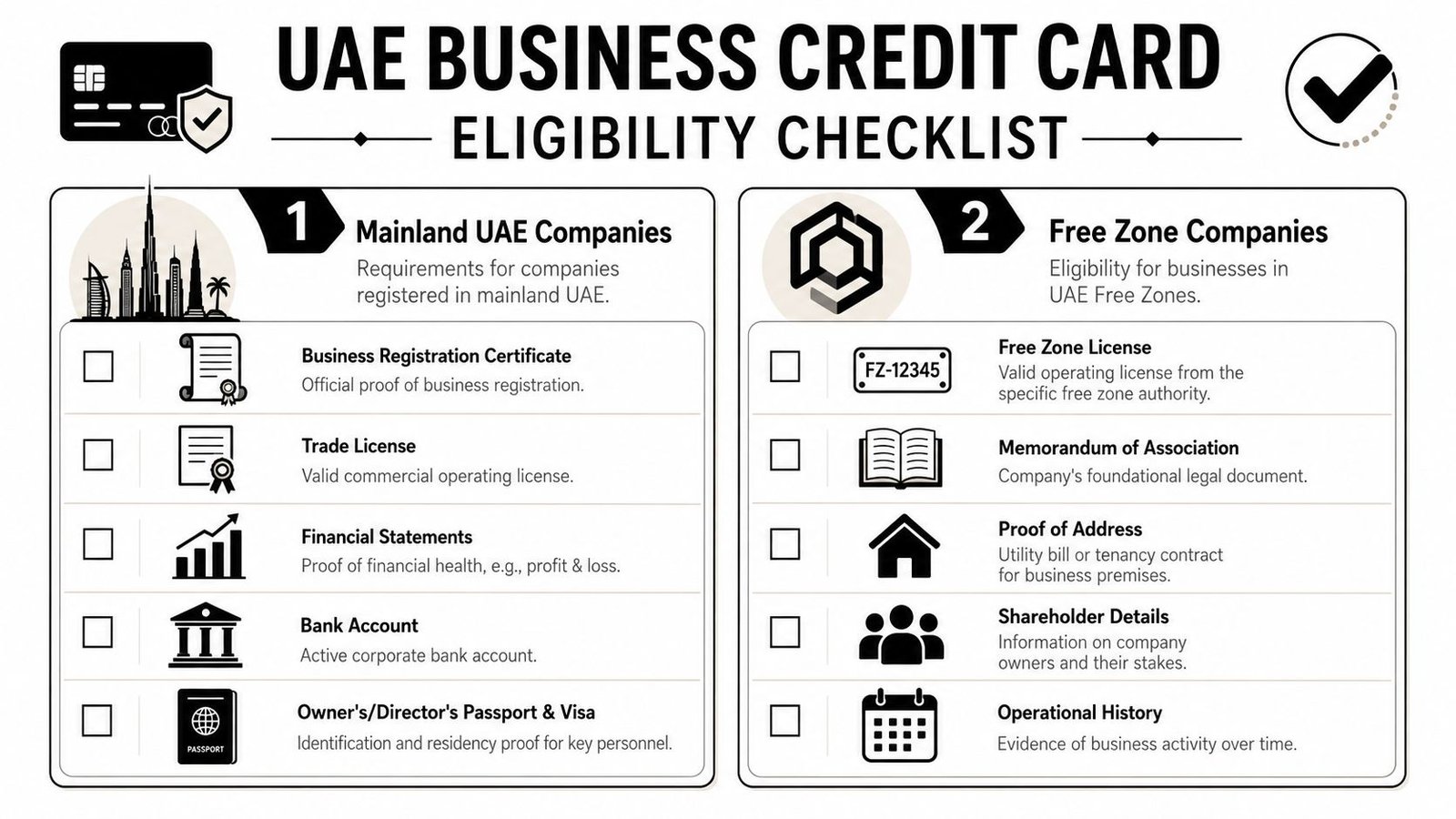
What do mainland companies usually need
Mainland companies usually have the clearest path when the bank can see active local operations, clean licensing, and a functioning corporate account. The bank will want to understand what the company does, where revenue comes from, and whether the applicant is using the card for normal operating needs rather than informal funding.
Common documents and checkpoints include:
- Valid trade licence: The licence must reflect the actual activity of the company.
- Corporate bank account: This account serves as the essential foundation. Without it, there is rarely a realistic card conversation.
- Company constitutional documents: These can include incorporation papers and shareholder records.
- Passport and visa records for owners or directors: Banks need to identify who controls the business.
- Financial evidence: Statements, management accounts, or other records that show business movement and consistency.
A bank usually feels more comfortable if the Mainland company has real office presence, clear invoices, and transaction behaviour that matches its licensed activity.
What do free zone companies usually need
Free Zone companies can qualify well, but the strength of the application often depends on the free zone itself, the nature of the activity, and the substance the company can show. A consultancy in Abu Dhabi Global Market, a trading business in Dubai Airport Freezone, and a startup in Sharjah Research, Technology and Innovation Park may all be reviewed differently.
The bank usually checks whether the company has a valid Free Zone licence, coherent ownership documents, proof of address, and enough operating history to support a business card facility. Free Zone companies that only exist on paper and haven't yet built visible transaction patterns often struggle more than founders expect.
The clearest published baseline is this: in the UAE, business credit cards for startups and SMEs are assessed on company financials rather than personal credit scores, with core requirements including a valid UAE trade licence, a minimum operational history of 6–12 months, and bank statements from the last 3–6 months showing regular cash flow. Most banks require annual revenues between AED 500,000 and AED 1,000,000, and corporate-tier cards may demand audited financials and a board resolution authorising the application, according to Kitt's guide to business credit cards in the UAE.
That explains why some founders in free zones feel blocked even when their company is legally active. The issue is often not the licence itself. It's the lack of transaction history, visible revenue, or supporting documents that prove the business is already functioning.
What about offshore companies
An Offshore company is usually set up for holding assets, structuring ownership, or international business purposes rather than daily onshore operations in the United Arab Emirates. That makes access to a standard credit card for business harder.
Banks often treat Offshore structures more cautiously because local operating substance may be limited. If the company's purpose is holding shares or assets rather than running active UAE trading or service delivery, it may not fit the profile banks prefer for business card facilities.
If you're choosing a jurisdiction and know you will need local banking tools, don't leave the card question until after incorporation. The licensing choice can affect your options later.
How to Apply for a Business Credit Card
Once the business is eligible on paper, the application itself is mostly a documentation exercise. The smoother your file, the fewer clarification loops you get from the bank.
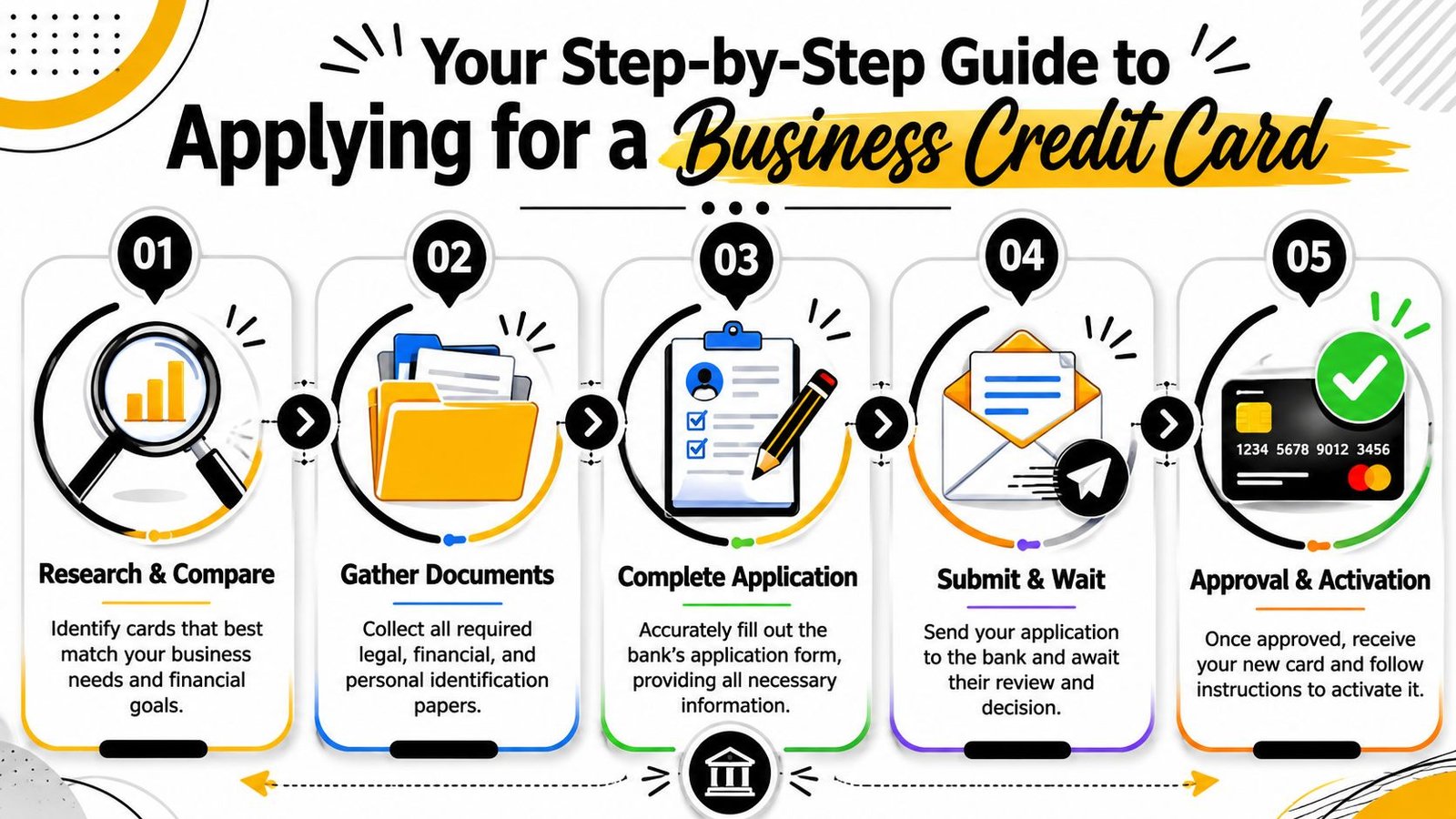
What should you prepare before you apply
Start by assembling the documents that explain three things clearly: who owns the company, what the company is allowed to do, and how the company earns and spends money.
A practical application pack often includes the trade licence, incorporation documents, memorandum of association if applicable, passport and visa copies for key owners or directors, and recent corporate bank statements. Some banks may also ask for internal financial statements, a tenancy document or address proof, and a board resolution where the company structure requires formal approval.
Before submission, check that names match across documents. Small inconsistencies between the licence, bank account, and constitutional papers can slow the process more than founders expect.
How do you choose the right bank and submit cleanly
Don't apply everywhere at once. It creates unnecessary noise, and it doesn't improve the quality of your file.
Instead, shortlist banks where your company already has a working relationship or where your business profile fits the card product. A founder with regular local revenue and straightforward operating spend may do fine with a standard SME product. A business with travel-heavy spending or more senior corporate structure may need a different fit.
Use a simple sequence:
- Match product to use case: Choose based on actual spend pattern, not the brochure headline.
- Confirm eligibility informally first: Ask the relationship manager or bank representative what their minimum comfort points are.
- Submit a complete pack: Partial applications create follow-up emails and delays.
- Answer queries quickly: Most delays happen because the bank asks a question and the founder responds days later with incomplete attachments.
What happens after submission
After submission, the bank reviews the company's legal documents, financial profile, and bank behaviour. It may ask about transaction patterns, major clients, expected card use, or whether employee cards are needed.
This review stage is where weak setup choices show up. If the company activity on the licence doesn't match the transaction trail in the bank account, expect questions. If the jurisdiction suggests one kind of business but the account behaviour suggests another, expect more questions.
A few habits help:
- Keep explanations short: One clear paragraph about what the company does is better than a vague multi-page note.
- Use labelled files: Banks respond faster when documents are named properly and grouped sensibly.
- Make sure signatories are available: Some applications stall because an authorised signatory is travelling or unreachable.
- Prepare for compliance follow-ups: Extra questions aren't unusual. They are part of the review.
Clean documentation often matters more than persuasive language. Banks approve files they can verify quickly.
What Fees and Limits to Expect
The cost of a business card in the UAE can vary a lot, and many founders focus on rewards before reading the pricing structure. That usually leads to disappointment later.
What will the card actually cost
The most useful hard benchmark is this: UAE business credit card annual percentage rates range from 23.88% annually (1.99% per month) on Emirates NBD corporate cards to 41.4% annually (3.45% per month) on products from RAKBANK, Commercial Bank of Dubai, HSBC, and Standard Chartered. Annual fees vary from AED 500 to AED 5,000 per card, while some products such as RAKBANK Titanium Business and Emirates Islamic Business are free for life, and interest-free purchase periods can extend up to 60 days on some startup-focused cards, according to Meydan Free Zone's guide to UAE startup business credit cards.
That range tells you two things straight away. First, revolving a balance can get expensive fast. Second, headline annual fees don't tell the whole story. A no-fee card isn't automatically cheaper if the structure or features don't suit how your company spends and repays.
A practical way to read card pricing is to split it into three questions:
- What is the standing cost: Annual fee, replacement fee, and any add-on card fee.
- What happens if you carry a balance: APR matters more than rewards if repayment isn't always full.
- How long is the grace period: An interest-free window helps only if your finance process uses it properly.
How should you think about credit limits
A credit limit is the maximum amount the bank allows the company to draw on the card facility. For a new SME, the bank usually bases this on visible business strength rather than optimism about future growth.
In practice, banks look at operating history, bank inflows, account conduct, and how established the company appears. A company with regular receivables, stable balances, and well-documented activity often has a stronger case for a useful limit than a newly incorporated business with thin movement, even if both have the same licence category.
Don't treat the first limit as a final verdict. Many businesses start lower than they want, use the card cleanly, pay on time, and later revisit the facility once the bank has more evidence.
A few sensible habits protect margin and avoid avoidable finance costs:
- Pay in full where possible: Business card interest is usually too expensive to treat as routine financing.
- Avoid using the card for long-term cash gaps: That's what structured lending products are for.
- Check foreign spend terms: If you pay overseas vendors often, fees and exchange treatment matter as much as rewards.
- Review benefit claims against real spend: A premium rewards card can disappoint if your company doesn't spend in the right categories.
Using Your Card and How Inpro Can Help
A business card works best when it becomes part of a disciplined finance system rather than a loose payment shortcut. Once the card is active, set rules early so it doesn't create the same mess it was meant to fix.

How should you use the card once you have it
Use the card for approved operating expenses only. Keep payroll, owner drawings, and unrelated personal costs out of it.
Connect the card feed to your accounting software and require receipts for each transaction. Xero, QuickBooks, and Zoho Books all work better when each charge has an owner, a category, and supporting documentation at the time of purchase rather than at month-end.
If staff need cards, don't hand them out casually. Put written spending rules in place, define who approves what, and review statements regularly. A simple internal policy saves arguments later.
Useful day-to-day habits include:
- Assign clear categories: Advertising, travel, software, office costs, and client expenses should be coded consistently.
- Set review rhythm: Finance or the founder should review charges routinely, not only when the statement lands.
- Use cards for traceable spend: Recurring subscriptions and planned purchases are easier to manage than ad hoc cash-like withdrawals.
- Redeem benefits intentionally: If the card has cashback or travel rewards, make sure someone tracks and uses them.
Why does setup quality affect card access later
Most founders think of the card as a banking product. In reality, it often reflects earlier setup decisions.
If the company was formed in the wrong jurisdiction for its real activity, banking gets harder. If the corporate account was opened without a clear transaction story, card access gets harder. If the documents, signatories, and ownership records are messy, approvals slow down.
That is why the card conversation starts earlier than people expect. It starts when you choose between Mainland and Free Zone, when you decide where the business will have substance, and when you open the first corporate bank account with documents that match how the company will trade in Dubai, Abu Dhabi, Sharjah, or elsewhere in the UAE.
If you're setting up in the United Arab Emirates and want the company structure, licensing, banking, and document flow handled properly from the start, speak with Inpro Corporate Services L.L.C.. A clean setup makes later steps, including corporate banking and access to a credit card for business, much easier.