


The corporate tax registration deadline in the UAE is not one single date; it depends on the month your business licence was issued and your financial year end. You must submit your application before your first tax return is due.
If you're reading this while juggling licence renewals, bank onboarding, visas, and bookkeeping, you're not alone. Many founders in Dubai, Abu Dhabi, Sharjah, and across the United Arab Emirates assume corporate tax registration is a one-off date announced to everyone at once. It isn't. The rule is more specific than that, and once you understand the logic, it's much easier to act on time.
Table of Contents
- Understanding UAE Corporate Tax and Registration
- Who Is Required to Register for Corporate Tax
- How to Determine Your Registration Deadline
- A Step-by-Step Guide to the Registration Process
- Consequences of Missing the Registration Deadline
- What to Do If You Have Missed Your Deadline
- Frequently Asked Questions About Tax Registration
Understanding UAE Corporate Tax and Registration
What is UAE Corporate Tax
UAE Corporate Tax is a federal tax on the net profits of businesses. For most founders, the practical point isn't the definition. It's that registration is a separate compliance step from licence issuance, value added tax registration, payroll, or bank account opening.
A common misunderstanding is that a company only needs to register if it expects to pay tax. That's not how you should approach it. In practice, businesses across the UAE, including many in free zones, should treat corporate tax registration as a standard requirement unless they have confirmed, case-specific grounds showing otherwise.

Practical rule: Don't wait until you know whether you'll owe tax. Registration usually comes first. Assessment of liability comes after.
Who handles registration in the UAE
The Federal Tax Authority, or FTA, is the government body that administers tax matters in the United Arab Emirates. The registration itself is handled through EmaraTax, which is the FTA's online tax portal.
If you've dealt with the Department of Economy and Tourism in Dubai, the Abu Dhabi Department of Economic Development, or a free zone authority such as Dubai International Financial Centre and Abu Dhabi Global Market, this can feel confusing because those bodies issue or regulate licences. Corporate tax registration sits with the FTA, not with the licensing authority.
That distinction matters because many founders assume licence issuance triggers tax registration automatically. It doesn't. You still need to complete the corporate tax registration process on the FTA platform, using your company details, authorised signatory details, and supporting records.
Who Is Required to Register for Corporate Tax
Do mainland and free zone companies both need to register
A taxable person is a person or entity that falls within the UAE corporate tax system. In plain terms, that usually includes companies incorporated in the UAE mainland and companies incorporated in free zones.
Mainland companies are the easiest category to understand. If your business was set up under a local licensing authority in Dubai, Abu Dhabi, Sharjah, or another emirate, assume registration applies unless you've had proper advice confirming a rare exception.
Free zone companies often get this wrong. A free zone company isn't automatically outside the system just because it sits in a special economic area. That applies whether the company is in Dubai Airport Freezone, Dubai Multi Commodities Centre, Sharjah Media City, Abu Dhabi Global Market, or Dubai International Financial Centre. Some free zone businesses may end up with favourable tax treatment, but registration and tax status are not the same thing.
Free zone status can affect the tax result. It doesn't remove the need to check registration duties carefully.
Do foreign companies with UAE activity need to register
Foreign legal entities can also fall into the net if they have a sufficient presence or business activity in the UAE. The key concept here is whether the business has a taxable connection in the country, such as a local branch, fixed place of business, or other form of presence that creates a filing obligation.
This catches some international founders by surprise. They assume that because the parent company is incorporated outside the United Arab Emirates, local registration isn't relevant. If the business is conducting operations in the UAE in a way the rules recognise, that assumption can create avoidable problems.
The safest approach is to look at how the business operates on the ground. Ask where contracts are managed, where staff sit, where customers are served, and whether the company has a licensed presence or branch.
Do individuals and freelancers need to register
A natural person is an individual, not a company. In UAE corporate tax practice, this matters because some individuals carry on business activities under a commercial licence in their own name or through a sole establishment.
That means many freelancers, consultants, and sole proprietors shouldn't dismiss the topic as something only large companies deal with. If a person is doing licensed business activity in the UAE, registration may still apply even when the operation is small, newly launched, or run by one person.
A practical way to think about it is this:
- Licensed activity matters: If you hold a commercial, professional, or freelance licence, tax registration may be relevant even if you're the only person in the business.
- Revenue isn't the only trigger to review: Businesses with light activity, slow starts, or no invoices yet still need to check their status.
- Structure changes the process: A company, branch, and sole establishment don't always follow the same paperwork path, even when the owner is the same person.
How to Determine Your Registration Deadline
A founder usually checks this after the uncomfortable moment. The accountant asks for the tax registration number, the bank is doing a review, or an investor DD list lands in the inbox. At that point, the only useful question is simple. What is my deadline, and have I already missed it?
Start with two dates. The first is the month on the trade licence issuance record. The second is the deadline for the first corporate tax return. In practice, the earlier pressure point is the one to respect.
What date controls your deadline
For most businesses, the licence issue month is the starting point. It does not turn on when operations became busy, when the first invoice was raised, or when the team started paying attention to corporate tax. The licence record is usually what sets the registration timetable.
Because this article is published on 4 July 2026, some 2026 licence-month deadlines have already passed. Read the table below as a status check, not as a list of future dates.
| UAE Corporate Tax Registration Deadlines by License Issuance Month (2026 status as of 4 July 2026) | Registration Application Deadline | Status on 4 July 2026 |
|---|---|---|
| January or February | 31 May 2026 | Passed |
| March or April | 30 June 2026 | Passed |
| May or June | 31 July 2026 | Upcoming |
| July or August | 31 August 2026 | Upcoming |
| September or October | 30 September 2026 | Upcoming |
| November or December | 31 October 2026 | Upcoming |
One mistake shows up often. Businesses look at the licence year instead of the licence month. For this deadline check, the month is the practical reference point.
How should you read the deadline table
Take the original licence issuance month from the official record and match it to the table. A mainland company licensed in June and a free zone company licensed in June fall into the same month bucket for this purpose.
Then stop and sense-check the result against your filing cycle. If the first corporate tax return deadline arrives sooner than expected, do not treat the table as a reason to delay. Registration should be completed early enough that the business can file properly and fix any portal or document issues without last-minute pressure.
If the licence paperwork is unclear, use the earliest clear official issuance record and verify it before filing. That small check is usually faster than correcting a bad submission later.
How does the first tax return timing affect registration
The licence month gives you the starting deadline. Your first tax return timing tells you how much room you really have.
A business with a straightforward calendar year may feel it has time. Sometimes that is true on paper and false in practice. Signatory access is missing. The trade licence was renewed but the old version is still being used internally. The person handling EmaraTax cannot complete the submission because authority was never set up properly. Those are the delays that matter.
Here is the practical playbook I use with clients:
- Pull the latest licence and confirm the original issue month.
- Confirm the financial year end used for corporate tax.
- Check whether the registration deadline has passed, is close, or still gives you time.
- If the deadline is still ahead, file early rather than waiting for month-end.
- If the deadline has already passed, prepare the application immediately and deal with the missed-deadline issue as a separate step.
That last point matters. A missed deadline is not a reason to freeze. It is a reason to file now, keep records clean, and then handle any penalty or clarification from a better position.
A simple example helps. If your licence was issued in April, your registration deadline was 30 June 2026. As of 4 July 2026, that date has passed. The right move is not to debate whether the business was active enough to count. The right move is to confirm the facts, submit the registration without delay, and prepare for the next steps.
If your licence was issued in June, the table gives you 31 July 2026. That is still close. Treat it as a working deadline for this month, not something to leave until the final few days.
A Step-by-Step Guide to the Registration Process
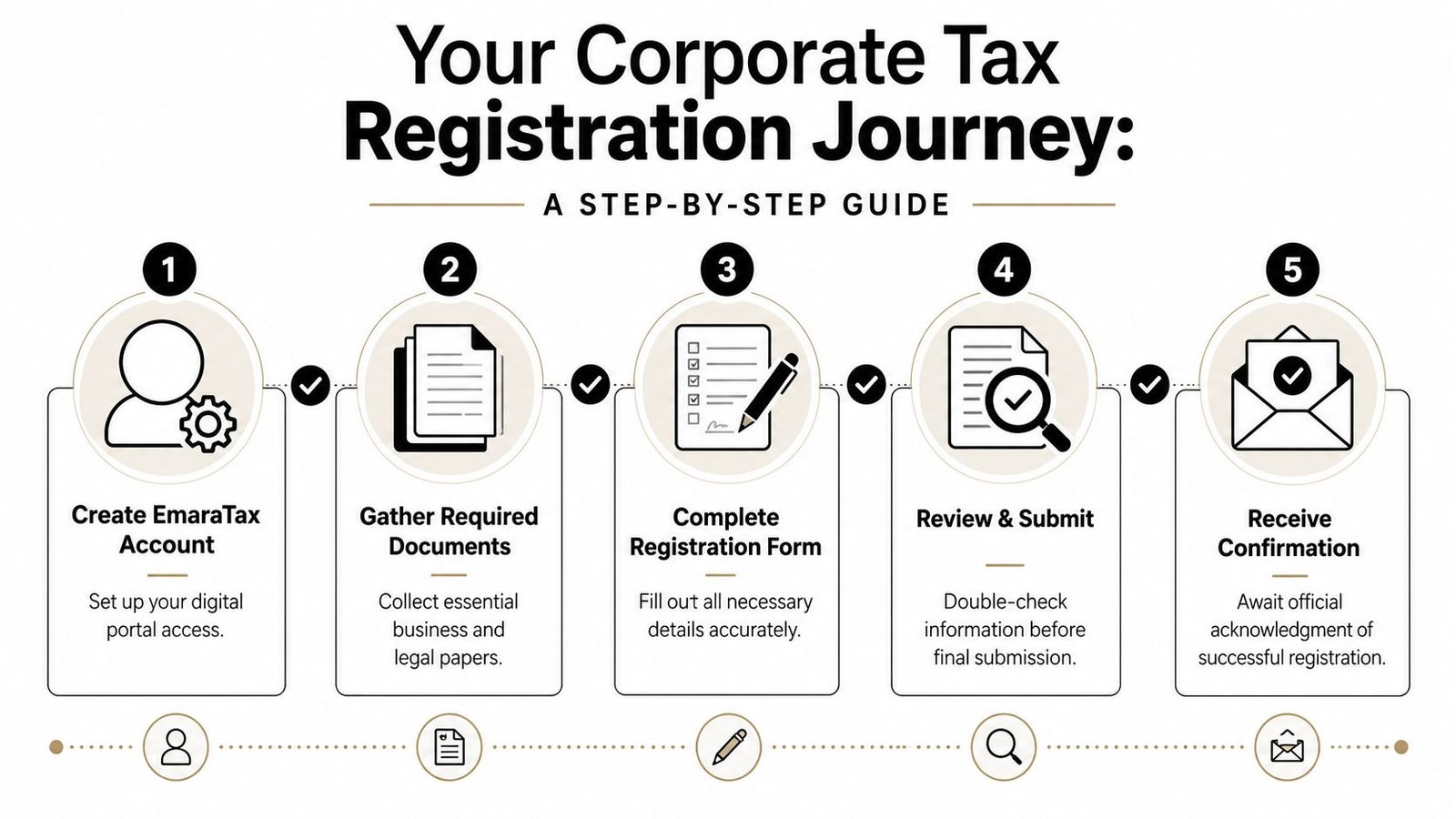
A clean application starts before you log into EmaraTax. Most delays happen because the business hasn't aligned its documents, signatory authority, and legal details across the trade licence, passport records, and tax portal profile.
What documents should you prepare first
Start with the basics and make sure they match. If your company name appears one way on the licence, another way on the immigration record, and a third way in internal files, stop and fix that first.
A practical document checklist usually includes:
- Trade licence copy: Use the latest official licence and check that the issue date is readable.
- Passport and Emirates ID details: Prepare identity documents for the owner, manager, or authorised signatory, depending on the structure.
- Contact information: Use an email address and phone number the business actively monitors.
- Entity details: Keep the legal name, registered address, business activities, and ownership information ready in one place.
- Authorisation records: If someone other than the owner is handling the filing, make sure the authority is clear before submission.
How do you complete the application on EmaraTax
EmaraTax is the FTA's digital portal for registrations, returns, and tax account management. If the business doesn't already have access, create the login first and make sure the right person controls the credentials.
Then move through the registration form carefully. Enter the entity type, licence details, business activities, contact details, and financial year information exactly as the official records show them. If the company is part of a wider group or has related parties, don't improvise descriptions just to get through the form faster. Those entries can affect later filings.
This walkthrough can help if you want to see the process visually before starting:
What mistakes slow applications down
The most common problems are boring, which is good news because they're avoidable. Most are caused by inconsistency, not technical complexity.
Watch for these trouble spots:
- Wrong tax period selection: Don't pick a financial year casually. Use the company's actual reporting cycle.
- Mismatch in legal names: The portal entry should reflect the licence and constitutional documents.
- Loose ownership details: If shareholders or partners have changed, update records before filing where needed.
- Unclear signatory authority: The FTA needs to see that the person acting for the business is entitled to do so.
A fast filing isn't the same as a good filing. A careful application saves time later when returns, amendments, or clarifications come up.
Consequences of Missing the Registration Deadline
What penalty applies if you register late
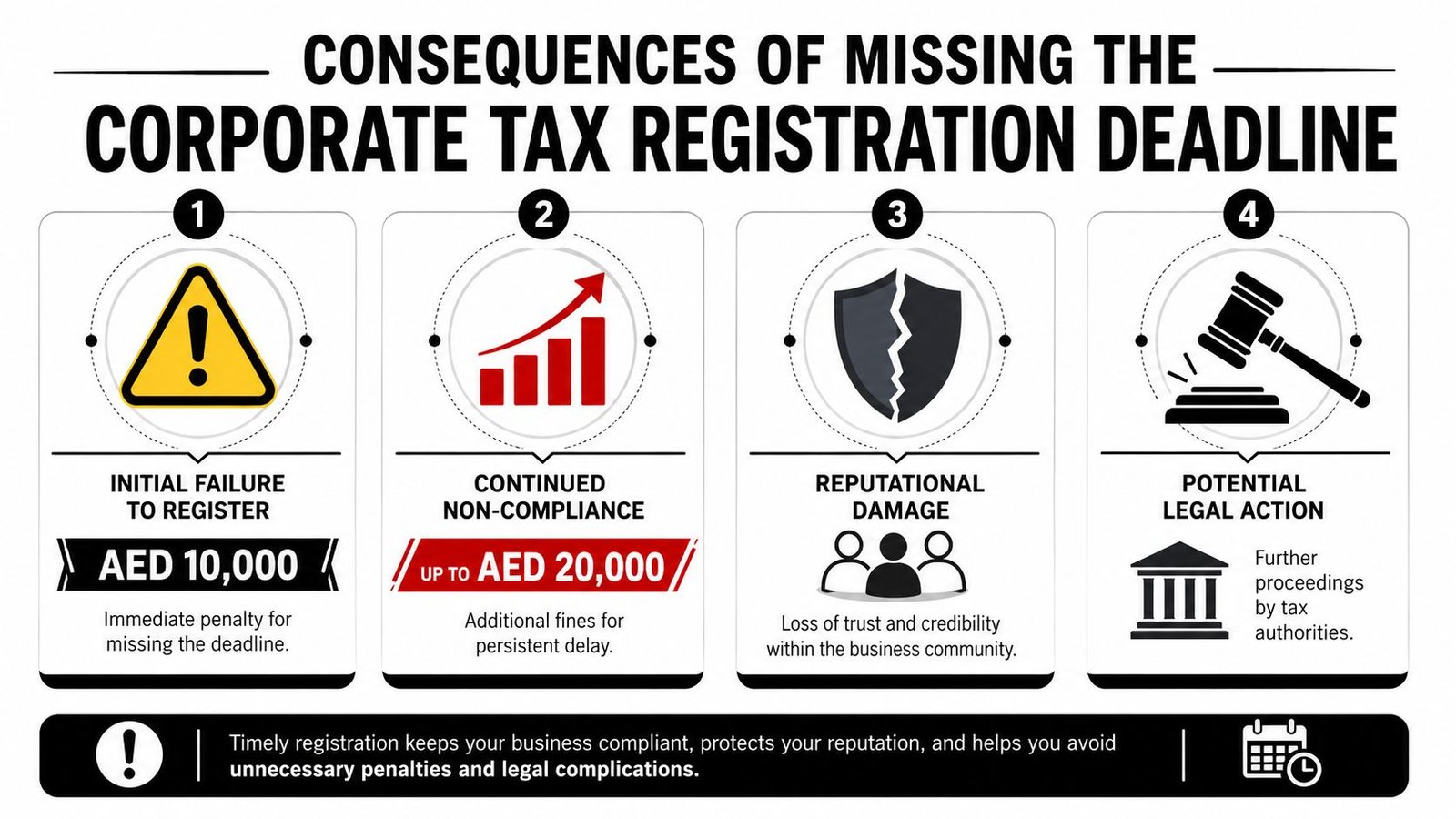
Missing the corporate tax registration deadline has a direct cost. The Federal Tax Authority has specified an administrative penalty of AED 10,000 for businesses that fail to submit their corporate tax registration application within the designated timeframe, under Cabinet Decision No. 75 of 2023 on Administrative Penalties issued by the FTA.
That is the part most founders focus on first, and rightly so. It turns a delayed admin task into a real business expense.
Why late registration creates bigger admin problems
The penalty is only one issue. Late registration also tends to spill into other areas of business operations.
When a company registers late, the finance team often has to solve several problems at once. They may be trying to complete bookkeeping, confirm the tax period, clean up signatory access, and prepare for filing deadlines under pressure. That increases the chance of bad data going into the system.
For founders, the bigger trade-off is attention. Fixing late compliance usually drags management time away from sales, hiring, or launch work. If you're running a lean operation in the UAE, that distraction is often more painful than the registration itself would have been.
A calm approach works better than panic:
- Registering on time keeps options open: You can handle returns, amendments, and internal planning in order.
- Waiting creates avoidable friction: Small document mismatches become urgent issues when deadlines are close.
- Order matters: Registration first, then ongoing filing discipline.
What to Do If You Have Missed Your Deadline
What should you do first if you are already late
If you've missed your deadline, the first step is simple. Register now.
Don't wait for a perfect explanation, a cleaner set of books, or a quieter week. Those delays usually make the position harder, not better. Open the file, confirm the company details, and get the application moving through EmaraTax.
Late is still fixable. Silence is what usually makes a manageable issue worse.
Can you still fix the situation cleanly
Yes, in many cases you can still put the business back into order. The usual path is to complete the overdue registration, keep records showing what happened, and review whether any follow-up action is appropriate based on the specific facts.
If a penalty has already been applied or you think the filing history needs correction, get proper advice before making further submissions. The right next step depends on the company structure, what has already been filed, and whether there were genuine access or record issues. Founders often make things messier by sending partial explanations before they understand the full file.
A practical recovery plan looks like this:
- Submit the registration without more delay.
- Download and save all portal confirmations.
- Review the tax period and filing calendar immediately after registration.
- Check whether any correction or further representation is needed.
- Keep one person responsible internally so the matter doesn't drift again.
Frequently Asked Questions About Tax Registration
Do free zone companies expecting 0 tax still need to register
Yes, in many cases they do.
A free zone company can still be within the corporate tax system even if it expects to qualify for 0 percent treatment. Registration is about entering the system on time. Whether tax is payable comes later, based on the company's facts, income, and compliance position.
What if the business is dormant or has no revenue
Dormant does not automatically mean exempt from registration.
If the legal entity exists, the right question is whether it falls within the UAE corporate tax rules, not whether sales are low this year. I often see founders assume inactivity buys time. It usually does not. Check the entity status, licence details, and deadline rather than relying on a common-sense guess.
Do offshore companies need to register
Sometimes yes, sometimes no.
The answer depends on the legal structure, where the business is managed, and whether the setup creates a UAE tax obligation. Offshore cases are often where broad advice causes trouble, because the paperwork may say one thing while the actual operating model says another. If there is any UAE presence, local management, or UAE-source activity, get the position reviewed properly before you assume registration is not required.
Is there a government fee for corporate tax registration
No, there is no government fee for the corporate tax registration application itself. However, failing to register on time can lead to an administrative penalty of AED 10,000.
For stressed founders, the practical playbook is simple. If you are unsure whether the entity must register, confirm that first. If registration is required, submit it before the deadline. If you are already late, file now and then sort out the follow-up steps with a clear record of what was submitted and when.
If you're a founder, freelancer, HR lead, or international business owner expanding into Dubai, Abu Dhabi, or another part of the United Arab Emirates, keep the process simple. Confirm which entity is in scope, work out the correct deadline, and complete the registration before the first return cycle becomes a problem.
Not sure where to start? Book a free strategy call with Inpro Corporate Services L.L.C. for practical help with UAE company setup, PRO support, visas, and corporate tax registration.