

Setting up an LLC in the UAE involves choosing a jurisdiction, Mainland, Free Zone, or Offshore, preparing legal documents, and completing a multi-step registration process, which can take from a few days to several weeks. If you're trying to decide where to start, the practical answer is this: pick the right jurisdiction first, because that decision affects your licence, visas, banking, office needs, and how you can trade inside the United Arab Emirates.
Most founders arrive at this point with the same concern. They don't mind doing the work, but they don't want to choose the wrong structure, lose time on avoidable rejections, or discover after incorporation that banking or visas are harder than expected. That's a sensible concern.
An LLC in the UAE can be straightforward when you break it into the right sequence. The UAE remains an active place for new company formation. According to the UAE Ministry of Economy media centre, the number of new business licences issued in 2025 grew by over 15% year-on-year, which reflects continued demand from founders, investors, and expanding businesses.
Table of Contents
- Your Guide to Setting Up a UAE Limited Liability Company
- Choosing Your Jurisdiction Mainland Free Zone or Offshore
- The LLC Registration Process and Timelines
- Navigating Visas Ownership and PRO Services
- Banking Taxation and Budgeting for Your LLC
- Common Pitfalls and How Inpro Streamlines Your Setup
Your Guide to Setting Up a UAE Limited Liability Company
You have a business plan, a shortlist of names, and a rough budget. Then the important questions begin. Should the company sit on the mainland or in a free zone, can you own it the way you expect, will the bank ask for more than the licence, and how long will visas take?
That is usually the point where founders realise UAE company formation is not difficult because the rules are hidden. It is difficult because several decisions connect to each other. The legal structure affects the licence. The licence affects the office requirement. The office setup affects visas. Your activity, ownership profile, and visa plan all affect banking.
A limited liability company separates the company's obligations from your personal assets under the applicable legal framework. For a foreign founder, that matters, but the practical question is simpler. Is this the right vehicle for the business you want to run, not just the company you want to register this month?
In most cases, the answer depends on five points: where you want to operate, what activity you will be licensed for, who the owners are, whether you need residence visas, and how clients and suppliers will pay you.
There are three broad jurisdiction choices:
- Mainland companies are licensed to operate in the local UAE market.
- Free Zone companies are formed inside a designated zone with its own authority and operating rules.
- Offshore companies are usually used for holding assets or cross-border business, not for day-to-day UAE operations.
A cheap setup can become an expensive correction. I have seen founders choose a structure based on the first quote they received, then spend more time and money fixing licence scope, banking issues, or visa limits a few months later.
The better approach is to start with the business you expect to be running six months from now. If you need local clients, staff on the ground, and a bank account that supports real trading activity, your setup should reflect that from day one. If you are building a holding structure or serving overseas clients remotely, the right answer may be very different.
Choosing Your Jurisdiction Mainland Free Zone or Offshore
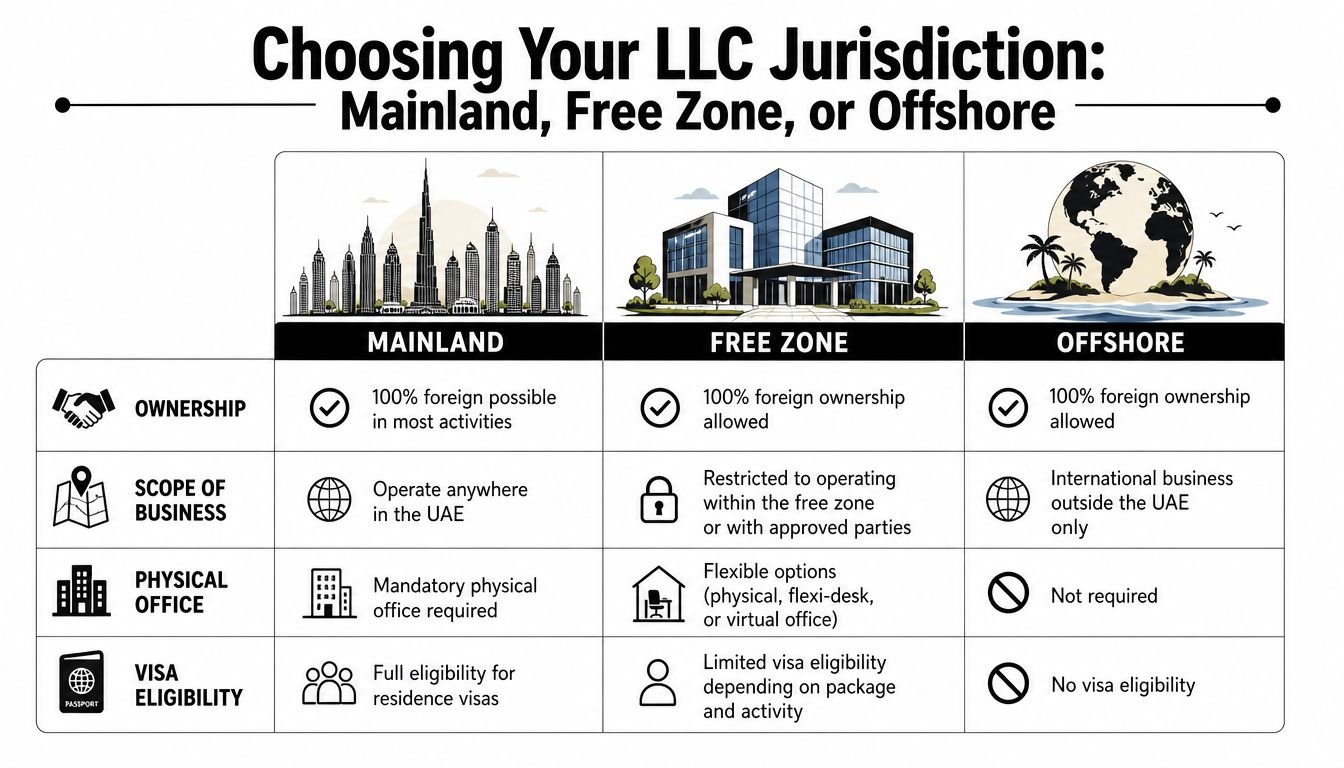
This is the decision that shapes almost everything else. Ownership, local trading rights, office obligations, immigration options, and even the bank account conversation all start here.
What is a Mainland LLC
A Mainland LLC is a company licensed by the relevant emirate-level authority for onshore business activity in the UAE. In Dubai, founders often deal with the Department of Economy and Tourism, commonly called DET, which is the authority responsible for issuing many mainland business licences in Dubai.
Mainland usually suits founders who want to trade directly within the UAE market, sign local commercial contracts, open a visible office presence, or bid for work with businesses across the country. If your clients are in Dubai, Abu Dhabi, or Sharjah and you want fewer structural restrictions on where you operate, mainland is often the practical answer.
A common example is a trading company, consultancy with local corporate clients, restaurant group, clinic support business, or recruitment firm serving UAE employers.
What is a Free Zone LLC
A Free Zone LLC is a company registered inside a special economic area governed by its own authority. Free zones are popular because they often offer simpler incorporation paths, controlled business environments, and structures that are familiar to foreign founders.
Many free zones are sector-led. Dubai International Financial Centre, or DIFC, is a financial centre with its own legal and regulatory environment. Abu Dhabi Global Market, or ADGM, serves a similar role in Abu Dhabi. Others, such as logistics or media-focused zones, are designed around particular industries or business models.
Free zone setup often works well for consultants, holding companies, digital businesses, regional service firms, and founders who don't need to trade freely across the onshore UAE market from day one. The trade-off is that the free zone itself may define what activities, office formats, and external trading arrangements are allowed.
What is an Offshore company
An Offshore company is a non-resident structure usually used for international trade, holding shares, asset ownership, or group structuring. It isn't the right vehicle for someone who wants to rent an office in Dubai and hire a local sales team for direct UAE trading.
Founders usually look at offshore structures when they want a clean holding layer, a vehicle for owning assets, or a company for cross-border arrangements that don't require local operational substance in the UAE. Examples often include entities registered through jurisdictions such as RAK ICC for international structuring purposes.
Offshore sounds simple on paper. It often disappoints founders who actually need visas, premises, or local commercial operations.
How should you choose between them
The cleanest way to decide is to match the structure to your real operating plan.
| Need | Usually points to |
|---|---|
| Direct business in the UAE market | Mainland |
| Sector-specific ecosystem or simpler setup path | Free Zone |
| Holding assets or international structuring | Offshore |
| Staff visas tied to an operating company | Mainland or Free Zone |
| No local operations planned | Offshore may fit |
A few practical signals help:
- You need local customers now: Mainland is usually the safer choice.
- You sell services remotely or regionally: A Free Zone company may be enough.
- You want a holding vehicle: Offshore may be the cleaner route.
- You're still unsure about activity scope: pause and define your licence activity before filing anything.
The LLC Registration Process and Timelines
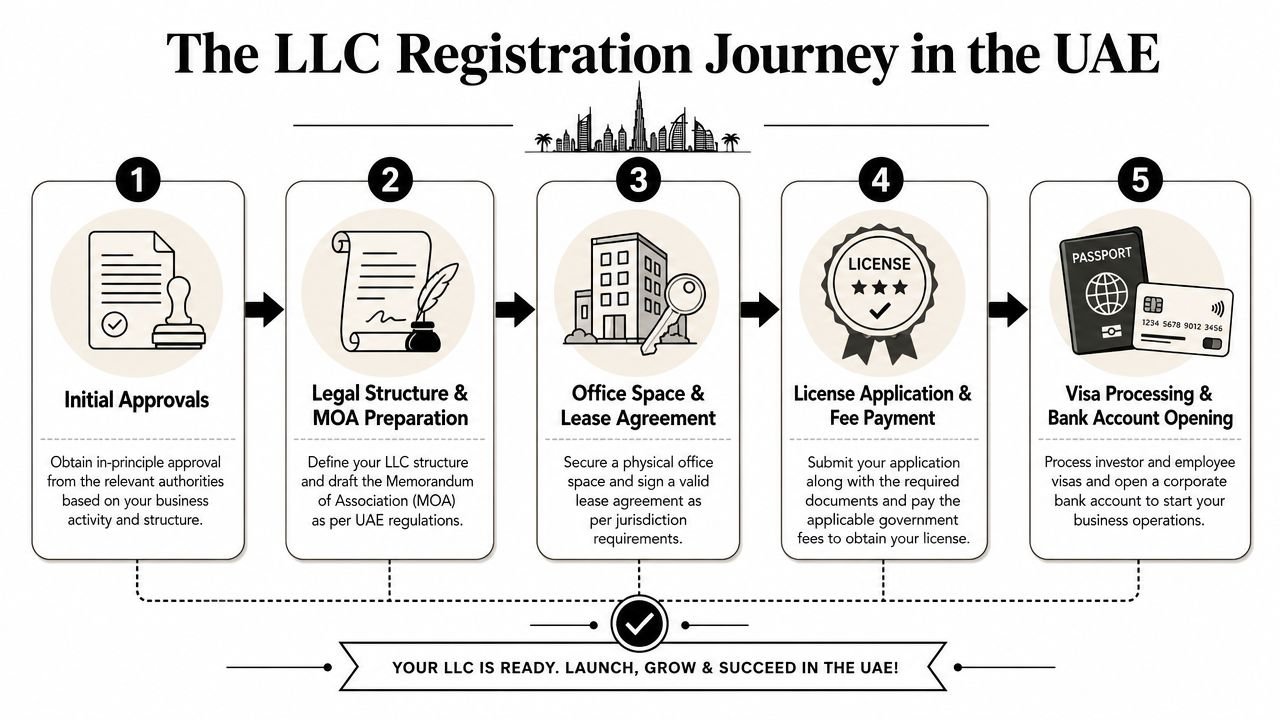
Registration isn't one form. It's a chain of approvals, documents, and authority checks that need to line up properly.
A simple visual helps:
How does the process usually start
The process usually begins with licence activity selection, trade name reservation, and initial approval. Activity selection matters because the authority will assess your company against the exact commercial activity on the application, not the broad idea in your head.
Trade name checks are more important than many founders expect. Names can be rejected for similarity, restricted wording, regulated terms, or mismatch with the intended activity. If the founder rushes this stage, delays often start here.
What documents and approvals do you usually need
Most setups require passport copies, shareholder details, a proposed company structure, and formation forms from the relevant authority. A Memorandum of Association, often shortened to MoA, is the legal document that sets out ownership and company rules for many structures.
For mainland companies, office evidence is often tied closely to licensing. For free zones, office requirements vary. Some allow flexible desk or business centre options, while others expect a more defined physical presence depending on activity and visa allocation.
A realistic sequence usually looks like this:
- Choose the activity and legal form so the authority can assess the right licence class.
- Reserve the trade name and clear any naming objections early.
- Prepare constitutional documents such as the MoA and shareholder resolutions where required.
- Secure premises or lease evidence if the jurisdiction requires it.
- Submit the licence file and pay fees once the paperwork is aligned.
The practical mistake is filing documents before the activity, ownership, and premises logic are fully consistent. Authorities don't like ambiguity, and banks like it even less later.
How long does setup usually take
Timing depends on the jurisdiction, the activity, the document quality, and whether external approvals are required. Some free zone cases move quickly when the activity is standard and documents are clean. Mainland cases can move smoothly too, but they often involve more moving parts, especially where office documentation, regulated activity approvals, or additional shareholder documentation are involved.
This video gives a useful overview of the setup journey founders usually go through:
A company can be incorporated before the founder feels operationally ready. The licence is only one milestone. Banking, immigration, tax registration, and document consistency are where many delays actually show up.
A sensible expectation is to think in stages rather than one deadline. Company formation may move in days in some cases, but full operational readiness can extend into weeks once visas, banking, and post-licence registrations begin.
Navigating Visas Ownership and PRO Services
A company setup isn't finished when the licence is issued. For most founders, the next pressure point is residency, staff onboarding, and dealing with government channels they haven't used before.
What is the difference between an investor visa and an employee visa
An investor visa is a residency route linked to ownership or shareholding in the company. Founders and shareholders usually apply under this path when they are setting up the company or joining as owners.
An employee visa is a work and residency route sponsored by the company for staff. That includes managers, administrators, sales staff, and specialist hires, subject to the company's licence, immigration file, and labour approvals.
The distinction matters because each path can involve different documents and approval logic. A founder shouldn't assume that having a company licence automatically resolves staff sponsorship or labour registration.
How does the residency visa process work
The residency process usually includes entry status steps where applicable, medical fitness testing, biometric capture, and Emirates ID registration. The Emirates ID is the national identity card used across the UAE for official verification, banking, telecoms, tenancy, and many routine transactions.
Founders often underestimate how sequence-sensitive this is. If the company immigration file isn't ready, or if a signature, job title, or shareholder detail doesn't match the licence file, the visa process can stall.
A practical checklist helps:
- Check shareholder details first: Passport spellings, nationality details, and signatures should match the company file.
- Confirm visa eligibility early: Some structures offer more flexibility than others for shareholder and employee visas.
- Prepare for in-country steps: Medical tests, biometrics, and ID issuance are part of the normal process.
- Track expiry dates carefully: Renewal problems usually start with missed reminders, not complex law.
What is a PRO and why does it matter
A PRO, or Public Relations Officer, is the specialist who handles company-facing government transactions in the UAE. That can include immigration processing, labour-related submissions, document attestation follow-up, licence amendments, and interactions with ministries and local departments.
Two authorities often matter here. MOHRE means the Ministry of Human Resources and Emiratisation, which handles labour-related matters for many employers in the UAE. Immigration departments handle residency and entry status procedures tied to visas and Emirates ID processing.
When founders say UAE setup is confusing, they usually don't mean the idea of forming a company. They mean the volume of small official steps that depend on one another.
For a new entrant, PRO support is often the difference between chasing portals, counters, and status updates yourself, or having someone manage the sequence on your behalf. That doesn't remove your obligations as the owner, but it saves time and reduces avoidable filing errors.
Banking Taxation and Budgeting for Your LLC
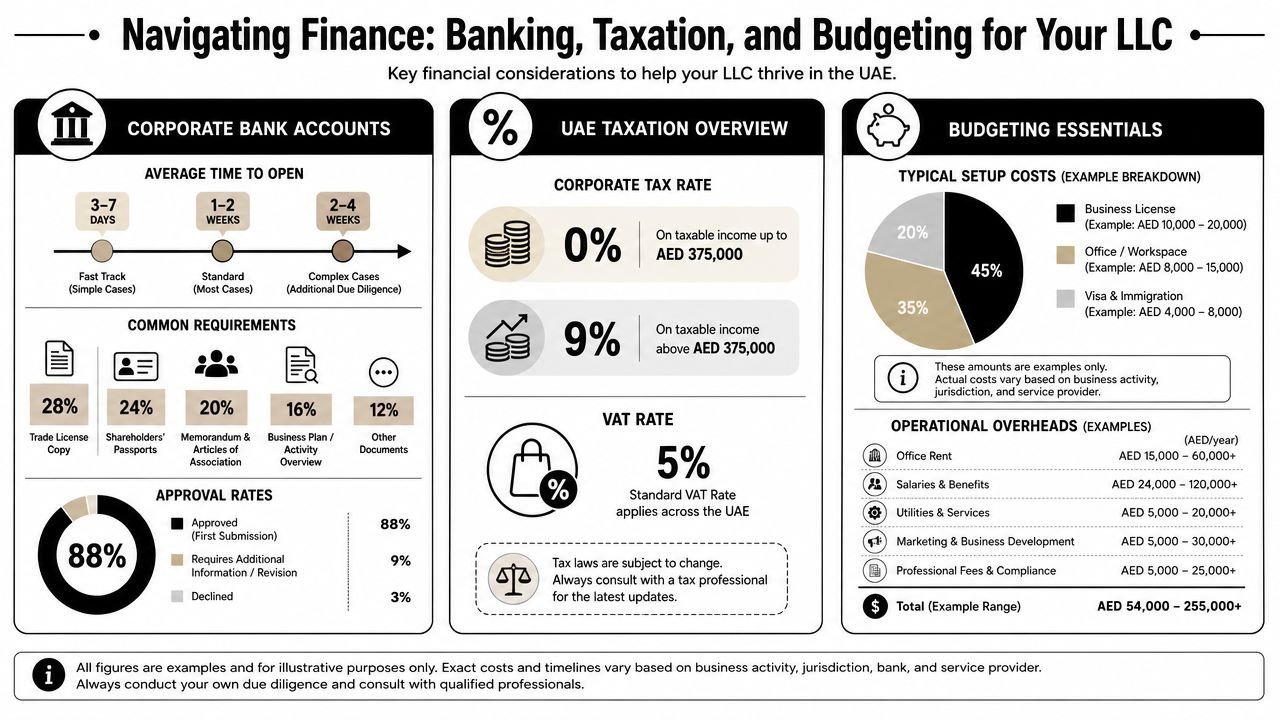
Once the licence is live, the financial side starts, and many founders then realise that incorporation and actual operating readiness are not the same thing.
Why is corporate banking often the hardest part
A corporate bank account is a business account opened in the company's legal name for receiving payments, paying suppliers, payroll, and routine operations. In the UAE, banks usually look beyond the trade licence itself. They want to understand ownership, activity, source of funds, expected transaction profile, and whether the company has real commercial substance.
Weak setups become evident when the licence activity is vague, the website doesn't match the business, the shareholder can't explain the model clearly, or documents conflict. The bank may then ask repeated questions or not proceed.
The founders who move through banking more smoothly usually do three things well:
- Present a consistent file: Licence, MoA, passport details, website, invoices, and business plan all tell the same story.
- Show substance: Office arrangements, contracts, supplier relationships, or a clear operating model help.
- Choose the right bank approach: Different banks have different risk appetites, sectors, and document expectations.
What should you know about tax in the UAE
Value Added Tax, or VAT, is a consumption tax that applies to certain taxable supplies in the UAE. Corporate Tax is a business tax regime that can apply depending on the company's profits, activities, and status.
What matters for a founder at the start is less about memorising tax law and more about knowing your obligations early. If your company should register, file, maintain records, or charge tax correctly, waiting until the first deadline is a mistake.
The practical approach is simple:
| Area | What founders should focus on |
|---|---|
| VAT | Whether the company needs to register and how invoicing should be handled |
| Corporate Tax | Whether the company falls within the regime and what filings will be expected |
| Accounting records | Keeping books, contracts, and invoices organised from the first month |
| Substance and compliance | Making sure the legal structure matches real business activity |
If you're unsure, get accounting and tax advice before the first invoice cycle gets messy. Untidy records create bigger problems than most founders expect.
How should you budget for setup and ongoing costs
Budgeting for an LLC in UAE means separating one-off formation spend from recurring operating spend. The exact amount varies too much by jurisdiction, activity, office format, number of visas, and banking route to give one reliable figure here without risking misdirection.
A better budgeting model is to group costs into buckets:
- Formation costs: licence issue fees, registration charges, name reservation, legal drafting, and authority submissions.
- Immigration costs: investor visa processing, employee visa processing, medical testing, Emirates ID steps, and immigration file work.
- Premises costs: lease, desk package, office fit-out, or business centre arrangements depending on the licence.
- Annual compliance costs: renewals, accounting support, tax filings, payroll administration, and document amendments.
One practical note. Cheap formation packages can shift cost into later stages by excluding office upgrades, amendment work, or post-licence support. That's why a clear written scope matters more than a low headline number.
Common Pitfalls and How Inpro Streamlines Your Setup
A common founder scenario unfolds as follows. The licence is issued, the team expects the hard part to be over, and then significant pressure begins. The bank asks for more documents, the visa file does not match the licence activity, or the business learns too late that its chosen jurisdiction does not fit how it will conduct its operations.
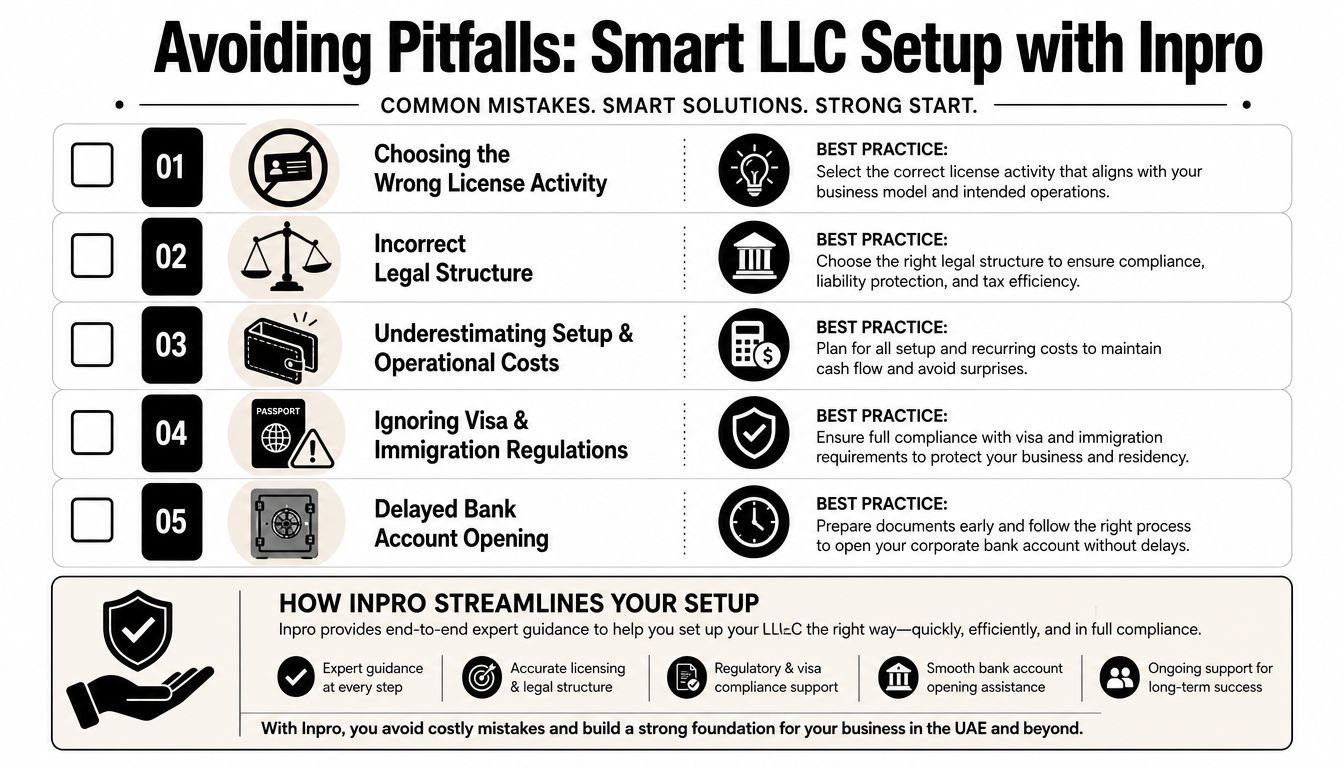
Which mistakes cause the most stress
The problems that hurt founders most usually start with a mismatch.
The first is a licence activity that is too broad, too narrow, or wrong for the way the company will sell. That issue tends to surface later, when a customer reviews your contract, a bank asks what the business does, or an immigration file uses job titles that do not sit comfortably with the licensed activity.
The second is choosing a structure on headline cost alone. A free zone setup may look efficient at the start, but if the business later needs a stronger mainland presence, a different visa model, or a specific office arrangement, the original saving can disappear in amendment work or a second company.
Banking is another pressure point. Founders often assume the licence triggers account opening as a routine next step. In practice, banks review the full commercial story. They want clear ownership records, a sensible business model, consistent documents, and a file that explains where revenue will come from and how funds will move.
Visa administration creates its own kind of stress. One missed renewal or one inconsistency between the company file and an employee's designation can slow down processing and distract management at the worst possible time.
The pattern is simple:
- Wrong activity: the company struggles to contract, invoice, and explain its operations clearly.
- Wrong jurisdiction: the setup works on paper but limits how the business can run.
- Weak banking preparation: the bank requests repeated clarifications or does not proceed.
- Poor visa control: renewals become reactive, and small errors turn into delays.
Clean setup work depends on alignment. The licence, legal structure, immigration plan, and banking file need to tell the same story.
What does a smoother setup look like in practice
A smoother setup starts before any application is filed. The adviser needs to understand how the business will trade in real life, not just what sounds acceptable on a form. That means asking where customers are based, who will sign contracts, whether stock or staff will be in the UAE, how many visas are needed, and what a bank will see when it reviews the case.
That early work saves time later.
Once the setup route is chosen properly, the documents can be prepared with fewer contradictions. The ownership plan matches the legal structure. The licence activity reflects the actual service or product. The visa path and banking file are prepared as part of the same process, not treated as separate problems.
Inpro Corporate Services L.L.C. handles company formation across Mainland, Free Zone, and Offshore structures, along with PRO services, visa support, banking support, and tax-related administration. For founders, the practical value is coordination. One team keeps track of sequence, documents, authority submissions, and follow-up points that are easy to miss when different providers handle each stage in isolation.
If you're comparing setup support, ask direct questions:
- Who handles authority submissions: an in-house team or third-party contractors?
- What happens after licence issue: are visas, banking support, tax registration, amendments, and renewals included or quoted separately?
- How are timelines explained: with specific dependencies and realistic ranges, or with vague promises?
- How are corrections handled: if the first route turns out to be unsuitable, can the adviser adjust the plan without restarting everything?
Not sure where to start? Book a free strategy call with Inpro Corporate Services L.L.C. to map the right UAE structure, visa path, and banking approach for your business.