


Under UAE law, all private sector employment contracts must now be fixed-term for a maximum of three years. A fixed-term contract is an employment agreement with a defined start and end date, usually aligned with the employee's residence visa validity, and it isn't the old open-ended model many founders still assume applies.
That single rule catches a surprising number of businesses in Dubai, Abu Dhabi, Sharjah, and other parts of the United Arab Emirates. Founders often spend time negotiating salary and title, then miss the part that creates the primary risk: the contract format, the Arabic version, the salary structure for gratuity, the registration process with the right authority, and the fact that even Golden Visa holders still need proper employment paperwork when working in the private sector.
Table of Contents
- The New Standard for UAE Employment Contracts
- What Are the Main Types of UAE Employment Contracts
- What Must Be Included in Your UAE Employment Contract
- How Contracts Differ Across Jurisdictions
- Common Pitfalls and How to Avoid Them
- A Practical Checklist for Drafting Your Contract
- Ensuring Compliance and Moving Forward
The New Standard for UAE Employment Contracts
What is the rule now
The basic rule is simple. Under Federal Decree-Law No. 33 of 2021, all employment contracts in the UAE private sector must be fixed-term, and the term cannot exceed three years. Unlimited-term contracts were removed, and existing unlimited contracts had to be updated by 31 December 2023, as explained in Al Tamimi's update on UAE limited and unlimited employment contracts.
For founders, that changes how you hire and how you plan. A contract is no longer something you issue once and forget. You need a system for tracking expiry dates, renewals, notice, and visa timing, because a missed renewal cycle can create administrative and legal problems that were easier to gloss over under the old model.
Practical rule: If your team is growing fast, build a contract expiry calendar from day one. Don't wait until the first renewal month.
Who does this apply to
This applies broadly across the private sector in the United Arab Emirates. If you're hiring through a mainland company in Dubai or Abu Dhabi, this is the baseline position. It also matters to founders who relocate and start employing staff after incorporation, because employment compliance starts early, often before internal HR processes are mature.
A lot of confusion comes from mixing company setup with employment setup. Company registration and employee contracting are linked, but they aren't the same thing. A founder can complete incorporation correctly and still create risk by issuing the wrong employment contract, using an outdated template, or treating a renewal as a casual admin task instead of a regulated employment event.
What Are the Main Types of UAE Employment Contracts
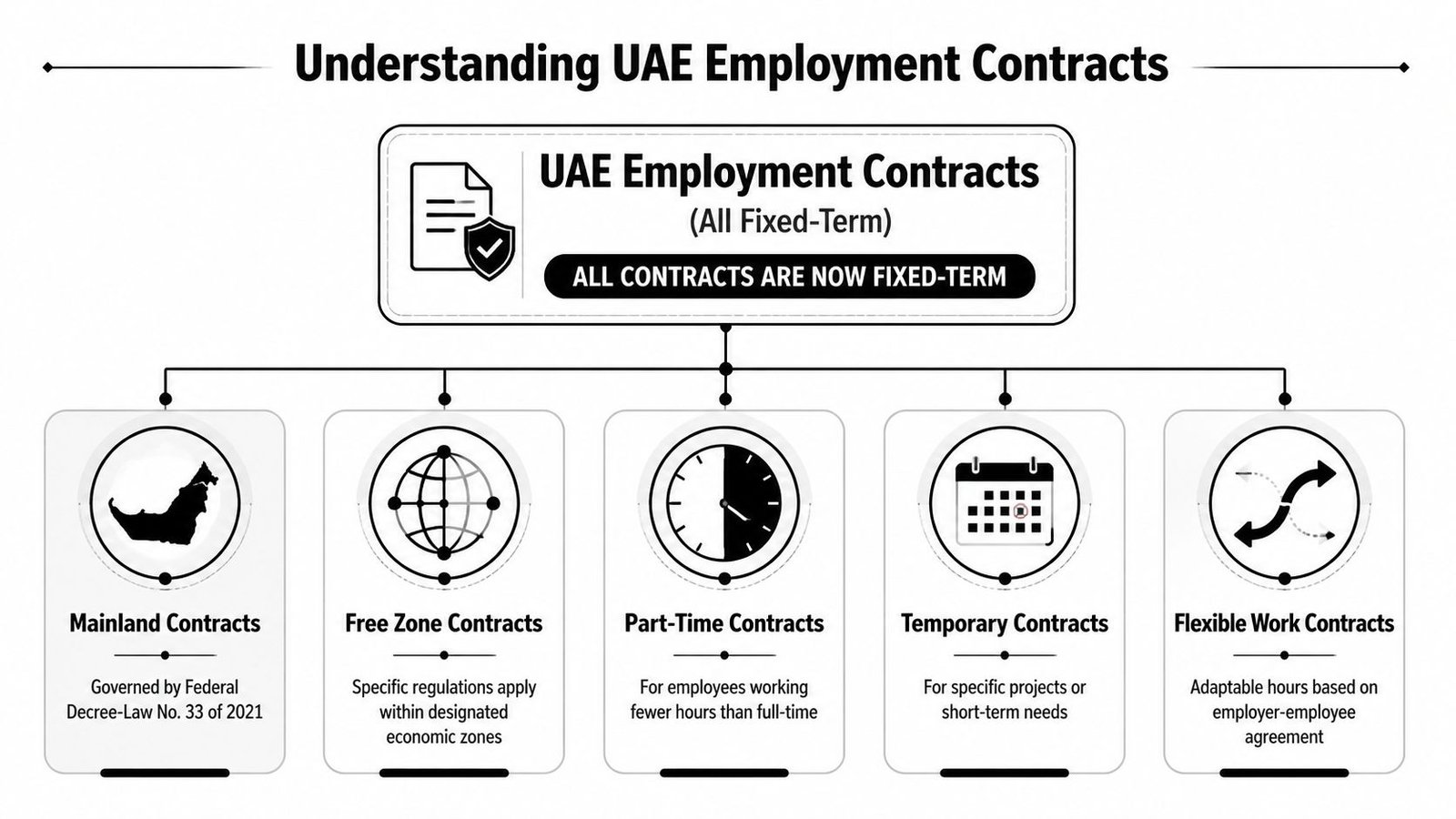
Not every contract looks the same in practice, even though the legal container is now fixed-term. The right choice depends on the role, the workload, the place of incorporation, and who will sponsor the employee.
What is a full-time contract
A full-time contract is the standard arrangement for an employee working regular hours for one employer. On the UAE mainland, private sector contracts must be in bilingual Arabic and English format and registered with the Ministry of Human Resources and Emiratisation, which is the federal labour authority usually shortened to MoHRE, as outlined by Safeguard Global's UAE employment law guide.
For most operating businesses, this is the default. If you're opening a sales office, hiring operations staff, or building an internal finance team, a full-time fixed-term contract is usually the cleanest structure.
What is a part-time contract
A part-time contract is a contract for someone who works fewer hours than your standard full-time employee. It suits businesses that need specialist skills without a full headcount commitment, such as marketing support, a finance manager a few days a week, or a technical adviser during launch.
What works well is matching the contract to the actual working pattern. What doesn't work is calling someone part-time while treating them like a full-time employee in practice. If the actual arrangement and the paper arrangement drift apart, you create problems when disputes arise over hours, leave, or visa conditions.
What is a temporary work contract
A temporary work contract is a fixed-term contract tied to a project, seasonal need, or defined short assignment. This can make sense for product launches, event staffing, implementation projects, or short operational surges.
This model works best when the contract states the work clearly. If the role keeps rolling beyond its original purpose with no proper renewal or amendment, the paperwork starts lagging behind reality. In the UAE, that gap is where simple hires turn into avoidable compliance issues.
What about mainland and free zone contracts
A mainland contract is typically issued through a company licensed under the relevant emirate's onshore system and overseen for labour purposes by MoHRE. A free zone contract is issued through a company incorporated in a designated economic zone that may apply its own administrative processes and templates.
Most founders should think about this less as a legal theory question and more as an operating question:
- Hiring location: Where is the company incorporated and licensed to hire?
- Regulator: Who issues or approves the employment paperwork?
- Visa workflow: Which authority handles the related employee immigration process?
- Template control: Are you using the authority's accepted contract form, not a recycled foreign template?
The mistake isn't choosing mainland or free zone. The mistake is assuming the same HR paperwork works in both.
What Must Be Included in Your UAE Employment Contract
A compliant employment contract UAE founders can rely on needs more than a salary line and a job title. The document should match statutory rights, accurately reflect the role, and leave little room for later argument.
What are the non-negotiable terms
Some points are statutory and need to be reflected properly in the contract. Under UAE Labour Law, maximum normal working hours are 8 hours per day or 48 hours per week, overtime is paid at 1.25 times the regular wage, employees are entitled to at least 30 days of paid annual leave, and maternity leave is 60 days, made up of 45 days at full pay and 15 days at half pay, as set out in the UAE legislation portal.
These aren't optional benefits you add only if you want to be generous. They are part of the legal floor. If your contract ignores them, your paper may look neat, but it won't hold up well when tested.
How should salary and benefits be written
This is where many founders make expensive drafting mistakes. Salary should be broken down clearly between basic salary and allowances. That distinction affects statutory calculations, payroll expectations, and the cost of exit.
A vague line that says “monthly salary package” is weak drafting. It may feel simpler when you hire, but it creates uncertainty later, especially if the employee and employer have different understandings of what forms part of the basic wage.
Use a structure that spells out the components plainly:
- Basic salary: The amount used for statutory calculations where the law requires it.
- Allowances: Housing, transport, or other agreed supplements.
- Variable pay: Commission, bonus, or discretionary payments if they apply.
- Currency and payment terms: State the payment terms clearly and align them with your payroll process.
Clear salary drafting prevents two common arguments. First, what the employee was promised. Second, what the employer thought was included.
What should termination wording cover
Termination language should be practical, not dramatic. It needs to cover notice, expiry, non-renewal procedure, handover, final dues, and any contractual obligations that survive termination such as confidentiality.
A good clause answers operational questions, not just legal ones. Who gives notice. How it must be delivered. What happens if the company doesn't want to renew. When company property must be returned. When final payroll calculations are triggered.
A founder should also check that the job title and duties are stated carefully. If the wording is too broad, it becomes hard to manage performance fairly. If it's too narrow, normal business changes may require a formal amendment sooner than expected.
How Contracts Differ Across Jurisdictions
The contract rules change shape depending on where the company sits. For a founder, the core issue isn't just “mainland versus free zone”. It's which authority controls the employment record, visa process, and dispute route.
How does a mainland contract differ from a free zone contract
A mainland employment contract usually sits within the federal labour framework administered by MoHRE. A free zone employment contract may still follow federal principles as a baseline, but the zone authority often controls templates, onboarding steps, and practical HR processing.
Here's the working comparison most founders need:
| Attribute | UAE Mainland | Most Free Zones (e.g., DMCC, RAKEZ) | Financial Free Zones (DIFC, ADGM) |
|---|---|---|---|
| Main labour authority | MoHRE | Free zone authority plus applicable federal framework | Separate financial free zone authority |
| Contract template | Usually standardised and authority-led | Often zone-specific format or portal workflow | Distinct regime and documentation style |
| Employee visa workflow | Linked closely to mainland government process | Handled through the relevant free zone system | Managed within the financial free zone system |
| Founder risk point | Using outdated or unregistered paperwork | Assuming all free zones follow the same admin process | Assuming federal templates apply unchanged |
| Best use case | Broad UAE trading and local market access | Businesses that want zone-specific setup and admin convenience | Firms that need those specific financial centre frameworks |
When do DIFC and ADGM need separate attention
The Dubai International Financial Centre and the Abu Dhabi Global Market are financial free zones with their own legal frameworks. Founders often hear those acronyms early and assume they're premium free zones. In practice, they need separate legal attention because employment handling there doesn't mirror a standard mainland hire.
If your business is outside those zones, don't copy a DIFC or ADGM document just because it looks polished. That's a common imported-template problem. The right contract is the one that matches your company's actual jurisdiction, not the one a friend shared from another setup.
Common Pitfalls and How to Avoid Them
The expensive mistakes usually don't come from refusing to comply. They come from assuming the UAE works like another market, or assuming a small wording detail won't matter later.

Why do founders get gratuity wrong
The biggest drafting error I see is simple. Founders calculate end-of-service exposure on the employee's total package, or they assume the split between basic salary and allowances is just a payroll preference. It isn't.
The Arabic text is legally binding, and gratuity is calculated on basic salary only, not total pay. The impact can be large. In the example set out in this legal analysis of UAE contract pitfalls, a monthly package of AED 20,000 with AED 12,000 basic produces AED 144,000 gratuity after 5 years, while AED 18,000 basic produces AED 216,000, which is a 50% difference.
That means your salary structure is not just a compensation choice. It's a liability decision.
Why does the Arabic version matter so much
A bilingual contract isn't just a courtesy translation. In a dispute, the Arabic text carries legal weight. If the English version is polished but the Arabic version is inconsistent, the business can find out too late that it signed up to wording it didn't properly verify.
What works is simple:
- Use authority-accepted wording: Don't freestyle legal clauses if a regulator template exists.
- Check the salary section line by line: Mismatch in this area causes damage.
- Review title and duties carefully: Translation drift here creates amendment and performance issues later.
- Keep the signed version organised: Founders often lose the final Arabic-English execution copy.
If you can't explain each line of the Arabic salary and duties section, don't approve the contract yet.
A short explainer can help if you want to see how these issues show up in practice.
What is the Golden Visa work permit paradox
A Golden Visa is a long-term residence route. It is not an exemption from labour compliance. That catches founders, investors, and senior hires all the time.
The practical misunderstanding goes like this: “The employee has a Golden Visa, so we don't need a normal employment contract.” In the private sector, that assumption is unsafe. A Golden Visa holder still needs proper employment documentation and the relevant work permit process when working for a company. The risk for non-compliance can be AED 5,000 to AED 1 million per employee, as discussed in Morgan Lewis on UAE employment compliance and Golden Visa work permits.
What else creates avoidable compliance trouble
Some problems look small until they become disputes.
- Recruitment fees: UAE rules prohibit charging workers or potential employees recruitment fees. If your hiring chain includes agencies, check what candidates are being asked to pay.
- Passport handling: Businesses should avoid any practice that looks like passport confiscation.
- Loose renewals: Treat renewal as a formal legal event, not an automatic HR email.
- Notice and final dues: A rushed exit process creates more disputes than a difficult hire.
The founders who stay out of trouble usually do one thing well. They treat employment paperwork as part of operational control, not as back-office admin.
A Practical Checklist for Drafting Your Contract
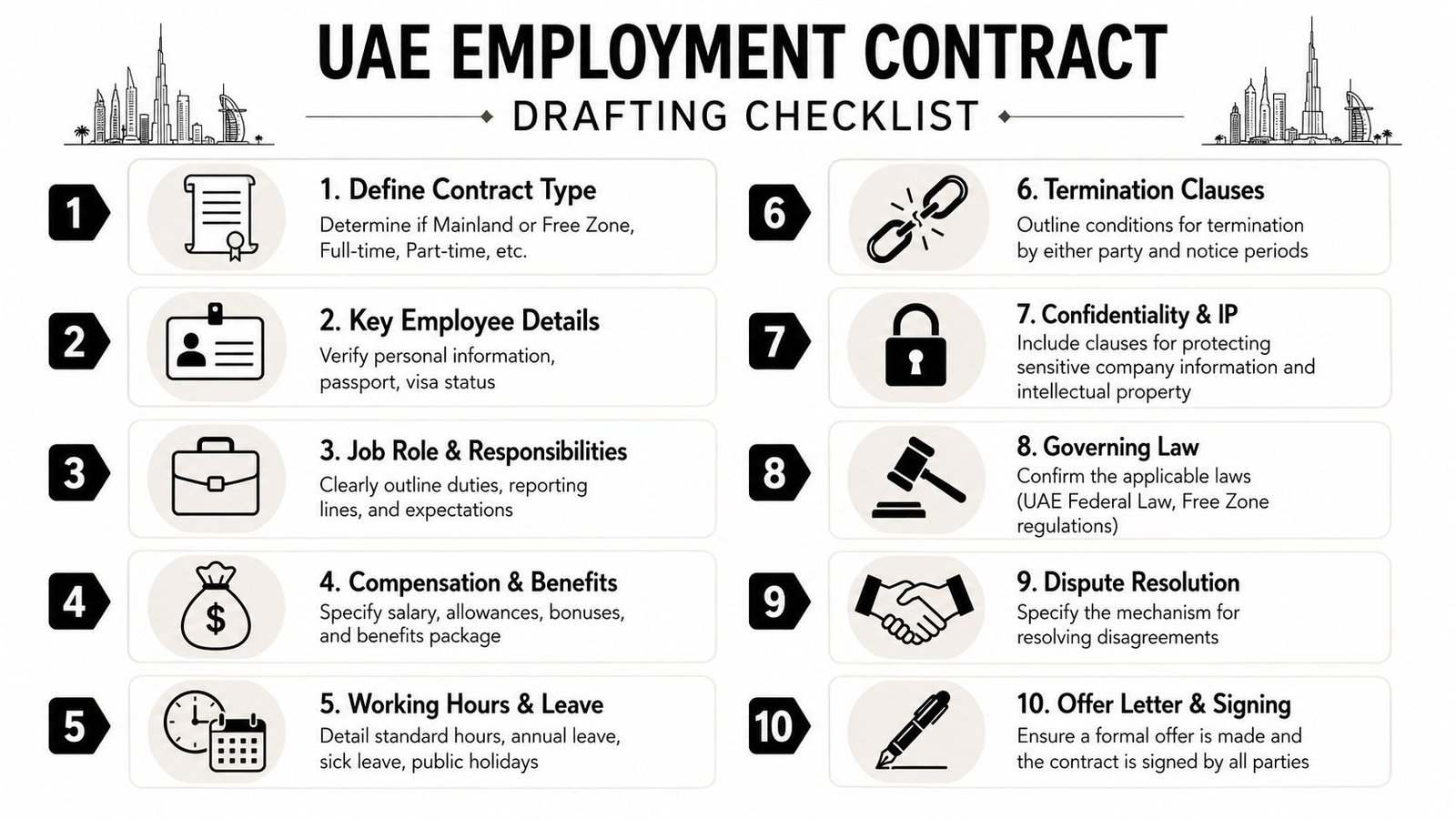
A good employment contract UAE file should survive three tests. It should satisfy the authority, reflect the actual agreement made with the employee, and still make sense when someone reviews it months later during a renewal, dispute, or visa process.
What should you check before anyone signs
Use this as a pre-signing review list:
- Fixed term confirmed: The contract term should be stated clearly and kept within the legal maximum.
- Jurisdiction matched: Mainland, standard free zone, and financial free zone paperwork shouldn't be mixed.
- Employee identity checked: Name, passport details, visa status, and role should match the supporting documents.
- Basic salary separated: Don't bury salary components in one package figure.
- Job title and duties aligned: The written role should match what the person will do.
- Hours and leave included: Statutory rights should appear properly in the contract.
- Notice wording reviewed: Exit mechanics should be clear and practical.
- Confidentiality and IP handled: These clauses should suit the business, especially for tech, product, and client-facing roles.
- Arabic version verified: Don't assume the translation says what the English draft says.
- Signature process controlled: Keep the final signed copy and registration evidence in one place.
Working habit: Keep one approved template per jurisdiction and role type. Most contract chaos starts when teams edit old files from different entities.
What wording helps avoid later disputes
Simple wording usually works better than impressive wording. For salary, the contract should clearly separate components. For example: basic salary, allowances, and any variable compensation should each sit on their own line rather than being collapsed into one sentence.
For restrictive clauses, keep expectations realistic. The law allows non-compete clauses only where they are reasonable in scope and duration, and they typically should not exceed two years to be enforceable, as noted in Darwinbox's overview of UAE employment law updates. A founder who tries to restrict everything, everywhere, for too long usually ends up with a clause that looks tough and performs badly.
There's another trap many businesses miss during restructures or annual renewals. Employers can't legally reduce salary, change job title, or alter the nature of work without the employee's express consent and a registered amendment. A 2024 Ministry clarification reinforced that any such change requires a new mutually agreed contract filing, as explained in LexisNexis coverage of the Ministry clarification on employment contract amendments.
That means renewal isn't a free chance to rewrite terms unilaterally. If the business model changes, the amendment process has to be handled properly.
Ensuring Compliance and Moving Forward
A UAE employment contract is not just an HR document. It sits at the centre of payroll, visa processing, role definition, leave rights, termination handling, and dispute prevention. If the contract is wrong, the business usually discovers it at the worst moment, during a renewal, an employee complaint, or an exit.
What happens after the contract is drafted
Once the contract is agreed, the next step is formal execution through the right channel. On the mainland, that often means the labour process runs through MoHRE. In a free zone, the relevant zone authority may control the workflow. Either way, the contract has to match the employee's immigration and work authorisation path.
Founders should keep a simple internal file for each employee with the signed contract, amendments, visa records, salary breakdown, and renewal dates. That one habit prevents a lot of last-minute scrambling.
Why do founders still get stuck
Most delays come from mismatch. The company is set up in one jurisdiction, the draft contract comes from another. The employee has a visa assumption that doesn't fit the work permit reality. The salary package was negotiated commercially but not drafted in a way that supports lawful calculations later.
That's why practical compliance matters more than theory. You don't need a dramatic legal strategy. You need the right contract, in the right format, filed through the right authority, with the right salary structure and amendment discipline.
If you're hiring in Dubai, Abu Dhabi, Sharjah, or elsewhere in the United Arab Emirates and want the paperwork handled properly from the start, Inpro Corporate Services L.L.C. can help you structure contracts, visa workflows, and government processing with less friction. Not sure where to start? Book a free strategy call with the team.