

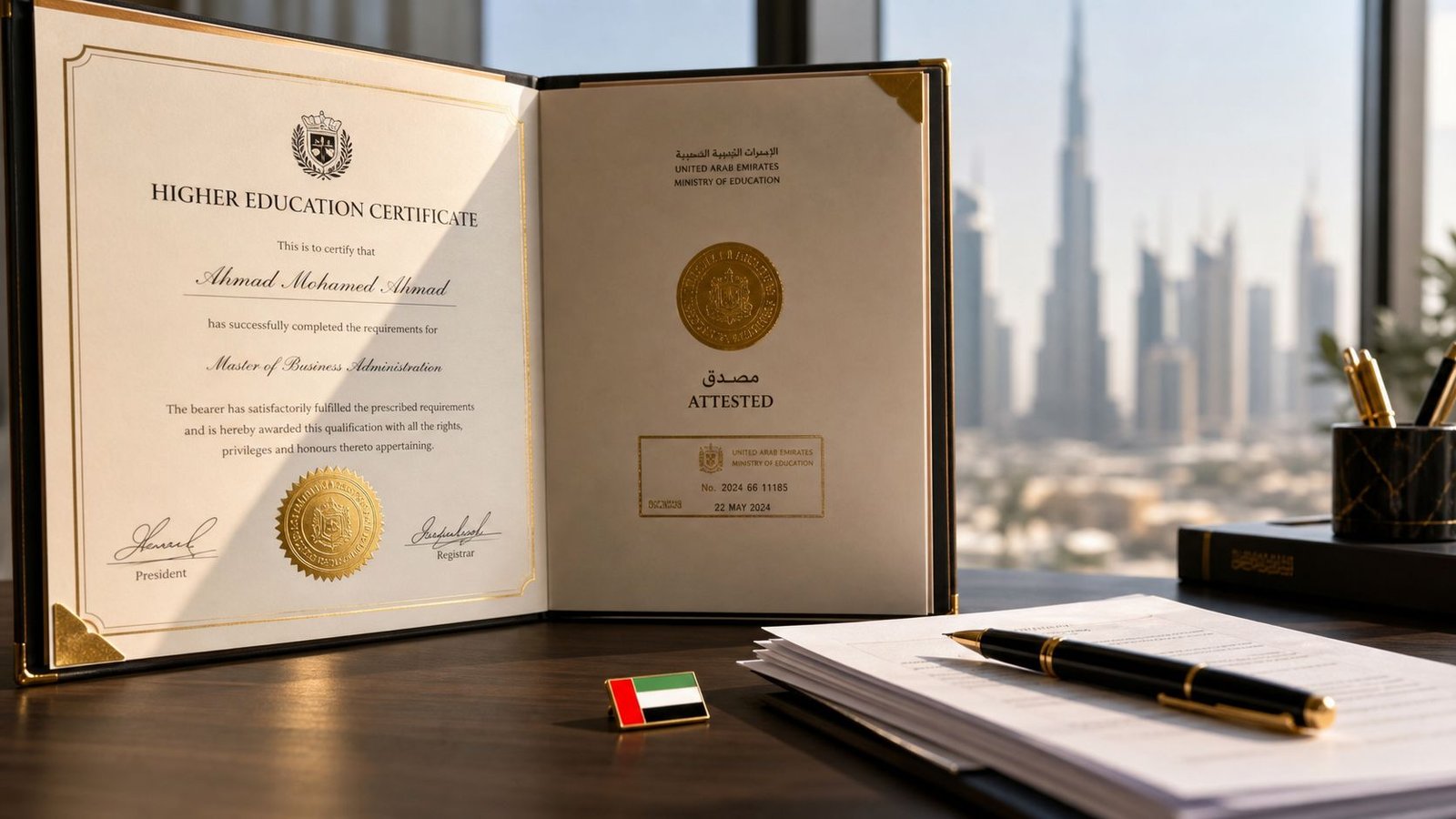
Educational certificate attestation is a mandatory multi-step legal validation process that starts in the country where your degree was issued and ends in the UAE. If you need a professional job, an employment visa, residency processing, or licensing in the United Arab Emirates, this process often isn't optional.
If you're reading this while a visa is pending, a company setup is moving ahead in Dubai or Abu Dhabi, or HR has just asked for an attested degree you've never heard of before, you're in the same position as many founders, employees, and Golden Visa applicants. The stress usually comes from one false assumption: people think attestation is a paperwork formality. It isn't. It's a risk-control process, and one small mistake can trigger a full rejection cascade across translation, embassy verification, and final Ministry stamping.
Table of Contents
- What Is Educational Certificate Attestation?
- The Step-by-Step UAE Attestation Process
- Preparing Your Documents for a Flawless Submission
- Timelines Fees and When to Hire a Professional
- Common Rejection Traps and How to Avoid Them
- Your UAE Attestation Action Checklist
What Is Educational Certificate Attestation?
Educational certificate attestation is the legal process that makes a foreign academic document valid for official use in the UAE. In plain terms, it tells the authorities in Dubai, Abu Dhabi, Sharjah, and other emirates that your degree is genuine, issued by a real institution, and accepted for the purpose you're using it for.
The UAE government treats this as a formal compliance requirement, not a courtesy check. According to the UAE government guidance on preparing to work in the private sector, educational certificate attestation is a mandatory legal requirement for expatriates seeking residency and employment in specific professions, and the process begins in the country of origin before ending with final attestation in the UAE.
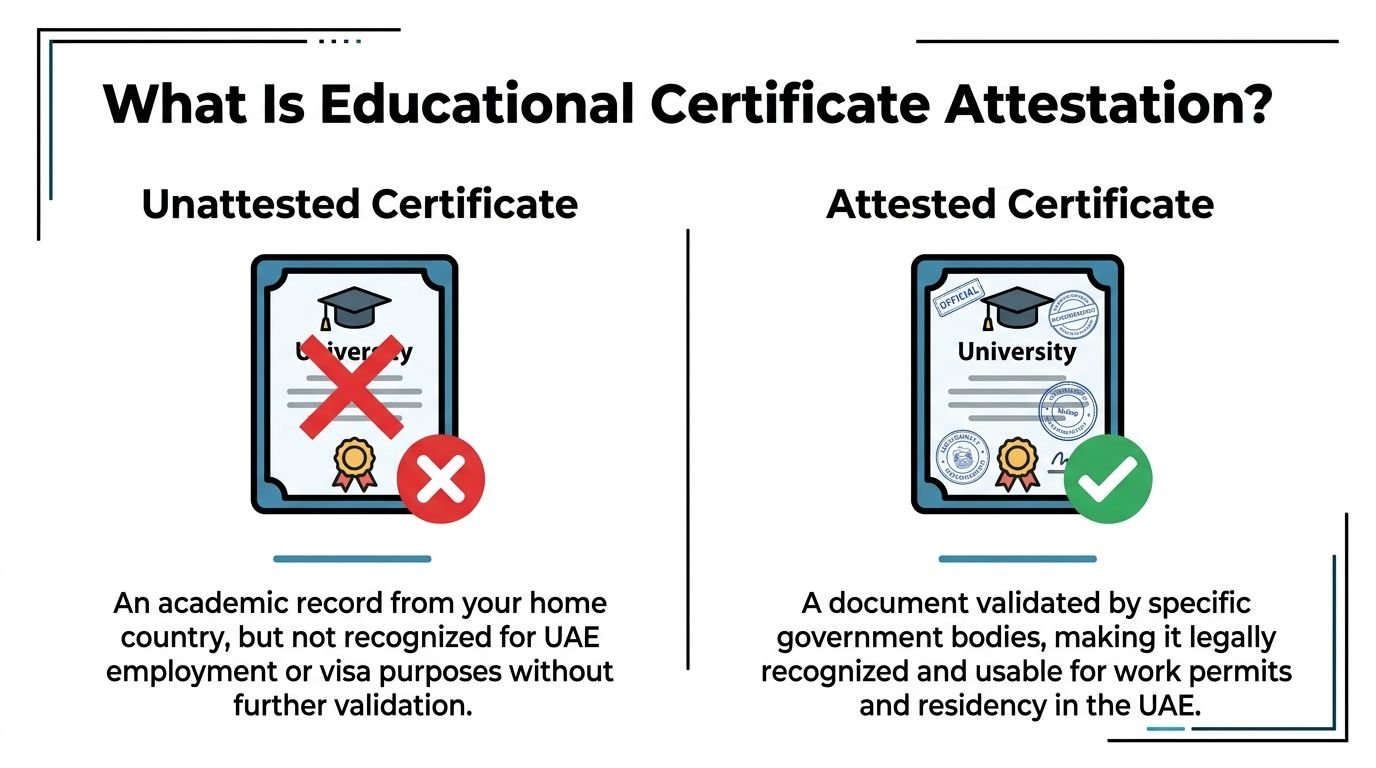
What is attestation
Attestation is legal authentication by a chain of authorised bodies. Each authority confirms the stamp before it, so the certificate builds a recognised trail from the issuing country to the United Arab Emirates.
That chain matters because the UAE doesn't accept a degree based on its appearance alone. The document has to pass through official hands in the correct order. If one authority is missing, the next authority may refuse the file without reviewing anything else.
Practical rule: An attested degree isn't just a stamped degree. It's a degree stamped in the right sequence by the right authorities.
Why is it required for a UAE visa
For many professionals, attestation is tied directly to visa and employment eligibility. Employers, free zones, government-linked entities, and licensing bodies may ask for it before they can complete hiring, work permit processing, or role-specific approvals.
People often find themselves in a difficult situation. They've signed the offer, rented a flat, and booked a flight, but the certificate still isn't legally usable in the UAE. In practice, educational certificate attestation sits at the point where immigration, labour compliance, and professional credibility meet.
What is the difference between Apostille and Consular Attestation
Consular attestation is the route the UAE requires for foreign educational documents. An Apostille is a different legalisation model used by countries that participate in the Hague Apostille Convention.
For UAE use, the working assumption should be simple: your degree usually needs the embassy or consular route, not a shortcut. That's why a certificate often has to move through your home country authorities and then the UAE embassy or consulate before the UAE Ministry of Foreign Affairs and International Cooperation, commonly called MOFAIC, will complete the final stage.
The Step-by-Step UAE Attestation Process
A common failure looks like this. The candidate has the degree, the employer is ready to process the visa, and everyone assumes the document can be stamped in Dubai in a day or two. Then MOFA rejects the file because the home-country chain is incomplete, or the translated name does not match the passport. At that point, the problem is no longer administrative. It affects joining dates, labour processing, and in some cases the role itself.
That is why attestation should be handled as sequence control, not paperwork collection. Each authority is checking whether the previous authority did its part. If one link is missing or inconsistent, the next desk often refuses the file without reviewing anything else. That is the rejection cascade applicants need to avoid.
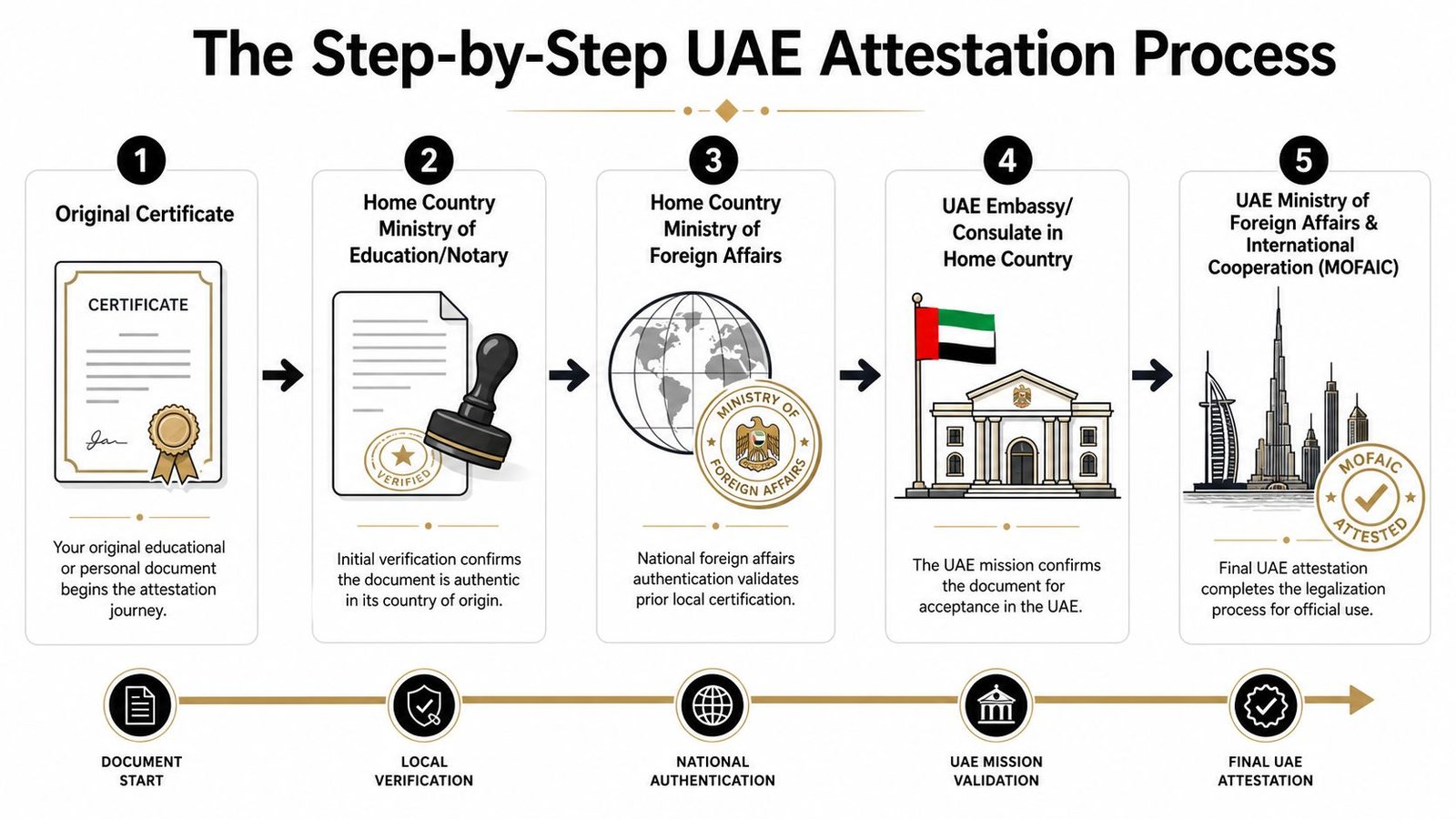
A visual map helps before you begin.
Where does the process start
It starts in the country where the certificate was issued. For educational documents, the UAE does not begin the legalisation chain. The document must first be validated by the issuing side, then by the foreign ministry side, then by the UAE mission, and only after that by MOFA inside the UAE. The official MOFA attestation service guidance reflects this requirement by stating that documents issued outside the UAE must already be attested by the foreign affairs authority in the origin country and by the UAE Embassy or Consulate there before UAE attestation.
In practice, the first stop is usually the university registrar or issuing institution. That stage confirms the award details and allows the file to move to the education authority that sits above the institution in that country.
The next step is usually the relevant State Education Department, Higher Education Department, or Ministry of Education, depending on the jurisdiction. At this stage, applicants often make the first strategic mistake. They follow a friend's process from the same country without checking whether their own university falls under a different state, board, or federal pathway. One wrong submission can cost more time than the full attestation itself.
What happens before the UAE will touch your document
Once the education authority has attested the certificate, the file usually moves to the home country's Ministry of External Affairs, or the equivalent foreign ministry. That stamp prepares the document for international legal use.
After that, the certificate goes to the UAE embassy or consulate in the country of origin. This stage is regularly misunderstood. It is not a duplicate stamp. It is the point where the foreign attestation chain becomes acceptable for UAE recognition.
Files usually fail here for predictable reasons:
- A missing upstream stamp: If the education or foreign ministry attestation is absent, the embassy may refuse the document immediately.
- A mismatch between the certificate and passport: A shortened name, missing middle name, maiden name, or spelling variation can trigger rejection later even if the embassy accepts the file.
- An incorrect translation path: If the certificate or supporting records were translated by the wrong provider, or translated before the correct source document was fixed, the error follows the file through every later stage.
- Laminated or damaged originals: Physical condition matters. If a stamp cannot be placed or verified properly, the document can be refused.
- Missing supporting academic records: Some cases move with the degree alone. Others do not. If the authority or employer expects transcripts or mark sheets and they are not aligned with the main certificate, the file can stall.
Attestation shifts from routine admin to risk management. A translation error is rarely isolated. It can force retranslation, re-submission to the embassy, rebooking of the UAE stage, and in some cases amendment of visa paperwork that was prepared using the wrong name format.
A practical walkthrough can make the flow easier to picture:
What happens once the certificate reaches the UAE
The final stage is submission to MOFAIC in the UAE. This is the last attestation that makes the foreign educational certificate usable for UAE employment, immigration, and other official purposes.
Many applicants assume the UAE step is the easy part because the submission system is digital. The core issue is file integrity. MOFA is checking whether the document presented in the UAE matches the exact document that completed the overseas chain. If the degree, translation, passport name, or supporting papers do not line up, the file can still be rejected after all prior work is done.
For business professionals, the risk is usually larger than the government fee. A rejected degree can delay onboarding, freeze a work permit sequence, and force HR or PRO teams to revise a file they believed was ready. I have seen straightforward hires turn into multi-week delays because one authority accepted a name format that the next authority would not.
Here is the clean order:
| Stage | Authority | Why it matters |
|---|---|---|
| Home country verification | University registrar | Confirms the document was issued by the institution |
| Education authority attestation | State department or ministry | Confirms academic validity at government level |
| Foreign ministry attestation | MEA or equivalent | Prepares the document for international legal use |
| UAE embassy or consulate | UAE mission in origin country | Connects the foreign attestation chain to UAE recognition |
| Final UAE attestation | MOFAIC | Makes the certificate legally usable in the UAE |
Preparing Your Documents for a Flawless Submission
Most failed applications don't fail because the degree is fake. They fail because the file is sloppy. A missing mark sheet, a small name difference, an old laminated certificate, or the wrong translator can undo the whole chain.
Which documents should you gather before you begin
Start with the original educational certificate. Not a scan, not a photocopy, and not a decorative university copy you framed years ago. You also need to gather any supporting academic records requested for the jurisdiction or employer involved.
A working file usually includes:
- Original degree certificate: This is the core document for attestation.
- Academic transcripts or mark sheets: In practice, complete year-by-year records are often expected when the authorities or service provider review the file.
- Passport copy: The name on the passport should match the certificate exactly.
- Any prior correction documents: If your name changed after graduation, keep the legal supporting paper ready from the start.
When is legal translation required
Legal translation is required when the degree is not in English or Arabic. Consequently, many otherwise organised applicants lose weeks.
According to the guidance on UAE degree attestation and translation requirements, for non-English and non-Arabic degrees, a single translation error by an unvetted UAE legal translator can invalidate the entire Ministry of Justice and subsequent MOFA chain. The same source states that translations from non-approved vendors are automatically rejected, causing 3–6 weeks of re-attestation delay.
That's the rejection cascade in real life. One weak translation doesn't only fail the translation stage. It poisons every step that follows.
A translator being “certified” in the general sense isn't enough. For UAE use, the translator needs to be approved for the relevant legal process.
This matters even more for founders and professionals coming from Latin America, Eastern Europe, Central Asia, or parts of Asia where the original academic documents aren't in English or Arabic. Many people assume they can translate locally before travel and save time. Sometimes that works for internal review. It often doesn't work for final UAE legalisation.
What should you check before handing over the file
Before the file leaves your hands, check the details the way an examiner would.
- Match the name exactly: Compare passport, degree, transcript, and any existing attestations letter by letter.
- Inspect the physical condition: Don't submit a laminated certificate. If it's already laminated, ask about reissuance options before moving further.
- Confirm sequence readiness: The next authority should only receive the document after the previous authority has completed its part.
- Keep scanned copies: You still need the originals, but clean scans help with pre-checks, courier coordination, and internal HR review.
People often focus on collecting papers. The better approach is file hygiene. A complete file isn't enough. It has to be internally consistent.
Timelines Fees and When to Hire a Professional
Expectations need to be realistic. Attestation can move quickly when the issuing university responds, the home-country ministries are efficient, the embassy stage is clean, and the UAE submission is accurate. It can also drag when one desk asks for a correction or a prior stage was handled badly.
How long does educational certificate attestation take
The 2025 MOFA attestation guide referenced here states that the standard MOFAIC fee is AED 150 for a single educational document. The same source says the full process generally takes seven to ten business days under optimal conditions, but can extend to six weeks depending on document completeness and bureaucratic delays.
That range is why planning matters. If your employment start date in the United Arab Emirates is fixed, “I'll sort the attestation after I arrive” is often the wrong move. A founder opening in a Dubai free zone, an HR team onboarding a technical hire in Abu Dhabi, or a Golden Visa applicant trying to align dependent files all need to work backwards from the slow scenario, not the fast one.
The same source also notes that MOFAIC moved to a digital Smart Attestation model in June 2021 for academic certificates, allowing electronic application through the website or app with courier handling. That has reduced friction. It hasn't removed the need for a correct file.
What does it cost
The MOFAIC end of the process is straightforward. The final attestation fee is AED 150 for one educational document, based on the source above.
The total cost is less predictable because the home-country side varies. In the attestation chain already discussed earlier, the UAE embassy stage is commonly AED 300–500, and some workflows also cite final MOFA charges within a broader AED 150–250 range depending on the handling context. Beyond government fees, applicants may also pay for courier service, document retrieval, legal translation, and agent coordination.
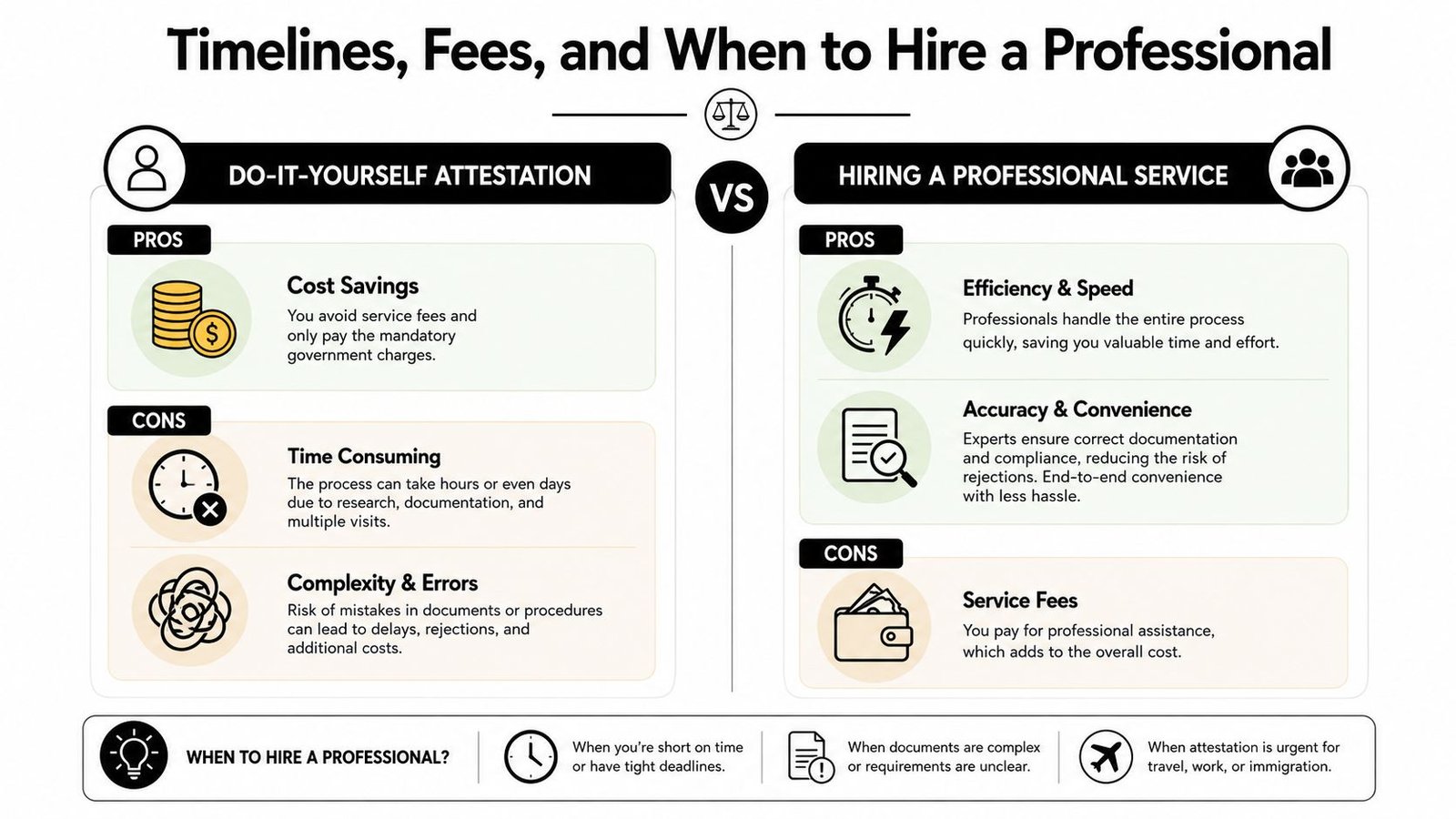
Here's the trade-off in simple terms:
| Option | What you save | What you risk |
|---|---|---|
| DIY | Service fees | Delays, restarts, courier errors, missed details |
| Professional handling | Your time and internal admin load | Extra service cost |
When does DIY stop making sense
DIY can work if your certificate is in English, your name matches perfectly, your issuing country has a clear process, and your deadline has some room. It tends to break down when the file is tied to a business launch, a key employee visa, or a relocation timeline with no buffer.
For example, UK and US applicants often assume the process will be simple because the institutions are well known. Recognition of the university isn't the point. Chain compliance is. If the wrong body certifies the document, or a state-level stage is missed, the certificate still stalls.
Decision test: If a rejected file would delay your visa, your hire, or your company launch, the real cost isn't just the government fee. It's the lost time around it.
Common Rejection Traps and How to Avoid Them
A file often looks fine until it reaches the first desk that checks it against the passport, prior attestations, and translation. Then the whole chain stops. In practice, one small mismatch can trigger a rejection cascade, especially when the certificate is tied to a visa, a regulated role, or a start date that cannot slip.
Why do so many applications fail
Rejections usually come from preventable inconsistencies, not obscure rules. I see the same pattern repeatedly. A name is written one way on the degree and another way on the passport. A translation is done by the wrong party. A supporting document is uploaded with details that do not match the physical certificate. The file reaches the next authority, and every later stage inherits the same defect.
That is why attestation works best as risk control. Precision matters more than effort.
Which mistakes cause immediate rejection
Name mismatches are one of the fastest ways to lose time. Even a minor variation in spelling, spacing, initials, or surname order can stop the file until supporting proof or a correction document is produced.
Other hard-stop problems come up often:
- Laminated certificates: Counter staff may refuse them because the document cannot be properly stamped or examined.
- Missing upstream attestations: UAE authorities do not complete a broken home-country chain.
- Translations from the wrong source: If the translation is not accepted at a later stage, the rest of the file can become unusable.
- Paperwork mismatches across documents: A passport number, graduation date, or name format that differs from the certificate can trigger a return for correction.
- Incorrect declarations or booking details: If the submitted record does not match the document set in hand, the file can be refused before the main review starts.
How do you avoid a rejection cascade
Treat the certificate, passport, translation, and supporting papers as one file with one identity. If one item says something different, the whole submission becomes harder to defend.
Use this review routine before you send anything:
- Audit the name line by line: Match spelling, sequence, initials, and spaces across the passport, degree, transcript, and any affidavits.
- Check the document condition early: Damage, lamination, or unclear seals should be dealt with before the attestation chain starts.
- Confirm translation acceptance first: For non-English and non-Arabic documents, verify who can translate and at which stage that translation will be accepted.
- Match all reference details: Dates, document numbers, and issuing authority names should align everywhere.
- Verify the order of attestations: One missing or misordered stage can force you back to the country of origin.
The cost is not just the government fee. It is the lost time around it, the courier cycle, the revised translation, the resubmission, and the visa or onboarding delay that follows.
For business professionals, that is the part that hurts. A rejected educational certificate does not stay an isolated admin issue. It can hold up a work permit, delay a key hire, or push back a company setup timeline by weeks.
Your UAE Attestation Action Checklist
The smoothest attestation files are the ones that are prepared before the first stamp is requested. Use this as a working checklist, not a memory exercise.
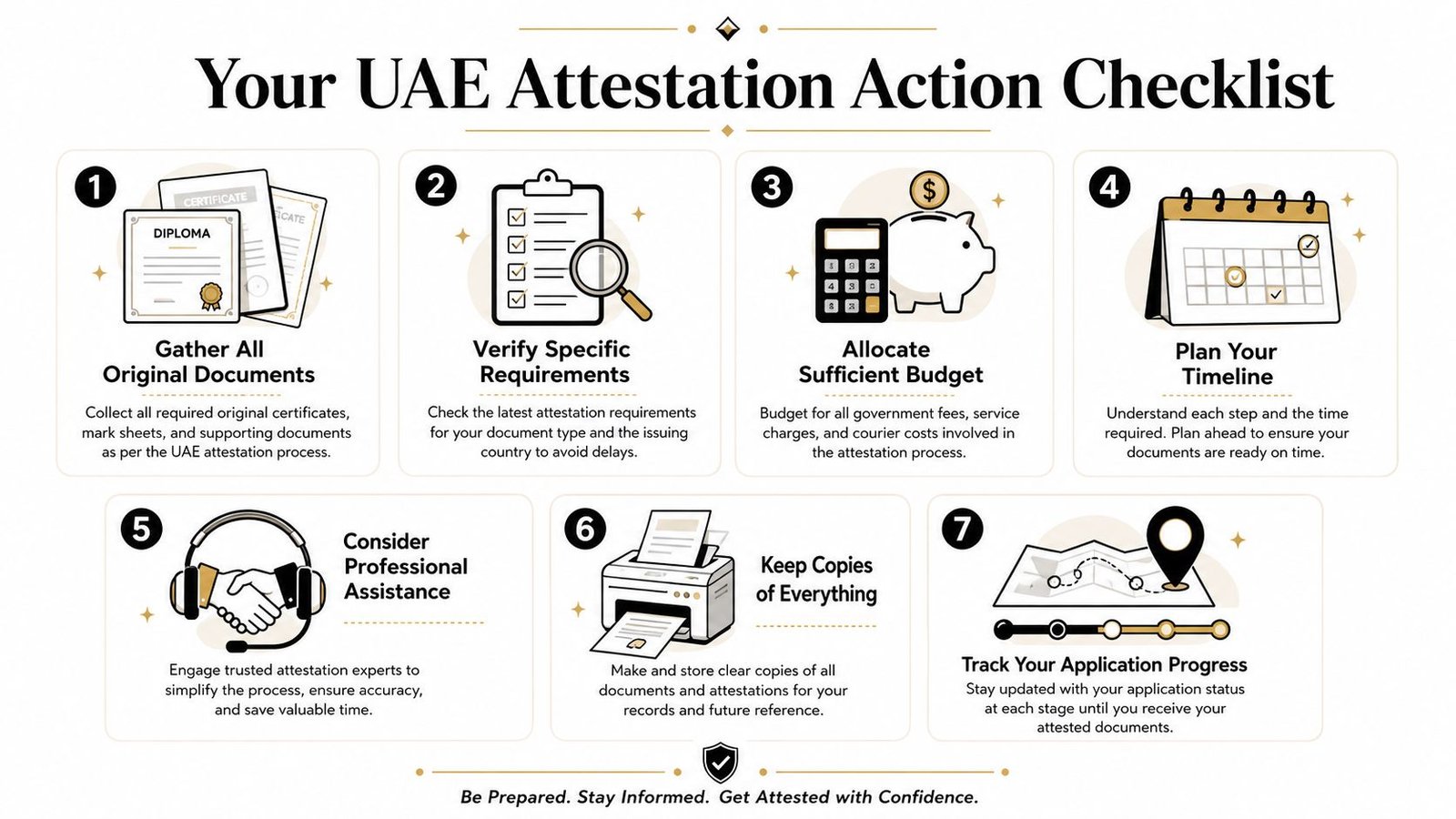
What should you do before you start
- Pull the original certificate now: Don't plan around copies.
- Compare names across all records: Passport, degree, transcripts, and any supporting documents must align.
- Check language requirements: If the document isn't in English or Arabic, confirm the legal translation route before anything else.
- Look at the physical document: If it's laminated or damaged, deal with that issue first.
What needs to happen in your home country and in the UAE
- Start with the issuing authority: Get university or registrar verification where required.
- Move through the home-country education and foreign ministry chain: The order matters.
- Send the document to the UAE embassy or consulate in the country of origin: Don't skip this link.
- Complete final attestation with MOFAIC in the UAE: This is the last legalisation stage for UAE use.
What should you confirm at the end
- Review every stamp and endorsement: Make sure the chain is complete and readable.
- Keep copies of the fully attested file: HR teams, free zones, and immigration handlers often need a set.
- Track the process against your visa timeline: Business setup and employee onboarding in the UAE move faster when document risk is handled early.
Educational certificate attestation is easier when you treat it as risk management, not admin. That mindset saves time, protects visa deadlines, and keeps small errors from turning into long delays.
Not sure where to start? Book a free strategy call with Inpro Corporate Services L.L.C. for help with UAE document attestation, visas, and business setup.