


An international wire transfer is a bank-to-bank electronic transfer across countries, and for a new UAE business it's one of the standard ways to fund operations, pay setup costs, and settle overseas invoices. In the United Arab Emirates, that process is reliable and routine, but your first transfer goes smoothly only if the payment data and compliance details are prepared correctly from the start.
If you're opening a company in Dubai, Abu Dhabi, Sharjah, or a free zone and trying to move funds for licence fees, supplier deposits, or shareholder support, the banking side can feel more stressful than the company formation itself. The good news is that most problems aren't random. They usually come from missing fields, mismatched names, or choosing the wrong payment rail for the job.
Table of Contents
- Your First International Wire Transfer in the UAE
- How to Send an International Wire Transfer
- Understanding Transfer Costs and Timelines
- UAE Banking Compliance Explained
- Exploring Alternatives to Traditional Wires
- Common Problems and How to Fix Them
- Streamline Your Transfers with the Right Foundation
Your First International Wire Transfer in the UAE
An international wire transfer is a formal electronic payment sent from one bank to another in different countries. For a founder in the UAE, it's often the first serious financial action after incorporation. You might use it to fund your company account, pay a government-related invoice, or settle an overseas supplier bill.
The United Arab Emirates is built for cross-border money movement. The country maintains the second-largest hub for outbound remittances globally, with the UAE Cross Border Remittances Market valued at approximately USD 39 billion, according to Ken Research's UAE cross-border remittances market analysis. That scale matters because it reflects how normal international transfers are in the local financial system.
For new businesses, that's reassuring. Banks in Dubai and Abu Dhabi deal with international payments every day, and founders in free zones or on the mainland aren't trying to force an unusual process through the system. They're using an established channel that already supports trade, payroll, investment flows, and supplier settlement across Asia, Europe, Africa, and beyond.
What makes wire transfers standard for business use
A corporate card is fine for software subscriptions and travel. It isn't the right tool for everything.
An international wire transfer is still the standard for larger payments, formal supplier invoices, shareholder funding, and transactions where both sides want bank records that clearly show the sender, recipient, amount, and purpose. If you're paying for office fit-out work in Sharjah or settling an overseas professional services invoice for your Dubai entity, a bank transfer usually gives the cleanest paper trail.
Practical rule: If the payment relates to incorporation, trade activity, investor funding, or a material supplier invoice, assume the bank transfer route will be the most acceptable starting point.
Why founders worry more than they need to
Most first-time founders expect the hard part to be sending the money. Usually, the hard part is preparing the data properly.
Once the account is active and the transfer instructions are complete, the process itself is straightforward. The friction tends to come before submission. Missing addresses, inconsistent beneficiary names, and unclear payment purpose are what create follow-up questions from banks and payment teams.
How to Send an International Wire Transfer
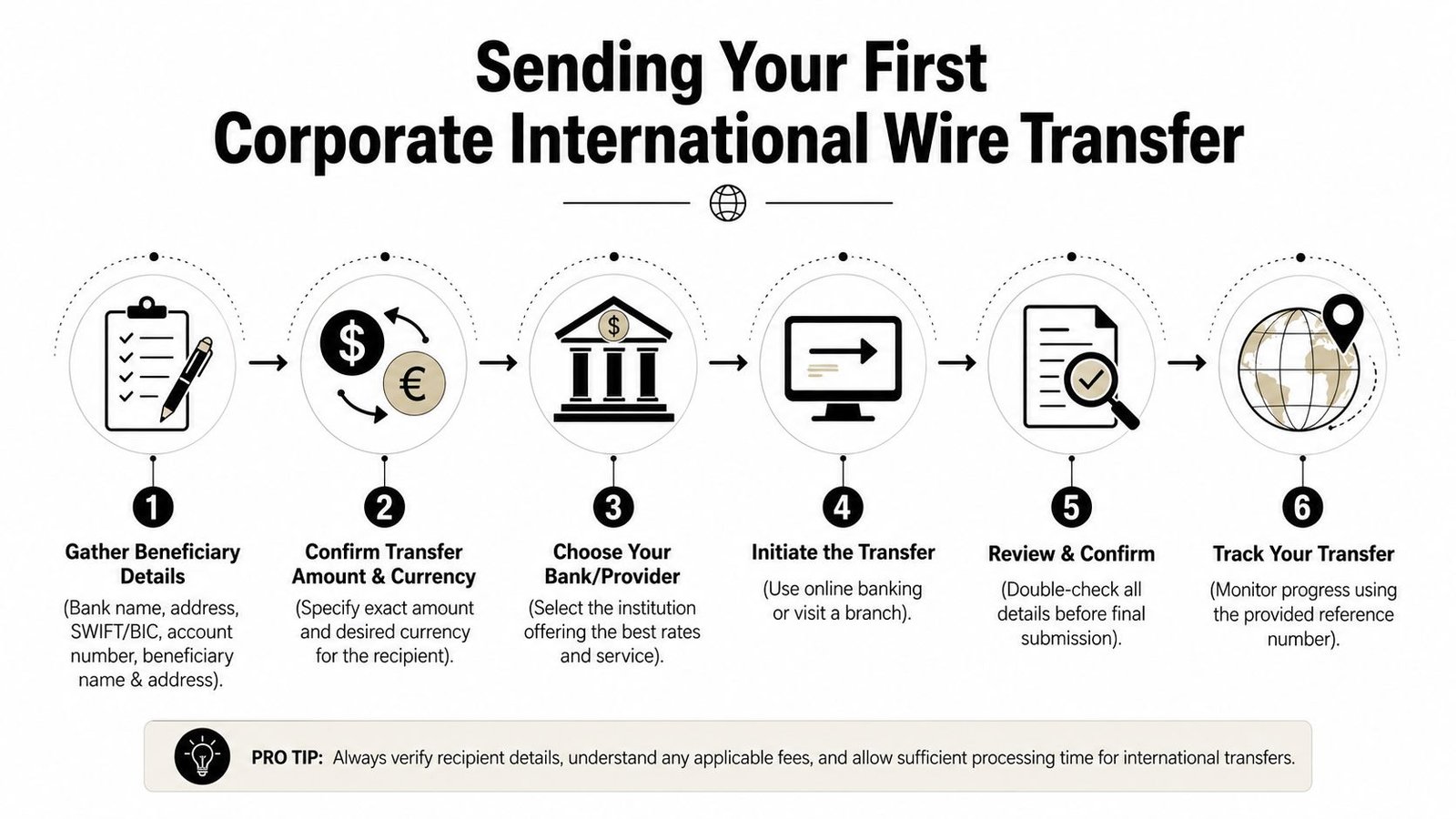
A clean transfer starts before you log in to online banking. Gather the exact beneficiary details, confirm the currency, and choose the provider that fits the payment type. That's what keeps your first corporate transfer from turning into a chain of avoidable email corrections.
What is the transfer actually doing
A SWIFT code is an international bank code that identifies a bank in the global messaging system used for many cross-border payments. A BIC is the same identifier in many banking contexts, so you'll often see SWIFT/BIC written together.
An IBAN is an international bank account number used to identify a specific account in a standardised format. For transfers involving the UAE region, incoming international wires need the beneficiary's full name, address, IBAN, and the beneficiary bank's SWIFT/BIC code with precise branch-level address details, according to East West Bank's outgoing wire country guide.
A beneficiary is the person or company receiving the funds. The originator is the sender. In a corporate setting, the bank will look closely at whether those names match the account records and supporting documents.
What details do you need before you start
Use a checklist. It saves time and stops rushed corrections later.
- Beneficiary legal name: This is the exact registered name on the receiving account. If the invoice says one thing and the bank account says another, stop and verify.
- Beneficiary address: This is the full address attached to the recipient. Banks and fintechs often validate this against account records or compliance files.
- Bank name and branch address: This identifies the receiving institution and the branch details needed for routing.
- SWIFT/BIC code: This tells the banking network where the money needs to go.
- IBAN or account number: This identifies the destination account. For relevant transfers into the UAE, the IBAN format is strictly validated.
- Transfer amount and currency: This is the exact amount to send and the currency the recipient should receive.
- Purpose of payment: This explains why the money is being sent. In the UAE, that field can't be treated as optional for the situations covered later in this article.
How do you send and receive funds without errors
For most founders, the simplest flow looks like this:
- Collect the invoice or banking instruction from the supplier, consultant, shareholder, or related party receiving payment.
- Match the names on the invoice, contract, and bank instruction. Small spelling differences can become a compliance problem.
- Confirm the currency before you submit. If the recipient expects euros and you send dollars, someone may lose money on conversion or reject the payment.
- Choose the channel. That might be your UAE corporate bank, a licensed exchange house, or a licensed fintech platform.
- Enter the payment purpose clearly. Keep it factual and tied to the underlying transaction.
- Review before release. The final review is where most preventable mistakes are caught.
A transfer form isn't just admin. It's the instruction set the bank will rely on when it decides whether to route, review, or stop the payment.
Receiving funds is the mirror image. Your customer, investor, or parent company needs your company name exactly as held by the bank, your account details, your bank's SWIFT/BIC, and any extra bank-specific receiving instructions. If you're in a free zone such as Dubai International Financial Centre (DIFC), which is a financial free zone in Dubai, or Abu Dhabi Global Market (ADGM), which is a financial free zone in Abu Dhabi, your banking relationship may also come with its own formatting preferences for incoming transfers.
Understanding Transfer Costs and Timelines
Cost surprises usually come from two places. The first is assuming the sending fee is the whole fee. The second is assuming every international wire transfer moves at the same speed.
Why do costs vary so much
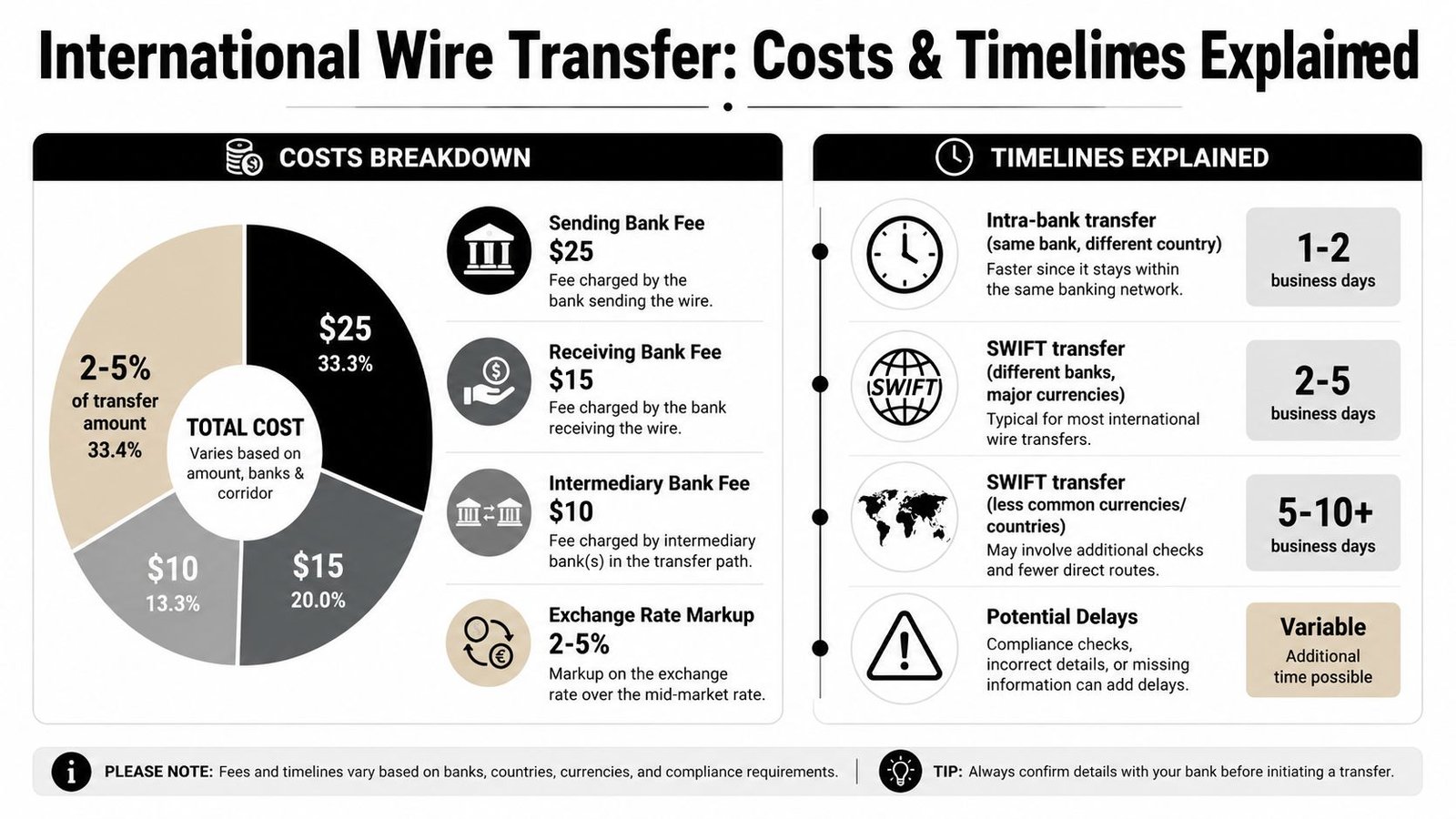
In 2024, the average cost of sending a $200 international wire transfer from the UAE via traditional banks was nearly 14% of the transaction value, compared with approximately 5.4% through licensed money exchange houses and as low as 2.8% through modern mobile remittance apps, based on StashAway's summary of 2024 World Bank UAE remittance cost data. That's a wide spread, and it explains why founders shouldn't default to the bank channel for every payment.
For UAE-side outbound bank wires using SWIFT, fees typically range from AED 50 to AED 150 per transfer, with online banking often cheaper than branch initiation. Receiving banks may also deduct USD 10 to USD 30, and correspondent banks may take an extra cut, according to UAE Inform's remittance fee guide. For a transfer of AED 3,675, total bank costs can range from AED 50 to AED 300+ depending on the corridor and currency.
A correspondent bank works like a middle courier in the chain. If your bank doesn't have a direct route to the receiving bank in the target currency, another institution helps pass the payment along. Each handoff can add fees, time, or both.
| Cost layer | What it means in practice |
|---|---|
| Sending fee | Charged by your bank or provider when you initiate the payment |
| Correspondent fee | Charged by intermediary institutions routing the transfer |
| Receiving fee | Deducted by the beneficiary bank when funds arrive |
| FX spread | Embedded in the exchange rate if one currency is converted into another |
A quick visual helps if you're comparing methods before sending.
How long does an international wire transfer take
Speed depends on route, currency, and whether the payment clears automated checks without a manual review.
For international USD wires to the UAE, benchmark data shows that transfers typically average 2 business days when all details are correct, while incomplete instructions can extend processing to 3 to 5 days due to manual intervention by correspondent banks. Weekends, public holidays, cut-off times, and time-zone differences all affect the actual clock, even when nothing is wrong with the payment.
If a payment is time-sensitive, don't judge by the day you clicked send. Judge by the banking cut-off, the receiving country calendar, and whether a compliance team needs to look at the file.
UAE Banking Compliance Explained
A new founder often sees the same pattern on the first UAE outbound payment. The transfer is submitted, the bank says it is under review, and everyone assumes the money has been blocked. In practice, the hold usually starts with incomplete KYC records, weak payment wording, or a mismatch between the company profile and the transaction.
In the UAE, remittance controls are formal and predictable. Once the account file is clean and the payment narrative matches the documents, international transfers tend to move without much drama.
Who regulates remittances in the UAE
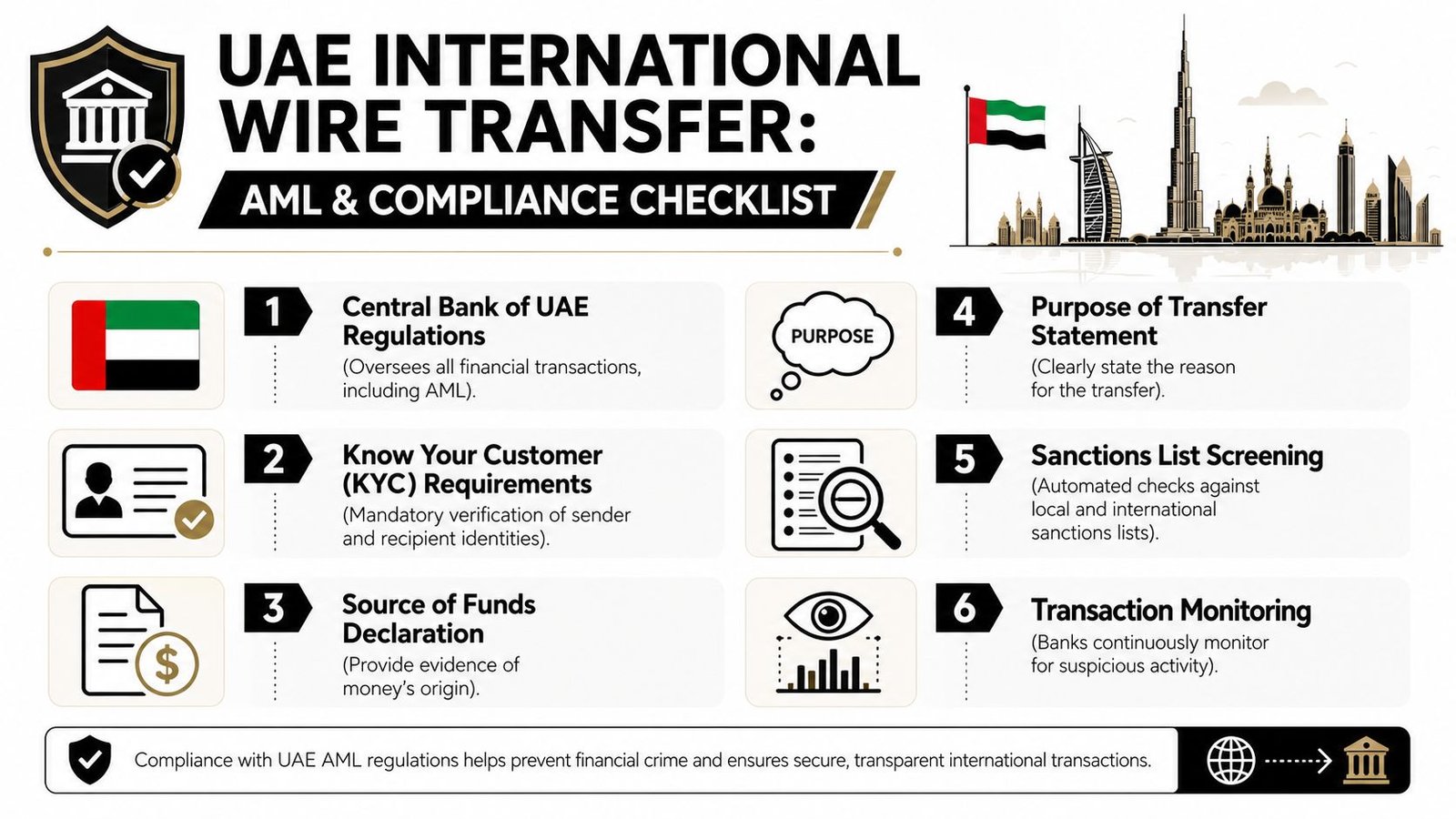
The Central Bank of the UAE is the main authority overseeing remittances. It requires firms handling money transfers to be licensed, including banks, exchange houses, and licensed fintechs, according to Kevin Crowther's guide to legal overseas transfers from the UAE.
That point matters when founders compare SWIFT with newer payment platforms. A cheaper or faster provider is only usable if it is properly licensed for the activity it performs in the UAE. The same source notes that a valid Emirates ID is required for money transfers from the UAE, and providers commonly ask for the sender's passport plus standard beneficiary banking details.
For a new international business, this is the first strategic filter. If the transfer route looks efficient but the licensing position is unclear, do not treat it as a serious operating option.
What is the purpose of payment requirement
A purpose of payment explains why the funds are being sent. For international wire transfers to the UAE, that description is required under compliance protocols, and leaving it blank can trigger automated flags in SWIFT Message Type 103, according to Capital One's country-specific international wire guide for AE.
If the field is vague or inconsistent with the supporting documents, the transfer may move into manual review. That is why a founder can hear “pending compliance” even though the account is active and funded.
Use plain, document-matched wording. “Invoice payment for software development services”, “shareholder capital contribution”, or “consultancy fee under contract” gives the reviewer something they can verify quickly.
Banks want wording that matches the invoice, contract, or board record. They are checking consistency, not style.
What the AED 3,500 threshold means
AED 3,500 is a traceability threshold, not a ceiling on how much you can send.
Under Article 28 of Cabinet Decision No. (10) of 2019, UAE financial institutions must verify originator information for international wire transfers equal to or exceeding AED 3,500, as set out in the UAE jurisdictional requirements summary published by HelpNotabene. At or above that level, the institution needs complete sender data, including the sender's full name and identifying details.
That is why founders sometimes think the bank is rejecting the amount, when the actual issue is incomplete originator information. The rule is aimed at audit trail quality and the ability to trace the payment end to end.
A practical market detail helps explain user expectations. In 2023, more than 80% of personal remittances in the UAE still moved through licensed exchange houses such as Al Ansari Exchange and Al Fardan Exchange, according to UAE Expert Hub's guide to sending money from the UAE. Many residents are used to exchange-house checks at the counter, then get caught off guard when a corporate banking portal or licensed fintech asks for fuller digital records, source details, or a clearer commercial reason for payment.
For new UAE companies, the trade-off is straightforward. SWIFT through a bank usually suits higher-value payments, capital movements, and transfers where board records or audit support matter. A licensed fintech can be a good fit for routine operating payments if its UAE compliance process is clear, its beneficiary checks are solid, and your finance team can produce matching documents quickly. The wrong choice is not the slower rail or the newer platform. It is using a provider whose compliance requirements you do not understand before the first payment is due.
Exploring Alternatives to Traditional Wires
SWIFT is still the default in many corporate banking relationships across Dubai and Abu Dhabi. It isn't always the best tool for recurring, lower-value, or speed-sensitive business payments.
When is SWIFT the right choice
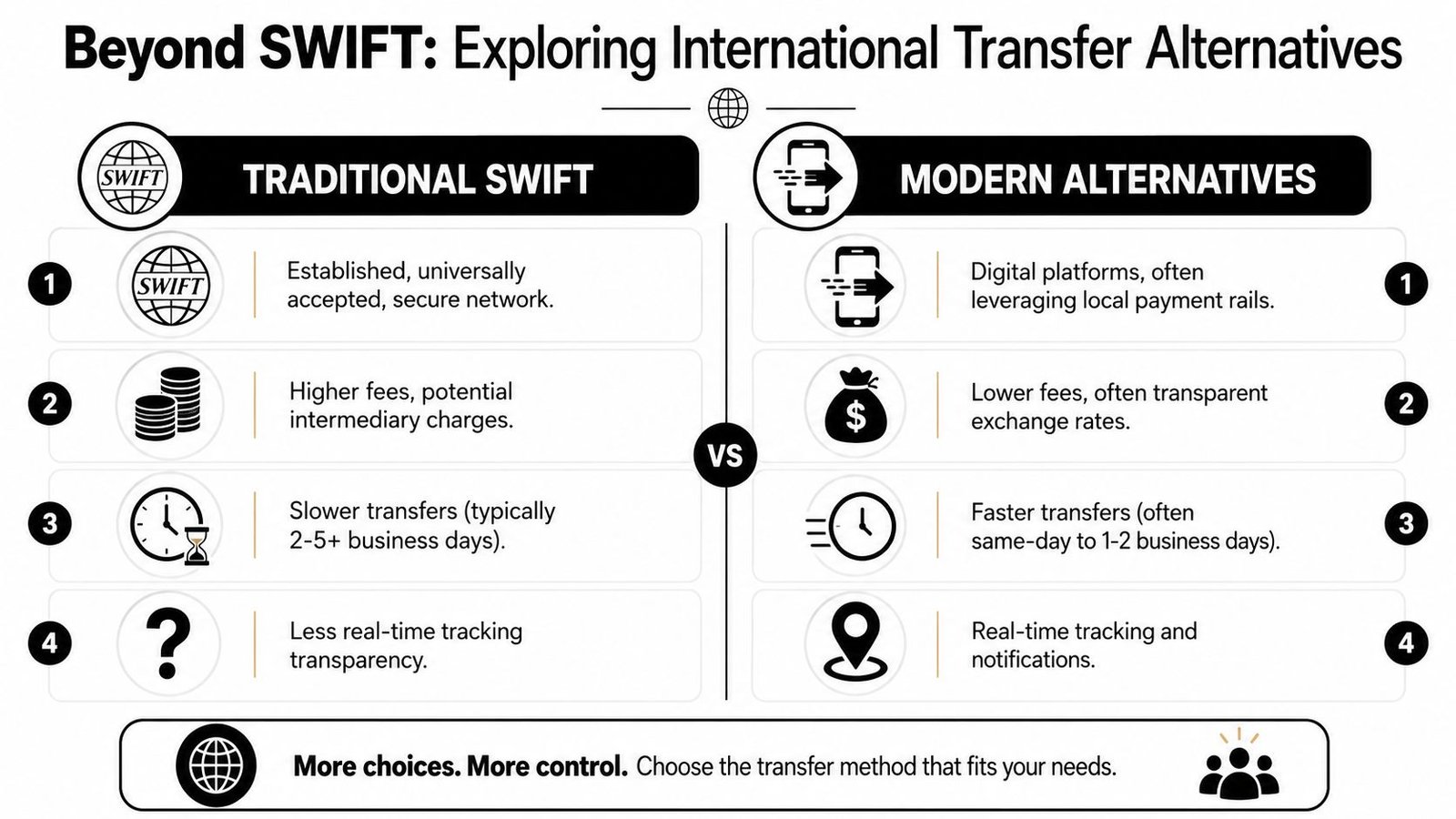
SWIFT is the established global bank messaging network used for many cross-border transfers. It remains a solid fit when you're sending larger formal payments, dealing with a recipient that only accepts bank wires, or moving funds into corridors where bank-to-bank acceptance matters more than speed.
A traditional bank wire can also be the better choice when the transaction needs to align neatly with finance-team controls, board approvals, or external audit expectations. Many founders keep SWIFT for capital movements, major supplier settlements, and payments tied to legal documentation.
When do modern payment platforms make more sense
The trade-off becomes clearer when speed and cost matter more than banking tradition. The SWIFT vs. local rail difference is significant. Traditional SWIFT wires from the UAE take 3 to 5 days with fees of $20 to $50, while modern platforms using local rails such as SEPA, Faster Payments, or ACH can settle in seconds to next-day with fees of $3 to $10, based on Hubpay's guide to international transfers from the UAE.
A local rail is a domestic payment network in the destination country or region. SEPA is a euro payment system used across much of Europe. Faster Payments is a UK payment system. ACH is a US bank transfer network.
That makes modern platforms useful for cases like:
- Remote payroll: Paying team members in the UK or Europe where speed affects trust and payroll timing.
- Recurring SaaS invoices: Settling software subscriptions or monthly service bills without paying full wire costs each time.
- Supplier top-ups: Sending operational payments that aren't large enough to justify heavier SWIFT costs and slower settlement.
Use SWIFT when acceptance and formality matter most. Use a licensed digital platform when speed, visibility, and lower routine payment cost matter more.
The key is not to treat all international payments as identical. Founders who do that often overpay for simple transfers and underprepare for formal ones.
Common Problems and How to Fix Them
The first failed transfer usually looks worse than it is. A founder sends a supplier payment on Tuesday, the beneficiary says nothing has arrived by Wednesday, and the bank portal still shows "processing." In the UAE, that often means the payment has been pulled into a compliance or routing review. It does not mean the funds have disappeared.
Why do transfers get delayed
Transfers slow down for two practical reasons. The payment details are incomplete, or the transaction does not make sense to the reviewing bank based on your account profile.
If all details are correct, many USD transfers to the UAE clear in about two business days. Once a bank or correspondent needs to verify a branch detail, beneficiary field, or payment purpose, the timeline often stretches to several business days.
Common delay patterns include:
- Missing branch details: Some banks still want the exact branch information on file before they release the transfer.
- Unclear payment purpose: "Services" or "consulting" can be too vague for a new UAE corporate account, especially if the invoice is more specific.
- Mismatch between account name and beneficiary name: If the invoice says one legal name and the bank record shows another, the receiving side may hold the funds for checks.
- Cut-off timing: Instructions submitted late in the UAE banking day often start processing on the next business day.
- New account scrutiny: A fresh corporate account sending its first overseas payment can face more questions than the same payment would face six months later.
What causes a rejection instead of a delay
A rejection is different. The bank is not asking for time. It is refusing the instruction as submitted.
In practice, the usual cause is a hard mismatch in the payment data. The legal company name may be shortened on the invoice but written in full at the bank. The IBAN may have one wrong digit. A fintech platform may also reject a payment that a traditional bank would review manually, because fintech systems tend to validate fields more aggressively at the point of submission.
That trade-off matters. SWIFT can be slower, but it is often more forgiving for unusual corporate payments that need human review. Fintech platforms are faster and cheaper for routine transfers, but only when the beneficiary data and payment purpose are clean from the start.
| Problem | Likely cause | Best fix |
|---|---|---|
| Funds returned | Beneficiary name does not match bank records | Ask the recipient for bank-issued transfer instructions, not invoice-only details |
| Payment on hold | Purpose of payment is missing, vague, or inconsistent with your business activity | Use wording that matches the invoice, contract, and your licensed activity |
| Transfer cannot be processed | IBAN or account number is incorrect | Validate against the original bank instruction and save the verified record |
| Unexpected deductions | Intermediary or receiving bank charges were applied | Confirm fee method in advance and agree who absorbs shortfalls |
| Bank asks for documents after submission | The payment falls outside your normal profile | Prepare the invoice, contract, and a short business explanation before you send |
How can you prevent repeat issues
Treat payment data like compliance data. In the UAE, those two are often the same thing.
Set up a standard payment pack for each recurring beneficiary. Include the legal name, registered address, account details, SWIFT or BIC, branch details if required, invoice copy, and approved payment purpose wording. For higher-risk or first-time transfers, keep the contract and a short explanation of the commercial reason ready as well.
One habit saves a lot of trouble. Never send from memory, screenshots, or copied fragments from old emails.
Keep one verified beneficiary record and reuse it. Manual re-entry causes more transfer problems than the banking system itself.
Streamline Your Transfers with the Right Foundation
Smooth payments start before the first invoice. They start with the right company setup, the right bank account, and a clear understanding of what your bank will ask for when money starts moving.
What setup work makes banking easier
A properly opened corporate account gives the bank a clean compliance picture from day one. That means your company documents, shareholder structure, business activity, and expected payment profile are already aligned with the account opening file. When your payment pattern matches what the bank understands about your business, reviews tend to be simpler.
Founders in the UAE often save the most time, not by finding a magic transfer trick, but by making sure the business is structured correctly for the transactions it will make. A mainland trading company, a free zone consultancy, and a holding structure won't all be treated the same way by banking teams.
What should founders do before the first payment
Before sending your first international wire transfer, make sure you can answer four questions without hesitation:
- Who is paying and from which exact account
- Who is receiving and under what exact legal name
- Why is the money being sent
- Which channel fits this payment best
If those answers are documented clearly, most of the friction disappears. Your transfer becomes what it should be: a normal operational step in running a business in Dubai, Abu Dhabi, Sharjah, or anywhere else in the United Arab Emirates.
Not sure where to start? Inpro Corporate Services L.L.C. can help you set up the right UAE company structure, prepare for corporate banking, and avoid payment friction before your first transfer is due.