

A coffee making machine for office use in the UAE is not a small facilities purchase. It's an operating decision that affects budget, hiring appeal, client experience, and day-to-day workflow. In the United Arab Emirates, that matters more than many founders expect because office coffee has already moved from perk to baseline infrastructure.
Table of Contents
- Why Your Office Coffee Machine is a Strategic Asset
- Choosing the Right Machine Type for Your UAE Office
- Planning for Capacity and Office Size
- Calculating the Total Cost of Ownership
- Installation and Compliance in the UAE
- Sustainable Coffee Solutions for a Modern UAE Business
Why Your Office Coffee Machine is a Strategic Asset
A surprising part of office setup in Dubai or Abu Dhabi is that coffee usually stops being optional before many founders expect. The UAE coffee machine market was valued at USD 50.12 million in 2022 and is projected to grow at a CAGR of 1.75% through 2028, according to TechSci Research's UAE coffee machine market report. That tells you something practical. Businesses across the UAE already treat coffee equipment as standard workplace infrastructure.
What makes office coffee a business decision
A coffee making machine for office use is part hospitality tool, part staff amenity, and part signal. When candidates visit your office in Dubai, when clients wait for a meeting in Abu Dhabi, or when a team settles into a long day in a Sharjah free zone, the quality of simple operational details shapes how organised the business feels.
Founders often focus on licence issuance, banking, visas, fit-out, and payroll. They should. But daily office systems also define whether the business feels settled. A poor coffee setup creates queues, mess, service calls, and quiet frustration. A good one disappears into the background and works.
Practical rule: If people use something every day, it belongs in your operations plan, not your miscellaneous purchases list.
Why this matters early in a UAE setup
The United Arab Emirates is a market where office presentation matters. In client-facing sectors such as consulting, technology sales, media, and financial services, a decent machine supports the professional standard people expect from a company that says it is established.
This is also a retention issue, though not in a simplistic way. Staff don't stay because of coffee alone. They do notice whether management gets the basics right. In competitive office clusters, small operational choices add up. Coffee, internet reliability, access control, meeting rooms, and pantry quality all sit in the same category: they show whether the company is run properly.
A founder should treat the machine choice the same way they treat internet service level, printer leasing, or cleaning contracts. Don't buy for showroom appeal alone. Buy for uptime, service access, cleaning discipline, and the kind of drinks your team will consume.
- For client-heavy offices: presentation and consistency matter more than novelty.
- For internal delivery teams: speed and low-maintenance workflow usually matter more than latte theatre.
- For lean startups: the smartest choice is often the one that avoids hidden supply and servicing costs.
Choosing the Right Machine Type for Your UAE Office
Most office buyers don't choose between brands first. They choose between operating models. That's the right order. If you pick the wrong machine category, even a good brand won't save the result.
What is a bean-to-cup machine
A bean-to-cup machine is an automatic coffee machine that grinds beans and prepares drinks with limited staff input. In office settings, this is often the most balanced option because it gives better drink quality than basic pod systems while staying easier to run than a traditional espresso setup.
For many UAE offices, this is the default shortlist. Machines in this category suit businesses that want espresso-based drinks without hiring barista-level skill internally. They also fit shared offices where different people use the machine throughout the day.
Who should use a pod system
A pod system is a machine that prepares single-serve coffee from sealed capsules. It's simple, tidy, and easy to train on, which makes it attractive for small teams, executive cabins, or low-volume offices.
The trade-off is obvious in practice. Pods reduce mess and decision fatigue, but they can become expensive operationally, limit drink flexibility, and create waste management issues. They also tend to look less serious in offices where clients expect a polished hospitality setup.
Pod machines work best when convenience matters more than beverage range.
When does a bulk-brew filter machine make sense
A bulk-brew filter machine is a machine designed to produce larger volumes of black coffee in batches. This type makes sense in offices where black coffee is commonly consumed, where demand comes in waves, or where hospitality means serving multiple guests quickly.
This setup is often underrated. In training centres, back-office teams, and operations floors, filter machines can be more sensible than espresso systems because they avoid queues. They are less suitable if your team expects cappuccinos and milk-based drinks as standard.
Who actually needs a traditional espresso machine
A traditional espresso machine is a machine that prepares coffee through pressured extraction and usually needs more manual input. It can produce the best experience in the right office, but it's the wrong fit for many founders because quality depends on workflow discipline, cleaning, and staff behaviour.
There is also a technical point many buyers miss. For office environments in the UAE, espresso machine temperature stability should stay between 90–93°C to ensure proper extraction, and deviations can push flavour toward sour or bitter results, as explained in Your Kitchen Center's UAE professional coffee bar setup guide. In simple terms, cheap espresso hardware that looks impressive can still produce poor coffee under office pressure.
Office Coffee Machine Comparison
| Machine Type | Best For (Office Size) | Avg. Cost Per Cup (AED) | Maintenance Level | Pros | Cons |
|---|---|---|---|---|---|
| Bean-to-cup | Small to mid-sized offices | Varies by supplier and usage | Medium | Good balance of quality, speed, and ease | Needs regular cleaning and servicing |
| Pod system | Small offices or executive rooms | Varies by pod brand and usage | Low | Simple, tidy, easy for anyone to use | Less flexible, ongoing consumable spend can rise quickly |
| Bulk-brew filter machine | Teams that mainly drink black coffee | Varies by coffee and serving style | Low to medium | Fast batch output, simple workflow | Limited appeal for milk-based drink culture |
| Traditional espresso machine | Hospitality-led or premium client-facing spaces | Varies by beans, milk, and labour | High | Strong drink quality when managed well | More training, more maintenance, more room for inconsistency |
A quick shortlist usually looks like this:
- Choose bean-to-cup if your office wants one-button drinks and reliable daily use.
- Choose pods if headcount is small and no one wants to manage coffee operations.
- Choose filter if volume matters more than espresso culture.
- Choose traditional espresso only if someone will own the process.
Planning for Capacity and Office Size
Capacity planning is where many coffee projects go wrong. Founders often buy for headcount on paper, then discover that coffee demand is shaped by work pattern, not just employee count.
How do you estimate daily demand
A simple starting point is to map who drinks coffee, when they drink it, and whether visitors are part of the equation. A ten-person startup in a Sharjah free zone may need a compact, simple machine if only part of the team drinks coffee. A smaller client-facing office in Dubai can still need a stronger machine if meetings run all day.
Start with these questions:
- How concentrated is usage. Does everyone arrive at the same time and order drinks together?
- What do people drink. Black coffee moves faster than milk-based drinks.
- Who else uses it. Guests, interview candidates, landlords, and partners all increase demand.
What changes during the morning rush
Morning pressure matters more than daily totals. A machine that handles normal flow may still fail if it can't deal with a short surge before the first round of meetings.
Queue time becomes the true cost. If staff wait around the pantry, the issue isn't only coffee quality. It's lost time, congestion, and a poor office rhythm. In larger premises, a single machine near one department can also create friction if the whole floor shares it.
If your office has a clear morning rush, size for the rush, not for the average day.
In practical terms, founders should think in scenarios. A quiet software team may accept a slower cycle. A sales office or recruitment business usually won't. In locations such as Dubai International Financial Centre, which is the Dubai financial free zone, front-of-house flow often matters as much as back-office convenience.
How should founders think about future growth
A growing office should avoid buying the smallest machine that works today. That usually leads to replacement earlier than planned. It's smarter to choose a machine with some headroom if hiring is active and your office lease allows for growth.
Three planning habits help:
- Map present use accurately. Don't rely on supplier assumptions.
- Check peak moments. The busiest half hour matters more than the whole day average.
- Leave room to scale. If your team may expand soon, avoid a machine that already feels stretched.
For larger offices, a second smaller machine in another pantry can work better than one oversized central unit. That reduces queues and cuts the operational risk of a single point of failure.
Calculating the Total Cost of Ownership
The machine price is only one line item. The actual budget sits in the ongoing programme around it.
What does total cost of ownership actually include
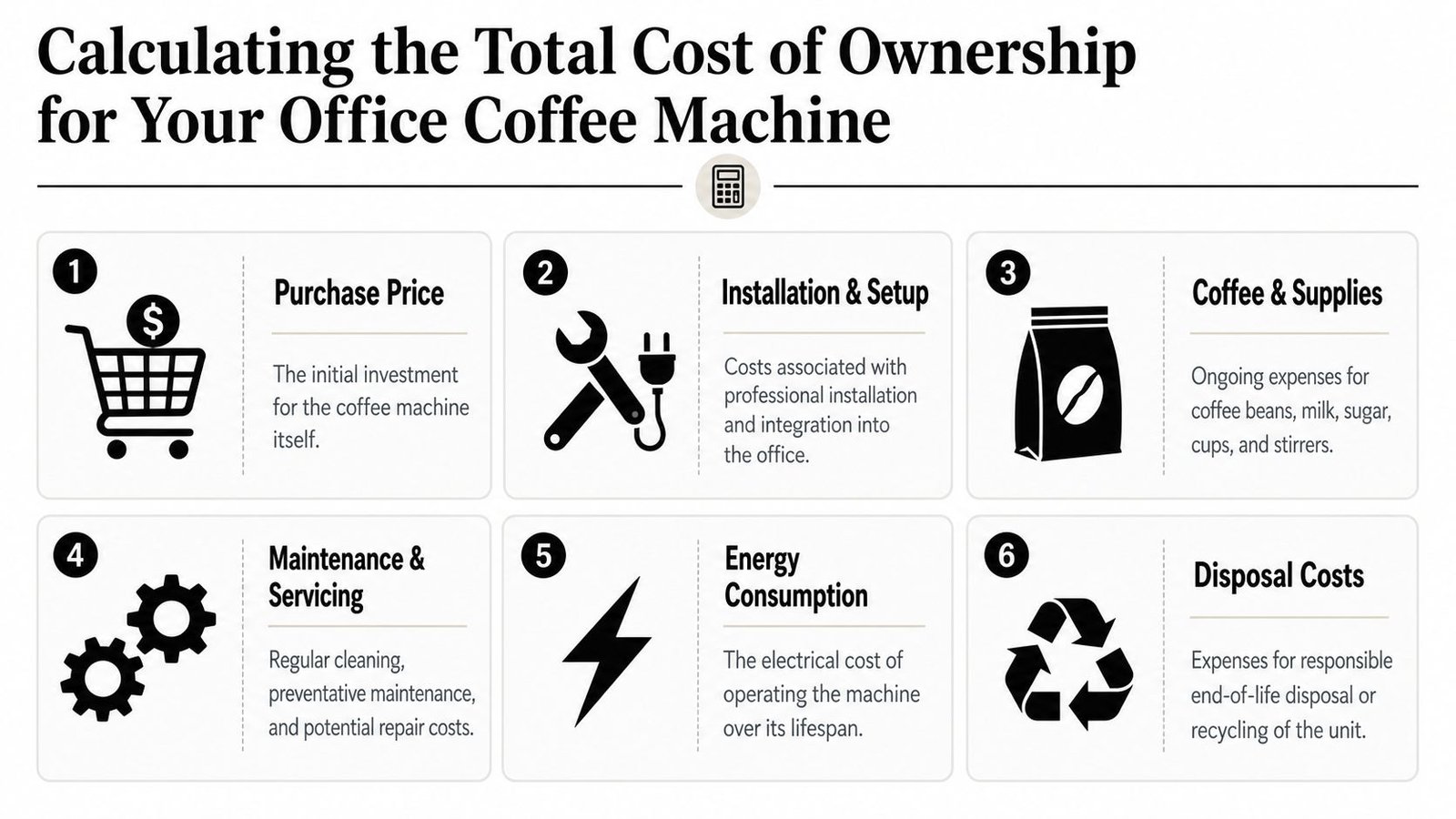
Total cost of ownership is the full operating cost of a machine over time, not just the purchase or lease amount. For office coffee, that means beans, milk, filters, cleaning products, servicing, water treatment, and replacement parts, along with the machine itself.
For a realistic UAE benchmark, My Healthy Office's UAE office coffee programme guide states that a 50-person office in Dubai can spend around AED 75,000 per year on a full coffee programme, or roughly AED 1.25 per cup. In that same breakdown, machine amortisation is AED 9,000 annually, beans cost AED 24,000–28,000, and milk costs AED 28,000. That changes the conversation immediately. The machine is not the whole budget. In many offices, consumables become the bigger issue.
A founder who sees only the equipment invoice usually underbudgets. The more honest way to plan is to separate cost into two groups:
- Fixed costs: machine purchase or rental, installation, filtration, service contract
- Variable costs: beans, milk, cups, stirrers, sugar, cleaning supplies, user behaviour
Here's the practical problem. Cheap machines can look economical upfront, then create a higher running cost because they break, waste coffee, or need more attention from staff.
A short explainer helps visualise the budget components:
Should you lease or buy
Leasing protects cash flow. Buying gives you more control over the asset. The right answer depends on your stage.
For an early-stage company, leasing can make sense if cash needs to stay available for licensing, deposits, salaries, and marketing. It also reduces the risk of choosing the wrong machine and being stuck with it. For a settled office with predictable use, purchasing can be cleaner if the machine will stay in service for years and the maintenance arrangement is solid.
Commercial view: Founders should compare lease plus consumables plus service against purchase plus service, not lease against sticker price.
What doesn't work is buying a premium machine without a proper servicing plan. That usually turns into downtime, emergency repairs, and staff complaints.
How does VAT affect the decision
Value Added Tax, or VAT, is the UAE's consumption tax applied to taxable supplies. If your business is growing, equipment decisions can affect reporting and cash flow even when they don't change the underlying business case.
A useful threshold to remember is that mandatory VAT registration in the UAE applies when taxable supplies exceed AED 375,000 annually, under the rule explained in BCL's guide to opening a UAE free zone company. A large equipment purchase or lease can become relevant inside the broader accounting picture, especially if the business is already nearing registration level.
That doesn't mean a coffee machine decides your tax position on its own. It means founders should keep operational purchases connected to finance, not treat them as isolated admin. If accounting is outsourced, make sure the finance team sees the lease, service contract, and supplier invoices early.
Installation and Compliance in the UAE
A machine that fits your office on paper can still become a headache on site. Installation issues usually show up late, often after the lease is signed and the pantry layout is fixed.
What should you confirm before the machine arrives
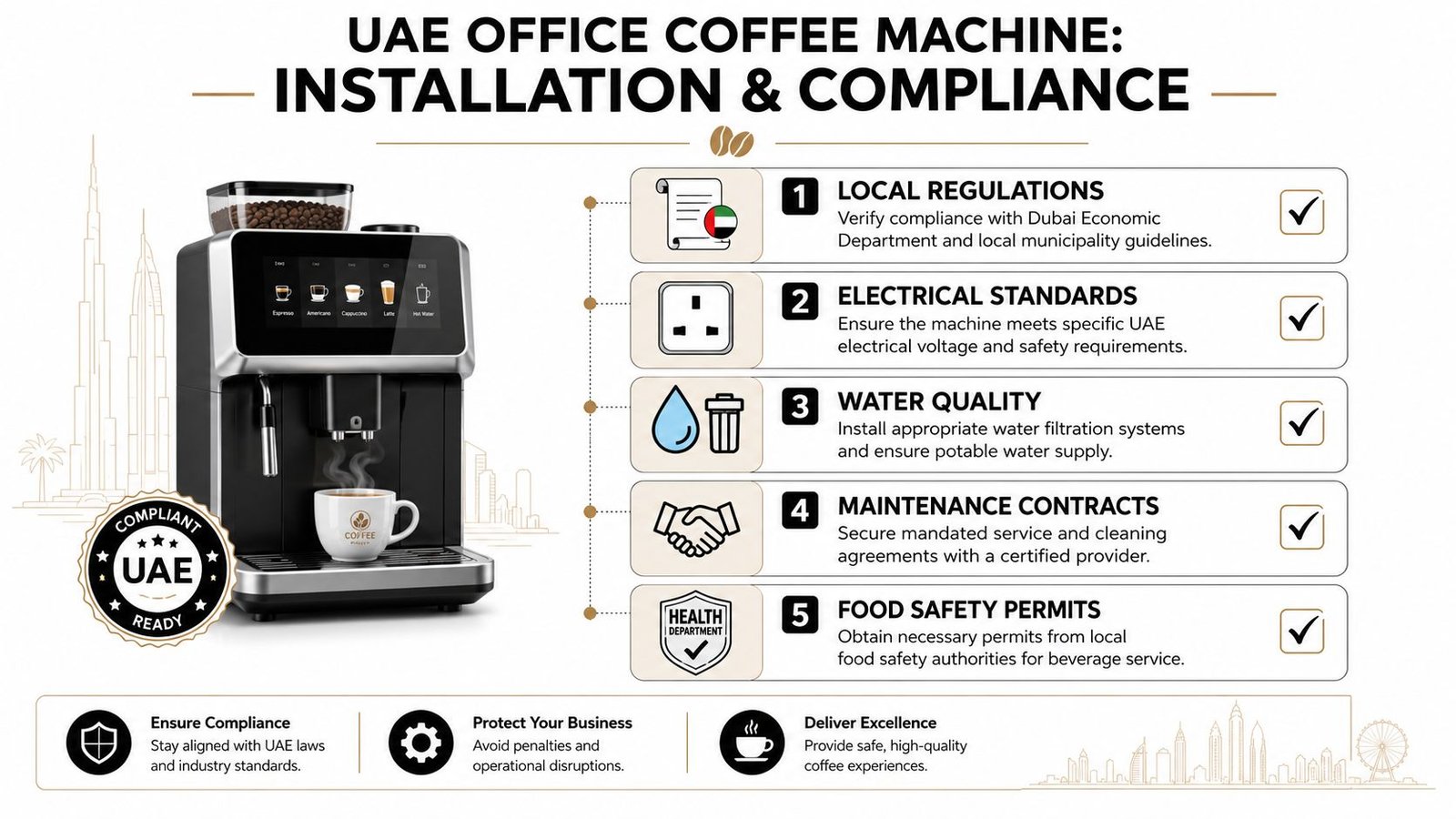
The first checks are practical. Confirm power supply, plug compatibility, counter space, drainage if needed, and whether the unit will be manually filled or connected to mains water. In many offices, the actual issue isn't the machine itself. It's whether the pantry was designed for serious daily use.
Water quality also matters. In UAE conditions, filtration isn't just a taste preference. It protects the machine, reduces scale-related service issues, and supports more consistent output. If a supplier talks only about beverages and not about water treatment, that's a warning sign.
There is also a landlord and facilities layer. In business centres and fitted offices, pantry modifications may need approval. That becomes more relevant if plumbing, cabinetry, or drainage changes are involved.
Why is maintenance also a compliance issue
Cleaning isn't only about keeping coffee tasting acceptable. In office environments, pantry hygiene can become a building management and municipal concern. If milk systems, waste trays, and water lines are neglected, the issue quickly moves from convenience to sanitation.
That's why service contracts matter operationally. A maintenance schedule creates accountability. It also helps if your office has regular visitors, food handling expectations, or managed building standards that are taken seriously by facilities teams.
A machine with automatic cleaning features still needs human ownership. Offices get into trouble when everyone assumes someone else is handling it.
What should be on your pre-install checklist
Use a simple checklist before approving any coffee making machine for office use in the United Arab Emirates:
- Electrical fit: confirm the pantry can safely support the machine's requirements.
- Water plan: decide between refill, direct connection, and filtration before delivery day.
- Drainage and waste: check how drip trays, grounds, and milk waste will be handled.
- Cleaning ownership: assign a person, team, or vendor. Shared responsibility often means no responsibility.
- Service contract: don't wait for the first fault before arranging support.
A founder setting up in Dubai, Abu Dhabi, or another UAE business hub should treat coffee equipment like any other office system. If it depends on power, water, hygiene, and supplier support, it belongs on the operations checklist from the start.
Sustainable Coffee Solutions for a Modern UAE Business
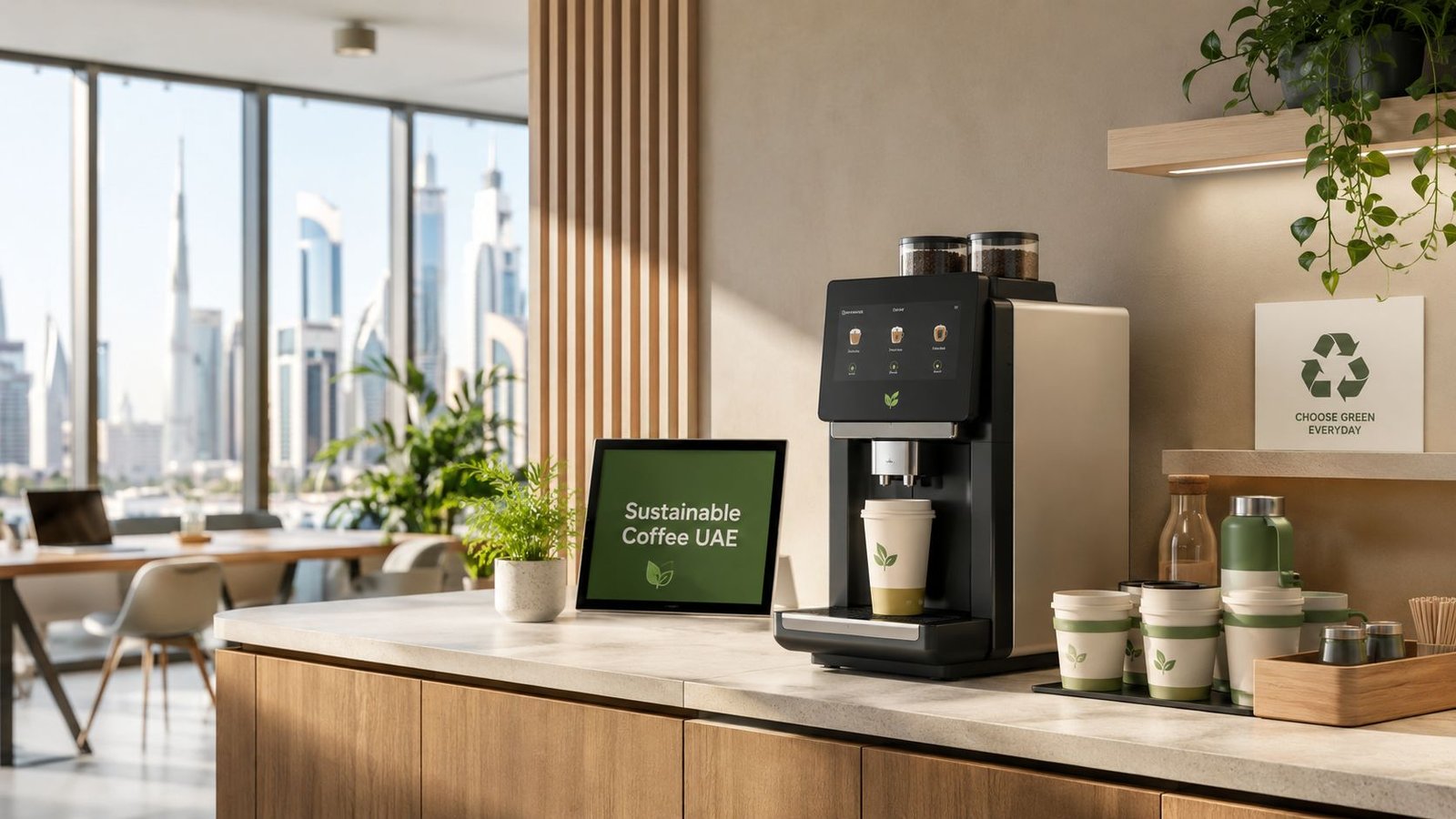
Sustainability in office coffee isn't about making the pantry look green. It's about choosing a setup that creates less waste, uses resources more sensibly, and doesn't force you into a messy supply chain six months later.
What makes an office coffee setup more sustainable
A sustainable office coffee setup is a setup that reduces unnecessary waste, avoids inefficient supply choices, and stays workable for daily operations. In practice, that means looking at pods, cups, milk handling, cleaning products, and machine energy settings together.
The wrong approach is cosmetic. Buying a sleek machine and then running it on disposable items all day doesn't improve much. The better approach is to reduce waste at the system level.
How can founders make practical green choices
A few options are realistic for UAE offices without making the setup complicated:
- Choose reusable serviceware where possible: mugs and glasses reduce the stream of disposable cup waste in internal offices.
- Ask suppliers about pod recovery or recyclable options: if you use capsules, don't ignore the waste chain.
- Pick machines with energy-saving modes: this is useful in offices where equipment stays on for long periods.
- Buy only what the team will consume: over-ordering beans, milk, and extras creates avoidable spoilage.
- Match machine style to actual demand: an oversized machine can be wasteful in both energy and consumables.
This is also where bean-to-cup systems often beat pod-heavy setups in daily office use. They can create less packaging waste if the office has the discipline to manage beans, milk, and cleaning properly.
Why do these choices matter for your brand
A modern business in the UAE is judged on details. Staff notice whether the company acts thoughtfully or just decorates the language around sustainability. Clients notice too, especially in sectors where procurement, governance, or brand reputation matter.
That doesn't mean every office needs a formal environmental policy around coffee. It means consistent, sensible choices say something about how the business operates. In Dubai and across the United Arab Emirates, that kind of operational maturity travels further than slogans.
For most founders, the best sustainable setup is also the best operational setup. It avoids waste, supports cleaner procurement, and reduces the number of daily workarounds your team has to invent.
If you're setting up or scaling a business in the UAE and want the operational side to be as organised as the legal side, Inpro Corporate Services L.L.C. can help you handle formation, visas, PRO support, and the practical details that shape day-to-day business life. Not sure where to start? Book a free strategy call with the team.