


UAE gratuity is calculated on the employee's last basic salary only, at 21 days' pay per year for the first five years and 30 days' pay per year after that, with the total capped at two years' basic salary. The advice many founders still see online is wrong on one key point: under the current law, old resignation penalties for full-time expatriate employees no longer apply, so the calculation must follow the updated rules rather than legacy templates.
That matters in practice. A founder in Dubai, an HR manager in Sharjah, and a growing team in Abu Dhabi can all make the same avoidable mistake: they rely on an old calculator, use total salary instead of basic salary, round up partial years, and end up with a settlement figure that doesn't match the law in the United Arab Emirates.
Table of Contents
- Your Guide to End-of-Service Gratuity in the UAE
- Understanding Your Core Gratuity Obligations
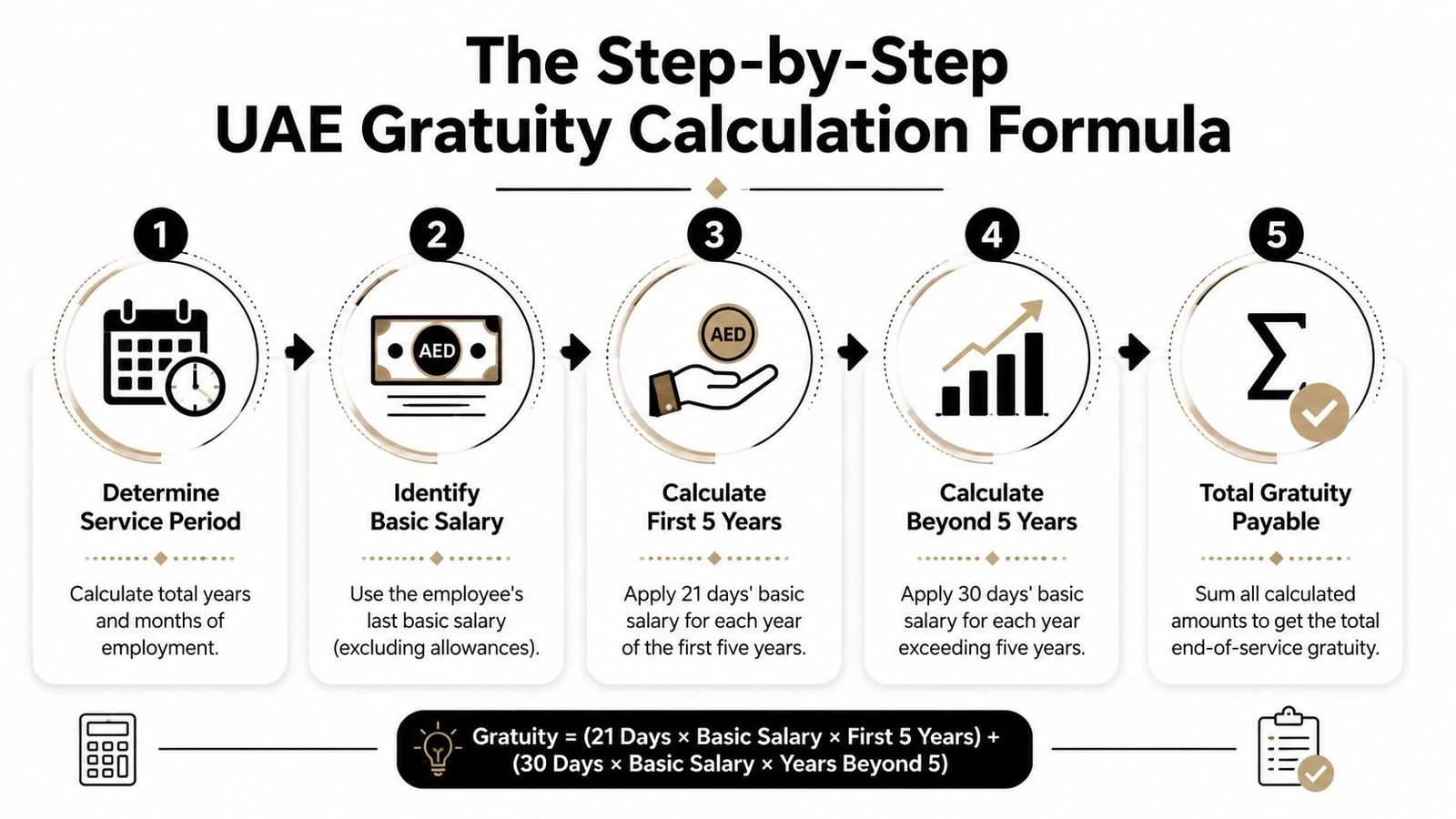
- The Step-by-Step UAE Gratuity Calculation Formula
- Worked Examples for Common Scenarios
- Critical Mistakes to Avoid in Your Calculation
- Finalizing the Payment a Compliance Checklist
Your Guide to End-of-Service Gratuity in the UAE
End-of-service gratuity is a statutory payment due when an eligible employee leaves service. For most mainland private sector employers across the UAE, the rule is defined by Federal Decree-Law No. 33 of 2021, and once you understand the inputs, the math is consistent and manageable.
Founders often expect gratuity to be flexible because salary structures in the UAE can be flexible. It isn't. The law fixes the basis of calculation, fixes the accrual rates, and fixes the cap. That's helpful, because it means you don't have to guess what applies in Dubai or elsewhere in the United Arab Emirates if you're under the mainland labour system.
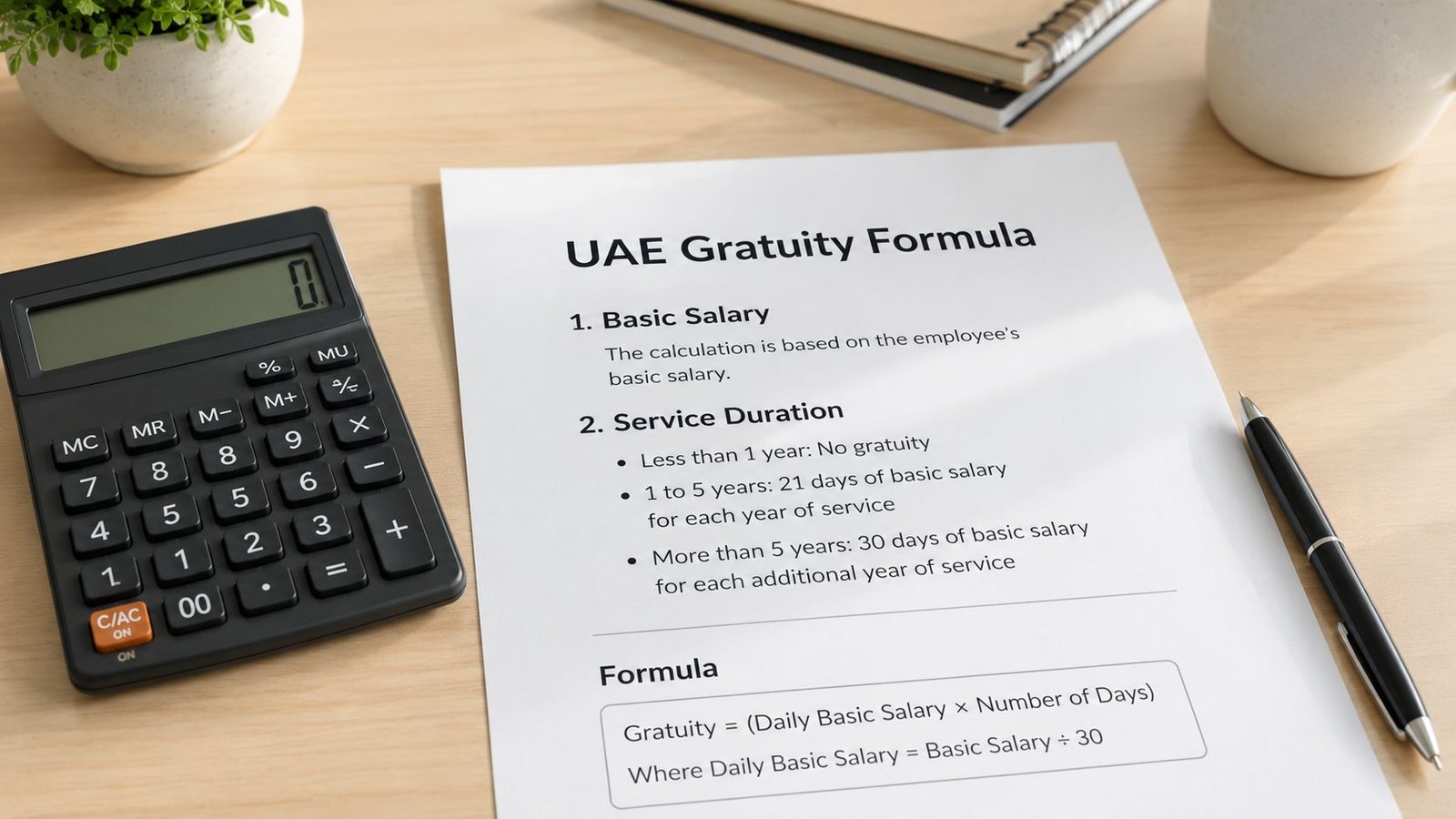
Practical rule: Start every UAE gratuity calculation with the labour contract, not the payroll summary. The contract tells you the basic wage. That's the figure that matters.
If you're new to UAE employment administration, keep one principle in mind. Gratuity isn't a negotiated estimate at exit. It's a legal settlement item that needs to be calculated correctly and paid on time.
Understanding Your Core Gratuity Obligations
What is end-of-service gratuity
End-of-service gratuity is a mandatory terminal benefit paid to eligible employees when their employment ends. In mainland private sector employment, it forms part of the final settlement due under the labour law framework.
For most employers, the main issue isn't whether gratuity exists. It's whether the company is calculating it on the right pay base and the right service period.
Who qualifies for gratuity
Eligibility is tied to service length. An employee generally needs at least one year of service before gratuity becomes due. That one-year threshold is the first question I'd check before opening a spreadsheet.
If the employee hasn't completed one year, gratuity doesn't arise. That simple threshold clears up many probation-period misunderstandings.
What counts as basic salary
Basic salary is the contractual wage excluding extras such as housing, transport, commissions, and bonuses. Under UAE gratuity rules explained with reference to Article 51, gratuity is calculated only on the employee's basic salary, with 21 days of basic salary for each year from one to five years, and 30 days for each year after five years under the 2021 law.
That's where many employers slip. Their payroll sheet shows a package. The law looks at the basic wage. If those are different, gratuity follows the basic wage, not the headline monthly package.
| Contract pay element | Included in gratuity basis |
|---|---|
| Basic salary | Yes |
| Housing allowance | No |
| Transport allowance | No |
| Commission | No |
| Bonus | No |
A clean contract split between basic salary and allowances makes exit calculations easier and reduces disputes.
Who oversees these rules on the mainland
The Ministry of Human Resources and Emiratisation (MOHRE) is the federal authority that oversees labour relations for mainland private sector employment in the UAE. If your company is licensed on the mainland rather than in a separate financial free zone system, MOHRE is the framework most founders need to understand.
That distinction matters because not every zone applies the same employment model. Mainland employers in Dubai, Abu Dhabi, and other emirates usually work within MOHRE rules, while some financial free zones operate separately.
The Step-by-Step UAE Gratuity Calculation Formula
A correct UAE gratuity calculation follows a simple sequence. Work out the service period. Confirm the last basic salary. Convert that monthly basic salary into a daily wage. Then apply the right rate to the right years.
How do you find the daily wage
Daily wage is the monthly basic salary divided by 30. That 30-day divisor is part of the standard calculation method used for gratuity purposes.
Founders sometimes overcomplicate things by trying to use the actual number of days in a month. Don't. For gratuity, use the legal method and keep it consistent.
How do you calculate the first five years
For service from one year up to five years, multiply the daily wage by 21, then multiply that result by the number of completed years in that band. That gives you the gratuity accrual for the first tier.
If someone has worked only within that first band, the calculation stays straightforward. No second tier applies unless service goes beyond five years.
How do you calculate service beyond five years
Once service exceeds five years, the first five years remain on the 21-day rate. Only the years after that move to the 30-day rate. That means longer service produces a blended result rather than one flat rate for the entire period.
Here's the structure in plain terms:
- Find daily basic wage by dividing monthly basic salary by 30
- Calculate first five years at 21 days per year
- Calculate later years at 30 days per year
- Add both figures
- Check the legal cap before finalising payment
How should fractional years be handled
This is one of the most useful corrections to old online advice. Partial service after the first completed year should be pro-rated, not merely rounded up to the next full year. Under the UAE gratuity formula guidance covering pro-rated fractions, the first five years are calculated at 21 days of daily basic wage per year, later years at 30 days, and fractional years must be pro-rated by dividing the annual gratuity by 12 and then by 30 to reach the precise amount due.
That means an employee with four years and several additional months doesn't automatically receive five full years of gratuity. The extra months should be calculated as a proportion of the relevant annual entitlement.
Don't round service up because it feels fair. Apply the formula because it's legally defensible.
Worked Examples for Common Scenarios
Examples are where the rules stop feeling abstract. These are the sorts of cases founders and HR teams face during offboarding.
Example 1 terminated after 3 years and 4 months
A marketing manager in Dubai has a basic salary of AED 12,000 and leaves after 3 years and 4 months.
- Daily wage = AED 12,000 ÷ 30
- Annual gratuity within the first five years = daily wage × 21
- Full entitlement = 3 full years of annual gratuity
- Add a pro-rated amount for the extra 4 months
Because the employee is still within the first five years, only the 21-day rate applies. The extra 4 months should be pro-rated rather than rounded to a full year.
Example 2 resigned after 7 years
A software developer in Abu Dhabi has a basic salary of AED 12,000 and resigns after 7 years.
The correct approach is split into two parts:
- First 5 years: daily wage × 21 × 5
- Next 2 years: daily wage × 30 × 2
This is the example many legacy calculators still distort because they try to reduce gratuity for resignation. Under the current law for full-time expatriates, that old reduction model no longer applies, so the employee's resignation does not trigger a lower percentage of gratuity.
Example 3 why probation does not qualify
A sales executive in Sharjah leaves during probation after only a few months. No gratuity is due because the employee hasn't reached the one-year service threshold.
That's a legal eligibility issue, not a calculation issue. If the minimum service period isn't met, there's nothing to calculate.
Example 4 total package versus basic salary
A founder hires an operations lead on a monthly package of AED 20,000, but the labour contract states a basic salary of AED 12,000 and the rest is allowances. Under this UAE gratuity calculation guide based on Article 51, gratuity must be calculated on the AED 12,000 basic salary, not on the AED 20,000 package.
That single distinction changes the result materially. It's also one of the easiest mistakes to prevent if the employment contract is drafted clearly from day one.
If your payroll software displays one monthly total, always cross-check it against the signed contract before approving the final settlement.
Critical Mistakes to Avoid in Your Calculation
The biggest gratuity mistakes don't come from difficult maths. They come from outdated assumptions and messy payroll habits.

Why old resignation deductions are wrong
A surprising number of internal calculators still apply the old rule that resignation reduces gratuity in the early years. That's no longer the right approach for full-time expatriates under the current framework. As this analysis of resignation penalties under the updated UAE law notes, those penalties were removed by Federal Decree-Law No. 33 of 2021, and 14% of UAE HR professionals still mistakenly apply the old reduction formulas.
For a founder, that creates two risks at once. You may underpay the employee, and you may also create an internal compliance problem that repeats every time someone exits.
Why total salary causes bad calculations
The next failure point is using the employee's total package instead of the last basic salary. If housing, transport, or commission are baked into the formula, the result is wrong from the first line.
In real companies, this happens because someone pulls the amount from payroll rather than from the contract. A basic salary field should be checked manually before any settlement letter is issued.
A short explainer can help teams visualise the difference:
Why the legal cap still matters
Long-serving employees can produce large entitlement figures on paper. But the law still imposes a ceiling, and your calculation process should check for it before final approval.
A sensible internal review checklist is:
- Verify the contract figure: Confirm the final basic salary, not the gross package
- Review service dates: Exclude unpaid absence periods where required
- Apply pro-rating carefully: Don't round partial years into full years
- Check the cap last: Make sure the final result doesn't exceed the legal limit
Finalizing the Payment a Compliance Checklist
Getting the number right is only half the job. The exit process also needs the right documents, the right sequence, and the right payment timing.
What should be checked before payment
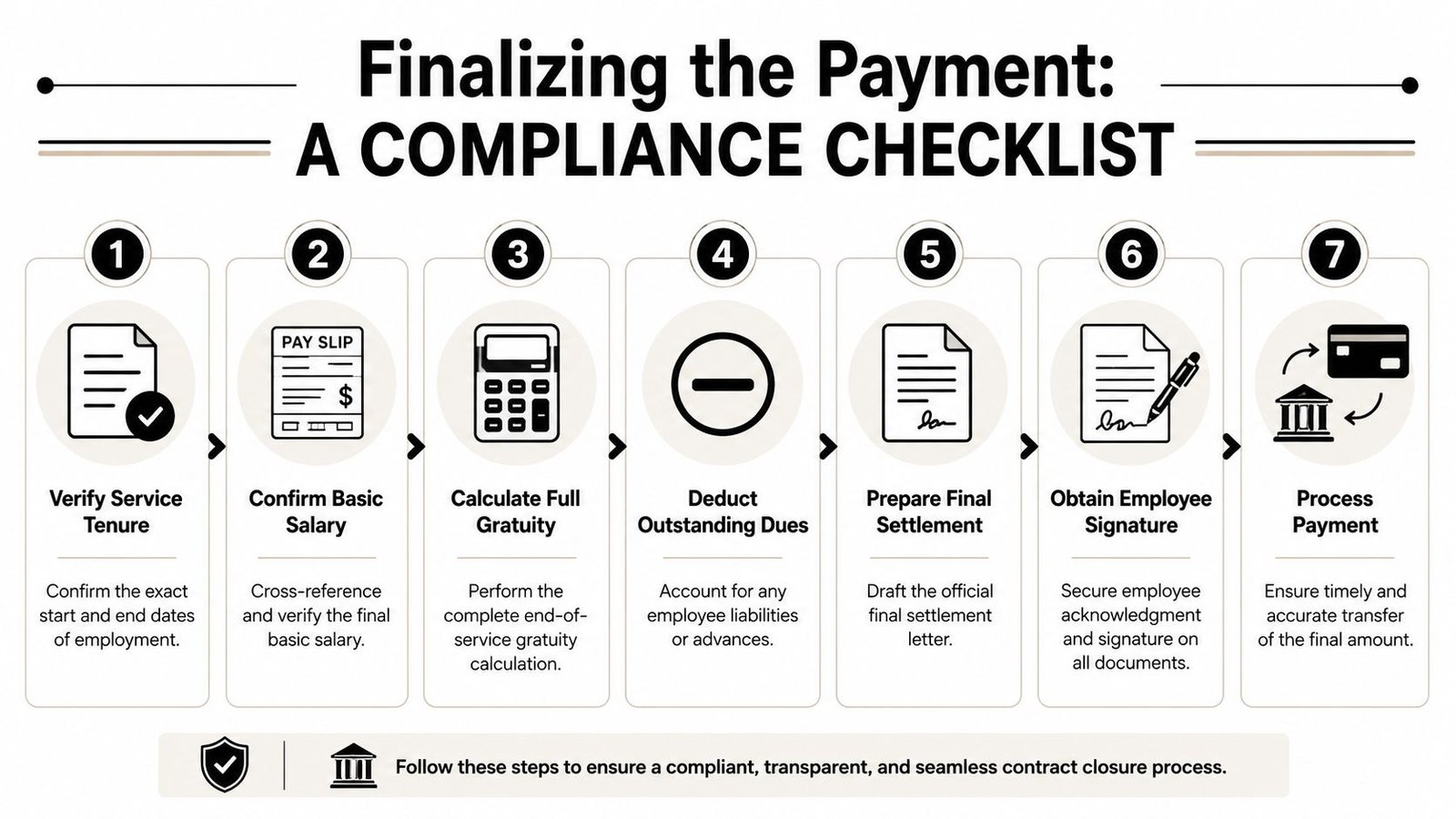
Use a simple closeout checklist before issuing the final settlement:
- Service dates: Confirm the employee's exact start and end dates
- Basic salary: Match the payroll record to the labour contract
- Outstanding items: Review advances, unpaid leave records, and any agreed deductions
- Settlement paperwork: Prepare the final settlement form and acknowledgement documents
- Immigration steps: Align the settlement with visa cancellation and related employment records where applicable
When must gratuity be paid
Payment timing matters. The gratuity and other final dues should be settled within 14 days of contract termination under the UAE labour framework, and that deadline should be built into your offboarding process from the start rather than treated as an afterthought.
A disciplined exit file usually includes the employment contract, payroll confirmation of the final basic wage, leave and absence review, the signed settlement record, and proof of payment. That's the paperwork set I'd want ready before closing the employee file.
Do DIFC and ADGM follow the same system
Not always. Dubai International Financial Centre (DIFC) and Abu Dhabi Global Market (ADGM) are financial free zones with their own employment frameworks, and they can operate differently from the mainland Ministry of Human Resources and Emiratisation system.
That distinction catches international founders off guard. If your team sits in a mainland company, apply the mainland gratuity rules. If your entity is in a financial free zone, check that zone's employment regime before treating it as identical.
One final check shouldn't be skipped. Under the UAE gratuity cap set out under Article 51, total entitlement cannot exceed 24 months' basic wage, even where a long period of service would produce a higher arithmetic figure.
The cleanest employee exits happen when the company can show its calculation, its documents, and its payment date without scrambling.
Not sure where to start? Book a free strategy call with Inpro Corporate Services L.L.C. for practical guidance on UAE employment administration, PRO support, and compliant business operations.