

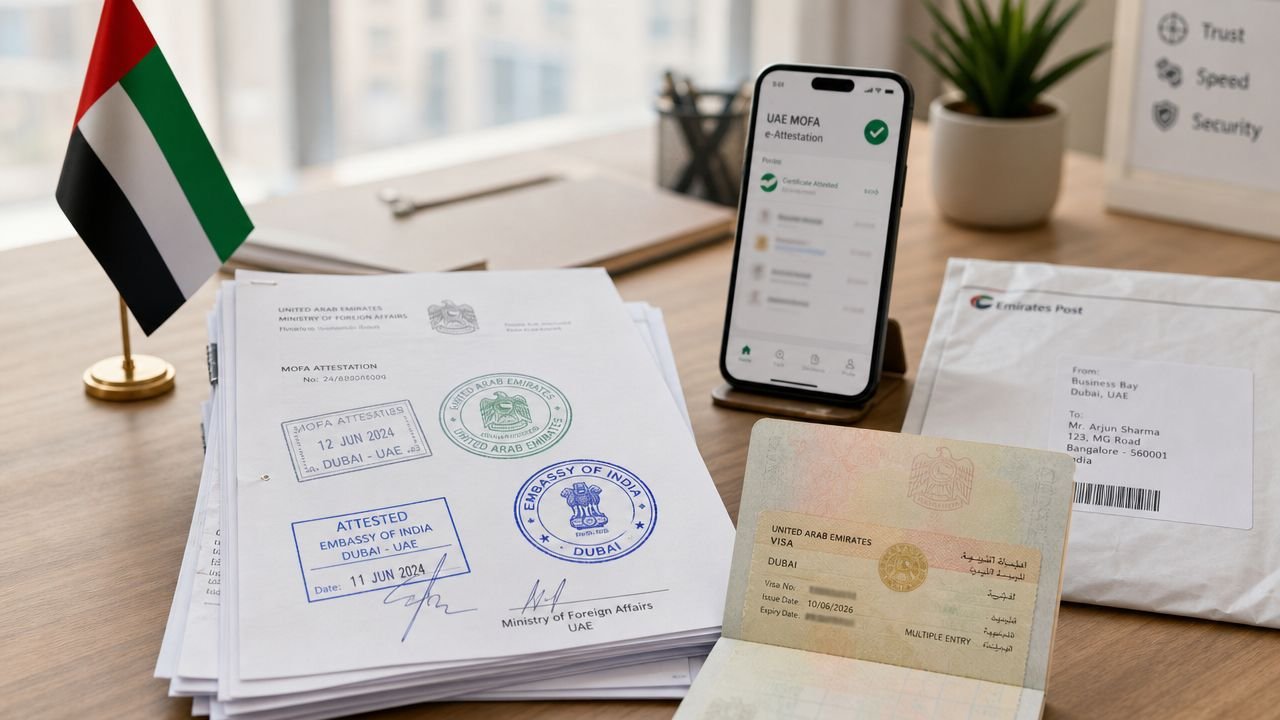
You're probably at the point where a stack of documents is sitting on your desk, and one missing stamp is blocking everything else. Attestation service UAE is the process that makes foreign-issued documents legally usable in the UAE and the United Arab Emirates, and the fastest way to avoid delays is to respect the full legal chain, not just the final stamp.
Table of Contents
- What Attestation Service UAE Actually Means
- Types of Attestation and the Documents Behind Each
- The Authority Sequence From Origin to UAE
- Fees, Timelines and the Same-Day Digital Shortcut
- Common Mistakes That Delay Attestation in the UAE
- When an Attestation Service Genuinely Pays Off
- Practical Checklist and Final Questions
What Attestation Service UAE Actually Means
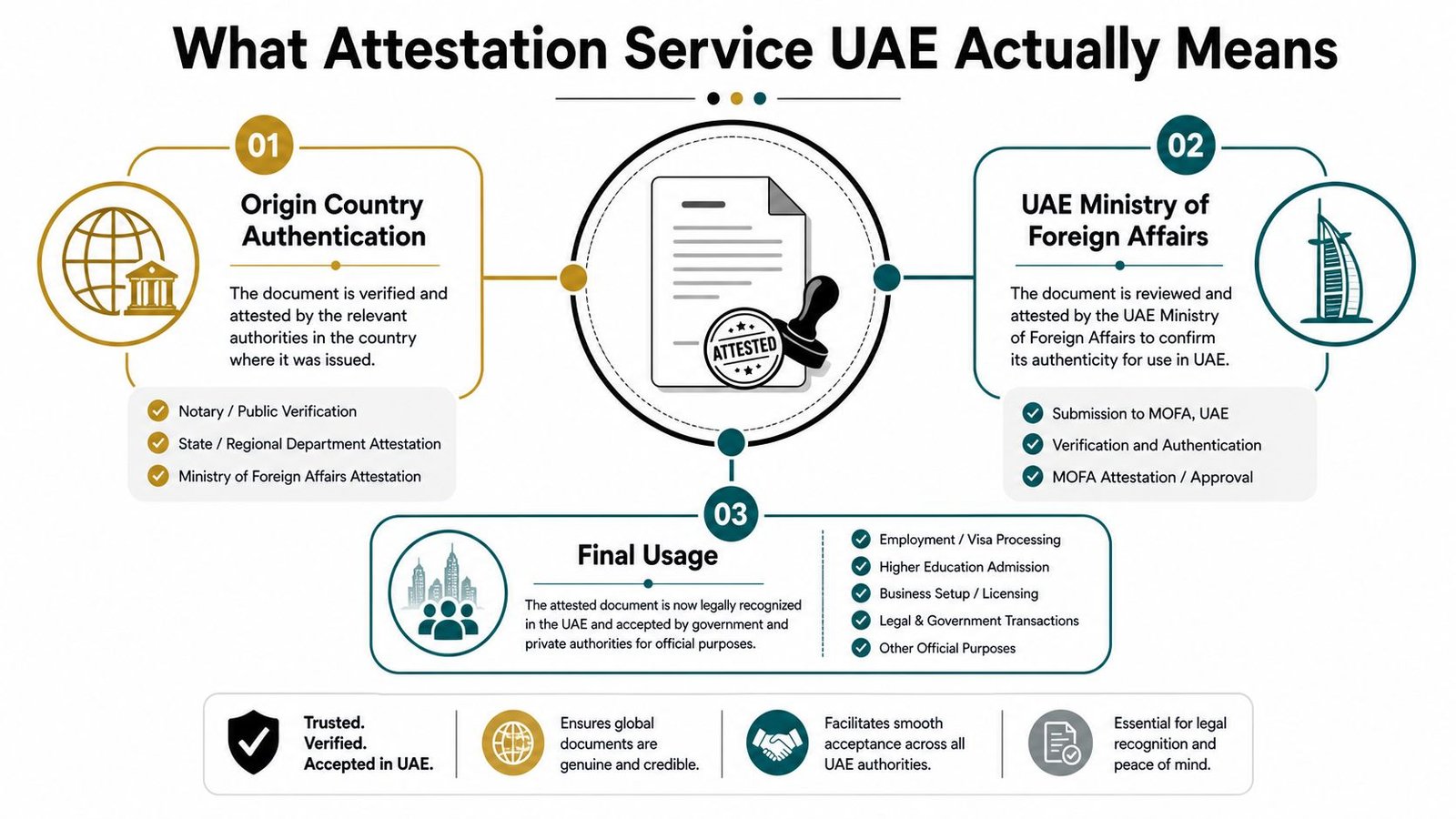
A founder walks into a typing centre in Dubai with a degree, a marriage certificate, and a commercial paper, then discovers none of them will move forward without the right stamps. That's what attestation service UAE really is, a legal verification chain that turns a foreign document into something UAE authorities will accept.
MOFA is the UAE Ministry of Foreign Affairs, and it sits at the end of the chain. Official guidance from MOFA says the process runs through three stages, first authentication in the country where the document was issued, then attestation by the UAE Embassy or Consulate abroad, then final attestation by MOFA in the Emirates (MOFA attestation service guidance). MOFA provides the service through both the website and the UAE MOFA smart app.
Practical rule: if the document was not issued in the UAE, treat the final MOFA stamp as the point where it becomes usable for official work, not as a nice extra.
The reason people get stuck is simple. A foreign degree, marriage certificate, birth certificate, or commercial invoice does not become legally usable in the UAE until the final stage is complete. That affects employment, education, family sponsorship, and company filings, which is why this process is a bottleneck for founders, HR teams, and Golden Visa applicants.
For business owners, the pain is usually not the idea of attestation, it's the wait, the rework, and the fact that one missing step can invalidate the whole file. That's why Dubai, Abu Dhabi, Sharjah, and the free zones all end up dealing with the same basic question, has this document been verified in the right order, or not?
Types of Attestation and the Documents Behind Each
Different files fail for different reasons, and you save time when you know the category before you start chasing stamps. In practice, an attestation service UAE usually handles personal, educational, and commercial documents, and each category tends to come with a different supporting paper trail.
Which documents count as personal, educational, or commercial
Personal attestation covers civil-status papers such as birth certificates, marriage certificates, divorce papers, and in many workflows police clearance certificates. HR teams using these documents for employee visas or family sponsorship usually need clean originals, correct translations when required, and the right prior authentication in the issuing country.
Educational attestation is the lane for degrees, transcripts, diplomas, and professional certificates. This is the category that trips up new hires the most, because employers in Dubai or Abu Dhabi often need these files before they can continue with employment processing.
Commercial attestation is for company-facing papers such as commercial invoices, powers of attorney, commercial agreements, and corporate documents. Founders entering mainland Dubai through the Dubai Department of Economy and Tourism need to expect a different paper trail from a free zone authority such as DMCC or RAKEZ, and financial free zones such as DIFC or ADGM can add their own compliance layer before a document is ready for MOFA.
Operational shortcut: if the document supports a visa, think personal or educational. If it supports trade, ownership, or a filing, think commercial.
A smart first move is to collect the original plus any translations, school letters, company authorisations, or chamber stamps that match the category. If you sort the file by document type before you touch any portal, you cut out most of the back-and-forth that slows applicants down in the UAE.
The Authority Sequence From Origin to UAE
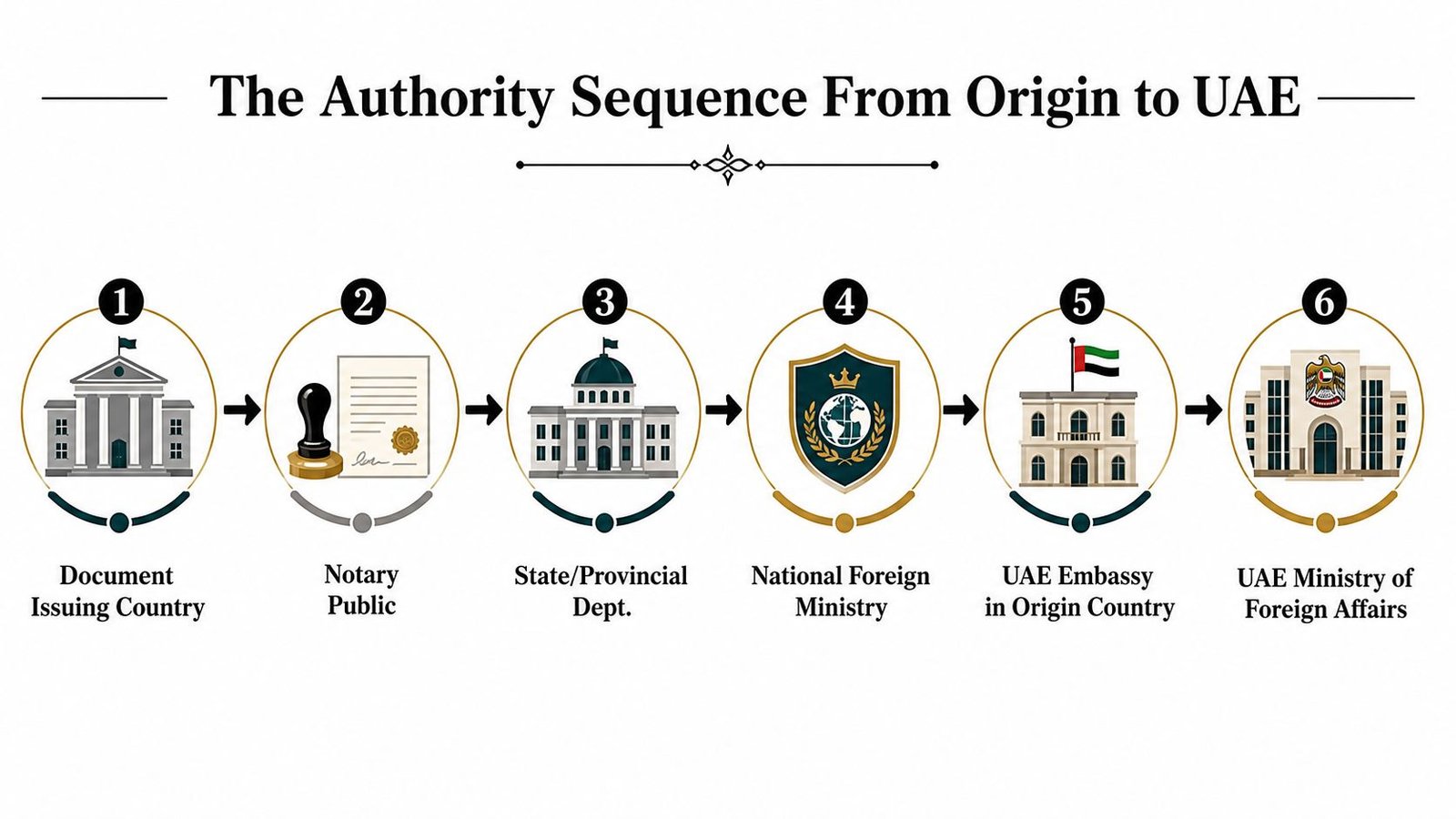
The legal order matters more than the courier label, and a common point of failure for many files is here. A document usually has to move through the country of issue first, then the UAE mission abroad, and only then MOFA in the United Arab Emirates.
What happens in the country where the document was issued
Start with the authority that recognises the document locally. That might be the Ministry of External Affairs in India, a Chamber of Commerce for commercial papers, or an education or home affairs authority for school and personal files. If the country of origin does not certify the document correctly, the UAE side has nothing clean to work with.
After that, the document goes to the UAE Embassy or Consulate in that country. For foreign certificates, MOFA's public process expects the applicant to confirm “Yes” to both prior-attestation declarations in the online form before the UAE side will continue (Gulf News guide on foreign certificates).
How the UAE side receives the original document
The original physical paper is handed to a courier such as Emirates Post, Zajeel, Tawzea, or Aramex for delivery to MOFA. That original handoff matters, because the file is not just being uploaded, it is being physically moved into the official attestation workflow. The same Gulf News guide says the original document must be handed to the courier for delivery to MOFA in Abu Dhabi or Dubai, which is the detail people forget when they only focus on the online form.
For commercial invoices, MOFA routes company users through Companies Service and the Electronic Documents Attestation System (eDAS), so you should not treat business papers like personal certificates (MOFA FAQ on commercial invoices). That separate path is a common source of wasted time, especially for founders and operations teams who assume one portal covers everything.
If your document is for a free zone structure, an offshore entity, or a financial free zone file, expect legalisation logic to differ from a standard embassy-attestation workflow. Check the exact route before you send the original anywhere.
The clean rule is simple. Origin country first, UAE mission second, MOFA last. If you reverse that order, you usually create rework.
Video guide for a quick visual walk-through.
Fees, Timelines and the Same-Day Digital Shortcut
The fee is rarely the problem. Files lose time at the counter, in courier handoff, or after a rejection that sends the original back into circulation.
What MOFA Charges
MOFA public guidance and UAE-focused reporting show a standard attestation fee of Dh150 plus a Dh6.06 E-dirham fee for listed document types, with courier charges added separately (Gulf News fee and timing guidance). The same source says typical turnaround windows are about 48 hours to three days, depending on the channel and document complexity.
MOFA's FAQ gives the direct-service split founders and HR teams should use when comparing self-service with an intermediary. Normal attestation is AED 40 in 3 working days, express is AED 150 in 1 working day, and companies and entities can also use prepaid courier packages through the official channels (MOFA FAQs).
Which option makes sense in real life
MOFA also offers same-day digital completion within official hours for eligible cases through the website and app (MOFA FAQs). If the document is already in the UAE and can be processed directly, paying a third party only to upload the same file usually wastes time.
| Service Tier | Fee (AED) | Turnaround |
|---|---|---|
| Normal attestation | 40 | 3 working days |
| Express attestation | 150 | 1 working day |
| Standard listed-document fee | 150 plus 6.06 E-dirham | Around 48 hours to 3 days, depending on channel |
| Urgent MOFA service, widely cited guide | 300 to 500 | Faster processing window |
Use the higher-cost route only when the deadline is real, the file is complex, or the document is still abroad. If the paper is already in the Emirates and the path is straightforward, direct MOFA service usually wins on cost and speed.
Common Mistakes That Delay Attestation in the UAE
Most attestation delays are self-inflicted, and the patterns are boringly consistent. If you know the failure mode, you can fix the file before it leaves your desk.
The errors that keep showing up
Laminated originals. MOFA cannot stamp a laminated original, so the file gets sent back and the applicant has to source a duplicate. The fix is to use an unlaminated original or obtain a fresh certified copy before submission.
Skipping the embassy step abroad. If the document has not already been approved by the UAE mission in the country of issuance, MOFA stops the file at the declaration stage. The fix is to complete origin-country authentication and UAE mission attestation before anything reaches the UAE.
Wrong supporting papers. Missing translation, no Chamber of Commerce stamp on a commercial paper, or an expired police clearance will all slow the file down. The fix is to match the support documents to the document category before courier pickup.
Using the wrong portal for commercial files. A company invoice sent through a personal-service flow causes confusion, because MOFA channels commercial invoices through Companies Service and eDAS. The fix is to route business papers through the company path from the start.
Ignoring special-case handling. Senior citizens, people of determination, and death certificates go through the MOFA call centre rather than the standard app flow. The fix is to ask for the special route immediately instead of forcing a standard submission.
Practical rule: if a file feels “almost ready”, it usually isn't. Check the document surface, the prior stamps, and the correct service path before you book the courier.
Corporate users lose the most time here. One wrong assumption in a batch of employee files can create a pile of rework, and that usually costs more than taking an extra ten minutes to review the paperwork properly.
When an Attestation Service Genuinely Pays Off
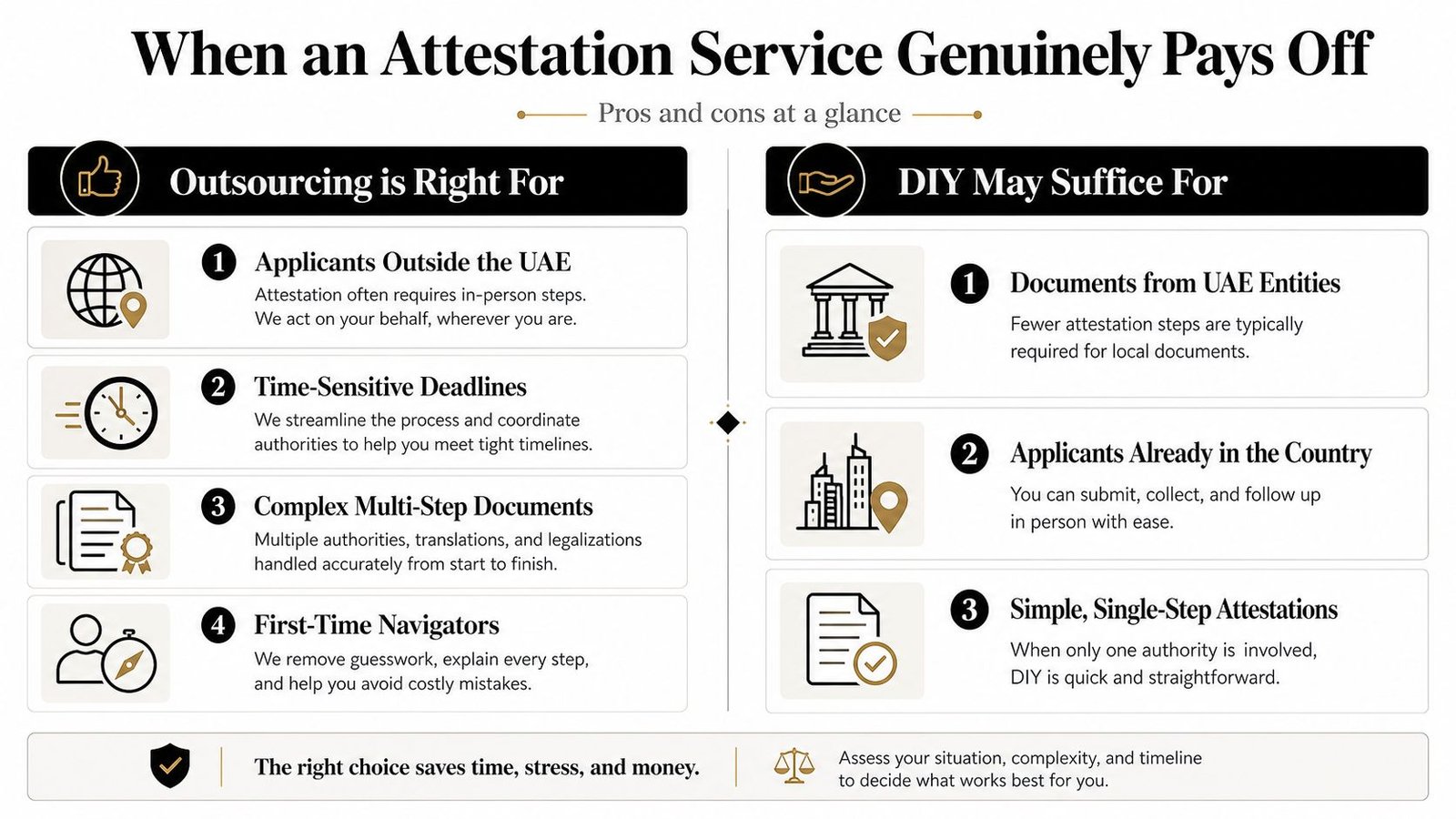
A third-party attestation service UAE is not always faster, and I wouldn't recommend it for every file. It makes sense when the workflow is awkward, repeated, or tied to a deadline that can't absorb a rejection.
When outsourcing is the better call
If the applicant is outside the UAE and has no easy access to a UAE mission, outsourcing can save weeks of coordination. The same is true when a company needs bulk processing for employee files, because repeated submissions across multiple jurisdictions are usually more about project management than stamp collection.
It also pays off when the documents have prior complications, such as embassy-only chains, commercial documents moving through free zone authorities, or cases where the applicant can't afford a reject-and-resubmit loop. That applies to visa stamping, school admission, and Golden Visa timelines, where one missing step can hold up a larger plan.
When DIY is the smarter route
If the document is already in the UAE, is a single personal file, and the timeline is normal, self-service usually wins. You book the courier slot, submit through the MOFA app, and avoid paying someone else to do a task you can do directly.
The decision rule is simple. Abroad, complex, or batch files usually justify a service partner. Single, clean, in-country documents usually do not.
Practical Checklist and Final Questions
The fastest files are the ones that were checked before anyone touched a portal. If you want fewer surprises, run this list before you submit anything.
Your working checklist
- Verify the document type and required route. Decide whether it is personal, educational, or commercial.
- Confirm the right embassy or consulate. Match the issuing country to the correct UAE mission abroad.
- Gather translations and supporting letters. Add whatever the document category requires, not what feels convenient.
- Choose normal, express, or prepaid courier. Pick the service level that matches your deadline and volume.
- Decide self-service or a PRO partner. Use direct MOFA where the file is clean, and use a partner where the workflow is messy.
Three questions people ask after they've done the hard part
Can documents be attested while abroad? Yes, the origin-country and UAE mission steps happen before the file reaches the UAE, and that's often the right approach for overseas applicants.
What happens if the original is lost in courier handling? Stop the submission and trace the shipment immediately, because the original is the document MOFA needs to complete the process.
Do Golden Visa applicants face a different route? The document logic is the same, but the deadline pressure is usually higher, so the file needs tighter checking before submission.
For anyone filing in Dubai, Abu Dhabi, Sharjah, or a free zone, the right move is to treat attestation as part of the setup plan, not an afterthought. If you're unsure which path fits your file, use a team that handles UAE licensing, visas, and document workflows every day, then visit Inpro Corporate Services L.L.C. to book a free strategy call and plan your next step with less guesswork.