

A license in the UAE is a government-issued permit tied to your activity and location, and the three main tracks are commercial, professional, and industrial. In practice, the right file is less about finding the cheapest package and more about matching your activity to the authority that can approve it.
If you're staring at a stack of forms, a trade name shortlist, and a UAE bank account waiting in the wings, you're already in the right frame of mind. The mistake most founders make is treating the license in UAE as a single product. It isn't. It's a regulatory journey, and the route changes depending on whether you want Mainland reach, Free Zone simplicity, or an Offshore structure for holding assets.
Table of Contents
- What a License in UAE Actually Means
- Mainland vs Free Zone vs Offshore
- Types of Business Licenses You Can Apply For
- Who Qualifies and What Documents You Need
- Typical Costs and Timelines in 2026
- Visas and PRO Implications of Your License
- Renewals, Compliance, and Common Pitfalls
- Your Next Step With inpro.me
What a License in UAE Actually Means
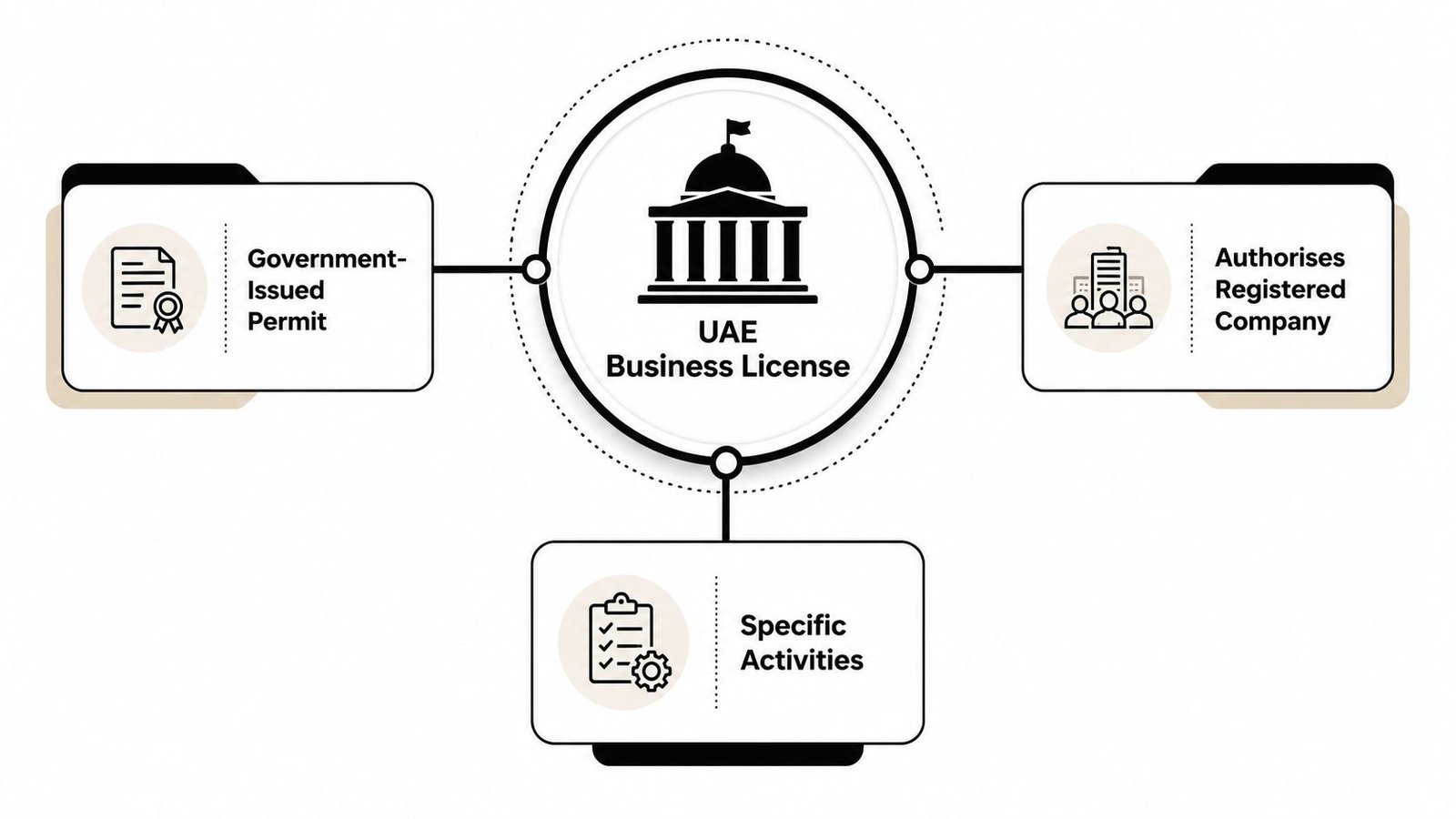
A license in UAE is a government-issued permit that authorises a registered company to carry out specific commercial, professional, or industrial activities in a chosen jurisdiction. It sits on top of company registration, not instead of it, which is why two businesses can both say they are “licensed” while following completely different approval paths.
That distinction matters because the authority that owns your activity code usually controls the rest of the file too. A trading company in Dubai Mainland does not go through the same route as a design studio in a Free Zone or a holding vehicle in an Offshore jurisdiction.
Which authorities actually issue it
Mainland licences are handled by emirate-level economic departments, such as the Department of Economy and Tourism in Dubai and the Department of Economic Development in Abu Dhabi, with equivalent bodies in Sharjah and the other emirates. Free Zone licences are issued by the zone authority itself, such as DIFC, ADGM, DMCC, RAKEZ, or IFZA. Offshore structures are different again, and are typically used for holding and asset structures under authorities like JAFZA Offshore or RAK ICC.
The practical lesson is simple. The licence, the legal entity, and the office solution are three separate decisions, and they have to fit together cleanly. If you choose the wrong one, you don't just lose time, you create rework in banking, visas, and later renewals.
Why founders get stuck on the wrong question
Many ask, “How much is a licence?” That's the wrong first question. The better question is, “Which authority can approve my activity, my office model, and my market access without forcing me to restart later?”
Practical rule: start with the activity, then the jurisdiction, then the office. Price comes after that, not before.
Mainland vs Free Zone vs Offshore
If you want to pick sensibly, compare the three tracks on the things that affect operations: market access, ownership, office, and future compliance. The UAE and the United Arab Emirates both use these structures, but they serve different business models.
Mainland is the straightforward choice for companies that need to trade across the UAE and work directly with government or semi-government clients. Free Zones suit founders who want a cleaner setup, full foreign ownership, and a zone built around a specific sector. Offshore is for international holding and asset structures, not for day-to-day operating businesses.
How the three structures differ
| Dimension | Mainland | Free Zone | Offshore |
|---|---|---|---|
| Market access | Can trade anywhere in the UAE and with government-related clients | Restricted for direct mainland trading unless a distributor or mainland entity is used | Not designed for operating trade in the UAE |
| Ownership | 100 percent foreign ownership is now allowed for most commercial and industrial activities after the 2021 reforms | Full foreign ownership is standard | Full foreign ownership is standard |
| Office | Usually needs an office or approved workspace | Often allows flexi-desk or zone-based space | No physical office |
| Visas | Can support residency visas through the licence file | Can support visa allocations tied to package and space | No UAE residency visa |
| Best for | Retail, local services, contracting, government-facing work | Startups, tech, consulting, export-oriented firms | Holding companies, IP ownership, asset protection |
Where financial free zones fit
DIFC and ADGM are not just ordinary Free Zones. They operate with their own civil-law based common-law frameworks, which matters if you run a fintech, fund, wealth, or advisory business that needs a predictable legal environment. That legal setup is one reason these zones attract firms that care as much about jurisdiction as they do about office rent.
Offshore still has a place, but don't force an Offshore structure onto an operating business just because it looks neat on paper. If you need local clients, staff visas, or a practical bank-ready setup, that route usually gets in your way later.
Types of Business Licenses You Can Apply For
The UAE does not hand out one generic business licence and call it a day. It issues activity-led licences, and the right category depends on what your company does. Get that wrong, and every other step becomes harder than it should be.
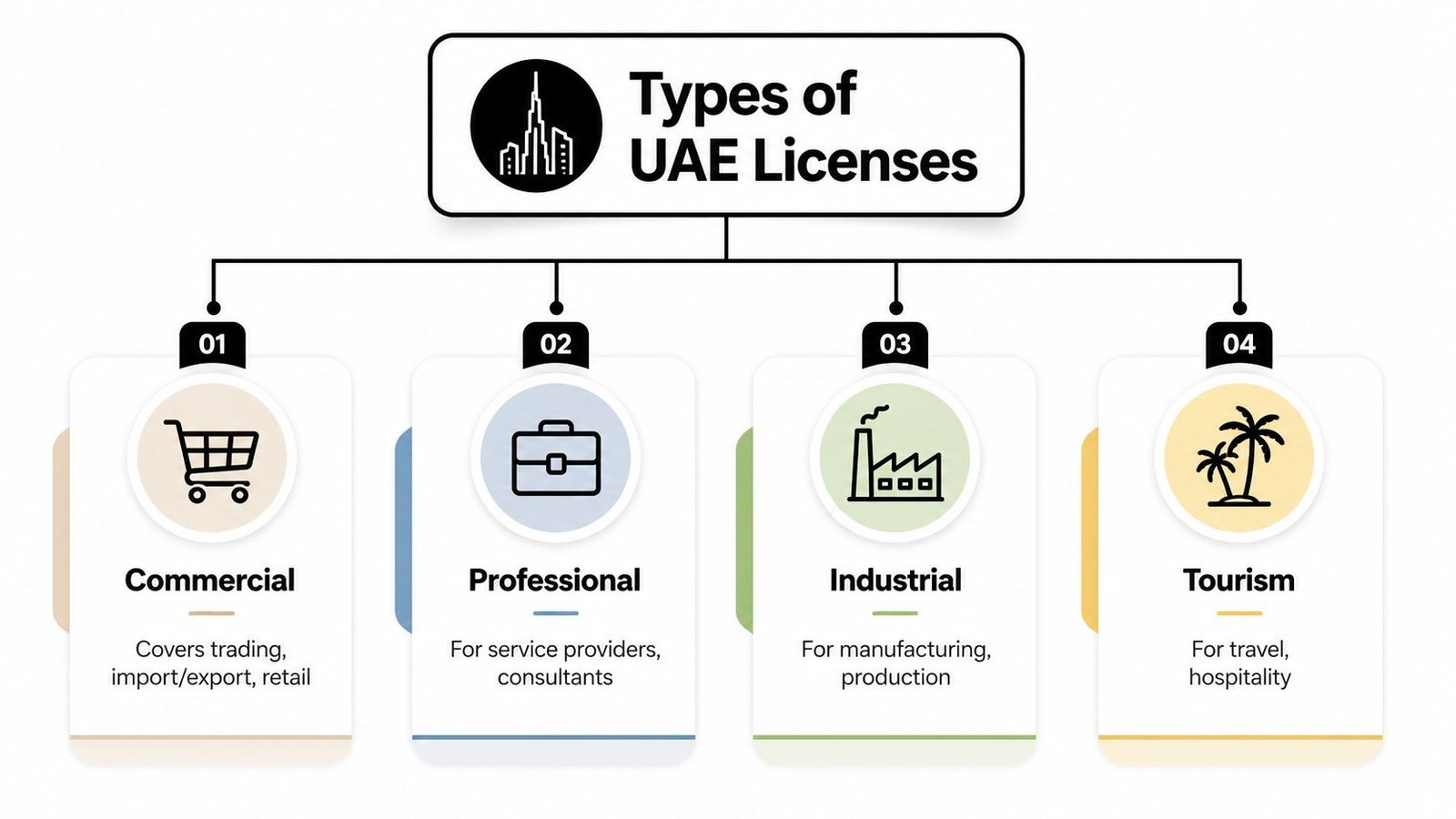
Commercial, professional, industrial, and tourism licences
A commercial license is the permit for trading, import and export, retail, and e-commerce. The UAE Ministry of Economy says company establishment is done by choosing the location, business activity, and paying fees for a commercial licence, which is why activity selection matters from the first form onward.
A professional license is for service providers such as consultants, designers, marketers, and freelancers. It's usually issued in the name of the practitioner or service provider, because the regulator is approving expertise more than inventory.
An industrial license covers manufacturing, processing, packaging, and assembly. This route usually brings extra steps because the authority wants to see a plot, a production setup, and environmental sign-off before it lets the file move forward.
The regulated activities people forget to check
Tourism, agricultural, and occupational activities can sit outside the simple trade licence model, because they pull in separate sector rules. In regulated sectors, the licence application may also depend on approval from bodies such as the Ministry of Health and Prevention, the Securities and Commodities Authority, or the Central Bank before the trade licence is granted.
That's why one activity code can save you weeks and another can slow everything down. The single biggest determinant of a smooth file is usually the activity code you select at the start, not the logo on the licence. Choose carefully, because the wrong category turns a clean application into a chain of corrections.
Good filings are boring filings. The cleaner the activity code, the less drama later.
Who Qualifies and What Documents You Need
The UAE usually accepts applicants who are residents, GCC nationals, or foreign individuals and corporate shareholders, but the file still has to fit the authority's rules. Age checks, good conduct checks, and activity-specific approvals all sit in the background, even if the forms make the process look simpler than it is.
For a basic company file, you should expect the authority to ask for passport copies, visa or entry stamp details, an Emirates ID where applicable, a proposed trade name, and an initial activity code. If you are renting space, you'll also need a tenancy contract or Ejari, which is Dubai's official tenancy registration. Where a shareholder is already employed in the UAE, a No Objection Certificate may be needed from the current employer.
The documents that cause the most delays
Corporate shareholders need a board resolution, not just a signed email or a casual letter. The authority wants proof that the company really authorised the new entity, and it will not guess on your behalf.
- Passport copies: clear scans, no cropped edges, no expired travel document.
- Visa or entry stamp: shows your current status in the UAE.
- Emirates ID: needed when the applicant already holds UAE residency.
- Trade name and activity code: the authority uses these to map the licence correctly.
- Ejari or tenancy contract: shows where the business is based.
- NOC: sometimes required for employees on an existing visa.
- Board resolution: required when a company is the shareholder.
Any document issued outside the UAE usually needs attestation through the Ministry of Foreign Affairs and the UAE embassy in the country of origin. Skip that step, and the file may sit untouched while everyone wonders why the review is “taking time.”
When the licence is tied to a regulated profession
Healthcare is the clearest example. Under the UAE health authority framework, applicants for health-sector roles need nationally accredited education and recognised qualifications, and physicians and dentists must complete 1 year of internship after graduation or show 2 additional years' experience if internship evidence is missing, according to the Ministry of Health and Prevention's published professional qualification requirements (MOHAP PQR document).
That is the pattern in regulated work. The authority is not just checking the company, it is checking the person behind the activity. If your file is in a sector like healthcare, finance, or transport, build extra time for attestation, equivalency, and experience validation.
Typical Costs and Timelines in 2026
A sensible 2026 budget starts with the structure, then adds the moving parts. For a single-shareholder Free Zone commercial licence, expect AED 12,500 to AED 25,000 including a flexi-desk and first-year licence fee. For a Mainland commercial licence in Dubai or Abu Dhabi, a practical range is AED 15,000 to AED 30,000 excluding office rent.
Those ranges are only the starting line. Professional licences are often cheaper because they don't need the same setup, while industrial licences cost more because land, facility, and approval requirements push the bill up.
What moves the price up or down
The main cost drivers are predictable. Number of shareholders matters, visa allocations matter, and regulated activities are always more expensive because they trigger external approvals. Add trade name reservation, notarisation, and PRO service fees, and the final figure can move more than first-time founders expect.
A clean file is faster and cheaper than a messy one. If you submit the wrong activity, forget a signature, or need to rewrite a board resolution, you pay in time first and money second.
How long the process really takes
A clean Free Zone file can usually be issued in 3 to 7 working days once the documents are complete. Mainland applications with multiple activities or external approvals usually need 7 to 15 working days. Complex regulated activities can stretch to 4 to 8 weeks.
The sequence matters too. Company formation and licence issuance are not the same transaction, even if the sales brochure makes them sound merged. Formation sets up the entity, then the licence clears the activity.
Don't budget on the fastest case you've heard about from a friend. Budget on the file you can actually prove with documents in hand.
Visas and PRO Implications of Your License
A licence in the UAE is tied to immigration from the start. Most founders only feel that link when they try to open a bank account, sponsor staff, or move from a visit visa into a residence file. By then, the order of operations already matters.
Each licence comes with a visa quota that depends on the office size or flexi-desk package. The licence must be active before an Investor Visa, Employee Visa, or Golden Visa route can move ahead, because residency processing sits on top of the business file, not beside it.
The usual filing sequence
The process normally runs in this order. First the licence is issued. Then the establishment card is filed with the labour system, usually through the Ministry of Human Resources and Emiratisation (MOHRE) for labour matters. After that, the entry permit is applied for, followed by the medical test, Emirates ID biometrics, and finally visa stamping in the passport.
The Federal Authority for Identity, Citizenship, Customs and Port Security handles the residency side, while MOHRE handles labour files. Those are separate channels, and mixing them up is one of the easiest ways to waste days chasing the wrong desk.
What PRO services actually do
PRO services are the government-facing admin work that prepares, submits, and follows up on these filings on the company's behalf. That includes licensing, attestations, visa processing, and the back-and-forth that comes with ministry portals and appointment slots.
For founders who want fewer queue visits and fewer rejected uploads, a firm like Inpro Corporate Services L.L.C. fits naturally. It handles the filing side so the founder can focus on banking, hiring, and getting the business open.
Renewals, Compliance, and Common Pitfalls
A trade licence in the UAE is typically valid for one year, and it has to be renewed before expiry. The same basic discipline applies to Establishment Cards, labour files, and employee visas. Let one of them lapse, and the rest of the setup starts to wobble.
The compliance calendar founders ignore
A working 12-month calendar usually includes trade licence renewal, Ejari renewal, MOHRE WPS compliance, VAT filing where registered, and beneficial ownership updates under Economic Substance rules. If you only think about the licence once a year, you're already too late.
Founders often repeat the same costly errors. They select an incorrect activity code, open a bank account before the licence is active, hire staff before the labour file is ready, or assume Free Zone status automatically means a tax-free life with no conditions attached.
The myths that cause damage
Free Zone status does not automatically solve every tax question. Corporate Tax rules still look at substance, the nature of the activity, and whether the entity meets the conditions that apply to it. Treat the licence as an operating asset, not a trophy document sitting in a folder.
A proactive compliance calendar changes the economics of the business. Instead of scrambling around expiry dates, you keep the file live, the banking relationship cleaner, and the visa path more predictable.
A good renewal habit is cheaper than a rescue job.
Your Next Step With inpro.me
Before you apply, make three decisions in order. Decide the jurisdiction, decide the license type, and decide the visa plan. If those three do not line up, the cheapest package will cost you more later.
The right answer depends on your activity, your customer base, and how fast you want to grow. A founder selling services to UAE clients does not need the same structure as a holding company, and a fintech team does not need the same authority path as a consulting firm.
If you want a clean decision instead of another week of comparing brochures, book a free strategy call with the inpro.me team. They can compare Mainland, Free Zone, and Offshore routes, estimate the total setup cost, and give you a timeline you can plan around.
Inpro Corporate Services L.L.C. helps founders with company formation, licence issuance, renewals, PRO work, visa processing, and related compliance across the UAE. If you want a clear route for your license in UAE, visit Inpro Corporate Services L.L.C. and speak with a team that handles the filings from start to finish.