

A Power of Attorney Attestation is the multi-stage legalisation chain, notarisation, foreign ministry or apostille, UAE embassy stamp, and final UAE MOFA attestation, that makes a POA legally usable in the United Arab Emirates or abroad. For a file moving across borders, the rule is usually 4 stages, and in a public consular schedule you can see the process is time-bound, with fees like £13.50 per person, a separate £23.50 for a foreign national or FCDO-attested POA, and about 3 working days for processing, with documents generally valid for 120 days after consular attestation (Pakistan Ministry of Foreign Affairs consular schedule).
You're probably dealing with this because a bank, court, land department, or shareholder is asking for a document that looks simple but has to survive government checks in more than one country. In the UAE and the wider Arab Gulf region, power of attorney attestation is rarely about domestic estate planning, it's about whether a document can survive cross-border use for ownership, immigration, banking, or property work. If you get the order wrong, the file doesn't just slow down, it can fail.
Table of Contents
- What Power of Attorney Attestation Means in the UAE
- The Full Attestation Chain From Origin Country to MOFA
- Apostille or Consular Legalisation, and How to Decide
- Personal POAs Versus Corporate POAs and the Documents Each Needs
- Realistic Timelines, Fees and Validity Windows
- Common Mistakes and the Post-2025 Authentication Gap
- Practical Checklist and How Inpro Can Run the File
What Power of Attorney Attestation Means in the UAE
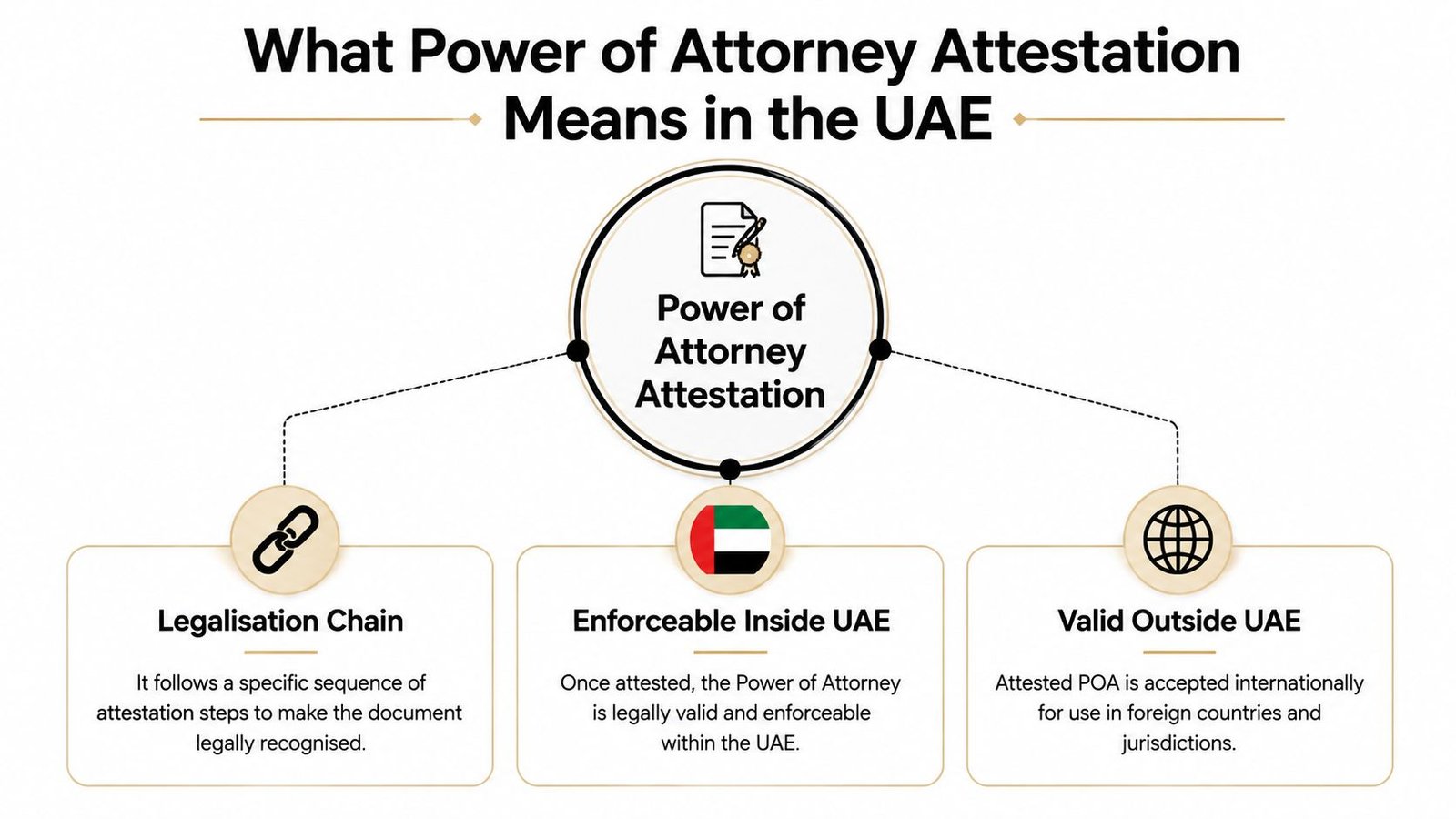
Power of attorney attestation is the legalisation chain that makes a POA usable inside or outside the United Arab Emirates. A POA is the document that gives one person authority to act for another, while attestation is the process that proves the document's signature trail is genuine enough for a government or registry to accept.
A Dubai founder usually feels the problem first. The shareholder is overseas, the property deal is moving, the bank wants authority on file, and someone has to sign while the decision-maker is not in the room. That is the point where a plain POA stops being enough, because attestation turns private paper into authority that an office, bank, court, or registry will accept.
If the POA will be used in the UAE, the route still depends on where it was signed and which authority will read it. A POA signed in Pakistan, for example, follows Pakistan's own attestation schedule first, and those consular fees belong to Pakistan, not the UAE. The Pakistan process guide lists a fee of £13.50 per person for some cases, £23.50 for a foreign national, and a three-working-day timeline, but those figures are only relevant to that origin-country step, not to UAE filing costs.
Practical rule: if the receiving authority sits in another country, a POA usually needs more than one stamp. If it will be used inside the UAE, the route is often shorter, but it still has to match the destination and purpose.
Who is involved in the file
The executant is the person who signs the POA and gives authority. The attorney is the person who receives that authority and acts under it. The legalising authority is any notary, ministry, embassy, consulate, or MOFA office that checks the document trail and stamps it.
That split matters because people often talk about “getting the POA attested” as if one office handles everything. In practice, each actor validates a different layer, identity, signature, origin, or destination.
What this article covers
There are two directions of travel. One is a POA signed outside the UAE and used inside the UAE, which is the most common cross-border case. The other is a POA signed in the UAE and used abroad, which often trips people up because the foreign country may want its own embassy or consular check before it accepts the file.
That is why this topic is not a single-stamp issue. It is a sequence, and the sequence changes depending on where the document is signed and where it has to work.
The Full Attestation Chain From Origin Country to MOFA
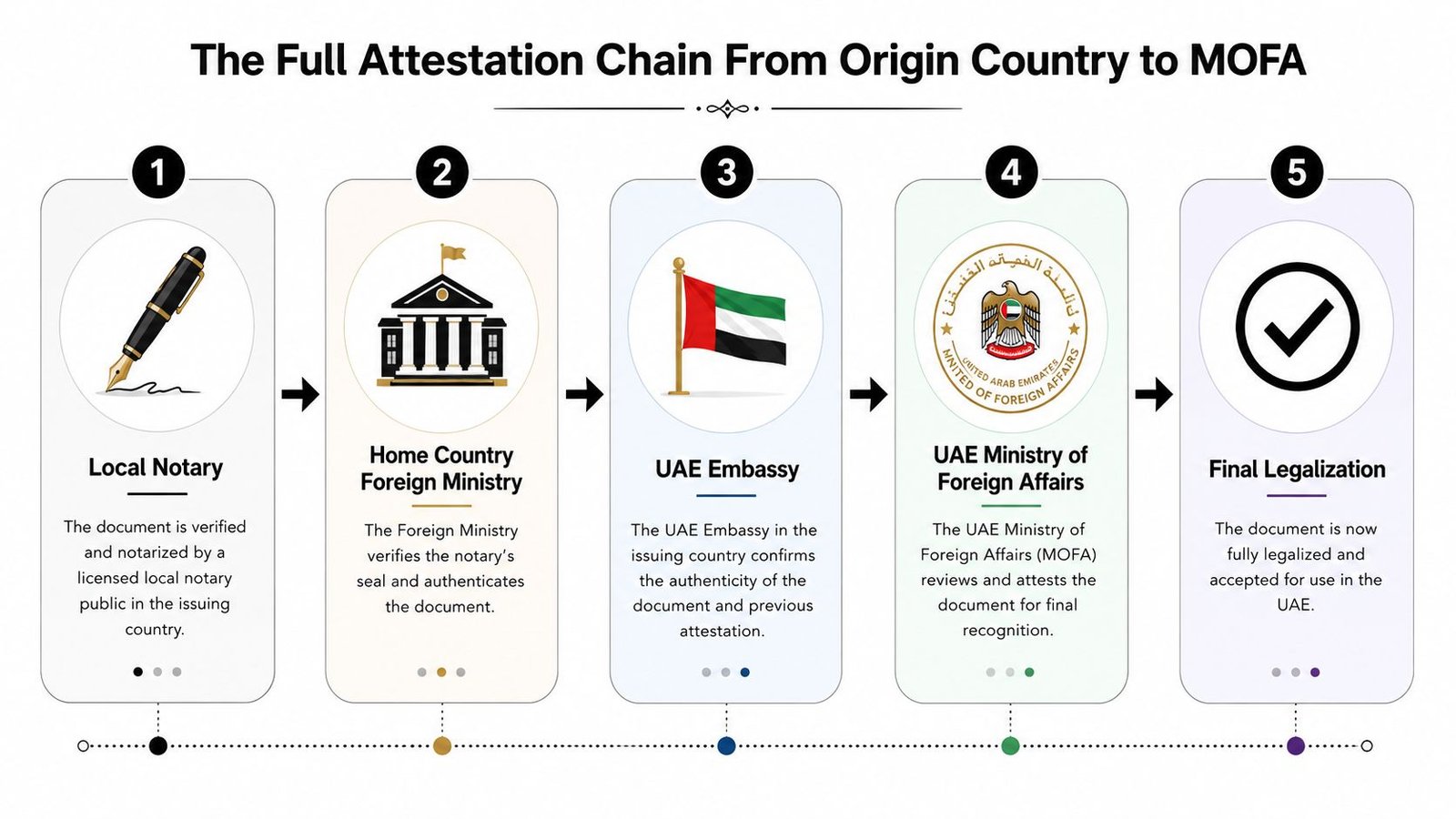
When a POA is signed outside the UAE and needs to work in the UAE, the file moves through a four-stage workflow. The exact shape is clear in UAE-focused legal guidance, notarisation in the signing country, authentication by that country's foreign ministry or apostille authority, UAE embassy or consulate legalisation where needed, and final MOFA attestation in the UAE (UAE power of attorney attestation process).
What notarisation does first
Notarisation is the first formal checkpoint. A notary verifies identity and witnesses the signature, so the document starts life with a recognised public seal rather than a private signature alone. Without that base layer, later stamps have nothing reliable to authenticate.
That is why a POA should be prepared before the appointment, not after. Once the signing and notarisation happen, changing the wording usually means redoing the file.
Why the foreign ministry or apostille comes next
After notarisation, the document goes to the origin country's foreign ministry or apostille authority. If the country is part of the Hague Apostille Convention, an apostille can replace the consular legalisation stage. If it is not a Hague country, the full embassy route stays in place.
The apostille changes the route, but it doesn't end the process for a UAE-bound file.
Where UAE embassy or consular legalisation fits
If the origin country needs consular legalisation, the UAE embassy or consulate in that country confirms the document's chain for use in the UAE. This is the stage many first-time filers underestimate, because they assume a notary seal is enough. It isn't, if the destination authority wants a cross-border chain.
What MOFA does at the end
The final stamp is MOFA attestation in the UAE. That last step is the country-level validation before the document is relied on locally, usually through the Ministry of Foreign Affairs in Abu Dhabi or an authorised service channel in Dubai. In plain terms, the UAE wants to see the whole chain before it accepts the authority.
For the reverse direction, a POA signed inside the UAE and used abroad usually needs the executant to appear in person, with supporting identity copies and any destination-country legalisation that follows. Public consular checklists for Pakistan-linked files show how strict that can be, with executant presence, passport and ID copies, photographs, and a signed-in-front-of-the-officer requirement (Pakistan Consulate Los Angeles requirements).
Apostille or Consular Legalisation, and How to Decide
The decision point is simple. If the POA is signed in a Hague Apostille Convention country, an apostille usually replaces the foreign ministry and embassy stages. If it is signed in a non-Hague country, you need the full consular legalisation chain.
The fast way to choose the route
Start with the place of signing, not the destination office. That is the mistake people make. The country of origin decides whether an apostille is enough, while the UAE still expects its own final MOFA attestation for a file being used here.
Practical rule: apostille replaces embassy legalisation, not UAE MOFA attestation.
What this means for common UAE user groups
For founders and freelancers in the UAE, this choice comes up constantly. A UK or US POA may be apostilled, while a POA from a non-Hague jurisdiction may need the full consular path before it lands in Dubai or Abu Dhabi. Pakistan-linked files often follow their own consular logic, and the same is true for many South Asian and MENA-origin documents.
| Origin Country | Hague Signatory | Required Path | Typical Extra Stage |
|---|---|---|---|
| India | Yes | Apostille route | UAE MOFA attestation |
| United Kingdom | Yes | Apostille route | UAE MOFA attestation |
| Pakistan | No | Consular legalisation route | UAE embassy legalisation |
| Philippines | Yes | Apostille route | UAE MOFA attestation |
| Egypt | No | Consular legalisation route | UAE embassy legalisation |
| United States | Yes | Apostille route | UAE MOFA attestation |
Why the table matters in practice
The table is the quickest way to prevent a wrong submission. If the origin country is Hague-based, don't waste time looking for a UAE embassy stamp that the system does not need. If it is not Hague-based, don't assume an apostille will solve the file.
The supporting paperwork also changes. Apostille files are generally cleaner, while consular files more often ask for extra formality, appointment booking, and destination-specific checks. That's why the safest question is always, “Where was the POA signed?”
Personal POAs Versus Corporate POAs and the Documents Each Needs
A personal POA is granted by an individual. A corporate POA is granted by a company, which means the legal file has to prove the company itself authorised the signatory. That second layer is where many first-time business owners get stuck, because they prepare the POA text but forget the corporate approvals behind it.
What a personal POA usually needs
For a personal file, the core pack is usually the original POA, passport copies, visa or Emirates ID copies, photographs, and the attorney's ID. Some channels also ask for proof of address or proof of relationship, depending on the destination and use case.
Witness rules can be strict. Public consular checklists show that witnesses may need to provide passport or Civil ID copies, and in some cases a spouse is not accepted as a witness. That detail catches people out because they assume family support makes the file easier, when the opposite is often true.
What a corporate POA adds
A company POA needs the authority chain behind the signature. That usually means a board resolution, an extract from the memorandum and articles, a trade licence copy, and sometimes a certificate of good standing. If the signatory is not clearly authorised on paper, the file can stall before it reaches the attestation stage.
Practical rule: if the principal is a company, ask first who has authority to sign, then ask how the POA should be attested.
Side by side, the difference is the proof of authority
| File type | Core documents | Extra authority proof |
|---|---|---|
| Personal POA | Original POA, passport copy, visa or Emirates ID, photographs, attorney ID | Witness IDs, sometimes address or relationship proof |
| Corporate POA | Original POA, trade licence, signatory ID, company documents | Board resolution, memorandum and articles excerpt, sometimes good standing certificate |
The split matters because a corporate file often fails for a reason that has nothing to do with attestation itself. The problem is upstream. The company never proved who could sign.
For UAE founders, this is especially relevant in Dubai free zones and mainland structures where the legal owner, the manager, and the bank signatory are not always the same person. If the document is for a business action, treat it as a corporate file until you have proved otherwise.
Realistic Timelines, Fees and Validity Windows
A POA file lives on a clock from the moment it is signed. If it is signed in Pakistan and then legalised for UAE use, the public guidance from Pakistan's consular process shows attestation can take about 3 working days, and the POA is generally treated as valid for 120 days after consular attestation (Pakistan Ministry of Foreign Affairs attestation schedule). That is a useful benchmark, but it is not a UAE fee table, and it does not tell you what the full file will cost once UAE steps, translation, or PRO handling are added.
The time each stage usually takes
The fastest stage is usually notarisation in the country where the POA is signed, provided the draft is clean and the signer appears with the right ID. Foreign ministry authentication or apostille takes longer because the file enters a government queue, and that timing changes depending on whether the country is Hague or non-Hague. Embassy or consulate legalisation can add more working days, especially when the mission requires original signatures, supporting IDs, or a prior appointment. The final MOFA stage in the UAE is usually the shortest part once the paperwork is complete and the route is already correct.
For UAE-facing files, the decision tree is straightforward. If the POA is signed outside the UAE, get the origin-country notarisation first, then follow the correct apostille or consular legalisation route, then complete UAE MOFA attestation. If the POA is signed inside the UAE for use outside the country, the file normally needs a different route, and that should be checked before anyone books a counter slot. The mistake I see most often is people treating every POA as if it follows one chain. It does not.
That still does not make the file easy. Most delays come from wrong documents, missing IDs, a bad appointment sequence, or sending the file to the wrong authority first. The stamp itself is rarely the problem.
Why fees are more than one line item
The cost is never just one government fee. You may face notarisation charges, foreign ministry or apostille charges, embassy or consular charges, translation costs if Arabic is needed, and any typing or PRO handling charge. Public fee markers for Pakistan-linked consular attestation show £13.50 per person and £23.50 for a foreign national or FCDO-attested POA, which is a reminder that fee schedules are jurisdiction-specific and should not be read as a UAE benchmark (Pakistan Ministry of Foreign Affairs consular schedule). For UAE work, the practical answer is to budget for the whole chain, not only the final stamp.
UAE clients should also expect the file cost to move with the route. A simple personal POA that stays within one country's normal process is cheaper than a cross-border file that needs notarisation, legalisation, translation, and UAE MOFA handling. Corporate files cost more again when the signer's authority has to be proved with company papers. That is normal, and it is where weak files get exposed.
Budget for the whole chain, not the stamp you can see first.
What to watch before you book the appointment
- Check the destination use case early. A UAE mainland property matter, a bank mandate, and an overseas litigation file may need different routes and different levels of legalisation.
- Confirm the origin country route. Hague and non-Hague countries do not follow the same legalisation path, and the wrong assumption wastes time.
- Treat validity as a deadline. A stamped POA should not sit idle. Once the legalisation window passes, a fresh file may be safer than trying to force an old one through.
- Keep translations ready. Arabic filing needs can add time even when the legalisation route is already correct, and that is one of the easiest delays to avoid.
Common Mistakes and the Post-2025 Authentication Gap
Most rejected POA files fail for simple reasons. The document arrives already signed when the consular counter requires signing in front of the officer, the witness is the wrong person, the attorney's contact details are missing, a recent photograph was never attached, or someone presents a copy that never received the needed foreign ministry stamp. Those are avoidable errors, and they usually cost more time than the official fee does.
The mistakes that keep happening
A prepared-but-not-signed POA is often the right form, but only if the appointment rules say the signature must happen in front of the officer. Public checklists also show that executant presence can be mandatory, and identity copies must match what the mission asks for. If you ignore that, the file turns into a reset, not a submission.
Another common error is witness choice. Some consular channels are strict enough that family assumptions do not help, and a spouse can be rejected as a witness. That can be awkward, but it is better to learn it before the appointment than at the counter.
The post-2025 issue people are missing
The doctrinal change most UAE-facing guides still ignore is the July 2025 Kalawathi decision. The Indian Supreme Court held that when a document is executed by a power-of-attorney holder, the PoA must be authenticated at presentation under Sections 32(c) and 33 of the Registration Act, and that authentication is mandatory (Supreme Court authentication update).
That matters for anyone using a UAE-executed POA for property, banking, or court filings in India. A consulate-stamped POA may still face rejection if the registering authority says the holder's authority to present was not separately authenticated. The issue is not the attestation chain alone, it is whether the presenting authority is proved in the way the registry now expects.
How to think about the risk
If your document is heading to India, do not assume that consular stamping ends the analysis. The registration office may still care about authentication at presentation. For cross-border founders and non-resident principals, that means the file needs two questions answered, “Is the POA legalised?” and “Is the holder's authority to present properly authenticated?”
Practical Checklist and How Inpro Can Run the File
Use this as your working checklist.
- Confirm where the POA was signed. That decides whether apostille or consular legalisation applies.
- Confirm where it will be used. UAE, India, or another country can change the final stage.
- Check the signatory status. Individual or company, the proof of authority is different.
- Collect the right IDs. Passport, Emirates ID, visa, photographs, and attorney details should all match the destination checklist.
- Verify witness rules before booking. Don't assume a spouse or a family member will be accepted.
- Ask about presentation authentication. If the file is for India, the post-2025 authentication issue needs a separate check.
- Track expiry. A stamped POA is time-sensitive.
For cross-border, corporate, and time-critical files, a good PRO partner saves you from rebooking appointments and redoing signatures. Inpro Corporate Services L.L.C. can handle translation, typing, embassy appointment booking, MOFA submission, and rejection follow-up when a stage comes back with a problem. If you'd rather get the route right before you print anything, start with the file plan, then move to the stamp.
If you need a clean route for power of attorney attestation in the UAE, Inpro Corporate Services L.L.C. can help you map the right legalisation path, prepare the document pack, and manage the government steps without guesswork. Visit Inpro Corporate Services L.L.C. to book a free strategy call and see how their team can handle your POA, attestation, and cross-border filing workflow.