


Business advisory services in the UAE provide practical support for setting up, running, and keeping a company compliant, and the work usually covers strategy, finance, compliance, market entry, and PRO and visa support. In a market with 13,000 new companies joining Dubai Chamber in 2023 and the chamber reaching over 204,000 companies that year, founders are usually not asking whether they need advice, they're asking which part of the process they're about to get wrong. Dubai Chamber's 2023 membership figures show the scale of the ecosystem, and the smarter question is how to buy the right help without paying for fluff.
You're probably here because the paperwork has started to pile up. Maybe you're choosing between a mainland licence and a free zone, maybe you've heard about VAT, labour files, or a residence visa and don't yet know which one comes first, or maybe you're comparing advisers and every quote looks different.
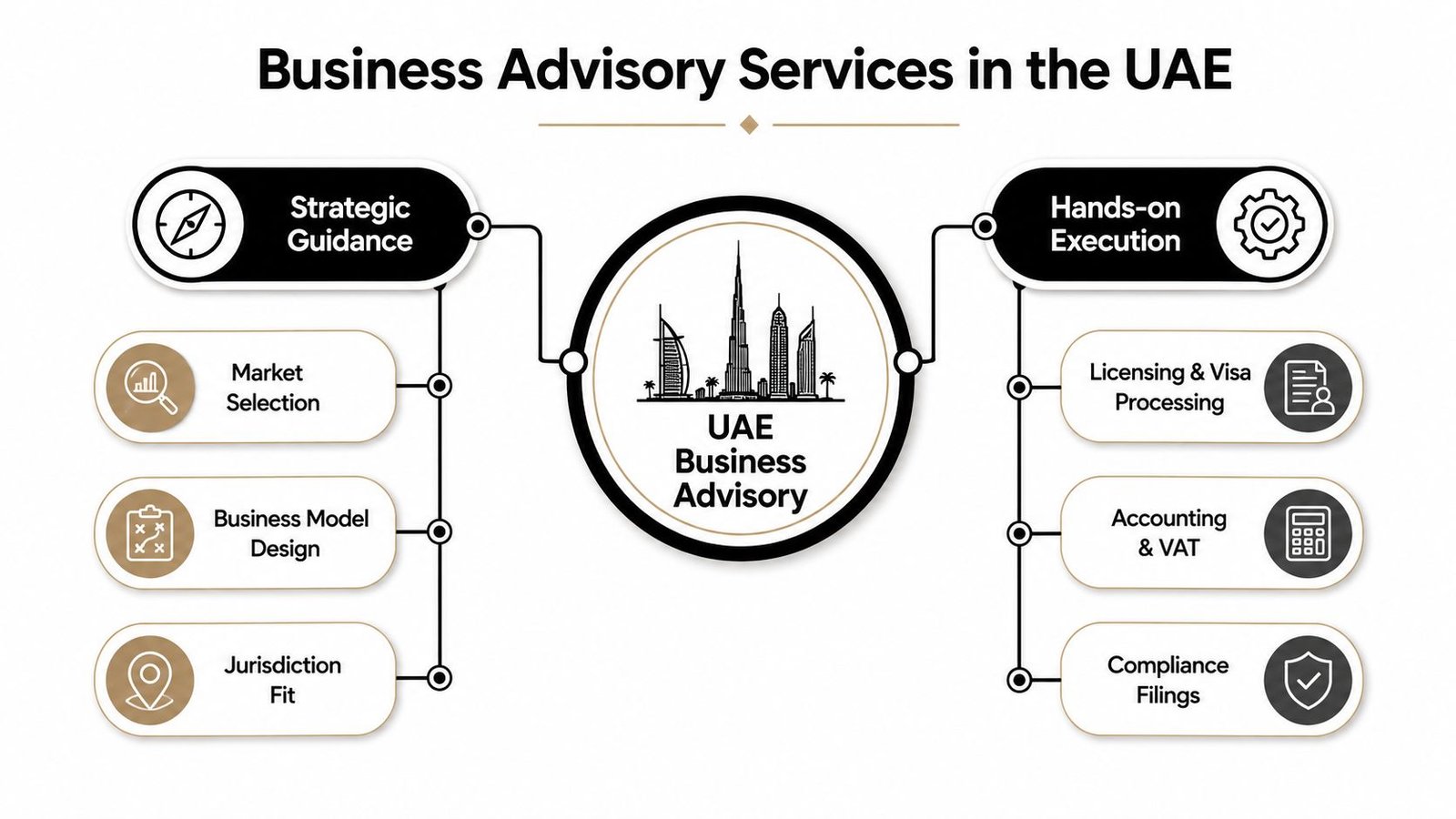
Table of Contents
- What Business Advisory Services Actually Mean in the UAE
- Mainland, Free Zone, or Offshore
- The Five Service Areas Most UAE Founders Actually Use
- How a Typical Advisory Engagement Unfolds
- How to Choose a Business Advisory Provider in the UAE
- Why Advisory Is a De-Risking Tool, Not a Luxury
- Pricing, Audience Fit, and Your Next Step
What Business Advisory Services Actually Mean in the UAE
In the United Arab Emirates, business advisory services are not just slide decks and opinion. They're a mix of planning, filing, coordination, and follow-through that helps a founder move from idea to licensed company without breaking the rules halfway through.
What makes UAE advisory different
A generic consultant can talk about growth. A UAE adviser also has to understand the path through the Department of Economy and Tourism (DET), which is the Dubai authority that handles many mainland licensing steps, plus free zone authorities, the Federal Tax Authority, and the Ministry of Human Resources and Emiratisation (MOHRE), which manages labour-related processes. That stack matters because the Ministry of Economy and Tourism directs applicants to emirate authorities for activity-specific requirements, so the right answer often depends on where the company sits and what it will do. Company formation requirements in the UAE
Practical rule: if the adviser can't explain which authority signs off on your activity, you're not buying advice, you're buying guesses.
A good UAE advisory relationship usually covers the dull but decisive details, like legal form, trade-name steps, constitutional documents, office evidence, licence issuance, and the first tax and labour registrations. The value is not mystery, it's sequencing.
What most founders actually need
Most founders don't need abstract strategy first. They need one of five things, and the answer should be direct.
- Strategy, if they're still deciding market, structure, or jurisdiction.
- Finance, if bookkeeping, VAT, banking, or tax positioning is the blocker.
- Compliance, if renewals, filings, or licence maintenance are the risk.
- Market entry, if they need a partner, distributor, or commercial route.
- PRO and visa support, if people, residency, and government files are the bottleneck.
The point is simple. In the UAE, advisory services are tied to a live regulatory system, not a general business-coaching exercise. That system now touches a large taxpayer base too, with the Federal Tax Authority recording 487,438 VAT-registered businesses by 31 December 2024, up from 309,000 in 2022, after the UAE introduced 5% VAT on 1 January 2018. VAT registration growth in the UAE
Mainland, Free Zone, or Offshore
Jurisdiction is the first real decision, because it shapes where you can trade, who regulates you, and what paperwork comes next. If you choose badly, every other step gets clumsy.
Mainland and free zone are not interchangeable
A mainland licence is issued by an emirate-level economic authority, such as DET in Dubai, formerly called the DED, and it normally gives the broadest access to the UAE market. A free zone licence is issued by the zone authority itself, such as DMCC or JAFZA, and it usually comes with its own setup rules, office requirements, and activity list. That is why “UAE company setup” is not one decision, it's a set of jurisdiction decisions.
Offshore is different again. It's usually used for holding structures or asset protection, and it generally has limited ability to trade inside the UAE. For founders who want local customers, staff, and bank-facing substance, offshore is rarely the first choice.
| Factor | Mainland | Free Zone | Offshore |
|---|---|---|---|
| Regulator | Emirate-level authority such as DET in Dubai | Free zone authority | Offshore registry or authority |
| Trading inside the UAE | Generally broader access | More limited, depends on activity and structure | Limited |
| Office expectation | Often tied to local premises evidence | Usually tied to zone rules | Typically lighter operational footprint |
| Visa and labour setup | Often linked to local company activity and employee planning | Usually handled through the zone | Usually not set up for active local hiring |
| Best fit | Local trading, service firms, branches, hiring plans | Export-led, digital, specialised, or zone-based teams | Holding and asset structuring |
The licence type is not a branding choice. It decides what the company can actually do.
Why advisers push this choice early
Good advisers ask about customer location, hiring plans, and banking needs before talking about a licence package. If you're planning to serve Dubai clients and hire staff, a zone that looks cheap on paper can become expensive in friction later. If you only need a holding vehicle, mainland tools are often unnecessary.
Offshore, mainland, and free zone each solve a different problem. The right adviser will say that plainly, then keep the conversation tied to your operating model instead of selling the same answer to every founder.
The Five Service Areas Most UAE Founders Actually Use
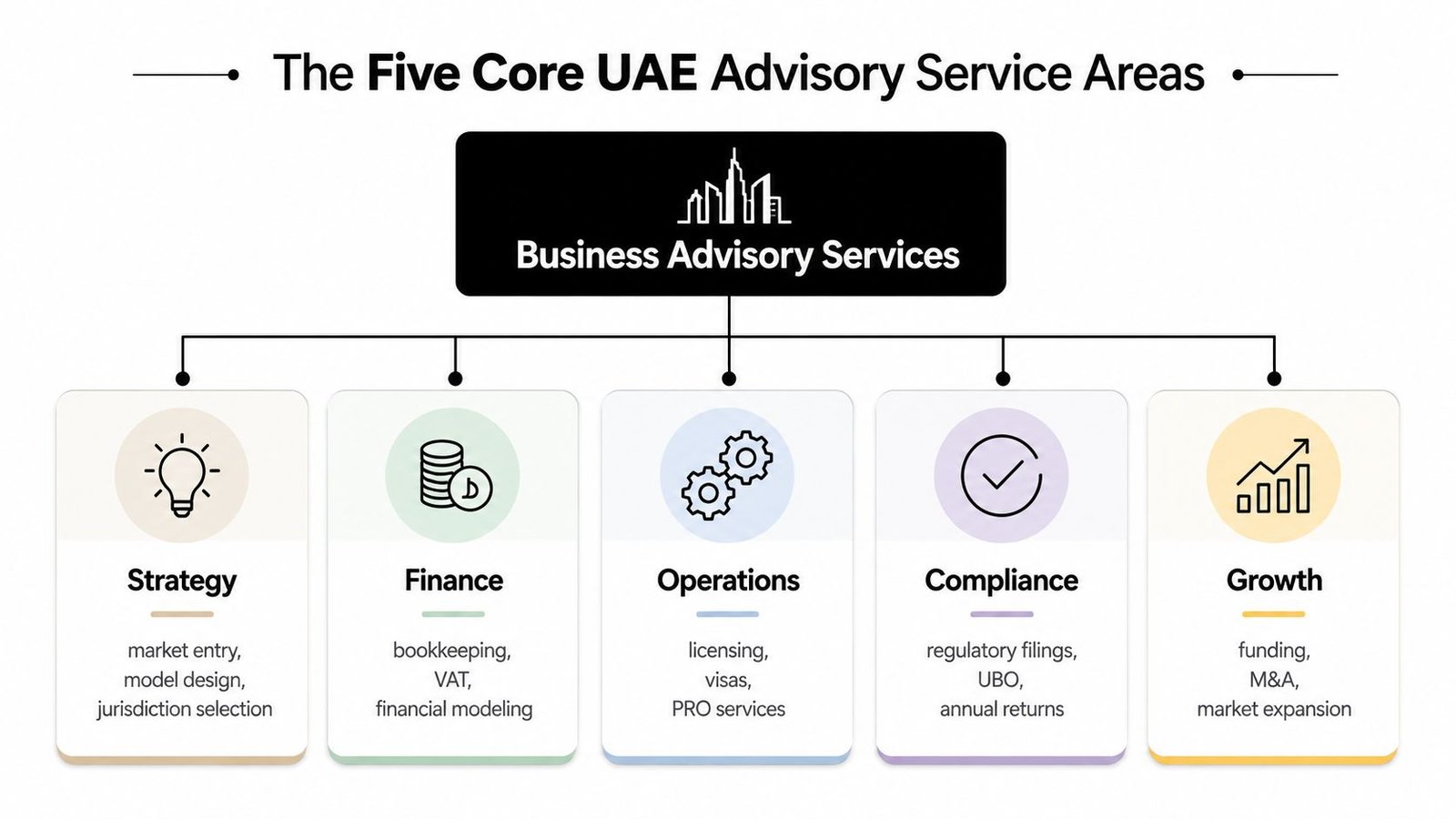
The phrase “advisory” sounds broad because it is broad. In practice, most UAE founders pay for one of five workstreams, and the job is to know which one they need before they start comparing quotes.
Strategy and finance
Strategy is the part where an adviser helps you choose market, model, and jurisdiction fit. It answers questions like whether your idea belongs in Dubai mainland, a free zone, or a different structure altogether.
Finance is the practical side, bookkeeping, VAT registration, tax positioning, and bank account preparation. It matters because the UAE's compliance environment is real, not theoretical, and the market is big enough to support specialised support around tax and filings. The business advisory category itself is projected in the broader market to reach USD 58.28 billion by 2035, up from USD 29.16 billion in 2026, which tells you the knowledge-services side of this work is expanding rather than shrinking. Business advisory services market outlook
Compliance and market entry
Compliance covers the unglamorous work that saves you from clean-up later, licence renewals, UBO filing, and ongoing monitoring. UBO, or Ultimate Beneficial Owner filing, is the disclosure of the individual who ultimately owns or controls the company.
Market entry is different from setup. It's the work of mapping distributors, commercial partners, and the route to actual trading. If your product is ready but you don't know how it reaches customers in the UAE, that's a market-entry issue, not a formation issue.
PRO and visa support
PRO stands for Public Relations Officer services in the UAE company context, and it usually means document handling with government channels. It often sits beside visa work because employee and investor visas normally depend on company records, approvals, and sponsorship status.
Dubai SME's ecosystem data shows why this matters. In 2024, it facilitated the launch of 3,461 new Emirati businesses and provided advisory services to 3,075 entrepreneurs, bringing total advisory beneficiaries to 53,206 since 2002. Dubai SME 2024 milestones
Straight answer: if your problem is paperwork and deadlines, advisory is not a luxury. It's the layer that keeps the company moving while the government file is open.
How a Typical Advisory Engagement Unfolds
A founder opening a consultancy on Dubai mainland with two employee visas does not begin with visas. The first decision is the business activity, because that choice sets the licence route, and the licence route sets the rest of the file.
The order matters
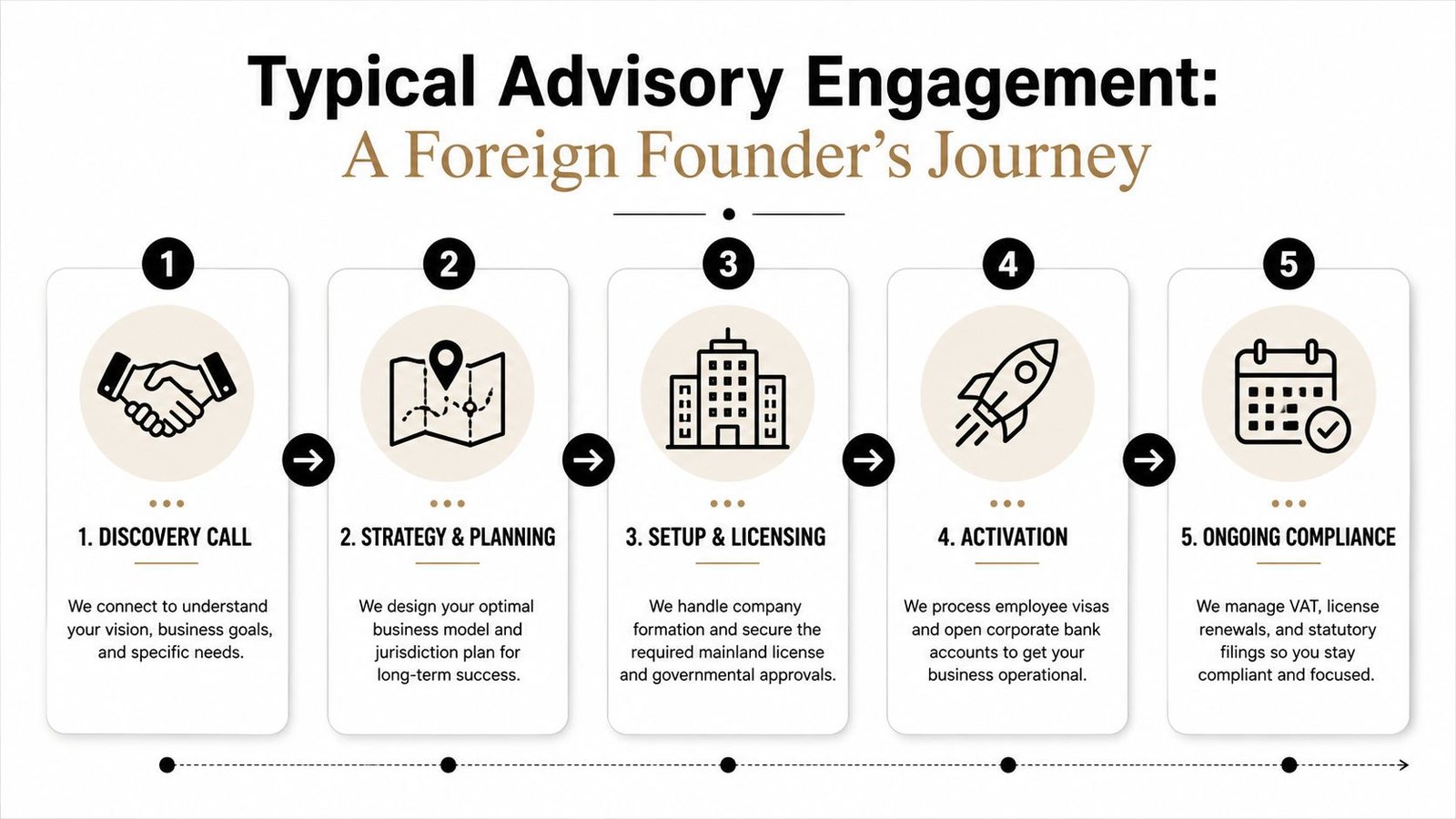
Activity selection and legal form come first. Trade-name approval follows, then initial approval, constitutional documents, office evidence, and the licence itself. Tax and labour registrations come after that, because the company has to exist before most downstream filings can even open. Advisory firms add value by keeping that sequence clean and by cutting the back-and-forth that slows filings across several authorities.
The same logic applies once the file reaches the Federal Tax Authority and labour systems. A visa file is rarely a standalone task. It sits inside a wider workflow involving the licensing authority, immigration channels, and, where relevant, MOHRE, which is why many firms bundle PRO services with company formation in the United Arab Emirates. UAE advisory service provider guidelines
What happens after the licence
Once the licence is active, the founder moves to visa processing, banking, and operational setup. Banking usually comes near the end because the bank wants a formed company, not a promise. Founders waste time when they try to do everything at once, then wait for each authority to ask for the document from the previous step.
Recurring obligations begin right after launch. Renewals, VAT thresholds, and UBO filing turn setup into an ongoing compliance relationship. Dubai Chamber membership growth and the VAT-registered base in the UAE point to the same practical reality, founders who file cleanly keep momentum, while those who treat formation as the finish line end up back in the queue. Dubai Chamber membership growth VAT-registered businesses in the UAE
How to Choose a Business Advisory Provider in the UAE
Ignore the glossy pitch first. Ask four blunt questions and see whether the answer is clean, specific, and separated from sales language.
Ask about jurisdiction fit and price structure
A provider should be able to handle the path you need, not just one jurisdiction they happen to know well. If they only sell free zone packages, they may not be the right fit for mainland licensing in Dubai, Abu Dhabi, or Sharjah.
Pricing has to be broken into government fees, service fees, and third-party costs. If a quote hides those pieces together, you can't tell whether you're paying for filings or padding.
Ask about timelines and execution
Good providers give timelines in working steps, not vague promises. They should also say what depends on you, because client delays are real, and bad advisers hide that fact until the process stalls.
Look for the practical signals that they understand the work.
- Clear jurisdiction coverage: mainland, free zone, and offshore are all explained.
- Line-item pricing: fees are split cleanly, with no mystery add-ons.
- Timeline ownership: each step shows who is responsible.
- Renewal support: they mention what happens after licence issuance, not just before it.
A provider that can connect to referral, fintech, or SaaS workflows through partner or API capabilities is worth a look if you're a platform or channel partner. If you're a founder, the bigger question is whether they can keep your file moving without making you repeat the same document request five times.
One option in the market is Inpro Corporate Services L.L.C., which handles company formation, PRO and visa services, bank account support, and accounting and tax-related work across UAE setups. That matters only if the scope matches your actual problem.
Why Advisory Is a De-Risking Tool, Not a Luxury
I'd rather pay for prevention than for correction, and that's the honest case for advisory in the UAE. Fixing a wrong activity code, a missed filing, or a badly chosen licence usually costs more time and money than getting it right the first time.
The mistakes that hurt
The common failure points are predictable. A founder chooses the wrong activity code and boxes the company into the wrong scope. Someone forgets the UBO filing. VAT registration happens too late. The licence type doesn't match the business model. A visa is left to overstay, and fines start stacking up.
Plain rule: the cheaper adviser is not cheaper if they create rework.
The UAE's compliance environment makes that risk worse because the obligations don't stop at incorporation. The federal tax system already covers a large registered base, and the visa side can involve threshold-based eligibility. For example, under the Green Visa framework, a freelance or self-employed applicant generally needs a bachelor's degree or specialised diploma, a self-employment permit, and annual self-employment income of at least AED 360,000 over the previous two years, or proof of financial solvency. Green Visa eligibility guidance
When advisory may not pay off
If you're setting up a simple, low-risk entity and you already understand the filing burden, direct filing can work. But once you're crossing into hiring, residency, tax, or multiple authorities, the cost of one mistake rises fast.
Advisory pays when the company has moving parts. It also pays when the founder doesn't have time to read every circular, track every deadline, or interpret what one authority's approval means for the next one. That's not a weakness. It's just how regulated setups work in the United Arab Emirates.
Pricing, Audience Fit, and Your Next Step
Read pricing in three parts, government fees, service fees, and third-party costs. That separation tells you whether the adviser is selling process control or just reselling paperwork.
Different readers need different help. Founders usually need jurisdiction choice and setup. SMEs need compliance and hiring support. Investors and holding companies care more about structure. HR and operations teams need visa flow. Platform partners care about integration and repeatable fulfilment.
If you want a simple next move, start with the one that matches your stage. Compare mainland, free zone, and offshore if you're still deciding where the company should live. Ask for a cost estimate if price clarity is the blocker. Book a strategy call if you need someone to tell you which authority comes first and which documents can wait.
Inpro Corporate Services L.L.C. helps founders, SMEs, and platform partners set up and run companies in the UAE with company formation, PRO and visa support, corporate bank account opening, and accounting and tax services. If your setup is getting tangled between jurisdiction choice, filings, and renewals, visit Inpro Corporate Services L.L.C. and ask for the path that fits your business instead of buying a package that doesn't.