

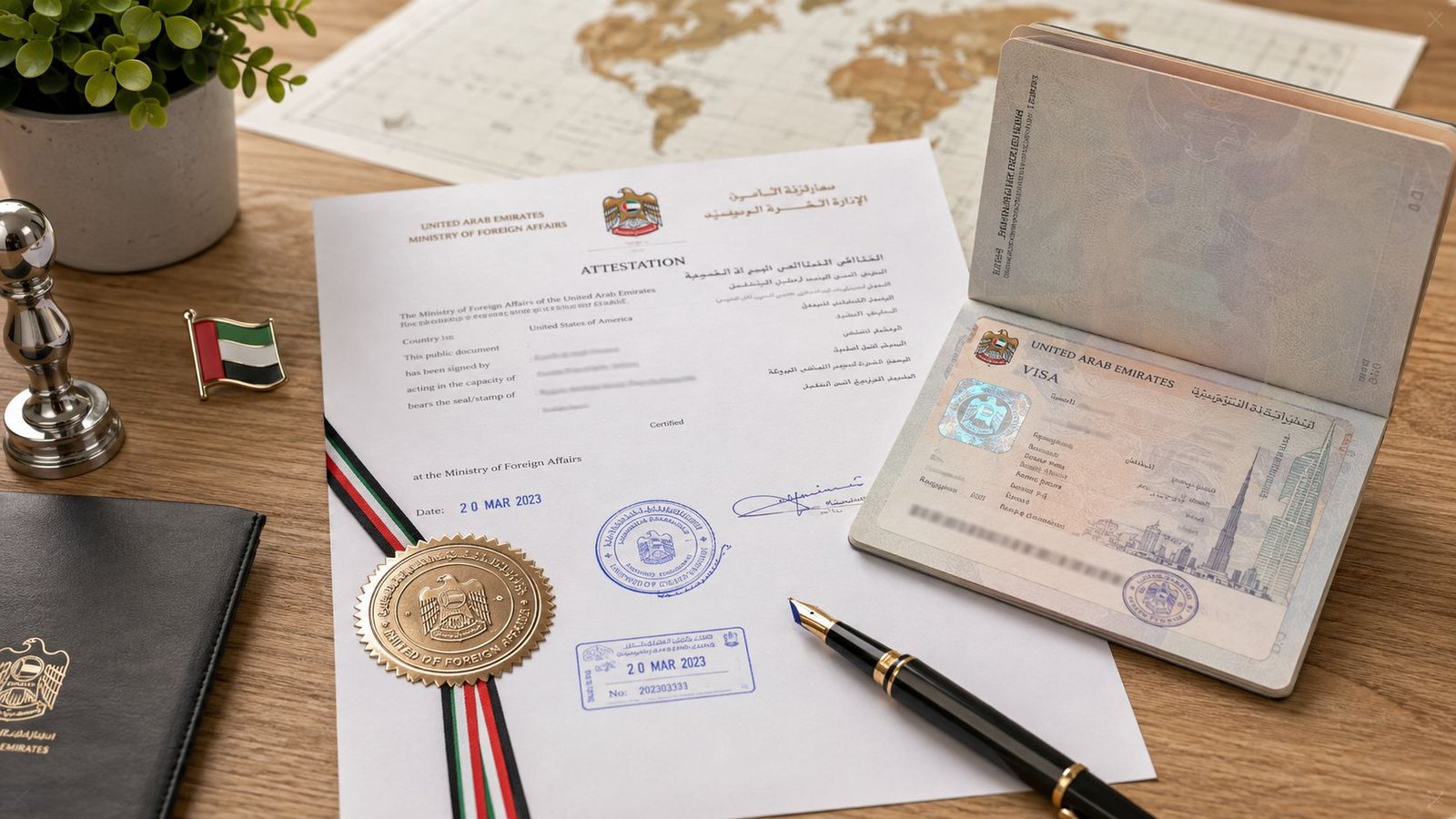
You've arrived in Dubai with a degree, marriage certificate, or company papers, only to discover that a government office or bank needs them attested first. UAE document attestation is the official chain of approvals that confirms a foreign-issued document is genuine and legally usable in the United Arab Emirates. In 2026, the process combines physical legalisation steps with online applications and digital verification, so the main operational risk is often choosing the wrong route or document category rather than merely obtaining a final stamp.
Table of Contents
- What UAE Document Attestation Actually Means
- The Three Document Categories You Need to Know
- The Four-Stage Attestation Chain Explained
- Understanding Fees and Processing Timelines
- Five Common Mistakes That Cause Delays
- Your Attestation Action Plan and When to Get Help
What UAE Document Attestation Actually Means
Attestation is the formal verification of a document's authenticity. A document issued outside the UAE normally passes through authorities in its country of origin, the UAE embassy or consulate there, and finally the UAE Ministry of Foreign Affairs, commonly called MOFA, inside the Emirates.
That final MOFA step matters because foreign documents aren't automatically accepted for local government, banking, immigration, or commercial purposes. A properly completed document may support a family visa, employment or professional licensing application, company formation, corporate bank account opening, property transaction, or power-of-attorney process. The exact requirement depends on the receiving authority and the document itself.
Practical rule: MOFA attestation is the final legalisation step, not the first application you submit.
The UAE's official service architecture now supports online applications through the MOFA attestation service, the UAE MOFA smart application, and a digital document verification service. That means the workflow has moved beyond a paper-only model, although digital access doesn't remove the need for correct prior approvals, original documents, translations, or physical handling where required.
The scale is significant. MOFA's dashboard showed 1,748,738 total transactions inside the UAE, with 807,059 additional transactions visible on a public dashboard snapshot, demonstrating that attestation is an established government service rather than a niche administrative task. These figures are available through the UAE Ministry of Foreign Affairs attestation service.
For a founder setting up in a Dubai or Abu Dhabi free zone, the practical lesson is simple: start with the document's intended use, not with the MOFA website. Identify who will receive it, confirm whether it's personal, educational, or commercial, and then map the approval chain in the issuing country. That approach prevents an expensive final-stage rejection.
The Three Document Categories You Need to Know
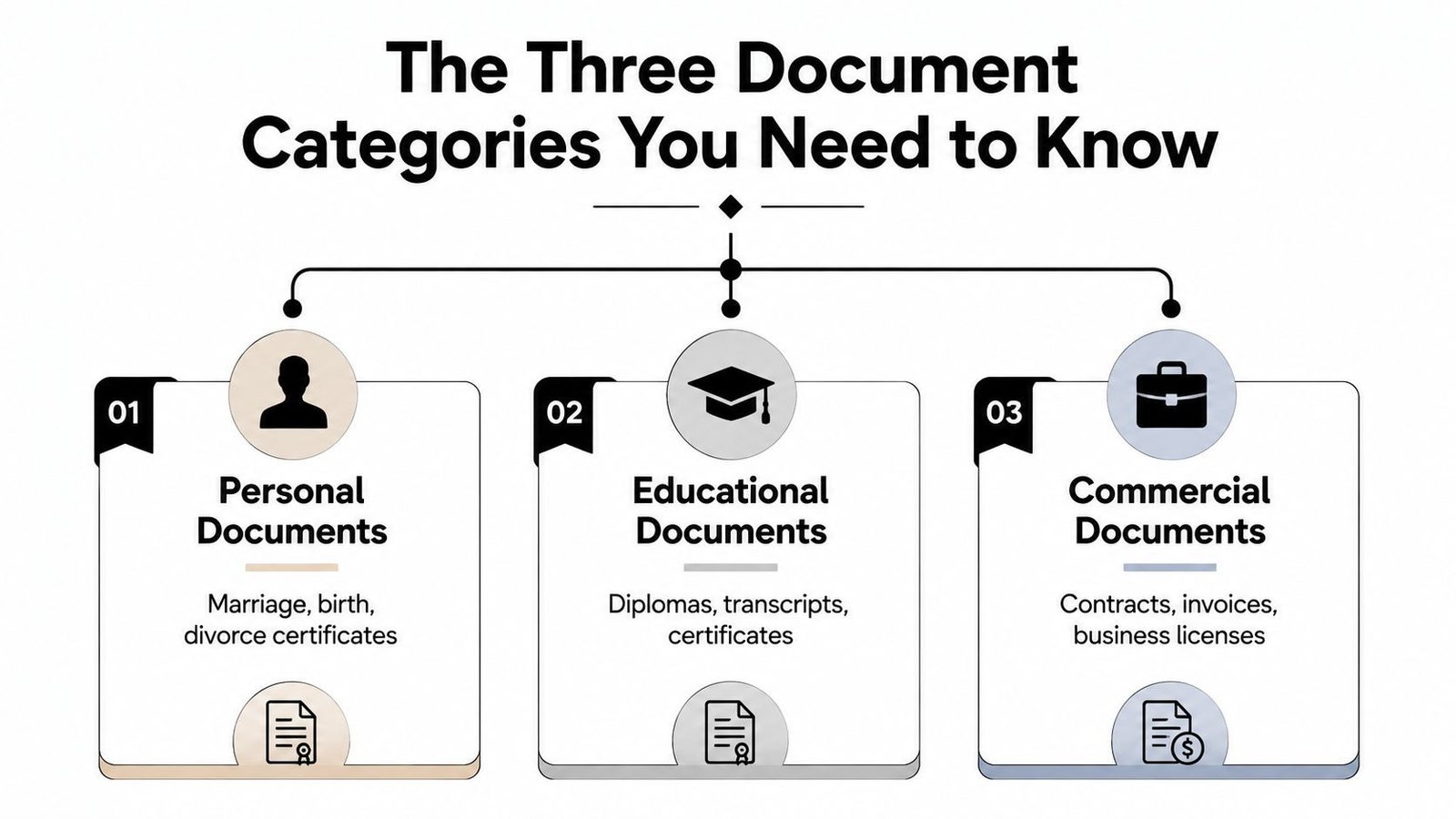
The document category affects the approval route, the fee, and the level of review a file may receive. A marriage certificate and a company power of attorney might both be issued overseas, but they don't follow the same commercial logic once they reach UAE authorities.
What are personal documents?
Personal documents are records about an individual or family relationship. Common examples include marriage certificates, birth certificates, divorce decrees, and police clearance certificates. Families may need them for dependent visas, family sponsorship, or a Golden Visa application where proof of relationship or personal status is requested.
A personal document normally belongs to the lower individual-affairs fee category. That doesn't mean it's always quick. Civil registry checks, issuing-country authentication, translation, and embassy processing can still create delays, particularly when names, dates, or passport details don't match.
What are educational documents?
Educational documents prove academic qualifications. Degrees, diplomas, mark sheets, and transcripts can be requested for employment visas, regulated professions, university admissions, or professional licensing.
An employer may accept a qualification for an initial discussion but still require attestation before completing a regulated employment or licensing process. The document may also need verification by the issuing country's education authority before foreign-ministry authentication. The exact route varies by country and by whether the institution is recognised.
What are commercial documents?
Commercial documents support a business transaction, legal authority, or corporate structure. Examples include certificates of incorporation, memorandums of association, powers of attorney, board resolutions, commercial contracts, and documents used for corporate restructuring or bank account opening.
This category is where founders most often underestimate cost and review time. A document connected to a company, business authority, or commercial transaction may be treated differently from a personal certificate, even if an individual signs it. Confirming the classification before submission is a basic control for a UAE mainland, Dubai free zone, Abu Dhabi free zone, or offshore structure.
Dubai Chambers attested 11,740 documents in the first half of 2024, an increase of 20.5% year on year, according to Gulf News' report on UAE document attestation procedures. The figure reflects the continuing role of attested commercial documents in UAE business operations.
The Four-Stage Attestation Chain Explained
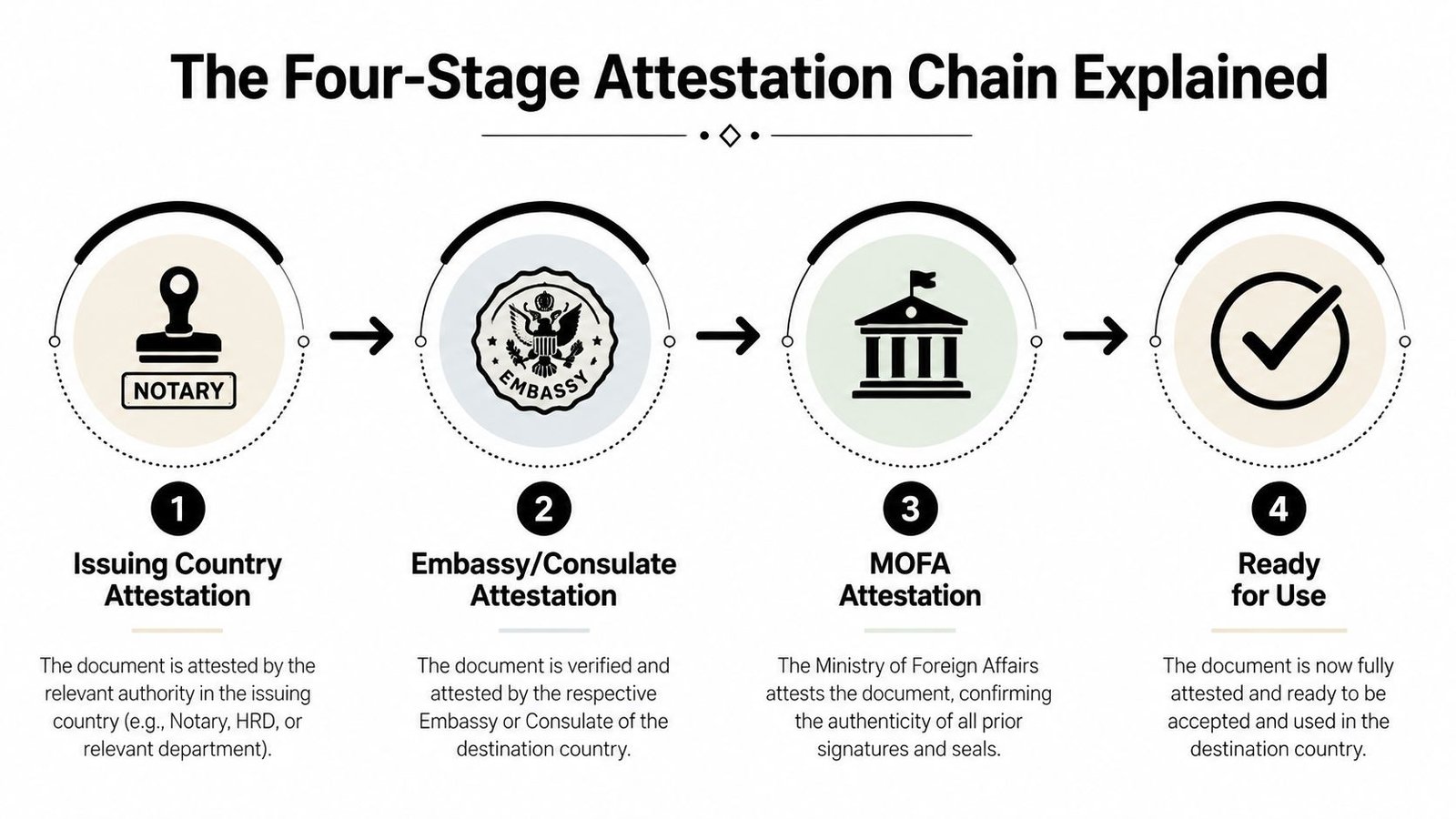
The safest way to approach attestation is to treat it as a chain. Each authority validates the approval before it, so completing the last stage first won't repair a missing earlier step.
What happens in the issuing country?
Stage one is the local authentication step. Depending on the country, the document may need notarisation, state-level authentication, education-authority verification, chamber certification, or an apostille under the Hague Convention. An apostille is a standardised certificate used between participating countries to confirm the origin of a public document.
The correct first step depends on the document and source country. A degree from India may require education or state verification before authentication by India's Ministry of External Affairs. A UK document may follow a solicitor or notary route and then legalisation through the UK Legalisation Office. A US document may require state-level authentication before federal or relevant authority processing. Pakistani documents can require verification through the appropriate issuing and foreign-affairs channels.
How does the UAE embassy or consulate verify the document?
Stage two is authentication by the issuing country's foreign ministry or equivalent authority. This confirms that the preceding notary, education authority, chamber, or state office is legitimate.
Stage three is attestation by the UAE embassy or consulate in the issuing country. The mission checks the document for use in the UAE. The location can matter. For example, India has UAE diplomatic missions serving different regions, while applicants in the UK, US, or Pakistan must follow the instructions of the UAE mission responsible for their document and location.
What does MOFA do inside the UAE?
Stage four is final attestation by MOFA inside the Emirates. MOFA requires the foreign document to have already been approved by the foreign ministry or equivalent authority in the issuing country and stamped by the UAE embassy or consulate there. The application asks the user to confirm those prior attestations before processing continues, as described in this explanation of foreign certificate attestation through MOFA.
MOFA can reject a document that skips the earlier stages. Its online channel improves submission and tracking, but it doesn't change the order of legalisation.
A short visual walkthrough can help first-time applicants understand how the chain fits together:
Understanding Fees and Processing Timelines
The fee difference between personal and commercial documents is the budget issue that catches many founders off guard. MOFA lists AED 150 for individual affairs documents and AED 2,000 for commercial documents, a 13.3x difference, in its official frequently asked questions.
Commercial classification can apply to certificates of incorporation, memorandums of association, powers of attorney, board resolutions, and other papers tied to a business transaction or corporate authority. Marriage and birth certificates remain personal documents. A document's title alone isn't always enough, so confirm its purpose and receiving authority before you submit it.
| Document Type | MOFA Fee (AED) | Typical Timeline | Common Use Cases |
|---|---|---|---|
| Personal | 150 | Standard processing is often described as 1 to 3 working days after a complete MOFA submission | Family visas, relationship proof, personal-status applications |
| Commercial | 2,000 | Standard processing is often described as 2 to 3 working days after a complete MOFA submission | Company formation, bank account opening, powers of attorney, corporate restructuring |
| Educational | Confirm classification before submission | Depends on education verification, foreign-ministry approval, embassy processing, and MOFA submission | Employment visas, professional licensing, education or qualification review |
The MOFA stage is only one part of the schedule. End-to-end timing also depends on the issuing country's authentication process, embassy or consulate appointments, courier handoffs, translation, and whether the original document meets local requirements. Some providers advertise express MOFA completion in 1 working day, but that doesn't mean the full international chain will finish within that period.
A useful planning distinction is between a simple personal file and a commercial file with several approvals. Personal documents may be relatively straightforward when the issuing authority and UAE mission have clear procedures. Commercial files often need more coordination because the document's classification, signing authority, company records, and supporting stamps may all be reviewed.
Budget before submission: the wrong category can change the official fee by thousands of dirhams, while a missing prerequisite can add delay without moving the application forward.
Five Common Mistakes That Cause Delays
Most delays don't come from the final stamp itself. They begin earlier, when someone submits an incomplete chain, selects the wrong category, or assumes a document is acceptable because it looks official.
What errors should you check first?
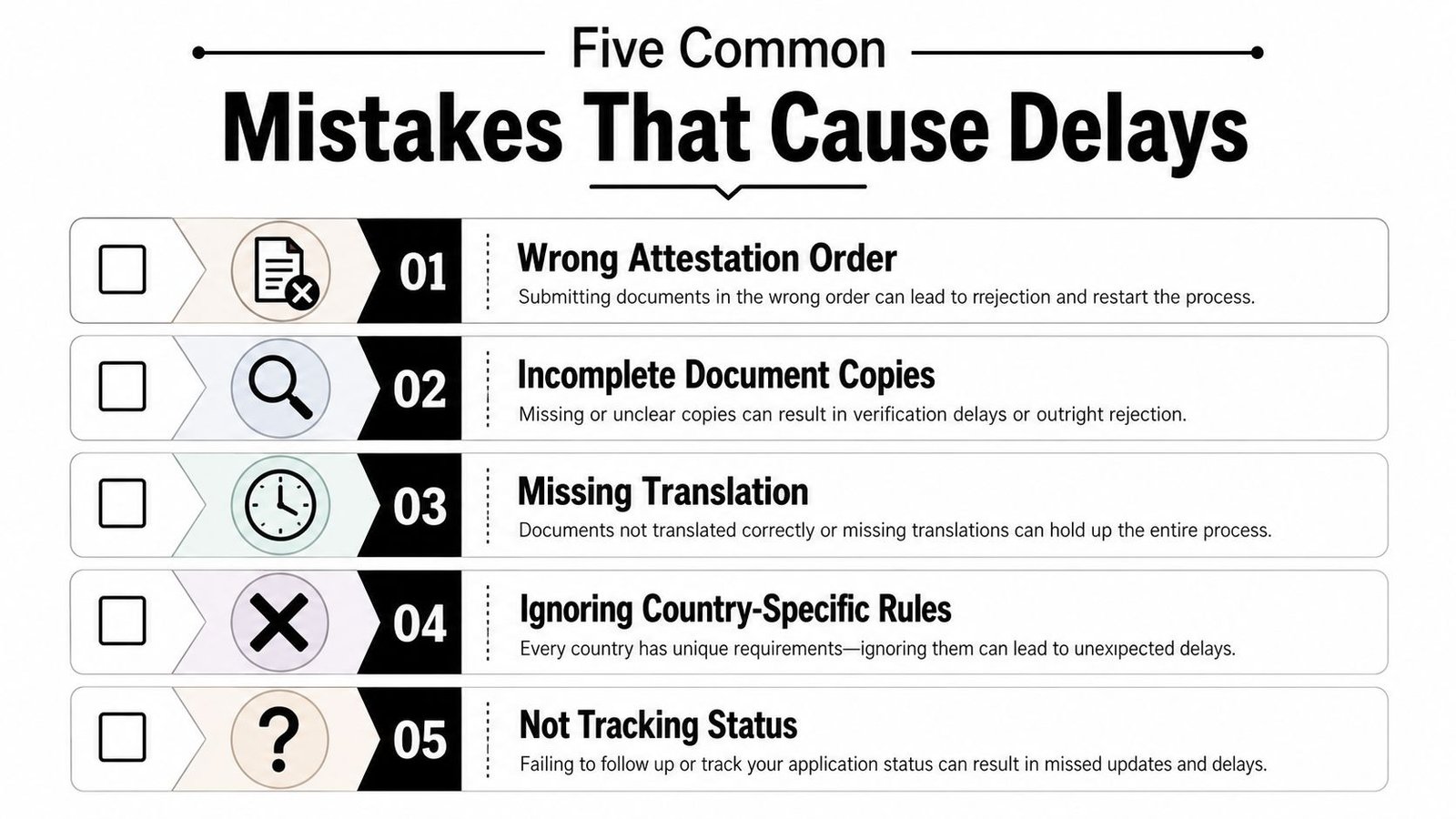
Wrong attestation order: Sending a foreign document to MOFA before the issuing-country authority and UAE embassy or consulate have approved it will usually lead to rejection. Check the stamps in sequence and keep evidence of each approval before starting the UAE submission.
Misclassified commercial paperwork: Treating a company power of attorney or incorporation document as personal to avoid the commercial fee can trigger manual review. Describe the document's purpose accurately and ask the receiving bank, free zone, mainland authority, or other institution how it classifies the file.
Outdated records: Some receiving authorities ask for recently issued personal records, and older certificates may need replacement or additional confirmation. Don't assume an old document remains acceptable merely because it has an earlier stamp. Confirm the validity requirement with the authority requesting it before paying for the chain.
Missing issuing-country authentication: A UAE embassy stamp doesn't replace the foreign ministry or equivalent approval that should come before it. Review the document against a country-specific checklist, including education, civil-status, chamber, notary, or state-level requirements.
Untranslated documents: Documents that aren't in English or Arabic may need translation by a certified legal translator. The translation may also need its own approval or attestation, depending on the receiving authority and document type.
Keep a scan of the original, every stamp, the translation, courier receipt, application reference, and final digital verification record. That file makes it easier to answer a bank, immigration officer, employer, or free zone compliance team if they ask how the document was legalised.
The official service model has made status tracking more accessible, but tracking can't correct an incorrect submission. The most effective pre-check is a document-by-document review against the rules of the issuing country and the intended UAE recipient.
Your Attestation Action Plan and When to Get Help
Use the document's intended use as the starting point. A founder opening a corporate account, an HR manager arranging an employee visa, and a Golden Visa applicant may all need attestation, but each file has different supporting requirements.
What should you verify before submission?
- Confirm eligibility: Check that the document is original, legible, complete, and issued by the correct authority.
- Identify the category: Decide whether it is personal, educational, or commercial before budgeting.
- Check the source country: Confirm notary, apostille, education, civil registry, chamber, and foreign-ministry requirements.
- Plan embassy handling: Identify the responsible UAE embassy or consulate and confirm submission or appointment rules.
- Arrange translation: Use a certified legal translator where the receiving authority requires English or Arabic.
- Control courier movement: Record collection, delivery, and return details, especially when documents are moving between countries.
- Prepare MOFA submission: Upload or submit the completed chain through the official channel and retain the reference.
- Verify the result: Check the final attestation and digital verification record before presenting it to the bank, immigration authority, employer, or licensing body.
A simple timeline template keeps expectations realistic:
| Workflow | Early preparation | Middle approvals | UAE completion |
|---|---|---|---|
| Personal document | Confirm validity, translation, and source-country rules | Complete local authentication and UAE mission attestation | Submit to MOFA and verify the final record |
| Commercial document | Confirm classification, signing authority, company records, and intended use | Coordinate foreign ministry, chamber, notary, and UAE mission requirements | Submit to MOFA, then deliver the verified document to the bank or corporate authority |
Handling the process yourself can work for a straightforward personal document when the source-country instructions are clear and you have time to manage appointments and couriers. Professional support makes more sense for commercial documents, several documents from different countries, complex translations, or deadlines tied to incorporation, banking, employee visas, or a Golden Visa.
Inpro Corporate Services manages the attestation workflow through government channels, including prerequisite stamps, translations, courier coordination, and MOFA submissions. Not sure where to start? Book a free strategy call with the inpro.me team to map out your attestation requirements.
Inpro Corporate Services L.L.C. can review your personal, educational, or commercial documents, confirm the correct UAE attestation route, and coordinate the required approvals through to MOFA verification. Visit Inpro Corporate Services L.L.C. to request practical guidance on your document workflow, timing, and next steps.