


You've received your UAE trade licence, but the bank still wants more documents, an employee visa is waiting, and a tax registration deadline is approaching. A corporate service provider takes responsibility for those government submissions, document workflows, and continuing compliance tasks, so your company stays operational after incorporation rather than becoming another unfinished file.
Table of Contents
- What a Corporate Service Provider Actually Does in the UAE
- Why the UAE Market Makes a CSP Essential in 2026
- Core Services Every UAE CSP Should Handle
- Choosing Between Mainland, Free Zone, and Offshore
- How the Same Setup Looks Different for Real Founders
- A Practical Checklist for Choosing the Right CSP
- Timelines, Costs, and the Hidden Variables That Matter
- How Inpro Applies This in Practice
What a Corporate Service Provider Actually Does in the UAE
What is a corporate service provider
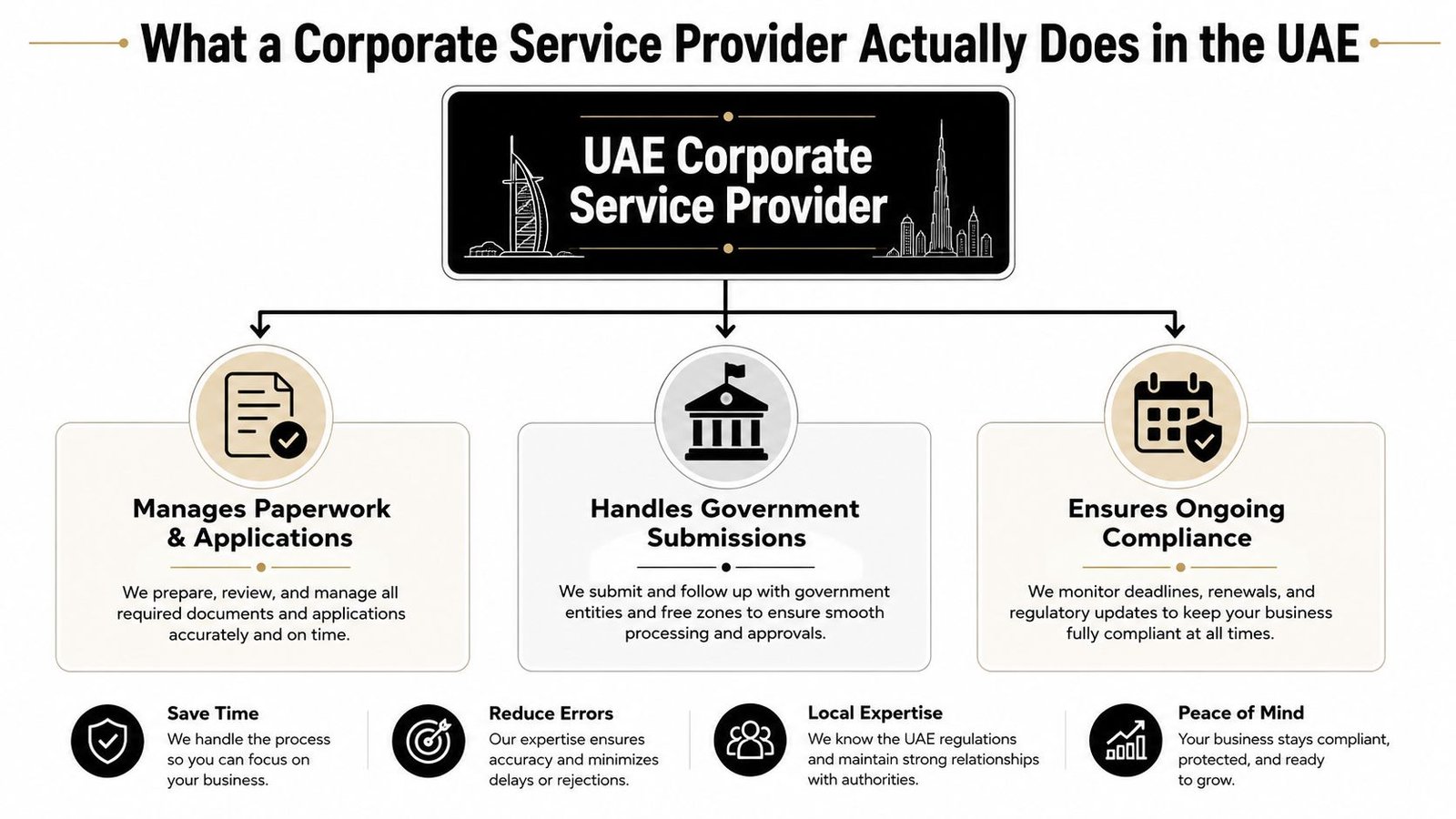
A corporate service provider, or CSP, is a professional firm that handles company formation, government paperwork, immigration processes, and ongoing regulatory administration for businesses in the UAE. The work can include trade licence issuance, public relations officer support, visa processing, tax registration, beneficial ownership records, and licence renewals.
The role is broader in the United Arab Emirates than many first-time founders expect. Dubai, Abu Dhabi, and Sharjah each have their own government departments, while free zones operate separate licensing systems. Federal processes, including tax registration through the Federal Tax Authority's EmaraTax platform, add another layer.
What does a CSP handle after incorporation
A capable provider keeps a structured record of your company, shareholders, employees, deadlines, and government applications. Its day-to-day work may include:
- Licensing: Selecting the correct activity, preparing applications, securing initial approvals, and issuing or renewing the trade licence through the relevant authority.
- Public relations officer work: Submitting immigration, labour, and establishment-card applications, then tracking approvals and corrections.
- Visas: Coordinating investor, employee, and family residence applications, medical testing, Emirates identity procedures, and visa stamping.
- Tax administration: Supporting VAT and corporate tax registration, document collection, and filing workflows through EmaraTax.
- Corporate records: Maintaining shareholder information, beneficial ownership data, resolutions, and statutory documents.
- Banking support: Preparing a coherent application pack and helping the founder answer the bank's questions.
Practical rule: Judge a CSP by what happens after the licence lands. Formation is only the opening file, not the finished business.
The right provider also explains what it isn't handling. A quote that covers licensing but excludes renewals, tax work, office requirements, or immigration follow-up may look inexpensive while leaving you with the hardest administration. The decision is which CSP can manage your full operating cycle, not which one can submit the first application.
Why the UAE Market Makes a CSP Essential in 2026
Why is post-setup support now more important
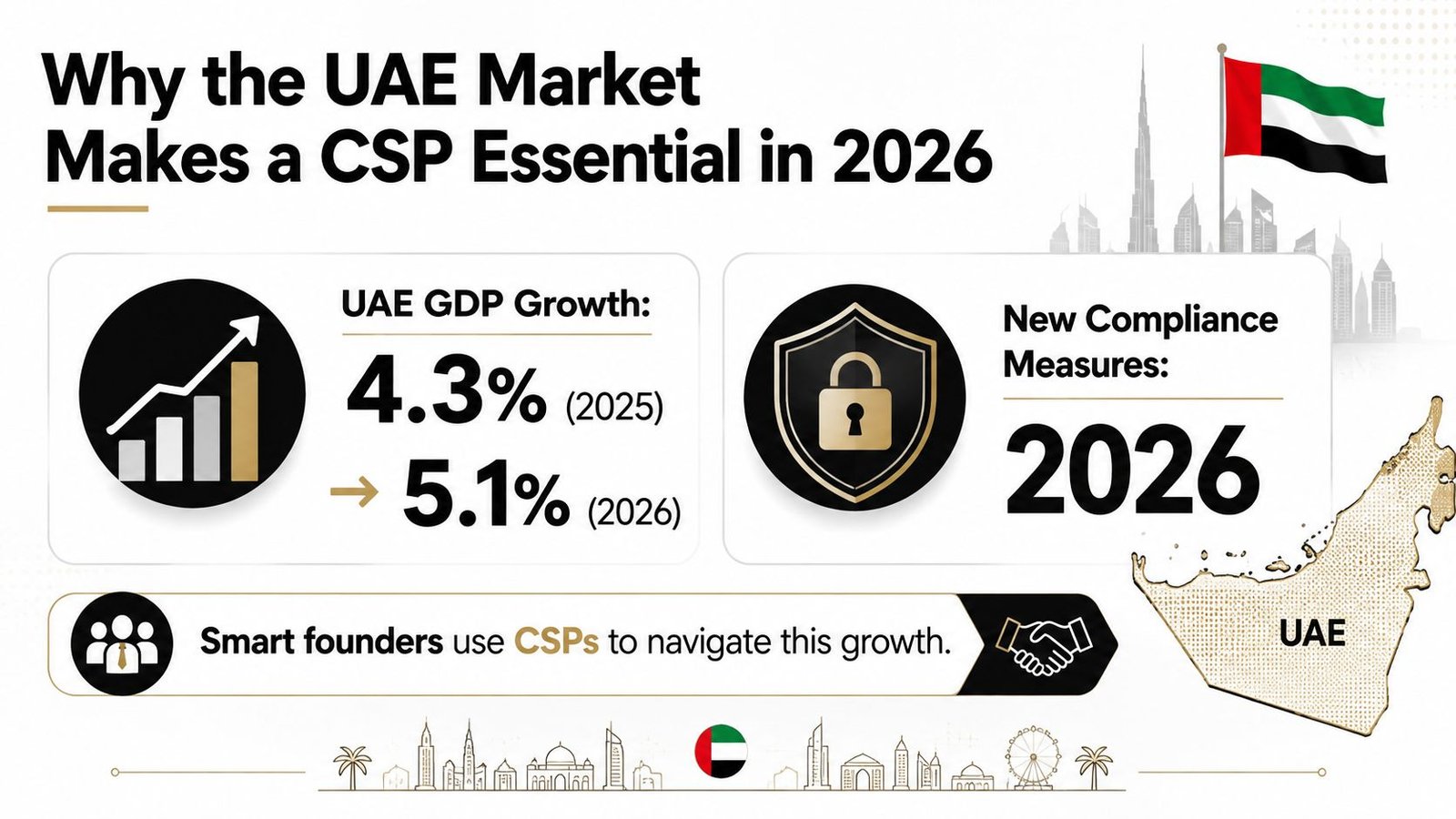
Company formation has become easier to compare and more competitive, but that doesn't mean the work ends sooner. UAE reporting states that the country ended 2025 with more than 1.4 million active companies and added about 250,000 new firms during 2025, while Dubai Chamber membership reached 292,486 active companies after 71,830 new companies joined in 2025. These figures are reported in The National's coverage of UAE company growth.
That scale has changed the founder's problem. Basic incorporation instructions are widely available, and providers can often present similar licence packages. The harder questions now concern market access, banking readiness, tax registration, employee administration, accurate records, and uninterrupted renewals.
Which compliance changes should founders watch
The first phase of mandatory UAE e-invoicing begins in July 2026 for large businesses with annual revenue at or above AED 50 million, as reported in the UAE digital compliance overview. The same reporting identified only 32 accredited service providers in May 2026, which points to a limited implementation pool for businesses that must prepare.
A CSP should also understand corporate tax obligations for free-zone businesses, including the conditions relevant to a Qualifying Free Zone Person. That requires more than forwarding a renewal notice. Your provider should understand the relationship between permitted activities, records, invoicing, accounting, and the company's actual operations.
Golden Visa applications add another documentation burden. The UAE Government states that the programme offers 5-year or 10-year residence, and the public-investment route for investors requires AED 2 million in minimum capital, depending on the category described in the official Golden Visa guidance. A provider that only sells incorporation won't necessarily be equipped to maintain the evidence needed for later residency decisions.
Core Services Every UAE CSP Should Handle
How should a CSP manage formation and licensing
Formation starts with choosing an activity and jurisdiction, not with completing a generic form. A CSP should confirm whether your business belongs on the mainland, in a free zone, or in an offshore structure, then prepare the application, shareholder documents, business plan where required, and authority submissions.
In Dubai, the Department of Economic Development, commonly called DED, handles mainland licensing. In Abu Dhabi, the equivalent emirate authority performs that role. Free zones, including Dubai International Financial Centre, or DIFC, and Abu Dhabi Global Market, or ADGM, run their own procedures and document standards.
What does PRO support include
PRO means public relations officer work. It covers government liaison, application submission, document collection, status tracking, and corrections across labour, immigration, and licensing channels.
For employee matters, the provider may deal with the Ministry of Human Resources and Emiratisation, known as MOHRE, for labour files and work-related processes. Visa stamping and residency administration may involve the General Directorate of Residency and Foreigners Affairs, the immigration authority commonly known by its full name or local emirate abbreviation.
Can a CSP help with banking
Bank account support should begin with preparation, not promises of approval. Banks assess the business activity, ownership, source of funds, expected transactions, office arrangements, and supporting corporate documents.
A responsible provider organises the pack, checks that names and activities match across documents, introduces the application where appropriate, and prepares you for questions. No CSP can guarantee a bank's decision, so treat guaranteed approval as a warning sign.
Who handles tax registration and accounting
The Federal Tax Authority, or FTA, manages UAE tax administration. Its EmaraTax portal is used for VAT and corporate tax registration, so the CSP should coordinate turnover expectations, accounting records, identity documents, and filing dates rather than treating tax as a separate afterthought.
VAT registration becomes mandatory when taxable supplies and imports exceed AED 375,000 over 12 months, while voluntary registration is available above AED 187,500, according to the FTA VAT registration requirements. Those thresholds make bookkeeping and turnover monitoring part of operational compliance.
What ongoing records should remain current
A company needs more than a valid licence. The CSP should track renewals, immigration files, shareholder changes, beneficial ownership information, tax submissions, accounting records, and corporate resolutions.
Ask for a written compliance calendar. It should show who owns each task, which documents are needed, and when the provider will contact you. The point of a CSP is continuity after day one, not a handover that leaves you chasing the next deadline.
Choosing Between Mainland, Free Zone, and Offshore
Which UAE jurisdiction fits your business
The jurisdiction decision affects where you can trade, which authority issues your licence, how visas are handled, and what documents banks may request. The UAE Ministry of Economy's company establishment guidance distinguishes these routes clearly enough to make one point: your business model must come before the package price.
| Jurisdiction | Licensing Authority | Trading Scope | Best For |
|---|---|---|---|
| Mainland | Relevant emirate authority, such as Dubai's DED or Abu Dhabi's Department of Economic Development | Generally able to trade across the UAE | Businesses serving UAE customers, hiring locally, or operating from the domestic market |
| Free Zone | The selected free-zone authority | Typically suited to activity inside the zone or international trade | International services, specialised activities, and founders seeking a zone-based structure |
| Offshore | The offshore registry selected for the holding structure | Not intended for onshore operating trade | Holding, asset structuring, and ownership arrangements |
When should you choose mainland
Choose mainland if your revenue depends on selling directly within the UAE or maintaining broad domestic market access. The relevant emirate authority licenses the company, and the structure generally suits businesses that need local premises, employees, or customer contracts tied to UAE operations.
That choice can involve more coordination around office documentation, approvals, notarisation, and immigration files. It can still be the cleaner option if your clients, staff, and daily operations are in Dubai, Abu Dhabi, or another emirate.
When is a free zone the better route
A free zone entity is licensed by a zone authority and is often designed for international trade or activity within the zone. The official free-zone establishment process shows that initial approval may require an application, business plan, shareholder and manager passports, and later notarised registration documents.
Free zones can offer a practical home for consultants, technology companies, exporters, and international founders. Don't select one only because its headline package is cheap. Match the permitted activity, office requirement, visa allocation, banking profile, and future customer base to the zone.
What is offshore suitable for
Offshore vehicles are holding and structuring tools. They aren't intended for ordinary onshore trading, so they're unsuitable for a founder who needs to invoice UAE customers from the operating entity or sponsor a normal local workforce.
An offshore structure may suit a family holding arrangement or ownership layer, but it demands careful advice on beneficial ownership, banking, tax treatment, and the relationship with any operating companies. Ask the CSP to document the purpose of every entity before filing.
How the Same Setup Looks Different for Real Founders
What might a consultant need
A UK-based consulting founder serving international clients may choose a Dubai free zone such as DMCC or IFZA. The core file could include the business plan, shareholder passport, manager documents, activity approval, office or desk arrangement, one investor residence route, and a bank application pack.
The founder doesn't need every add-on sold during a formation call. If there are no employees, employee visa packages and labour-file administration can wait. If the company is not yet approaching the VAT threshold, tax registration may be a later workflow, but bookkeeping should still begin immediately so turnover and expenses are recorded properly.
The CSP's value lies in keeping the activity, licence, visa, and bank story consistent. A consultant who describes the business as one activity on the application, another in the bank pack, and a third in marketing material creates avoidable questions.
How does a holding structure differ
A European family office considering a Ras Al Khaimah offshore holding company has a different checklist. The provider must understand the ownership chain, prepare corporate documents, maintain beneficial ownership records, and explain that the offshore entity isn't a substitute for an onshore operating company.
If the structure connects to Abu Dhabi Global Market, or ADGM, the CSP framework matters. ADGM's Company Service Provider rules took effect in April 2021 and were implemented from 12 July 2021. Pre-existing special purpose vehicles and Foundations had until 11 July 2022 to appoint a licensed CSP, as described in the ADGM framework overview.
The family office may also assess Golden Visa eligibility separately from the holding company. Abu Dhabi's skilled-professional route requires a Ministry of Human Resources and Emiratisation classified Level 1 or Level 2 role, a bachelor's degree or equivalent, and a monthly salary of AED 30,000, with documents including an attested degree, employment contract, employment certificate, and six months of bank statements, according to Abu Dhabi's official guidance.
These files look nothing alike. A useful CSP listens before recommending services.
A Practical Checklist for Choosing the Right CSP
What should you check before signing
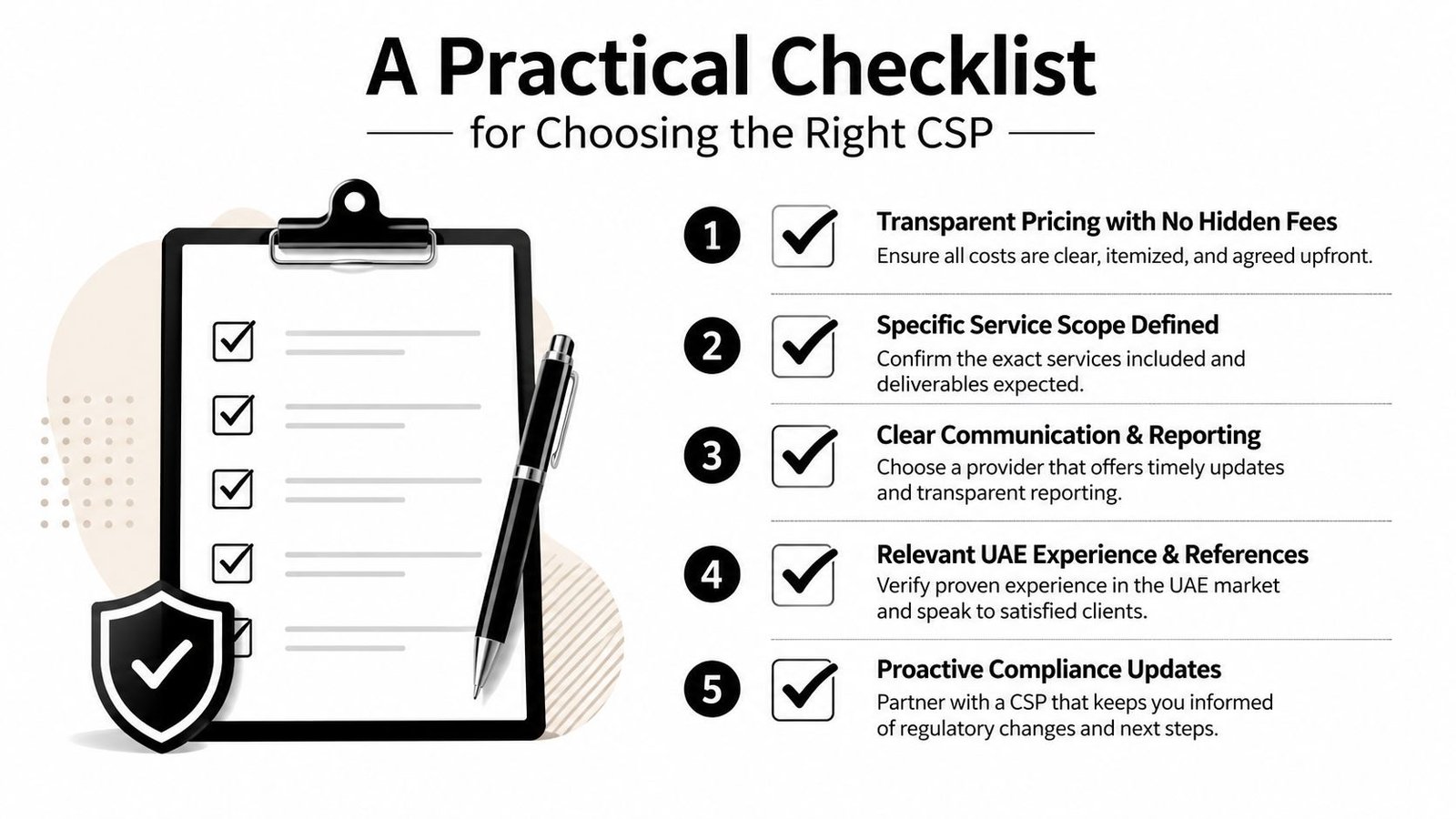
Use this order when comparing providers:
- Transparent pricing: Request a line-by-line quote showing government charges, professional fees, office costs, visas, renewals, tax work, and any optional services.
- Defined service scope: Confirm what happens after licence issuance. The agreement should state who handles renewals, immigration files, beneficial ownership updates, accounting, and tax submissions.
- In-house PRO capacity: Ask whether the people submitting applications are employees or outsourced agents. Outsourcing isn't automatically wrong, but you should know who controls your file.
- Relevant government experience: A provider should understand the authorities in Dubai, Abu Dhabi, and Sharjah, as well as the free zones you're considering. Ask for examples involving a business similar to yours.
- Accounting and tax depth: Simple bookkeeping isn't enough if your turnover, ownership, or activity creates more demanding reporting needs. Ask who prepares VAT and corporate tax registration and who reviews filings.
- Technology and reporting: Client portals, document status tracking, and API access can matter for HR teams, fintech platforms, SaaS businesses, and referral partners managing multiple applications.
Which warning signs should concern you
Vague timelines, unspecified licensing charges, pressure to pay before explaining the structure, and no named relationship manager all deserve scrutiny. So does a quote that says “full compliance” without listing the filings and renewal dates included.
Test the provider before committing. Send a short, realistic question about your activity and jurisdiction, then assess whether the reply is clear, prompt, and specific. The first response often reveals how your file will be treated later.
Timelines, Costs, and the Hidden Variables That Matter
What changes the setup timeline
A fast-track free-zone formation may be completed within a few working days when documents and approvals are straightforward. Mainland formations can take several weeks once authority approvals, notarisation, office evidence, and Ejari registration are included.
Your budget also depends on choices that headline packages often separate:
- Office or flexi-desk requirements
- Visa allocation and immigration processing
- VAT registration support
- Bank account introduction and document preparation
- Licence, immigration, and accounting renewals
The UAE free-zone market is large. The National Economic Register reported around 60,600 free-zone businesses by mid-February 2021, representing more than 8% of all UAE-registered companies, as reported by the Emirates News Agency. Competition can keep entry packages attractive, but maintenance costs vary sharply by authority, office arrangement, visa needs, and provider scope.
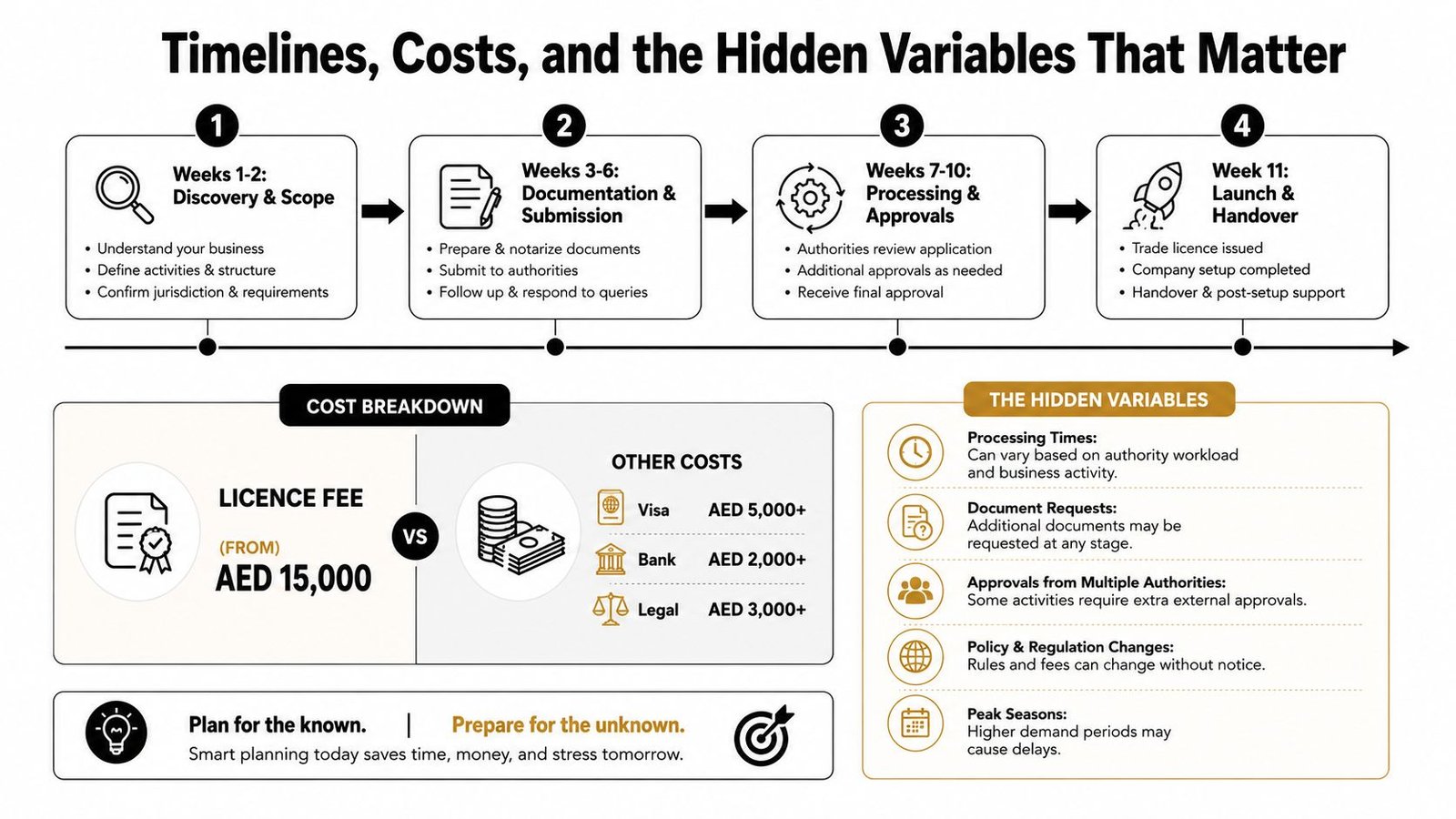
Use a structured estimator and ask for a renewal forecast instead of relying on a single advertised figure. The cheapest first invoice can become an expensive choice if it excludes the administration you'll need every year.
How Inpro Applies This in Practice
What should a modern CSP provide
Inpro Corporate Services L.L.C. supports mainland, free-zone, and offshore setup workflows, then continues with PRO, visa, accounting, VAT, and corporate tax administration. Its visa support covers Investor, Golden, and Employee routes, while its banking service focuses on preparing and coordinating corporate account applications rather than promising a bank decision.
The practical difference is clarity. A founder should receive a defined jurisdiction recommendation, a document list, a timeline, and a breakdown of what continues after the licence is issued. HR teams need dependable employee visa processing, while holding companies need careful ownership records and structured compliance support.
Partners also have a different requirement from individual founders. Fintech, SaaS, and referral platforms may need API-enabled workflows that let them embed UAE formation into their own customer experience instead of sending every user to a separate manual process.
A corporate service provider earns its place by reducing repeated questions, missed dates, and inconsistent submissions. Compare the provider's proposed workflow with your actual business, not with a generic package page.
Inpro Corporate Services L.L.C. can help with UAE mainland, free-zone, and offshore formation, PRO and visa processing, banking support, accounting, VAT, and corporate tax workflows. Visit Inpro Corporate Services L.L.C. to book a free strategy call and map your jurisdiction, likely costs, and post-setup timeline.