


You may already have a UAE company, a property purchase, or a senior employment contract and still be unsure whether you qualify for the Golden Visa. The short answer is that eligibility depends on your exact route, emirate, occupation classification, investment evidence, and supporting documents, not just on your income or business ownership.
Table of Contents
- Who Qualifies for the UAE Golden Visa Today
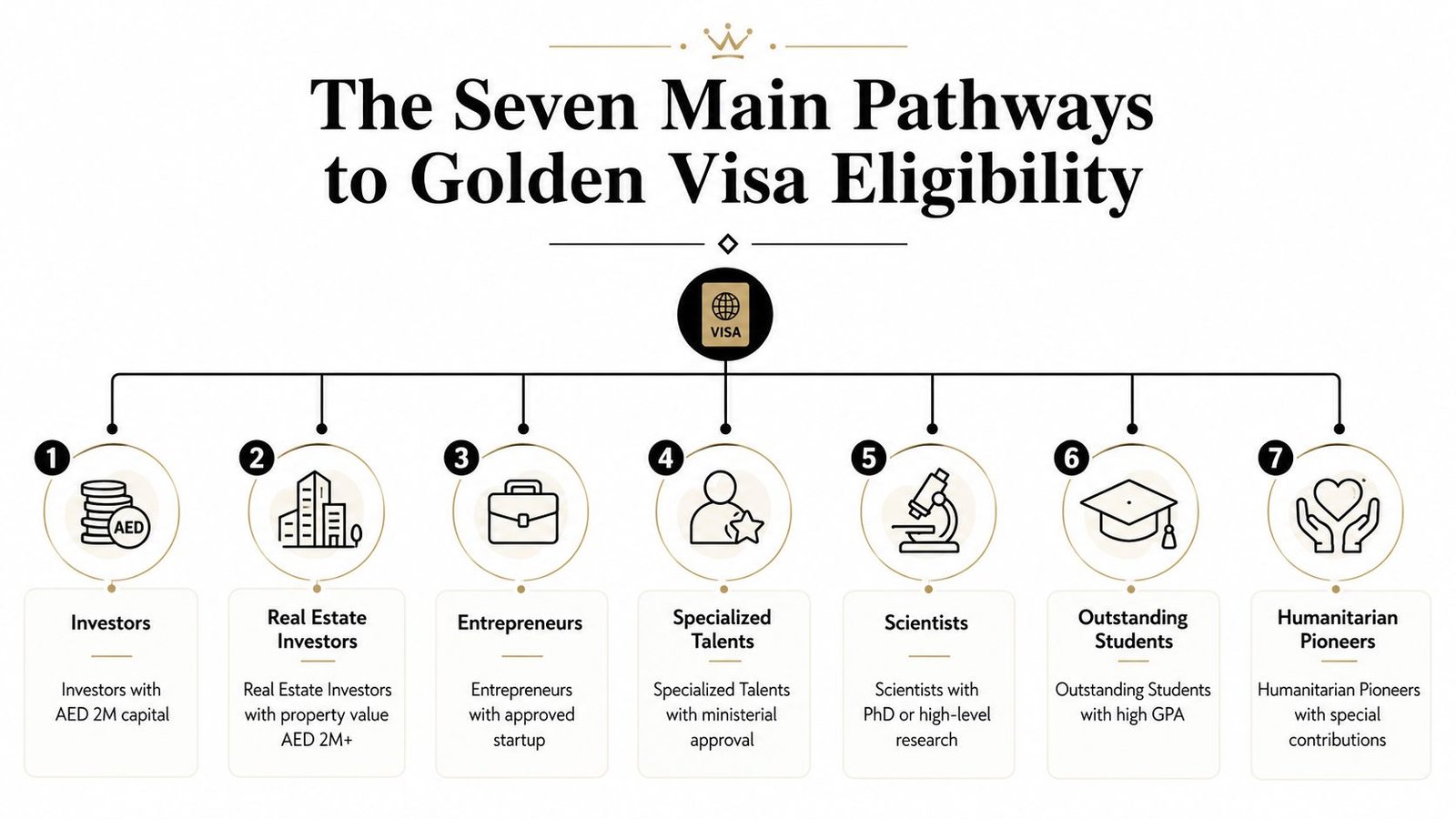
- The Seven Main Pathways to Golden Visa Eligibility
- Documents and Endorsements Required for Each Route
- Where Eligible Applicants Quietly Get Disqualified
- How Golden Visa Eligibility Connects to Company Formation and Investor Visas
- Real Timelines and What the Process Looks Like
- Next Steps and How Inpro Helps With Your Application
Who Qualifies for the UAE Golden Visa Today
A senior employee with the right classification may qualify, while a business owner with similar income may need an investor or entrepreneur route. The UAE Golden Visa is a renewable residence permit for applicants whose investment, professional standing, talent, academic record, or recognised contribution meets the applicable criteria. It is generally not tied to one employer, but approval depends on documents reviewed by the relevant federal or emirate authority.
For investors, AED 2 million is the clearest benchmark. The UAE government's Golden Visa framework states that public-investment applicants may qualify for a 10-year visa, while real-estate investors may qualify for a 5-year visa, subject to the route and supporting proof. The framework also recognises property ownership and contribution to an establishment paying at least AED 250,000 annually in taxes as possible eligibility bases.
What route is most likely to fit your profile
Match the route to evidence already available, not to the category with the most appealing label.
- Investor: You can document qualifying capital, a deposit, company investment, or an accepted tax contribution.
- Real-estate investor: Your ownership and title documents satisfy the applicable value and registration requirements.
- Entrepreneur: You operate an approved or recognised startup or entrepreneurial project.
- Specialised talent: Your professional or creative work can obtain endorsement from the relevant authority.
- Skilled professional: Your occupation, qualification, salary, and employment classification meet the applicable rules.
- Scientist: Your research record and institutional endorsement support the application.
- Outstanding student: Your grades and education record satisfy the relevant criteria.
Remote income from overseas does not usually create a standalone Golden Visa category. A remote worker should test other options, including qualifying employment, investment, entrepreneurship, or a separate residence route.
Practical rule: Treat eligibility as an evidence test. If the investment, occupation classification, qualification, or endorsement cannot be shown in an accepted document, a promising profile may still fail at review.
Dubai, Abu Dhabi, Sharjah, and UAE free zones can apply different procedures and endorsement requirements. The practical question is therefore not only whether the profile appears eligible, but which authority can accept the evidence and which filing route fits it. That choice can determine whether an otherwise suitable application proceeds smoothly or requires restructuring before submission.
The Seven Main Pathways to Golden Visa Eligibility
The seven pathways help narrow your options, but they are not interchangeable applications. An investor with a qualifying deposit faces a different review from a property owner, while a senior employee may depend on occupation classification and salary. The authority accepting your evidence matters as much as the category itself.
Which investment route applies
The public-investment route can provide a 10-year visa, while the real-estate route can provide a 5-year visa, under the federal framework. The central capital benchmark is AED 2 million. Applicants must prove the qualifying investment, not merely show personal wealth. Federal guidance also refers to property ownership and to contributions to an establishment that pays at least AED 250,000 annually in taxes.
Abu Dhabi offers several investor options. The Abu Dhabi Residents Office investor guidance refers to a minimum investment value of AED 2 million, including a deposit or company investment. It also recognises proof of tax payment of at least AED 250,000 per year for two years before the application. The practical choice is between tying up capital in a deposit, investing through a company, or proving an eligible tax contribution.
Dubai has a separate property route. The Dubai Land Department service page states that a real-estate investor can apply for a 10-year renewable residence permit when the property purchase value is AED 2 million or more at the time of purchase. That rule applies to Dubai and should not be treated as a universal description of every emirate's process.
When skilled professional eligibility works
Abu Dhabi's skilled-professional route sets clear conditions. The applicant must hold a role classified at Ministry of Human Resources and Emiratisation, or MOHRE, Level 1 or Level 2, have at least a bachelor's degree or equivalent, and earn a minimum monthly salary of AED 30,000 excluding allowances. The official Abu Dhabi guidance for skilled professionals also requires a UAE practising licence where the profession is regulated.
How the other pathways are assessed
Entrepreneurs generally need an approved startup, project, or business profile supported by the relevant authority. A company licence alone does not establish entrepreneurial eligibility.
Specialised talents may include applicants with recognised ability in culture, arts, sport, technology, or other designated fields. An endorsement or nomination usually carries more weight than a self-description.
Scientists need a credible research profile and appropriate institutional or ministerial support. A degree alone may not show that the applicant fits this category.
Outstanding students are assessed through academic records and the applicable recommendation or nomination process. Match the category to the evidence you can obtain, then confirm which authority must endorse it before preparing the application.
Documents and Endorsements Required for Each Route
A strong file is built around the authority responsible for approving the chosen route. Investors must prove ownership and funds. Skilled employees need employment records that match their occupation classification. Talent, scientist, entrepreneur, and student applicants need supporting evidence from the institution, ministry, or emirate body that can endorse the profile.
Collect documents in their original form first. Then check whether each item requires certification, attestation, or an approved translation. Foreign degrees, company records, tax documents, and civil documents may need certified translation before submission. Emirates ID processing, medical screening, and biometrics normally come after approval or at the relevant application stage. They are separate from the initial eligibility file.
What investors should prepare
An investor file may contain a trade licence, company ownership records, audited financial statements where applicable, tax payment certificates, bank references, deposit evidence, or property documents. The required bundle depends on whether the application is based on public investment, a UAE company, property ownership, or tax contribution.
For Abu Dhabi, the Abu Dhabi Residents Office investor guidance identifies qualifying forms such as a deposit, company investment, or documented tax payment. A founder should therefore prepare a clear financial trail early. A licence certificate by itself may not show the required investment or contribution.
The property-investor route can provide a 5-year visa, while qualifying purchases under Dubai guidance may provide a 10-year renewable route. Title deeds, purchase records, valuation documents, and ownership evidence should be consistent across the application.
What skilled employees should prepare
A specialist employee should normally prepare an employment contract, salary certificate, degree certificate, proof of MOHRE classification, and a UAE practising licence where the profession is regulated. The salary certificate must separate basic salary from allowances because the Abu Dhabi professional rule excludes allowances from the AED 30,000 threshold.
The endorsing authority depends on the filing location and route. Federal applications may involve the Federal Authority for Identity, Citizenship, Customs and Port Security, or ICP. Dubai applications commonly involve the General Directorate of Residency and Foreigners Affairs, or GDRFA Dubai. Abu Dhabi routes may involve Abu Dhabi Registration and Licensing, or ADDED, and the Abu Dhabi Residents Office, or ADRO, alongside the applicable federal immigration channel.
| Pathway | Core documents | Endorsing authority | Visa length |
|---|---|---|---|
| Public or company investor | Investment proof, company records, financial evidence, tax documents where relevant | ICP or the relevant emirate authority | 10 years under the federal investor framework |
| Real-estate investor | Title deed, purchase evidence, property valuation or ownership proof | Dubai Land Department or relevant emirate authority | 5 years under the federal real-estate framework, with Dubai guidance providing a 10-year renewable route for qualifying property purchases |
| Skilled professional | MOHRE-classified contract, salary certificate, attested degree, practising licence where applicable | ICP, GDRFA Dubai, or Abu Dhabi channels | Route-specific |
| Entrepreneur | Approved project or startup evidence, business records, endorsement | Relevant emirate or federal authority | Route-specific |
| Scientist or specialised talent | Credentials, portfolio or research evidence, nomination or endorsement | Relevant ministry or emirate authority | Route-specific |
| Outstanding student | Academic records and recommendation or nomination | Relevant education authority | Route-specific |
Where Eligible Applicants Quietly Get Disqualified
Refusals usually follow a document mismatch. The applicant may meet the broad profile, yet the submitted records do not prove the salary, role, ownership, or qualification described in the application.
A senior employee can meet total monthly compensation while falling short on basic salary, because allowances are excluded. Abu Dhabi's skilled-professional requirements include AED 30,000 monthly excluding allowances, a bachelor's degree or equivalent, and a MOHRE Level 1 or Level 2 role, as set out by the Abu Dhabi Department of Economic Development guidance for skilled professionals.

Which employment details cause trouble
The authority may compare the job title, occupation code, employer classification, contract type, and emirate. A well-paid freelancer may not fit the skilled-professional route if the required employment structure or classification is missing. An employee can face the same problem when the employer's registered occupation code does not match the senior position stated in the application.
Regional immigration guidance identifies requirements that may include a AED 30,000 basic monthly salary, two years of continuous employment, and MOHRE-backed evidence for executive and highly skilled professional applicants. The regional employment and immigration alert also highlights differences between emirates and occupation codes. Check these details before filing rather than treating a strong salary or title as sufficient.
Property applications fail for different reasons. An off-plan purchase may have substantial commercial value, but the authority still needs the accepted ownership and valuation records for the selected route. A property investor may therefore fall below the required AED 2 million value in the official evidence, even when the applicant considers the asset eligible.
Review the file against these points:
- Salary structure: Separate basic salary from allowances.
- Occupation code: Confirm the employer's registered classification.
- Qualification: Check degree equivalency and attestation.
- Licence status: Verify a UAE practising licence for regulated work.
- Property evidence: Confirm the recorded value and ownership status.
- Emirate: Apply the rule used by the authority handling the file.
A polished application cannot correct a mismatch between the employment contract and the government record.
Review the documents before submission. Use the video below for general orientation, then follow the current requirements of the authority responsible for the chosen route.
How Golden Visa Eligibility Connects to Company Formation and Investor Visas
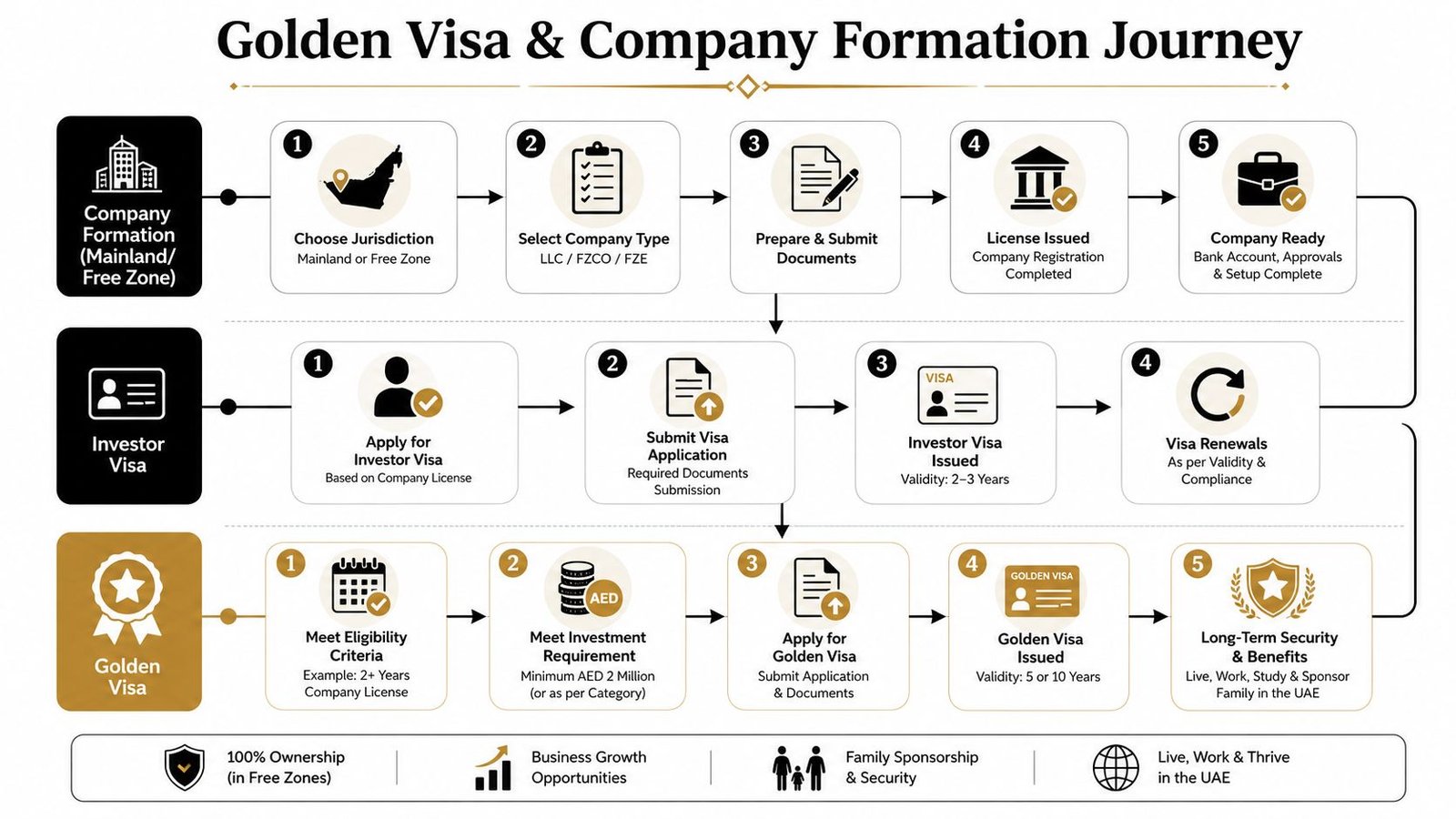
A founder may register a company, obtain an Investor Visa, and still have no qualifying Golden Visa route. Company formation establishes a business and residence basis. Golden Visa eligibility depends on the investment, property, tax record, or other evidence accepted for the selected category.
Start with the founder's actual objective. A business serving UAE customers may need a Mainland structure, while an international services or technology company may prefer a free zone. An offshore entity can suit holding or asset-protection purposes, but it generally provides weaker evidence of active UAE operations. The structure should follow the business model, not the hope that incorporation alone will qualify the owner for long-term residence.
Which structure suits the founder
Mainland: A Mainland company may fit a founder selling directly in the UAE or working with clients across the United Arab Emirates. Its financial records and tax history may support an investor assessment where the chosen route accepts that evidence. The trade-off is a broader operating setup, with licensing and compliance obligations that must remain current.
Free zone: A free-zone company offers a defined licensing environment for international services, technology businesses, and other activities permitted by the selected authority. The licence may support an Investor Visa and related residence process. It does not, by itself, establish Golden Visa eligibility. The file still needs qualifying investment or another recognised basis.
Offshore: An offshore structure may work for holding assets, but it is a poor fit for a founder whose case depends on active UAE operations. Ownership records and business evidence must match the visa category.
When a founder should apply
Apply when the evidence is ready, rather than relying on the company's age. A founder may use an Investor Visa while building the business, then pursue a Golden Visa after the investment, property, or tax record satisfies the relevant route.
Abu Dhabi's investor pathway may recognise tax payments made over the required assessment period. The tax evidence must be properly documented and connected to the qualifying establishment. A profitable business can still face difficulty if payments, ownership, or establishment records do not align.
A senior employee may remain on a standard residence visa while building the employment record for a professional route. HR should verify the occupation code and salary structure before presenting Golden Visa eligibility as certain. The practical choice is the pathway supported by the applicant's records today, not the route that looks strongest on the company registration certificate.
Real Timelines and What the Process Looks Like
A Dubai-based specialist moving from a standard residence visa to a Golden Visa usually begins with a profile review, not a medical test. The employer record, salary certificate, degree, occupation classification, and practising licence, if relevant, must first align with the chosen route.
What happens during the application
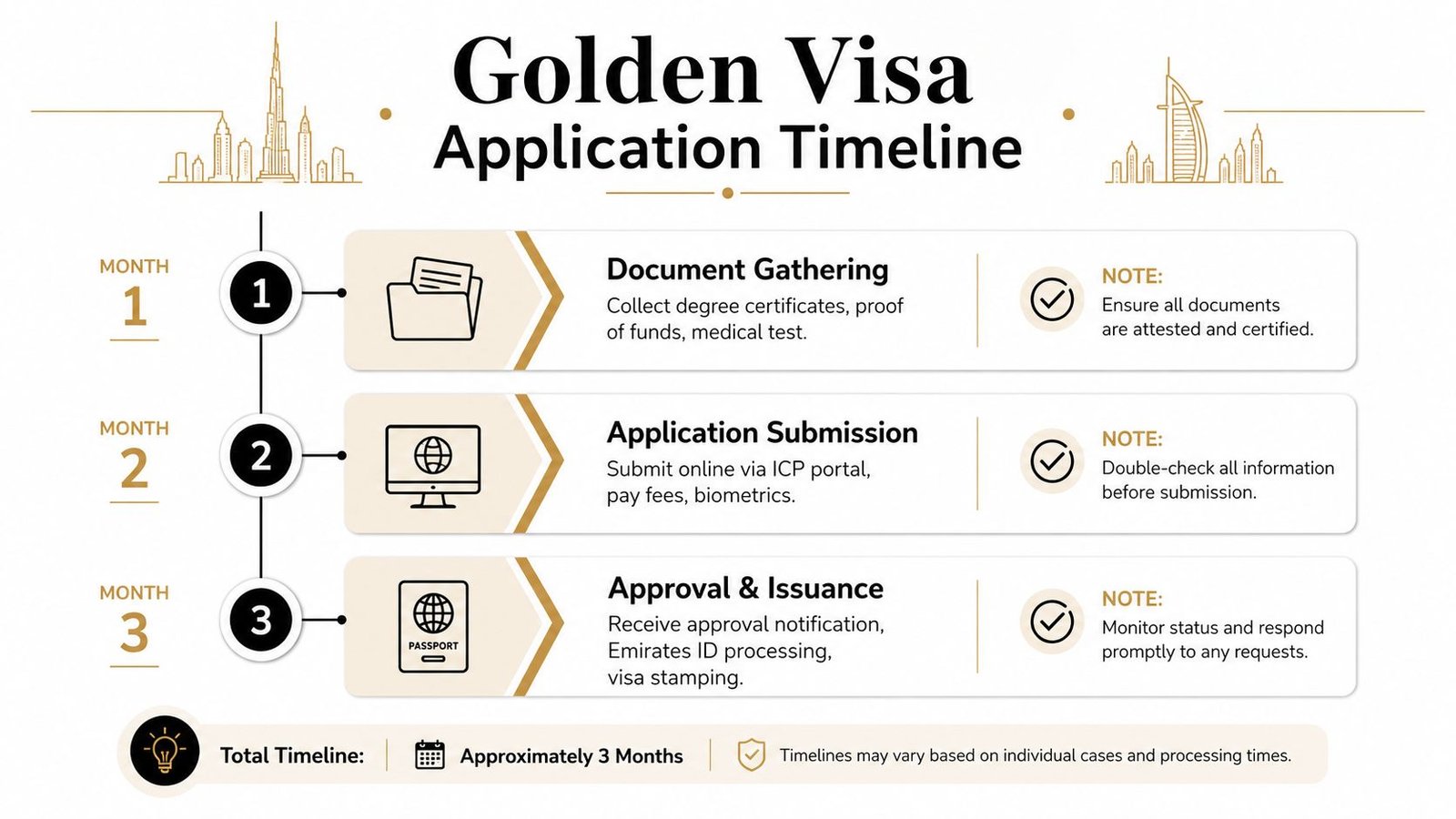
The practical sequence is usually:
- Eligibility review: Confirm the route, emirate, authority, occupation, investment, and evidence.
- Document collation: Obtain attestations, certified translations, salary records, financial evidence, and endorsements.
- Online submission: File through the relevant federal or emirate portal.
- Approval stage: Respond to requests for clarification or missing documents.
- Medical screening: Complete the required medical process after the applicable approval stage.
- Emirates ID and biometrics: Provide identity details and biometrics for the residence record.
- Issuance: Complete the residence permit and Emirates ID process.
Federal applications may take several weeks when the file is complete, while Abu Dhabi applications can take longer where an ADDED review or specialist endorsement is required. A missing attested degree, an unclear salary breakdown, or an employer classification mismatch can add delay without changing the applicant's underlying profile.
How renewal and family sponsorship fit
The visa duration depends on the approved pathway. The federal framework identifies 5-year and 10-year routes, and renewal requires the applicant to continue meeting the relevant conditions.
Golden Visa holders can generally sponsor eligible family members under the applicable residence rules, but the supporting documents and conditions should be checked at the time of filing. Parents and domestic staff may be subject to specific conditions, so applicants shouldn't assume that every family member follows the same process as a spouse or child.
Next Steps and How Inpro Helps With Your Application
Before paying for an application, answer three questions:
- Which pathway fits the evidence you already have?
- Which emirate and authority will process the file?
- Which documents prove the route without gaps?
Inpro Corporate Services L.L.C. can review eligibility against federal and emirate requirements, coordinate documents with MOHRE, the relevant free-zone authority, or the Dubai Land Department, and manage the PRO process with ICP, GDRFA Dubai, or Abu Dhabi channels. The team supports applications across Dubai, Abu Dhabi, and Sharjah, including attested translations, company formation, corporate bank account support, and visa filing.
The useful starting point is a document audit. Compare the contract, salary structure, degree, licence, property record, company ownership, and tax evidence against the route before submission. That approach helps founders, HR teams, freelancers, and investors avoid building an application around a category they can't prove.
If you're assessing golden visa eligibility or combining a Golden Visa application with UAE company formation, Inpro Corporate Services L.L.C. can review your route, coordinate the required documents, and manage the government filing process. Visit the site to arrange a strategy discussion or use the cost estimator to plan your next step.