

You can register a company in the UAE without a mandatory Emirati shareholder for most activities, but the right setup depends on where you'll sell, how you'll invoice, how many visas you need, and what compliance obligations you can manage. In 2026, the practical answer isn't just “mainland or free zone”. It's choosing the structure that matches your revenue model, then starting the tax, immigration, and banking work before the licence is issued.
A founder who starts with a trade name often discovers later that the chosen activity doesn't support the intended market, the office arrangement limits visas, or the bank wants documents that weren't prepared. The process becomes much easier when you make the jurisdiction and activity decisions first.
Table of Contents
- Understanding What Registering a Company in the UAE Actually Means
- Choosing the Right Jurisdiction for Your Business
- The Step-by-Step Registration Process and Timelines
- Costs, Documents, and Budget Planning
- Visas, PRO Services, and Opening a Bank Account
- Post-Incorporation Compliance and Tax Registration
- Common Pitfalls, Final Checklist, and Next Steps
Understanding What Registering a Company in the UAE Actually Means
Registering a company in the United Arab Emirates is a staged legal and administrative process, not one online form. You define the activity, select a legal form, choose a jurisdiction, reserve a trade name, obtain approvals, submit documents, and then complete immigration and tax work.
The UAE's company-law framework changed through Federal Decree-Law No. 26 of 2020 and Federal Decree-Law No. 32 of 2021. The later law came into effect on 2 January 2022 and removed the long-standing 51% Emirati ownership rule for most mainland activities, allowing foreign investors to own up to 100% of many onshore companies, subject to strategic-sector approvals and other conditions. The reform is explained in this overview of the UAE company-law changes.
What are the four decisions behind registration?
Think of setup as four connected decisions. Each one affects the next.
| Decision | What It Controls | Key Authority | Typical Time to Decide |
|---|---|---|---|
| Business activity | What the company may legally do | Department of Economy and Tourism or free zone authority | One to several working days |
| Legal form | Ownership, liability, and governance | Relevant licensing authority | One to several working days |
| Jurisdiction | Market access, office rules, visas, and licensing route | Mainland department, free zone, or offshore registrar | Several working days |
| Trade name | The company's registered identity | Licensing authority | Often one working day, subject to review |
The Department of Economy and Tourism, often called the DET in Dubai, handles Dubai mainland licensing. Other emirates use their own economic departments. Free zone authorities license companies within their designated zones, while the Federal Authority for Identity, Citizenship, Customs and Port Security manages immigration and identity services.
Which filters should you apply first?
Start with four filters:
- Activity classification: A consultancy, trading company, software business, restaurant, recruitment agency, and freelancer may need different approvals.
- Market access: If you'll contract directly with UAE customers or operate across Dubai, mainland licensing may fit better.
- Ownership preference: Most mainland activities now allow full foreign ownership, while free zones also offer foreign ownership within their frameworks.
- Speed to launch: A simple free zone structure can move quickly, while regulated activities, foreign corporate shareholders, and physical premises add work.
The UAE's company environment is large and active. By the end of September 2025, active commercial licences had nearly reached one million, based on National Economic Registry data reported by the Ministry of Economy coverage. That scale gives founders choice, but it also means the correct authority and activity classification matter from the start.
Choosing the Right Jurisdiction for Your Business
The old mainland-versus-free-zone debate is too narrow for many companies. A Dubai software firm might hold its primary licence in a free zone, sell internationally, and later add a mainland branch or temporary permit for local contracts. A trading business may need mainland access from the outset. An offshore company may suit a holding structure but won't replace an operating licence for UAE activity.
What does each UAE jurisdiction control?
Mainland companies are licensed through the relevant emirate's economic department. In Dubai, that means the Department of Economy and Tourism. Mainland companies are generally the clearest route for trading within the UAE and accessing the wider local market, as explained by the Dubai mainland company guidance.
Free zones are specialised business districts with their own authorities, licensing systems, office models, and sector clusters. They can suit international services, technology, media, logistics, consulting, and holding activities, but each zone sets its own rules for activities, premises, and visa eligibility.
Offshore companies are generally used for holding assets, intellectual property, or international invoicing where the company doesn't need a physical operating presence in the UAE. Offshore registration isn't a substitute for a mainland or free zone operating licence if you plan to conduct regulated or local commercial activity.
| Criterion | Mainland | Free Zone | Offshore |
|---|---|---|---|
| Ownership | Foreign ownership allowed for most activities, subject to conditions | Foreign ownership generally available within the zone framework | Designed for non-operating ownership structures |
| Office requirements | Usually tied to the licensed activity and premises rules | Options may include flexi-desk, shared office, or dedicated space, depending on the zone | No normal operating office requirement |
| Tax treatment | Subject to UAE tax rules | Subject to UAE tax rules, with free zone treatment conditional rather than automatic | Requires careful analysis of tax residence and substance |
| Visa quotas | Linked to premises and authority rules | Linked to package and office arrangements | Usually unsuitable for operating staff visas |
| Market access | Direct route to the wider UAE local market | Zone-based activity, with mainland access subject to rules and permits | International and holding use |
| Cost band | Can rise with premises and approvals | Often more predictable for simple setups | Usually lower for a holding structure, but not an operating solution |
Can a free zone company do business in the mainland?
Dubai's Executive Council Resolution No. 11 of 2025 allows free zone companies to open a mainland branch or obtain a temporary permit. This weakens the old assumption that a free zone company is permanently cut off from onshore selling. The company still has to satisfy activity, approval, and permit conditions, so you shouldn't treat the rule as a blanket right to conduct every mainland activity.
Current market commentary on the 2026 free zone and mainland hybrid model reflects this shift. The strategic question is now: which combination supports your revenue streams without creating duplicate entities or unnecessary compliance?
Practical rule: Choose the jurisdiction for the work you'll actually perform, not for the cheapest headline package.
For a UAE consultancy serving overseas clients, a free zone may be efficient. For a retailer, local contractor, recruitment business, or company bidding for mainland work, Dubai mainland may be more suitable. For a holding company, offshore may have a role, but it shouldn't be presented as a general business licence.
The Step-by-Step Registration Process and Timelines
The UAE registration process follows a recognisable sequence, although the exact portal and approvals depend on the emirate, activity, and jurisdiction. The Ministry of Economy company-establishment guidance starts with choosing the activity and jurisdiction, then moves through the trade name, initial approval, licensing documents, and submission through the relevant platform.
What happens before the licence is issued?
- Classify the business activity. Select the activity that matches the actual service or goods you'll provide. An inaccurate activity can create banking, contract, and regulatory problems later.
- Choose the legal form. The authority may offer forms such as a limited liability company, sole establishment, civil company, branch, or free zone entity, depending on the business.
- Reserve the trade name. The authority checks whether the name is available and compliant with naming rules. Names can be rejected for similarity, restricted wording, or links to regulated sectors.
- Obtain initial approval. This confirms that the authority has no objection to proceeding, but it isn't the final licence.
- Prepare the Memorandum of Association and Articles of Association. The Memorandum of Association sets out the company's objects and ownership framework. The Articles of Association establish internal governance rules.
- Confirm premises. Mainland companies may need a tenancy contract registered through Ejari, Dubai's tenancy registration system. Free zones may accept a flexi-desk or shared office package for eligible activities.
- Submit and pay. The authority reviews the documents, collects the applicable fees, and issues the trade licence.
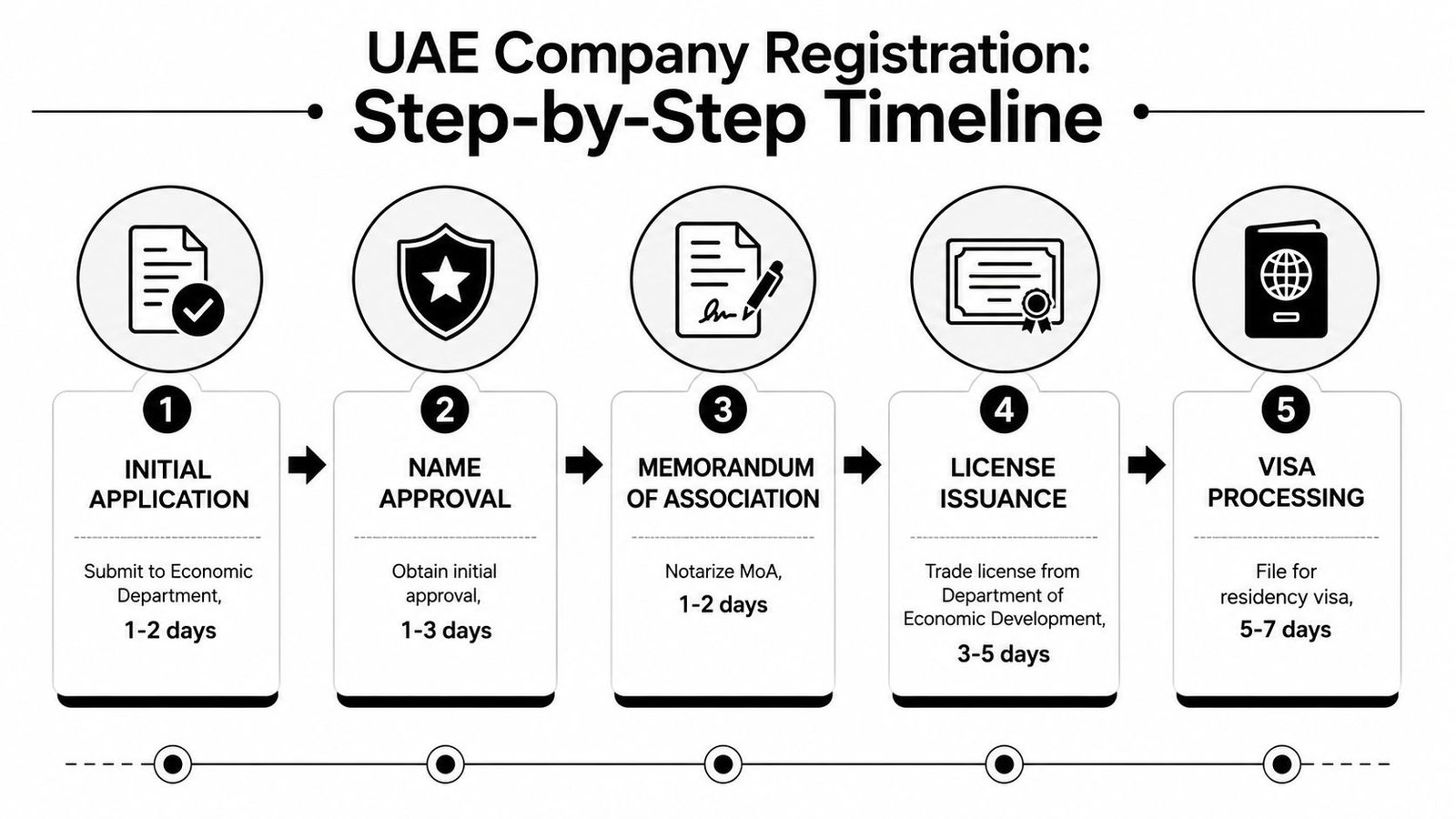
How long does registration take?
Use the following as a planning guide, not a promise:
- Trade name reservation: around one working day.
- Initial approval: roughly two to five working days.
- Licence issuance: roughly three to seven working days.
- Establishment card and labour file: often another one to two weeks.
A free zone portal can combine several stages and may issue a simple licence within a shorter window, sometimes three to seven working days, when documents and approvals are ready. Mainland registrations can take longer when the activity requires external approval or the lease is delayed.
The main bottlenecks are predictable. A rejected name forces a new submission, Ejari delays hold up the premises file, and foreign shareholder documents may require legalisation, attestation, or certified translation. Run visa, PRO, and banking preparation in parallel rather than waiting for the licence certificate to arrive.
Costs, Documents, and Budget Planning
There isn't one honest UAE company-formation price. A low-cost free zone package, a Dubai mainland company with a physical office, and an offshore holding entity have different fee profiles. The licence fee is only one part of the budget, and the cheapest package can become expensive when you add premises, visa capacity, attestations, and banking support.
What should your setup budget include?
| Cost Item | Mainland (DED) | Free Zone (e.g., IFZA) | Offshore (RAK ICC) |
|---|---|---|---|
| Trade name reservation | Authority fee, varies by emirate and name | Zone fee, varies by authority | Registrar fee, subject to structure |
| Initial approval | Activity and authority charges | Usually included or charged by the zone | Registrar and agent charges may apply |
| MOA or Articles attestation | May require notarisation and legal drafting | Authority or notary requirements depend on structure | Corporate documents and registered agent requirements |
| Establishment card | Needed for immigration and visas | Issued through the free zone or immigration channel | Generally not an operating visa solution |
| Ejari or virtual office | Physical premises may be required | Flexi-desk or shared office may be available | No normal operating office |
| PRO and document support | Separate service-provider fee | Separate service-provider fee | Often handled through a registered agent |
| Banking support | Bank review and KYC work | Bank review and KYC work | Banking depends on substance and risk review |
The authority fee schedule should be checked before payment. Third-party costs commonly include PRO services, document translation, shareholder attestation, medical processing, Emirates ID processing, and bank-account assistance. Physical offices may also require deposits and utility arrangements, which aren't reflected in a basic licence quote.
Which documents should you prepare?
Prepare documents while the name and activity are being reviewed:
- Passport copies for shareholders, directors, and authorised signatories.
- UAE entry stamps or entry records, where requested.
- Passport photographs meeting the authority's requirements.
- No-objection certificate, or NOC, from a current sponsor when applicable.
- Proof of address for shareholders and directors.
- Business plan, especially for regulated, financial, technology, or bank-sensitive activities.
- Proposed activity list with a clear description of what the company will sell.
- Corporate shareholder documents, including constitutional records and ownership information, if another company is investing.
Translation and attestation are often underestimated. Foreign documents may need notarisation, legalisation, embassy processing, or Arabic translation, depending on the authority and document type. Gather these early so the licensing clock doesn't stop after you've paid the initial fees.
Visas, PRO Services, and Opening a Bank Account
The trade licence starts the operating process, but it doesn't complete it. After issuance, the company normally needs an establishment card, immigration file, labour file where applicable, and an organised plan for investor or employee visas.
How many visas can a UAE company obtain?
Visa capacity depends on the jurisdiction, office size, package, activity, and authority rules. A flexi-desk package may support fewer visas than a dedicated office, while a mainland company's capacity is linked to premises and labour requirements. Don't buy a licence before confirming the visa quota in writing if you'll employ staff or relocate a team.
An investor visa is connected to the owner or shareholder's relationship with the company. An employee visa is sponsored by the company for a staff member working under its employment structure. Both involve immigration procedures, but they serve different purposes and shouldn't be treated as interchangeable.
What do medical tests and Emirates ID involve?
The applicant completes the required entry or status-change process, medical fitness examination, and Emirates ID application. The Emirates ID is the United Arab Emirates identity card used for government, banking, and many business transactions. Processing time depends on the applicant's status, appointment availability, document accuracy, and immigration authority.
A PRO, or Public Relations Officer, handles government paperwork and coordination. A good PRO service can prepare applications, submit documents, track approvals, arrange appointments, and create the labour file where needed. Labour matters may involve the Ministry of Human Resources and Emiratisation, known as MOHRE, while immigration work is coordinated through the relevant residency authority.
Why is bank-account opening often slower than licensing?
Banks assess the company's activity, ownership, expected transactions, customers, source of funds, and physical substance. They may request a lease, utility bill, business plan, beneficial-owner declaration, contracts, invoices, and evidence explaining where funds originate.
Corporate account approval commonly takes two to six weeks, depending on the bank and profile. The practical lesson is simple: prepare banking documents as soon as the activity and ownership structure are clear. Opening an account before trade-name approval isn't realistic, but waiting until every government file is complete can create unnecessary delay.
Post-Incorporation Compliance and Tax Registration
Your compliance clock starts on incorporation day. A trade licence confirms that the business is licensed, but it doesn't remove tax registration, filing, accounting, ownership-reporting, or renewal duties.
When must a UAE company register for corporate tax?
Companies must register for corporate tax through EmaraTax, the Federal Tax Authority's online platform, within three months of incorporation, according to the compliance guidance cited by Alpadis on UAE company setup and tax requirements. Registration is an obligation even when the company expects little taxable profit or believes it may qualify for relief.
Taxable income up to AED 375,000 is taxed at 0%, while taxable income above that threshold is taxed at 9%, as set out in this UAE corporate tax registration guide. The rate doesn't mean every company pays tax immediately, but every company should maintain proper accounts and assess its filing position.
Natural persons conducting a business can also fall within corporate-tax registration rules. The Federal Tax Authority said individuals exceeding AED 1 million in total turnover in a calendar year must register, with the deadline for the 2024 year set as 31 March 2025, according to the FTA notice for natural persons.
When does VAT registration apply?
Value Added Tax, or VAT, is an indirect tax on taxable supplies. Mandatory registration applies when taxable supplies exceed AED 375,000. Voluntary registration may be available once taxable supplies exceed AED 187,500, subject to the applicable rules.
Free zone status or small-business relief doesn't automatically remove the need to assess registration. Keep sales records, invoices, contracts, and expense evidence from the first transaction.
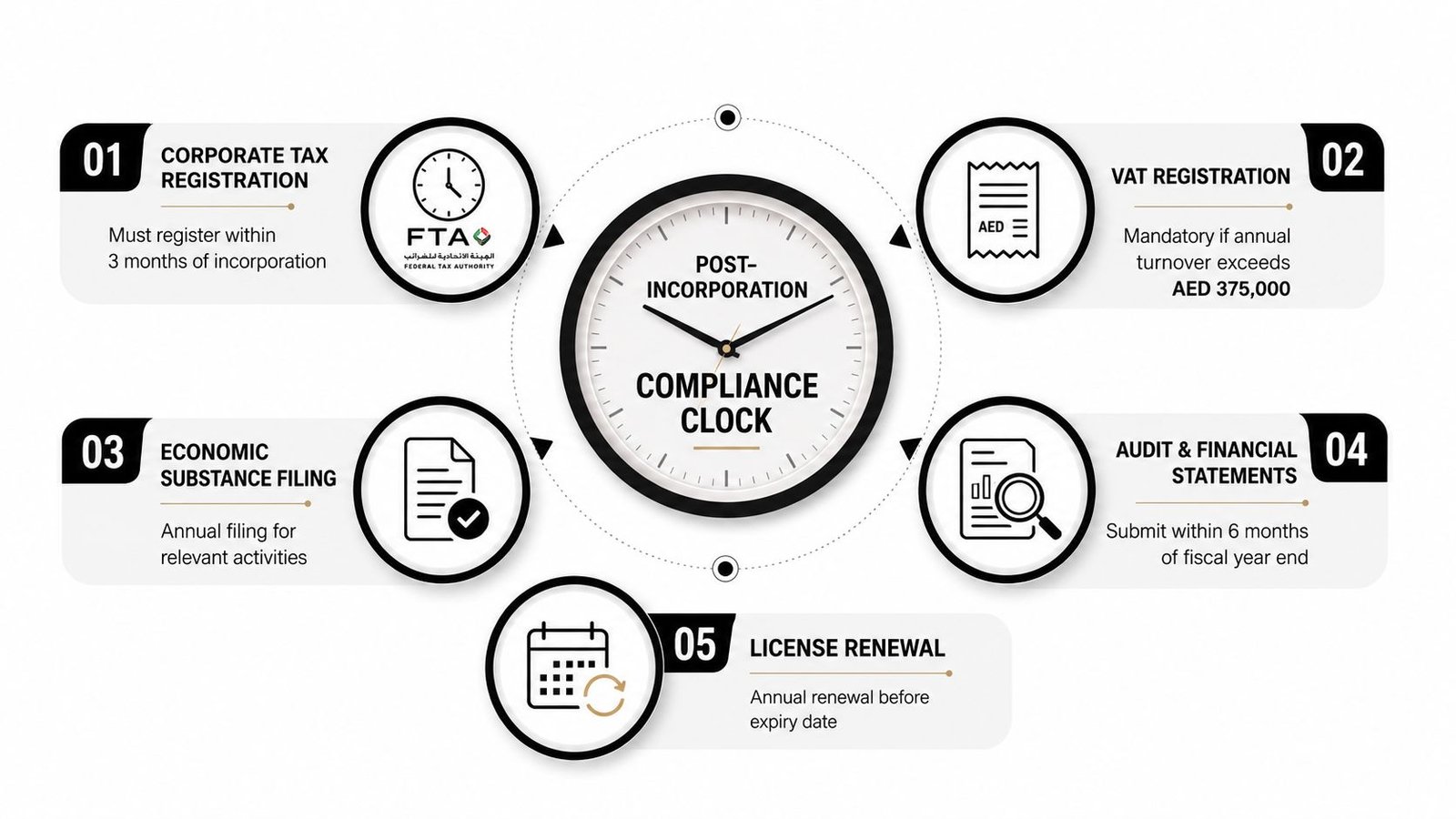
What else belongs on the compliance calendar?
- Accounting records: Keep organised books that support tax returns and management decisions.
- Economic Substance Regulations: Assess whether the company performs a relevant activity and whether notification or reporting applies.
- Ultimate Beneficial Owner filing: Maintain accurate ownership information and submit required declarations through the relevant channel.
- Financial statements: Check whether the authority, lender, free zone, or company structure requires an audit.
- Licence renewal: Track the expiry date and renew before the company's licence lapses.
Common Pitfalls, Final Checklist, and Next Steps
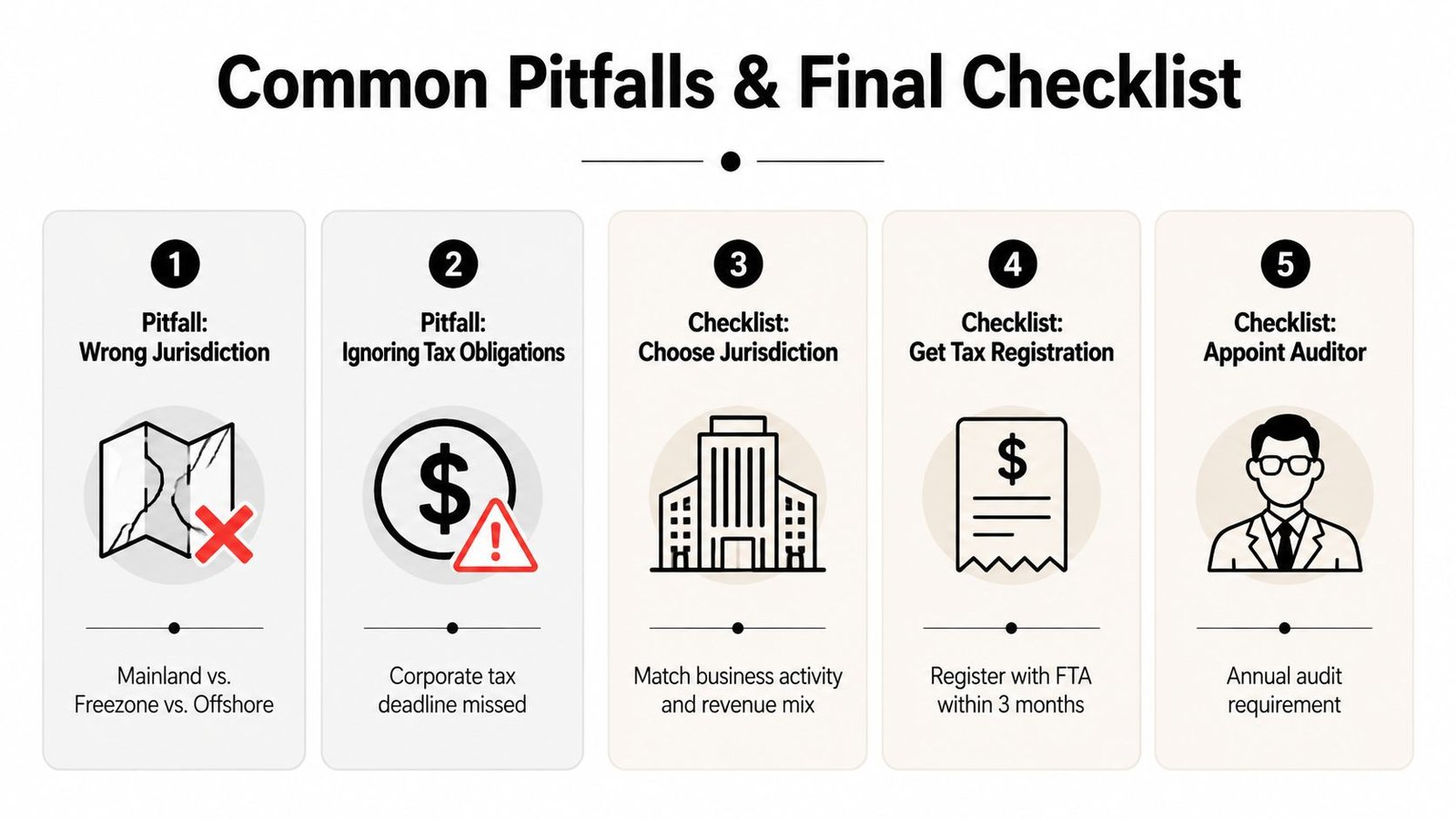
Most registration problems are caused by decisions made too early, not by complicated government forms. Founders choose a jurisdiction based on a promotional package, describe the activity too narrowly, or assume the licence itself covers tax, immigration, employment, and banking.
Which mistakes create avoidable delays?
- Wrong jurisdiction: A free zone package may not support the mainland contracts or visa volume you need.
- Missed corporate-tax registration: The EmaraTax deadline begins after incorporation, not after your first sale.
- Unconfirmed visa quota: Office and package rules can limit the number of employees you sponsor.
- Premature banking plans: Banks need a coherent business profile and ownership trail, not just a licence certificate.
- Ignored ownership filings: Economic Substance Regulations and Ultimate Beneficial Owner requirements need an active review.
Use this checklist before launch:
- Choose the structure: Match mainland, free zone, offshore, or a hybrid arrangement to the revenue mix.
- Confirm the activity: Check whether external approvals apply.
- Reserve the trade name: Keep alternative names ready.
- Apply for the licence: Submit the correct ownership and premises documents.
- Sign the constitutional documents: Complete the Memorandum of Association and Articles of Association requirements.
- Open the immigration file: Obtain the establishment card and labour file where applicable.
- Process visas: Complete entry, medical fitness, and Emirates ID steps.
- Prepare bank KYC: Organise the lease, utility evidence, business plan, contracts, and source-of-funds records.
- Register for tax: Complete corporate-tax registration and assess VAT eligibility.
- Set the renewal calendar: Track licence, tax, accounting, ownership, and filing deadlines.
What do founders still ask?
Is minimum share capital always required?
The answer depends on the legal form, activity, authority, and constitutional documents. Don't assume a generic online statement applies to a regulated or specialised business. Ask the licensing authority what must be stated and paid for your exact structure.
Can I use a virtual office?
Some free zones offer flexi-desk or shared-office packages, while mainland activities may require premises that meet local rules. A virtual arrangement may also affect visa capacity and bank due diligence, so confirm both before choosing it.
How long does a UAE licence remain valid?
Licence validity depends on the authority and licence type. Check the expiry date shown by the issuing authority and start renewal work before it passes.
What should I do if a visa is rejected?
Ask the immigration or PRO team for the specific rejection reason, then correct the missing document, status issue, medical result, or sponsor information before reapplying. Don't submit repeated applications without fixing the underlying issue.
Inpro Corporate Services L.L.C. helps founders compare UAE mainland, free zone, and offshore structures, prepare licensing and attestation documents, manage PRO and visa applications, and organise tax and VAT registration after incorporation. Visit Inpro Corporate Services L.L.C. to request a free consultation and receive a setup plan matched to your activity, revenue mix, visa needs, and launch timeline.