

You're comparing a UAE mainland licence with a free zone licence, trying to work out where you can sell, how much tax you'll pay, how many visas you can support, and whether a bank will take you seriously. The direct answer is simple: mainland gives you unrestricted access to the UAE market, while a free zone gives you a zone-based structure designed mainly for international, export, holding, and specialised activities.
Table of Contents
- The Short Answer Before the Long One
- What Mainland and Free Zone Mean in the UAE
- Side-by-Side Comparison: Ownership, Market Access, and Compliance
- Tax, VAT, and the Real Cost of the Free Zone 0% Rate
- Visas, PRO, Office, and Banking on Both Sides
- Setup Costs, Timelines, and the Fees Nobody Quotes Upfront
- Which Jurisdiction Fits Your Business and What to Do Next
The Short Answer Before the Long One
A founder choosing between mainland and free zone should start with the revenue path, not the licence brochure. A mainland company can sell directly across the UAE, serve consumers and local businesses, open physical outlets, and bid for government work. A free zone company operates through its zone and international channels unless it reaches the UAE market through an approved route, such as a distributor, branch licence, or temporary permit.
The old rule that “free zone is always cheaper” no longer holds. Federal Decree-Law No. 26 of 2020 removed the mandatory 51% local ownership requirement for most commercial and industrial mainland activities. Federal Decree-Law No. 32 of 2021 consolidated that position, effective from 2 January 2022. Foreign founders can now own mainland companies across far more activities, while strategic activities may still carry separate conditions.
Choose the jurisdiction around how money will come in during the first two years.
- Choose mainland when UAE customers will generate a material share of revenue, particularly through retail premises, recurring local sales, client-site work, or public-sector contracts.
- Choose a free zone when revenue comes mainly from outside the UAE, including SaaS, exports, investment holding, or specialised activities managed through zone-based administration.
- Plan a two-entity structure when a free zone holding or regional operation must sit alongside a mainland trading or service business.
That mixed model needs careful tax planning. A free zone company may have access to a 0% corporate tax treatment only for qualifying income and subject to the relevant conditions, including substance. A second-year shift toward UAE customers can change the required route, documentation, and tax result. Small incidental mainland revenue may be treated differently from a sustained local trading operation, so founders should model the de minimis threshold before choosing a structure.
The practical comparison is ownership, market access, permitted activities, qualifying income, substance, VAT, visas, offices, banking, setup costs, and the route for adding mainland activity later.
What Mainland and Free Zone Mean in the UAE
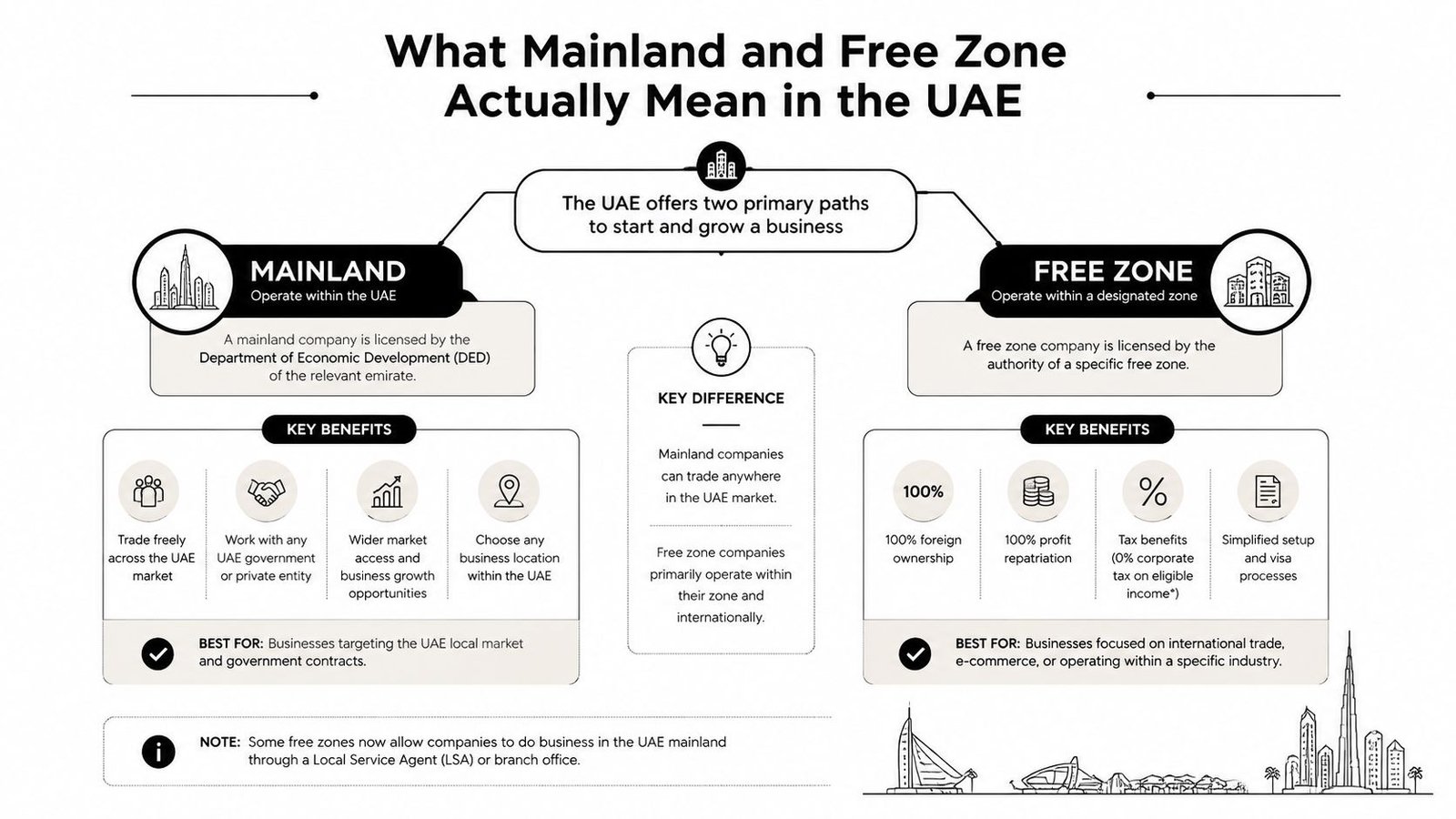
Mainland is the onshore UAE jurisdiction regulated by the economic authority of the relevant emirate. In Dubai, that authority is the Department of Economy and Tourism. Abu Dhabi, Sharjah, and the other emirates have their own economic departments and licensing processes. A mainland company is not limited to one district or economic zone. Its licence generally allows it to contract with customers across the UAE, subject to activity-specific approvals.
A free zone is a designated economic area governed by its own authority. The UAE has many free zones, each with its own activity list, office options, visa rules, and commercial incentives. Examples include Dubai Multi Commodities Centre, known as DMCC, Jebel Ali Free Zone, known as JAFZA, Ras Al Khaimah Economic Zone, known as RAKEZ, Abu Dhabi Global Market, known as ADGM, and Masdar City.
Free zones were established to attract foreign investment into specific industries and locations. Depending on the zone, a company may access dedicated warehouses, ports, laboratories, media facilities, financial regulation, or technology infrastructure. The free zone authority usually manages licensing, office arrangements, establishment documents, and immigration applications through a concentrated process.
The trade-off is clear. A free zone company gets a defined regulatory and administrative environment, while access to the wider UAE mainland market remains regulated. International sales and zone-based operations are usually straightforward. UAE mainland work may require a branch licence, temporary permit, distributor, or another approved route, depending on the activity and circumstances. The practical conditions for free zone mainland operations are discussed in this 2026 UAE market-access analysis.
Founders should test the structure against year-two revenue, not only the launch plan. A free zone company serving overseas customers can later add UAE clients, but the route depends on the activity, the scale of local revenue, applicable de minimis treatment, and whether the company maintains the required substance. That can mean adding a mainland entity, securing an approved permit, or separating qualifying and non-qualifying activities. A small incidental local transaction is not the same planning problem as sustained UAE trading.
What makes ADGM and DIFC different?
ADGM and the Dubai International Financial Centre, known as DIFC, are financial free zones with their own commercial regulators and legal systems. They use a common-law framework rather than operating as ordinary mainland jurisdictions. That makes them specialist choices for financial services, funds, fintech, wealth management, and related professional activities, not default substitutes for a normal Dubai mainland licence.
Side-by-Side Comparison: Ownership, Market Access, and Compliance
A founder selling mainly inside the UAE should start with mainland. A company serving overseas customers, operating regionally, or building a specialised holding structure may fit a free zone better. The ownership headline rarely decides the outcome now. Since the UAE reforms consolidated in 2021, 100% foreign ownership is available for most mainland activities, while free zones generally provide full foreign ownership under their own regulations.
The practical decision is the route your company will use to invoice customers in year two. A free zone company can begin with international revenue and later add UAE clients, but the correct route depends on the activity, local revenue pattern, approved permits, and substance requirements. Sustained onshore trading may justify a mainland entity or branch. A limited incidental transaction is a different compliance question.
| Criterion | Mainland | Free Zone |
|---|---|---|
| Foreign ownership | 100% foreign ownership is allowed for most activities, subject to activity-specific rules. | 100% foreign ownership is generally available under the zone's regulations. |
| Market access | Can contract directly with customers across the UAE and bid for government work. | Usually operates inside the zone or internationally. Mainland sales may require a distributor, branch, permit, or another approved route. |
| Permitted activities | Broad activity options, including many retail, commercial, contracting, and professional services. | Activity lists are set by the individual zone and may reflect its sector focus. |
| Licensing authority | Issued by the economic authority of the emirate, such as Dubai's DET. | Issued by the selected free zone authority. |
| Licensing process | Can involve trade name approval, initial approval, constitutional documents, tenancy registration, and municipal or sector approvals. | Often uses a zone single-window process with standardised documents and bundled services. |
| Office requirement | Most activities need a physical workspace with a registered tenancy, commonly recorded through Ejari in Dubai. | Flexi-desks, shared offices, and virtual office arrangements may be accepted, depending on the zone and visa needs. |
| Government contracts | Eligible to bid for UAE public-sector work, subject to tender requirements. | Access is limited unless the company establishes an approved mainland presence or meets the contracting authority's conditions. |
| Visa capacity | Usually linked to the approved premises and activity, with mainland routes for investor and employee visas. | Often tied closely to the facility type and office package selected by the zone. |
| Tax position | Generally subject to 0% corporate tax up to AED 375,000 of taxable income and 9% above that. See the UAE mainland and free zone tax comparison. | A Qualifying Free Zone Person can receive 0% on qualifying income, while non-qualifying income is taxed at 9%. |
| Substance expectation | Must meet ordinary licensing, accounting, tax, and operational obligations. | Must maintain adequate UAE substance and satisfy the Qualifying Free Zone Person conditions to preserve the 0% treatment. |
| Best fit | UAE-facing services, retail, restaurants, contracting, local distribution, and government work. | Export, international consulting, SaaS, holding, regional operations, and businesses that do not need unrestricted onshore sales. |
The office choice affects more than rent. A mainland workspace can support client meetings, employee visas, inspections, and banking evidence. A free zone flexi-desk reduces the initial commitment, but it may not support the visa capacity, substance, or client-facing presence required as the company grows.
ADGM and the Dubai International Financial Centre, known as DIFC, require separate consideration. They are financial free zones with their own commercial regulators and legal systems, using a common-law framework rather than operating as ordinary mainland jurisdictions. Choose them for financial services, funds, fintech, wealth management, and related professional activities. They are not default substitutes for a standard Dubai mainland licence.
Practical rule: Choose the jurisdiction based on the invoice you expect to issue most often in year two, not the package you can buy fastest in week one.
The embedded video gives a visual explanation of the licence and market-access differences.
Tax, VAT, and the Real Cost of the Free Zone 0% Rate
The UAE corporate tax question isn't “free zone or mainland, which one has no tax?” The useful question is which income qualifies, what evidence supports the position, and what happens if your revenue mix changes.
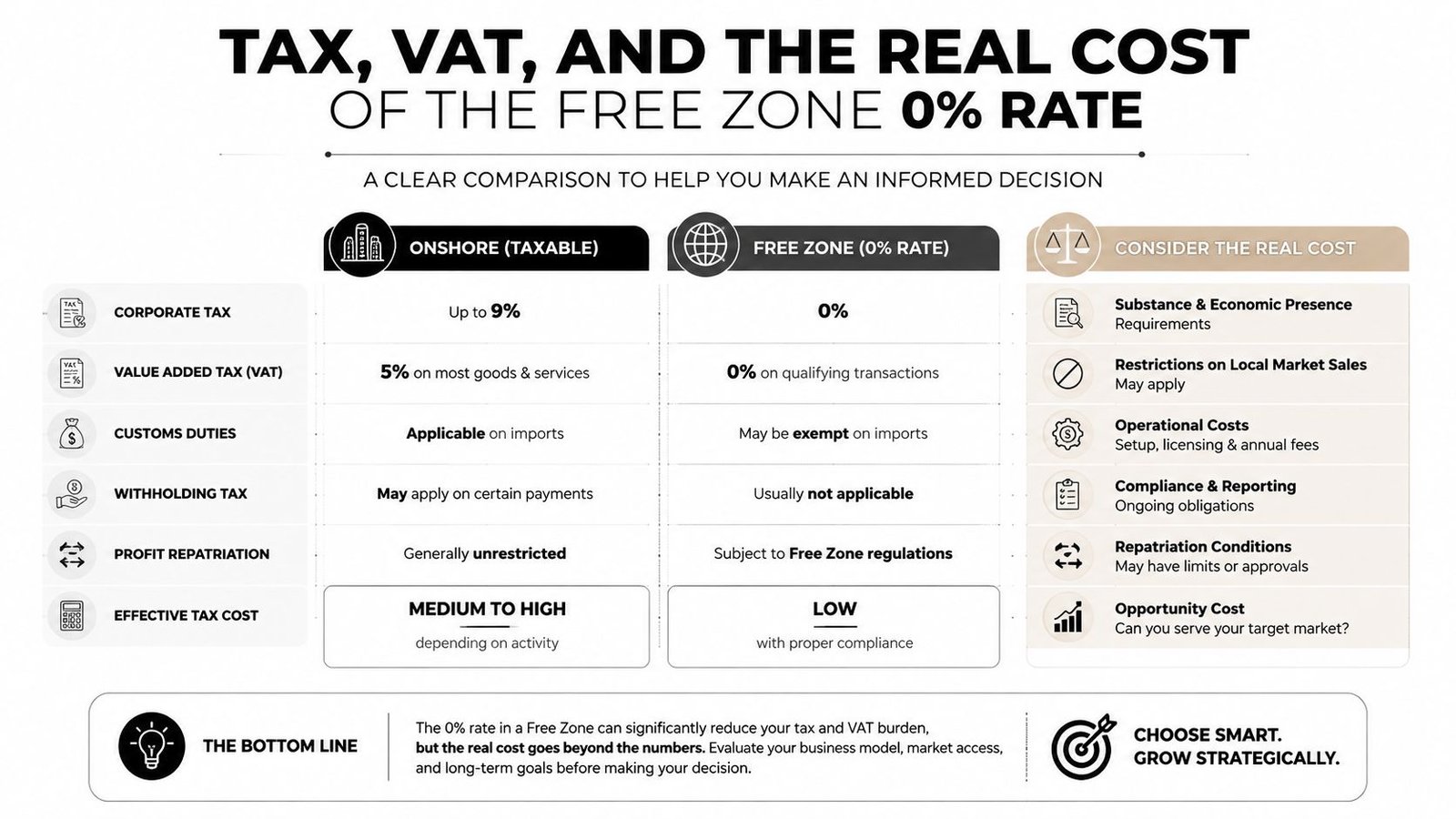
A mainland entity generally pays 0% corporate tax on taxable profits up to AED 375,000 and 9% on taxable profits above AED 375,000. A free zone company may qualify as a Qualifying Free Zone Person, or QFZP, and receive 0% on qualifying income. The 0% rate isn't automatic. The company must meet the applicable conditions, including adequate substance in the UAE, required records and compliance, and the de minimis test. The Federal Tax Authority's free zone bulletin explains the qualifying-income framework.
How does the de minimis test affect mixed revenue?
The de minimis threshold is the lower of 5% of total revenue or AED 5 million. If non-qualifying revenue breaches that limit, the company can lose QFZP treatment for five tax periods, according to the guidance on maintaining the free zone 0% corporate tax position.
That creates a common year-two problem. A software company may start with overseas subscriptions and qualifying regional services, then add UAE customers, implementation work, local distribution, or a mainland-facing service line. The company can still have a free zone licence, but the tax treatment of each revenue stream must be reviewed. A free zone licence doesn't turn every invoice into qualifying income.
What does a AED 2 million services business need to model?
Assume a services company earns AED 2 million in taxable profit, rather than revenue. A mainland company would generally apply the 9% rate to the amount above AED 375,000, producing a corporate tax charge of AED 146,250 under the standard banding described in this mainland versus free zone tax explanation. A free zone company could receive 0% on qualifying income if it meets the QFZP conditions, but it could face 9% on non-qualifying income and risk losing the status if it fails the relevant requirements.
This example isn't a promise that one structure will always cost less. Audit work, accounting, office substance, transfer-pricing records, tax registration, and compliance support can reduce the difference between the headline rates. VAT is separate. VAT registration becomes mandatory at AED 375,000 of taxable supplies and voluntary at AED 187,500, so a growing business should monitor its rolling position and keep invoices and records organised.
Free zone companies also need to examine where services are performed, who receives them, where customers sit, and whether related-party transactions require transfer-pricing support. A founder who sells to the mainland should model tax leakage before selecting a low-cost free zone package.
Visas, PRO, Office, and Banking on Both Sides
A founder may secure the licence quickly, then lose time on the establishment card, visa files, premises evidence, or bank questions about actual business activity. The jurisdiction affects each step after incorporation.
An establishment card is the immigration file that lets a company sponsor residence applications. It is separate from the trade licence. Once active, the usual visa process covers entry or status change, medical fitness testing, Emirates ID application, and residence completion. A PRO, or Public Relations Officer, handles government submissions involving immigration, labour, document attestation, and employee visa workflows.
Mainland companies generally use investor or partner routes for owners, with employee sponsorship handled through labour and immigration authorities. Free zone companies work through the zone's visa quota, facility category, and immigration process. A flexi-desk can fit a solo consultant, but it may restrict team growth and provide weak evidence of the operating substance expected of a QFZP. If your year-two plan includes mainland sales, warehousing, local staff, or several revenue streams, choose the office and visa structure for that plan, not only for launch.
| Requirement | Mainland | Free Zone |
|---|---|---|
| Establishment card | Opened through the relevant emirate and immigration channels after licensing. | Opened through the free zone authority and linked to its immigration process. |
| Investor visa | Available through the company structure and approved activity, subject to government conditions. | Available through the zone, with quotas linked to the selected facility and package. |
| Employee visas | Usually tied to premises, activity, and immigration approvals. | Often tied directly to office size, facility type, and zone quota. |
| Office evidence | Most activities need a physical commercial premises and registered tenancy. | Flexi-desk, shared office, warehouse, or dedicated office options depend on the zone. |
| PRO workflow | Includes labour, immigration, tenancy, municipal, and sector-related submissions. | Usually concentrated through the zone, immigration, and any relevant federal channels. |
| Golden Visa support | The company structure can support an application, but eligibility depends on the applicant's route and evidence. | The same principle applies. A free zone licence alone doesn't guarantee Golden Visa approval. |
| Banking file | Banks usually expect the licence, premises evidence, ownership documents, business model, and transaction explanation. | Banks may request additional evidence about the zone, substance, customers, contracts, and expected activity. |
Why does banking feel different?
Banks make independent decisions, so a licence does not guarantee an account. Mainland companies can be easier for a bank to assess when they show direct onshore market access and a conventional commercial footprint. A free zone company can also present a strong file, provided its activity, shareholders, contracts, customers, and financial projections align.
Banking can take four to eight weeks for many applications, and some banks still require a personal visit, as reflected in this UAE mainland and free zone banking comparison. Incorporation is only the start of the banking work. Prepare a concise business profile, customer contracts, source-of-funds evidence, expected transaction flows, and a clear explanation of why the selected jurisdiction matches the business.
Your revenue mix matters. A consultant serving free zone clients, mainland customers, and overseas buyers may need different contracts, invoices, and evidence for each route. Review where services are delivered, who receives them, and whether the company has the staff, premises, assets, and expenditure that support its tax position. A QFZP structure requires substance and qualifying treatment, so a cheap desk should not drive the decision.
A shared desk can satisfy a licensing package. It does not automatically prove that your company has the people, assets, activity, and expenditure needed for its tax position.
Setup Costs, Timelines, and the Fees Nobody Quotes Upfront
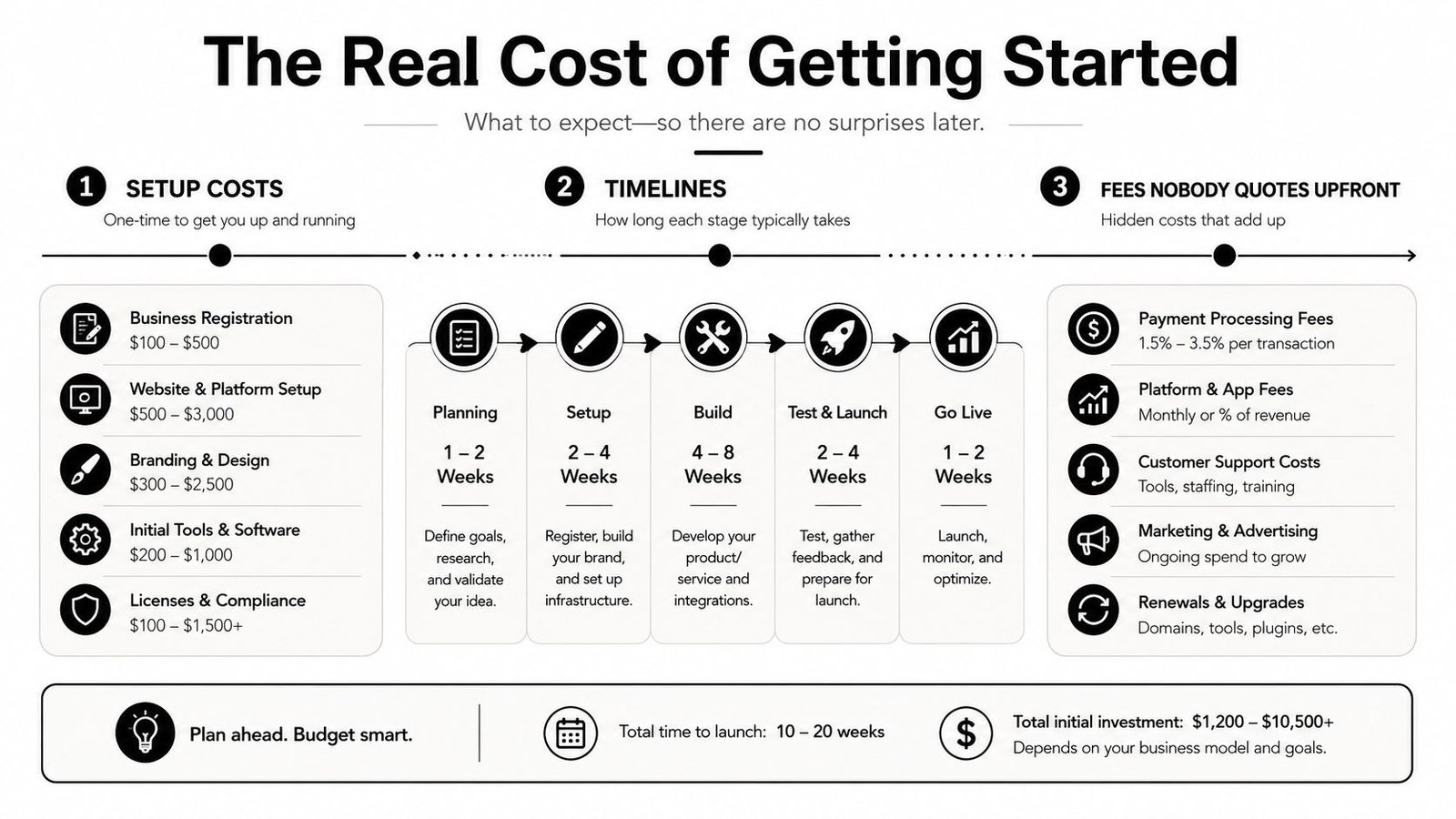
A founder can receive a low free zone quote, then discover that visas, office requirements, tax work, and renewals change the first-year total. Mainland setup through an emirate-level economic authority typically falls around AED 15,000 to AED 35,000, covering items such as trade name registration, initial approval, the Memorandum of Association, and Ejari registration, according to this UAE company setup cost comparison. The bill rises if the activity requires a No Objection Certificate, document attestation, municipal approval, external PRO work, or larger premises.
Free zone packages can start from AED 5,750 in lower-cost options such as IFZA or SPC and exceed AED 50,000 for a DMCC or JAFZA structure with office space. These are starting points, not comparable totals. Check whether the quote includes the licence, establishment card, visa allocation, medical processing, Emirates ID, office, immigration charges, tax registration, accounting, and renewal. A useful visual breakdown appears in this UAE mainland and free zone licensing comparison.
Budget for the items commonly left outside the headline price:
- Immigration costs: Medical testing, Emirates ID, visa stamping, status changes, and establishment-card charges may be separate.
- Premises renewals: A virtual office or flexi-desk may renew separately and may not support future visa requirements.
- Document work: Overseas shareholders can add attestation, translation, notarisation, and powers of attorney.
- Professional support: PRO, tax, accounting, and bank-account assistance may be quoted separately.
- Activity changes: A regulated or operational activity can require new approvals, premises, or amended licence charges.
Free zone incorporation can often finish within 3 to 7 working days. Mainland setup commonly takes 2 to 4 weeks, since Ejari, notarisation, municipal approvals, and the emirate's economic authority may be involved, according to the licensing comparison above. Banking follows its own timetable, so build a two-year budget. Include renewals, additional visas, office upgrades, accounting, tax filing, and compliance. If revenue later comes from both mainland and free zone customers, review contracts, delivery location, de minimis thresholds, qualifying income, and substance before choosing the cheapest package.
Which Jurisdiction Fits Your Business and What to Do Next
The best answer to “what is difference between mainland and freezone UAE” depends on where the customer sits, how the company earns revenue, and what the team must do physically. Use the following recommendations as a starting point, then confirm the activity and tax treatment before paying a licence fee.
| Founder Profile | Recommended Setup | Why It Works |
|---|---|---|
| UAE-resident founder targeting local government and retail contracts | Mainland licence, often through the relevant emirate's economic authority. Add a free zone branch or holding structure only when there is a clear reason. | Direct UAE market access, eligibility for public-sector work, physical outlets, and straightforward local contracting. |
| Expat founder serving regional B2B clients | A reputable free zone matched to the sector. Add a mainland branch or approved route after local revenue justifies it. | Keeps the initial structure focused on regional operations while preserving a planned route into onshore work. |
| Pure export or e-commerce operator | Free zone. | The business can keep its administration and logistics within a designated zone while serving customers outside the UAE. |
| Regulated professional services or financial activity | Mainland or a designated specialist free zone such as DIFC or ADGM, depending on the regulator. | The activity may require a specific regulator, legal framework, premises, or approval that a general-purpose zone can't provide. |
| Capital-heavy regional headquarters | Free zone holding or regional entity alongside an operating mainland company. | Separates holding and regional functions from UAE-facing operations, while giving the operating company direct local access. |
Before selecting a jurisdiction, complete five checks:
- Confirm the activity classification. A “consultancy” can mean different things to different authorities, and regulated services may need extra approval.
- Project the tax position. Separate UAE mainland revenue, overseas revenue, qualifying income, non-qualifying income, related-party transactions, and expected taxable profit.
- Choose the office model. Decide whether you need a registered commercial office, flexi-desk, shared workspace, warehouse, or premises that supports a larger visa quota.
- Shortlist two suitable zones. Compare their activity list, banking familiarity, visa capacity, office rules, renewal charges, and mainland access route.
- Obtain pre-approval advice. Confirm the branch, distributor, permit, or regulated-activity route before signing a lease or purchasing a package.
A free zone isn't automatically the leaner choice, and mainland isn't automatically the more expensive one. The right structure is the one that lets your company invoice the right customers, sponsor the right people, maintain the right evidence, and grow without rebuilding its legal setup halfway through the business plan.
Inpro Corporate Services L.L.C. helps founders compare mainland, free zone, and offshore options, manage licensing, PRO and visa workflows, and prepare corporate tax, VAT, accounting, and bank-account files. Visit Inpro Corporate Services L.L.C. to discuss your activity, customer mix, office needs, and the setup route that fits your next stage.