


Offshore company formation in the UAE means incorporating a non-resident holding entity through a licensed registry such as JAFZA Offshore, RAK ICC, or Ajman Offshore. It cannot trade inside the UAE, so it isn't a substitute for a Dubai, Abu Dhabi, Sharjah, or other UAE trade licence.
You may be considering it after hearing that offshore is simpler, private, or tax-efficient. The question in 2026 is more practical: will the structure support your ownership plan, banking needs, reporting duties, and future growth? If you need employees, local customers, premises, or UAE residency visas, offshore is usually the wrong starting point. If you need a company to hold shares, intellectual property, foreign assets, or international contracts, it may fit.
Table of Contents
- Offshore Company Formation in the UAE
- How Offshore Structures Evolved in the Emirates
- How an Offshore Company Actually Works
- Offshore vs Free Zone vs Mainland Compared
- The Formation Process From Name to Bank Account
- Compliance, Red Flags, and Banking Reality
- When Offshore Is the Right Choice
- Choosing Your Path With Inpro
Offshore Company Formation in the UAE
What is offshore company formation?
Offshore company formation is the incorporation of a non-resident legal entity under a UAE offshore registry. Common UAE choices include JAFZA Offshore, RAK ICC, and Ajman Offshore, each operating separately from mainland licensing authorities and ordinary free zone licensing systems. The entity receives a Certificate of Incorporation, not a conventional trade licence, as explained in this UAE offshore formation guide.
That distinction controls what the company can do. An offshore company can hold shares in another company, own intellectual property, sign international contracts, hold assets, and invoice customers outside the UAE. It cannot open a shop in Dubai, provide local services to UAE customers, lease ordinary commercial premises, or employ staff through a UAE labour file.
A mainland company is licensed by the relevant Department of Economy and Tourism or economic department. A free zone company receives permission to conduct defined activities through its chosen free zone. An offshore entity belongs to a separate legal framework and is generally administered through a licensed registered agent, who submits incorporation documents, conducts Know Your Customer checks, and maintains compliance records.
What does offshore mean for owners?
The owners, directors, and Ultimate Beneficial Owners, or UBOs, are disclosed to the registry and agent. A UBO is the natural person who ultimately owns or controls the company, even where ownership passes through several corporate layers. The register isn't a promise of secrecy from banks, regulators, or competent authorities.
Practical rule: Treat offshore as a holding and structuring tool, not as a UAE operating licence.
The structure can be useful above an operating business. For example, an offshore parent may own a UAE free zone subsidiary, while the subsidiary signs local contracts, rents premises, hires employees, and sponsors visas. The offshore company remains outside the day-to-day UAE trading activity.
If your immediate goal is to relocate, obtain an employee visa, sponsor family members, or serve UAE customers, start by assessing a free zone or mainland licence. Offshore formation may be added later if your ownership or asset structure gives it a genuine purpose.
How Offshore Structures Evolved in the Emirates
When did offshore formation begin in the UAE?
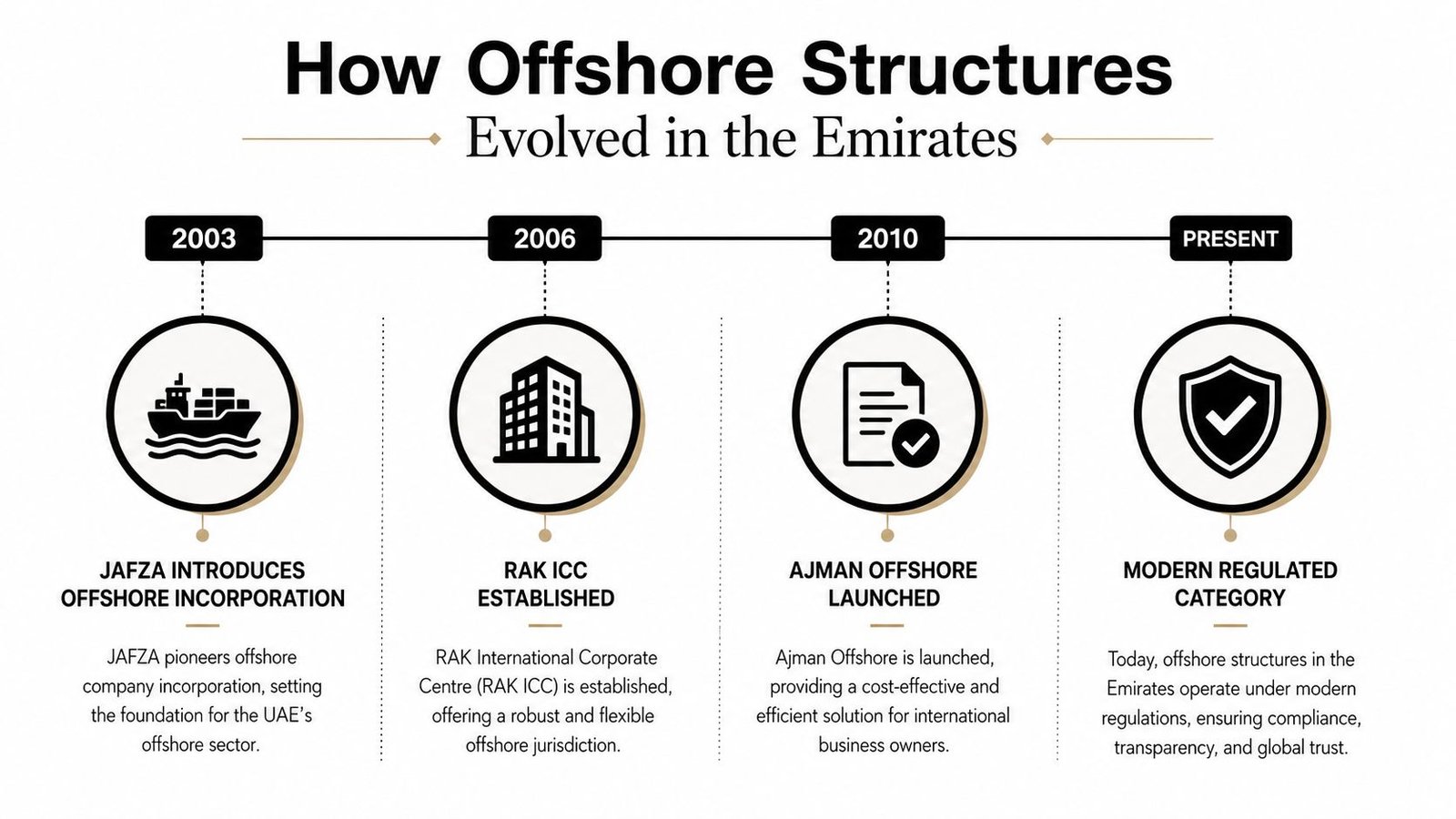
The UAE's offshore framework is relatively recent. JAFZA introduced Dubai's first offshore company regime in 2003 under the Jebel Ali Free Zone Offshore Companies Regulations 2003. JAFZA itself was established in 1985, so offshore incorporation was a later legal layer built on the UAE's free zone infrastructure, not an original feature of JAFZA, as set out in the historical overview of UAE offshore structures.
Ras Al Khaimah launched its international company structure in 2006, and Ajman followed in 2014. That progression gave founders, investors, and family offices more than one registry to assess, but it also created differences in forms, agents, document standards, and practical acceptance by banks.
Why did compliance change the product?
The compliance environment moved offshore away from the old privacy-and-tax marketing pitch. Economic Substance Regulations were issued through Cabinet Resolution No. 31 of 2019 on 30 April 2019, effective from that date, according to the Lexology explanation of the UAE Economic Substance Regulations.
The effect was practical. A company with relevant activities could no longer be assessed only as a convenient incorporation vehicle. Founders and holding companies had to consider whether the structure had the required connection between its activities, management, records, and the UAE.
UAE beneficial ownership rules now make ownership reporting a central obligation. Independent coverage states that almost all UAE entities, including offshore structures, must maintain a beneficial ownership register, identify owners at the 25% threshold, and report changes within 15 days. The same 2025 coverage of UAE beneficial ownership rules explains that false UBO reporting can create criminal exposure under the newer anti-money-laundering framework.
Modern offshore formation is therefore a regulated category for legitimate holding, asset, and cross-border structures. It isn't a legal route for concealing the person who controls the funds.
How an Offshore Company Actually Works
Who administers the company?
The registry issues the Certificate of Incorporation after approving the application. The registered agent acts as the formal liaison with the registry, collects certified identification, checks the ownership chain, submits filings, and maintains the company's compliance file.
Shareholders may be individuals, companies, or a combination of both. Directors and shareholders can sometimes be the same person, subject to the chosen registry's rules and approval. The company also declares its share capital at incorporation, but that declaration doesn't turn the entity into an operating business with permission to trade in the United Arab Emirates.
JAFZA states that its offshore structure permits 100% foreign ownership, with no local shareholding requirement. It can have one or more shareholders, with no maximum shareholder cap, and shareholders may be individuals, companies, or a mixture, as described on JAFZA's company formation page.
What can the company do?
The legal purpose should be written around the actual structure. Common functions include holding shares in UAE mainland or free zone companies, owning trademarks and other intellectual property, holding overseas property, maintaining foreign bank accounts, and invoicing international clients where the activity is permitted and commercially credible.
The company may also support intercompany ownership and treasury arrangements. Those arrangements need written agreements, clear accounting, and evidence showing why money moves between the parties.
What can't it do?
JAFZA's earlier offshore regulations prohibited direct commercial activity in the UAE, ordinary UAE property leases outside designated freehold areas, and banking, insurance, or other regulated financial services. The rules also recognised specific exceptions, including holding meetings in the UAE, owning property in designated freehold areas, owning shares in UAE operating companies, and opening UAE bank accounts, as described in the legal commentary on JAFZA offshore restrictions.
| Activity | Allowed for Offshore Entity |
|---|---|
| Hold shares in a UAE operating company | Generally permitted, subject to registry and legal requirements |
| Own trademarks or intellectual property | Permitted where properly documented |
| Sign international contracts | Permitted for genuine cross-border activity |
| Trade directly inside the UAE | Not permitted as a default |
| Rent ordinary UAE commercial premises | Generally not permitted |
| Employ staff through a UAE labour file | Not available as an offshore function |
| Sponsor UAE residency visas | Not available merely through offshore ownership |
| Open a UAE bank account | Possible, but subject to bank approval and evidence |
| Conduct banking, insurance, or regulated financial services | Restricted and requires separate authorisation |
The UBO register now sits at the centre of this process. Keep identity documents, shareholder registers, ownership charts, resolutions, and source-of-funds evidence consistent. A later bank review will test the same information that the registered agent collected at incorporation.
Offshore vs Free Zone vs Mainland Compared
Which UAE structure matches the business?
Choose based on the activity, not the promotional headline. The UAE passed 1.4 million active companies by the end of 2025 and added roughly 250,000 new businesses during 2025, while Dubai Chamber membership grew by 71,830 new companies in 2025 to 292,486, according to UAE company formation market data. That demand doesn't make offshore the default. It makes the initial classification more important.
An offshore entity suits ownership and cross-border holding. A free zone licence suits a business operating within a defined free zone framework, with foreign ownership and a route to premises and visas subject to the licence and facility. Mainland is the normal route for unrestricted UAE commercial activity, local premises, and broader market access.
| Criterion | Offshore | Free Zone | Mainland |
|---|---|---|---|
| Main purpose | Holding, assets, international structuring | Trading or services within the free zone framework | Direct UAE commercial activity |
| Foreign ownership | Available, including JAFZA's stated 100% foreign ownership | Generally available, subject to activity and authority rules | Full foreign ownership is available for most activities under modern UAE reforms, subject to exceptions |
| Trade inside the UAE | Not permitted as a default | Depends on activity, approvals, and distribution arrangements | Designed for UAE market activity |
| Office footprint | Usually no ordinary UAE commercial office | Facility requirements depend on the free zone and licence | Premises and tenancy requirements depend on activity and authority |
| UAE employee visas | Not available through the offshore entity | Available subject to facility and authority limits | Available subject to establishment and labour requirements |
| Local bank account | Possible, but evidence-heavy | More realistic where activity and substance are clear | More realistic where local operations are clear |
| Ownership role | Parent, asset holder, or international contracting entity | Operating company or regional platform | UAE-facing operating company |
| Growth headroom | Limited for UAE operations | Good for structured expansion | Broadest UAE operating access |
Corporate tax needs a separate review. Don't assume that an offshore label removes UAE tax, foreign tax, reporting, or Economic Substance questions. Tax treatment depends on the company's activities, income, management, ownership, and the laws of every country connected to the structure.
If customers, staff, premises, and revenue are mainly in the UAE, start with an operating licence. Add offshore ownership only when the ownership plan justifies it.
The Formation Process From Name to Bank Account
What happens first?
Start by selecting the registry, not by choosing the cheapest package. JAFZA Offshore, RAK ICC, and Ajman Offshore each have different processes and practical expectations. A registered agent should first check the proposed activity, owners, directors, UBO chain, intended assets, and likely bank profile.
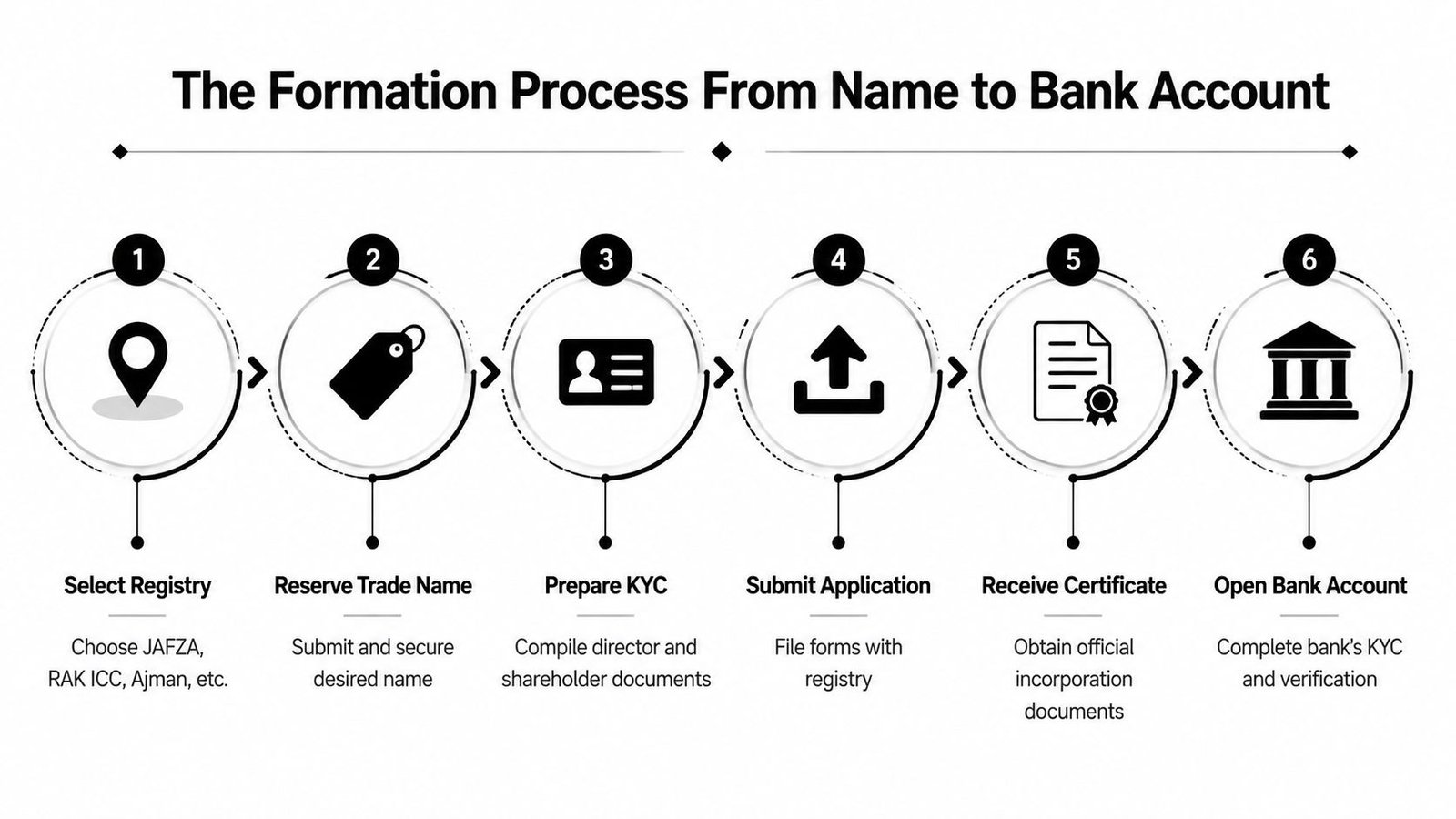
The working sequence is usually:
- Select the registry: Match the jurisdiction to the ownership and holding purpose.
- Reserve the name: Submit proposed names and confirm that the wording is acceptable.
- Prepare KYC: Collect certified passport copies, proof of address, source-of-funds information, UBO details, and corporate documents where a shareholder is another company.
- Draft governing documents: Prepare the memorandum, articles, shareholder information, and director details.
- Submit and pay: The registered agent files the application and separates registry charges from professional fees.
- Receive the certificate: The registry issues the Certificate of Incorporation after approval.
- Apply for banking: Present the incorporation file, ownership chart, business explanation, contracts or invoices where available, and source-of-funds evidence.
The paperwork is formal even when the entity won't rent an office. A JAFZA document list includes an information form, three proposed names, a short note on the intended activity, passport copies, banker references, utility bills, CVs, and, for UAE residents, a No Objection Letter from a local partner or employer, according to the JAFZA incorporation document list.
Where do delays occur?
The incorporation stage can be relatively quick when documents are current, consistent, and correctly certified. Banking takes longer because the bank assesses the commercial reason for the structure, the ownership chain, expected transactions, countries involved, and source of funds.
Documents may require notarisation, attestation, or apostille depending on their origin and the registry's instructions. Expired passports, old address evidence, inconsistent company names, missing ownership links, and unexplained nominee arrangements commonly force the agent to restart questions.
Compliance, Red Flags, and Banking Reality
Is offshore still private?
It may offer a separate legal structure, but it isn't a secrecy product. The registry and registered agent must identify the UBO, understand the ownership chain, and retain documents that support the company's stated purpose. Banks and authorities can request information when the law permits or requires it.
The UAE's Economic Substance Regulations made activity and management relevant for companies with covered activities. UBO reporting, anti-money-laundering controls, and international tax transparency have added more checks around ownership and transactions. The practical standard is simple: the documents must tell one consistent story.
What causes banking problems?
Banks often question offshore companies that have no clear commercial reason, no credible business plan, or no evidence supporting expected activity. Prepare answers before incorporation:
- Hidden principals: A nominee arrangement that doesn't identify the controller creates a serious UBO issue.
- Round-tripping: Money moving through connected companies without commercial contracts or invoices can look artificial.
- Unclear source of funds: Personal or corporate wealth must be supported with appropriate records.
- High-risk corridors: Payments involving higher-risk jurisdictions may trigger enhanced review.
- Weak governance: Missing resolutions, unclear authority, or inconsistent director information damages confidence.
- Thin substance: A holding chain that claims meaningful management activity but has no records, decisions, or supporting evidence may fail review.
Banking reality: A Certificate of Incorporation proves that the entity exists. It doesn't prove that a bank should accept its transactions.
The 2023 revisions to JAFZA's offshore regulations add another layer. Later commentary says business activity in the UAE may be possible only where the JAFZA Registrar permits it and the relevant competent authorities license or authorise it, as discussed in the updated JAFZA regulatory commentary. Never rely on the word “offshore” alone. Check the planned activity, approval route, and regulated-sector requirements before signing contracts.
When Offshore Is the Right Choice
Does a holding company need an operating licence?
Not always. A founder may set up a UAE free zone company to employ a product team and serve customers, then place ownership of that operating company under an offshore parent. The operating company handles local licensing, premises, staff, and visas. The parent holds the shares and manages the ownership relationship.
An intellectual property structure can follow the same pattern. The offshore entity owns a software trademark or other intellectual property, while an operating company receives a licence to use it under a written agreement. Royalty payments must be commercially supported, properly recorded, and reviewed for tax and transfer-pricing consequences.
Which scenarios fit?
| Scenario | Best Structure | Why |
|---|---|---|
| Parent company owns a UAE free zone subsidiary | Offshore parent with a free zone operating company | Separates ownership from local trading and employment |
| Software group owns trademarks and licences them internationally | Offshore or another suitable holding structure, with tax advice | Keeps intellectual property ownership distinct from delivery operations |
| Family assets sit across several countries | Offshore holding vehicle, trust, or foundation assessment | Can organise ownership, but does not defeat creditor, tax, inheritance, or disclosure rules |
| Founder invoices overseas customers without UAE operations | Offshore may fit if the activity and banking case are credible | Supports cross-border contracting without pretending to be a UAE storefront |
| Consultancy serves Dubai clients directly | Free zone or mainland | The business needs a UAE operating licence and a local commercial framework |
| Startup needs employees, visas, and a UAE office | Free zone or mainland | Offshore cannot replace the labour, premises, and immigration infrastructure |
The decision test is direct. If the entity must sell, employ, rent, or sponsor visas inside the UAE, choose an operating licence. If it only owns, holds, or invoices across borders, offshore may be the leaner answer.
Don't use offshore for a freelancer who wants to work from Dubai for UAE clients. A freelancer needs an appropriate permit or licence, immigration status, and compliant contracting route. Offshore ownership doesn't create personal work permission or residency.
Choosing Your Path With Inpro
What should happen before incorporation?
Start with a short scoping call that identifies four things: where the customers are, where the work is performed, who needs visas, and what the entity will own. That usually classifies the project as mainland, free zone, or offshore before anyone reserves a name.
For an offshore case, the preparation should cover the proposed registry, activity wording, shareholders, directors, UBO chain, source of funds, expected countries of payment, and whether the structure may fall within Economic Substance requirements. The banking file should be designed at the same time as the incorporation file, not after a rejection.
A practical engagement can include:
- Structure review: Compare offshore, free zone, and mainland against market access, staffing, ownership, and banking needs.
- Document preparation: Organise passports, address evidence, corporate records, ownership charts, and certified documents.
- Registered agent coordination: Submit the application and manage registry correspondence.
- Corporate records: Prepare the memorandum, articles, incorporation documents, shareholder register, and UBO filing.
- Compliance screening: Review Economic Substance relevance and ongoing reporting duties.
- Bank introduction: Present the company to banking contacts familiar with international ownership structures, without promising approval.
JAFZA shareholders must be present in Dubai to execute governing documents unless they provide a duly notarised and attested power of attorney. That requirement can affect travel planning and should be checked before selecting the registry.
Inpro Corporate Services L.L.C. provides UAE mainland, free zone, and offshore formation support, along with document workflows, registered-agent coordination, corporate banking assistance, and continuing compliance support. Ask for a fixed-fee scope with government costs shown separately, then confirm what renewals, UBO updates, and substance reviews will cost after incorporation.
The right structure is the one that still makes sense when the bank, registry, tax adviser, and future investor all ask the same question: why does this company exist?
Inpro Corporate Services L.L.C. can assess whether offshore, free zone, or mainland formation fits your ownership, banking, visa, and UAE market plans. Visit Inpro Corporate Services L.L.C. to request a practical setup review and move from options to a clear formation path.