

The employment visa process for the UAE is an employer-sponsored, sequential workflow that typically takes 2–4 weeks, covering a work permit, entry permit, medical fitness test, Emirates ID enrolment, and residence visa issuance. The entry permit is generally valid for 60 days from issuance, giving the employee time to complete the residence steps.
You may be hiring from overseas, moving a founder into Dubai, or trying to onboard someone already in Abu Dhabi on a visit status. The process can feel like one application, but it isn't. Several authorities, portals, approvals, and handoffs are involved, and a delay in one system can prevent the next step from starting. The practical difference between a smooth application and a stressful one usually comes down to document accuracy, employer readiness, and clear coordination between labour and immigration authorities.
Table of Contents
- Understanding the UAE Employment Visa Framework
- Required Documents and Eligibility Criteria
- The Sequential Application Workflow
- Mainland Versus Free Zone Processing
- Common Rejection Reasons and How to Avoid Them
- Timelines Costs and Final Onboarding Steps
Understanding the UAE Employment Visa Framework
What is the UAE employment visa process?
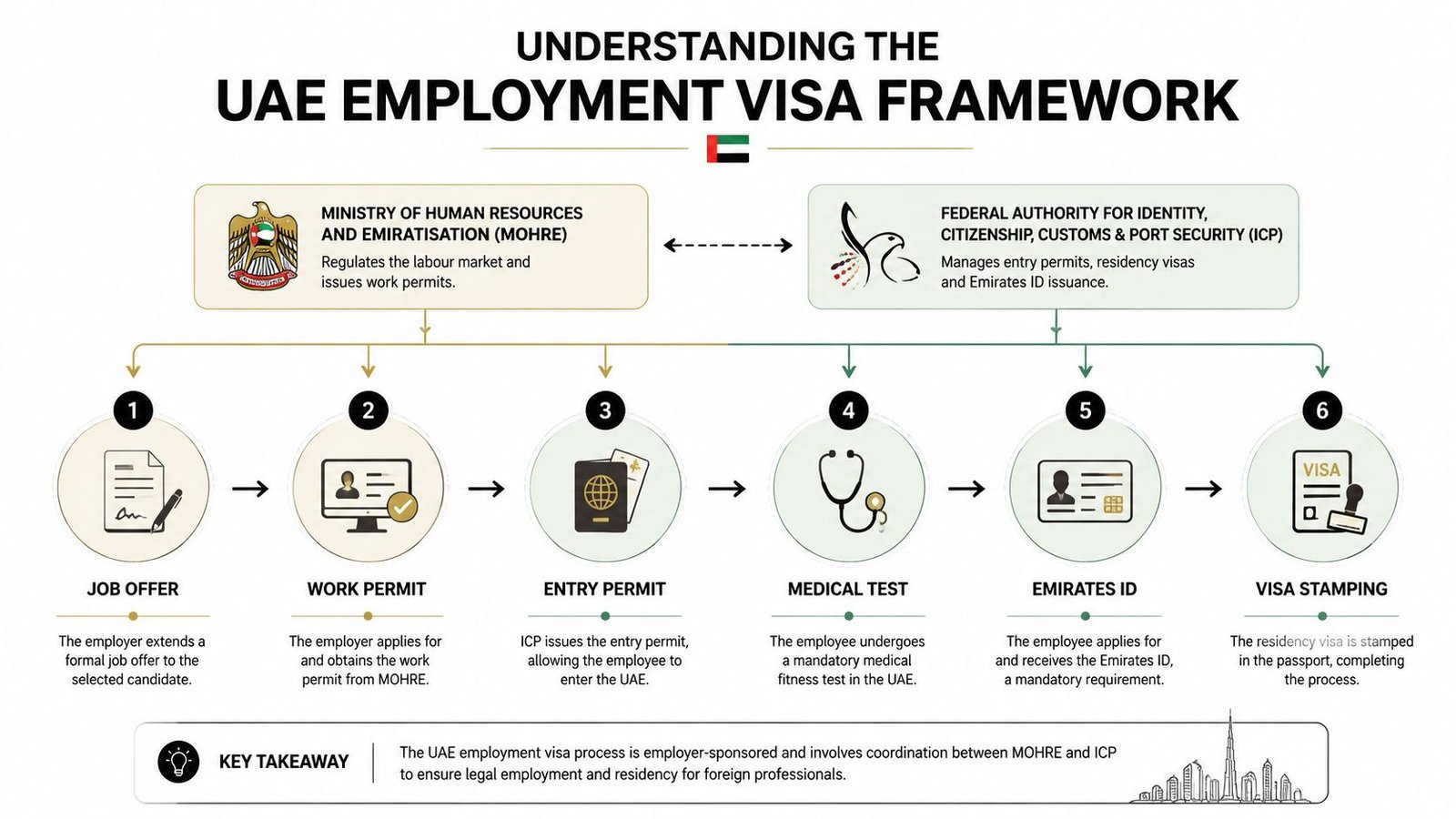
A founder may have an approved offer ready while the employee's residence record remains incomplete. That situation is common because a UAE employment visa is a chain of government approvals, not one document. The employer submits the offer and applies for the work permit through the Ministry of Human Resources and Emiratisation, known as MOHRE. Immigration processing then runs through the Federal Authority for Identity, Citizenship, Customs and Port Security, known as ICP, or the General Directorate of Residency and Foreigners Affairs, known as GDRFA, in Dubai. Employer sponsorship remains the standard basis for private and government-sector employment visas. The UAE employment visa process and employer sponsorship framework
The operational sequence is:
- Employer-approved offer and labour contract.
- MOHRE work permit approval.
- Entry permit issued by ICP or GDRFA.
- Status change inside the UAE, where applicable.
- Medical fitness testing.
- Emirates ID application and biometric enrolment.
- Digital residence issuance.
The employer starts the application, keeps its company records valid, and ensures the employee's status is regularised. A candidate cannot independently apply for a standard employee-sponsored work visa in the same way they might apply for a self-sponsored residence route.
Why do MOHRE and immigration authorities both matter?
MOHRE manages the employment relationship, including the work permit and labour contract. ICP handles federal immigration services outside Dubai, while GDRFA performs the equivalent role in Dubai. The employer therefore coordinates two connected tracks rather than submitting one application to one office. How UAE employee sponsorship is divided between labour and immigration authorities
That division is a direct reason applications stall. MOHRE can approve the employment side while the immigration file still requires an entry permit. An entry permit can also be issued while medical testing, Emirates ID enrolment, or residence issuance remains unfinished. A PRO, or Public Relations Officer, can coordinate these handoffs, but cannot correct an expired passport, an incorrect job classification, or an unresolved previous visa record.
The UAE is also shifting residence documentation towards digital records. Current process descriptions indicate that final residence evidence is increasingly issued digitally, reducing reliance on physical passport stamping and making the Emirates ID the practical proof of residence. Earlier approvals still matter. Digital issuance changes how the completed residence status is recorded and accessed, not the need to complete each preceding authority's requirements.
Practical rule: Treat the application as a chain. Do not schedule onboarding around the work permit alone. Immigration, medical, identity, and residence stages must also be completed.
Required Documents and Eligibility Criteria
What does the employee need to provide?
The employee's passport must generally have at least six months of validity, and the copy must be clear and complete. Depending on the occupation, the file may also require an attested educational certificate, professional evidence, photographs, and information needed for the employment contract. A skilled occupational classification can create additional document expectations, so the proposed job title should be checked before the offer is submitted.
The name on the passport should control the application. Differences between the passport, degree certificate, translated document, and previous UAE records can create a manual review or rejection. Arabic transliteration also matters. A spelling that looks minor to an HR team can be treated as a data mismatch by a government portal.
What must the employer have ready?
The sponsoring company needs an active trade licence, an establishment card, and a valid labour file where applicable. It must also have the capacity to sponsor the proposed employee, including an available quota and a job classification that fits the licensed activity. The offer letter and labour contract should match the approved occupation, salary structure, company details, and passport information.
Digital uploads don't make weak documents acceptable. Blurry scans, incomplete pages, inconsistent dates, and incorrect job codes can still require resubmission through the MOHRE or ICP-related systems.
| Document | Responsible Party | Common Rejection Trigger |
|---|---|---|
| Passport copy | Employee | Less than six months' validity, unclear scan, or data mismatch |
| Passport photograph | Employee | Poor quality, incorrect format, or inconsistent identity details |
| Attested educational certificate | Employee | Name or qualification doesn't align with the occupation |
| Signed offer letter | Employer and employee | Job title, salary, or personal details differ from the submitted file |
| Labour contract | Employer | Incorrect occupational classification or incomplete registration |
| Trade licence | Employer | Expired licence or activity that doesn't support the proposed role |
| Establishment card and labour file | Employer | Incomplete employer records or unavailable sponsorship capacity |
| Previous UAE visa details | Employee and employer | Uncancelled record, overstay, or unpaid fines |
A document checklist should be completed before the first submission, not after a government query. In practice, checking the whole file as one set is more effective than reviewing each document in isolation.
The Sequential Application Workflow
How does the application move from offer to residence?
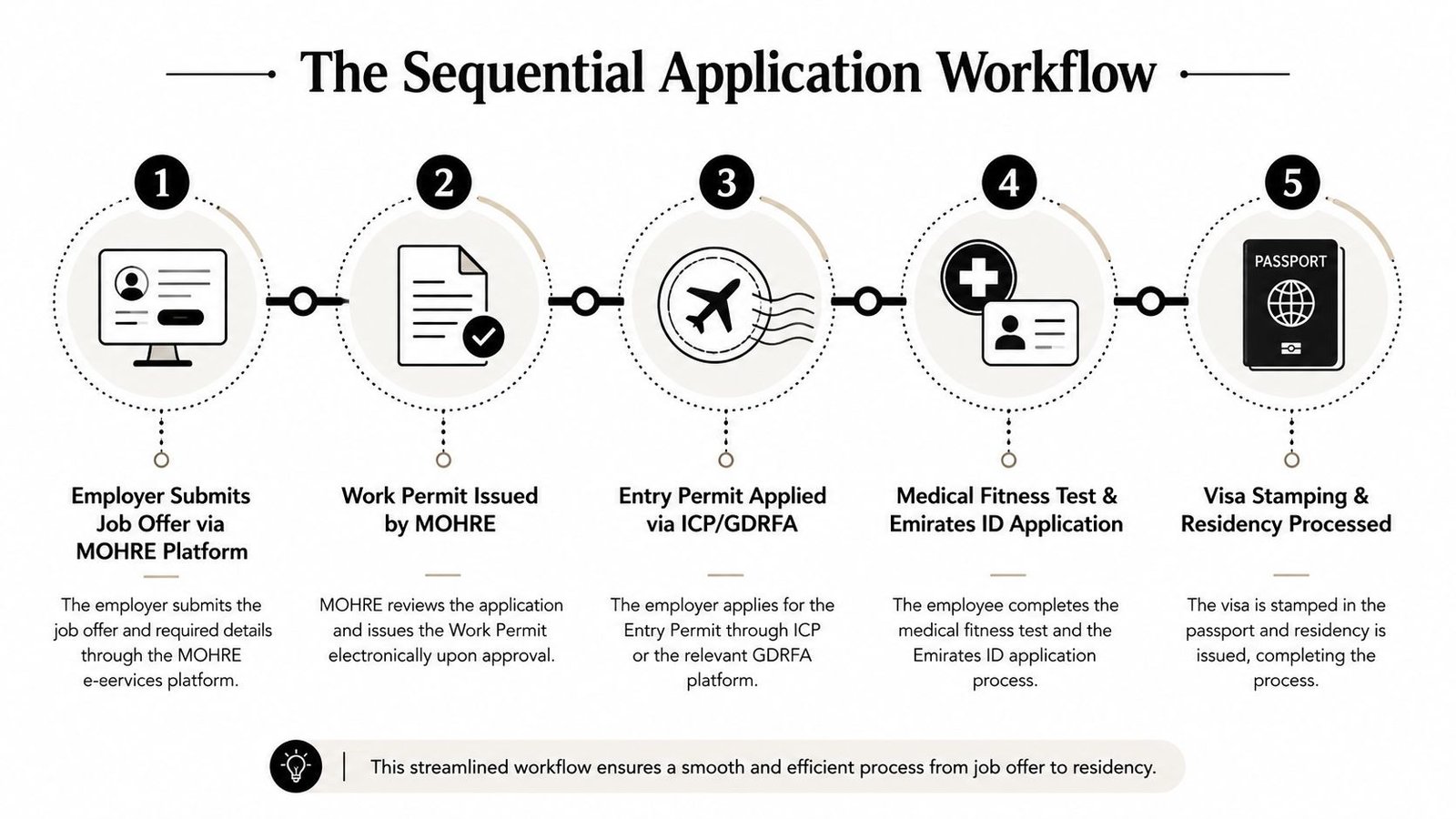
The process starts when the employer prepares the offer and submits the employment information through the MOHRE platform. The work permit is the first formal labour authorisation, so approval confirms that the employer can employ the person in the proposed role. The MoHRE Work Bundle pathway is described as using five steps, five documents, two in-person visits, and a five-working-day target for the core work-permit stage.
That target applies to the core bundled work-permit stage, not necessarily to the complete residence journey. Employers still need to coordinate immigration, medical fitness, biometrics, and residence issuance. Once MOHRE approves the labour side, the employer applies for the entry permit through GDRFA in Dubai or ICP elsewhere in the UAE.
What happens if the employee is outside the UAE?
An employee outside the country normally uses the employment entry permit to enter the UAE and complete the residence formalities. The entry permit is commonly valid for 60 days from issuance, according to current process guidance from Dubai's residency authority. The employer should plan medical and Emirates ID appointments early rather than treating the entry permit as the end of the process.
Can an employee switch status inside the UAE?
In-country status change can be possible for an employee already in the UAE on a tourist or visit status. Whether it is suitable depends on the person's current status, the issuing authority, the employer's route, and the exact application type. The employee shouldn't assume that an exit and re-entry are always required, but shouldn't assume an in-country change is automatic either.
After the entry or status stage, the employee completes a medical fitness test at an approved centre. The employer then arranges Emirates ID enrolment and biometrics. Once the required clearances are complete, the residence record is issued digitally in the current system, rather than depending solely on physical passport stamping.
The workflow is operationally sequential, even where some preparation can happen in parallel. A neutral process benchmark describes the full journey as typically 2–6 weeks, with entry permit issuance taking about 5–10 working days and medical plus biometrics taking 7–14 days. UAE employment visa workflow and timing benchmarks
The practical lesson is simple. HR should track the application by authority and status, not by a single vague label such as “visa in process”. That makes it clear whether the next delay sits with MOHRE, GDRFA or ICP, the medical centre, the employee, or the employer's own documentation.
Mainland Versus Free Zone Processing
How does a Mainland employment visa work?
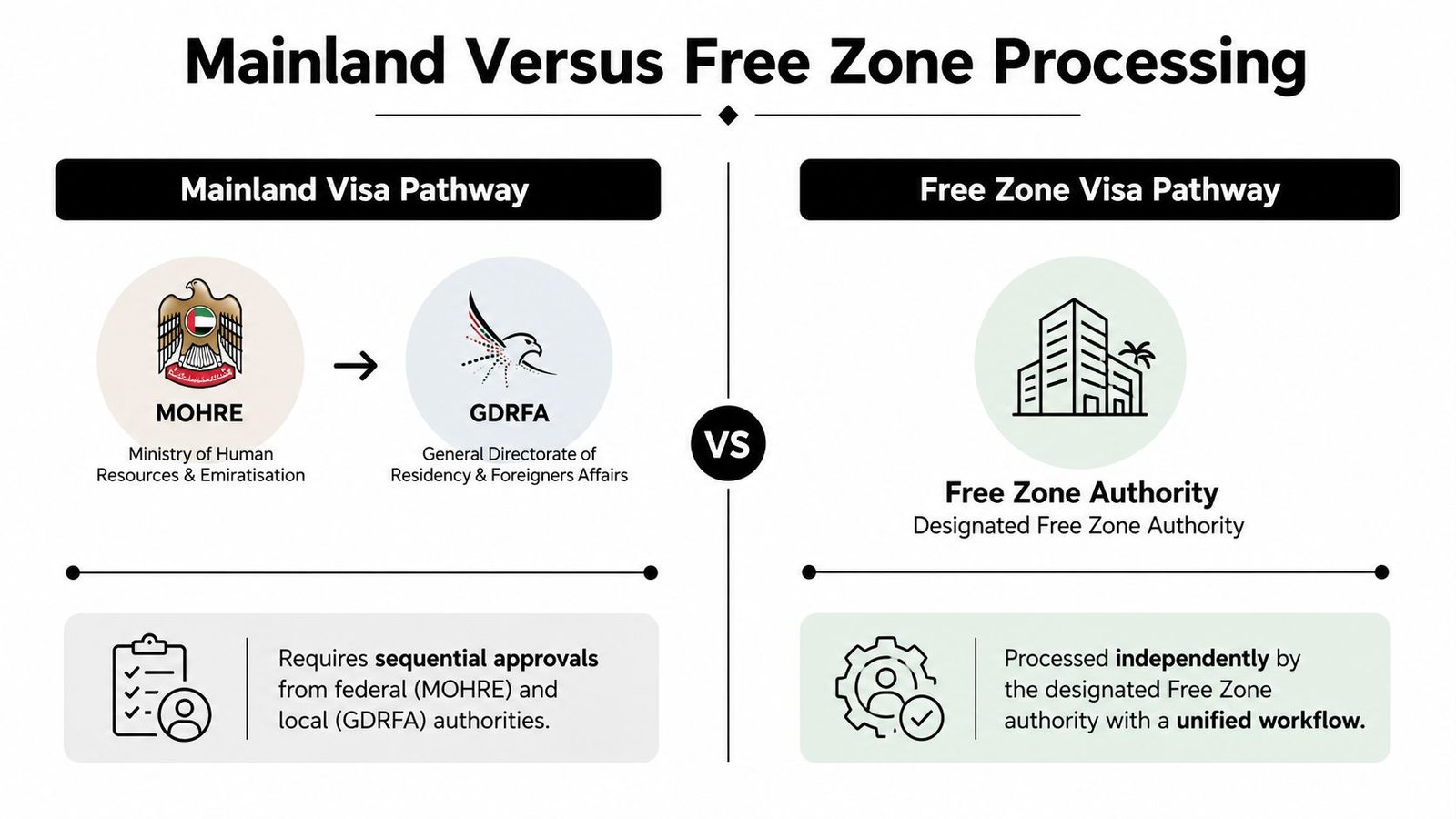
A Mainland company is licensed to operate under the economic department and federal labour framework of the relevant emirate, such as Dubai, Abu Dhabi, or Sharjah. For a current private-sector employee, the usual route involves MOHRE for the work permit and labour contract, followed by GDRFA in Dubai or ICP elsewhere for the entry permit and residence process.
Mainland employers also need to keep their labour file, company licence, employee records, and sponsorship capacity in order. HR teams may face additional compliance considerations linked to Emiratisation and the Wage Protection System, or WPS, which is the regulated salary-payment system used for covered private-sector employees.
How is a Free Zone route different?
A Free Zone is a designated business jurisdiction with its own licensing authority and operating rules. A Free Zone company may deal first with its authority for employment approvals and visa administration, before the residence file is processed through the relevant immigration authority. Examples include Dubai Multi Commodities Centre, known as DMCC, Jebel Ali Free Zone Authority, known as JAFZA, and Dubai Airport Freezone, known as DAFZA.
The Free Zone route can feel more unified because the company works through one dedicated authority portal or service centre for much of the initial process. That doesn't mean every Free Zone follows the same workflow. Each authority has its own portal, document standards, quota rules, service levels, and fee structure.
| Consideration | Mainland | Free Zone |
|---|---|---|
| First employment authority | MOHRE | Relevant Free Zone authority |
| Immigration authority | GDRFA in Dubai or ICP elsewhere | GDRFA or ICP, depending on location |
| Main coordination issue | Labour approval followed by immigration approval | Free Zone approval followed by immigration processing |
| Compliance focus | Labour file, WPS, Emiratisation, quota and activity alignment | Authority-specific quota, portal, documents and package rules |
| Practical fit | Broad local-market operations and flexible staffing structures | Businesses operating within a defined Free Zone framework |
Which route is easier for scaling?
Neither route is automatically faster in every case. A Free Zone can offer a clear internal workflow, but attestation, medical scheduling, or immigration handoffs can still delay the file. Mainland processing can involve more visible authority coordination, yet an experienced HR team or PRO provider can manage that sequence predictably.
Choose based on the company structure, intended market, employee quota, and compliance obligations. Visa convenience alone shouldn't decide where the business is licensed.
Common Rejection Reasons and How to Avoid Them
Why are UAE employment visa applications rejected?
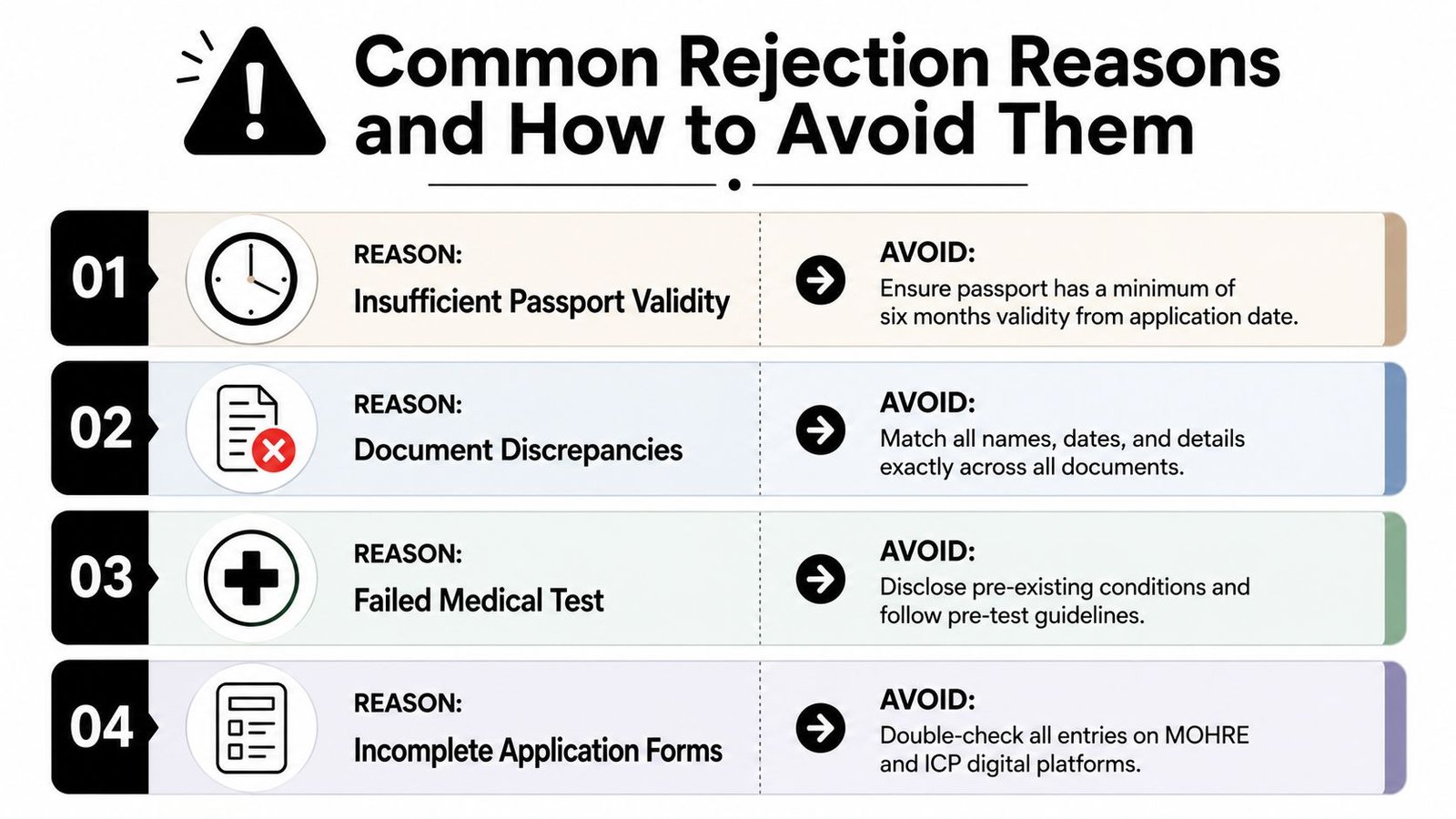
Most problems are administrative rather than mysterious. UAE-focused visa guidance identifies passport-data mismatches, unclear scans, insufficient passport validity, previous overstays or fines, and uncleared UAE visa records as recurring failure points. Employer-side issues can also block approval, including quota restrictions, job-role mismatch, salary inconsistencies, and incomplete company records.
The common assumption is that an approved offer means the visa is safe. It doesn't. The offer is only one part of the file, and the government systems compare information across documents, employer records, and previous immigration history.
Which checks should HR complete before submission?
Start with the passport. Confirm the expiry date, spelling, nationality, date of birth, and passport number against every document and portal entry. If the employee previously held a UAE visa, check that the old record was properly cancelled and that no fines or unresolved status remain.
Next, review the occupation. The proposed job title should make sense for the company's licensed activity and should align with any educational or professional evidence required for that classification. An attested degree with a different name, qualification, or role description can create a mismatch, particularly in regulated or skilled professions.
A short pre-submission review should include:
- Identity matching: Compare names, dates, nationality, and passport numbers across the full file.
- Employer capacity: Confirm the trade licence, establishment card, labour file, and available quota are active.
- Role alignment: Check that the job title, occupational code, salary structure, and qualifications support one another.
- Previous status: Confirm that earlier UAE permits are cancelled and any fines or overstay issues are cleared.
- Medical readiness: Tell the employee what the approved medical centre requires and arrange the appointment promptly.
A rejected application shouldn't be resubmitted unchanged. Identify the exact mismatch, correct the source document or employer record, and then submit a clean version. Repeated submissions with the same error can consume time without changing the result.
Timelines Costs and Final Onboarding Steps
How long does the full process take?
A founder may have an approved hire waiting while the employer record, work permit, medical result, and residence file move through different systems. The 2026 digital residency process reduces paper handling, but it does not remove coordination between MOHRE and GDRFA in Dubai or ICP elsewhere. A delay at one stage can hold the next submission, even when the employee's documents are complete.
The full employment visa process usually takes several weeks. Timing changes with the employer's readiness, the authority route, the employee's existing UAE status, appointment availability, and whether a correction is requested. The Work Bundle's five-working-day target applies to its core work-permit stage, not necessarily to medical clearance, Emirates ID enrolment, or final digital residence issuance. Current UAE employment visa process guidance
Costs vary by route and by what the service provider includes. Government charges, medical testing, Emirates ID processing, document attestation, translation, courier work, status change, and PRO support may appear separately. Compare the full scope, not only the first quotation.
| Component | Mainland | Free Zone |
|---|---|---|
| Work authorisation | MOHRE work permit and labour processing | Free Zone employment approval and authority charges |
| Immigration | GDRFA in Dubai or ICP elsewhere | Relevant GDRFA or ICP route |
| Medical and identity | Medical fitness test and Emirates ID enrolment | Medical fitness test and Emirates ID enrolment |
| Residence record | Digital residence issuance after clearances | Digital residence issuance after clearances |
| Variable extras | Attestation, translation, courier, status change, PRO support | Authority package charges, fast-track options, attestation, translation and PRO support |
What should happen before the employee starts?
Do not assign duties that depend on lawful employment status until the required residence steps are confirmed. HR should then record the Emirates ID details accurately in payroll, benefits, banking, access control, and internal systems.
Use a written onboarding checklist:
- Immigration status: Confirm the residence record is issued and the employee's status is regular.
- Identity records: Add Emirates ID information to approved company systems.
- Payroll setup: Check salary administration and applicable WPS obligations.
- Insurance: Arrange health insurance required for the employee's location and arrangement.
- Document archive: Store the offer, contract, permit, medical result, identity application, and residence record.
Prepare payroll, insurance, equipment, and appointments while authorities process earlier stages. Submit each step only after the relevant MOHRE, GDRFA, or ICP confirmation is available. That separation prevents an internal onboarding decision from outrunning the digital immigration record.
Inpro Corporate Services L.L.C. supports UAE company formation, Mainland and Free Zone licensing, employment visa processing, document attestations, and compliance coordination. For help aligning MOHRE, GDRFA, or ICP requirements for a new hire, visit Inpro Corporate Services L.L.C..