


An ultimate beneficial owner is the natural person who ultimately owns or controls a company in the UAE, and the usual threshold is 25% of shares, voting rights, or effective control. If the bank has asked for UBO paperwork, you're dealing with a normal compliance question, not a mystery.
Your name on the trade licence is not always the name the UAE wants to see. If you've built a holding structure, brought in a nominee, or parked shares in another company, the question is who stands at the end of that chain.
Table of Contents
- What an Ultimate Beneficial Owner Actually Means in the UAE
- How the UAE UBO Framework Took Shape
- Who Qualifies as a UBO Under UAE Rules
- Tracing Ownership Through Layered Structures
- UBO Rules Across Mainland, Free Zone, and Offshore
- Common UBO Mistakes That Stall Bank Accounts and Renewals
- Keeping UBO Records Clean and Getting Banks to Say Yes
What an Ultimate Beneficial Owner Actually Means in the UAE
A practical way to read ultimate beneficial owner is this, the UAE wants the natural person who ultimately owns or controls the business, even if that person sits behind other entities. The common disclosure line is 25% of shares, voting rights, or other effective control, and that applies across most mainland and non-financial free zone entities under the UAE's modern regime formalised in 2020 and updated in 2023 UAE UBO regime overview.
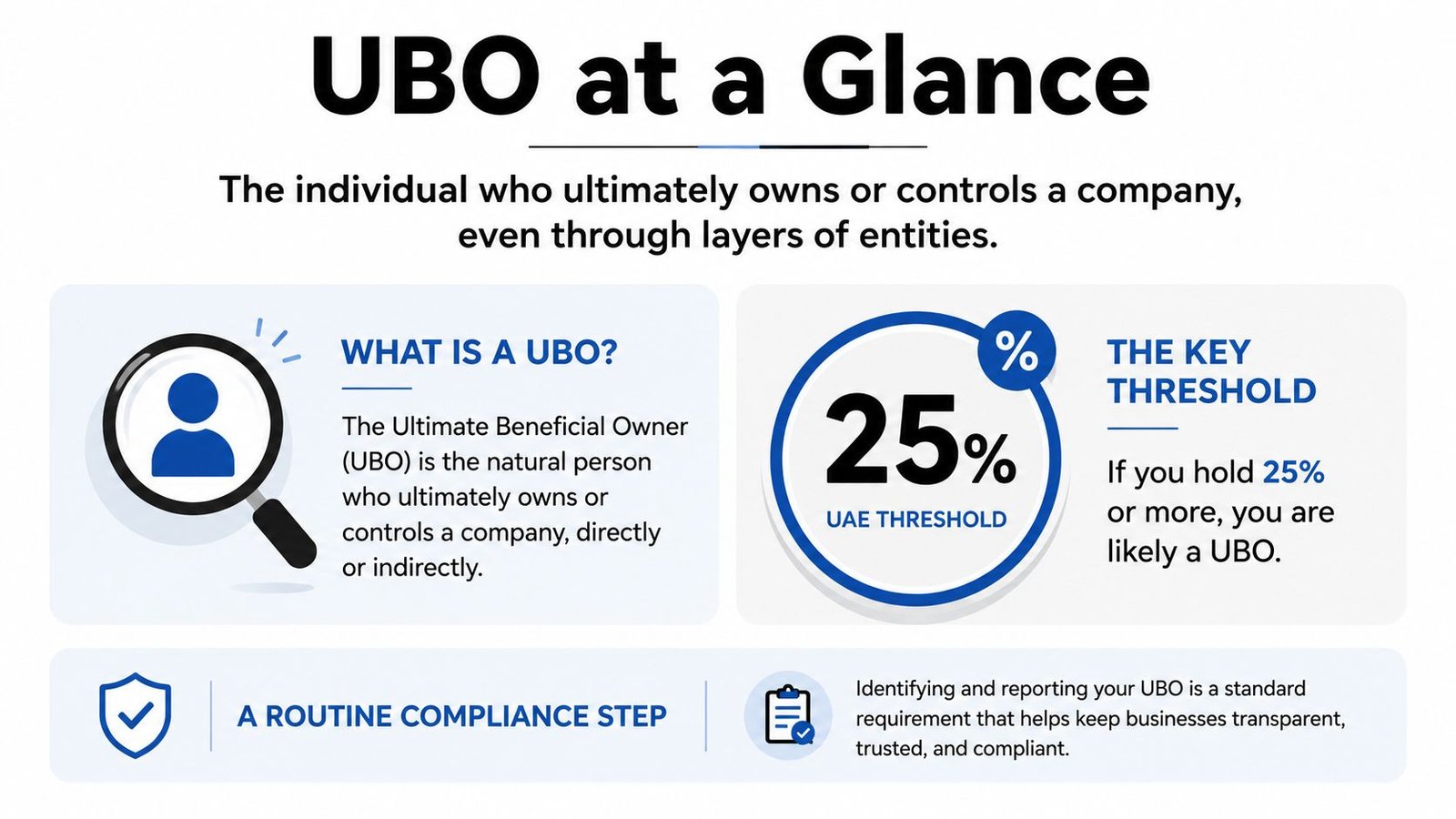
A founder usually meets this issue the moment a bank, licensing team, or compliance officer asks for the UBO file. The bank isn't being awkward, it's checking who really sits behind the share register, because the UAE framework treats ownership transparency as part of normal business maintenance, not a one-off incorporation form Central Bank beneficial owner rulebook.
Practical rule: if someone can own, control, or direct the company through layers, that person needs to be tested against the UBO rules, even when they don't appear on the first page of the register.
The right mental model is simple. The 25% test is the starting line, not the finish line. If no one meets that threshold, the analysis moves to other forms of control, and then to senior management as a fallback, because the UAE wants a natural person at the end of the chain rather than a stack of entities UAE legislation on beneficial ownership.
That matters in Dubai, Abu Dhabi, Sharjah, and free zones alike, because the same person can affect licensing, bank onboarding, and AML/CFT checks at the same time. If your structure is clean, the paperwork is routine. If it isn't, the bank will feel it first.
How the UAE UBO Framework Took Shape
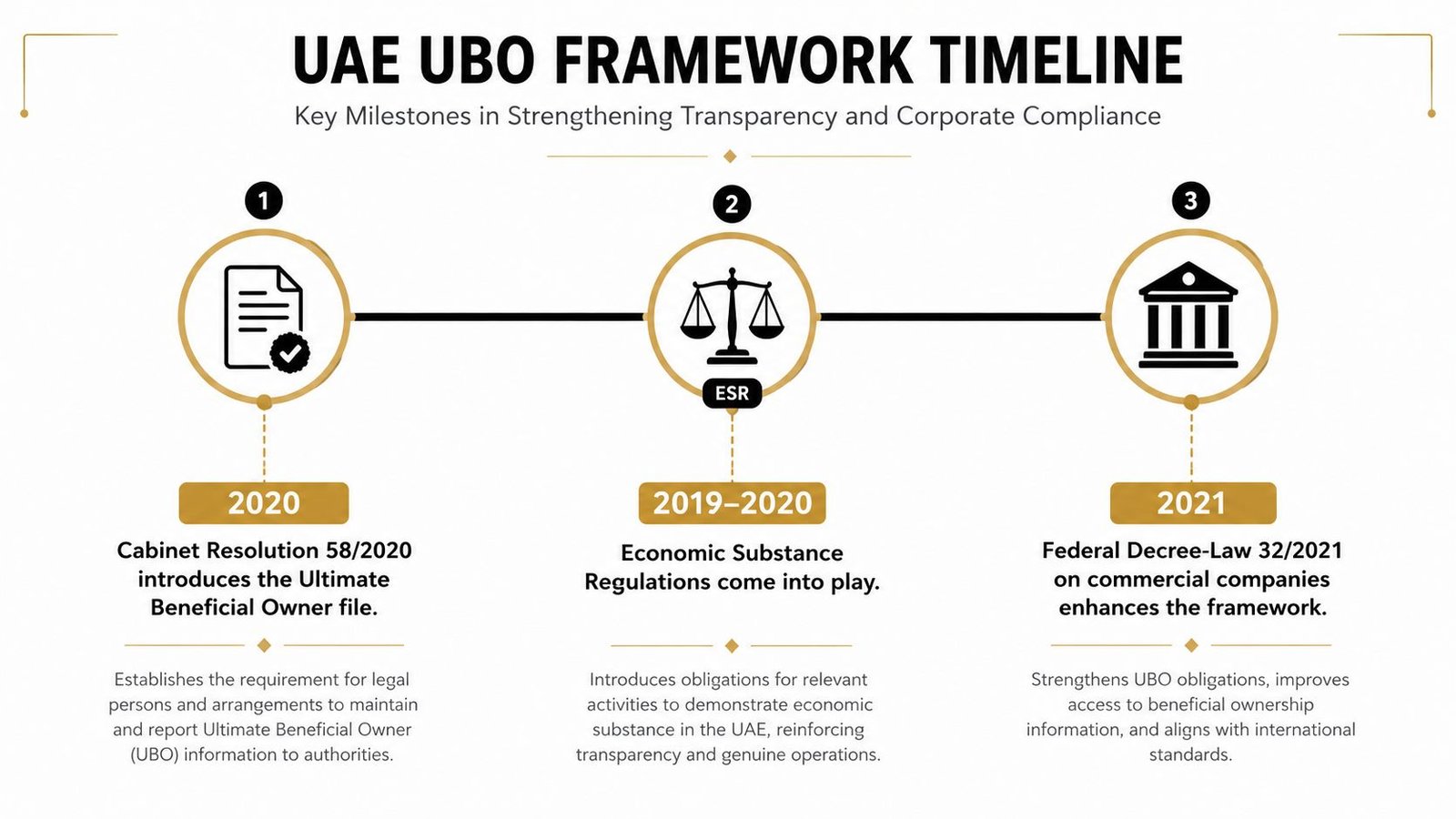
The UAE didn't arrive at today's UBO rules by accident. Cabinet Resolution No. 58 of 2020 created the original filing baseline, took effect on 28 August 2020, and required existing legal persons to submit UBO details by 27 October 2020 UAE UBO regime overview. Later, Cabinet Resolution No. 109 of 2023 came into effect on 16 November 2023, tightening the regime and making ownership transparency a standing compliance expectation rather than a one-time filing exercise UAE UBO regime overview.
The logic behind the framework is visible in the way the UAE speaks about beneficial owners across the regulatory system. The Central Bank requires legal persons to identify beneficial owners and keep them in a Register of Beneficial Owners, and the legal definition tracks the same natural-person test used in the wider regime Central Bank beneficial owner rulebook. That consistency matters, because a founder doesn't want one answer for the licensing office, another for the bank, and a third for a regulator.
The UAE is not asking who holds the paper share certificate. It is asking who can actually own, direct, or benefit from the company.
The 2023 update also made the operating environment stricter in practice for mainland and commercial free zone entities. Companies now need cleaner records, faster updates, and better internal discipline around changes in ownership or control UAE UBO regime overview. That is why the 25% threshold became the default baseline across most operating companies in the United Arab Emirates, even where the entity sits inside a free zone structure.
The larger shift is cultural as much as legal. UBO transparency moved from a new filing requirement into routine corporate housekeeping. If your register, licensing file, and bank KYC pack don't tell the same story, someone will ask for a better version before the account opens or the licence renews.
Who Qualifies as a UBO Under UAE Rules
Who counts under the 25% test
A person qualifies as a UBO if they directly or indirectly own 25% or more of shares or voting rights, or if they can appoint or remove the majority of directors Central Bank beneficial owner rulebook. The test is not limited to the person's name on the latest share certificate, because indirect holdings still count if they lead to the same result.
If one shareholder has 15% and another related interest has 12%, the question is not whether each block looks small on its own. The question is whether the facts together show the same natural person crossing the threshold through separate routes.
What if no one reaches 25%
Then the analysis moves to other means of control, such as veto rights, shareholder agreements, or governance rights that let someone steer the company even without hitting the ownership line UAE legislation on beneficial ownership. If that still doesn't produce a natural person, the rules fall back to senior management.
That fallback exists for a reason. The UAE would rather identify the decision-maker than stop at a formal structure that looks tidy on paper but hides control in practice.
How do nominees and trustees fit in
Nominees, trustees, and corporate officers are treated as intermediaries unless they are the actual natural person with ultimate ownership or control. The framework is designed to look through the wrapper and ask who really benefits, votes, or directs the entity.
| Test | Trigger | Evidence Required |
|---|---|---|
| Direct ownership | 25% or more of shares | Share register, share certificate, ownership chart |
| Voting control | 25% or more of voting rights | Constitutional documents, voting schedule, board papers |
| Indirect ownership | Chain leads to 25% or more | Group structure chart, upstream registers, declarations |
| Other control | Veto rights, appointment rights, shareholder agreement | Signed agreements, board resolution copies |
| Senior management fallback | No natural person meets the earlier tests | Management appointment evidence, internal resolution |
Practical rule: at identification stage, a clean paper trail matters more than a polished explanation. If you can't show the path, you haven't proved the owner.
Tracing Ownership Through Layered Structures
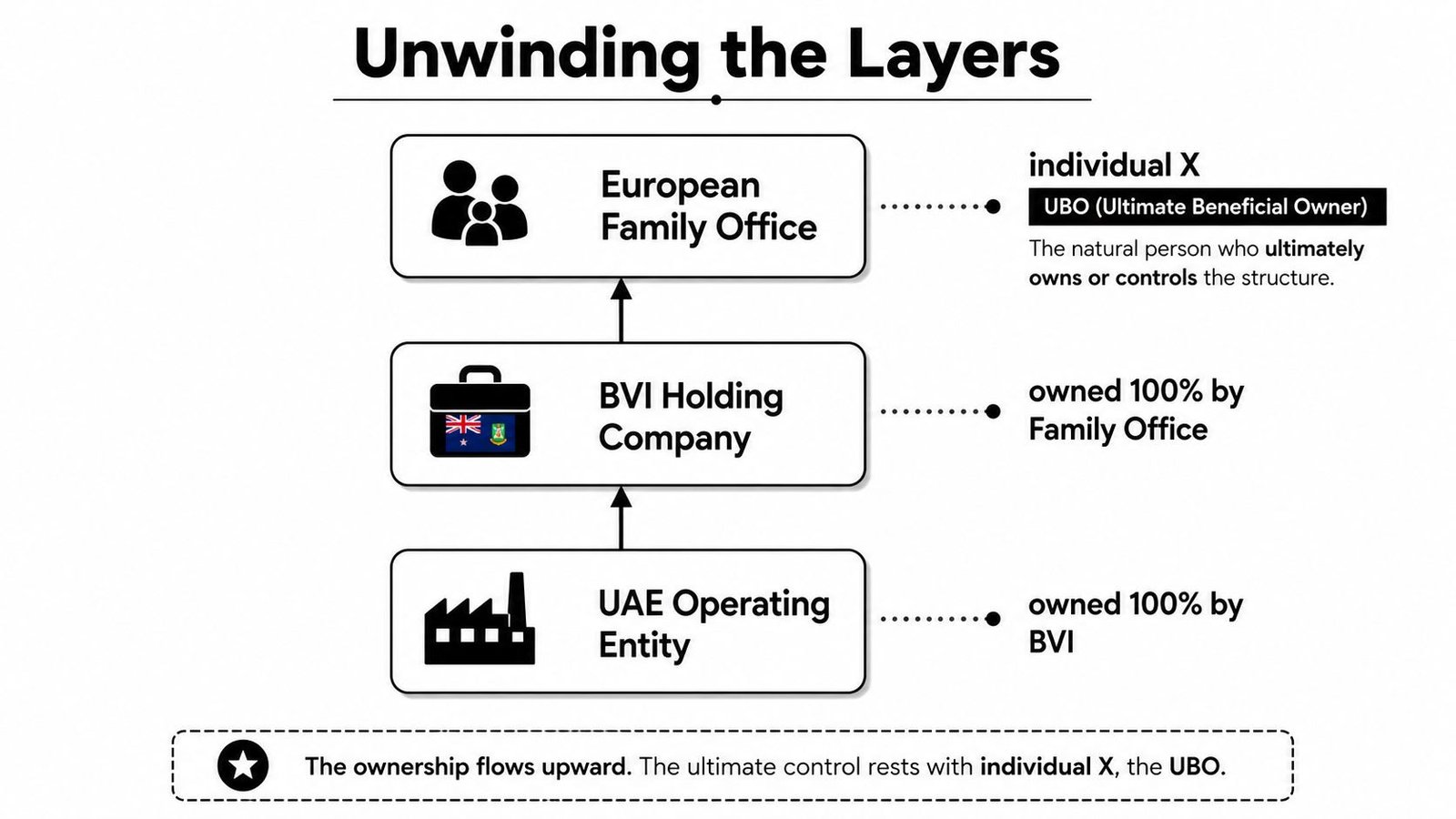
A layered structure only becomes difficult when the documents are messy. Start with a UAE operating entity, move up to the immediate shareholder, then keep moving until you reach the first natural person who owns or controls the business through that chain.
If a BVI holding company owns the UAE entity, and a European family office owns the BVI company, you don't stop at the BVI level. You test whether the family office is itself just a vehicle, then identify the natural person or persons behind it who satisfy the UBO test.
What evidence belongs at each layer
The registry and the bank will usually want a coherent pack, not a loose set of uploads. That means incorporation certificates, register excerpts, signed declarations, and a structure chart that shows where the 25% threshold sits at every layer.
- UAE entity records: trade licence, share register, and constitutional documents.
- Intermediate entity records: certificate of incorporation, shareholder register, and evidence of who controls the entity.
- Natural-person evidence: passport copy, proof of address, and a signed declaration confirming the ownership path.
A trust-like arrangement or voting agreement can still point back to an individual if that person directs outcomes. The label on the structure does not matter as much as the control mechanics inside it.
The break-points are usually obvious once you look properly. Undisclosed nominee shareholders, silent partners, and bearer-style instruments create gaps the UAE framework does not like, because they make the ownership story impossible to evidence cleanly.
Good filing discipline: if a person can't be named, documented, and linked to the control chain, the bank will treat the structure as unfinished.
UBO Rules Across Mainland, Free Zone, and Offshore
Where the rules look the same
The 25% test is the same starting point across mainland companies and most non-financial free zones, and the broader UAE framework still centres on a natural person at the end of the chain UAE UBO regime overview. Exemptions are narrow, mainly for publicly listed companies and government-owned entities UAE UBO regime overview.
Where the paperwork changes
Mainland companies are usually the most exposed in day-to-day practice, because licensing, banking, and renewal workflows expect a current UBO record. Free zones often keep their own registries or evidentiary packs, but the end result is the same, you need to show who owns or controls the entity.
| Dimension | Mainland | Free Zone | Offshore (RAK ICC / JAFZA Offshore / ADGM SPV) |
|---|---|---|---|
| Filing posture | Direct corporate compliance expectation | Parallel registry or zone-level process | Lighter day-to-day filing, but UBO records still needed on demand |
| Threshold | 25% ownership or control | 25% ownership or control | 25% ownership or control |
| Exemptions | Publicly listed and government-owned entities | Similar narrow exemptions, depending on zone rules | Depends on the vehicle and counterparty checks |
| Bank impact | Missing UBO file can block account opening | Stale records can slow onboarding | Passes incorporation, then fails CDD later if documents are weak |
Offshore vehicles such as RAK ICC, JAFZA Offshore, and ADGM SPVs can look lighter at the filing stage, but the practical test comes later when a bank or counterparty asks for the file. If the register is stale, the structure may still exist legally, yet fail the CDD review when money or counterparties enter the picture.
The smarter approach is to assume every jurisdiction will ask for the same substance, even if the format differs. The paperwork may look different in Dubai compared with Abu Dhabi or a free zone, but the ownership story has to hold together everywhere.
Common UBO Mistakes That Stall Bank Accounts and Renewals
The five errors that keep showing up
The first mistake is nominee layers that hide the person behind the structure. The fix is blunt, remove the layer or document it properly, because a nominee who blocks the ownership trail will frustrate the bank and the licensing file.
The second mistake is a register that was correct on incorporation day but never updated. Share transfers, new investors, and board reshuffles happen, and the register has to move with them.
The third mistake is missing the update window. The UAE framework requires companies to create and file the beneficial ownership register within 60 days of the legal person coming into existence or from the relevant decision, and updates are required when ownership or control changes UAE UBO regime overview; reported enforcement summaries also note fines starting at AED 50,000 and reaching AED 100,000, with possible licence suspension in some cases UAE compliance summary.
A clean UBO file is cheaper than a delayed bank account. It also makes the next renewal much easier.
The fourth mistake is a privacy assumption that the corporate veil hides everything from UAE authorities. That is not how the system works. The fifth is a weak bank pack, usually missing dated source documents, signed declarations, or a clear ownership chart.
- Nominee layers: Remove ambiguity or document the control chain properly.
- Stale registers: Update after every ownership or board change.
- Missing supporting documents: Keep proof of ownership ready, not scattered across inboxes.
- Inconsistent filings: Make sure licence, bank, and UBO records tell the same story.
- Weak control criteria: Write down who controls what, and why.
The fix is a pre-flight checklist before anyone sends a bank pack or starts a renewal. If the chain can't be defended in one sitting, it isn't ready.
Keeping UBO Records Clean and Getting Banks to Say Yes
What to keep aligned every month
A clean UBO process is less about paperwork volume and more about consistency. Keep the UBO register, the Economic Substance Reporting file, and the bank KYC pack aligned with the same ownership chart, the same passport copies, and the same proof of address.
When a share transfer lands, or a director changes, treat that as a trigger to review the file immediately. Waiting until the renewal email arrives is how teams end up in a scramble.
What banks look for first
Banks in the UAE want the ownership path to make sense before they care about the company story. That means source-of-funds evidence, a coherent shareholder structure chart, and signed declarations that match the documents already on file.
ADCB, FAB, Mashreq, and Emirates NBD all work from the same basic principle, the relationship manager should not be the first person to spot a mismatch. If the internal file is clean, onboarding becomes a document exercise rather than a correction exercise.
Best practice: keep one master pack for banking, licensing, and UBO updates, then refresh that pack whenever ownership changes.
Licence renewal is where sloppiness gets expensive in time, not just in stress. Mainland licences and free zone licences usually trigger re-confirmation of ownership details, so a clean register reduces the back-and-forth and avoids last-minute submissions.
The founder's job is to make the truth easy to verify. If the register, the bank file, and the licence record all say the same thing, the process usually moves without drama.
If you want a clean UBO file, a bank-ready KYC pack, and support with UAE company maintenance, Inpro Corporate Services L.L.C. can handle the filings and paperwork around it. Visit the team before your next bank request or licence renewal lands on your desk.