


A transferable visa in the UAE is not a separate visa category. It's a regulated process that lets a resident worker move employment sponsorship from one employer to another without leaving the country, provided the previous contract ends lawfully and the new employer files within the required window.
You may be dealing with this now: an employee has resigned, the new offer is ready, and everyone assumes the visa can be “transferred”. In practice, the delay usually comes from the order of cancellation, the authority handling the file, or a missed deadline. The process can involve the Ministry of Human Resources and Emiratisation, immigration, medical testing, Emirates ID, and sometimes a status amendment rather than a direct transfer.
Table of Contents
- What a Transferable Visa in the UAE Actually Means
- How UAE Law Defines Visa Transfer Eligibility
- The Step-by-Step Visa Transfer Process
- Mainland, Free Zone and Emirate-Specific Pathways
- Hidden Risks and Common Transfer Pitfalls
- How a Corporate Services Provider Simplifies Transfers
- Your Next Steps for a Smooth UAE Visa Transfer
What a Transferable Visa in the UAE Actually Means
A transferable visa in the UAE is the practical name for moving a resident employee from one employer-sponsored residence arrangement to another while remaining in the United Arab Emirates. The employment permit, labour records, residence status, and identity records must be updated through the relevant government systems.
It isn't a standalone visa product that a worker applies for independently. The new employer normally starts the employment permit process after the previous employer has lawfully ended the existing employment relationship and cancelled the relevant records.
Who can usually use this process
The route is most relevant to mainland private-sector employees, many free-zone workers, and some people whose residence status is linked to a family sponsor or another qualifying arrangement. The exact route depends on the worker's current sponsor, the new employer's jurisdiction, and whether the file is handled through Dubai's General Directorate of Residency and Foreigners Affairs, known as GDRFA, or the Federal Authority for Identity, Citizenship, Customs and Port Security, known as ICP.
A tourist visa isn't transferred into an employment visa. Certain government roles and cases involving serious employment or immigration breaches may also follow different rules or require clearance before a new permit can be issued.
What “lawful end” means
The previous employment relationship must normally end through contract expiry, resignation with the required notice, or mutually agreed termination. The employer must then complete the cancellation process correctly. A worker who leaves without resolving the employment record may face problems even if a new company is ready to hire them.
Practical rule: Treat the cancellation date as the starting point for the new application, not as an administrative detail to handle later.
A clean transfer therefore depends on more than the employee's intention to change jobs. It depends on the old employer, the new employer, and the relevant government channels completing connected steps in the right order.
How UAE Law Defines Visa Transfer Eligibility
A new employer can be ready to issue an offer while the previous employment file still blocks the next application. UAE visa eligibility turns on how the old relationship ended, which authority holds the record, and whether the required cancellation sequence has been completed.
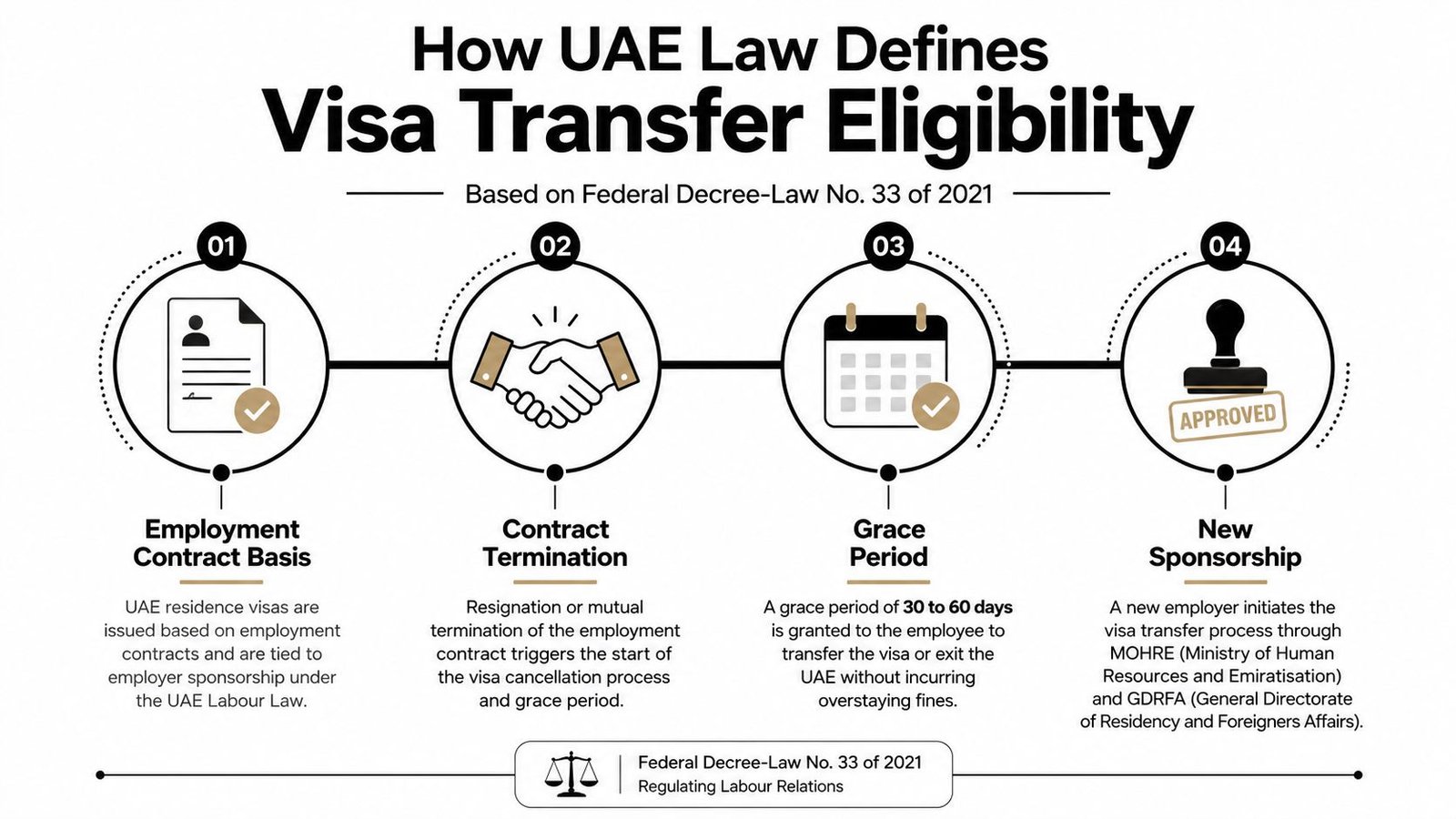
The legal basis changed when Federal Decree-Law No. 33 of 2021 on Employment Relationships came into force on 2 February 2022, as recorded in the UAE legislation portal and discussed in this explanation of the 2022 UAE employment law change. The framework moved away from a general employer-blocking model and tied mobility to lawful contract expiry, agreed termination, notice compliance, and correct permit cancellation.
Before that framework, employment-change cases commonly involved a six-month ban. The current rules do not give every worker an unrestricted right to change jobs. They instead focus on whether the employment relationship ended lawfully and whether the related records are clear.
What the 2022 framework changed
For mainland private-sector workers, the Ministry of Human Resources and Emiratisation, or MOHRE, controls the employment permit and labour-side records. Article 27 of Cabinet Resolution No. 1 of 2022 provides for work with another employer after the prior relationship ends under the law.
The wording has operational consequences. Eligibility can depend on the termination method, completion or valid agreement of the notice period, work-permit cancellation, and any restriction recorded against the worker. A new offer does not resolve an incomplete labour file.
Earlier reforms were introduced in stages. In July 2019, the Naturalisation and Residency Department reported removal of the long-standing six-month ban on switching sponsors within an emirate. Nine employee categories could still transfer under special conditions, including a one-year service requirement with the former sponsor and a no-objection certificate. Earlier rules also permitted transfers without a prior employer NOC for workers meeting salary thresholds of AED 5,000, AED 7,000, or AED 12,000, depending on qualification level, as described in this history of changing jobs in the UAE.
Why notice and records matter
“Lawful termination” is the combined result of the contract terms, notice obligations, employer acceptance where required, cancellation records, and the absence of issues such as an absconding report or serious breach.
For HR teams, the sequence is the working test:
- The old employment relationship ends correctly.
- MOHRE or the relevant free-zone authority closes the employment record.
- Immigration records are cancelled or amended through the correct channel, such as GDRFA in Dubai or ICP for federal routes.
- The new employer submits the next employment and residence applications within the applicable filing window, including the 90-day period where it applies.
The cancellation date is therefore an operational milestone, not a clerical detail. Keep the confirmation and related clearance documents available before the next filing begins.
The Step-by-Step Visa Transfer Process
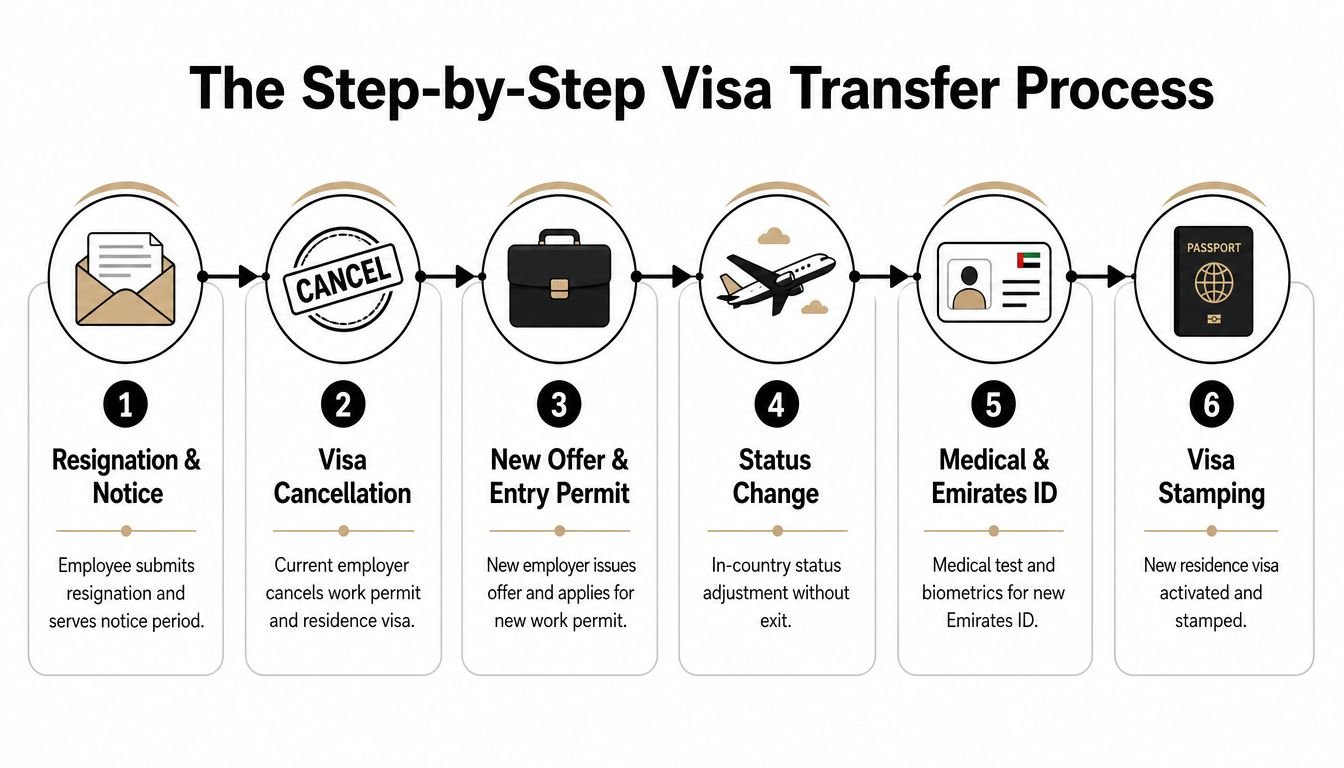
A UAE visa transfer can stall even when the employee, offer letter, and company approvals are ready. The usual cause is sequencing. The old work permit must be cancelled, the residence file must be checked through the correct immigration channel, and the new application must be filed before the applicable window closes. Treat the process as a controlled handover between employers, with each receipt confirming that the next step can begin.
1. Confirm the employment end date
The employee resigns or reaches the end of the contract, then serves the applicable notice period. Lawful notice periods are commonly described as 30 to 90 days, depending on the employment arrangement and contract, as reflected in UAE government service guidance.
The incoming employer should prepare the offer, company documents, and application data while notice is running. Filing against an active old permit may be blocked, so confirm the cancellation sequence before setting the employee's start date.
2. Cancel the MOHRE employment records
For a mainland private-sector employee, the outgoing employer cancels the work permit and labour contract through MOHRE. This closes the labour-side record. It must be completed before the related residence cancellation is processed through immigration.
The cancellation receipt is more than an administrative document. Some filing workflows will not accept the next application while the labour cancellation confirmation is missing or has not synchronised with the relevant system. Keep the receipt, contract cancellation record, and clearance documents together before asking the new employer to submit.
3. Cancel the residence visa through immigration
Once the labour permit and contract are cancelled, the residence visa is cancelled through the applicable immigration route. Dubai files generally move through GDRFA or an Amer service centre. Other emirates may use ICP for the residence record.
These records do not close as one transaction. MOHRE may show the employment file as cancelled while the residence file remains active. HR should verify both statuses and retain each confirmation. A single labour receipt does not prove that immigration has completed its part.
4. File the new permit within the deadline
The new employer must submit the transfer or new work permit application within 90 days of cancellation of the previous work permit, according to MOHRE's transfer work permit service. The new permit is valid for two years.
The deadline should be tracked from the recorded cancellation date, not from the employee's last working day or the date the parties signed the offer. If the filing is late, an in-country transfer may become a fresh entry or status-change route, adding steps while the employee's permitted stay continues to run.
5. Complete status, medical and identity steps
If the employee remains in the UAE, the new employer can request the applicable in-country status adjustment rather than arranging exit and re-entry. The file may then proceed to the medical fitness test, Emirates ID application and biometrics, followed by final residence activation.
Processing commonly takes roughly 10 to 20 working days when documents, approvals, and system records are ready, as reflected in MOHRE's official services information. Delays often start earlier, when the cancellation receipt is unavailable, the residence file is still active, or the application is sent through the wrong GDRFA or ICP route.
Documents to prepare before cancellation
Build the file before the outgoing employer cancels anything:
- Passport and existing visa details: Check names, passport numbers, and expiry information against every record.
- New employment offer: Keep the signed offer and company documents ready for submission.
- Cancellation evidence: Save the work permit, labour contract, and residence cancellation confirmations separately.
- Photographs and identity records: Use the format accepted by the relevant authority or service centre.
- Medical and Emirates ID information: Arrange these promptly once the new application reaches the required stage.
- Employer approvals: Confirm the new company has an active licence, available quota where applicable, and authority to submit.
Mainland, Free Zone and Emirate-Specific Pathways
A founder can cancel an employee's Dubai work permit and still be unable to file the replacement residence application through the same channel. “Visa transfer” may mean a genuine employment-permit transfer, or it may mean cancellation plus a new visa. The route depends on the old and new employers' licences, the sponsor, and the authority holding the residence file.
Which authority takes the lead
MOHRE generally handles the labour-side process for mainland private-sector employment. ICP provides federal immigration services for the relevant emirates, while GDRFA and Amer centres process Dubai residence transactions. A free-zone authority may control the employment permit and start its own procedure before immigration processing begins.
The operational split matters. A Dubai application may require GDRFA or an Amer centre submission, while a non-Dubai application may be filed through the ICP smart services portal. The worker's nationality does not decide this route by itself. The sponsor and jurisdiction do.
That sequencing creates friction after MOHRE cancellation. The labour record may close first, but the residence file still needs cancellation, status amendment, or a new application through the correct emirate pathway. If the wrong channel is selected, the case can pause even when the documents are complete.
Why free-zone transfers need an early check
The 2024 suspension of free-zone visa transfer services pushed many applicants towards cancellation-and-new-visa workflows, according to guidance on residency visa transfer pathways. Free-zone workers can therefore face a different sequence, document list, and approval route from mainland employees.
Before cancellation, ask the free-zone authority or registered service provider:
- Is the case being processed as a direct transfer or a new visa?
- Which authority will handle the residence record?
- Will the new filing be made through an Amer centre, GDRFA channel, or ICP smart services portal?
- What status will the worker hold while the application is pending?
| Jurisdiction | Primary Authority | Typical Workflow | Operational Difference |
|---|---|---|---|
| Mainland private sector | MOHRE, followed by ICP or GDRFA | Close the work permit and labour contract, complete the residence step, then file the new permit and immigration application | Dubai cases may use GDRFA or Amer, while other emirates generally use the ICP route |
| Free zone | Relevant free-zone authority, then ICP or GDRFA where required | Complete authority-specific cancellation, followed by a new permit or an available cancellation-and-reissue route | The free zone may require its own approval before immigration filing |
| Dubai employer or sponsor | GDRFA or Amer, with MOHRE where the employer is mainland | Complete labour cancellation where applicable, then process Dubai immigration cancellation, status amendment, or a new visa | Amer centre submission and GDRFA records must match the sponsor's file |
| Other UAE emirates | ICP, with MOHRE where the employer is mainland | Close the mainland employment record where applicable, then submit the federal immigration application | Filing is generally routed through ICP rather than Dubai's GDRFA system |
A founder moving an employee from a Dubai mainland company to an Abu Dhabi company should map both files before fixing the cancellation date. The outgoing Dubai residence record and the incoming employer's ICP pathway may require different actions, with the new filing window beginning only after the required cancellation evidence is available.
Hidden Risks and Common Transfer Pitfalls
A transfer can fail even when the employee, founder, and new employer agree on the move. The operational risk sits in the sequence: MOHRE cancellation, residence cancellation, the 90-day filing window, and the new permit must align. Dubai files may follow GDRFA, while other emirates generally use ICP. Treating these as one generic process creates avoidable delays.
The employment gap is a business problem
Inside-country processing can take two to four weeks after notice and paperwork, according to recent reporting on UAE job changes. During that period, the worker may not yet be fully active under the incoming employer's residence and employment records.
The impact reaches beyond the employee. A founder may have a key hire unable to perform regulated work, HR may need to coordinate payroll and insurance timing, and an international executive may have travel disrupted while status changes remain pending.
The safest transfer is planned before cancellation.
Where cases commonly fail
- Notice is assumed rather than documented: A verbal early-release agreement can conflict with the employee's final working day and the cancellation record.
- The new offer arrives too late: If the incoming employer has not prepared its licence, quota, authorised signatory details, and employee documents, the filing window can begin before the application is ready.
- Labour and residence records are treated as one closure: MOHRE cancellation does not by itself prove that the residence file is closed. Obtain evidence for each stage before submitting the next application.
- The wrong immigration route is selected: A Dubai sponsor may need the GDRFA pathway, while an Abu Dhabi or other emirate file may run through ICP. The authority must match the sponsor and establishment records.
- A record contains a serious issue: An absconding report, unresolved breach, or employment dispute can prevent a clean transfer or lead to additional review.
- The grace period is used as the schedule: After residence cancellation, a standard grace period is commonly described as 30 days for many workers. The person may leave, change status, or move to a new visa without overstaying if the next step is completed on time, as explained in this UAE visa cancellation guidance.
What protects continuity
The outgoing employer should confirm the cancellation date in writing and obtain the MOHRE and residence receipts separately. The incoming employer should prepare the offer, permit application, authority-specific documents, and status-change filing before the old work permit is cancelled.
The worker should retain copies of the offer, cancellation confirmations, passport, Emirates ID, medical records, and status-change receipts. Inpro Corporate Services L.L.C. can coordinate medical, Emirates ID, and residence stages, but the case still depends on correct sequencing and complete records.
A 30-day grace period is a safety window, not a project plan. Check the route, confirm which record has closed, and file through GDRFA or ICP within the applicable window.
How a Corporate Services Provider Simplifies Transfers
A corporate services provider adds value by owning the sequence, not by promising that government steps can be skipped. The useful work is practical: checking the file before cancellation, confirming the authority, preparing documents, and keeping the old and new employers aligned around one date.
For a founder or HR manager, the handoff can be organised into four controls:
- Eligibility check: Confirm how the existing contract ends, whether notice is complete, and whether any record could block the new permit.
- Authority mapping: Establish whether the file runs through MOHRE, a free-zone authority, ICP, GDRFA, or an Amer centre.
- Cancellation control: Track the labour cancellation and residence cancellation separately, with receipts for both.
- New application timing: Prepare the new offer, permit application, status amendment, medical appointment, and Emirates ID steps before the cancellation is completed.
This approach helps prevent the common failure where an employee is cancelled first and the new employer only then starts collecting documents. It also keeps the 90-day filing window visible, while reducing idle days caused by missing approvals or unclear ownership.
Inpro Corporate Services L.L.C. provides UAE visa filing support, including coordination of medical, Emirates ID, and residence stages for employment visas. A provider should still give you a clear route, expected dependencies, and pricing before work begins. Ask whether the quoted service covers only government filing or also document preparation, appointment coordination, status changes, and follow-up with the relevant authority.

Your Next Steps for a Smooth UAE Visa Transfer
Start with four answers: Is the contract ending lawfully? Which authority controls the file? When will the old permit be cancelled? Is the new route a transfer or cancellation plus a new visa?
Then align the new offer, cancellation date, status process, medical appointment, and Emirates ID application. Keep the 90-day filing deadline visible from the day the previous work permit is cancelled, and don't rely on the grace period as a scheduling buffer.
If the case involves a free zone, a move between Dubai and another emirate, a dependent sponsor, or a disputed employment record, obtain route confirmation before the old visa is cancelled.
Inpro Corporate Services L.L.C. can coordinate UAE employment visa transfers, including authority checks, cancellation sequencing, medicals, Emirates ID steps, and residence processing. Visit Inpro Corporate Services L.L.C. to book a strategy call or use its cost estimator for a clearer view of your UAE setup and visa transfer requirements.