


A UAE free zone company is a business licensed by a specific free zone authority, can be 100% foreign-owned, and operates under its own legal framework outside mainland jurisdiction, primarily for free zone and international activity. The UAE's National Economic Register reported around 60,600 companies operating in free-trade zones by mid-February 2021, representing over 8% of all registered companies at that time, so this isn't a niche structure. UAE Ministry of Economy data
But does 100% ownership mean you can sell freely to customers in mainland Dubai? Not automatically. The answer depends on your licence, business activity, location, tax position, and whether you obtain the separate permission required for mainland work.
Table of Contents
- Introduction to Free Zone Companies in the UAE
- What a UAE Free Zone Company Is and How It Works
- Key Advantages and Limits You Should Know
- Types of Free Zones Licence Categories and Legal Structures
- How to Set Up a Free Zone Company Step by Step
- Free Zone vs Mainland vs Offshore Compared
- Common Pitfalls Costs and Next Steps with Inpro
Introduction to Free Zone Companies in the UAE
Founders often begin with a simple goal: own the company fully, obtain UAE residency, open a bank account, and start serving customers. A free zone company can support those aims, particularly when the business works with international clients, imports and exports goods, or provides approved professional and technology services from a designated UAE jurisdiction.
A free zone company is a business licensed by a free zone authority rather than the mainland regulator. The authority manages licensing, approved activities, premises requirements, and many company administration processes within its jurisdiction. The company is legally distinct from a mainland business and follows the free zone's own compliance framework. The UAE Ministry of Economy explains free-zone establishment and regulation
The choice isn't limited to Dubai. Abu Dhabi has free zones linked to industrial, technology, logistics, and sustainability activity. Sharjah has zones serving trading, media, publishing, and professional businesses. Dubai offers a dense network of sector-specific locations, including logistics, technology, commodities, media, and financial services.
This structure can suit several types of applicants:
- International founders who want full foreign ownership and a UAE base.
- Freelancers and consultants whose work fits an approved professional or service activity.
- Trading companies that import, export, store, or distribute goods through permitted channels.
- HR and operations teams arranging employee visas through an established company.
- Golden Visa applicants who need a properly licensed UAE business or investor relationship as part of a wider eligibility assessment.
A free zone licence doesn't automatically give you permission to perform every commercial activity across the United Arab Emirates. Before you apply, check three things: what you'll sell, where your customers are, and whether staff need to work at customer premises. Those answers often determine whether a free zone structure is suitable or whether you'll need a mainland licence, permit, branch, or another operating arrangement.
What a UAE Free Zone Company Is and How It Works
The easiest way to understand the model is to separate the company from the jurisdiction.
A free zone authority is the regulator that licenses businesses inside a particular designated zone. It approves trade names, activities, incorporation documents, premises, and often visa-related applications. A mainland company, by contrast, is licensed through the relevant emirate's mainland authority. In Dubai, people commonly refer to the Department of Economy and Tourism, historically associated with the abbreviation DED, meaning the Department of Economic Development.
A mainland company is licensed to operate in the wider commercial territory of its emirate, subject to the activity and approvals on its licence. A free zone company normally has a more defined operating scope. It can conduct the activities approved by its authority, use the facilities permitted by that jurisdiction, and trade internationally, but direct mainland activity may require an additional route.
Core definition: A free zone company is a UAE business licensed by a free zone authority, with its own permitted activities and compliance requirements, usually operating from the zone or with international customers.
The model has a long commercial history. Dubai's Jebel Ali Free Zone, known as Jafza, was established in 1980. It officially started with 19 founding companies in 1985 and later grew to support over 11,000 businesses from 157 countries, according to the UAE Ministry of Economy's Jafza overview. That history helps explain why free zones are associated with foreign ownership, logistics, export activity, and international business.
A practical example makes the distinction clearer. A software consultancy licensed in a Dubai technology free zone may serve overseas clients and invoice UAE customers, but its ability to perform on-site work for mainland clients can depend on the exact activity and permit route. A trading company may import goods into a free zone warehouse, then need customs and mainland distribution arrangements before selling those goods within the domestic market.
Key Advantages and Limits You Should Know
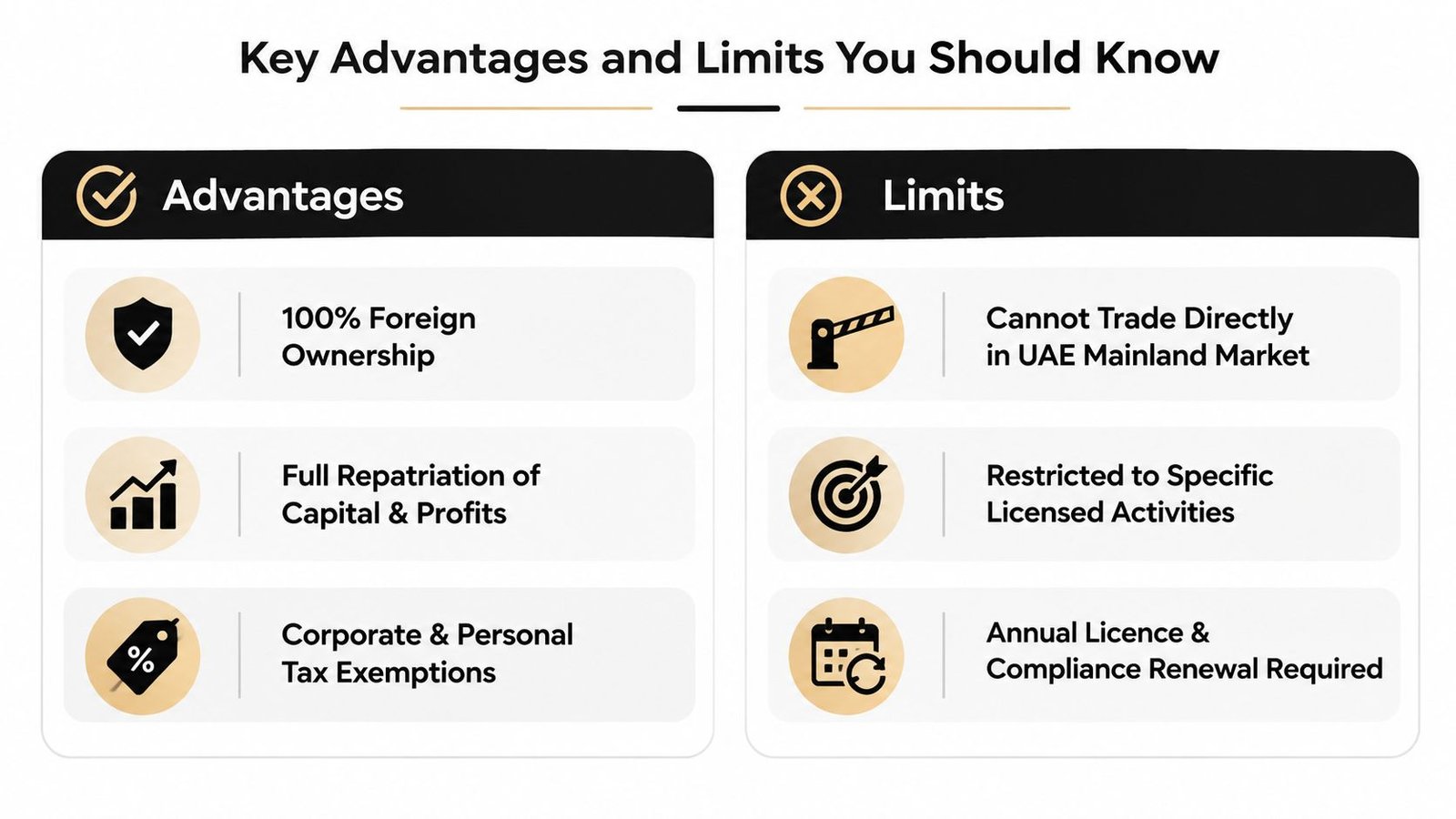
The main attraction is ownership. A free zone company can be 100% foreign-owned, which gives international founders direct control without structuring around a local shareholder requirement for the permitted activity. The authority also gives you a defined environment, with a licence category and activity list that clarify what the company may do.
Free zones often group related businesses together. A logistics zone may provide warehouses, freight connections, and customs support. A technology zone may offer offices and facilities suited to software, media, or innovation firms. This sector focus can make the setup more logical than choosing a jurisdiction based only on the cheapest advertised package.
Tax treatment requires more care. A Qualifying Free Zone Person can access a 0% corporate tax rate on qualifying income, but income that doesn't qualify is taxed at the standard 9% rate, as explained by the Federal Tax Authority's Free Zone Persons guide announcement. The 0% position isn't an automatic exemption attached to every free zone licence.
To preserve the intended treatment, the company must meet conditions that include:
- Qualifying income: Revenue must fall within the categories that qualify under the applicable corporate tax rules.
- Economic substance: The business must maintain suitable operations and substance in the free zone.
- Transfer pricing: Related-party transactions must follow arm's-length principles.
- Audited financial statements: The company must comply with the applicable audit and filing requirements.
Goods moving from a free zone into the mainland generally face a 5% customs duty on entry value, according to the UAE free-zone tax and customs explanation published by Duqe. Customs treatment depends on the movement, goods, and applicable rules, so a trading company should check the route before pricing products for mainland customers.
Can a free zone company sell in mainland Dubai?
The old answer, “yes” or “no”, is too broad. Dubai's Executive Council Resolution No. 11 of 2025 created a clearer route for free zone entities to conduct mainland activities through specific licences or temporary permits. The arrangement applies to Dubai and brings separate financial records and compliance duties. Existing mainland activity had to be regularised within one year of the resolution's effective date, as outlined in the analysis of free-zone mainland trading rules.
That means a free zone company may be able to serve mainland Dubai, but it shouldn't treat its free zone licence as a blanket mainland permission. You may need a specific licence, a temporary permit, a branch arrangement, or another approved route. The company must also keep mainland and free-zone activity properly separated in its records.
The practical question is not, “Can I sell in the UAE?” Ask instead:
- Is the customer in Dubai mainland?
- Will the company deliver goods or perform services there?
- Does the activity require another regulator?
- Will employees work at a mainland site?
- Do the books distinguish free-zone and mainland revenue and costs?
Types of Free Zones Licence Categories and Legal Structures
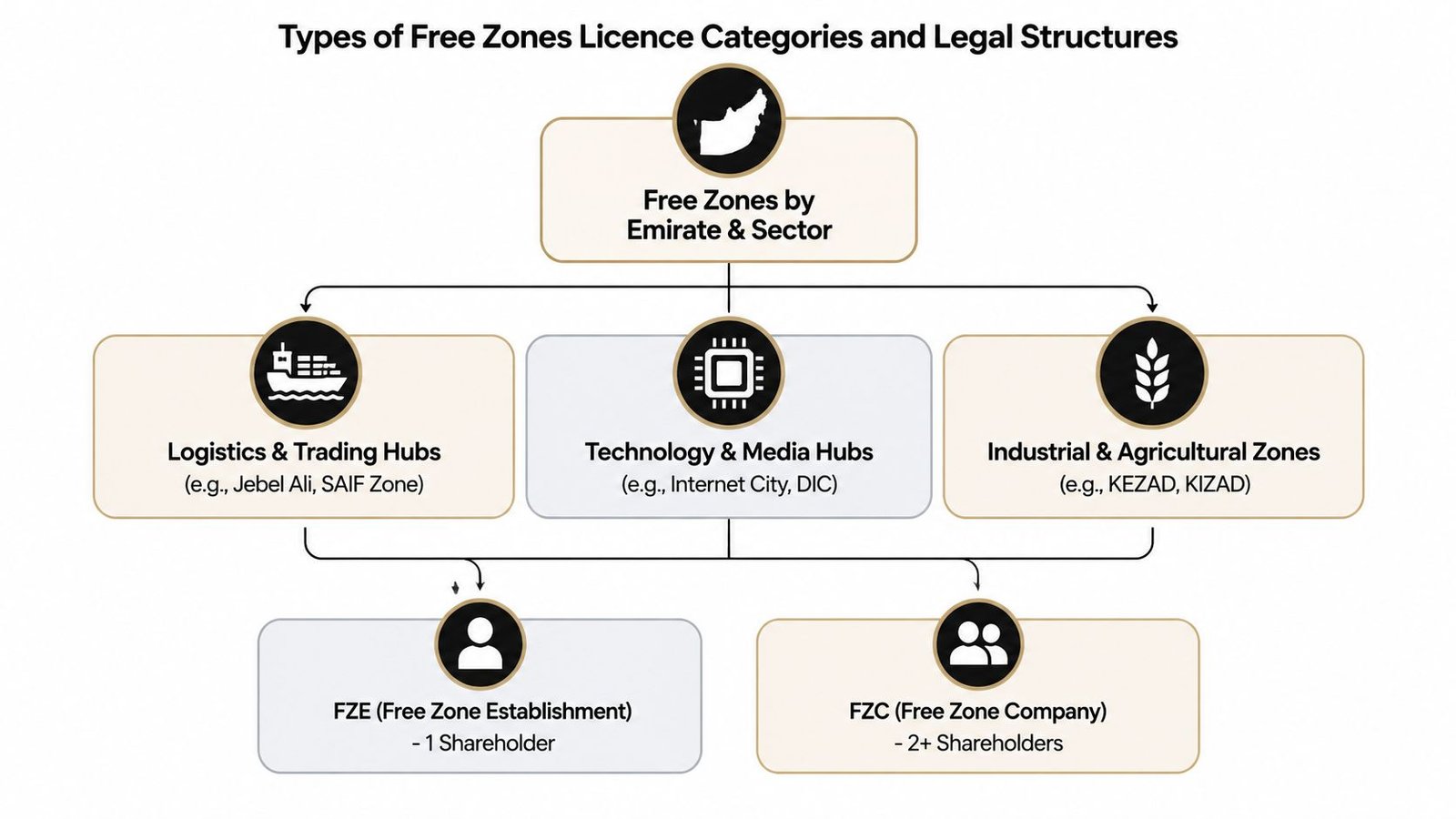
Free zones differ by emirate, sector, facilities, customer profile, and permitted activity. A founder choosing a Dubai logistics hub is making a different decision from a consultant choosing an Abu Dhabi sustainability-focused zone or a media professional choosing a Sharjah creative cluster.
Common licence categories include:
- Commercial licence: Used for approved trading, import, export, and distribution activities.
- Professional or service licence: Designed for consultancy, advisory, technical, or other approved services.
- Industrial licence: Used for manufacturing, processing, assembly, or related activities where the zone permits them.
- E-commerce licence: Used for approved online trading activities, subject to the authority's specific requirements.
- Freelance or individual permit: Available in selected jurisdictions for approved independent professional work, but it isn't the same as incorporating a full company.
The legal structure also matters. An FZE, or Free Zone Establishment, is a company commonly formed with one shareholder. An FZC, or Free Zone Company, is a company commonly formed with two or more shareholders. The exact names and requirements can vary between authorities, so confirm the available structure before preparing documents.
Which licence and structure fit your plan?
| Business Activity | Recommended Licence Type | Typical Legal Structure | Best Fit Free Zone Example |
|---|---|---|---|
| International goods trading | Commercial or trading licence | FZE or FZC | Jebel Ali or Sharjah Airport International Free Zone |
| Software and technology services | Technology or professional licence | FZE or FZC | Dubai technology hub or Abu Dhabi innovation zone |
| Consultancy and advisory work | Professional or service licence | FZE or FZC | Dubai, Abu Dhabi, or Sharjah professional-focused zone |
| Manufacturing and processing | Industrial licence | FZE or FZC | Abu Dhabi industrial zone |
| Online sales of approved products | E-commerce or commercial licence | FZE or FZC | Dubai or Sharjah e-commerce-friendly zone |
The table is a starting point, not an approval promise. A zone may classify the same business differently from another zone. Write down your actual revenue activities, not just the broad label you want on the licence. “Consultancy” can cover different approvals from “software development”, “marketing services”, or “management services”.
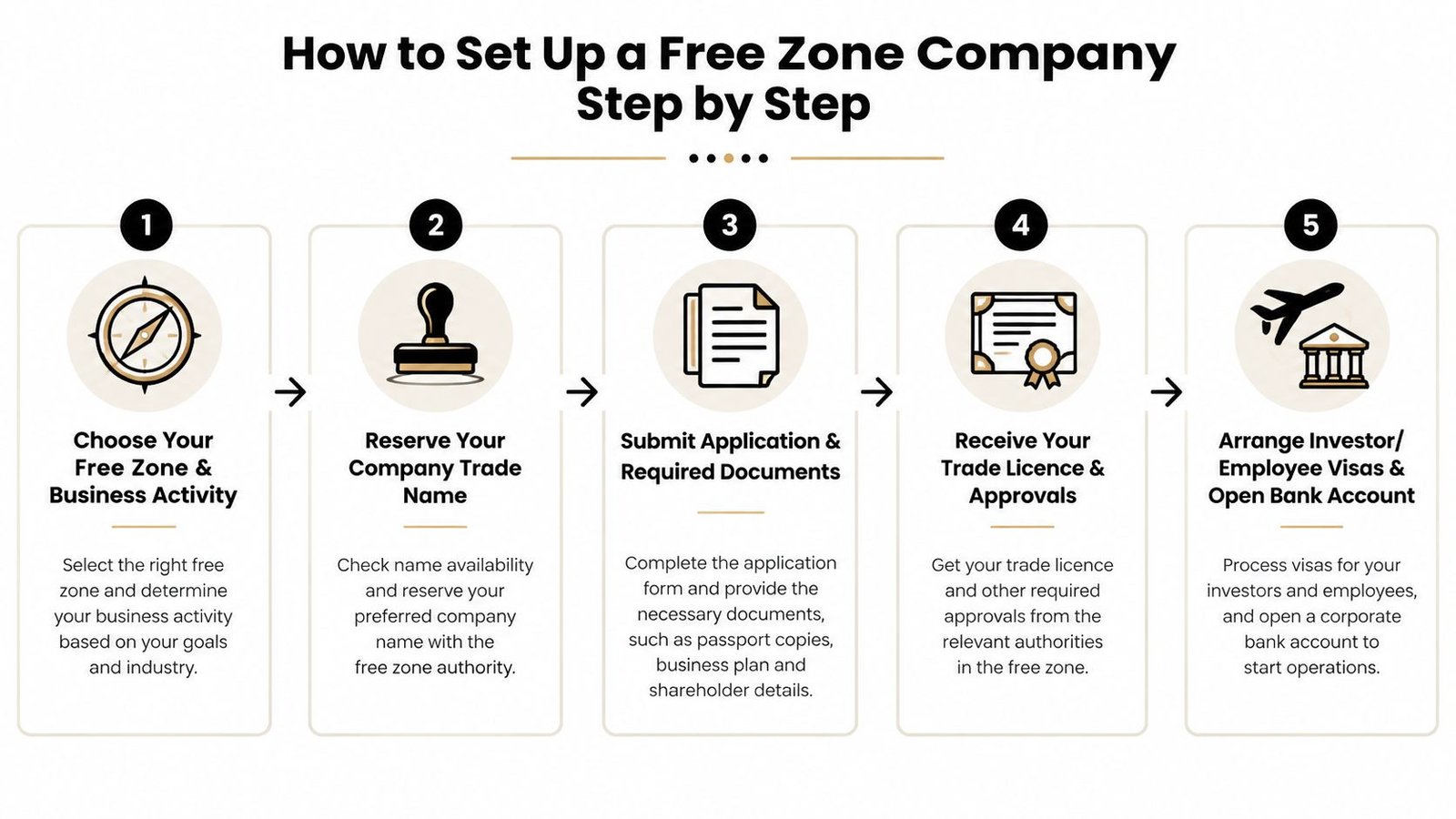
The five practical setup stages are shown below.
How to Set Up a Free Zone Company Step by Step
Start with the activity, not the package price. List what the business will sell, where the work will happen, whether goods will be stored, and whether employees will visit customers. The free zone authority uses this information to determine the permitted activity and required approvals.
What happens before the licence is issued?
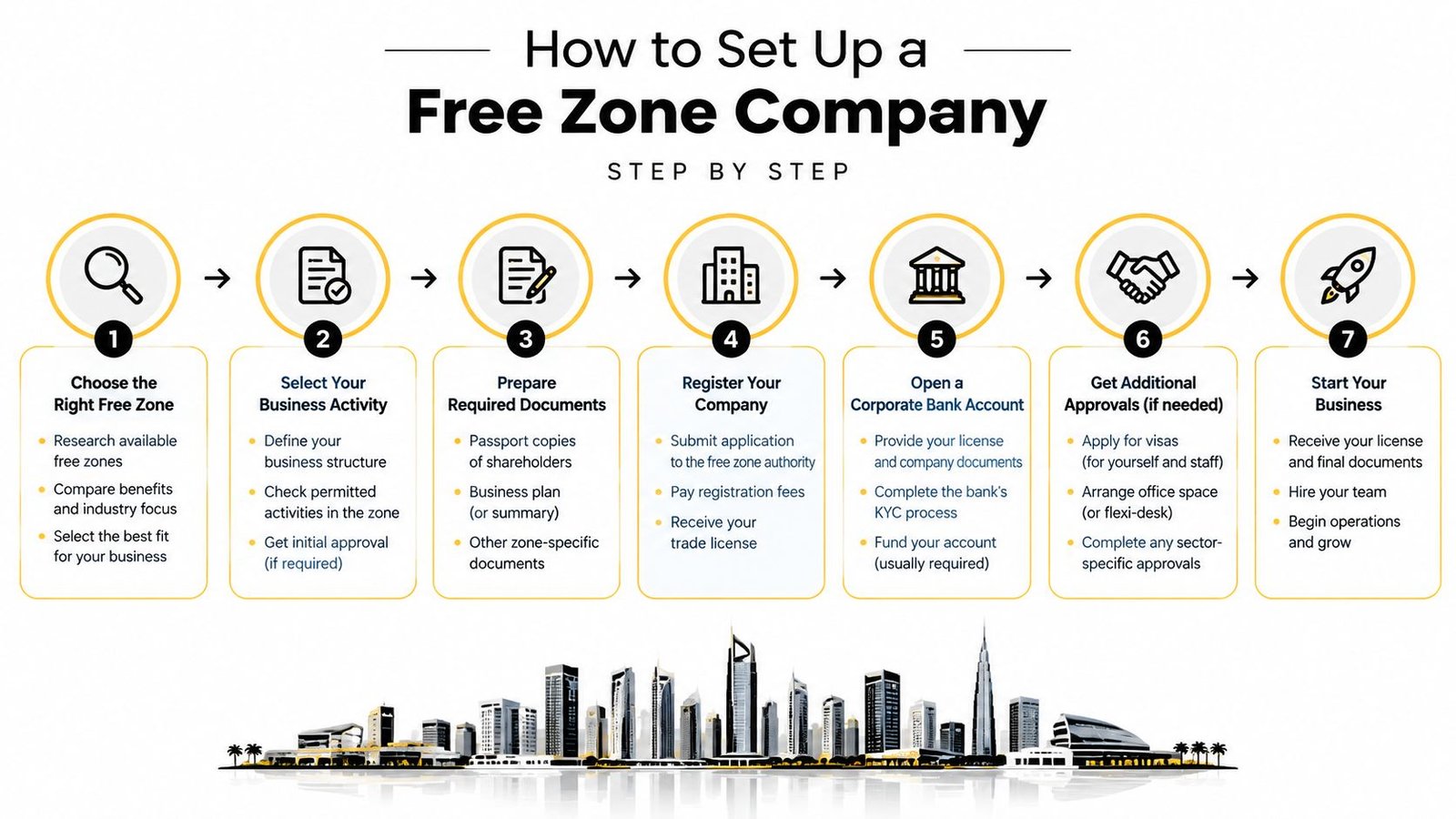
Choose the jurisdiction and activity. Compare Dubai, Abu Dhabi, and Sharjah zones based on sector fit, office options, warehouse needs, visa capacity, customer access, and renewal obligations. Confirm whether your intended activity needs approval from another government body.
Reserve the trade name. The trade name must follow UAE naming rules and the chosen authority's requirements. Avoid ordering branded materials until the name and licence details are confirmed.
Prepare and submit documents. Typical documents can include passport copies, shareholder information, a business plan for selected activities, incorporation forms, and corporate documents where a shareholder is another company. Some documents may require attestation or legalisation.
Arrange premises. Depending on the package and activity, this could be a flexi-desk, serviced office, dedicated office, warehouse, or industrial unit. The premises choice affects the company's practical capacity and may influence visa allocation.
Receive approvals and licence. Once the authority accepts the application and supporting documents, it issues the trade licence and incorporation documents. Some activities require external approval before the licence can be finalised.
What comes after incorporation?
The company may need an establishment card, an immigration file, and visa applications for shareholders or employees. Each visa applicant still needs to meet immigration, medical, and identity requirements. HR teams should maintain a calendar for passport validity, visa expiry, Emirates Identity Card processes, and employment administration.
A corporate bank account is a separate approval process. The bank may ask for the business plan, contracts, invoices, shareholder information, proof of address, and an explanation of expected transactions. A valid trade licence doesn't guarantee immediate account approval.
Recurring duties continue after setup. The company must renew its licence, keep records, follow its permitted activity, meet tax filing obligations, and prepare audited financial statements where required. Economic substance and transfer pricing requirements also need attention when the company seeks qualifying free-zone tax treatment.
A PRO, or Public Relations Officer, handles government-facing administrative work such as applications, document submission, status checks, and visa processing. A capable PRO process can reduce avoidable errors, but it can't replace the founder's responsibility to provide accurate documents and choose the correct activity.
Free Zone vs Mainland vs Offshore Compared
The right structure depends on the business's operating reality. A free zone is often suitable for international services, export activity, specialised sectors, and founders who want full foreign ownership within a defined jurisdiction. Mainland is generally the clearer choice when the company needs to trade directly across the local market under a mainland licence.
An offshore company is a structure generally used for holding assets or conducting international activities without operating as a UAE trading business. It normally isn't the route for UAE residency, a physical operating office, or direct local retail activity. Applicants should confirm the authority's rules before treating offshore incorporation as a substitute for a trading licence.
| Criteria | Free Zone | Mainland | Offshore |
|---|---|---|---|
| Ownership | 100% foreign ownership is available for the structure and permitted activity | Depends on the activity and applicable UAE rules | Ownership is held through the offshore structure |
| Market access | Free zone and international activity by default, with separate routes for mainland Dubai activity | Direct mainland trading under the approved licence | Not designed for ordinary UAE local-market operations |
| Office requirements | Depends on the zone, activity, and package | Depends on the activity and emirate requirements | Usually not an operating office |
| Visas | May be available subject to premises, authority rules, and allocation | Available subject to company and immigration requirements | Generally not intended as a residency route |
| Banking | Requires separate bank due diligence | Requires separate bank due diligence | Banking depends on the structure, owners, and business purpose |
| Tax position | A Qualifying Free Zone Person may receive 0% on qualifying income, while non-qualifying income is taxed at 9% | Subject to UAE corporate tax rules | Requires specific professional tax advice based on activities and residence |
| Mainland Dubai work | May require a specific licence or temporary permit under Executive Council Resolution No. 11 of 2025 | Covered by the mainland licence and approved activity | Not a substitute for mainland licensing |
The key mistake is choosing a jurisdiction before defining the sales model. A founder with overseas clients and no mainland delivery needs may prefer a free zone. A company supplying local shops, operating a customer-facing premises, or sending staff regularly to mainland sites may need mainland authorisation from the outset.
Common Pitfalls Costs and Next Steps with Inpro
The cheapest advertised package may not match your activity. Check the licence category, permitted wording, office requirement, visa capacity, external approvals, renewal terms, audit obligations, and mainland access route before signing.
Tax planning also needs operational discipline. A free zone company doesn't receive a permanent blanket exemption. If income falls outside qualifying categories, or if the company fails to meet substance, transfer pricing, record-keeping, or audit requirements, the expected tax outcome may not apply.
Keep the books clean from the first invoice. If Dubai mainland activity is authorised through a separate licence or temporary permit, maintain separate records for that activity rather than mixing all revenue and costs in one undifferentiated ledger. This helps the company explain its operations to the free zone authority, the Federal Tax Authority, banks, and auditors.
Founders should prepare four documents before applying:
- Activity note: What the company sells and how it delivers it.
- Customer map: Whether customers are overseas, in a free zone, or on the mainland.
- Staff plan: Who needs investor or employee visas and where they'll work.
- Compliance calendar: Licence renewal, visa dates, tax registration, filings, accounting, and audit tasks.
Inpro Corporate Services L.L.C. provides UAE company formation, licensing, PRO and visa processing, corporate bank account support, accounting, and tax and VAT services for founders and operating teams comparing free zone, mainland, and offshore structures.
If you're deciding between a UAE free zone and mainland company, visit Inpro Corporate Services L.L.C. for help comparing the licence, mainland access route, visa process, and ongoing compliance requirements. You can also use the available cost estimator to organise your setup decisions before submitting an application.