

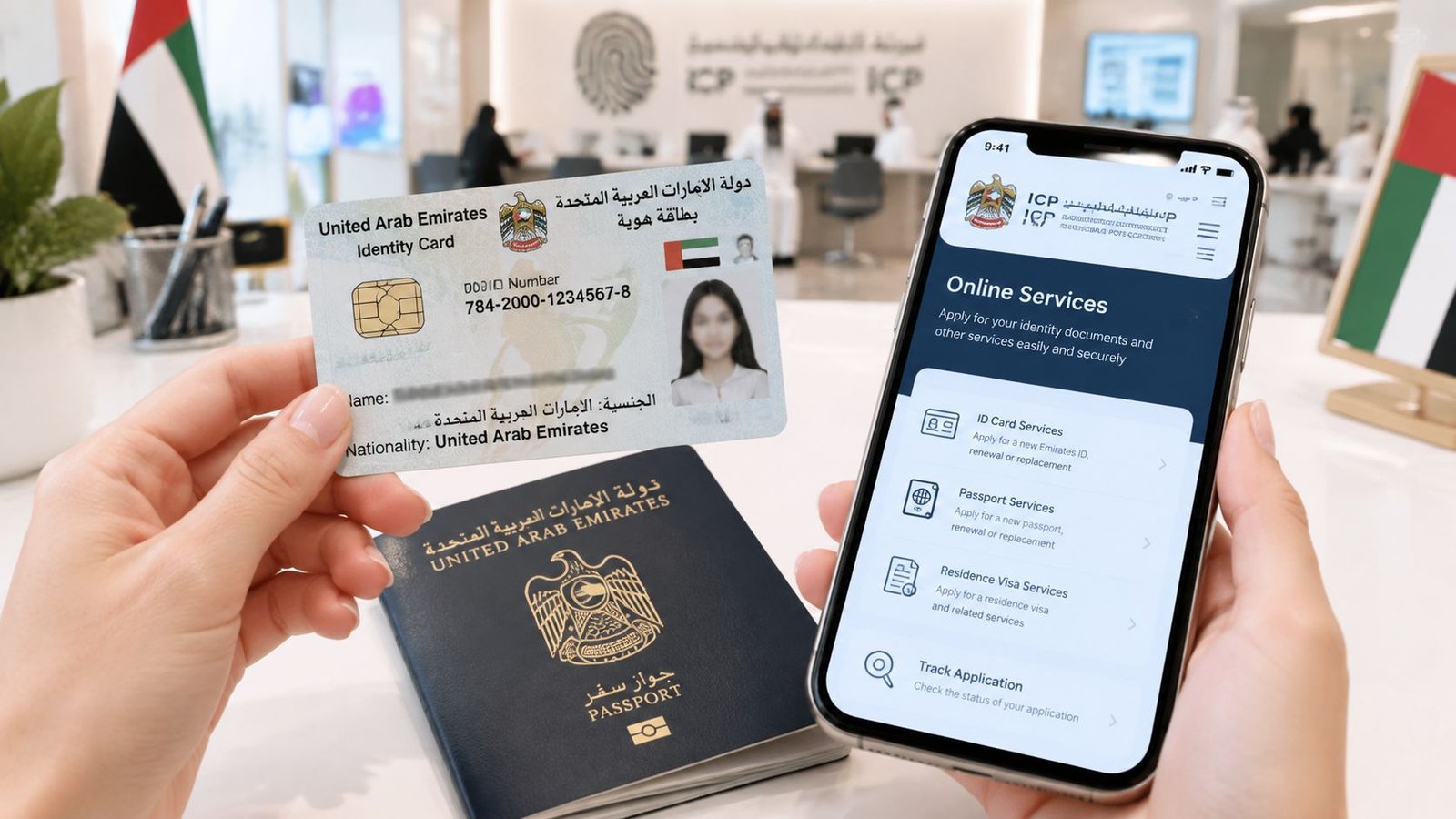
The Emirates ID application process is digital first, but it isn't fully online. For most applicants aged 15 and above, the processing time depends less on filling in the form and more on biometrics, residency checks, printing, and delivery, with a recent UAE-region breakdown putting the overall journey at about 7 to 12 working days (Arabian Me's processing guide).
For founders, HR managers, freelancers, investors, and Golden Visa applicants, the practical lesson is simple. Treat the Emirates ID as part of the wider residency workflow, not as a standalone card order. A clean application, a correctly booked appointment, and active status follow-up will protect your onboarding, banking, tenancy, and government-service deadlines.
Table of Contents
- Understanding the Emirates ID System
- Required Documents and Eligibility
- The Application Workflow Online and In-Person
- Booking and Attending Your Biometrics Appointment
- Fees Timelines and Tracking Your ID Card
- Common Issues and How PRO Services Can Help
Understanding the Emirates ID System
What is the Emirates ID application process?
The Emirates ID process is the official route for obtaining the identity card issued to UAE citizens and residents. Applicants submit a new card request through the Federal Authority for Identity, Citizenship, Customs and Port Security, commonly called ICP, using the official UAE Government Emirates ID service or an accredited typing centre.
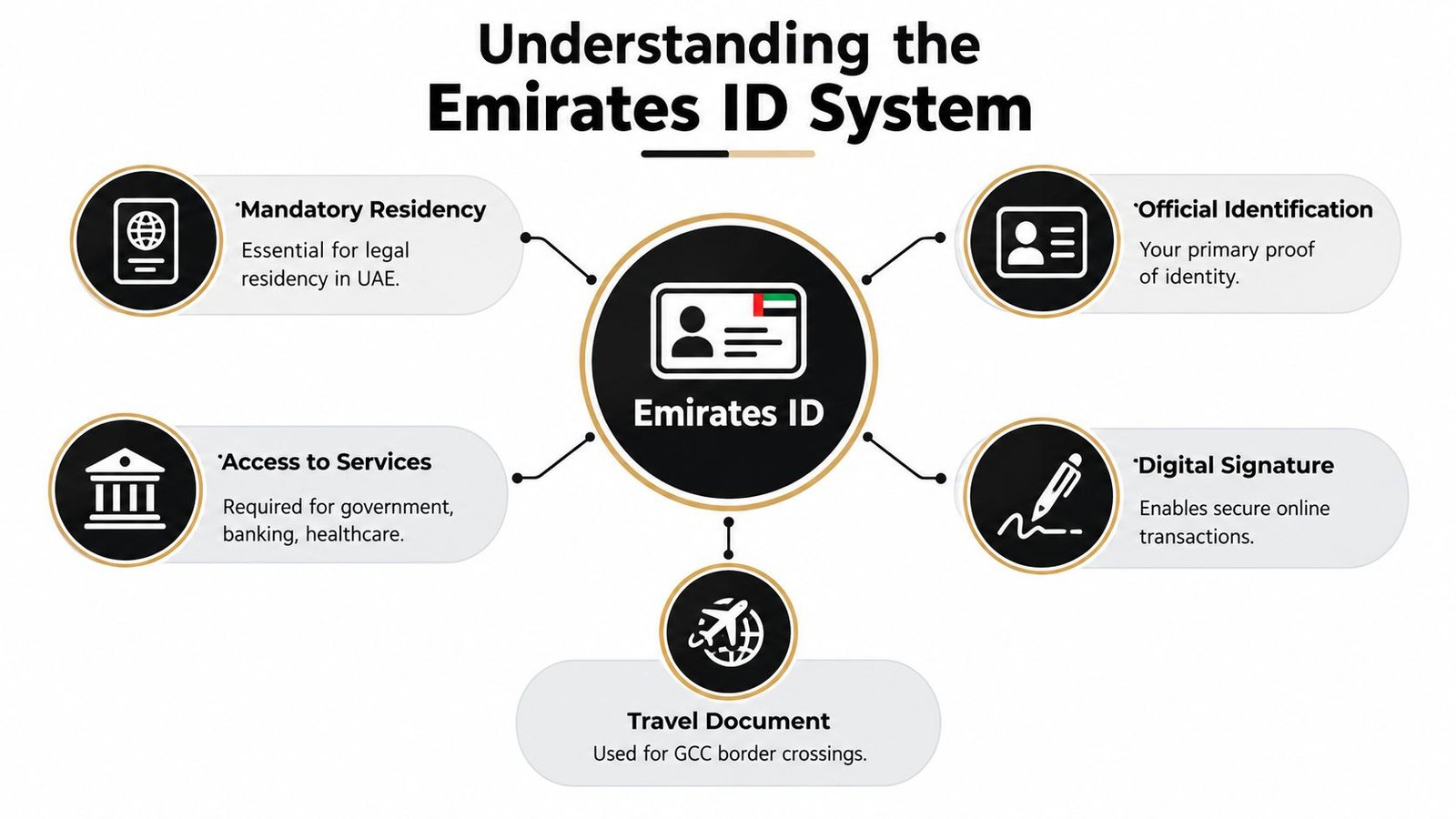
The Emirates ID is the primary identification document used across the UAE. It connects an individual's identity with government records and supports banking, healthcare, telecommunications, employment administration, and immigration-related transactions. A card may therefore be required for a task that does not initially appear connected to immigration, such as opening a bank account or completing company administration.
The process can begin online, while biometric capture may still require an in-person visit to an ICP service centre. A founder might complete the digital form from an office in Dubai, Abu Dhabi, or Sharjah, then wait for an appointment before the card can be issued. That appointment, rather than the form itself, often becomes the practical scheduling constraint.
Why is the Emirates ID linked to residency?
The card forms part of the wider UAE immigration system. Official guidance states that, except in Dubai, the renewal application is submitted with the residence application through a unified form. Dubai follows its relevant local immigration arrangement, so the sponsoring company or service provider should confirm the correct channel before submitting anything.
This connection makes the Emirates ID a business scheduling issue, not only an identification matter. A delayed card can hold up employee onboarding, dependent administration, banking access, or investor-related operational tasks. The risk increases when teams treat the card request as separate from the residence file and do not confirm which stage is waiting on the other.
The National ID programme moved from pilot to mass enrolment in 2005, supporting nationwide rollout. The system now combines federal digital submission with typing-centre assistance and physical appointments where biometrics apply.
Practical rule: Coordinate the Emirates ID, residence visa, medical fitness, and onboarding sequence as one workflow. Check status after each handoff, because a completed online form does not confirm that biometrics, approval, printing, or delivery is complete.
Required Documents and Eligibility
What documents does an employee need?
An employee sponsored by a mainland or free zone company normally needs a valid passport, the relevant residence or entry documentation, a recent personal photograph, and the employment or sponsorship details used in the immigration file. Where the employment record is handled through the Ministry of Human Resources and Emiratisation, or MOHRE, the labour contract or work-permit information should match the Emirates ID application.
A free zone employee may have a different sponsoring authority and document flow from an employee hired by a mainland company licensed through a Department of Economic Development, or DED. The key control is consistency. The passport name, nationality, date of birth, visa record, and employer details must agree across the submitted documents.
Which documents apply to investors and dependents?
An investor or business partner should prepare the passport, residence documentation, photograph, and company records that establish the person's relationship with the UAE business. These may include a trade licence, memorandum of association, shareholding evidence, or other records requested by the relevant authority.
A dependent application is based on the sponsor's residence file and the family relationship. A spouse may need a legal marriage certificate, while a child may need a birth certificate. Documents issued outside the UAE may require the appropriate attestation and translation before they can support a government application.
| Document | Employee (Company Sponsored) | Investor / Partner | Dependent (Spouse / Child) |
|---|---|---|---|
| Passport copy | Required, with details matching the employment and residence file | Required, with details matching company records | Required for the dependent |
| Residence or entry documentation | Sponsorship and residence records from the employer | Investor or partner residence records | Dependent residence records linked to the sponsor |
| Recent photograph | Prepare according to the application channel's specifications | Prepare according to the application channel's specifications | Prepare according to the application channel's specifications |
| Employment record | Labour contract or work-permit information where applicable | Usually replaced by company ownership or partnership records | Not normally applicable |
| Company documents | Employer licence or sponsorship details where requested | Trade licence, memorandum of association, or shareholding evidence where requested | Sponsor's residence and employment or business records where requested |
| Family relationship document | Not normally applicable | Not normally applicable unless dependents are included | Attested marriage certificate for a spouse or birth certificate for a child where requested |
| Original documents | Bring originals or accessible official copies if the service centre requests verification | Bring company and identity originals where available | Bring relationship documents and sponsor records where available |
How should HR teams organise the file?
HR teams should create one controlled file per applicant rather than sending scattered attachments through email or messaging apps. Use the applicant's passport name as the file reference, check that the visa and sponsorship details are current, and keep a record of the application number after submission.
For staff relocating to Dubai, Abu Dhabi, or a free zone, confirm which authority handles the residence file before choosing a submission route. A typing centre can enter the application, but it can't correct a mismatch created by the employer's underlying immigration records.
The Application Workflow Online and In-Person
Which application channel should you choose?
A founder handling a personal application may prefer the ICP website or smart application, particularly when the documents are already organised and the applicant is comfortable checking every field. The online route gives the applicant direct control over data entry and payment, but it also leaves the applicant responsible for spotting errors before submission.
An accredited typing centre is useful when an HR team is processing several employees, when the sponsor needs help with form entry, or when the applicant is uncertain about the correct service. The centre submits the information on the applicant's behalf, but the applicant or sponsor remains responsible for supplying accurate documents.
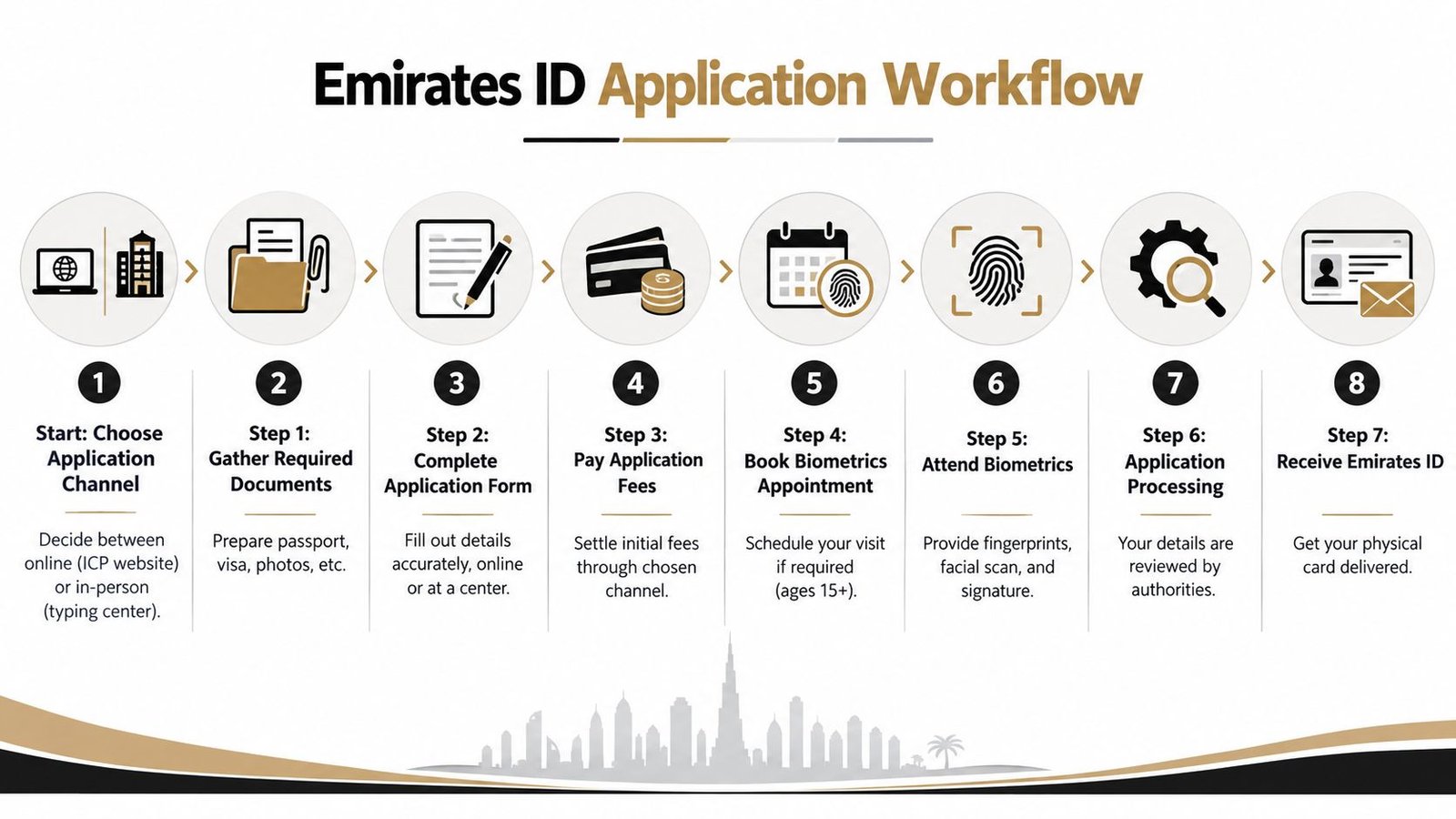
A typical journey looks like this:
- Choose the ICP online route or an accredited typing centre.
- Gather the passport, residence records, photograph, and supporting documents.
- Complete the application form and review every personal detail.
- Pay the applicable government and electronic form charges.
- Book biometrics if the applicant is required to attend.
- Attend the ICP service centre at the booked time.
- Wait while identity, security, and residency information is processed.
- Track delivery and receive the physical card.
How does the workflow differ across the UAE?
The federal ICP channel is relevant across the UAE, including Abu Dhabi and Sharjah. Dubai applicants should confirm whether the residence file is being handled through the Dubai immigration system or another sponsoring authority, because the unified-form arrangement described by the UAE Government applies to all emirates except Dubai.
Consider an overseas founder setting up a free zone company. The practical sequence may involve company formation, establishment records, an entry permit, medical and residency steps, then the Emirates ID application. An HR manager onboarding an employee may instead start with the employer's work-permit and residence file. Both applicants use the same identity system, but the supporting workflow differs.
The initial confirmation is not the physical card. Keep the application reference, payment record, and appointment details together. These are the records that help a sponsor or PRO team identify whether the file is waiting for biometrics, under review, in printing, or moving through delivery.
Booking and Attending Your Biometrics Appointment
Who must provide biometric details?
Applicants aged 15 years and above must complete fingerprint and signature procedures at an ICP service centre, according to the ICP service guidance. The biometric stage can require an in-person visit even when the application itself was submitted digitally. Treat the online submission as the start of the process, not proof that every step can be completed remotely.
The appointment usually covers identity verification, fingerprint capture, signature recording, and the image or biometric checks required by the service centre. Bring the passport, application confirmation, appointment details, and any original documents requested by the submission channel. A missing original document can turn a booked appointment into another visit.
How should you prepare for the appointment?
Book the appointment as soon as the application channel makes a slot available. Select a time that allows for travel and queues, especially when the applicant is moving between a company office, free zone, and ICP centre. Appointment availability can become the practical bottleneck in a residence or employee onboarding schedule, even when the application was submitted correctly.
The ICP New Identity Card Issuance service listing states that the customer must attend the authority's service centre at the exact booked date and time so the service can be delivered promptly. Missing the slot can interrupt the identity workflow and affect residence completion, employment onboarding, school registration, or another deadline tied to the applicant's status.
Arriving with the correct documents is only half the preparation. The applicant also needs the correct appointment details and enough time to attend the exact booked slot.
Keep the confirmation accessible on the phone and save an offline copy. If the appointment needs to change, use the official channel or ask the typing centre that submitted the file which rescheduling route is available. A message to a company administrator does not change the appointment in the government system.
What should applicants do after biometrics?
Before leaving, ask whether the service centre or submission channel can confirm the next status milestone. Continue checking the application through the official status tools connected to the application record.
If the status does not move, record the last update date, application reference, passport details, and residence file information. This gives the sponsor or PRO representative a workable case file for follow-up, rather than a general complaint that the card is late.
Fees Timelines and Tracking Your ID Card
How much does the Emirates ID cost?
The fee depends on the applicant category, card validity, and submission channel. Under the standard service guidance, the application fee is AED 100, and the card is valid for 5 years in the stated standard service guidance (ICP service guide).
For residents, ICP states that the charge is AED 100 for each year or part of a year of validity. Applicants also pay an electronic form fee of AED 70 at a printing office or AED 40 through the ICP website or smart application (ICP fee clarification).
UAE nationals and GCC nationals pay AED 100 for a card valid for 5 years under the same ICP statement. Review the final payment screen or service-centre quotation before payment. The total can combine the validity charge with the form fee for the selected submission channel.
How long does the application take?
Plan around a variable process rather than one guaranteed turnaround. A UAE-region processing breakdown gives these indicative stages:
| Stage | Indicative time |
|---|---|
| Data entry | Same day |
| Biometrics | 1 to 2 days |
| Security and residency checks | 3 to 5 days |
| Printing | 2 to 3 days |
| Delivery | 1 to 2 days |
| Total | About 7 to 12 working days |
The figures come from Arabian Me's Emirates ID processing guide. Use them for internal planning, not as a promise for every applicant or emirate.
Data entry may finish quickly, while review, printing, and delivery create the practical waiting period. For a founder or HR manager working toward an onboarding date, allow room for a stalled review or delivery issue. Check the current stage before submitting another application, since duplicate submissions can create more confusion.
How can you track the card?
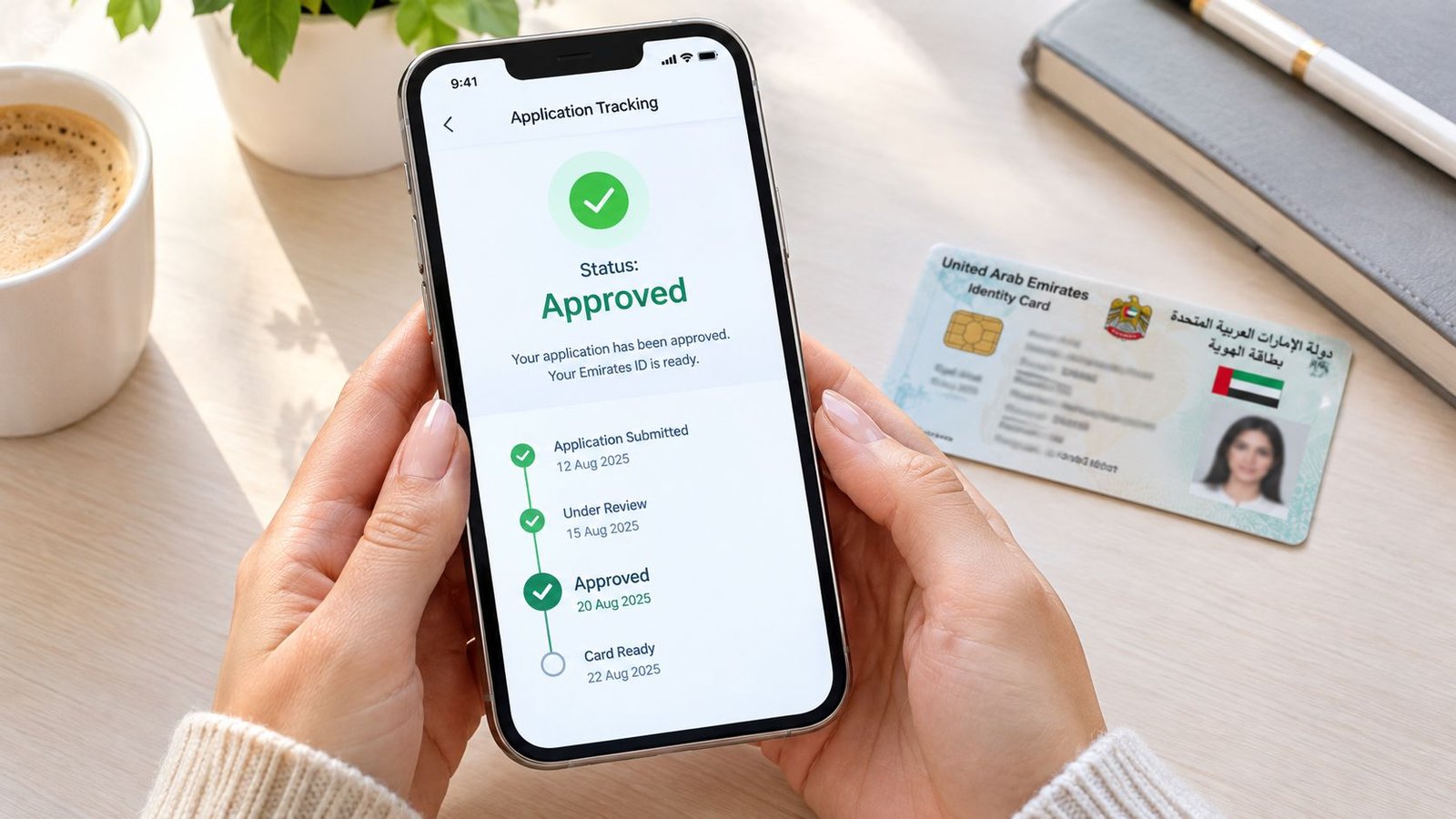
Keep the application reference and check the official ICP status channel connected to the submission. Monitor progress through review, approval, printing, and delivery, while ensuring the applicant's phone number and address remain available for delivery contact.
Assign one HR or operations owner to manage the file. That person should confirm the biometrics milestone, check alignment with the residence record, and respond if the delivery details need correction. A useful status enquiry includes the reference number, the last known stage, and the date of the last update.
Operational view: A “pending” status is not a diagnosis. Identify whether the hold relates to biometrics, residency verification, printing, or delivery before deciding what action to take.
From 14 July 2026, citizens can renew their Emirates ID up to one year before expiry, replacing the earlier six-month window (UAE Government Emirates ID guidance). Employers should apply this rule to citizen renewal reminders, while keeping resident fee and validity checks tied to the individual residence file.
Common Issues and How PRO Services Can Help
What causes avoidable delays?
Most avoidable problems begin before the application reaches a government reviewer. A mistyped passport name, an incorrect date of birth, a mismatch between the residence record and the submitted form, or an unclear photograph can send the application back for correction.
Appointment management creates a second risk. An applicant may submit the form correctly but miss the biometrics slot, arrive without the required document, or assume that a typing-centre submission removes the need for personal attendance.
Delivery can create a third delay. Keep the mobile number and address current, respond to delivery messages, and make sure the applicant knows who is expected to receive the card. If the card is not delivered, check the status and contact the responsible channel with the application reference rather than starting again.
What should you do when an application stalls?
Start with the last confirmed event. If biometrics weren't completed, solve the appointment issue. If biometrics were completed but the file remains under review, check the residence and sponsorship records. If the card has moved to printing or delivery, focus on the delivery contact details and courier instructions.
Use a short escalation record:
- Application reference: Keep the receipt and confirmation together.
- Applicant identity: Record the passport name and contact number exactly as submitted.
- Last completed stage: Note whether the file is awaiting biometrics, review, printing, or delivery.
- Supporting evidence: Save payment records, appointment confirmations, and messages.
- Next action: Assign one person to follow up and record the response.
This approach works better than repeated submissions, which can create confusion and additional administrative work.
When does a PRO service make sense?
A corporate Public Relations Officer, or PRO, manages government-facing administrative work for a company. For a founder, HR manager, investor, freelancer, or Golden Visa applicant, the value is not merely form filling. A capable PRO team checks documents, submits through the appropriate ICP or typing-centre channel, books appointments, monitors the status, and follows up when the file stops moving.
Inpro Corporate Services L.L.C. offers document preparation, Emirates ID and residence support, investor and employee visa services, company formation, licensing, and related government workflows through its UAE corporate PRO and setup services. The trade-off is a service fee, but the business retains internal time and gains a single owner for deadline management.
DIY submission works well when the applicant has a clean file, understands the correct authority, and can attend biometrics personally. A PRO route is more practical when several employees are being onboarded, the founder is abroad, the visa file involves a free zone or investor structure, or a delay would affect payroll, banking, or launch plans.
Inpro Corporate Services L.L.C. can prepare and submit your Emirates ID and residency documents, coordinate biometrics appointments, and monitor the application through the relevant UAE government channels. Visit Inpro Corporate Services L.L.C. to discuss your employee, investor, freelancer, or Golden Visa requirements and receive a clear plan for the next steps.