


You've chosen the UAE, perhaps while juggling relocation plans, investor questions, visa deadlines, and a bank asking for documents you didn't know you needed. Company setup in the UAE means selecting the right jurisdiction, securing a trade licence, and completing immigration, tax, and banking requirements, but the best structure depends on how and where you'll operate.
Table of Contents
- The 2026 Reality of UAE Company Formation
- Choosing Your Jurisdiction and Structure
- The Licensing and Incorporation Sequence
- Overcoming the Corporate Banking Bottleneck
- Tax Compliance and Visa Pathways
- Your 90-Day Setup Checklist and Cost Estimates
The 2026 Reality of UAE Company Formation
The old idea of registering a company, opening a bank account, and leaving everything untouched no longer reflects the United Arab Emirates business environment. In 2026, authorities, banks, and tax agencies expect the company's licensed activities, ownership records, contracts, premises, and money flows to tell the same story.
That doesn't make the process unmanageable. It means you need to make the structural decisions before submitting an application, rather than choosing a licence based only on the lowest advertised package.
The UAE has become a high-volume market for founders and expanding companies. By the end of 2025, the country had more than 1.4 million active companies, with roughly 760,000 companies established after the September 2021 Commercial Companies Law changes, according to UAE company formation market data. The increase followed the broader foreign-ownership reforms that opened more mainland ownership options and accelerated incorporation across Dubai, Abu Dhabi, Sharjah, and other Emirates.
What does company setup in the UAE involve?
Company setup is a sequence of jurisdiction selection, activity approval, trade-name reservation, incorporation documents, premises arrangements, licence issuance, visa processing, tax registration, and corporate banking. Mainland companies generally deal with the relevant emirate's Department of Economic Development, or Department of Economy and Tourism in Dubai, while free-zone companies apply through their chosen zone authority.
The legal entity is only the starting point. Your company must also be able to explain who owns it, what it sells, where it operates, who its customers are, and how it will receive and use funds.
Why has the old setup model changed?
The regulatory environment now gives founders more ownership and operating flexibility, but it also creates more responsibility. The post-2025 commercial law position means a free-zone company operating outside its zone can face mainland compliance requirements, particularly where it uses a branch or representative office for onshore activity.
That's why a cheap licence can become expensive if it forces you to add another entity, amend activities, repeat documentation, or rebuild a banking application. The sensible approach is to design the operating model first, then select the licence that supports it.
Practical rule: Choose the structure for your expected customers and transactions, not for the licence brochure alone.
Choosing Your Jurisdiction and Structure
Mainland and free-zone companies can both suit international founders, but they solve different operating problems. A mainland company is licensed by the relevant emirate authority and is designed for direct onshore commerce. A free-zone company is licensed by a zone authority and usually operates within a defined commercial ecosystem, subject to its permitted activities and operating rules.
Dubai's free-zone ecosystem illustrates the scale of the market. The UAE government recognises about 40 free zones, and Dubai accounted for roughly 53% of UAE free-zone licences, with more than 112,000 licences by November 2024, according to the UAE Ministry of Economy and Tourism free-zone guidance. In 2025, a framework also allowed certain free-zone companies to operate on the mainland through a branch licence or temporary permit. The branch licence fee is AED 10,000, while the temporary permit fee is AED 5,000, subject to the applicable framework and authority conditions.
Which route fits your customer base?
Use mainland licensing when your business expects to sell directly across Dubai, Abu Dhabi, Sharjah, or the wider UAE, particularly when contracts, staff, premises, or government-facing work will sit onshore. Dubai's official mainland company guidance presents mainland as the route for businesses seeking local market access beyond a free-zone perimeter.
A free zone can make sense for export-led activity, specialised sectors, holding structures, professional services, or companies whose customers and operations remain compatible with the zone's rules. It may also offer a focused ecosystem, but the licence still needs to match the business.
| Feature | Mainland, DED or DET | Free Zone |
|---|---|---|
| Licensing authority | The emirate's Department of Economic Development, or Department of Economy and Tourism in Dubai | The relevant free-zone authority |
| Local market access | Designed for direct onshore trade across the UAE | Primarily governed by the zone's rules, with mainland access requiring the appropriate route |
| Ownership | Broader foreign ownership is available for many activities | Foreign ownership is commonly available, subject to the authority and structure |
| Premises | Office requirements depend on the activity and authority | Office, flexi-desk, and facility requirements depend on the zone |
| Expansion choice | Suits businesses building an onshore team or customer base | Suits businesses aligned with a specialised zone or defined operating model |
| Cross-jurisdiction compliance | Direct mainland compliance | A mainland branch or permit may create additional records and obligations |
How do the 2025 hybrid rules affect the decision?
The old mainland-versus-free-zone choice is now less rigid. Certain free-zone companies can obtain a mainland branch licence or temporary permit without forming a second legal entity, but mainland activity must be scoped properly and financially separated where required.
The post-October 2025 commercial law amendments also mean that a free-zone company operating outside its zone can become subject to the UAE Commercial Companies Law. A founder planning to sell onshore, hire UAE-based staff, or sign local contracts should ask the authority and adviser to confirm the exact route before incorporation.
Tax should form part of the decision, but it shouldn't dictate the decision alone. A free-zone company isn't automatically exempt from corporate tax, and any preferential treatment depends on eligibility, income type, and substance requirements. If the business needs broad UAE market access, selecting a free zone only for a tax assumption can create a structure that doesn't work commercially.
The Licensing and Incorporation Sequence
The licensing process becomes easier when you treat it as a controlled sequence rather than a collection of forms. The authority, activity, ownership, premises, and supporting approvals should be agreed before the first application goes in.
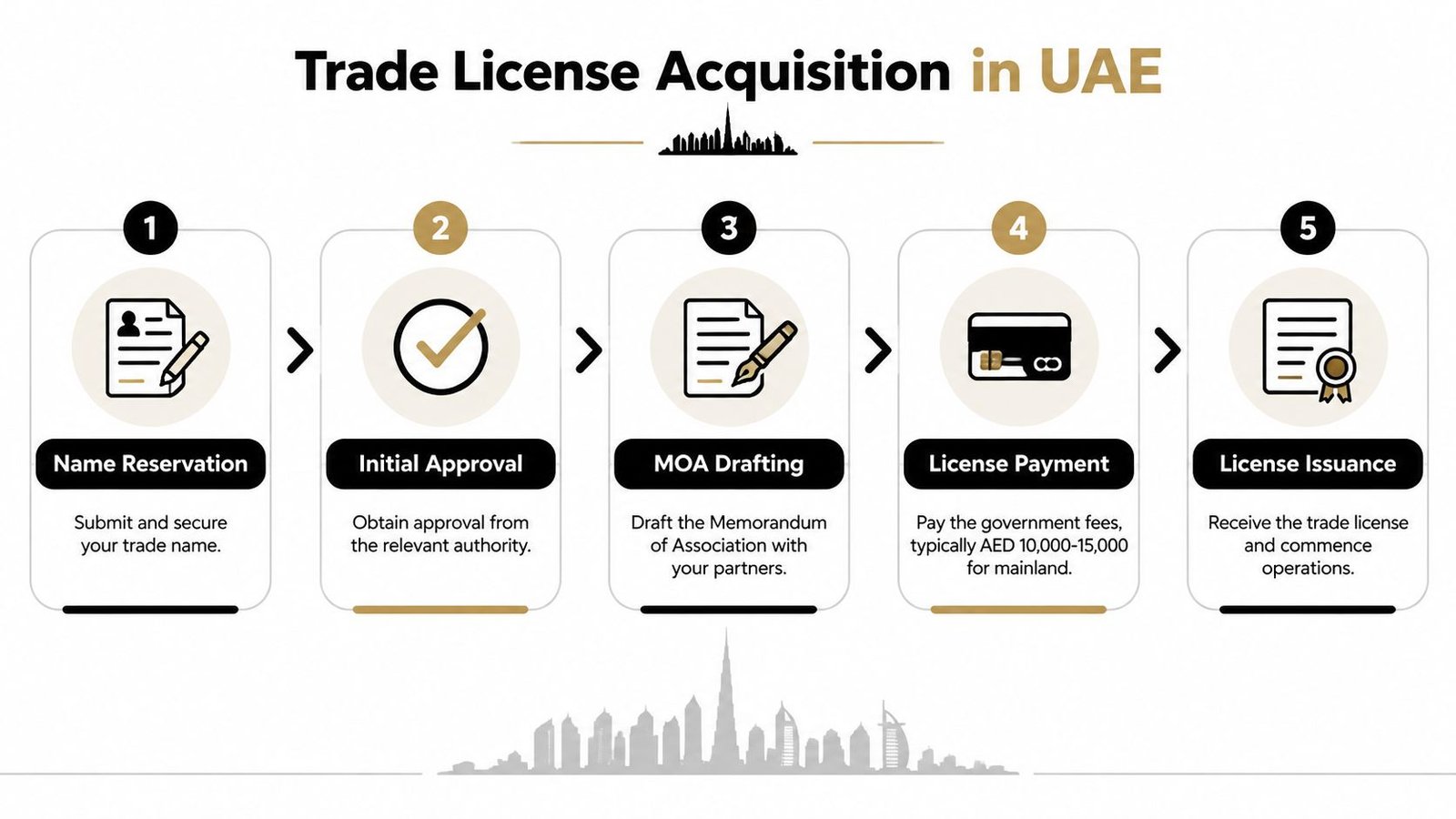
What happens before the trade licence is issued?
First, reserve the trade name. The name must meet the relevant authority's naming rules and shouldn't suggest activities or regulated services that aren't included in your application.
Next, obtain initial approval. This confirms that the authority has no objection in principle to establishing the company. It isn't the final licence, and regulated activities can still require separate approvals from another government body.
Then, prepare the Memorandum of Association, or MoA. An MoA is the document that records the company's ownership and governance arrangements. Where there are multiple shareholders, the document should reflect contribution, authority, transfer rights, and decision-making rather than copying a generic template.
Digital MoAs and e-signatures are legally recognised in most Emirates, which can reduce the need for some remote founders to attend every administrative step in person. The 2025 amendments also introduced tools such as re-domiciliation, multi-class share structures for onshore companies, and statutory drag-along and tag-along rights. These provisions matter to startups planning for investment, shareholder transfers, or a future move between licensing authorities, as discussed in what changed in UAE business registration.
What documents and approvals are usually required?
The exact list changes by authority, activity, and shareholder profile, but the application commonly involves:
- Identity documents, including passport copies for shareholders and managers.
- Trade-name and activity details, written in a way that describes the actual business.
- Premises evidence, such as a tenancy document or approved facility arrangement.
- MoA or incorporation documents, signed through the accepted process.
- External approvals, where the activity involves regulated professional, financial, health, education, food, transport, or technical services.
The final stage is payment and licence issuance. After that, the company still needs post-licensing work, including immigration establishment files, investor or employee visas, Emirates Identity Card applications, tax registrations where applicable, and banking.
The activity description is not a formality. If the licence says one thing and your website, contracts, invoices, and bank application describe another, the mismatch can create problems after incorporation.
Overcoming the Corporate Banking Bottleneck
A trade licence proves that an authority has approved your company. It doesn't guarantee that a bank will accept the account application. Banks assess the people behind the company, the source of funds, expected transactions, customers, countries involved, and whether the company has a credible operating reason to exist in the UAE.

Market sources report that 60% to 65% of SME and startup corporate bank applications face delays or rejection, with incomplete Ultimate Beneficial Owner, or UBO, documentation cited in 63% of failures, according to guidance on UAE bank-account rejection. A UBO is the individual who ultimately owns or controls the company, even where ownership passes through another company.
What should a bank-ready pack contain?
Prepare the banking file before you finalise the licence. That lets you test whether your proposed activity and structure make sense to a compliance team, rather than discovering a problem after paying setup costs.
Include:
- A clear UBO chart: Show every ownership layer until the real individuals are identified.
- A source-of-funds trail: Explain where the initial capital comes from and provide supporting records.
- A practical business plan: Describe customers, services, pricing, suppliers, territories, and expected payment flows.
- A contract pipeline: Signed contracts, proposals, purchase orders, or credible customer correspondence can demonstrate commercial intent.
- A licence-to-activity explanation: Use the same language in the licence application, website, contracts, invoices, and bank form.
- Manager and shareholder profiles: Explain relevant experience and the reason for establishing in the UAE.
Why do applications fail even after incorporation?
A company can be legally registered yet look incomplete from a bank's perspective. A free-zone entity with no coherent customer market, unclear ownership, unexplained international transfers, or activities unrelated to its licence may face enhanced questions.
The same applies to hybrid models. If a free-zone company plans to contract onshore through a branch or permit, the bank needs to understand which entity invoices the customer, which account receives funds, and how the records are maintained. Separate financial records for mainland activity should be planned from the start where the operating route requires them.
Starting with a bank that appears convenient isn't always the right move. Compare account requirements, interview expectations, transaction corridors, minimum-balance policies, and the bank's familiarity with your industry before applying.
Tax Compliance and Visa Pathways
Tax registration and residency planning should be part of the setup decision, not tasks left until the first invoice arrives. The UAE has a business-friendly tax framework, but free-zone incorporation doesn't remove the need to assess corporate tax, VAT, records, and filing responsibilities.
When must a UAE company register for VAT?
VAT is a consumption tax charged on taxable supplies. The Federal Tax Authority requires registration when taxable supplies and imports exceed AED 375,000, while voluntary registration may be available once the total exceeds AED 187,500, according to the Federal Tax Authority VAT registration rules.
Track turnover from the beginning and keep invoices, contracts, expense records, and tax evidence organised. The threshold is based on taxable supplies and imports, so founders shouldn't assume that a small office or free-zone licence removes the obligation.
How does corporate tax apply?
UAE corporate tax uses a two-tier rate. Taxable income up to AED 375,000 is subject to 0%, while taxable income above that amount is subject to 9%, based on current UAE tax guidance summarised by UAE tax compliance guidance.
A free-zone company isn't automatically outside corporate tax. The result depends on taxable income, qualifying conditions, income type, records, and whether the business maintains the substance required for its position. Keep accounting records from the first transaction and have a tax adviser review the structure before the first filing deadline.
Who can qualify for a Golden Visa?
The Golden Visa is a long-term residence pathway for eligible investors, property investors, entrepreneurs, and other approved categories. The official UAE Golden Visa platform states that investor visas can run for 10 years for public-investment investors and 5 years for real-estate investors, with a minimum capital requirement of AED 2 million for public investments.
Property investors can qualify through property ownership or a contribution to an establishment that pays at least AED 250,000 annually in taxes, subject to the official conditions. Entrepreneurs may qualify for a 5-year Golden Visa by showing a technical project, proof of project value, and a letter from a business incubator or relevant authority in the Emirate.
A trade licence alone doesn't guarantee Golden Visa approval. Keep the investment evidence, project documents, authority letters, and identity records consistent across the application.
Your 90-Day Setup Checklist and Cost Estimates
A workable first 90 days should run several tasks in parallel. While the licence is being processed, prepare banking documents, office arrangements, immigration files, accounting systems, and the evidence needed for any sector approvals.
What should happen before incorporation?
Start with the commercial decision. Confirm the customers you'll serve, the Emirates where you'll work, the activities you need, the shareholders, the intended office arrangement, and whether you'll need employee visas.
Then organise the evidence:
- Ownership file: Passport copies, shareholder details, and UBO information.
- Commercial file: Business plan, service descriptions, customer pipeline, and draft contracts.
- Premises file: Office or facility information appropriate to the selected authority.
- Compliance file: Any sector approval, tax assessment, and immigration requirements.
- Banking file: Source-of-funds records and a clear explanation of expected transactions.
How should the first 90 days be organised?
During the early stage, submit the name and licensing applications, finalise incorporation documents, and secure the premises arrangement. After licence issuance, begin visa and Emirates Identity Card processing, establish the company's immigration file, and submit the bank application with the complete pack.
The following period should focus on tax assessment, accounting setup, UBO records, employee documentation, contracts, invoicing, and operational controls. Before the 90-day point, review whether the selected structure still matches the business, check that activities remain within scope, and prepare for renewals and filings.
The infographic below provides a planning estimate based on the stated categories and assumptions. Actual costs vary by authority, activity, premises, visa requirements, and service scope.
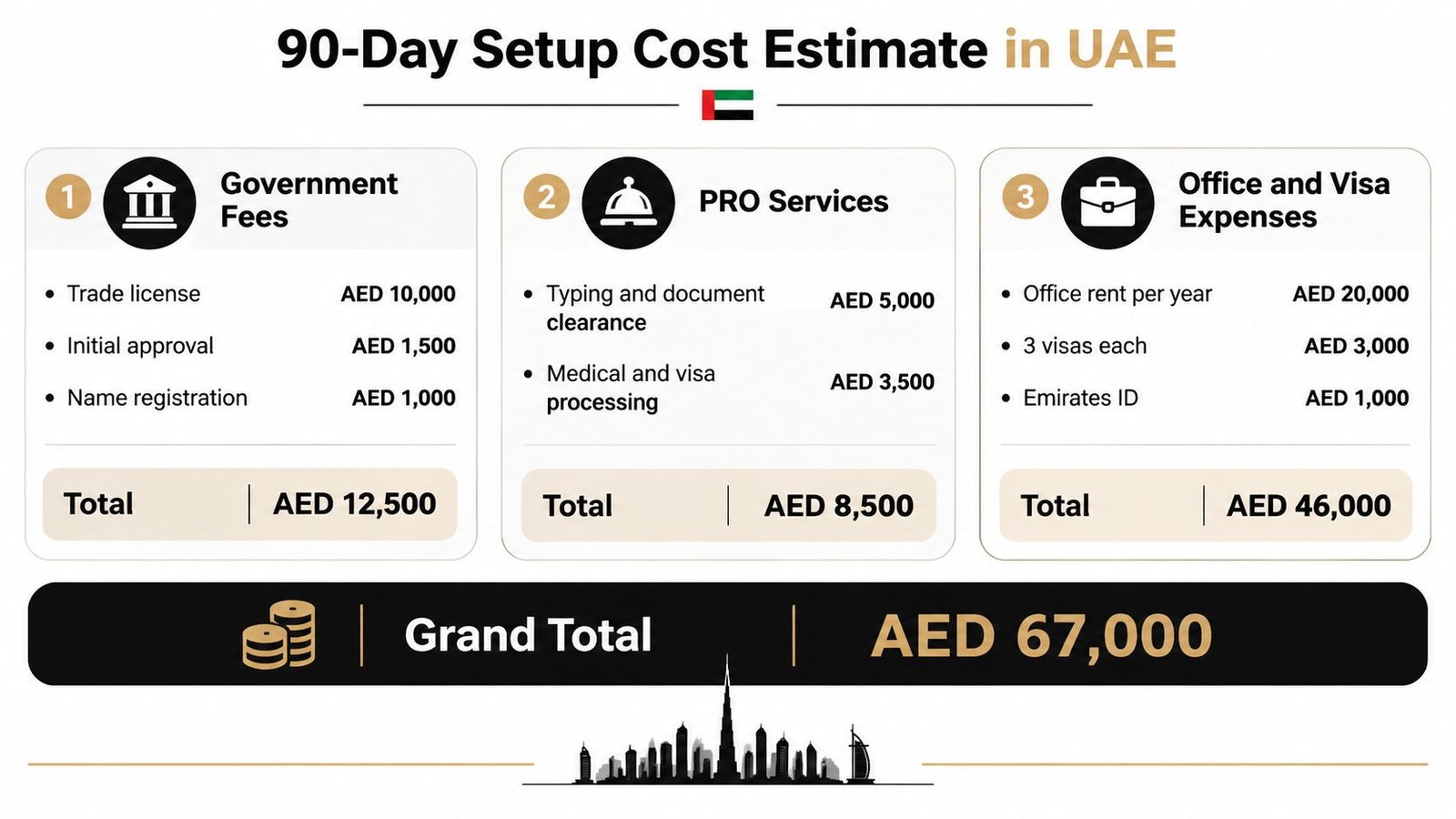
What cost estimate can a founder use?
The supplied estimate groups government fees at AED 12,500, including a trade licence, initial approval, and name registration. It lists PRO services at AED 8,500, covering typing, document clearance, medical processing, and visa processing. Office and visa expenses are shown as AED 46,000, producing a stated grand total of AED 67,000.
Treat this as a budgeting model, not a quotation. Ask any provider to separate authority fees, office costs, visa costs, tax work, banking assistance, and renewal obligations so you can see what is included and what may arise later.
If you want the structure, documents, visas, tax registrations, and banking preparation handled together, Inpro Corporate Services L.L.C. offers company formation across mainland, free-zone, and offshore routes, along with PRO, visa, accounting, tax, VAT, and corporate banking support. Visit Inpro Corporate Services L.L.C. to compare setup options, review your likely requirements, and request a practical plan for operating in the UAE.