


A clean UAE work visa usually takes 2 to 4 weeks, or around 10 to 20 working days from the first approval to completed residency steps. When jurisdiction, medical, security, or document issues add time, the practical range can extend to 2 to 6 weeks.
That difference matters if you're hiring a new employee, relocating as a founder, or arranging a start date around a lease or flight. The United Arab Emirates work visa isn't one approval issued by one office. It's a sequence involving employment approval, entry permission, medical fitness, biometrics, residence processing, and Emirates ID. Each stage can create a queue, and one missing document can hold up the stages that follow.
Table of Contents
- How Long Does a UAE Work Visa Really Take
- Understanding the UAE Work Visa Journey From Start to Finish
- Typical Processing Time for Each Visa Stage
- How Timelines Vary by Jurisdiction and Visa Type
- What Can Speed Up or Slow Down Your Application
- Expedited Options and Realistic Expectations for Founders and HR Teams
- Planning Your UAE Hiring Timeline With Confidence
How Long Does a UAE Work Visa Really Take
What is the UAE work visa processing time in practice?
For a straightforward employment file, plan around 10 to 20 working days, commonly described as 2 to 4 weeks from submission through the required residency steps. A practical range of 2 to 6 weeks is safer when the applicant's location, emirate, free-zone authority, medical appointment, document attestation, or security review adds time. UAE Expert Hub's 2026 employment-visa timeline separates the process into individual working-day stages.
The shorter estimate applies when the employer has the correct quota, the role needs no additional clearance, the documents are complete, and the government system accepts the file without requesting corrections. It also assumes the employee can attend medical and biometrics appointments promptly. A missing document can hold up every later stage, much like a blocked checkpoint on a route.
Why should employers plan in working days?
Government estimates generally use working days, not calendar days. Weekends, public holidays, appointment availability, and review queues can therefore extend a process that appears short on paper.
A founder may reason, “If approval takes two weeks, the employee can start in two weeks.” That plan can fail because the employee must satisfy the relevant work authorisation and residency requirements before beginning the intended employment. Set the start date after the stages affecting the employee's ability to work and reside have cleared.
Practical rule: Treat the shortest timeline as an operational target, not a promise. Keep the licence, quota details, passport copy, role information, attestation records, and appointment availability ready before submission.
What changes the timeline most?
The main variables are jurisdiction, applicant location, role classification, quota availability, document quality, and appointment timing. A mainland employer in Dubai may follow a different authority workflow from a company in a free zone. The employer should confirm which authority handles the file before applying, because the authority determines the submission path and available appointments.
An applicant already in the United Arab Emirates may need a status change. Someone outside the country follows an entry-based route. Those routes do not always produce the same sequence or waiting points, so HR teams should confirm the employee's location and intended start date before booking travel or announcing a joining date. The timeline becomes easier to manage when each government stage is tracked separately rather than treated as one approval.
Understanding the UAE Work Visa Journey From Start to Finish
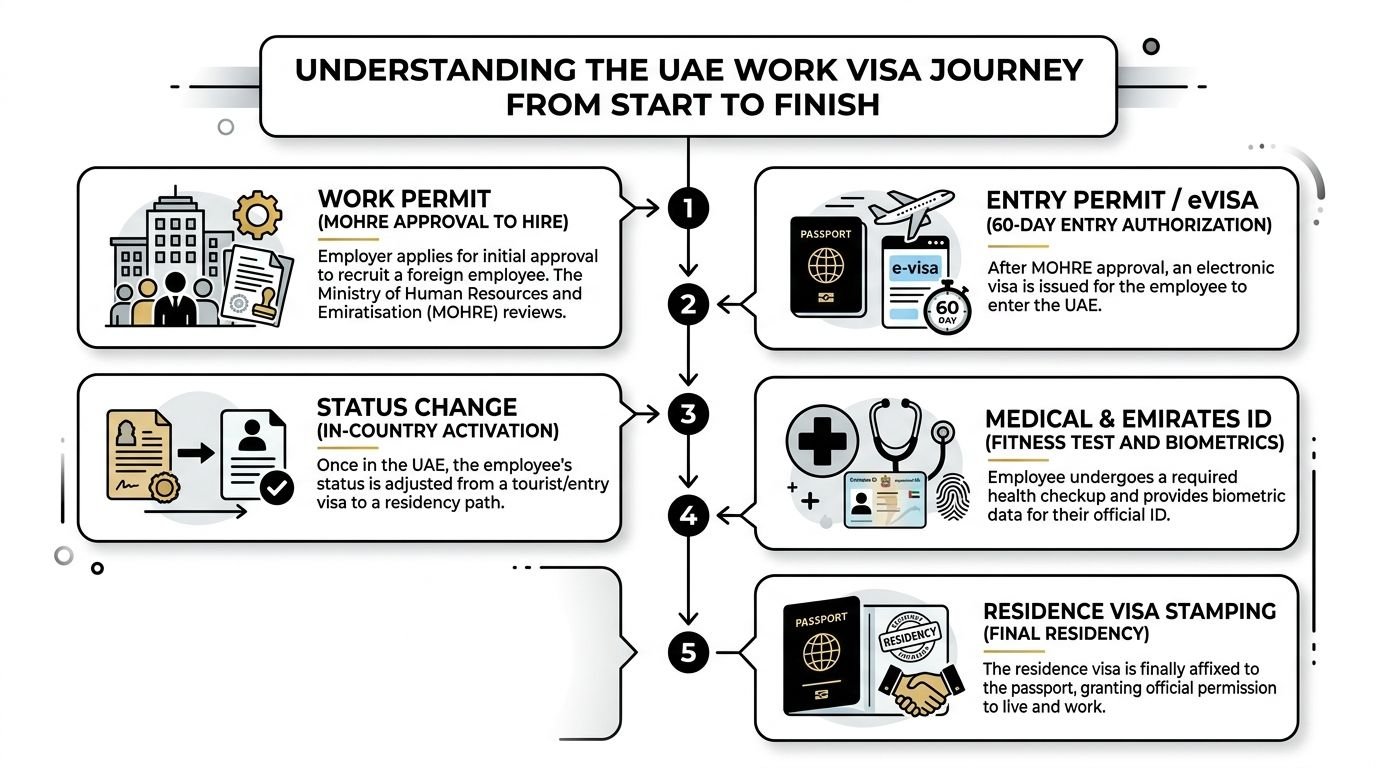
A UAE work visa is a sequence of linked approvals, not one document issued in a single step. Understanding the handoffs helps founders and HR managers identify the points that can turn a short application into a much longer wait.
What is a work permit?
A work permit is the employment authorisation that lets an employer hire a worker under the applicable UAE labour process. For mainland employment, the Ministry of Human Resources and Emiratisation, known as MOHRE, handles labour and employment matters. A free-zone employer usually works with the authority responsible for that zone, while later immigration steps still use United Arab Emirates government channels.
The employer normally begins the file. The company needs an eligible licence, an available quota where applicable, and role and employee details that match the submission. A work permit authorises employment. It does not, by itself, complete the employee's residence process.
What is an entry permit?
An entry permit allows an employee outside the United Arab Emirates to enter the country and continue the employment residence process. It is one handoff in the journey, not the final approval.
The permit also sets a completion window. UAE-specific guidance describes an entry permit that allows the applicant to enter and remain for up to 60 days while the employer completes the residence process, as explained in Aetna International's Dubai working-visa guide.
What happens after entry?
After arrival, the employee generally completes a medical fitness test and biometrics, the collection of identifying details such as fingerprints and a facial image. An employee already inside the UAE may require an in-country status change. This changes the immigration record from the existing status to the employment route, so the sequence may differ from an overseas applicant's route.
The employer or an authorised representative submits and coordinates the applications. The employee must attend the physical appointments. A missed appointment does not automatically mean refusal, but it can create another queue and hold up the next submission. HR should therefore confirm appointment availability before promising a joining date.
What are residence stamping and Emirates ID?
Residence visa stamping records the employee's residence permission after the preceding requirements are complete. Emirates ID is the identity card issued to UAE residents. These steps are connected, but they are not interchangeable. A completed work permit or entry permit does not confirm that residence processing is finished.
The journey works like a relay race. The employer starts with work authorisation, immigration issues entry permission, the employee completes the required appointments, and the residence and identity steps follow. A delay at one handoff holds up the stages behind it.
The process is becoming more digital. The MOHRE Work Bundle update describes changes intended to reduce required documents and in-person visits. Digital filing still does not remove medical testing, biometrics, or residence processing.
Typical Processing Time for Each Visa Stage
How long does each stage usually take?
A UAE work visa is a chain of approvals, appointments, and identity checks. For a standard case, the commonly cited 2026 timeline gives the following working ranges:
| Stage | Typical Time | Notes |
|---|---|---|
| Work-permit approval | 2 to 5 working days | Employer-led approval for a standard case |
| Entry-permit issuance | 2 to 5 working days | Allows the employee to enter and continue the process |
| Medical-test results | 24 to 48 hours | Depends on appointment and result processing |
| Emirates ID processing | 5 to 7 working days | Biometrics and identity-card workflow |
| Residence-visa stamping | 1 to 3 working days | Final residence processing step |
These ranges are set out in UAE Expert Hub's 2026 timeline for obtaining a UAE work visa. The source describes a straightforward file as taking 10 to 20 working days total. That total is a planning guide, not a guaranteed completion date, because some stages can overlap while others must wait for the previous approval or appointment.
Why don't the stage ranges simply add up?
The stages do not always run in a single line. An employer may prepare the next submission while an earlier approval is being completed, which can shorten the calendar time. A missing document, a status-change requirement, or an unavailable appointment can have the opposite effect by stopping the next handoff.
The entry permit provides a 60-day period for the employee to enter and complete the residence process. It gives HR a completion window, not permission to leave the file unattended. Medical checks, biometrics, identity processing, and residence formalities still need to be arranged within that period.
A useful comparison is a relay race. Each stage passes the file to the next team, and one missed handoff holds up everyone behind it.
Where is the critical path?
The first work-permit approval often receives the most attention because it opens the application. The longest wait may instead occur later, during medical fitness, biometrics, Emirates ID processing, or residence stamping. This is particularly relevant when the employee is already in the UAE or the preferred medical or biometrics centre has limited appointment availability.
For founders and HR managers, the practical checklist is simple:
- confirm that passport and employment documents match before submission;
- check whether the employee is inside or outside the UAE;
- book the next available medical appointment as soon as entry permission allows;
- prepare the employee for biometrics and identity-card requirements;
- track each approval together with its next required action.
An entry permit does not complete the employment residence file. The employee still needs the remaining appointments and residence processing before onboarding is fully secure.
The fastest first approval will not produce a fast joining date if the next appointment or residence submission is not ready.
How Timelines Vary by Jurisdiction and Visa Type
Does mainland processing differ from free-zone processing?
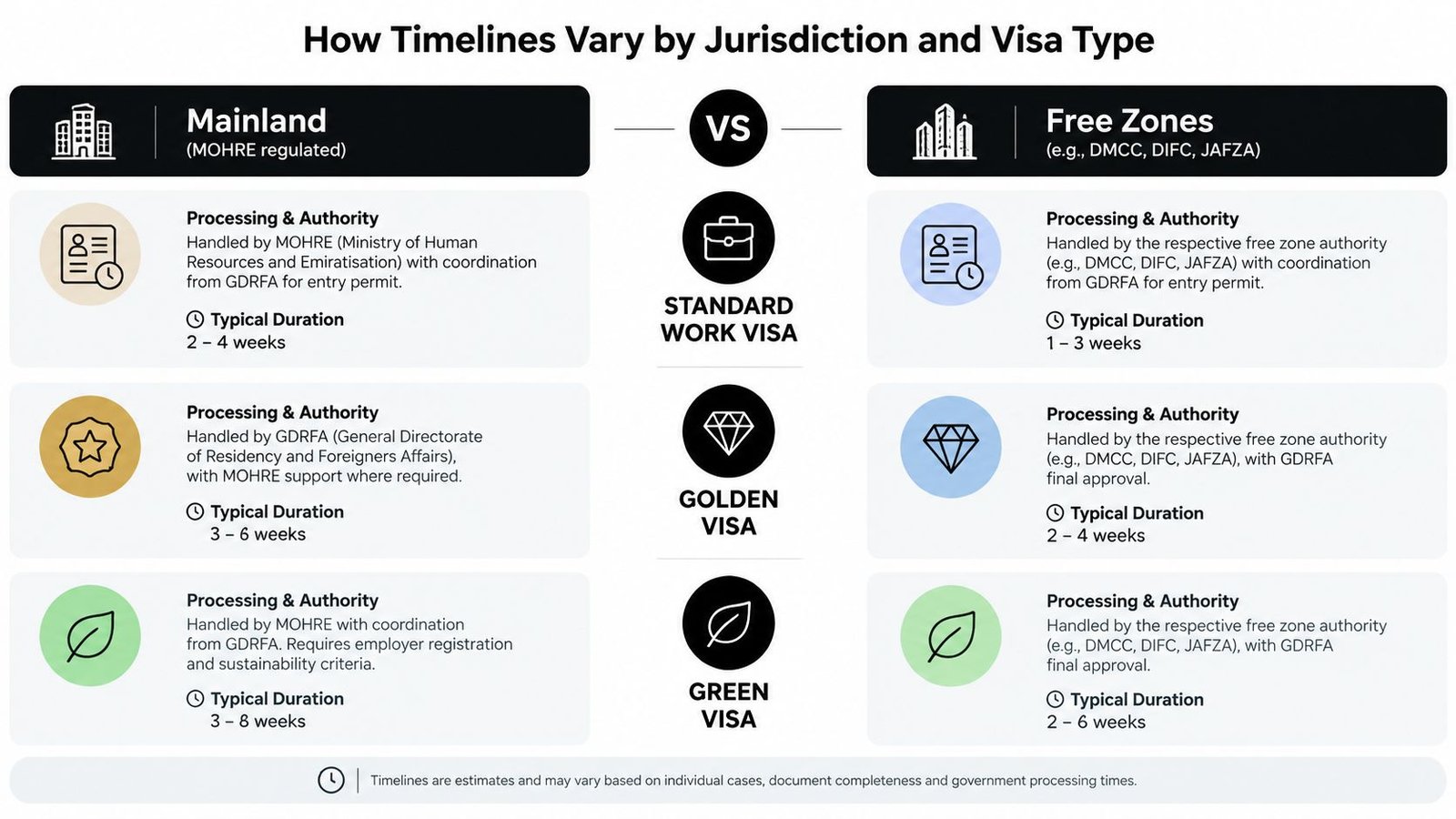
Yes. Mainland companies operate under the UAE's general commercial framework, so standard employment files commonly pass through MOHRE, the Ministry of Human Resources and Emiratisation. Free zones are designated business areas with separate licensing and administrative authorities. Their employers may submit employment files through the relevant zone instead of the mainland route.
Examples include Dubai Multi Commodities Centre, or DMCC, Dubai International Financial Centre, or DIFC, Jebel Ali Free Zone, or JAFZA, and Abu Dhabi Global Market, or ADGM. These authorities do not share one processing queue. Each may apply different internal checks, quota rules, and document requirements before the file reaches immigration stages.
For a founder or HR manager, the practical question is not just, "Is this a free-zone visa?" Check which authority sponsors the role, whether its quota is available, and whether its employment documents match that authority's format. A short internal review at this point can prevent the file from waiting between the employer submission and the next government stage.
How do Dubai, Abu Dhabi, and Sharjah affect timing?
The emirate affects the local immigration and administrative channels used for the application. Dubai, Abu Dhabi, and Sharjah may therefore differ in appointment availability, authority procedures, and employer requirements, even though the broad employment sequence remains similar.
A Dubai mainland file, an Abu Dhabi company file, and a Sharjah free-zone file should not receive one universal deadline. The employer's licence, sponsoring authority, role, and applicant status all matter. Ordinary UAE employment visa cases can fall within a wider 3 to 6 week range when documentation, security checks, or mainland and free-zone procedures add waiting time. For planning, treat this range as a risk window rather than a promised completion date.
Does visa type change the workflow?
A standard employee visa is employer-sponsored and follows the work-permit-to-residence sequence described earlier. A Golden Visa is a long-term residence route for eligible categories. A Green Visa is a separate residence route that may apply to eligible skilled professionals, freelancers, and investors. Neither is merely a faster version of a standard employee file, because the eligibility evidence and approving authority differ.
Applicant location also changes the sequence. Someone outside the UAE normally needs entry permission before completing local medical and biometric steps. Someone already in Dubai, Abu Dhabi, or Sharjah may need an in-country status change. That removes part of the travel sequence but adds its own administrative action.
The comparison below shows how expected processing timelines can differ between mainland and free-zone jurisdictions.
What Can Speed Up or Slow Down Your Application
Which employer checks prevent avoidable delays?
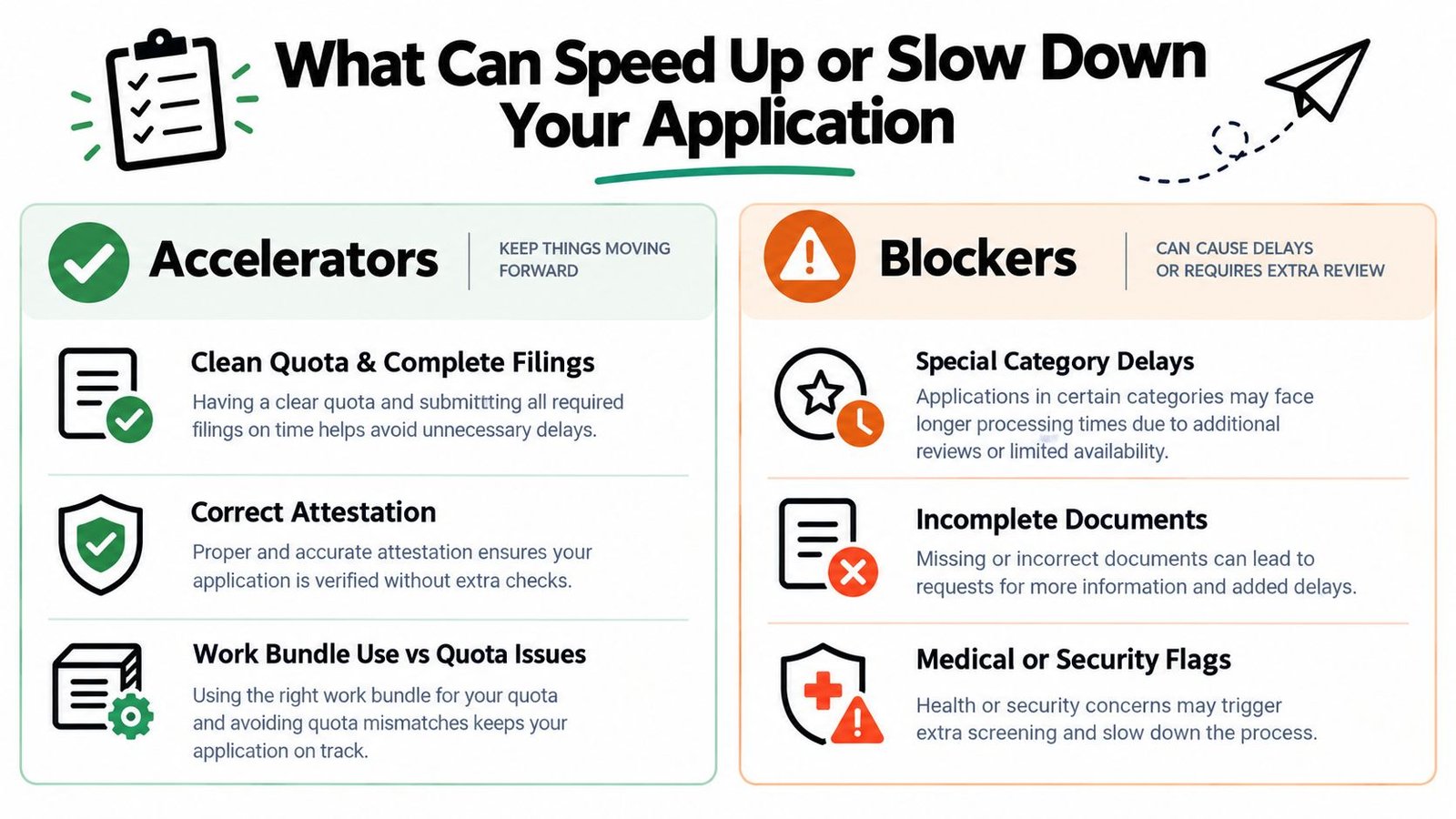
A fast file begins with checks before upload. The employer should confirm that the company may sponsor the role, that the required quota is available, and that the job details match the trade licence and employment documents.
Use this pre-submission checklist:
- Confirm quota eligibility: Resolve quota questions before filing, rather than after a rejection or hold.
- Match all names and details: Compare the passport, offer, contract, application, and licence for identical spelling and identity information.
- Prepare attested documents: For roles requiring educational or professional evidence, confirm whether attestation is needed before submission.
- Check applicant location: Decide whether the employee will apply from outside the UAE or complete an in-country status change.
- Book the next action early: Keep medical fitness testing and biometric scheduling in view once the entry stage is available.
The 2026 Work Bundle update made the employer-side quota step faster, with instant issuance reported for eligible cases. The change affects one stage only. Medical fitness testing, biometrics, Emirates ID, and residence stamping still require their own appointments, submissions, and approvals.
What role classifications take longer?
A standard mainland employment file generally takes around 2 to 5 working days for the work permit. Special-categorised roles may take around 15 working days because they require additional ministerial clearance, as explained in Dubai South Business Hub's work-permit status guidance.
This classification can alter the hiring plan before the employee reaches medical testing. HR should identify the role category at the start, rather than applying the standard permit estimate to every position.
What file problems commonly create a six-week timeline?
Incomplete documents, incorrect attestation, quota issues, medical retesting, security checks, and free-zone authority dependencies can extend the application. A replacement scan may seem minor, but the next authority may pause the file until the corrected document is uploaded and reviewed.
The employee's schedule can create another queue. Delayed travel, unavailable appointments, or a medical result requiring further review may add waiting time that resubmitting the original application cannot remove.
For a founder or HR manager, the practical control point is handoff discipline. Keep one checklist showing the responsible person, the next authority, the outstanding document, and the next appointment. This makes a small correction visible before it becomes a delay between government stages.
Expedited Options and Realistic Expectations for Founders and HR Teams
What did the Work Bundle change?
The Work Bundle is a UAE government workflow that reduces document handling and in-person steps during employment processing. One 2026 source says the Ministry of Human Resources and Emiratisation (MOHRE) work-permit stage was reduced to up to 5 working days from an earlier 30-day timeline, while the latest MOHRE update states that the quota stage can be issued instantly. Sarmat's 2026 employment-visa guidance describes the earlier Work Bundle reduction.
This may shorten the employer-side opening stage, especially for eligible mainland files. It does not make the complete employment visa instant. Medical fitness testing, biometrics, Emirates ID, and residence stamping still require separate appointments, submissions, and approvals.
How can a founder reduce avoidable lead time?
Begin with the items the company controls. Confirm the trade licence and quota position, collect clear passport copies and employment documents, check attestation requirements, and decide whether the employee will enter from abroad or change status inside the UAE.
Submit one complete digital file in the required format. Partial submissions create correction requests and another review queue. A complete file cannot guarantee approval, but it reduces administrative back-and-forth.
What should HR communicate to the employee?
Give the employee a sequence rather than one optimistic date. Receiving the entry permit is only one milestone. Medical fitness, biometrics, Emirates ID, and residence completion follow through separate government stages.
For teams hiring in Dubai or Abu Dhabi, use a shared tracker with the application reference, current authority, next action, document owner, and appointment date. This keeps responsibility clear when a file pauses. Avoid non-refundable travel bookings or a fixed joining date based only on the shortest estimate.
A practical checklist should also record the employee's travel status, document corrections, appointment availability, and any authority handoff. These small checks help prevent a file from stretching from roughly two weeks toward six weeks.

Planning Your UAE Hiring Timeline With Confidence
When should you set the start date?
Plan around 2 to 4 weeks for a clean UAE employment visa file, with a straightforward route often taking 10 to 20 working days. Allow for the broader 2 to 6 week range if the employer uses a free zone, the employee changes status inside the UAE, the role requires clearance, or documents and appointments are incomplete.
Treat the visa like a relay. Each government stage must hand the file to the next one, so a submission date alone cannot confirm the joining date. Check the entry permit or residence stage before booking flights, housing, or a fixed start date.
Preparation reduces avoidable pauses. Confirm the employer's quota and authority route, assign an owner to each document, and track medical fitness, biometrics, Emirates ID, corrections, and authority handoffs. Tell the employee that an entry permit is one milestone, not the finished residence process. These checks can keep a file near two weeks instead of allowing it to approach six.