


Dubai trade licence renewal is now fully online through the Invest in Dubai portal and DET eServices for mainland companies, and through each free-zone authority's own portal for free-zone companies. After expiry, businesses have a 30-day grace period before AED 250 monthly fines begin.
You may be checking the date because a bank has requested an updated licence, an employee visa process is waiting, or a renewal reminder has landed while you're managing clients and payroll. The process is usually straightforward when the company details, tenancy record, approvals, and account access are ready. It becomes slower when the wrong authority is selected or one document has expired.
The first decision is simple. Check whether your licence was issued by Dubai's Department of Economy and Tourism, commonly called DET, or by a free zone such as DMCC, JAFZA, DIFC, DAFZ, or IFZA. That single detail determines the portal, document list, fee schedule, and authority that issues the renewed licence.
Table of Contents
- What Renewing Your Dubai Trade Licence Online Actually Means
- Mainland or Free Zone and Why It Changes Your Renewal
- Step-by-Step Mainland Renewal Through Invest in Dubai
- Step-by-Step Free Zone Renewal Through the Zone Portal
- Fees Timelines and the 30-Day Grace Window
- Common Errors That Block Online Renewal
- When to Use a PRO Service Like Inpro
What Renewing Your Dubai Trade Licence Online Actually Means
Dubai trade licence renewal online means submitting the annual renewal application, confirming continuing compliance, paying the required government charges, and downloading the renewed licence electronically. For a mainland company, the official route is the Invest in Dubai trade licence renewal service, supported by DET eServices. Users can sign in with UAE Pass and complete the transaction without visiting a service centre.
A trade licence is the government authorisation that permits a company to carry out its approved commercial, professional, or industrial activity. Renewal keeps that authorisation current and supports the company's legal continuity and good standing. Dubai Development Authority guidance also tells licence holders to renew annually and on time to keep the licence valid, as stated in its official licence renewal guidance.
What happens during the online renewal?
The government system can prefill company information, check external approvals, and generate a payment voucher before final approval. In practical terms, this replaces several manual steps with one digital workflow, provided the licence record and supporting documents are in order.
For mainland companies, you'll generally work through Invest in Dubai or DET eServices. Eligible licences may also have access to Dubai Now and SMS renewal through 6969, as described in Dubai's online renewal channel guidance.
Free-zone companies don't use one shared Dubai renewal portal. Each authority controls its own online account, document requirements, invoices, and licence download. A DMCC company renews through DMCC, while a company in JAFZA, DIFC, DAFZ, or IFZA follows that zone's process.
Why does the renewed licence matter?
Banks commonly request a current licence during account reviews. Immigration and visa transactions can also depend on the company holding a valid licence, while counterparties may ask for the updated document before signing or renewing contracts. A payment receipt shows that money was submitted, but it isn't the same as the renewed licence PDF.
Practical rule: Save the final licence PDF, payment receipt, tenancy record, and approval documents together in the company's compliance folder.
Mainland or Free Zone and Why It Changes Your Renewal
A DET mainland licence and a free-zone licence may both support businesses in Dubai, but their renewal mechanics are different. Mainland licences are issued by DET and use Dubai's mainland government workflow. Free-zone licences are issued by the relevant zone authority and stay inside that authority's portal.
For a mainland company, the tenancy record is usually the key supporting document. Dubai businesses commonly use an Ejari registration, which is the official record of a tenancy contract. If the Ejari has expired, the portal may stop the application even when the trade licence itself remains within its renewal window. Regulated activities can also require an approval from an authority such as Dubai Municipality or the Roads and Transport Authority, known as RTA.
A free-zone company normally submits the zone's own tenancy evidence, office agreement, flexi-desk attestation, or equivalent occupancy document. The zone's membership and compliance records also control the renewal. DET involvement generally becomes relevant only where a separate mainland arrangement exists, such as a dual-licence structure.
Which authority issues the renewed document?
The issuing authority follows the licence header, not the company's address or where its employees work. A licence carrying a free-zone logo renews inside that free zone. A DET mainland licence renews through Dubai's mainland channels.
| Item | DET Mainland | Free Zone, such as DMCC or IFZA |
|---|---|---|
| Renewal portal | Invest in Dubai and DET eServices | The relevant free-zone member portal |
| Tenancy evidence | Valid Ejari or accepted mainland occupancy record | Zone contract, flexi-desk record, or zone-approved attestation |
| External approvals | May be requested for regulated activities | Depends on the activity and zone |
| Licence issuer | Department of Economy and Tourism | The relevant free-zone authority |
| Main risk | Expired Ejari or missing approval | Wrong zone portal, expired zone record, or missing zone document |
Don't begin by searching for a generic Dubai renewal form. Begin with the licence issuer. That prevents the common mistake of trying to renew a free-zone company through DET.
Step-by-Step Mainland Renewal Through Invest in Dubai
Mainland renewal is easiest when you treat it as a document check before it becomes a payment task. The portal can confirm data quickly, but it can't correct an expired tenancy record or replace an approval that your activity requires.
What should you check before signing in?
Start with the expiry date printed on the existing trade licence. Check the company's Ejari status at the same time, then review the activity and shareholder details shown on the licence. If the business operates in contracting, transport, food, healthcare, education, or another regulated field, locate the current external approval before opening the application.
Sign in to Invest in Dubai with UAE Pass and open the trade licence renewal service. The system uses the licence number or the trade name to locate the company record, then pre-populates available information from DET records. A practical walkthrough of the Dubai renewal flow describes the same basic sequence, including UAE Pass access, licence selection, confirmation, and online payment.
What do you verify inside the application?
Read every prefilled field. Confirm the trade name, activity code, legal form, shareholders, manager details, and registered address. Don't assume that an old activity code is still accepted just because it appears on the current licence. If the portal asks for an external approval, upload the current document rather than an older copy from the previous renewal.
The system then generates the payment voucher or moves you to the ePayment screen. Review the line items before authorising the payment. The receipt is useful for your records, but wait for the renewed licence PDF and download it from the portal once approval is complete.
The file you need for a bank review or visa transaction is the renewed licence, not only the payment confirmation.
Save the PDF with the renewal date and keep it beside the receipt, Ejari, approvals, and company constitutional documents. This makes the next bank KYC refresh, visa stamping request, or contract review easier for your HR or operations team.
Step-by-Step Free Zone Renewal Through the Zone Portal
Free-zone renewal follows a familiar shape, but the details belong to the authority. A DMCC renewal is a useful example because the company manager works through the DMCC member portal rather than Invest in Dubai.
How does a DMCC renewal usually begin?
Use the company's DMCC portal username, not an unrelated personal email account. Open the trade licence tile and check the current expiry date, lease status, outstanding compliance requests, and any pending external approval. If the account shows a blocked item, resolve that before moving to the invoice.
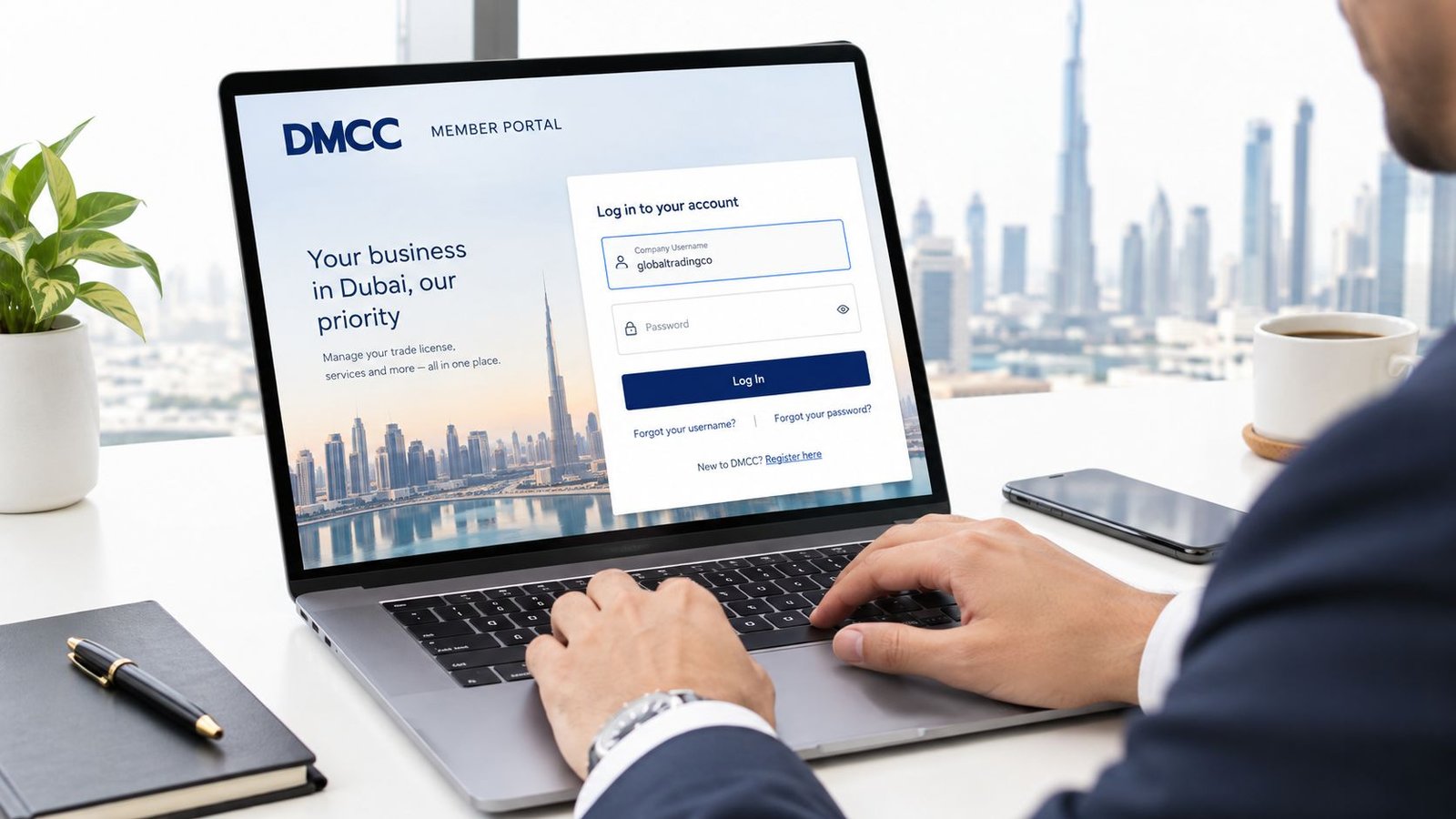
Prepare the renewed Ejari or the free-zone office contract, the establishment card copy, the manager's Emirates ID, and any activity-specific no-objection certificate, commonly called an NOC, listed under “required documents”. The portal may ask for additional records based on the activity or company structure.
What happens after document review?
Upload each file in the requested format and check that names, dates, and company identifiers match the portal record. A mismatched manager document or incomplete lease upload can send the application into manual review.
The invoice normally separates the licence charge from other applicable items. If the trade name changed, an attestation charge may appear. If the licence has already lapsed, the zone can add its own late penalty. Pay through the portal, then open the licence history tab and download the renewed PDF.
JAFZA, RAKEZ, and Dubai Internet City use the same broad pattern, account access, document upload, payment, and licence download. Their login addresses, calculators, lease evidence, and approval lists differ, so copy a checklist from another zone only as a starting point.
The video below provides another visual reference for the kind of online workflow companies may encounter.
Fees Timelines and the 30-Day Grace Window
Budgeting for renewal requires more than looking at one headline fee. The final amount depends on the issuing authority, business activity, tenancy arrangement, approvals, and whether the company has missed the deadline.
For mainland companies, the renewal may include the licence renewal charge, commercial register renewal, Chamber of Commerce subscription, and other itemised government charges shown in the payment voucher. An expired licence can also create a late-payment problem. A commonly cited Dubai rule gives the business a 30-day grace period after expiry, after which fines may begin at AED 250 per month, according to this Dubai trade licence penalty guidance.
The grace period shouldn't be treated as extra operating time. During the overdue period, banks, visa teams, clients, and government departments may still ask for a current licence. Free zones apply their own renewal invoices and penalties, so the exact amount must come from the company's authority account.
What should your working budget include?
| Cost line | DET mainland | DMCC | RAKEZ |
|---|---|---|---|
| Licence renewal | Issued as part of the DET payment voucher | Issued through the DMCC invoice | Issued through the RAKEZ invoice |
| Tenancy evidence | Ejari or accepted occupancy record | DMCC office or flexi-desk record | RAKEZ-approved tenancy evidence |
| External approval | Required where the activity calls for it | Required where the zone or regulator asks | Required where the zone or regulator asks |
| Late payment | AED 250 monthly after the stated grace period, where applicable | Zone-specific late charge | Zone-specific late charge |
| Final record | DET renewed licence PDF | DMCC renewed licence PDF | RAKEZ renewed licence PDF |
The safest timeline is to prepare documents before the expiry date, not after it. Treat the expiry date as a hard compliance milestone, even when the account still appears accessible.
Common Errors That Block Online Renewal
Most failed online renewals aren't caused by a difficult form. They happen because the portal checks a government record that the company hasn't updated. Run the audit before payment and you'll catch the issue while there's still time to fix it.
Which mainland issues cause the most trouble?
An expired Ejari is a common mainland blocker because the system checks the tenancy record against the registry. If the occupancy evidence is no longer valid, the renewal may stop before payment. Check the tenancy record first, then confirm that the company name and premises details match the licence file.
Other issues deserve the same attention:
- UAE Pass mismatch: The UAE Pass profile may not be linked to the licence manager's Emirates ID.
- Old activity code: The activity on the licence may no longer match the current DET classification.
- Missing approval: Dubai Municipality, RTA, or another regulator may need to approve the activity before DET completes renewal.
- Unattested name change: A trade name change may be recorded in one place but not properly attested in the renewal file.
- Unpaid government items: Outstanding fines or related company obligations can hold the application.
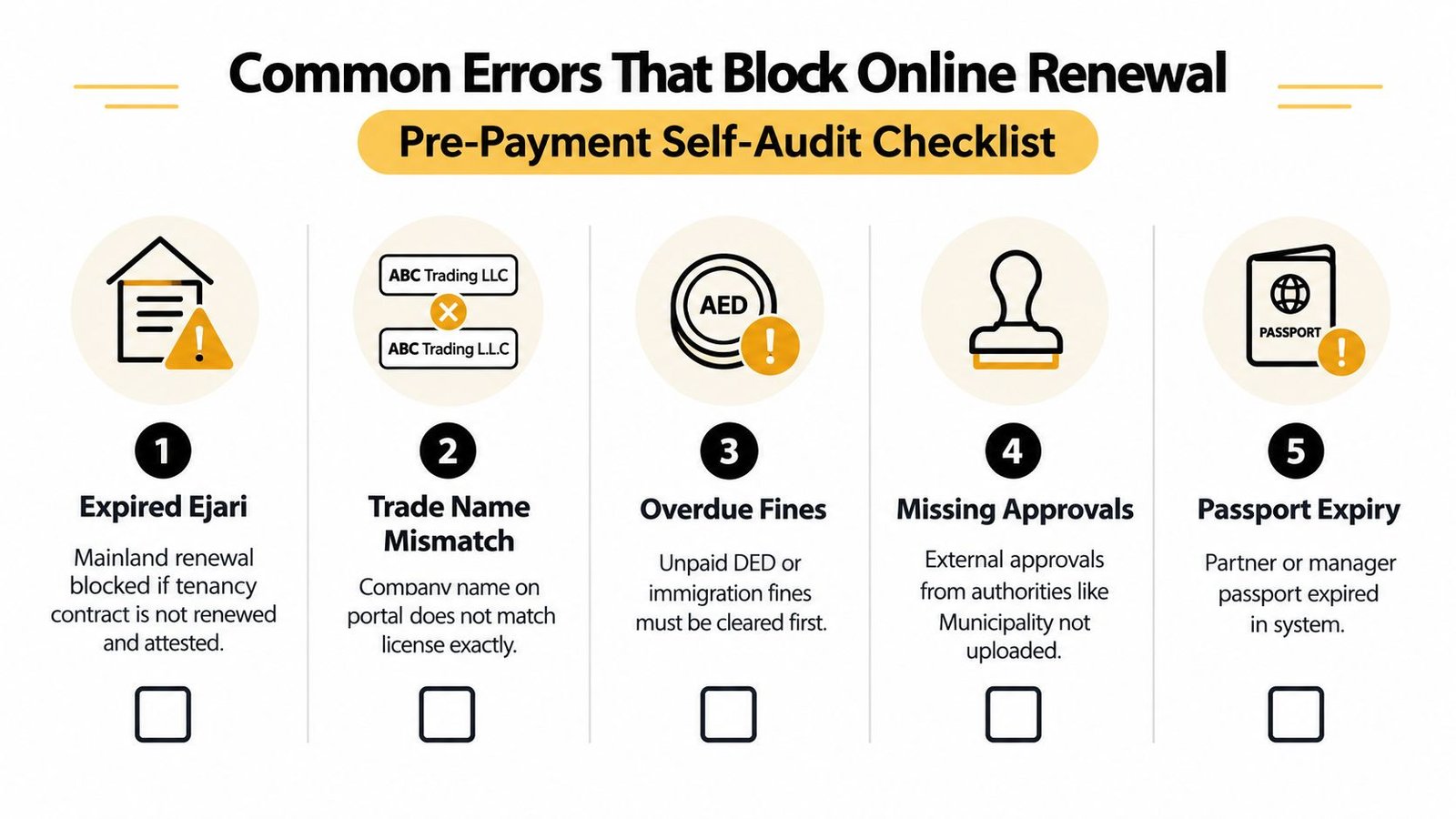
Free-zone companies face a different version of the same problem. Uploading a Dubai Chamber document when the authority wants its own membership certificate can create a rejection, even though the document may look relevant. Use the exact document name shown in the zone portal.
What should you check before pressing pay?
Match the company name, licence number, manager identity, tenancy dates, activity, and approval documents across the portal. If one record is inconsistent, stop and correct it rather than submitting a payment that may lead to manual follow-up.
When to Use a PRO Service Like Inpro
Doing the renewal yourself makes sense when the licence is active, the tenancy record is current, the activity is straightforward, and the authorised manager can access the correct portal. The process becomes a poor DIY task when the file has already fallen into an exception.
A PRO service, meaning a Public Relations Officer service, handles government-facing submissions, document follow-up, approvals, and status checks for a company. Consider one in three situations.
First, a lapsed licence may require more than clicking a renewal button. The company can face service-centre procedures, typed forms, or an approval memo, depending on the authority and file status. Second, regulated activities such as healthcare, education, financial services, and food trading can require approvals from bodies including the Dubai Health Authority, the Knowledge and Human Development Authority, the Dubai Financial Services Authority, or Dubai Municipality.
Third, an overseas founder may struggle with UAE Pass verification or an OTP-locked licence download. A local authorised representative can manage the final government steps and keep the company's records moving while the owner remains outside the UAE.
The trade-off is a service fee against your own time, follow-up, and the risk of further delay. Inpro Corporate Services L.L.C. provides UAE PRO and licensing support across mainland and free-zone companies, including renewal-related documentation and government workflow handling.
Send the PRO your current licence copy and last renewal receipt before authorising payment. They can check the authority, expiry status, document gaps, and expected government charges before giving you a renewal quote.
If your Dubai licence is due for renewal, Inpro Corporate Services L.L.C. can review the file, prepare the required documents, and manage the mainland or free-zone submission. Visit the team with your licence copy and expiry date so you can confirm the correct route before fines or portal delays begin.