


An offshore company in the UAE is a holding and international-activity vehicle formed through a registered agent in a designated offshore jurisdiction, most commonly JAFZA, RAK ICC, or Ajman Offshore. It cannot trade in the UAE domestic market or provide residence visas.
You may be comparing jurisdictions from a Dubai office, planning to hold shares in an international business, or trying to open a UAE bank account after hearing that offshore setup is simple. The registration itself can be orderly, but the decision comes earlier: do you need a holding vehicle, or do you need an operating company with local access, staff, and visas?
That distinction matters in the United Arab Emirates. By the end of 2025, the UAE had about 1.4 million active companies, up 119% since mid-2021, and around 760,000 companies had been established after the foreign-ownership reform. The country also issued around 250,000 new business licences in 2025, according to UAE business setup statistics and market trends. Offshore structures sit inside this much larger company-formation market, but they serve a narrower purpose.
Table of Contents
- What Offshore Company Setup in the UAE Actually Means
- Choosing Between JAFZA, RAK ICC, and Ajman Offshore
- Step-by-Step Formation Process and Documents Required
- Opening a Bank Account After Incorporation
- Tax, Substance, and Compliance in 2026
- Next Steps After Your Offshore Company Is Live
What Offshore Company Setup in the UAE Actually Means
What is a UAE offshore company?
A UAE offshore company is a legal entity incorporated through a registered agent in a designated offshore jurisdiction. The best-known options are JAFZA Offshore, RAK ICC, and Ajman Offshore, each operating under its own regulations, registrar, forms, and compliance procedures.
An offshore entity can hold international subsidiaries, shares in UAE free zone or mainland companies, real estate in permitted zones, intellectual property, yachts, and bank accounts. It can also support cross-border ownership and investment arrangements. These uses make offshore formation relevant to holding companies, international investors, and founders who want a separate ownership layer above an operating business.
It isn't a substitute for a trading licence. An offshore company generally can't sell goods or services inside the UAE mainland, conduct domestic commercial activity, or act as the local operating entity for UAE customers. It also can't sponsor employment or investor residence visas.
Practical rule: Choose offshore because your business needs an ownership or international-activity vehicle, not because the word “offshore” sounds cheaper.
The UAE offshore company framework is designed for international activity and asset holding rather than domestic trading. That distinction should guide the first meeting with your adviser. If your plan includes UAE invoices, local staff, warehouse space, or a residence visa, start with a free zone or mainland structure instead.
How does offshore differ from free zone and mainland setup?
A free zone company is licensed by a specific free zone authority, such as a Dubai, Abu Dhabi, or Sharjah free zone. Official UAE guidance confirms that free zones allow up to 100% foreign ownership, but the company's operating rights remain tied to the framework of that zone, as explained by the UAE Ministry of Economy and Tourism.
A mainland company is licensed by the relevant emirate's economic department and is intended for activity across the local market, subject to its licence and any sector controls. Foreigners can now own 100% of many mainland companies, following the ownership reforms described in official UAE government guidance.
Dubai also introduced a mainland-access route for free zone companies in 2025. U.S. Department of State reporting explains that Dubai Executive Council Resolution No. 11, issued in March 2025, allows free zone companies to operate legally on Dubai's mainland with the required permits from the Department of Economy and Tourism.
The decision tree is straightforward:
- Holding international shares or assets: Consider offshore.
- Operating inside a free zone: Consider a free zone licence.
- Selling to UAE customers or hiring local staff: Consider mainland or a suitable free zone structure.
- Needing residence visas: Offshore is the wrong tool.
Choosing Between JAFZA, RAK ICC, and Ajman Offshore
The three jurisdictions aren't interchangeable. They differ in reputation, documentation expectations, registered-agent support, banking conversations, and the signal they send to counterparties.
JAFZA Offshore has the strongest historical association with Dubai's free-zone system. The Jebel Ali Free Zone Authority was established in 1985, and Dubai granted it authority to create its own offshore company regime in 2003. The first framework was the Jebel Ali Free Zone Offshore Companies Regulations 2003, later replaced by updated regulations, as outlined in this history of JAFZA offshore company formation. That long-running legal architecture can help when a structure needs a recognised Dubai connection.
RAK ICC is often the practical default for a conventional international holding company. It suits founders who want a regulated UAE jurisdiction with a straightforward registered-agent process and broad use across holding and cross-border ownership structures.
Ajman Offshore can suit a smaller or simpler arrangement, particularly where the founder's priority is a lean holding structure, intellectual property ownership, or a yacht-related structure. It may attract closer questions from some banks, so the incorporation fee should never be the only selection criterion.
| Dimension | JAFZA Offshore | RAK ICC | Ajman Offshore |
|---|---|---|---|
| Best fit | Institutional holdings and family-office structures | Standard holdings and international ownership | Budget-sensitive holding, intellectual property, or property structures |
| Reputation | Strong Dubai recognition and established history | Broad practical acceptance for common holding structures | Suitable for simpler structures, with possible additional bank scrutiny |
| Cost position | Generally positioned at the premium end | Mid-range option | Generally positioned at the lower-cost end |
| Processing | Can require more detailed review | Often selected for a streamlined process | Often suitable where documentation is simple |
| Typical activities | Asset holding, shareholding, international structuring | Holding, investment, and cross-border ownership | Holding, intellectual property, property, and yacht-related uses |
| Banking signal | Stronger institutional comfort where the file supports it | Balanced choice for ordinary corporate banking | May require a clearer commercial rationale |
These are practical matching rules, not a substitute for a bank's approval. Large institutional holding or family office, choose JAFZA. Standard holding or consulting hub, start with RAK ICC. Budget-sensitive holding, intellectual property, or property structure, assess Ajman Offshore.
Don't select a jurisdiction based on a headline price. Ask what the registered agent maintains, which documents the registrar accepts, how the structure will be explained to a bank, and whether the intended asset or activity is permitted.
Step-by-Step Formation Process and Documents Required
The formation process is usually completed through a registered agent once the KYC file is ready. The founder prepares the personal and ownership evidence. The agent submits the formal application, drafts the constitutional documents, and manages communication with the registrar.
What does the founder prepare?
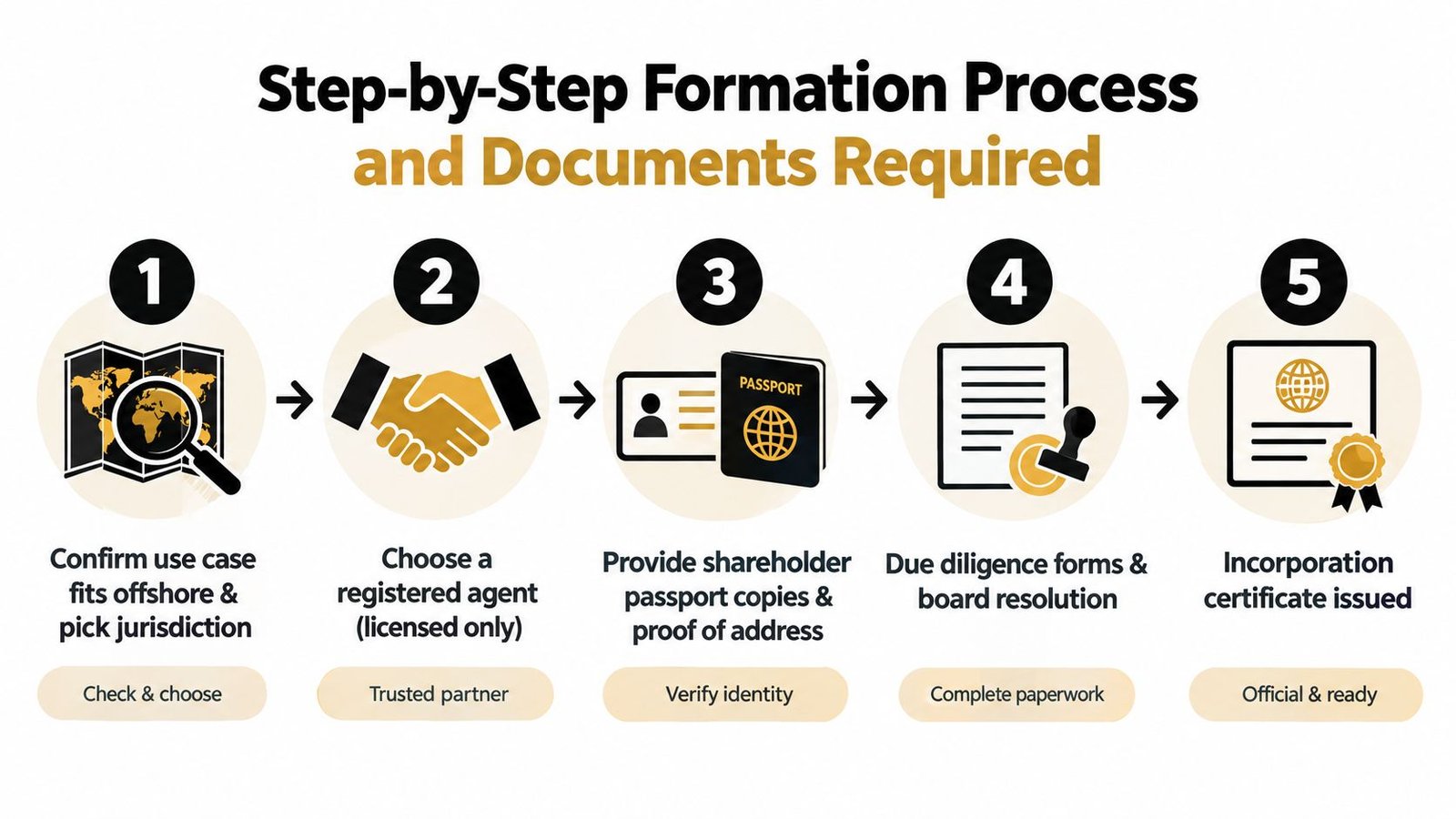
Start by confirming that the intended use fits offshore. Then select the jurisdiction and an authorised registered agent. The founder should prepare:
- Identity documents: Passport copies for shareholders, directors, beneficial owners, and secretary where required.
- Address evidence: Recent proof of residential address for each relevant individual.
- Professional profile: A CV or business profile explaining the person's background and role.
- Financial evidence: Bank reference, source-of-funds declaration, and supporting source-of-wealth information.
- Corporate shareholder documents: Certificate of good standing, constitutional documents, ownership chart, and board resolution where a company will hold the shares.
- Business rationale: A clear explanation of intended assets, counterparties, countries involved, and expected transactions.
The ownership chart deserves care. A bank or registrar needs to see the ultimate beneficial owner clearly, not just the name of an intermediate company.
What does the registered agent file?
The agent checks the proposed name with the relevant registrar, prepares the incorporation forms, and drafts the Memorandum and Articles of Association, often shortened to MOA and AOA. The agent then files the application together with KYC and anti-money-laundering documents.
The normal sequence is:
- Confirm the use case and jurisdiction.
- Appoint a licensed registered agent.
- Reserve an available company name.
- Submit shareholder, director, beneficial-owner, and corporate documents.
- Sign and file the MOA and AOA.
- Receive the certificate of incorporation and company register extract.
- Obtain the registered-agent certificate and, where needed, an apostilled company kit.
An apostille is a formal authentication attached to a public document for recognition in another participating jurisdiction. It can be useful for banking, overseas counterparties, and asset registrations.
How long does formation take?
The exact time depends on the jurisdiction, document quality, name availability, notarisation, and the complexity of ownership. A registered agent can usually move quickly when the file is complete, and expedited options may be available, but no agent can remove registrar or compliance review.
Common rejection triggers include a conflicting name, missing notarisation, inconsistent addresses, and incomplete beneficial-ownership disclosure. The UAE offshore setup process and compliance requirements also make clear that an offshore company normally needs a registered agent, a UAE registered office through that agent, and at least one director. A breach of the registered-agent requirement can result in a Level 3 fine of AED 5,000, according to the same guidance.
Opening a Bank Account After Incorporation
Incorporation and banking are separate workstreams. The certificate of incorporation proves that the company exists, but it doesn't guarantee that a UAE bank or an international bank branch will accept the account application.
Banks assess the beneficial owner, source of wealth, source of funds, expected transaction flows, countries involved, commercial rationale, and economic substance. A clean incorporation file can still be refused after review. The UAE offshore banking guidance indicates that the full account-opening process can take roughly 1.5 to 6 months, while document legalisation and compliance preparation may cost about USD 2,400 to USD 4,000 or more before bank review in some cases. Minimum-balance expectations may start around AED 250,000 and rise to AED 500,000 at more selective banks.
Prepare two document sets. The first is the company's legal file. The second is the beneficial owner's personal financial and KYC file.
| Requirement | Typical expectation | Common reason for decline |
|---|---|---|
| Certificate of incorporation | Legalised corporate certificate and registry evidence | Documents aren't legalised or don't match the application |
| MOA and AOA | Signed constitutional documents showing ownership and powers | Ownership structure appears incomplete |
| Beneficial-owner KYC | Passport, address proof, ownership chart, and role explanation | Beneficial ownership is unclear |
| Financial evidence | Personal bank statements and source-of-wealth explanation | Funds are not explained in a coherent way |
| Transaction profile | Expected currencies, countries, counterparties, and payment purpose | The business rationale is too general |
| Substance evidence | Explanation of management, assets, and operating purpose | The company appears to be a nominee shell |
| Legalisation | Correct notarisation, apostille, or embassy process where required | Re-submission follows a technical document error |
The founder should prepare a written transaction-flow narrative in the first week. State who will pay the company, where money will arrive from, what the company will own, and why the UAE entity is part of the structure. If the company is holding shares rather than trading, explain the ownership chain and expected dividend or disposal events.
Local UAE banks may offer useful familiarity with UAE documentation, while international branches may suit founders with an existing relationship or a cross-border treasury need. Neither route is automatic. Choose the bank after mapping the ownership and transaction profile, not before.
Banking advice: Never describe the account as “for general business”. Give the bank a specific, document-backed explanation of the money flows.
Tax, Substance, and Compliance in 2026
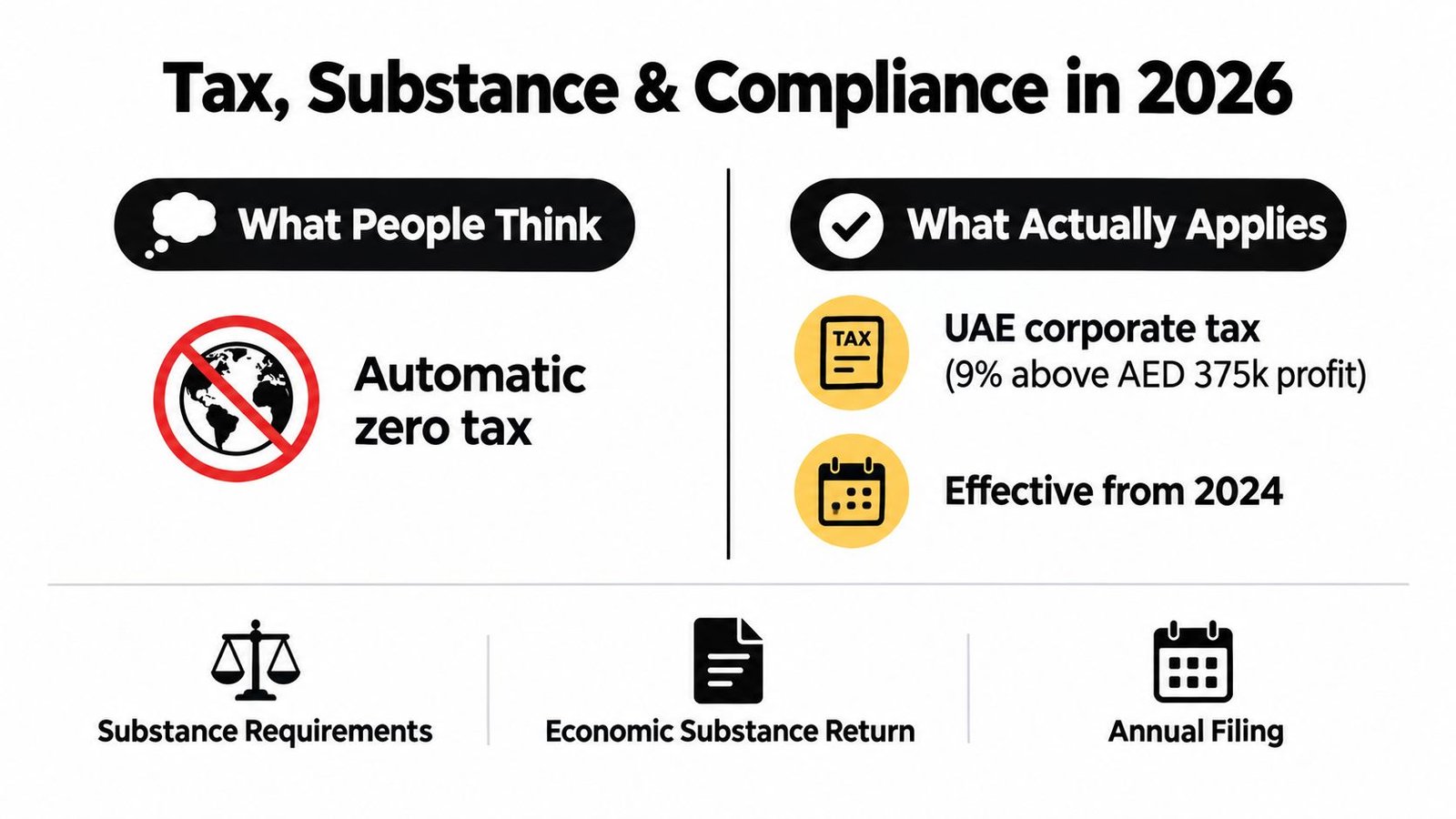
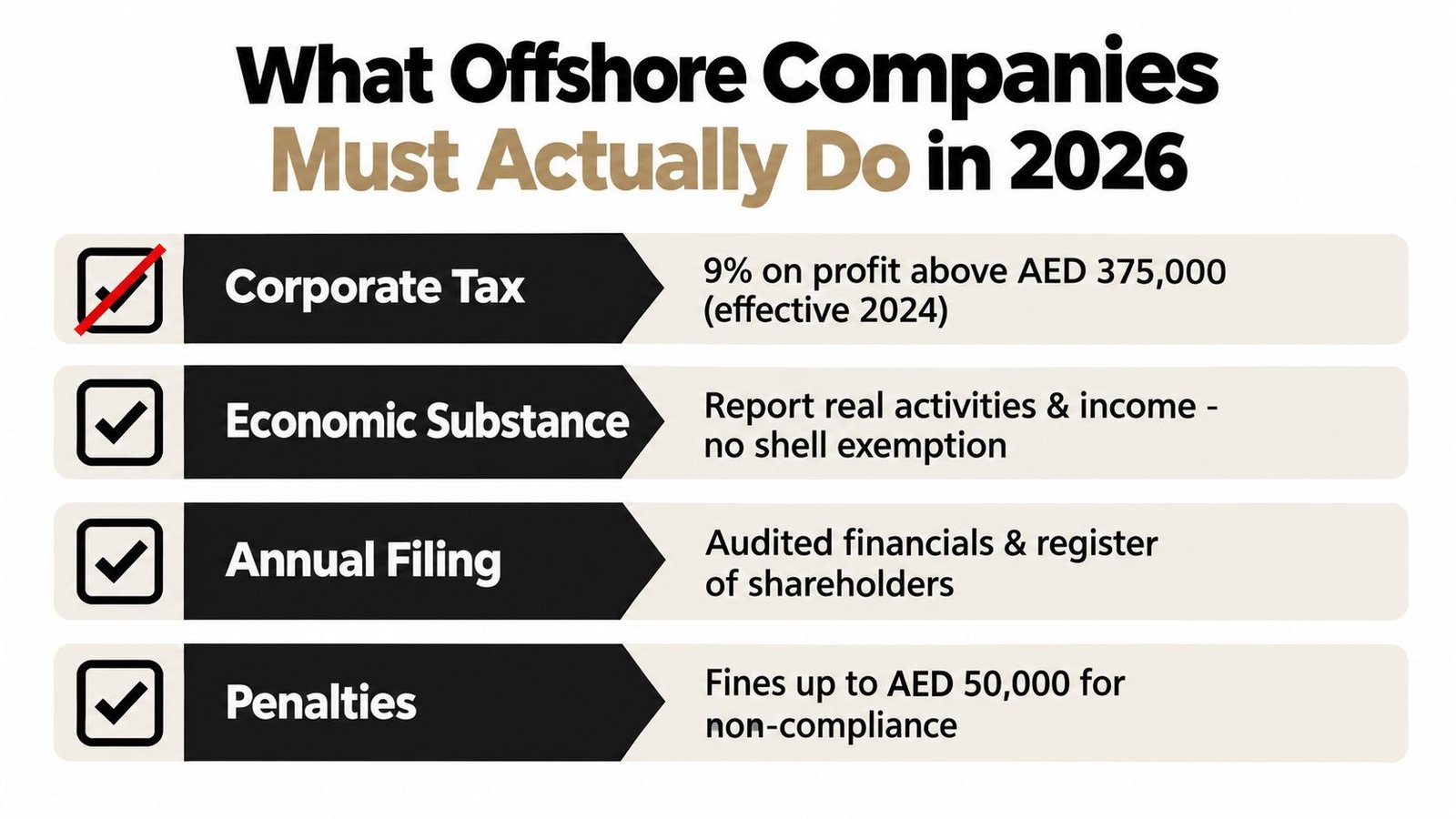
“Offshore” doesn't mean automatic zero tax. UAE corporate-tax rules apply from 2024, and the treatment of an offshore entity depends on its structure, income, activities, and whether it meets the relevant conditions.
The AED 375,000 threshold is associated with the qualifying free zone person framework, while the standard UAE corporate-tax rate is 9% above that profit threshold where the rules apply. Most offshore companies shouldn't assume that their registration in a designated offshore jurisdiction makes them a qualifying free zone person. UAE-sourced income may be exposed to corporate-tax rules, and some offshore structures have registration and filing obligations.
What should the owner check first?
The owner should identify where income arises, what the company does, who controls decisions, and whether related parties transact with it. A tax adviser can then determine whether registration with the Federal Tax Authority is required and what returns or supporting records must be maintained.
Don't rely on the licence label. The UAE offshore company compliance overview notes that offshore structures are no longer treated as automatically tax-exempt in every situation. It also highlights the importance of tax registration, invoicing changes, and the treatment of UAE-sourced income.
Economic substance is another practical issue. A holding company or intellectual-property company may need to demonstrate that its activities are real and managed appropriately. Evidence can include UAE-based board meetings, local decision-making records, adequate people or service arrangements, contracts, accounting records, and documents showing how the company earns and manages its income.
Which records should remain current?
Maintain the beneficial-owner register, shareholder register, accounting records, board resolutions, contracts, bank statements, tax correspondence, and registered-agent records. Related-party transactions should have a clear commercial basis and appropriate documentation.
A registered agent normally maintains statutory records and communicates with the registrar. That doesn't remove the owner's responsibility. Annual renewal, agent fees, registered-office maintenance, tax filings, and any required economic-substance reporting must be tracked through a compliance calendar.
The practical conclusion is simple. Treat tax, substance, and reporting as part of the structure from day one, not as paperwork to fix after the first bank request or tax notice.
Next Steps After Your Offshore Company Is Live
Incorporation is the start of the company's obligations. During the first twelve months, create a calendar covering the annual renewal date, registered-agent fees, registered-office arrangements, company-secretary requirements, tax work, and ownership updates.
Keep accounting records even where the company has no UAE-sourced income. Record asset purchases, share transfers, dividends, loans, board decisions, bank movements, and related-party arrangements. If the company owns intellectual property, document ownership, licensing, income, and management decisions. If it holds shares, preserve the share certificates, resolutions, and evidence supporting the ownership chain.
What must be reviewed each year?
- Renewal date: Confirm the licence and registered-agent renewal before expiry.
- Registered office: Make sure the UAE registered office arrangement remains active through the agent.
- Corporate records: Update directors, shareholders, beneficial owners, and company-secretary details when they change.
- Financial records: Reconcile bank activity and retain evidence for each material transaction.
- Tax position: Reassess registration, filing, invoicing, and related-party obligations as activity changes.
- Banking file: Refresh personal KYC, source-of-funds evidence, and expected transaction information when requested.
The structure should be revisited when the business changes. Signing a UAE client can create a domestic operating question. Hiring a UAE-resident employee requires an employer structure that can handle employment and immigration. Warehousing goods in Dubai, Abu Dhabi, or Sharjah points towards an operating licence and physical presence. Needing a residence visa is also a clear signal that offshore alone won't work.
A free zone company may suit operations within a designated zone, while a mainland company may be better for broader UAE market access. Dubai's 2025 mainland-access mechanism for free zone firms can be relevant in some cases, but it still requires the necessary permits and doesn't turn an offshore entity into a local trading company.
Revisit the structure when revenue changes materially, a co-founder joins, institutional investors enter, or the ultimate beneficial owner's tax residency changes. Each event can alter ownership, reporting, banking, and tax requirements. A structure that worked for a passive holding company may become unsuitable once people, customers, inventory, or investors enter the picture.
Inpro helps founders compare Offshore, Free Zone, and Mainland options, prepare formation and legalisation documents, support corporate bank-account applications, and manage accounting, tax, VAT, PRO, and visa workflows in the UAE. Visit Inpro to discuss your intended use case and choose a structure that matches your ownership, banking, market-access, and compliance needs.