

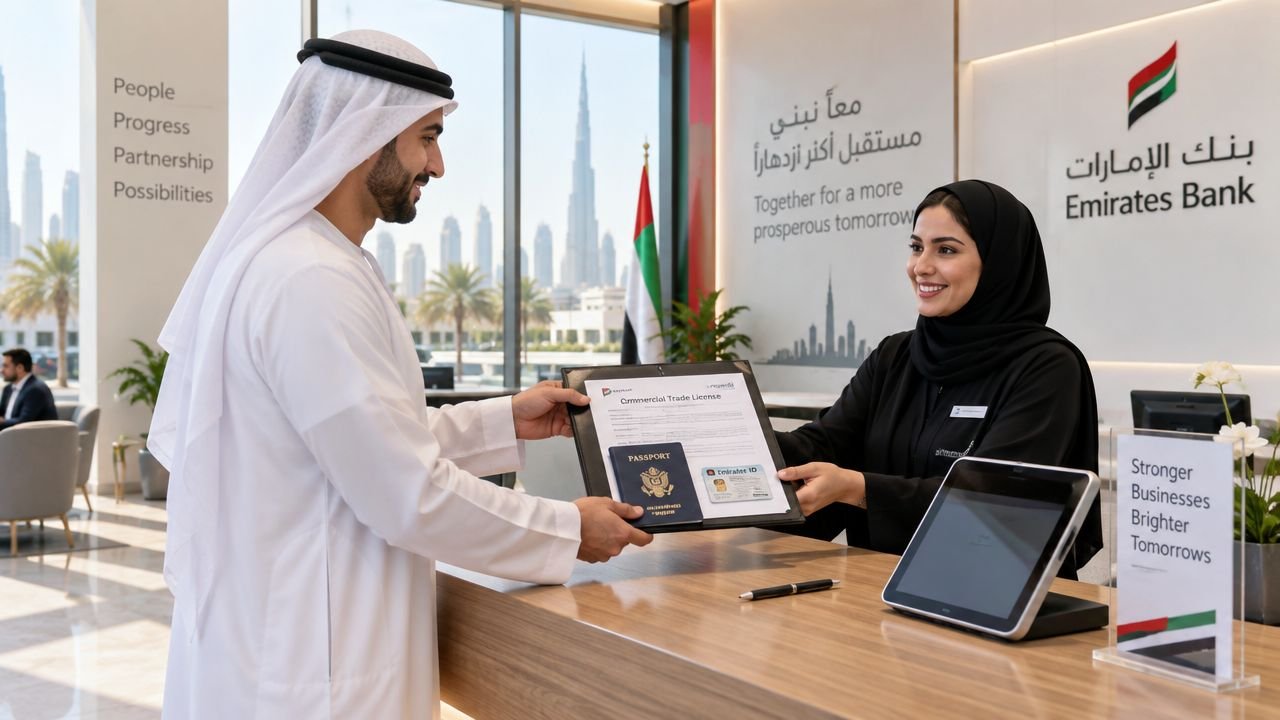
You've just received your UAE trade licence and need an operating account for payroll, suppliers, and client payments. The licence alone won't get you approved. To open a business bank account in the UAE, you need the right entity, a complete ownership and source-of-funds file, and a bank that accepts your activity and risk profile.
Table of Contents
- Why Opening a UAE Business Bank Account Is Harder Than It Looks
- Entity Type Matters More Than You Think
- The Document Stack Banks Actually Want to See
- Realistic Timelines for Opening Your Account
- Choosing Between Local, International, and Digital Banks
- Common Rejection Reasons and How to Avoid Them
- Your Practical Path to a Live Account
Why Opening a UAE Business Bank Account Is Harder Than It Looks
A founder once walked into a Dubai branch the morning after receiving his trade licence, licence in hand, expecting an account by lunch. He left with a detailed KYC questionnaire, a request for ownership documents, and a waiting period that stretched into weeks.
KYC, or Know Your Customer, is the process banks use to verify who owns and controls a business. AML, or Anti-Money Laundering, and CFT, or Countering the Financing of Terrorism, rules require banks to understand where money comes from and how it will move. In the United Arab Emirates, corporate onboarding is therefore a regulated compliance review, not a simple application form. Banks verify shareholders, identify the ultimate beneficial owner, screen sanctions exposure, assess business risk, and review expected transactions before activating the account. The UAE corporate account requirements guide outlines how this process is tied to the Central Bank of the UAE framework.
What changed for eligible SMEs in 2026
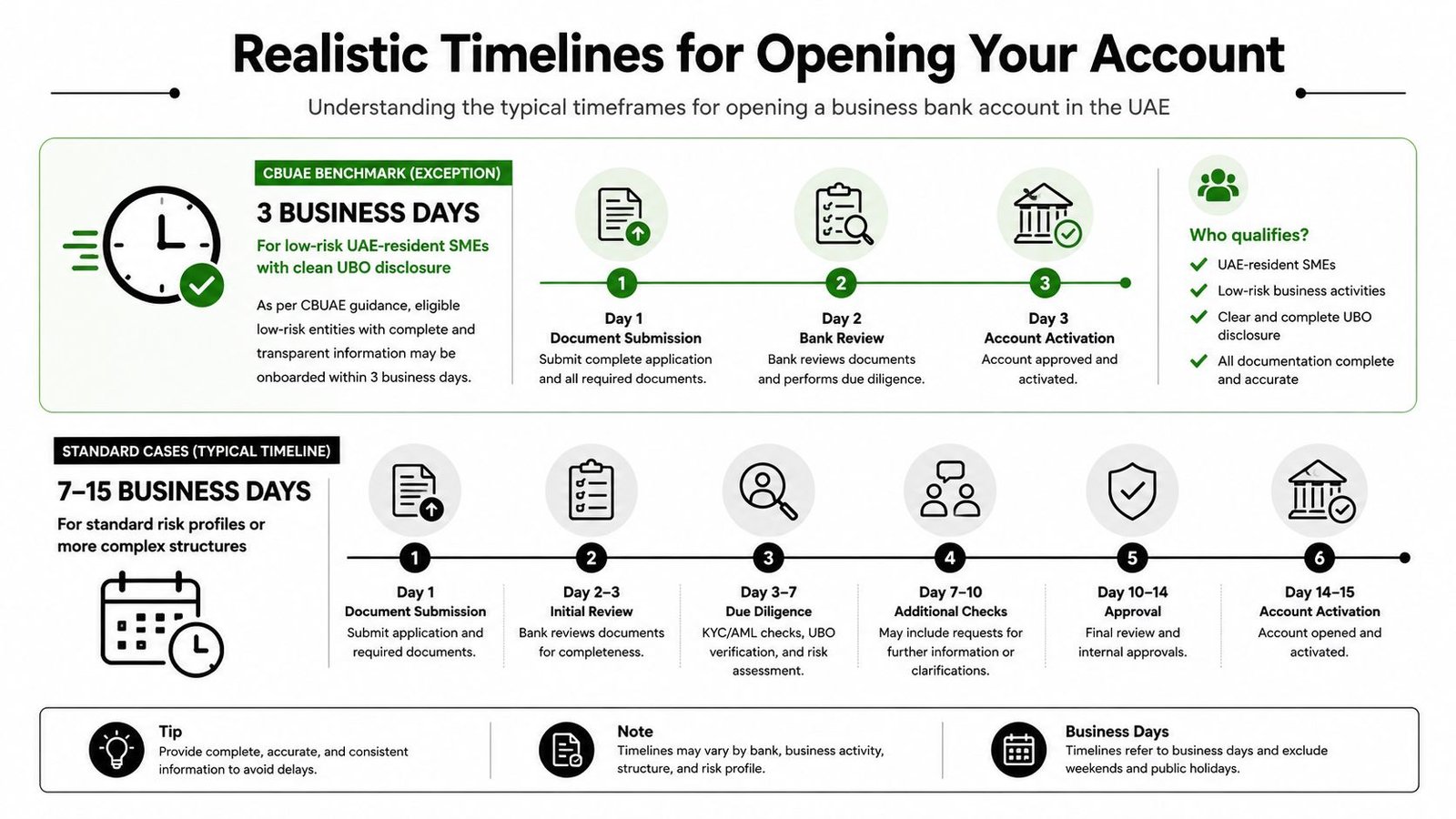
A formal three-business-day benchmark now applies to a low-risk SME with a complete file under a Central Bank rule effective 13 September 2026, according to the UAE-focused industry summary cited above. That benchmark matters, but it doesn't mean every founder receives an account in three days.
The same source says complete applications are often approved in 2 to 4 days, while many standard cases still take 3 to 6 weeks from a standing start. The split is the practical reality. A clean, low-risk, UAE-resident SME can move quickly, while incomplete files, higher-risk activities, and cross-border ownership structures still trigger enhanced checks.
Practical rule: Treat preparation quality as part of your banking strategy, not as administration after incorporation.
Why the account affects your launch
Your bank account is the gateway to more than receiving customer payments. You may need it to run payroll, pay suppliers, collect card transactions, fund government fees, and demonstrate operating substance to commercial partners. A delay can therefore affect hiring, visa processing, supplier onboarding, and client confidence.
Banks also assess whether your proposed transaction behaviour matches your licence. A consultancy expecting service payments from Europe presents a different profile from a trading company receiving funds from several jurisdictions. Explain that pattern clearly before submission, rather than forcing the bank to guess.
Entity Type Matters More Than You Think
Your licence tells a bank what your company is permitted to do. It also signals where the company operates, whether it has local substance, and what payment activity the bank should expect. That makes jurisdiction a risk input, not just a formation decision.
A Mainland company is licensed by the relevant Department of Economy and Tourism, commonly called a DED, or Department of Economy and Tourism, in Dubai. A Free Zone company is licensed by a specific UAE free zone authority, while an Offshore company is generally used for holding or international structures rather than day-to-day UAE operations.
How entity type shapes bank risk perception
| Dimension | Mainland | Free Zone | Offshore |
|---|---|---|---|
| Substance signal | Usually stronger local operating presence, especially with a valid office or tenancy | Depends on the zone, office arrangement, activity, and management location | Often limited or absent physical UAE operations |
| Activity scope | Can suit domestic services, professional activities, and broad commercial operations | Activity is tied closely to the selected free zone licence | Commonly associated with holding or international structures |
| Expected transaction pattern | Domestic UAE receipts, payroll, suppliers, and local operating costs may be expected | International services, import-export, or specialised activities may be expected | Cross-border transfers, asset holding, or parent-company movements may dominate |
| Bank scrutiny | Often manageable when ownership and activity are straightforward | Varies by zone, sector, shareholder profile, and office substance | Usually the most demanding because the bank must understand the wider structure |
| Best banking fit | Local operating account for a business trading in Dubai, Abu Dhabi, or Sharjah | Bank selected around the zone, activity, and payment corridors | Specialist relationship, where the bank accepts the structure and its purpose |
A Mainland consultancy with one resident owner and a clear UAE client base is easier for a bank to understand than a Free Zone trading entity with layered overseas ownership and a vague activity description. A Free Zone company isn't automatically difficult, but the bank will examine whether the licence, office arrangement, directors, owners, and expected transactions form a coherent picture.
When Offshore structures create friction
Offshore companies, including structures associated with JAFZA, Ajman, or RAK ICC, can face a higher barrier because the bank may see no obvious UAE operating footprint. The application must explain the parent structure, ownership chain, commercial purpose, and reason for seeking a UAE account.
Founders often choose an entity for incorporation cost or privacy, then discover that the same choice limits banking options. Decide your banking requirements before finalising the jurisdiction. If you expect local payroll, merchant acquiring, or regular UAE supplier payments, a structure designed only for holding assets may be the wrong starting point.
The Document Stack Banks Actually Want to See
Banks don't want a single perfect document. They want a consistent file that proves the company exists, identifies every relevant person, shows where the business operates, and explains how money will enter and leave the account.
Which documents belong in the master file
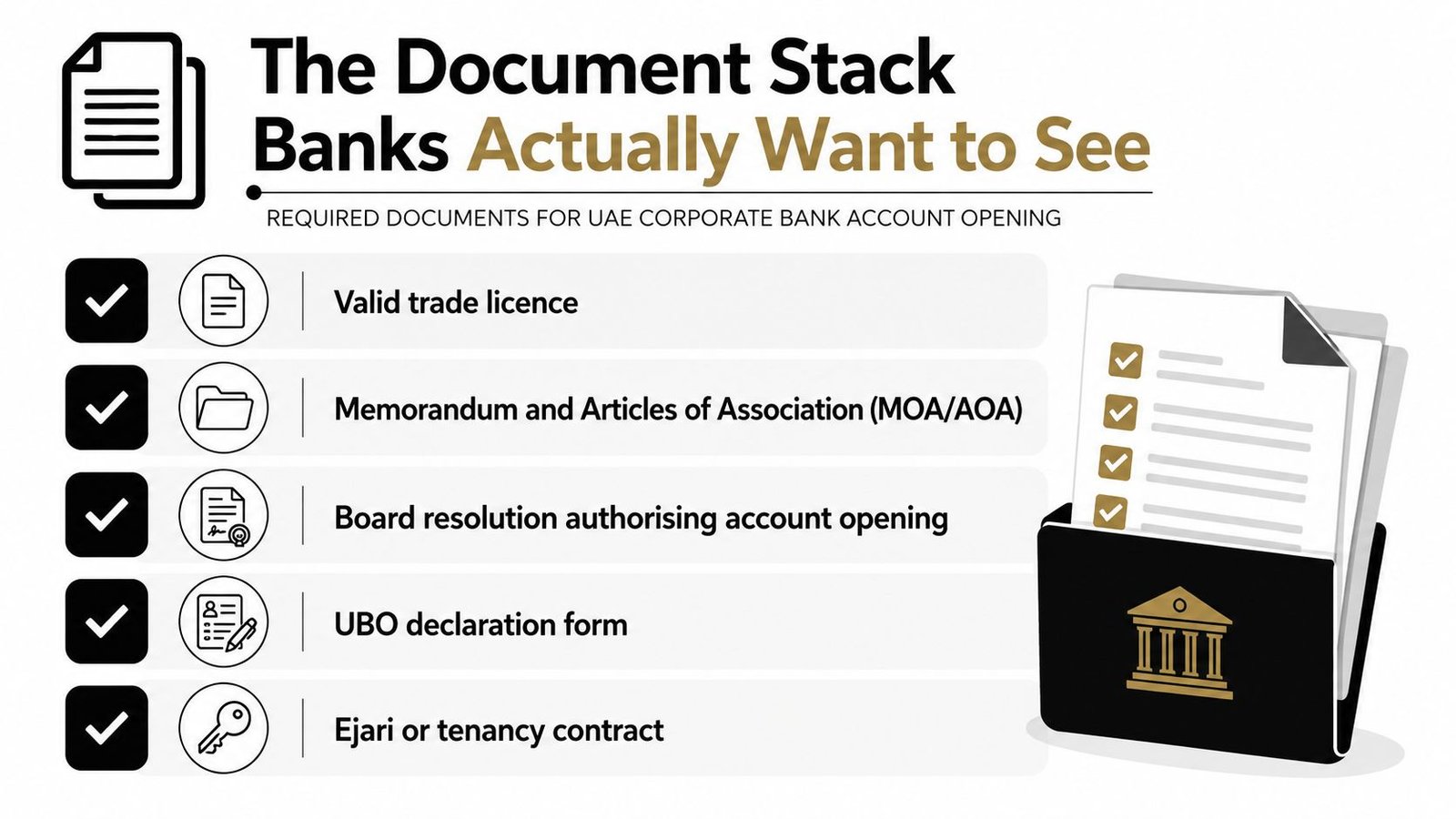
Prepare these documents before choosing a bank:
- Trade licence or certificate of incorporation: It must be valid and issued by a UAE authority.
- MOA/AOA: The Memorandum and Articles of Association explain ownership, powers, and governance.
- Board resolution: This authorises the account opening and names the approved signatories.
- UBO declaration: The Ultimate Beneficial Owner form identifies the natural persons who ultimately own or control the company.
- Office evidence: Provide an Ejari, which is Dubai's registered tenancy system, or another valid tenancy or office-lease document.
- Identity documents: Include passports, Emirates IDs, and proof of address for shareholders and authorised signatories.
- Banking history: Existing entities may be asked for company statements, while new companies may need personal or partner statements.
- Source-of-funds material: Explain how the initial capital was earned or transferred and support the explanation with records.
Emirates NBD's business account requirements confirms the central role of the trade licence, constitutional documents, board resolution, and identity documents. A UAE business-banking guide also lists examples of source-of-funds evidence, including parent-company accounts, previous bank statements, contracts, asset-sale records, and payslips, alongside a business plan or activity description for new companies (source-of-funds guidance for UAE banking).
What usually stalls an application
An outdated MOA can force a manual review, especially if it doesn't reflect current corporate details or required wording. An unsigned board resolution is another avoidable problem. So is a UBO form that stops at the immediate shareholder and fails to show the individuals behind a holding company.
A generic letter saying “business income” is not a source-of-funds explanation. Show the transaction behind the money, such as a contract, invoice, investment record, or parent-company transfer, and make sure the amount and parties align with the application.
Banks may also request a Power of Attorney for a non-owner signatory, VAT registration where relevant, a corporate website, customer contracts, or supplier agreements. These items help the reviewer connect your stated activity to a real commercial operation.
The rule I give founders: Prepare the complete document stack once, even if you start with a digital bank. A digital application can be quick, but compliance questions don't disappear after the first upload.
Realistic Timelines for Opening Your Account
The three-business-day CBUAE benchmark is for qualifying low-risk UAE-resident SMEs with complete, satisfactory due diligence. It isn't a universal promise for every company, owner, or sector.
Traditional UAE banking remains slower for many applicants. Historical market guidance reports typical windows of 2 to 4 weeks for traditional banks and 1 to 2 months for more complex cases (UAE business account timeline guidance). Wider market summaries put the range at 7 to 30 business days, with examples of 7 to 14 business days for Mainland LLCs, 10 to 21 business days for Free Zone companies, and 20 to 30 business days for Offshore structures, depending on risk and documentation.
Which cases move faster
A straightforward Mainland LLC with a clear activity, simple shareholding, resident signatory, suitable office evidence, and credible funding story has the cleanest route. A single-owner Free Zone company can also move efficiently when its activity and expected payment corridors fit the bank's appetite.
Free Zone structures with several shareholders, non-resident directors, or international ownership need more time. Offshore companies may require parent-structure verification and additional explanations before the bank makes a decision.
The bank may also return questions after the first review. Build time for corrected documents, revised declarations, and a second compliance review. Sending the same incomplete file to another bank usually wastes more time than fixing the first file properly.
What digital fast tracks can and can't do
The UAE market now includes faster digital routes. In 2026, Mashreq said it launched a one-day service promise for business customers, while Wio Business and Shams publicised digital flows that can start operating within about three business days, as reported in this UAE business banking overview.
Those routes suit eligible, lower-complexity applicants. They may not replace a full operating relationship if you need large transaction volumes, unusual payment corridors, cash handling, or several layers of corporate ownership. Use them as a primary account only after checking limits and beneficiary restrictions.
Choosing Between Local, International, and Digital Banks
The right bank depends on what your company does, not which logo another founder recommends. A Dubai trading company, Abu Dhabi consultancy, Sharjah manufacturer, and international SaaS business can need entirely different banking arrangements.
Local banks such as Emirates NBD, Mashreq, Abu Dhabi Commercial Bank, First Abu Dhabi Bank, and Dubai Islamic Bank generally provide stronger UAE payment infrastructure and branch access. International names such as HSBC and Citi may suit established businesses with cross-border needs, while digital-first providers such as Wio Business and Shams Pay can suit simpler, digitally managed operations.
UAE corporate bank comparison
| Bank | Category | Min. Balance (AED) | Typical Onboarding | Best For |
|---|---|---|---|---|
| Emirates NBD | Local | Varies by account | Traditional review or online start | UAE operating companies needing local services |
| Mashreq | Local and digital options | Varies by account | Traditional review, with digital routes available | SMEs seeking local banking and faster eligible onboarding |
| ADCB | Local | Varies by account | Traditional compliance review | Abu Dhabi-linked businesses and established SMEs |
| FAB | Local | Varies by account | Traditional compliance review | Larger operating businesses and corporate relationships |
| DIB | Local | From AED 50,000 for listed business accounts | Traditional review | Businesses able to maintain a material operating balance |
| HSBC | International | Varies by relationship | Detailed review | Established firms with international payment needs |
| Citi | International | Varies by relationship | Detailed review | Larger or internationally connected companies |
| Wio Business | Digital-first | Product-dependent | Digital onboarding for eligible applicants | Digital SMEs with straightforward ownership |
| Shams Pay | Digital-first | Product-dependent | Digital onboarding for eligible applicants | Eligible founders seeking a digital starting account |
Minimum balances vary by product and applicant. Dubai Islamic Bank lists a monthly minimum account balance starting from AED 50,000 for business accounts, which makes post-opening cash planning part of the decision, not an afterthought (DIB business account requirements).
How to make the choice
Choose a local bank when you need AED liquidity, local transfers, branch support, payroll, merchant services, or a relationship that can grow with a UAE operation. Choose an international bank when overseas collections, correspondent banking, and client expectations justify a more detailed onboarding process.
Digital banking fits a founder who has clean ownership, no cash-heavy model, predictable payment corridors, and limited need for complex corporate structures. Check transaction limits, supported currencies, beneficiary rules, and accounting integrations before treating a digital account as your only operating account.
Common Rejection Reasons and How to Avoid Them
The most common mistake is assuming that a bank will resolve inconsistencies during review. It won't. A compliance officer may classify the file as unclear, request more information, or decline it.
A UAE SME survey found that 65% of SMEs viewed banking as a challenge, and the account-opening process could take one month to three months, according to The National's UAE SME banking report. More recent UAE guidance reports initial application rejection rates of roughly 30% to 40% for compliance issues, which is why document matching matters before submission.
Where applications break down
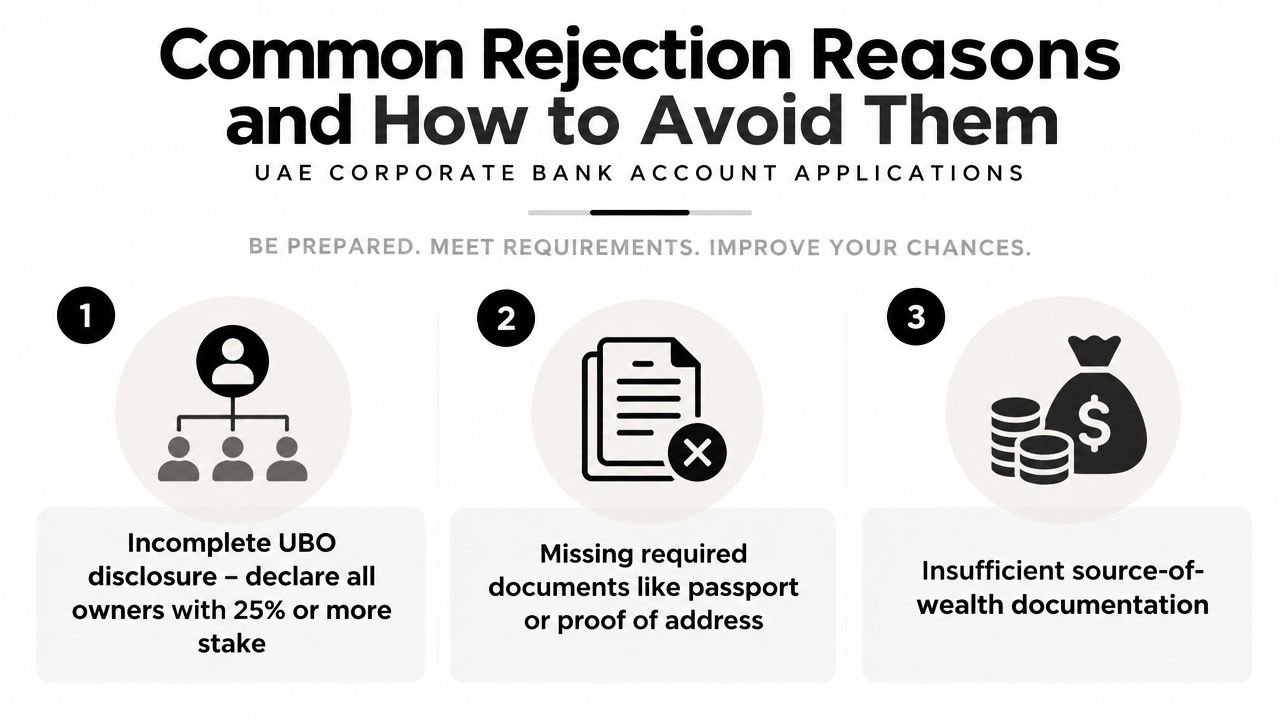
- Incomplete UBO disclosure: Declare every beneficial owner holding 25% or more, with the requested identity, address, and wealth information. If a company owns your company, continue through the chain until the individuals are clear.
- Mismatched business activity: A general trading licence paired with an application describing IT consultancy creates an immediate question. Make the licence, website, contracts, invoices, and transaction profile tell the same story.
- Weak source-of-funds evidence: A bank needs more than a statement that capital is “personal savings”. Link the deposit to bank statements, an employment history, a contract, an asset sale, or a parent-company transfer.
- Insufficient office substance: A fresh Ejari or suitable Flexi Desk agreement can help demonstrate where the business operates. The UAE Free Zone banking guidance explains that banks may still require office evidence, UBO information, source-of-funds material, and in-person or video verification.
- Unexplained historical entities: Dormant or struck-off companies connected to a shareholder can raise questions. Prepare an accurate explanation and resolve outdated records where possible.
Prepare a one-page activity-to-transaction profile before applying. State what you sell, who pays you, where funds arrive from, where they go, expected payment corridors, and why those flows fit your licence. That document gives the reviewer a clear commercial explanation instead of a collection of disconnected PDFs.
Your Practical Path to a Live Account
Most lost weeks come from running tasks sequentially. Don't wait for the licence before collecting KYC documents, and don't wait for the bank application before securing suitable office evidence. Run licensing, tenancy, ownership mapping, and source-of-funds preparation in parallel.
What should you do this week
- Confirm the entity and activity: Decide whether Mainland, Free Zone, or Offshore structure matches your customers, operating location, ownership, and payment flows.
- Build the master file: Collect the trade licence, MOA/AOA, board resolution, UBO declaration, tenancy evidence, IDs, statements, and source-of-funds documents. Pre-fill the UBO declaration and check every ownership layer.
- Shortlist the bank: Compare a local or digital option against your activity risk, payment corridors, balance requirements, currency needs, and transaction limits.
- Submit a coherent application: Add a concise activity-to-transaction profile and a source-of-funds narrative that matches the supporting records.
- Control the follow-up: If no response has landed by day 10, request a status update and ask whether the file is awaiting a document, clarification, or compliance decision.
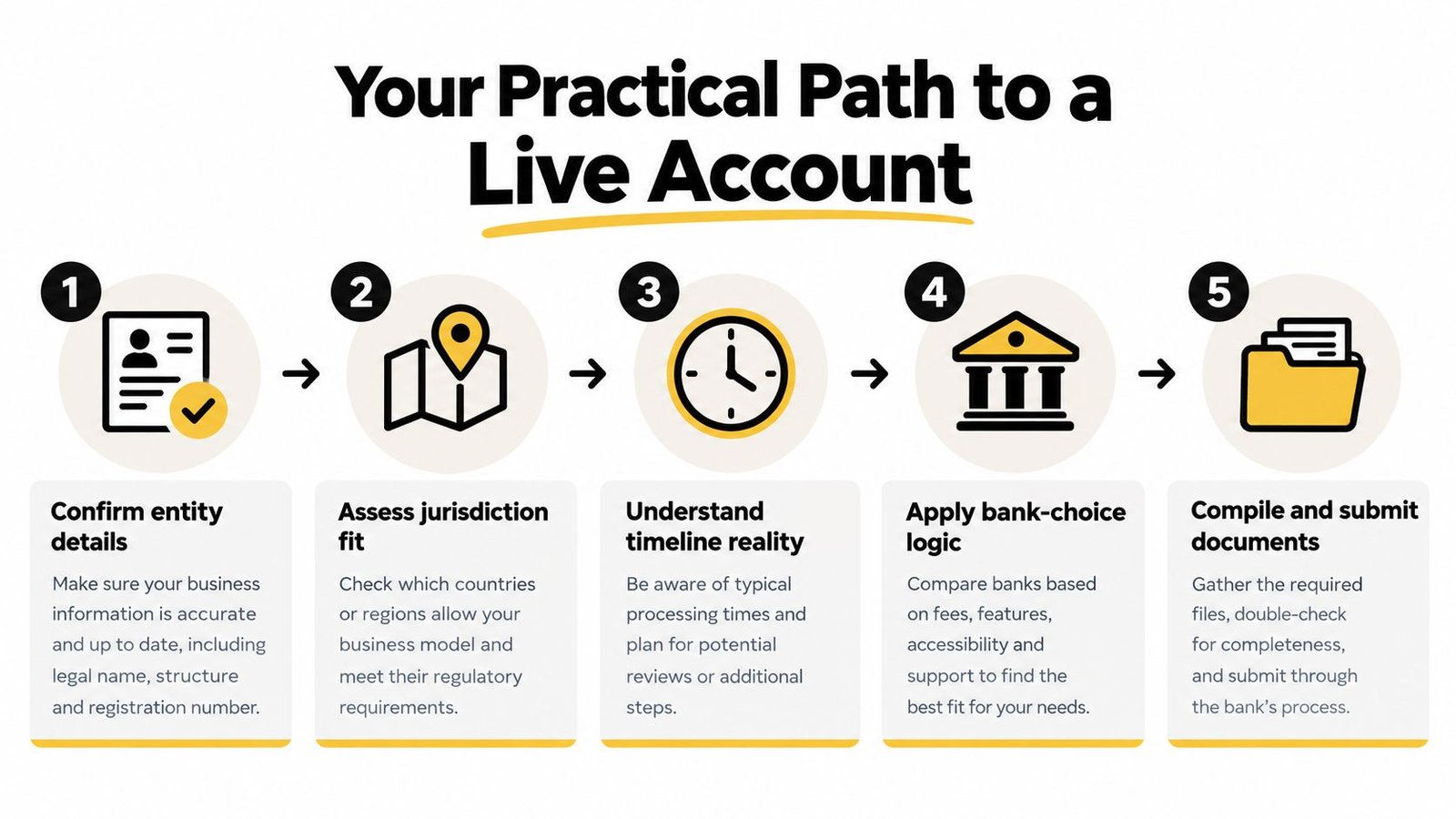
Run a final review 24 hours before submission. Check names, passport details, ownership percentages, activity descriptions, addresses, dates, signatures, and the connection between your funding evidence and proposed account activity. A clean file gives the bank fewer reasons to pause.
Budget for the account alongside your licence, visas, office arrangement, and operating costs. An estimator can show the likely formation and visa spend, while a strategy review can identify whether your chosen jurisdiction and bank fit your actual transaction profile.
Inpro helps founders set up UAE companies, prepare licensing and compliance documents, and receive support with corporate bank account opening, alongside PRO, visa, accounting, tax, and VAT services. Visit Inpro to review your UAE setup options, use the cost estimator, or arrange a strategy call before you submit your banking application.