

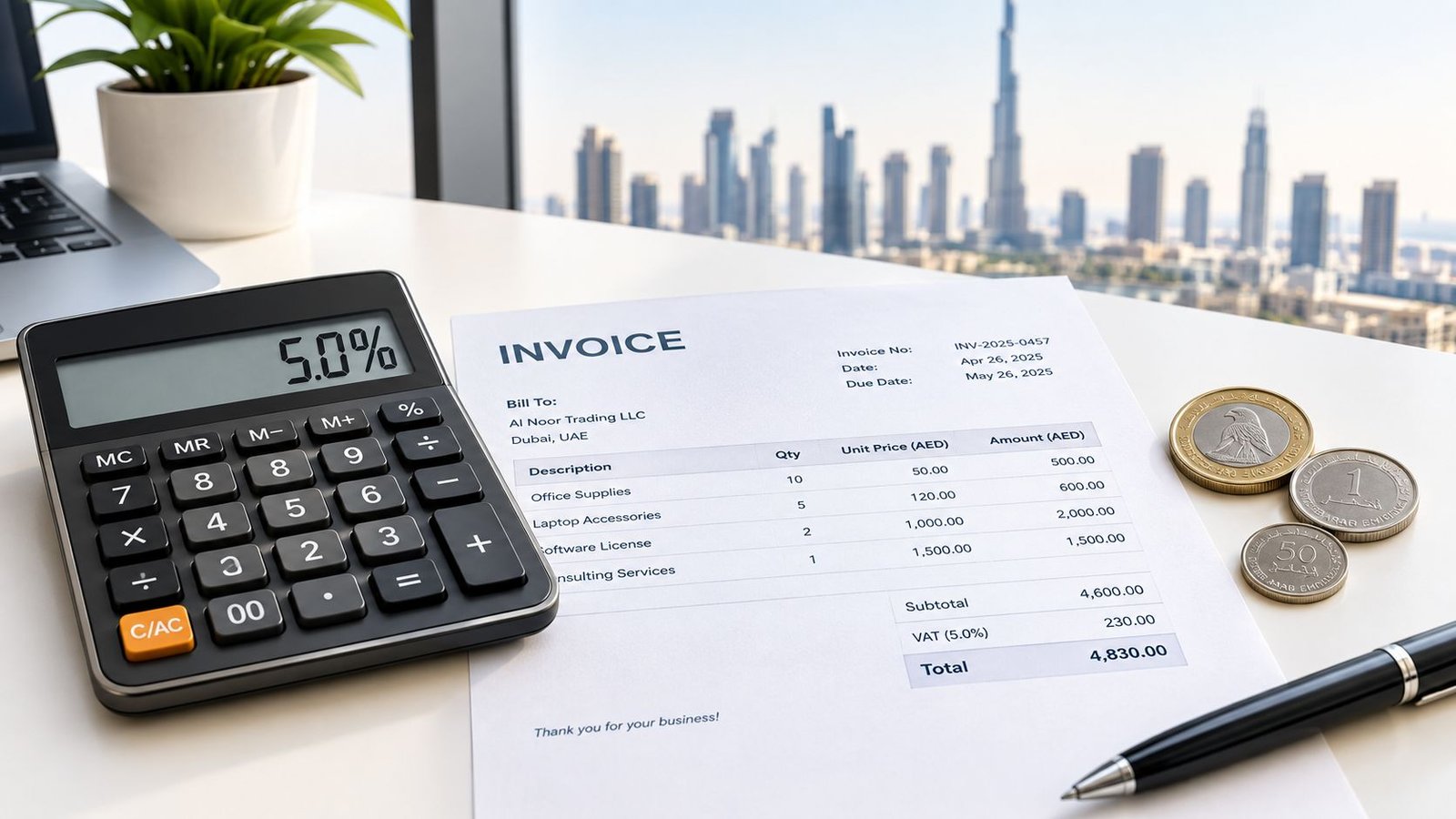
UAE VAT is calculated by multiplying the net amount by 5%, the standard rate, then adding that VAT to the net amount to get the total invoice value. For a taxable sale of AED 10,000, the VAT is AED 500 and the customer pays AED 10,500.
That calculation is simple. The part that causes problems for founders, freelancers, retailers, and international businesses is deciding whether the transaction is taxable, zero-rated, or exempt before applying any formula. A correct VAT return depends on that classification, the quality of your invoices, and the difference between VAT collected from customers and eligible VAT paid on business costs.
Table of Contents
- Understanding the UAE VAT Rate and What It Covers
- Calculating Output VAT on Your Sales and Invoices
- Understanding Input VAT Recovery and Net VAT Payable
- Common VAT Calculation Mistakes and How to Fix Them
- VAT Registration Thresholds and Compliance Timeline
Understanding the UAE VAT Rate and What It Covers
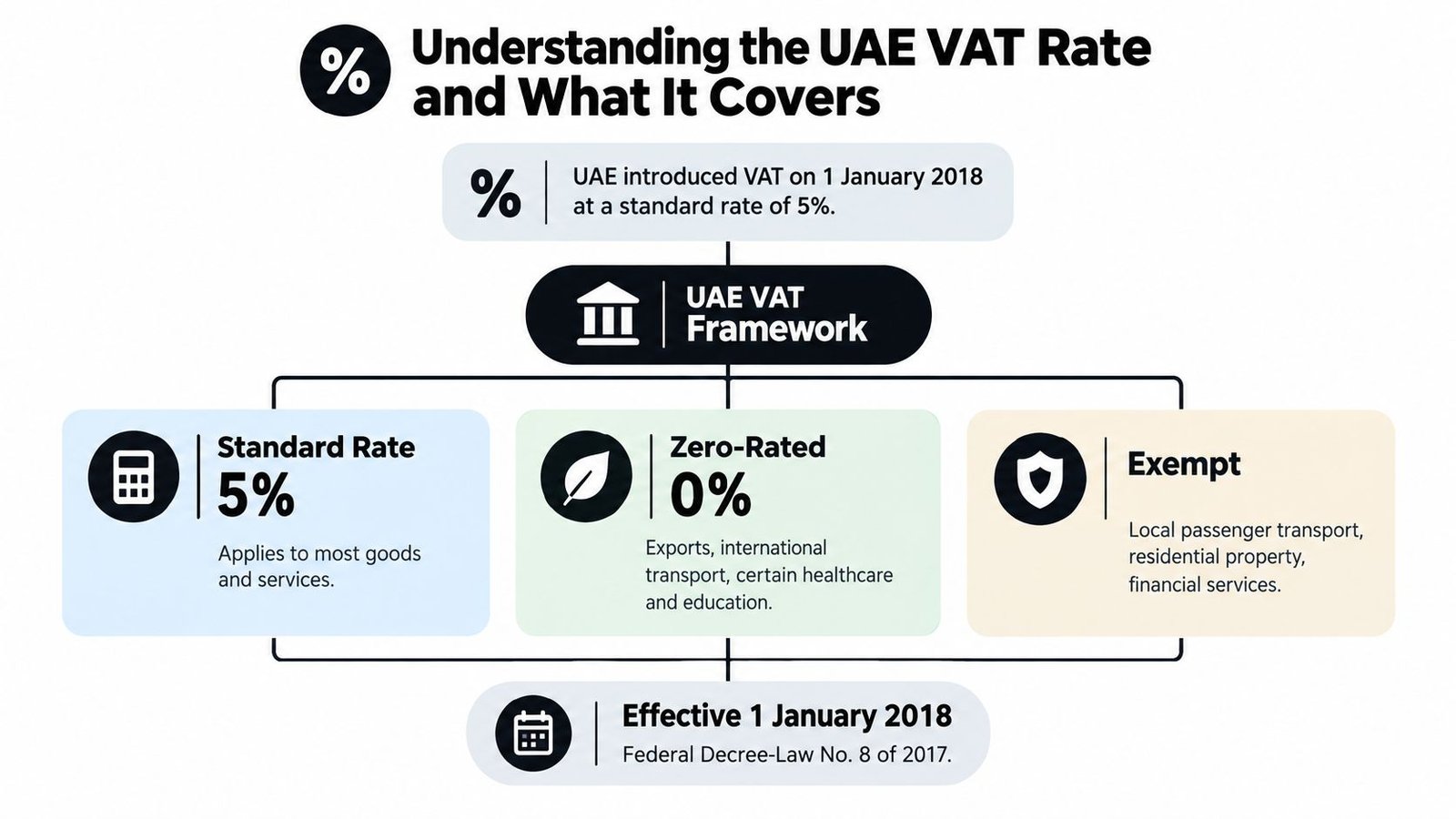
The United Arab Emirates introduced Value Added Tax, or VAT, on 1 January 2018. The standard rate is 5% for most taxable goods and services, applied through the supply chain until the final consumer bears the cost. The UAE government's VAT guidance confirms the rate and explains how the tax applies to different supply categories.
The rate is only the starting point. Before calculating an invoice, classify the transaction as taxable, zero-rated, or exempt. That classification determines whether VAT is charged, whether the sale counts toward taxable turnover, and whether related input VAT may be recoverable.
What is a taxable supply?
A taxable supply is subject to VAT at either the standard rate or zero per cent. Ordinary UAE sales of goods and services are usually standard-rated. A VAT-registered seller charges 5% output VAT, shows it on the invoice, and reports it to the Federal Tax Authority, or FTA, which administers federal tax.
For example, a UAE consultancy providing a taxable service to a client in Abu Dhabi would identify the agreed fee, confirm that the service is taxable, and then show the VAT separately. The same classification process applies to many mainland and free zone businesses, provided the free zone activity does not fall under a special treatment.
How do zero-rated and exempt supplies differ?
A zero-rated supply remains taxable, but the VAT rate is 0%. The customer pays no output VAT, while the business may still recover eligible input VAT connected with that activity. UAE guidance identifies exports, international transport, and certain education and healthcare supplies among the categories that may qualify.
An exempt supply has no VAT charged, but it is not treated like a zero-rated supply. Official categories include residential buildings, bare land, financial services, and local passenger transport. Input VAT linked to exempt activities generally cannot be recovered under the same rules that apply to taxable activities.
The distinction affects more than the invoice. A business can report a sale with no VAT charged while reaching a different result for taxable turnover and input VAT recovery, depending on whether the sale is zero-rated or exempt. The UAE Ministry of Finance VAT overview outlines these different consequences.
Practical rule: “No VAT charged” does not automatically mean zero-rated. Confirm the category first, then decide how to report the transaction and whether related input VAT can be recovered.
Who needs to register for VAT?
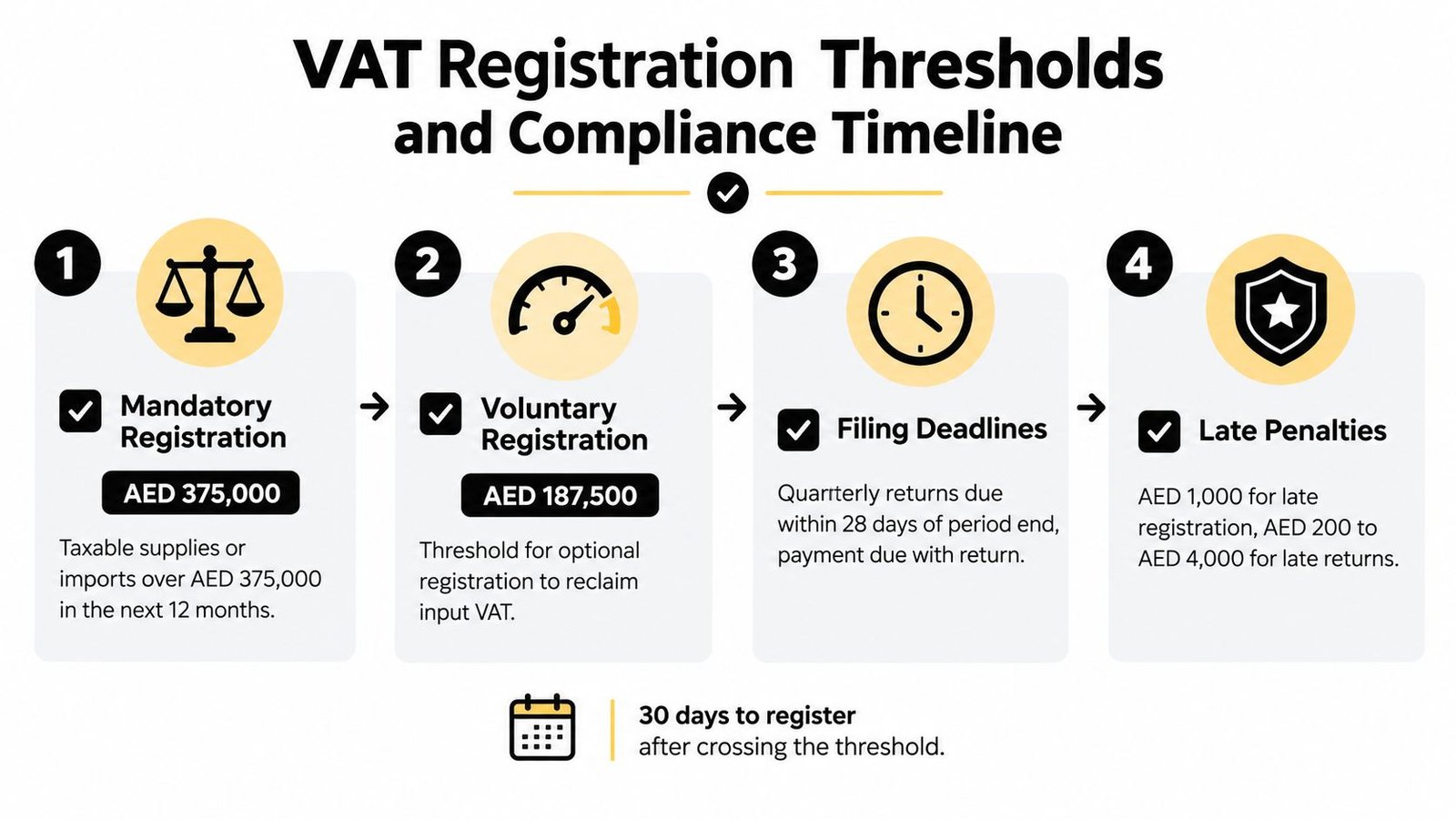
A UAE business must register when its taxable supplies and imports exceed AED 375,000 over the relevant 12-month period, according to the Federal Tax Authority registration guidance. Voluntary registration starts at AED 187,500.
For threshold testing, include standard-rated supplies, zero-rated supplies, deemed supplies, and imported goods and services. Exempt supplies and transactions outside the scope of VAT are excluded. A non-resident business making taxable supplies in the UAE may have registration obligations without relying on the same threshold test, so an overseas founder should review the position before making a taxable sale into Dubai or Abu Dhabi.
Calculating Output VAT on Your Sales and Invoices
Output VAT is the tax a VAT-registered business charges on taxable sales. Calculate it from the taxable net value, then apply 0.05. Before doing the arithmetic, confirm that the supply is standard-rated. A zero-rated supply requires a different reporting treatment, while an exempt supply has no output VAT to add.
How do you calculate VAT on a B2B invoice?
A UAE marketing consultancy issues a business-to-business invoice for services priced at AED 7,350, before VAT.
- Net taxable service value: AED 7,350
- VAT calculation: AED 7,350 × 0.05 = AED 367.50
- Total invoice value: AED 7,350 + AED 367.50 = AED 7,717.50
The client pays AED 7,717.50, but AED 367.50 is not the consultancy's revenue. It is output VAT collected for reporting to the FTA, subject to the business's eligible input VAT position.
Record the tax as a separate line on the invoice. A clear layout would show:
| Invoice line | Amount |
|---|---|
| Net taxable services | AED 7,350 |
| VAT 5% | AED 367.50 |
| Total amount after tax | AED 7,717.50 |
Include the supplier's details, tax registration information where applicable, invoice date, service description, net amount, VAT rate, VAT amount, and total. These details give the customer a clear charge and preserve an audit trail for the accounting records.
What happens on a B2C retail sale?
A consumer usually sees and pays the final price at checkout. If a taxable item is advertised at AED 10,500, inclusive of VAT, do not add 5% again. Divide the total by 1.05 to find the net value, then subtract that net value from AED 10,500 to identify the VAT element.
The same reversal method applies whenever a displayed consumer price already includes VAT. Keep the point-of-sale settings aligned with the invoice treatment, particularly where shelf labels, menus, or online prices show tax-inclusive amounts.
How should discounts and credit notes affect VAT?
A trade discount agreed before or at the sale reduces the taxable value before VAT is calculated. The VAT amount falls with the net selling price.
A post-sale reduction needs a documented adjustment. Issue a credit note, link it to the original invoice, update the customer account, and adjust the related output VAT in the appropriate records. Do not delete the original invoice or reduce an unrelated later sale, because that breaks the audit trail and can leave the VAT return inconsistent with the underlying transaction.
Understanding Input VAT Recovery and Net VAT Payable
Output VAT is only one side of the VAT return. Input VAT is the VAT charged to your business on eligible purchases and expenses. The basic calculation is:
Net VAT payable = output VAT − recoverable input VAT
If sales generate AED 5,000 output VAT and eligible business purchases contain AED 3,200 recoverable input VAT, the net VAT payable is AED 1,800. FTA's VAT resources explain VAT payable through this output-minus-input approach.
The important word is recoverable. A supplier charging VAT does not automatically make that VAT claimable. The expense needs a valid business purpose, suitable records, and a connection to taxable or qualifying zero-rated supplies. Costs connected with exempt supplies, private use, or restricted categories such as entertainment may not be recoverable.
How should you test an input VAT claim?
Start with the purchase itself, not the supplier's description. Check three points:
- Business connection: Was the purchase made for the taxable business rather than a private purpose?
- Supply connection: Does it support standard-rated or qualifying zero-rated supplies, rather than an exempt activity?
- Evidence: Do you hold the tax invoice and accounting records needed to support the claim?
A company operating from a Dubai office may recover VAT on qualifying equipment used for taxable consultancy work. The same company should treat a private expense paid through its business account differently, even if the supplier issued a correct VAT invoice.
Keep output VAT and input VAT in separate ledger accounts. Early netting can make it harder to trace a disputed sale, credit note, or unsupported expense claim.
What may change from October 2027?
In September 2026, UAE tax administration updates reported through the FTA indicated a proposed move toward an output-based method for residual input VAT recovery, currently scheduled for 1 October 2027, subject to final guidance. The proposal also includes a new limitation related to cash payments. Check the FTA tax portal for implementation details as the date approaches, because the final requirements may change.
Residual input VAT arises when a business has costs supporting more than one activity and cannot assign the VAT directly to taxable or exempt supplies. Businesses with mixed activities should review their chart of accounts, allocation records, and supporting calculations before any transition. A spreadsheet that records only total input VAT may not show why a particular amount was claimed or how the allocation was calculated.
Common VAT Calculation Mistakes and How to Fix Them
Most calculation errors begin before anyone opens a calculator. They arise when a business applies a familiar rate to the wrong type of supply or claims input VAT without testing the underlying expense.
What happens when you apply 5% to an exempt supply?
Charging 5% on an exempt transaction creates an inaccurate invoice and may lead to an incorrect output VAT declaration. Residential property, certain financial services, and local passenger transport can fall into exempt categories under UAE VAT guidance.
Red flag: Your invoice template applies 5% automatically to every product, service, or property-related charge.
Quick fix: Add a VAT treatment field to your sales ledger. Require the person issuing the invoice to select standard-rated, zero-rated, exempt, or outside scope before the system calculates tax.
Why is misclassifying a zero-rated export a problem?
A qualifying export can be zero-rated rather than standard-rated. If you treat it as a domestic 5% sale, you may charge the customer VAT that shouldn't appear on the transaction and distort your return.
Red flag: An overseas customer receives the same VAT treatment as a UAE customer without a review of the transaction and supporting evidence.
Quick fix: Keep export documentation with the sales invoice and confirm the conditions for zero-rating before filing. Don't assume that a foreign customer alone proves the transaction qualifies.
Can you claim VAT on every business expense?
No. A purchase can be paid by the company and still fail the recovery test. Personal use, exempt activities, and unsupported expenses are common sources of rejected claims.
Red flag: Your bookkeeping software claims input VAT from every supplier bill by default.
Quick fix: Create an exception workflow for mixed-use, personal, entertainment, and exempt-activity expenses. Mark non-recoverable VAT separately rather than allowing it to reduce the amount payable automatically.
Is a PDF an e-invoice?
A PDF invoice is not automatically an e-invoice. The FTA's e-invoicing explanation defines an e-invoice as structured invoice data issued, exchanged electronically, and reported to the Authority. PDFs, Word documents, images, scans, and emails are unstructured files and aren't considered e-invoices.
That doesn't make a PDF useless as a business record. It means you shouldn't confuse a digital copy with structured electronic invoice data when meeting the UAE's e-invoicing requirements.
VAT Registration Thresholds and Compliance Timeline
VAT registration planning depends on how sales are classified, not solely on total turnover. Mandatory registration applies when taxable supplies and imports exceed AED 375,000 over the relevant 12-month period, while voluntary registration starts at AED 187,500, according to FTA registration threshold guidance.
Use a rolling calculation rather than waiting for year-end accounts. For example, AED 320,000 of standard-rated supplies plus AED 60,000 of zero-rated supplies produces AED 380,000 for the threshold test and can trigger mandatory registration. AED 200,000 of exempt sales does not count toward that taxable-supplies total. Track outside-scope transactions separately, and retain the contracts and invoices supporting each classification.
What should you do after crossing the threshold?
Begin the review as soon as trading starts. Keep separate running totals for standard-rated, zero-rated, exempt, and outside-scope transactions. For voluntary registration, qualifying taxable expenses may also support the application, subject to the applicable conditions.
After registration, follow the filing period assigned by the FTA. Returns and payments are due within 28 days after the end of the assigned tax period, as explained in the FTA VAT registration and compliance information. Reconcile sales, purchases, imports, credit notes, and bank records before submitting the return.
The classification work also affects input VAT recovery. The September 2026 rule changes will affect recovery calculations for filings starting in October 2027, so businesses should review mixed taxable, zero-rated, and exempt activities before that transition.
What should a new UAE business keep ready?
Use this working checklist:
- Registration file: Keep the trade licence, business details, authorised signatory records, and rolling turnover analysis together.
- Sales evidence: Store tax invoices, credit notes, export documents, and the VAT treatment applied to each sale.
- Purchase evidence: Retain supplier tax invoices and identify input VAT that is recoverable, non-recoverable, or subject to allocation.
- Return review: Compare accounting records with the figures prepared for the FTA return.
- E-invoicing readiness: Check whether the system produces structured data rather than only PDFs or scans.
The embedded explainer shows how registration and filing tasks connect.
Mainland companies, free zone businesses, and cross-border service operations should include VAT classification in their setup process. Inpro provides company formation, tax and VAT registration support, and accounting and filing assistance. Visit Inpro to review registration timing and invoice processes before classification errors affect a return.