


You're trying to bring your spouse or children to Dubai, but the file already involves certificates, attestations, immigration, medical testing and Emirates ID appointments. Pro services for family visa Dubai can remove much of that coordination, but only if the provider manages the whole chain, not just types one application.
A family visa is rarely delayed by one dramatic problem. It usually stalls because a certificate is not attested correctly, a document is laminated, a sponsor's income proof doesn't match the file, or one government handoff happens before the previous step is complete.
Table of Contents
- What a Family Visa in Dubai Actually Means
- Who Can Sponsor Dependents in the UAE
- Documents and Attestation Before You File
- The Family Visa Process Step by Step
- Fees, Timelines and Real Costs to Budget
- How a PRO Firm Like Inpro Handles the File
- Common Delays and a Final Checklist Before You Apply
What a Family Visa in Dubai Actually Means
A family visa in Dubai is a residence visa linked to a sponsor. The sponsor is a UAE resident who supports a spouse, child or, in certain cases, parent's legal residence in the United Arab Emirates. The sponsor may be an employee, business owner, investor or eligible Golden Visa holder.
An entry permit is the permission that lets the dependent enter the UAE and begin the residence process. The residence visa is the longer-term immigration status recorded for the dependent and connected to the Emirates ID application. These are not interchangeable documents.
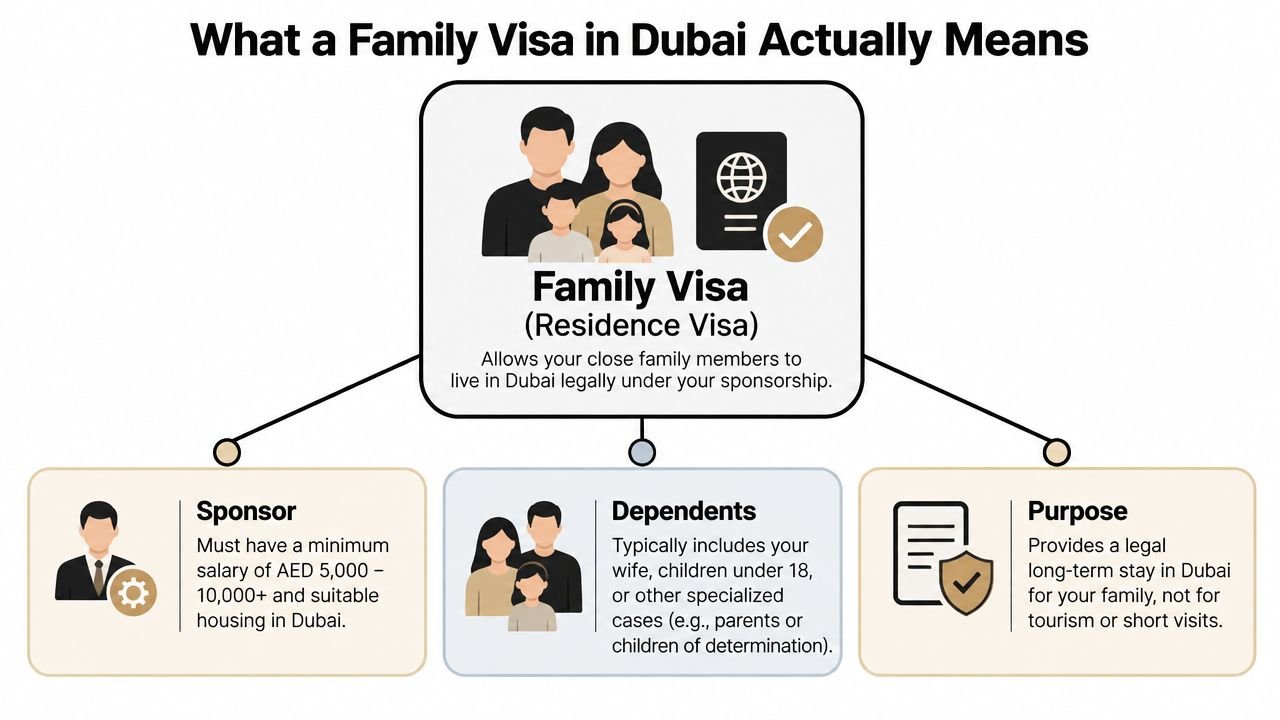
Which authority handles the application?
GDRFA Dubai, the General Directorate of Residency and Foreigners Affairs in Dubai, handles many Dubai mainland immigration applications. ICP, the Federal Authority for Identity, Citizenship, Customs and Port Security, operates federal smart services and covers certain free zone and federal categories.
Your route depends on the sponsor's visa, company jurisdiction and the dependent's application type. A sponsor in a Dubai mainland company may use GDRFA channels, while a sponsor connected to a free zone or another emirate may need ICP or a relevant authority.
What do the main terms mean?
A typed application form is the government application prepared and submitted through an authorised typing centre or service channel. File opening creates or activates the immigration record under which the dependent's application is processed.
A status change changes the dependent's immigration position from outside the UAE or visit status to the residence process. Medical fitness is the required health screening for dependents aged 18 and above, as stated by UAE government residence guidance. Visa stamping is the final residence issuance step, while an Emirates ID is the identity card issued to the resident.
Medical testing and Emirates ID biometrics are mandatory steps regardless of whether the file runs through Dubai or a federal route. Treat the application as a chain, not a single form.
Who Can Sponsor Dependents in the UAE
The starting point is the sponsor, not the child's passport or the marriage certificate. The sponsor must hold a valid UAE residence visa and meet the income or investor requirements before the dependent file is submitted.
For most resident sponsors, the commonly applied threshold is AED 4,000 per month, or AED 3,000 plus employer-provided accommodation, as reflected in official UAE family residence guidance. The sponsor also needs suitable proof, such as a salary certificate, employment contract or business documents.
| Sponsor Category | Minimum Salary / Proof | Eligible Dependents |
|---|---|---|
| Employee resident | AED 4,000 monthly, or AED 3,000 plus employer accommodation, subject to the applicable rules | Legal spouse and eligible children |
| Investor or partner | Valid trade licence and supporting immigration documents, with income and accommodation evidence where required | Legal spouse and eligible children |
| Freelancer or domestic worker sponsor | Strong income and accommodation documentation, with approval depending on the case | Dependents accepted under the relevant authority's rules |
| Female resident sponsor | Higher salary or special approval may apply | Dependents accepted after eligibility review |
| UAE national or GCC citizen | Different thresholds and routes may apply | Family members under the applicable national or GCC rules |
The ICP service requirements distinguish between relationship categories for sponsorship. Its published thresholds include AED 4,000 for first-degree relatives, AED 8,000 for second- and third-degree relatives, and AED 15,000 for friends. Visit sponsorship and residence sponsorship are different applications, so don't use a visit-visa threshold as proof that a residence file qualifies.
Which children can remain on a family visa?
Dubai immigration guidance states that a resident may sponsor a male child up to age 25, subject to the applicable conditions. Unmarried daughters may qualify without the same male-child age ceiling, while parents require a separate eligibility review and supporting evidence.
Consider a sponsor with a wife and two sons aged 10 and 23. The 10-year-old is straightforward, and the 23-year-old may qualify if he remains unmarried and is studying, with the correct evidence. A 26-year-old son generally needs his own residence status rather than remaining on the parent's sponsorship.
A freelancer on a freelance permit cannot assume that holding a permit automatically proves sponsorship eligibility. Female sponsors and sponsors with non-standard employment arrangements should obtain a pre-check before paying for typing, translation or medical appointments.
Documents and Attestation Before You File
Most avoidable failures start before immigration sees the application. Build the file in two groups, sponsor documents and dependent documents, then verify the relationship certificates before you book the submission.
For the sponsor, prepare the passport copy, Emirates ID, current residence visa page, salary certificate or labour contract, trade licence if the sponsor is an investor, accommodation evidence such as an Ejari, and supporting bank statements where requested. An Ejari is Dubai's registered tenancy record.
For each dependent, prepare a passport with at least six months' validity, recent photographs on a white background, the marriage certificate for a spouse, birth certificates for children and previous UAE visa pages if applicable. The government checklist also points to valid passports, photos and relationship proof, as reflected in GDRFA Dubai family service requirements.
How does certificate attestation work?
A marriage or birth certificate issued outside the UAE normally passes through the issuing country's competent ministry, the UAE embassy or consulate in that country, and then the UAE Ministry of Foreign Affairs, known as MOFA, in Dubai or Abu Dhabi. The exact route can differ by country, so confirm the chain before sending an original document.
MOFA states that documents must be original, in Arabic or English, or accompanied by an official translation. They must also be attested by the appropriate authorities and must not be laminated, according to MOFA attestation guidance.
Practical rule: Never laminate a certificate intended for UAE immigration. Stamps and seals need to remain visible and verifiable.
MOFA now supports digital service routes through UAE Pass and approved courier collection for some documents. That helps with logistics, but it doesn't remove the need for the correct issuing-country and embassy attestations.
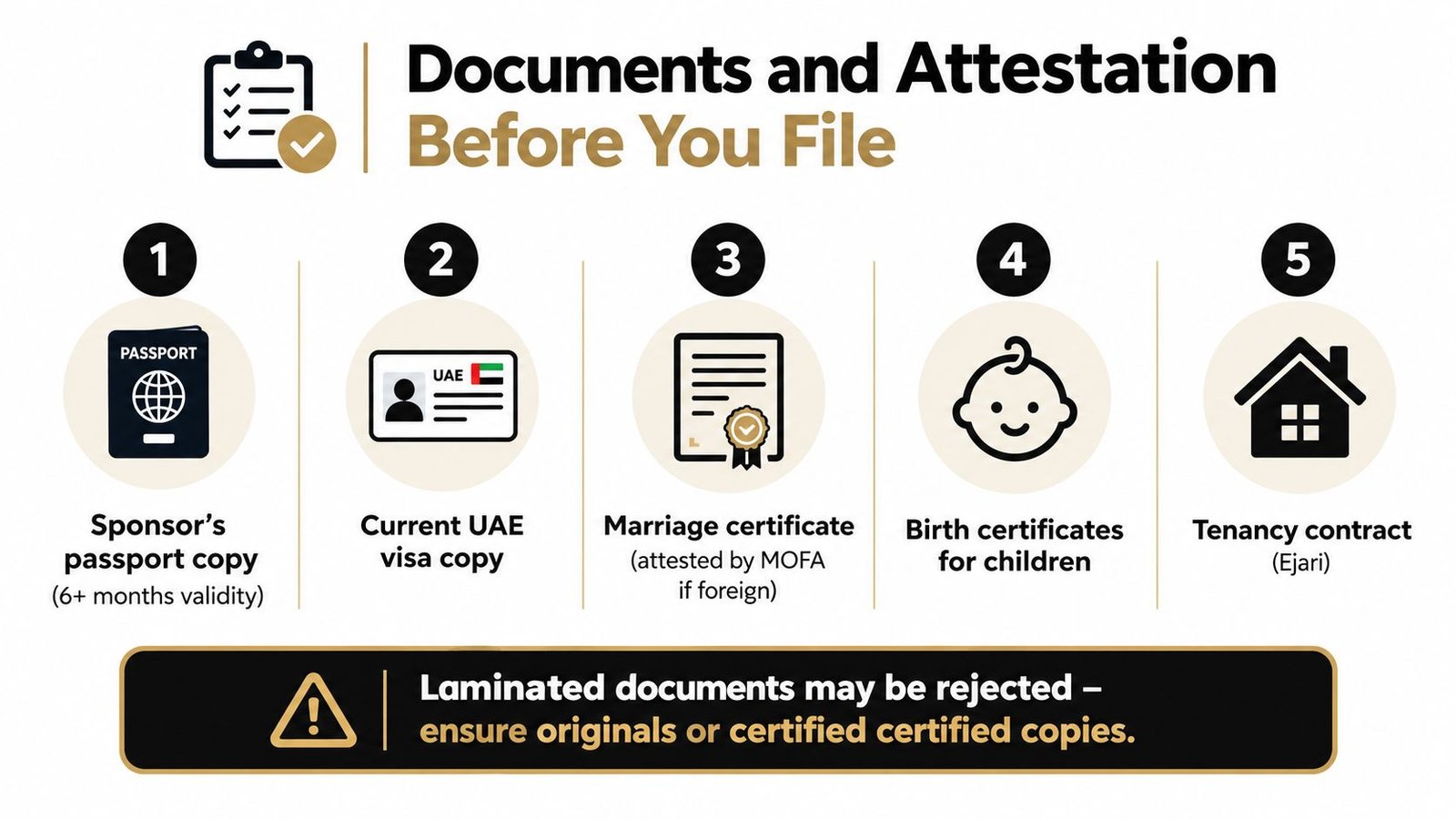
| Sponsor documents | Dependent documents |
|---|---|
| Passport copy | Passport with at least six months' validity |
| Emirates ID | Recent white-background photographs |
| UAE residence visa page | Attested marriage certificate for spouse |
| Salary certificate or labour contract | Attested birth certificate for each child |
| Trade licence for an investor or partner | Previous UAE visa pages, where applicable |
| Ejari or accommodation proof | Official translation where required |
| Supporting financial records | Medical fitness result for adults |
The Family Visa Process Step by Step
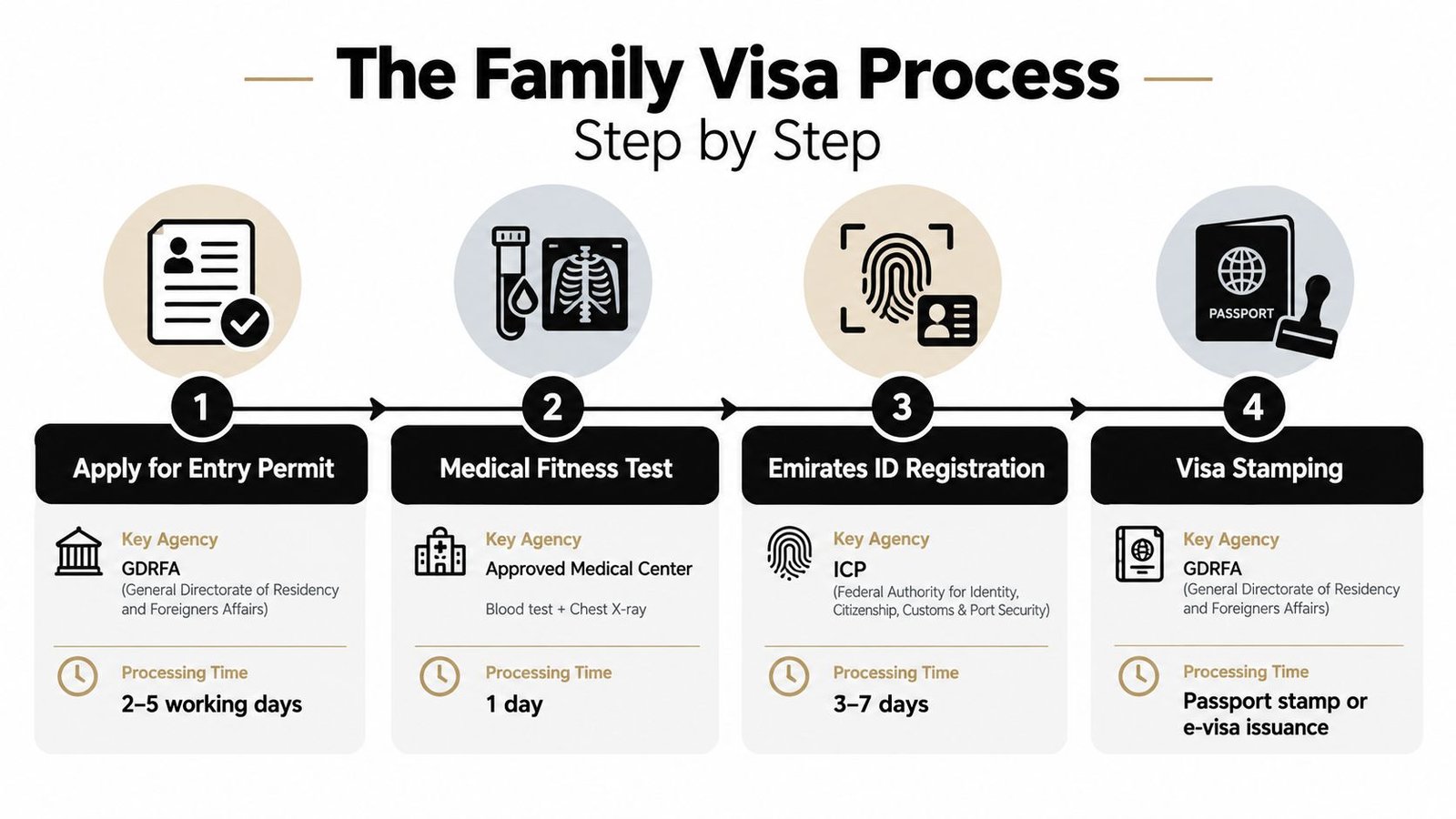
A clean Dubai file moves through several agencies in a fixed order. Start with sponsor eligibility, then relationship documents, then immigration submission, followed by medical fitness, biometrics and final residence issuance.
Step one starts with the entry permit
The sponsor or PRO submits the dependent's entry permit application through GDRFA Dubai or the relevant ICP route. The entry permit lets a dependent outside the UAE enter and begin the residence process.
Don't submit while a marriage or birth certificate is still waiting for attestation. An approval at the entry-permit stage doesn't repair a missing relationship document later.
Medical and biometrics come after arrival
Once the dependent is in the UAE, adults aged 18 and above complete the required medical fitness examination. The medical result must clear before residence issuance can be completed.
The dependent also completes Emirates ID registration and biometrics through the relevant service channel. The Emirates ID record is tied to the immigration file, so a spelling mismatch in the passport, visa application or relationship document can create rework.
Residence issuance closes the chain
After medical clearance and identity registration, the authority completes the residence permit or stamping stage. Depending on the route, the result may be recorded digitally rather than as a physical passport sticker.
The sequence matters more than rushing one appointment. Weekend schedules, public holidays, a borderline medical result or a rejected document can push the next handoff back. A PRO coordinator should monitor each status rather than asking the sponsor to check separate portals.
Fees, Timelines and Real Costs to Budget
Budget in layers. Government charges, medical services, Emirates ID issuance, insurance, document work and PRO fees are separate cost categories, and a quote that combines them without explanation is difficult to audit.
For Dubai relatives' visit visas, GDRFA publishes medical insurance fees of AED 40 for a 30-day visa, AED 60 for a 60-day visa and AED 90 for a 90-day visa, as reported with reference to the authority's published requirements by Times of India's UAE visa coverage. Those figures relate to visit visas, not the full cost of a residence sponsorship file.
What should your budget include?
| Line Item | Approximate Cost (AED) |
|---|---|
| Entry permit | 1,150 to 1,250 |
| Residence stamping per dependent | 1,000 to 1,200 |
| Medical typing | 350 to 400 |
| Medical screening | 320 to 370 |
| Emirates ID issuance | 270 to 370 |
| Medical retest buffer, if required | 100 to 250 |
| Basic annual health insurance | About 700 to 1,500 |
| PRO service fee per file | 1,500 to 4,000 |
The figures above are planning ranges, not a fixed government tariff. Fees can change with the authority, visa route and service channel. MOFA also lists individual affairs attestation charges separately on its official attestation service page, so document fees should appear as their own line in a quotation.
A practical planning figure is AED 4,500 to AED 6,000 per dependent including insurance, while a four-person family may require AED 14,000 to AED 22,000, depending on the file structure and service choices. Reconfirm every amount before payment, especially when a quote includes attestation, translation, courier work or insurance.
How a PRO Firm Like Inpro Handles the File
A good PRO service creates one accountable workflow for a file that otherwise crosses GDRFA, MOFA, ICP, typing centres, medical facilities and Emirates ID channels. The value isn't just submitting a form. It is preventing one incomplete handoff from becoming a second appointment, a replacement translation or a new application.
The process should begin with an eligibility review. The coordinator checks the sponsor's residence status, income evidence, accommodation, employment or trade licence documents, and the dependent relationship. If the marriage certificate isn't attested, the application should stop there until the attestation route is confirmed.
What should the coordinator own?
The provider should manage the relationship-document chain through the relevant issuing authority, UAE embassy or consulate and MOFA. It should then prepare the entry permit file for GDRFA Dubai or the applicable ICP channel, with the sponsor receiving a clear list of missing items rather than a vague request to “send everything”.
After entry, the coordinator arranges medical testing and biometrics around the family's availability. The provider tracks the file reference, checks medical status, follows Emirates ID registration and handles the final residence issuance step.
A useful service standard: One coordinator, one file record, written status updates and a named escalation route when a document or medical result is rejected.
What should you demand from a PRO provider?
Ask who checks the file before submission, who pays government charges, how rejected documents are handled and whether translations and attestation are included. A responsible provider separates government fees from service fees and tells you when a third party, such as an embassy or medical centre, controls the timing.
Inpro offers UAE visa processing and PRO support for dependent and family residency workflows, including documentation for spouses and children. For a founder, HR team or Golden Visa holder, that model is useful when the sponsor wants one point of coordination rather than separate follow-ups with each authority.
Common Delays and a Final Checklist Before You Apply
Family visa files usually stall at the edges. A salary letter may not match the establishment record, a foreign certificate may be laminated, or a child's circumstances may change while the application is being prepared. Treat the final review as a formal approval gate.
Check the file against the government requirements, not against a generic online checklist. The sponsor should confirm income, residence status and accommodation, while the dependent file should confirm passport validity, relationship proof, translation and attestation.
| Risk Area | Document or Verification | Owner |
|---|---|---|
| Sponsor eligibility | Residence visa, salary proof or investor documents | Sponsor and PRO |
| Income evidence | Salary certificate or contract matching the employer record | Sponsor and employer |
| Accommodation | Ejari or accepted tenancy evidence | Sponsor |
| Relationship proof | Attested marriage or birth certificate | Sponsor and PRO |
| Document condition | Original, unlaminated certificate with visible seals | Sponsor |
| Translation | Official Arabic or English translation where required | PRO or translator |
| Adult dependents | Medical fitness appointment and result | PRO and dependent |
| Identity registration | Emirates ID application and biometrics appointment | PRO and dependent |
| Travel timing | Dependent available for appointments and status steps | Family |
The strongest final check is simple: place every original beside two clean copies, confirm each name and date matches the passport, and verify that the next appointment is possible before filing. Don't let a cheap typing fee dictate the whole strategy. The provider that prevents rework can cost less overall than the provider that only submits the first form.
Inpro can review sponsor eligibility, coordinate attestation and prepare dependent residence files across the relevant UAE government channels. If you want one team to manage the handoffs for your spouse or children's application, visit Inpro to discuss the file before submission.