


Yes, Dubai is subject to UAE VAT at the standard rate of 5%, and a UAE-resident business must register once its taxable supplies and imports reach AED 375,000. The usual surprise is that VAT isn't a Dubai-only tax, and registration depends on taxable turnover, not just on whether you've opened a trade licence.
You may be setting up a mainland company, launching from a free zone, working as a freelancer, or moving staff and operations into the United Arab Emirates. The practical question isn't only “is there VAT in Dubai?” It's whether your activity is taxable, when your turnover crosses the registration line, and whether your invoices and records are ready when the Federal Tax Authority expects them.
Table of Contents
- Is There VAT in Dubai?
- How VAT Works in the UAE Market
- When Do You Need to Register for VAT?
- VAT Compliance for Different Business Structures
- How to File VAT Returns in the UAE
- 2026 VAT Updates That Affect Dubai Businesses
- What Founders Should Do Next
Is There VAT in Dubai?
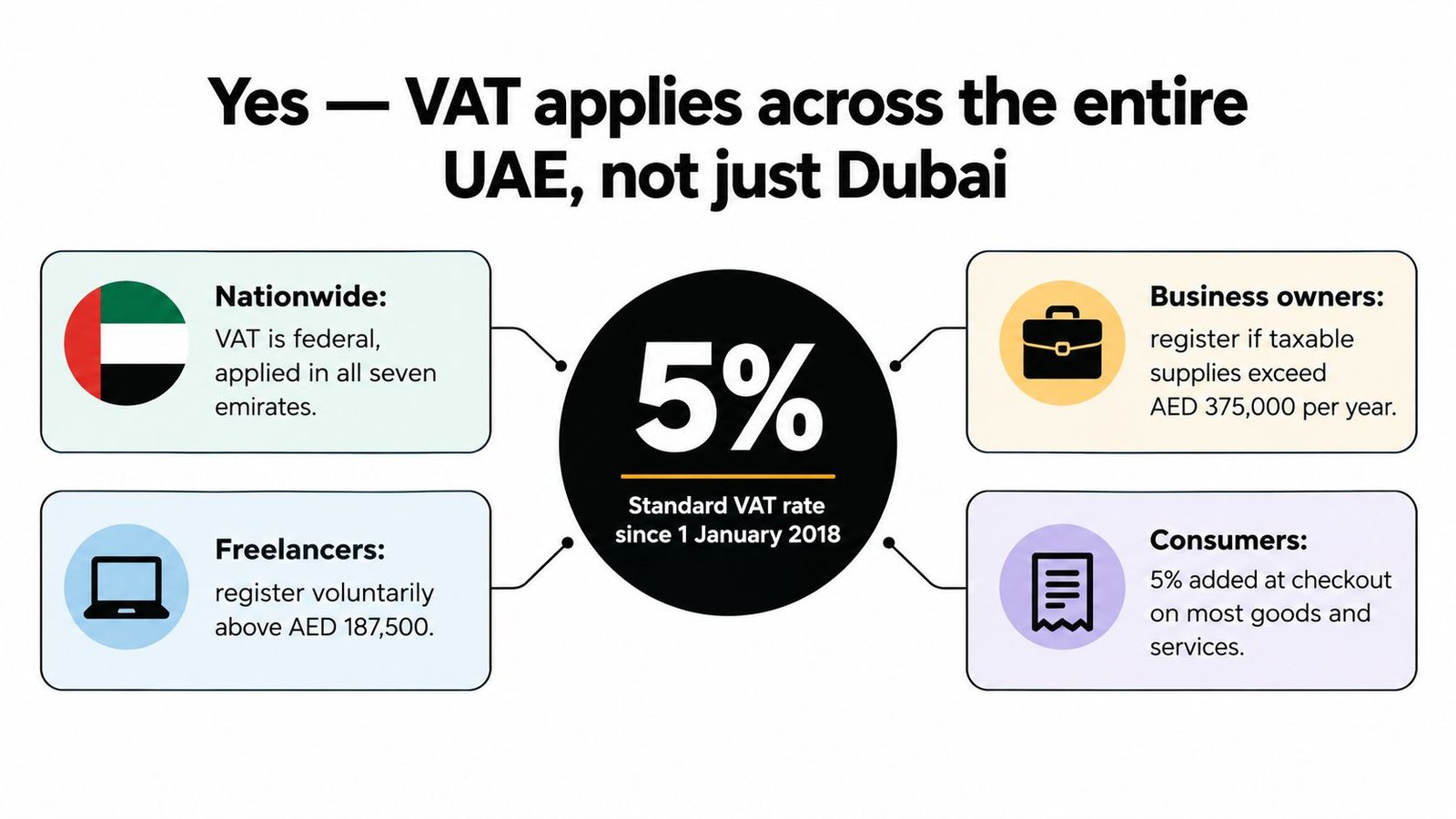
Yes. Dubai follows the UAE-wide VAT system, introduced across all seven emirates on 1 January 2018 at a standard rate of 5%, as confirmed by the UAE Ministry of Finance VAT guidance. The Dubai government also explains that VAT is charged at the point of sale, collected by businesses, and remitted to the Federal Tax Authority, or FTA, the federal body responsible for tax administration.
VAT is a consumption-based indirect tax. A business usually adds VAT to a taxable sale, records the amount collected, and accounts for it in its return. The business isn't normally the final economic payer. The cost generally rests with the end consumer, although a business can carry unrecovered VAT where the related purchase or activity doesn't qualify for input tax recovery.
What does VAT mean for a Dubai founder?
If you sell taxable goods or services in Dubai, you need to build VAT into your pricing and invoicing once you're registered. The rule applies whether you operate from mainland Dubai, a free zone, or another UAE emirate such as Abu Dhabi or Sharjah. A free zone licence doesn't automatically remove a business from federal VAT obligations.
Freelancers should assess taxable supplies and imports rather than assume that small-scale work is outside VAT. A freelancer below the mandatory threshold may still consider voluntary registration if eligible and if recovering input VAT would help cash flow. That decision should follow a review of customers, expenses, contracts, and expected turnover.
Practical rule: Treat VAT as an operating process, not a line added at the end of the year. Your contracts, price lists, invoices, bookkeeping, and cash collection should all reflect the position from the start.
The 5% rate applies to most taxable goods and services, but not every supply is treated identically. The distinction between standard-rated, zero-rated, and exempt supplies affects registration calculations, pricing, and whether input VAT can be recovered.
How VAT Works in the UAE Market
The UAE VAT system has three main treatments, and confusing them can create pricing and bookkeeping errors.
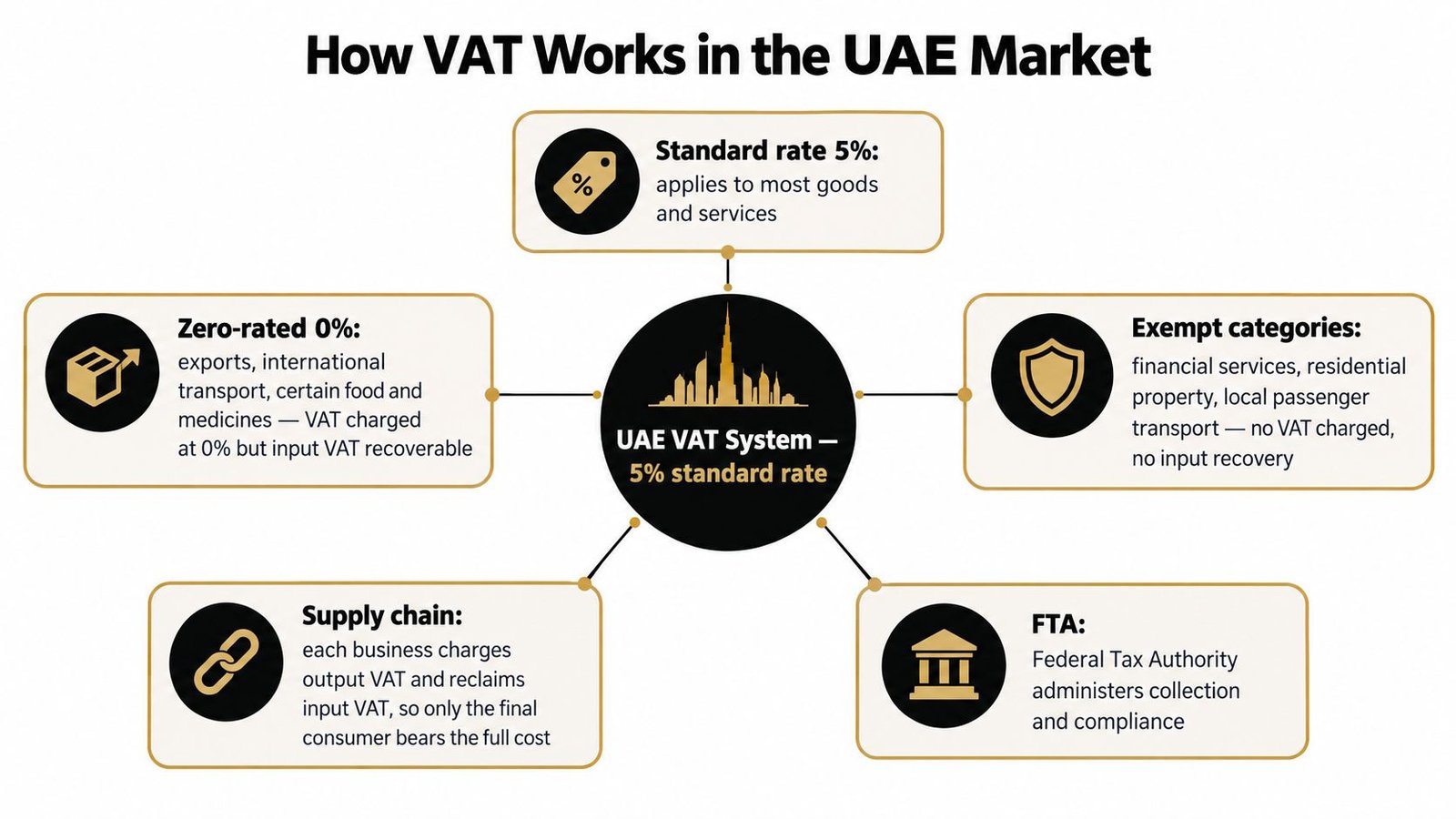
Standard-rated supplies carry VAT at 5%. The Federal Decree-Law on Value Added Tax sets the standard rate, which applies to most goods and services. A registered consultancy in Dubai, for example, generally charges output VAT on a taxable service and records the VAT paid on eligible business purchases as input VAT.
Zero-rated supplies are taxable supplies charged at 0%. They still matter for VAT because they can count towards taxable turnover, and eligible businesses can generally recover related input VAT. Exports and certain categories of international transport, food, medicines, education, and healthcare may fall within zero-rating where the legal conditions are met. Don't apply zero-rating just because a customer is overseas. The transaction must meet the relevant requirements and your records need to support the treatment.
Exempt supplies have a different effect. The supplier doesn't charge VAT, and input VAT linked to exempt activities generally can't be recovered. Financial services, some residential property transactions, and certain local passenger transport services can be exempt, subject to the applicable rules.
Who ultimately pays the tax?
VAT moves through the supply chain. Each registered business charges output VAT on taxable sales and may recover eligible input VAT paid to suppliers. The final consumer generally can't recover that tax, so the full burden settles at the consumer stage.
That model matters for a founder choosing between VAT-inclusive and VAT-exclusive pricing. Business customers may focus on the net price because they might recover eligible VAT. Consumers usually experience the tax as part of the final checkout price.
Why do classifications matter?
A service that looks similar commercially can receive a different VAT treatment depending on its legal nature, customer, location, and supporting documents. Your invoice should show the correct treatment rather than applying 5% to every transaction.
Keep separate records for standard-rated, zero-rated, exempt, and outside-scope activities where relevant. That separation helps your accountant prepare the return and reduces the risk of recovering input VAT against an activity that doesn't permit recovery.
When Do You Need to Register for VAT?
For a UAE-resident business, mandatory registration applies when taxable supplies and imports exceed AED 375,000 over the previous 12 months, or when the business expects to exceed that amount within the next 30 days, according to the Federal Tax Authority registration guidance.
Voluntary registration begins at AED 187,500 of taxable supplies and imports. This option can suit an early-stage company that has significant VAT-bearing expenses, sells mainly to VAT-registered customers, or wants to recover eligible input VAT before reaching mandatory registration.
Which threshold applies to you?
Use this decision path:
- Add taxable supplies and imports. Don't count every invoice automatically. Separate taxable activity from exempt activity and review zero-rated supplies correctly.
- Review the rolling period. Check the previous 12 months, not only the calendar year.
- Forecast the next 30 days. A reasonable expectation of crossing the mandatory threshold can trigger the obligation before the money has arrived.
- Check your customer and cost profile. If you're below the mandatory line but above the voluntary line, assess whether registration improves recovery and commercial credibility.
- Act promptly once mandatory. Delaying registration can leave you accounting for VAT from the date the obligation arose, while your earlier prices may not have allowed for it.
| Threshold type | Value | Registration requirement |
|---|---|---|
| Mandatory registration | AED 375,000 | Register when taxable supplies and imports exceed this amount over the previous 12 months, or are expected to exceed it within the next 30 days |
| Voluntary registration | AED 187,500 | Registration may be available when taxable supplies and imports reach this amount |
A non-resident business needs separate attention. A business based outside the UAE can face mandatory registration when it makes taxable supplies in the UAE, even below the resident threshold, where no other person is responsible for paying the tax. International founders should review the customer, place of supply, contract, and import arrangements before issuing UAE invoices.
Founder checkpoint: Don't wait for your bank balance to tell you that registration is due. Maintain a monthly taxable-turnover schedule and record the forecast that supports your decision.
VAT Compliance for Different Business Structures
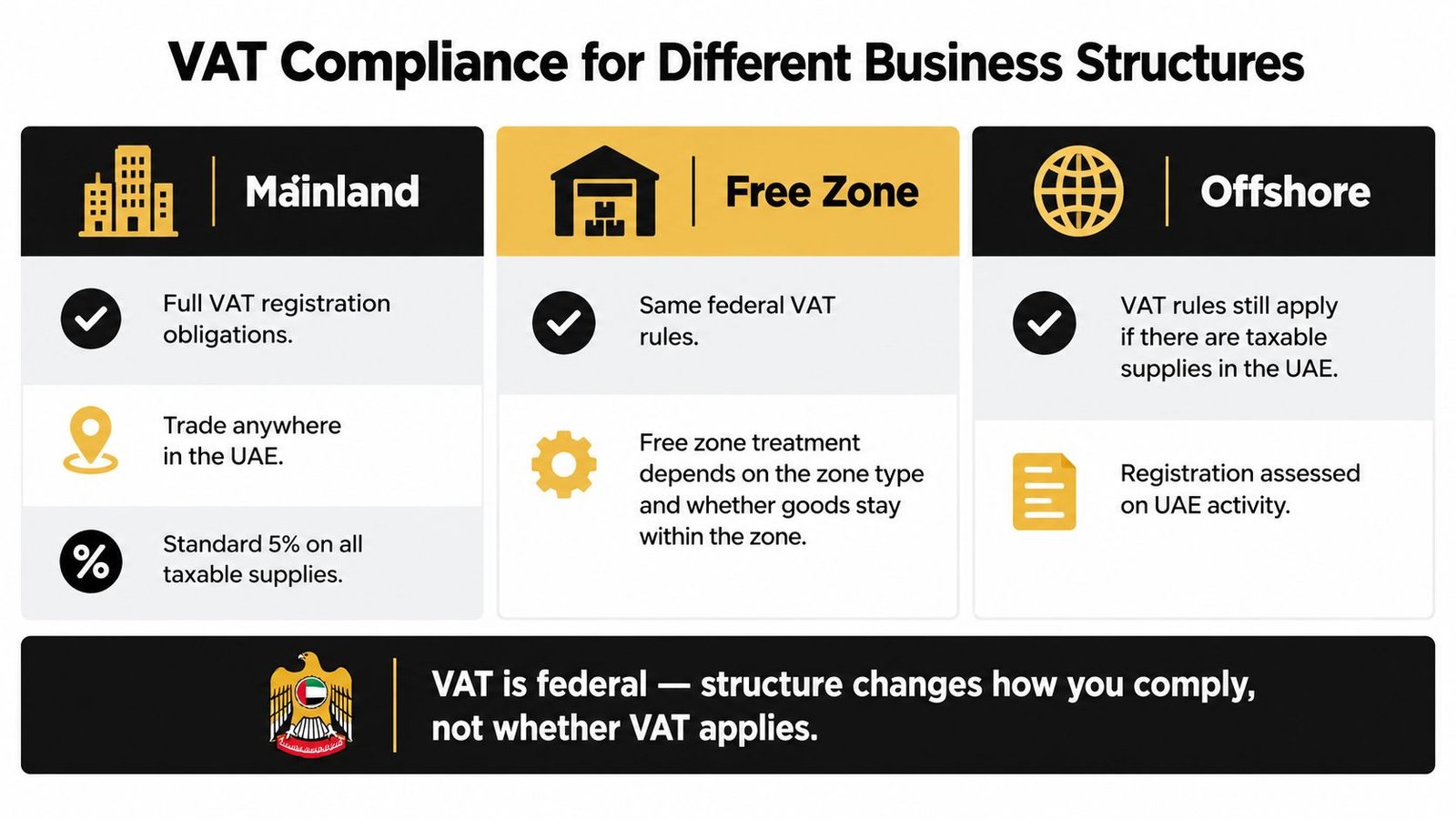
VAT is federal, so the same core rate and registration framework applies across business structures. The structure changes the practical work around licences, records, contracts, and transaction flows, but it doesn't create a general VAT exemption.
How does mainland VAT compliance work?
A mainland company is licensed to conduct business under the relevant emirate's mainland authority and can generally trade across the UAE within its permitted activity. Its VAT work centres on identifying taxable sales, issuing compliant invoices, recording eligible purchases, and filing through the FTA system once registered.
Mainland businesses should keep sales and expense records aligned with the trade activity on their licence. A mismatch between the licensed activity, the contract, and the invoice can make an otherwise simple transaction harder to explain during a review.
Does a free zone company avoid VAT?
A free zone is a designated business area offering its own licensing and operating framework. Free zone status doesn't automatically remove VAT obligations. The treatment of a transaction involving a free zone depends on the zone's status, the goods or services involved, and where the supply takes place.
Don't describe a customer invoice as VAT-free solely because your office is in a free zone. Review the actual transaction and retain contracts, delivery evidence, customs documents, and customer details where those records support the VAT treatment.
What about an offshore structure?
An offshore company is generally used for holding or international structuring purposes rather than ordinary UAE trading. Its label doesn't decide the VAT position. If the entity makes taxable supplies in the UAE, registration and reporting may still apply based on the activity and place of supply.
| Structure | Practical VAT focus |
|---|---|
| Mainland | Match invoices and records to UAE trading activity and customer contracts |
| Free zone | Check the transaction treatment, don't rely on the zone label |
| Offshore | Assess whether the entity makes taxable UAE supplies |
The sound approach is to map the flow of money and goods, not just the company formation certificate. Identify who contracts with the customer, who issues the invoice, who imports the goods, and who receives payment. That map normally reveals where VAT obligations sit.
How to File VAT Returns in the UAE
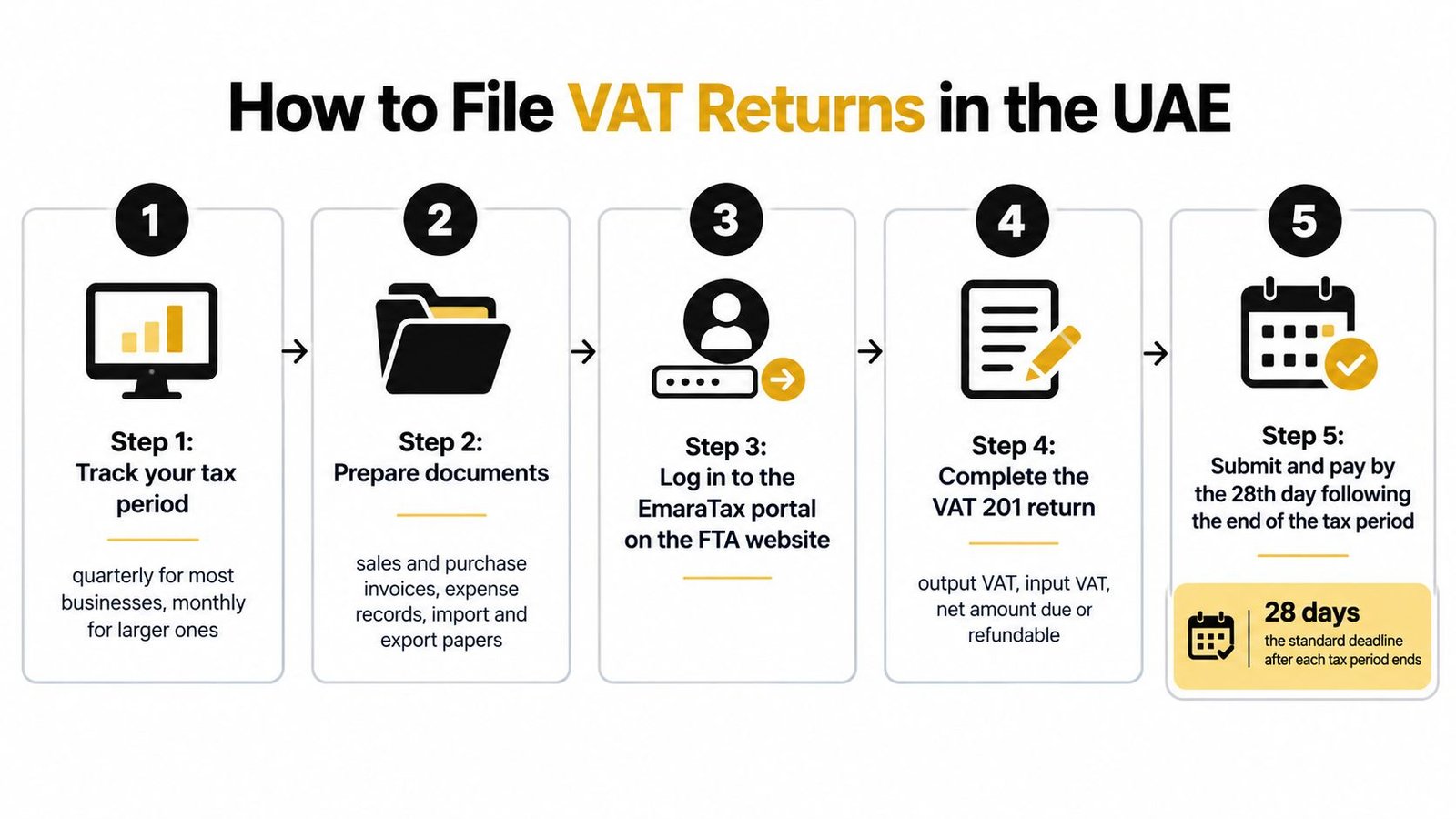
Registered businesses file VAT returns electronically through EmaraTax, the FTA's online portal. The return reports output VAT, eligible input VAT, adjustments, and the resulting amount payable or refundable.
The UAE government filing guidance states that VAT returns are usually due within 28 days after the end of the tax period. Businesses with annual turnover below AED 150 million generally have quarterly tax periods, while businesses with annual turnover of AED 150 million or more generally have monthly periods.
What should you prepare?
Use a close process before opening the return:
- Sales invoices: Reconcile taxable sales, credit notes, customer refunds, and output VAT.
- Purchase records: Check supplier invoices and confirm that input VAT relates to eligible business activity.
- Import and export documents: Keep customs and shipping evidence where it supports the treatment.
- Bank and ledger data: Match collections and payments to the accounting records.
- Tax treatment review: Separate standard-rated, zero-rated, exempt, and other relevant transactions.
How does EmaraTax filing work?
Log in to EmaraTax, open the VAT return area, and select the relevant VAT 201 return for the tax period. Confirm the pre-filled taxpayer information, enter the figures from your reconciled records, review the net position, submit the return, and arrange payment where VAT is due.
Don't leave filing until the last working day. A bank transfer delay, missing invoice, or unresolved credit note can interrupt submission even when the accounting work is otherwise complete.
The following video can help teams familiarise themselves with the filing workflow:
2026 VAT Updates That Affect Dubai Businesses
Dubai SMEs should treat 2026 as a process year, not just a year for checking the VAT rate. The Ministry of Finance announced Federal Decree-Law No. 16 of 2025, effective 1 January 2026, and Cabinet Decision No. 149 of 2026, effective 1 October 2026, amended parts of the Executive Regulation. The changes include input tax apportionment rules and VAT administration updates, as set out in the Ministry of Finance announcement on the VAT Executive Regulation amendments.
What should SMEs review?
Input tax apportionment matters when a business has both recoverable and non-recoverable activities. A startup that provides taxable consulting but also earns exempt income may need a clearer method for deciding which input VAT can be recovered.
Review your chart of accounts, expense coding, and supporting calculations. If your bookkeeping system puts all expenses into one VAT bucket, it may not produce a defensible recovery position when activities become mixed.
What does the compliance scale indicate?
The FTA reported 1.7 million tax registration transactions and AED 46 billion in VAT and excise revenues in its 2025 annual report, figures included in the Ministry of Finance's 2026 update. These figures show that VAT administration covers a broad and expanding compliance base, so founders shouldn't treat registration and filing as informal paperwork.
For SMEs and startups, the practical response is simple. Review input VAT recovery, update internal approval checks, keep transaction evidence, and confirm that your accountant is applying the 2026 administrative changes to the correct tax periods. The rules may be technical, but the operating requirement is clear: your records must explain your VAT position.
What Founders Should Do Next
Start with a turnover review. List your taxable supplies and imports, separate exempt activity, check the previous 12 months, and prepare a short forecast for the next 30 days. That tells you whether mandatory registration applies, whether voluntary registration is available, or whether continued monitoring is appropriate.
Then prepare the operating basics:
- Set up invoice controls: Show the correct VAT treatment and keep customer and supplier details consistent.
- Create a filing calendar: Record the tax period, return deadline, payment date, and internal review date.
- Reconcile monthly: Compare sales invoices, purchases, bank activity, imports, and accounting entries.
- Review your structure: Mainland, free zone, and offshore labels don't replace a transaction-level VAT assessment.
- Escalate technical issues: Get professional advice when you have mixed supplies, cross-border customers, imports, property income, or uncertain input tax recovery.
A founder doesn't need to become a tax lawyer, but someone in the business must own the process. If you don't have that person internally, an external accounting or PRO team can help with registration, EmaraTax filing, documentation, and deadline tracking. Inpro offers UAE company setup, VAT registration, VAT filing support, and related PRO services for founders and operating teams.
For help assessing your registration threshold, preparing your VAT records, or filing through EmaraTax, contact Inpro. The team can review your mainland or free zone setup, explain the next compliance steps, and help you put a clear VAT process in place before deadlines become urgent.