


If you're responsible for a UAE business with a monthly VAT period, the return and any VAT payment are due within 28 days after the end of that tax period. A period ending on 31 May is due on 28 June, while a deadline that falls on a weekend or UAE public holiday moves to the next working day, according to the Federal Tax Authority's VAT filing guidance.
The rule sounds simple until month-end close, missing invoices, reverse-charge entries and public holidays all arrive together. This guide explains who gets a monthly cycle, how to calculate each deadline in 2026, what to reconcile before submission and how the penalty position changed from 14 April 2026.
Table of Contents
- What the Monthly UAE VAT Return Due Date Is
- Who Gets Forced Into a Monthly VAT Cycle in the UAE
- How the 28-Day Rule Works in Practice
- Reconciling Your Books Before the 28th
- 2026 Penalties for Missing the Monthly Due Date
- Your 2026 Monthly VAT Filing Calendar
- Putting It All Together and What to Do Next
What the Monthly UAE VAT Return Due Date Is
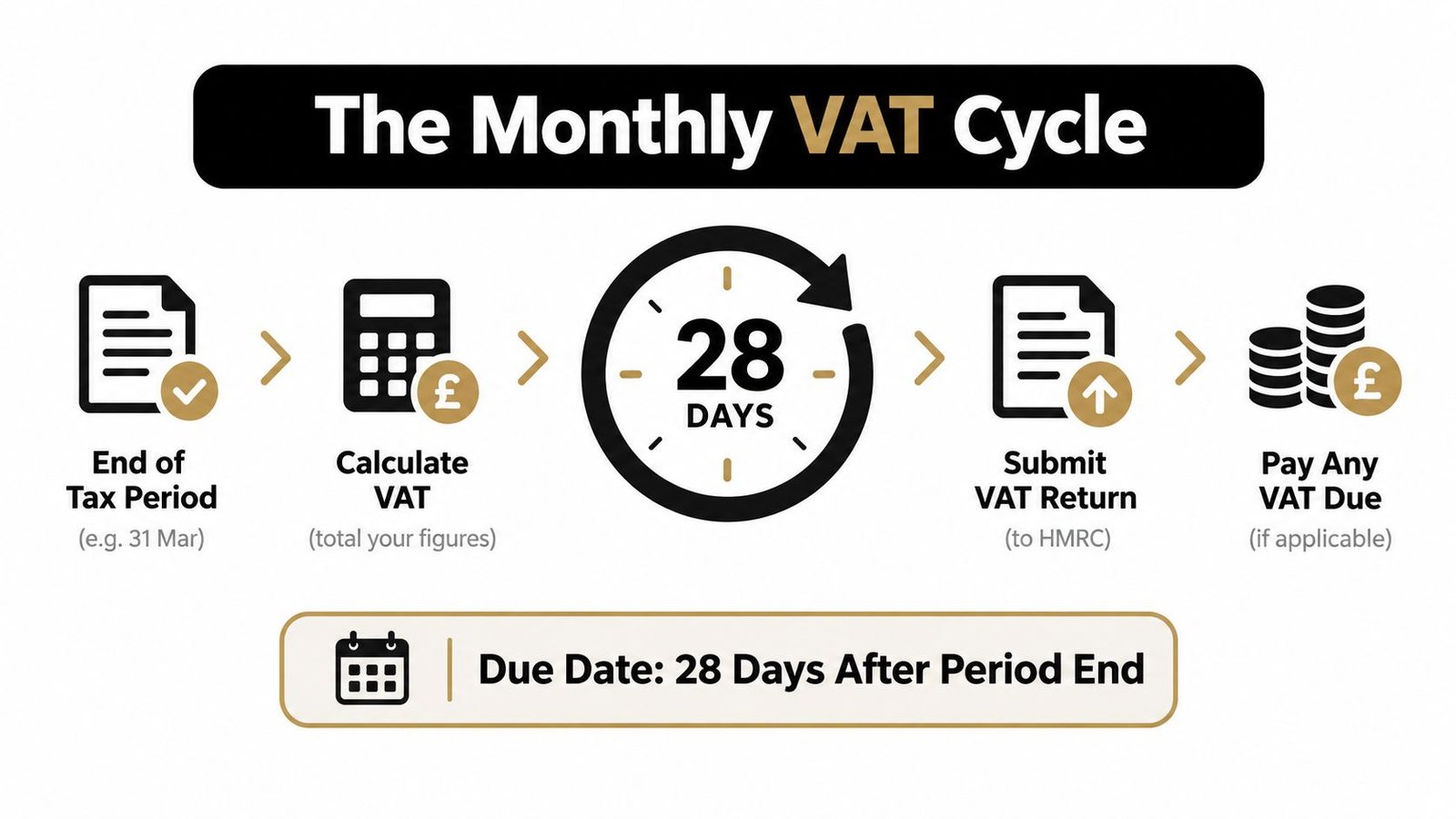
For a monthly filer, the UAE VAT return due date is the 28th day after the end of the assigned tax period. The electronic return and related payment must both be completed by that deadline, as set out in the FTA's filing guidance.
A tax period is the period covered by a VAT return. The Federal Tax Authority, or FTA, assigns the period to the taxable business and records it in the VAT registration details. Most businesses in the United Arab Emirates file quarterly, while larger businesses may be assigned a monthly cycle.
Use this process to set the deadline:
- Confirm the assigned period. Check the VAT certificate and the FTA electronic tax portal. Do not rely on another company's filing cycle, even if it belongs to the same group.
- Identify the period end. For a monthly filer, this is normally the last day of the relevant calendar month.
- Count 28 calendar days. The return and payment have the same statutory deadline.
- Check for a weekend or public holiday. If the date falls on either, the deadline moves to the first business day afterwards.
The 28 days are calendar days, not working days. Start gathering invoices, import records, reverse-charge entries and payment evidence during the month-end close. Waiting until the final week leaves little room to resolve missing documents or correct the VAT ledger.
What happens when the 28th is not a business day?
If the statutory date falls on a UAE weekend or declared public holiday, submission moves to the first business day after it. This commonly affects deadlines around Eid, New Year and other public holidays, when banks, customs teams and suppliers may also work to reduced schedules.
Practical rule: Record both dates in the finance calendar: the raw 28th and the adjusted working-day deadline. The adjustment changes the filing date, not the time available for preparing the return.
Who Gets Forced Into a Monthly VAT Cycle in the UAE
The UAE's standard VAT period is quarterly, but the FTA can assign a monthly period to a larger taxable business. The UAE government portal identifies annual turnover of AED 150 million or more as the threshold associated with monthly filing, as stated in its VAT return filing guidance.
Turnover should be read in the context of the business's taxable activity and the tax period assigned by the FTA. A Dubai mainland company, an Abu Dhabi consultancy, a Sharjah trading business or a VAT-registered free-zone entity shouldn't assume that its licence location decides the cycle. The assigned period on the VAT certificate and the FTA portal is the operational reference.
How can you confirm the assigned cycle?
Start with the VAT certificate. Look for the field showing the assigned tax period, then compare it with the return periods visible in the FTA's electronic system. If the certificate and portal appear inconsistent, keep a record of the issue and ask the FTA or a tax adviser to confirm the position before the next deadline.
Monthly filing creates a different operating rhythm. A monthly business must close and review VAT information every month, whereas a quarterly filer has a longer interval between returns. That can improve visibility over VAT payable, but it also leaves less room for unresolved supplier queries and coding errors.
| Criterion | Quarterly Cycle | Monthly Cycle |
|---|---|---|
| Typical assignment | Standard cycle for many VAT-registered businesses | Assigned by the FTA to qualifying larger businesses |
| Annual return count | Four returns | Twelve returns |
| Filing deadline | 28 days after each assigned quarterly period | 28 days after each assigned monthly period |
| Finance workload | Fewer formal submissions, with larger close batches | Smaller but more frequent close and reconciliation tasks |
| Cash-flow visibility | VAT position reviewed less often | VAT position reviewed each month |
| Main control risk | Quarter-end backlog | Repeated deadlines and incomplete monthly evidence |
The AED 150 million threshold is therefore more than a classification detail. It changes how accounting, treasury and tax teams schedule their work. A founder who has grown quickly should check the VAT certificate rather than waiting for an obvious reminder from the portal.
How the 28-Day Rule Works in Practice
The practical calculation starts with the period end. Treat the day after that date as day one, count 28 calendar days, then check whether the resulting date falls on a UAE weekend or public holiday.
For a period ending on 31 May 2026, the raw due date is 28 June 2026. For a period ending on 30 June 2026, the raw due date is 28 July 2026. The VAT return and payment should be scheduled against the applicable final due date, not left until the filing day.
A December close crosses into the following calendar year. A period ending 31 December 2026 is expected to produce a statutory due date of 28 January 2027, subject to confirmation against the FTA portal calendar.
| Period End | Day of Week | Raw 28th Day | Final Due Date | Reason for Change |
|---|---|---|---|---|
| 31 May 2026 | Sunday | 28 June 2026 | 28 June 2026 | No change is applied to this worked example |
| 30 June 2026 | Tuesday | 28 July 2026 | 28 July 2026 | No change |
| 31 December 2026 | Thursday | 28 January 2027 | 28 January 2027 | Year-end period, no stated holiday adjustment |
Dates later than the current filing year are provisional planning dates. Confirm them against the published FTA holiday calendar and the portal before relying on them for submission or payment scheduling.
The holiday rule is separate from the 28-day calculation. If the 28th falls on a UAE public holiday, including a holiday period around New Year or Eid, the deadline rolls forward to the next official business day. The same adjustment applies when the date falls on a weekend. That shift can affect both return submission and payment processing, so allow time for the payment to clear.
Why should you verify the portal calendar?
A printed schedule helps the finance team plan monthly closes, but it does not replace the FTA portal calendar. Public holidays can change the operational deadline, and payment processing may take longer than submitting the return.
Count the statutory date first, then apply the business-day adjustment. Do not move the deadline merely because the tax period ended on a weekend.
Reconciling Your Books Before the 28th
A monthly VAT return should be the result of a controlled close, not a last-minute export from accounting software. The review should connect the VAT return to the sales ledger, purchase records, customs evidence, bank movements and prior-period adjustments.
What should the reconciliation cover?
Start with output VAT from the sales subledger. Compare taxable sales in the ledger with issued tax invoices, credit notes and the revenue accounts used for the return. Investigate gaps caused by late invoices, cancelled documents or postings made directly to the general ledger.
Then review input VAT against supplier invoices and customs declarations. Check that each claimed amount has appropriate evidence and that the supplier's tax registration details are recorded correctly. Import VAT and other customs-linked entries need to agree with the supporting declarations.
Reverse-charge transactions deserve a separate review. A duplicate posting can inflate both the output and input sides of the return, while an omitted reverse-charge entry can leave the VAT treatment incomplete. Transactions involving goods or services from other Gulf Cooperation Council countries also require careful classification rather than an automatic code.
Zero-rated exports should be cross-checked against shipping documents and the customer's VAT certificate where relevant. Keep the evidence together, because a zero-rated treatment supported only by a sales description is difficult to defend during a review.
A practical pre-submission checklist
- Sales ledger: Match taxable sales, credit notes and output VAT to the return.
- Supplier invoices: Check recoverable input VAT, supplier tax registration details and invoice dates.
- Customs records: Reconcile import declarations and related VAT entries.
- Reverse charge: Test for omitted or duplicated postings, including cross-border service transactions.
- Zero-rated supplies: Match exports to shipping documents and customer records.
- Prior-period corrections: Review VAT adjustments, credit notes and errors carried into the current return.
- Cash and accrual timing: Investigate differences between the accounting basis used in the ledger and the timing reflected in VAT records.
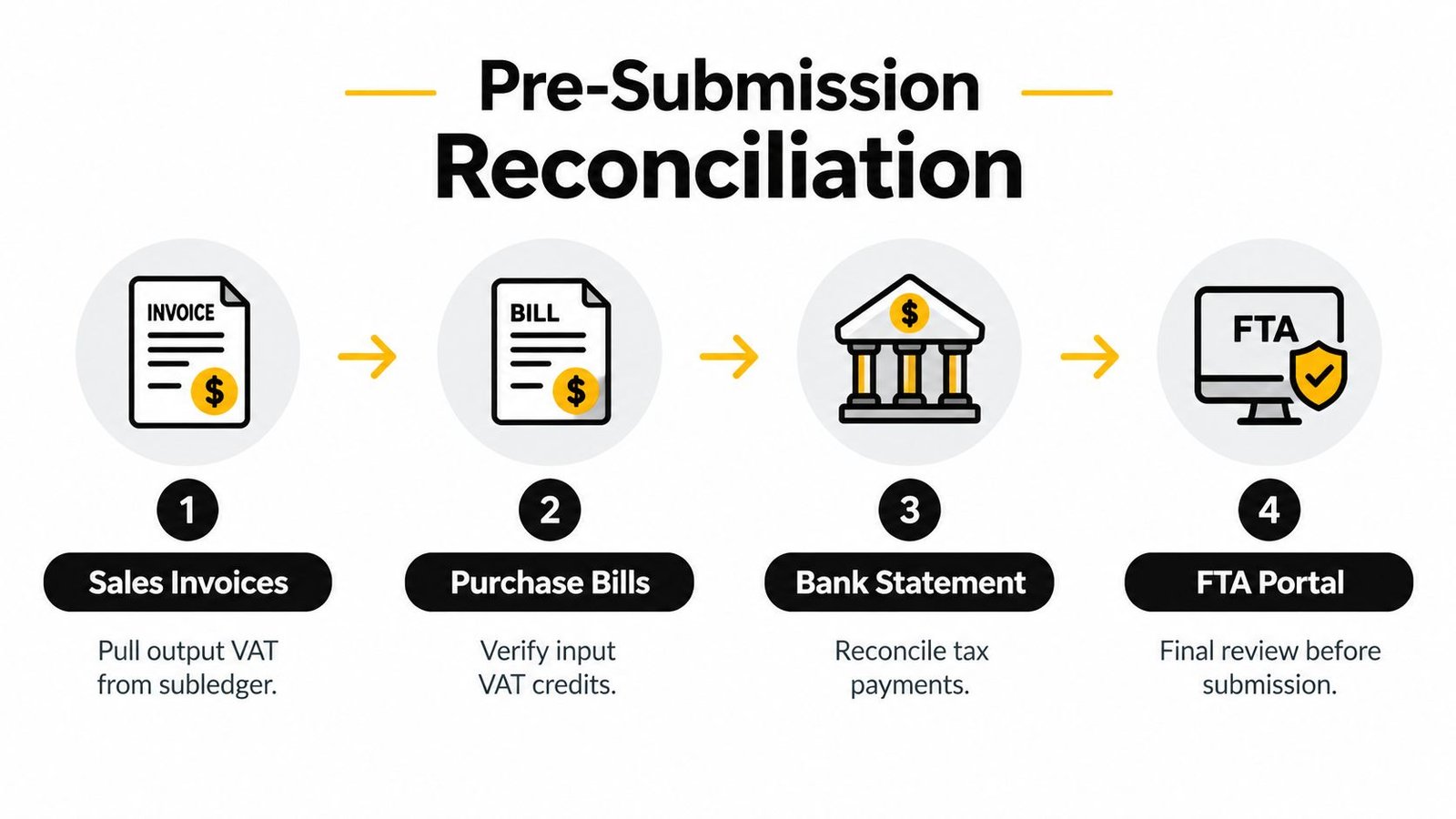
Run the main reconciliation at T-3 working days, then perform a shorter review at T-1 working day. This leaves time to request a missing invoice, correct a duplicate entry or confirm a customs document before the return is locked.
The FTA VAT Returns User Guide should be kept alongside the internal checklist so the person preparing the return can confirm the electronic submission steps.
2026 Penalties for Missing the Monthly Due Date
Missing a monthly VAT deadline can create two separate problems: late filing of the return and late payment of VAT due. The fixed late-filing amounts described in the 2026 material are AED 1,000 for a first offence and AED 2,000 for a repeated offence within 24 months, as reflected in the FTA VAT return filing dates guidance.
From 14 April 2026, the late-payment charge is described as a monthly charge calculated at 14% annually on unpaid tax. The practical point is that filing the return without paying the amount due doesn't remove payment exposure.
What does a missed deadline look like?
Assume a monthly return is due on 28 June 2026, but the business submits on 5 July. On the figures provided, the late-filing exposure is AED 1,000 for a first offence, plus the late-payment charge calculated at the 14% annual rate on the unpaid VAT for the relevant seven-day period.
That example doesn't calculate the charge in dirhams because the unpaid VAT balance isn't known. The amount depends on the tax payable and the applicable calculation method used by the FTA. Finance teams should therefore treat payment approval as part of the filing control, not as a separate task for later.
| Penalty Type | Pre-14 Apr 2026 | From 14 Apr 2026 |
|---|---|---|
| Late VAT return, first offence | AED 1,000 | AED 1,000 |
| Repeated late filing | AED 2,000 under the stated repeat-offence rule | AED 2,000 under the stated repeat-offence rule |
| Late payment | Earlier penalty treatment applied | 14% annually, charged monthly on unpaid tax |
| Practical response | File and pay by the statutory deadline | File and pay by the statutory deadline, with added attention to payment timing |
The FTA may also flag return errors through its electronic services. Where an error exceeds AED 10,000, the business may need to consider a voluntary disclosure rather than carrying the correction into a later return. The first AED 10,000 small-error relief is associated with Cabinet Decision No. 49, but the correct treatment depends on the facts and the applicable procedure.
Your 2026 Monthly VAT Filing Calendar
Use this calendar only if the VAT certificate and FTA records assign the business a monthly tax period. It follows the statutory 28th of the following month, adjusts the February cycle for the weekend, and marks later dates as provisional. Check the FTA portal before submission because an officially announced public holiday can move the final due date.
| Tax Period | Period End | Statutory 28th | Adjusted Due Date | Status |
|---|---|---|---|---|
| January 2026 | 31 January 2026 | 28 February 2026 | 28 February 2026 | Confirmed subject to FTA calendar |
| February 2026 | 28 February 2026 | 28 March 2026 | 30 March 2026 (28 March falls on a Saturday) | Confirmed subject to FTA calendar |
| March 2026 | 31 March 2026 | 28 April 2026 | 28 April 2026 | Confirmed subject to FTA calendar |
| April 2026 | 30 April 2026 | 28 May 2026 | 28 May 2026 | Confirmed subject to FTA calendar |
| May 2026 | 31 May 2026 | 28 June 2026 | 28 June 2026 | Confirmed subject to FTA calendar |
| June 2026 | 30 June 2026 | 28 July 2026 | 28 July 2026 | Confirmed subject to FTA calendar |
| July 2026 | 31 July 2026 | 28 August 2026 | 28 August 2026 | Confirmed subject to FTA calendar |
| August 2026 | 31 August 2026 | 28 September 2026 | 28 September 2026 | Confirmed subject to FTA calendar |
| September 2026 | 30 September 2026 | 28 October 2026 | 28 October 2026 | Confirmed subject to FTA calendar |
| October 2026 | 31 October 2026 | 28 November 2026 | 30 November 2026 | Provisional |
| November 2026 | 30 November 2026 | 28 December 2026 | 28 December 2026 | Provisional |
| December 2026 | 31 December 2026 | 28 January 2027 | 28 January 2027 | Provisional |
Dates from October 2026 onward are provisional and subject to the official UAE public holiday announcement and the FTA portal calendar. The same portal check remains sensible for earlier rows if a holiday announcement changes the working-day treatment.
Which 2026 dates need extra attention?
28 March 2026 falls on a Saturday, so the February return moves to Monday, 30 March 2026. The reason is visible in the table rather than left for the reader to infer.
28 May 2026 is a Thursday but falls close to the Eid period. Check the official holiday announcement and the FTA portal before treating it as an ordinary working day. Staff availability, banking access and supporting-document collection can still affect the close even if the statutory date remains unchanged.
28 December 2026 is a Monday and follows the year-end close for November. Prepare the return before the holiday period, particularly when managers travelling outside Dubai, Abu Dhabi or the wider UAE must approve the filing or payment.
The table does not apply to a quarterly filer. A company in a mainland jurisdiction, free zone or offshore structure should confirm the assigned cycle on its VAT certificate and in the FTA portal. The FTA assignment controls the filing period, so do not copy these dates into a quarterly compliance schedule.
Putting It All Together and What to Do Next
A workable monthly process has four fixed rules:
- Start the clock at period end: The return and payment are tied to the 28-day deadline.
- Confirm the assigned cycle: The AED 150 million threshold is the key published marker for monthly filing, but the VAT certificate and FTA assignment control the business's actual period.
- Apply the holiday safeguard: A weekend or public holiday moves the deadline to the next business day.
- Control the penalty exposure: From April 2026, late filing can mean AED 1,000 for a first offence or AED 2,000 for a repeat offence, while unpaid VAT carries the stated 14% annual charge calculated monthly.
A simple standard operating procedure works better than a heroic final-day close. Lock the books on day 25, complete the final review and approvals on day 26, submit on day 27 where possible, and pay through the available FTA payment route before the deadline. This gives the team a buffer if the portal rejects a return, a payment reference fails or a director is unavailable to approve the transaction.
What edge cases should you recheck?
Review any period-end date that falls on the 31st of a month with only 30 days. The period-end date and the next month's statutory 28th should be generated by the calendar system, not copied from a prior month.
Also check every FTA reassignment letter. A business can operate as a quarterly filer and later receive an instruction that changes the assigned cycle. That change affects close schedules, cash planning and the number of returns the team must prepare.
For a founder setting up in Dubai, an international entrepreneur expanding into Abu Dhabi, a freelancer becoming VAT registered, or an HR team supporting a growing business, the same discipline applies. Keep the VAT certificate accessible, reconcile before the final week, and treat filing and payment as one controlled event.
Inpro helps UAE businesses with VAT registration, VAT filing and related company compliance across mainland and free-zone structures. If you want support checking your assigned cycle or preparing an ongoing monthly process, visit Inpro to arrange a free 20-minute call.