

You've arrived in Dubai, your company licence is issued, and your phone is full of bank recommendations from friends and advisers. The practical answer is simple: to open a bank account in the UAE, you need the right residency status, a licence or identity file that matches your intended use, and a clear explanation of where your money comes from and how it will move.
The process is less about finding a “friendly” bank and more about submitting a file that a compliance team can approve without having to guess. For founders, that means treating banking as a sequence that follows company formation, visa issuance, and Emirates ID completion.
Table of Contents
- Setting the Scene for Banking in the UAE
- First Decisions Before You Apply
- Documents You Need to Prepare
- Walking Through the Application Process
- How Entity Type Affects Your Bank Choice
- Why Applications Get Rejected and How to Avoid It
- Practical Tips, Timelines, and When to Get Help
Setting the Scene for Banking in the UAE
A UAE bank account is more than a place to receive money. Depending on the product, it can combine a current or savings account, a debit card, online banking access, and a continuing obligation to keep ownership and personal information up to date. The Ultimate Beneficial Owner, or UBO, is the individual who ultimately owns or controls a company, and banks expect that person to be identified clearly.
The UAE Government Portal's banking guidance explains that residents commonly provide an Emirates ID, a valid UAE residence visa, and a passport. Banks may also request salary or address evidence, while many offer online or mobile applications and some support digital identity verification inside the app.
Why does opening an account feel layered?
Banks in Dubai, Abu Dhabi, and Sharjah must apply the United Arab Emirates' financial-crime controls, while also following their own risk appetite. One bank may be comfortable with a straightforward free zone consultancy, while another may ask for more evidence of premises, contracts, counterparties, or the founder's existing banking history.
That difference explains why social proof rarely helps. A recommendation from another founder can point you towards a useful bank, but it doesn't replace a review of your entity, nationality, ownership structure, business activity, and expected transactions.
For low-risk applicants with standard customer due diligence complete, the UAE Central Bank's account-opening rulebook says a licensed financial institution should be able to open an account within 3 business days. The same Central Bank rulebook makes clear that funds received while an account is being opened must remain blocked until account-opening requirements, sanctions screening, and other anti-money-laundering checks are complete.
Practical rule: A bank account application should read like a clear business story. The licence explains what you do, the ownership documents explain who controls it, and the forecast explains why the expected money flows make sense.
For a newcomer, the sequence normally begins with the company structure and trade licence. Residency follows through the visa process, then the Emirates ID application and registration. Only after those milestones are complete can many applicants present the identity file that a personal or corporate bank review expects.
First Decisions Before You Apply
The first banking decision isn't which application form to complete. It's whether your company structure, residency position, and bank shortlist fit together. Changing any of these after documents have been prepared can send the file back to the beginning.
Which UAE jurisdiction fits the banking plan?
Mainland companies are licensed through the relevant emirate's Department of Economy and Tourism or Department of Economic Development, often shortened to DED. A free zone company is licensed by a specialised authority such as DMCC, IFZA, or RAKEZ. DIFC, the Dubai International Financial Centre, and ADGM, the Abu Dhabi Global Market, operate under their own commercial and regulatory frameworks.
The licensing authority matters because the bank will test whether the entity is real, active, and suitable for the proposed transactions. A structure with a simple ownership chain and an activity that matches the founder's actual work is easier to explain than a layered structure with unclear commercial purpose.
Are you applying as a resident or non-resident?
A UAE resident commonly has an Emirates ID and residence visa that can support personal banking and, where appropriate, corporate signatory access. A non-resident can face tighter policies, and some accounts may be limited to savings or deposit products rather than a full current account. The InterNations guide to UAE banking and tax also notes that banks often require minimum balances, with average requirements commonly between AED 3,000 and AED 5,000, while some non-resident accounts may require as much as AED 100,000.
That liquidity requirement changes the decision. A founder may qualify on paper but still find that the chosen product ties up more working capital than expected.
Which bank category suits the business?
Conventional and Islamic banks offer different product structures, while large established banks and digital-first institutions can differ in how they handle interviews, in-person verification, and document uploads. Compare the bank's minimum-balance policy, international transfer needs, currencies, payment tools, and appetite for your sector before collecting documents.
A bank shortlist built only from a friend's experience is one of the easiest ways to repeat work. Start with the three filters above, then test the shortlist against your activity, ownership, residency, and expected transaction pattern.
Documents You Need to Prepare
Banks don't ask for documents to create administrative work. Each item helps the reviewer answer a specific question: who are you, where do you live, what does the company do, who owns it, and why will money move through the account?
The exact list varies by bank and account type. The table below separates the usual personal file from the corporate file while keeping room for additional requests.
What belongs in a personal and corporate file?
| Document | Personal Account | Corporate Account |
|---|---|---|
| Passport | Original passport and copy | Passport copies for shareholders, directors, UBOs, and authorised signatories |
| UAE immigration evidence | Residence visa page or entry evidence, where accepted | Visa and Emirates ID evidence for relevant owners and signatories |
| Emirates ID | Usually required for resident onboarding | Usually required for UAE-resident directors, shareholders, and signatories |
| Income or funds evidence | Salary or income letter and bank statements from the source jurisdiction | Source-of-funds evidence, contracts, invoices, purchase orders, or transaction support |
| Address evidence | Utility bill or other accepted proof of address | Tenancy contract, office evidence, or an Ejari record where applicable |
| Constitutional documents | Not applicable | Trade licence, certificate of incorporation, MOA, AOA, share certificate, and company profile |
| Authority to open the account | Personal application and KYC declaration | Board resolution or other authorisation for the account and signatories |
| Ownership information | Personal tax and residency declarations | UBO declaration, shareholder chart, and identification of controlling persons |
| Tax information | Relevant personal tax declarations | Tax registration evidence where requested, including TRN confirmation if applicable |
| Bank forms | Completed KYC and account application | Corporate KYC, UBO, source-of-funds, and expected-activity forms |
MOA means Memorandum of Association, while AOA means Articles of Association. They set out the company's constitutional arrangements, ownership, and authority structure. The Emirates NBD business account guidance specifically lists a valid trade licence or certificate of incorporation, passports and Emirates IDs for partners and authorised signatories, and the MOA, AOA, or board resolution. It also says a new company usually needs a six-month bank statement from a partner or existing company, with at least one signatory resident in the UAE.
Which documents cause avoidable questions?
The tenancy contract should make sense alongside the licensed activity and the company's operating model. A consultancy with no explanation of where its staff work, or a trading company with no evidence of suppliers and customers, can leave the reviewer asking whether the entity has genuine substance.
Visa and Emirates ID records also need to tell the same story. If the visa status, signatory details, and company records don't align, the relationship manager may pause the file while the applicant supplies clarification.
Keep originals available and use certified Arabic translations where a bank or authority requires them. Scanned copies are useful for preliminary review, but a bank can still request clearer documents, certification, or an in-person verification.
Walking Through the Application Process
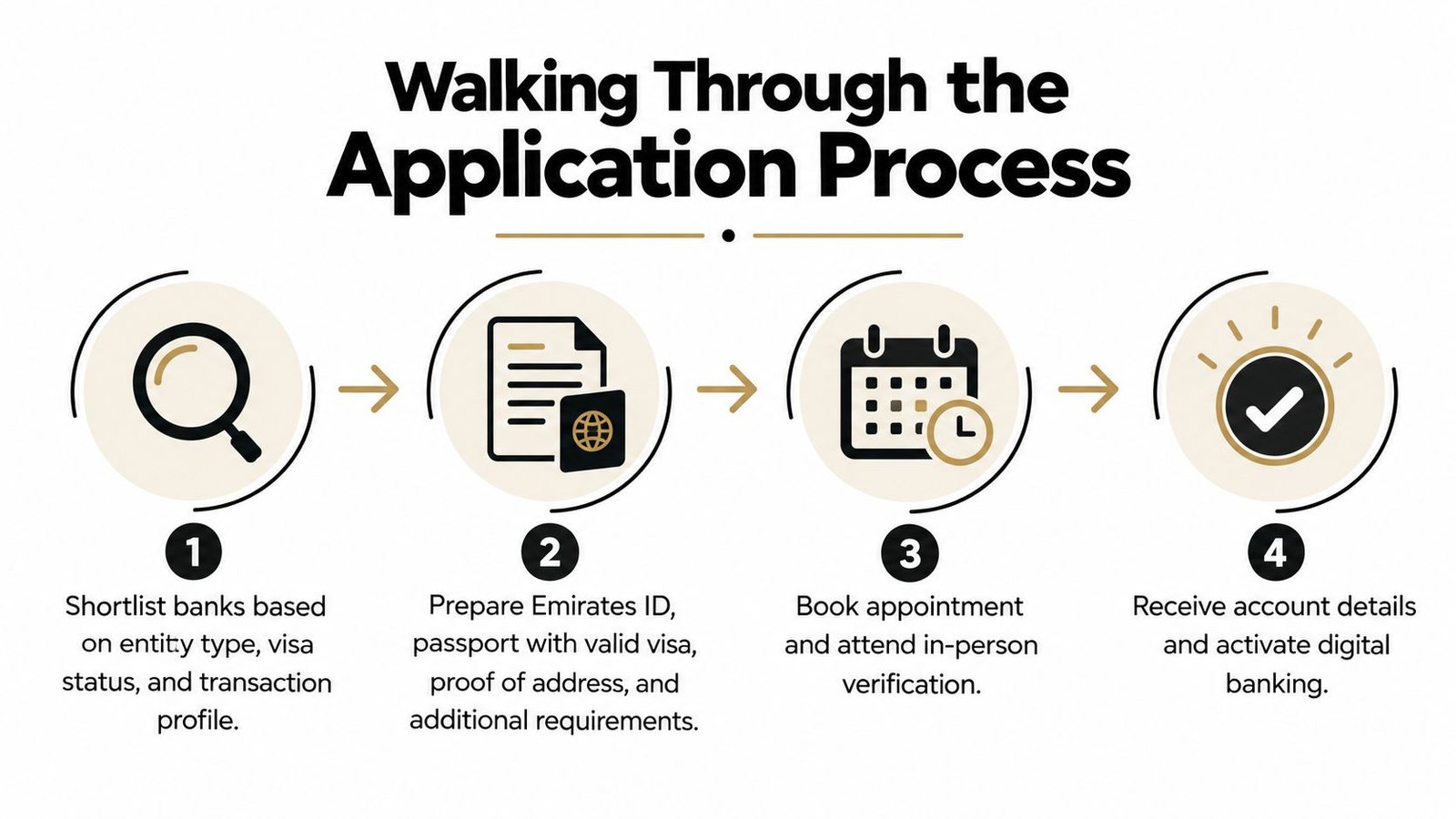
A successful application starts before the bank form. Shortlist institutions according to the entity type, residency status, expected monthly flows, currencies, counterparties, and business activity. A local trading company in Dubai may need a different account design from a remote software company registered in a free zone, even if both have clean incorporation documents.
What happens during the bank review?
The relationship manager usually performs the first fit assessment. This meeting may cover the company's services, customers, suppliers, source of funds, countries involved, expected incoming and outgoing payments, and the founder's existing banking relationship.
The file then moves into customer due diligence and source-of-wealth review. The bank may ask for contracts, invoices, personal statements, a business model summary, or an explanation for a particular country or currency. These requests are often clarifications rather than formal rejection notices, so a prompt, consistent answer matters.
In-branch verification remains common for first-time personal accounts and for corporate files with several signatories. Some digital channels, including FAB, Mashreq Neo, and Wio, offer app-based or remote onboarding for selected products and eligible entities. Availability depends on the applicant's status, entity structure, and the bank's current product rules.
Why does compliance take the most time?
After the relationship manager is satisfied with the initial file, a compliance committee or specialist review team checks ownership, sanctions exposure, business activity, source of funds, and expected transaction behaviour. A file can stall at this stage even when every uploaded document looks complete.
The practical response is to model the account before submission. Set out expected monthly flows, currencies, counterparties, payment purposes, and relevant countries. Then attach evidence that supports the model, such as signed contracts, purchase orders, invoices, or a credible pipeline.
A conditional approval normally leads to account details, card issuance, online banking credentials, and, for some corporate products, cheque-book delivery. Funds may still be restricted until all checks are completed, so don't promise suppliers or schedule payroll around an account that has only received conditional approval.
For a visual overview of the onboarding sequence, this video provides an additional reference:
How Entity Type Affects Your Bank Choice
A trade licence doesn't guarantee bank acceptance. The issuing authority, ownership structure, office arrangement, and commercial purpose all influence how a bank assesses the relationship before it reviews projected revenue.
Which entity is easiest to explain to a bank?
A mainland company can often present a direct UAE operating story, particularly when its activity, premises, employees, and customers align. A free zone company can also be bankable, but the bank may ask more about international ownership, cross-border payments, and how the company will operate from its registered location.
An offshore entity generally faces more restrictions for ordinary UAE operating banking. The bank needs to understand why an offshore structure is being used, where the business is conducted, and whether the proposed account activity fits the entity's legal purpose.
| Entity Type | Licensing Authority | Bank Acceptance | Common Banks | Typical Friction |
|---|---|---|---|---|
| Mainland | Department of Economic Development or the relevant emirate authority | Broad potential acceptance when activity and operations align | Emirates NBD, ADCB, FAB | Proof of premises, activity, signatories, and local operations |
| Free Zone | The relevant free zone authority, such as DMCC, IFZA, or RAKEZ | Widely considered, subject to ownership and activity review | UAE banks selected for the profile | International ownership, flexi-desk evidence, and transaction rationale |
| DIFC or ADGM | DIFC or ADGM authority | Assessed against the financial and commercial profile | Banks familiar with the centre and activity | Regulated activity, ownership layers, and specialist compliance |
| Offshore | JAFZA Offshore, RAK ICC, or another offshore authority | More restricted for ordinary UAE operating accounts | Selected institutions only, subject to review | Limited UAE operating substance and complex ownership |
A UBO declaration identifies the person who ultimately controls the entity. Banks compare that declaration with shareholder registers, passports, corporate charts, powers of attorney, and constitutional documents. If the ownership chain is difficult to verify, the application can be delayed before financial projections receive meaningful attention.
The Middle East Briefing guide to opening a UAE bank account describes the additional relevance of board resolutions, shareholder passports, constitutional documents, and ownership information. The choice of entity should therefore reflect both business objectives and the practical ability to satisfy KYC review.
Why Applications Get Rejected and How to Avoid It
A valid trade licence, Emirates ID, and clean passport are necessary, but they don't guarantee approval. Banks reject or pause applications when the file creates a risk question that the applicant hasn't answered.
What triggers enhanced review?
The most common issue is a mismatch between the licensed activity and the expected transaction pattern. A company licensed for general consultancy that expects large international trading flows needs a strong explanation, contracts, and evidence that the activity is genuine.
Banks also examine opaque ownership chains, high-risk jurisdictions, large cash activity, unknown third-party payments, and non-resident applicants without state-issued UAE identification. Sectors such as virtual assets, money services, forex, and precious-metals trading can receive more document-intensive review. A vague description such as “business services” is less useful than a precise explanation of the service, customer, contract, invoice, and payment route.
The UAE Expert Hub guidance on rejected corporate accounts highlights incomplete or outdated KYC, unclear activity, unexplained cash volumes, and weak commercial substance as practical risk indicators.
How can you pre-clear the risk?
Prepare the file as if a reviewer has no informal context about your business. Include:
- A one-page business summary: Explain the service, target customers, supplier relationships, countries, currencies, and payment purpose.
- A clean ownership chart: Show every company and individual in the chain until the natural person who controls the entity.
- A realistic activity model: Tie expected flows to contracts, invoices, purchase orders, or a credible pipeline.
- Source-of-funds evidence: Use audited accounts, salary records, dividend records, or other documents that explain the money entering the business.
- A completed identity file: Make sure visa, Emirates ID, passport, address, and signatory information agree before submission.
Politically Exposed Person, or PEP, screening can also create questions where applicants least expect them. A possible match doesn't automatically mean wrongdoing, but it can require clarification about identity, relationship, source of wealth, and public role.
Recent visa transfers, unclear income evidence, and a company that has no operating explanation can all slow the file. Pre-clear these points with the relationship manager before the application is formally uploaded.
Practical Tips, Timelines, and When to Get Help
Plan bank onboarding around the milestones that feed the file. For a resident founder, the visa and Emirates ID process often comes before full personal or corporate banking access. For a non-resident, ask the bank at the start whether it supports the account type you need, rather than assuming a savings product will support payroll, cheques, or regular commercial payments.
The Central Bank benchmark for a low-risk applicant with complete due diligence is 3 business days, as stated in its account-opening rulebook. Corporate files with complex ownership, international counterparties, regulated activities, or missing operating evidence can take longer, and there is no single reliable timeline for every UAE bank.
Do I need to visit the UAE?
Often, first-time personal applicants and corporate signatories may need in-person verification, although some banks and digital products support remote onboarding for eligible applicants. Confirm this before booking travel or assuming that an app-based application will suit your entity.
Can a non-resident open an account?
Sometimes, but policies are more restrictive. A non-resident may be offered a savings or deposit product rather than a full current account, and the bank may request additional proof of wealth, address, business purpose, and international banking history.
Can I maintain more than one UAE account?
Banks may allow multiple accounts, but each relationship still needs accurate KYC and a credible purpose. Keep every bank informed when ownership, address, signatories, residency, or business activity changes.
The UAE banking system is large and liquid. The UAE Central Bank's 2025 Financial Stability Report says banks held about AED 5.3 trillion in assets, with lending up 17.8% and deposits up 16.1%. The IMF's 2025 Article IV consultation also reports Tier 1 capital at 16.0%, well above regulatory requirements.
That scale doesn't remove onboarding friction. It makes preparation more valuable because banks have established controls and don't need to accept a file they can't explain.
Inpro helps founders choose a suitable UAE jurisdiction, organise visa and Emirates ID milestones, prepare corporate banking documents, and address compliance questions before submission. If you want a clearer route from trade licence to live account, visit Inpro to discuss your UAE setup and banking requirements.