

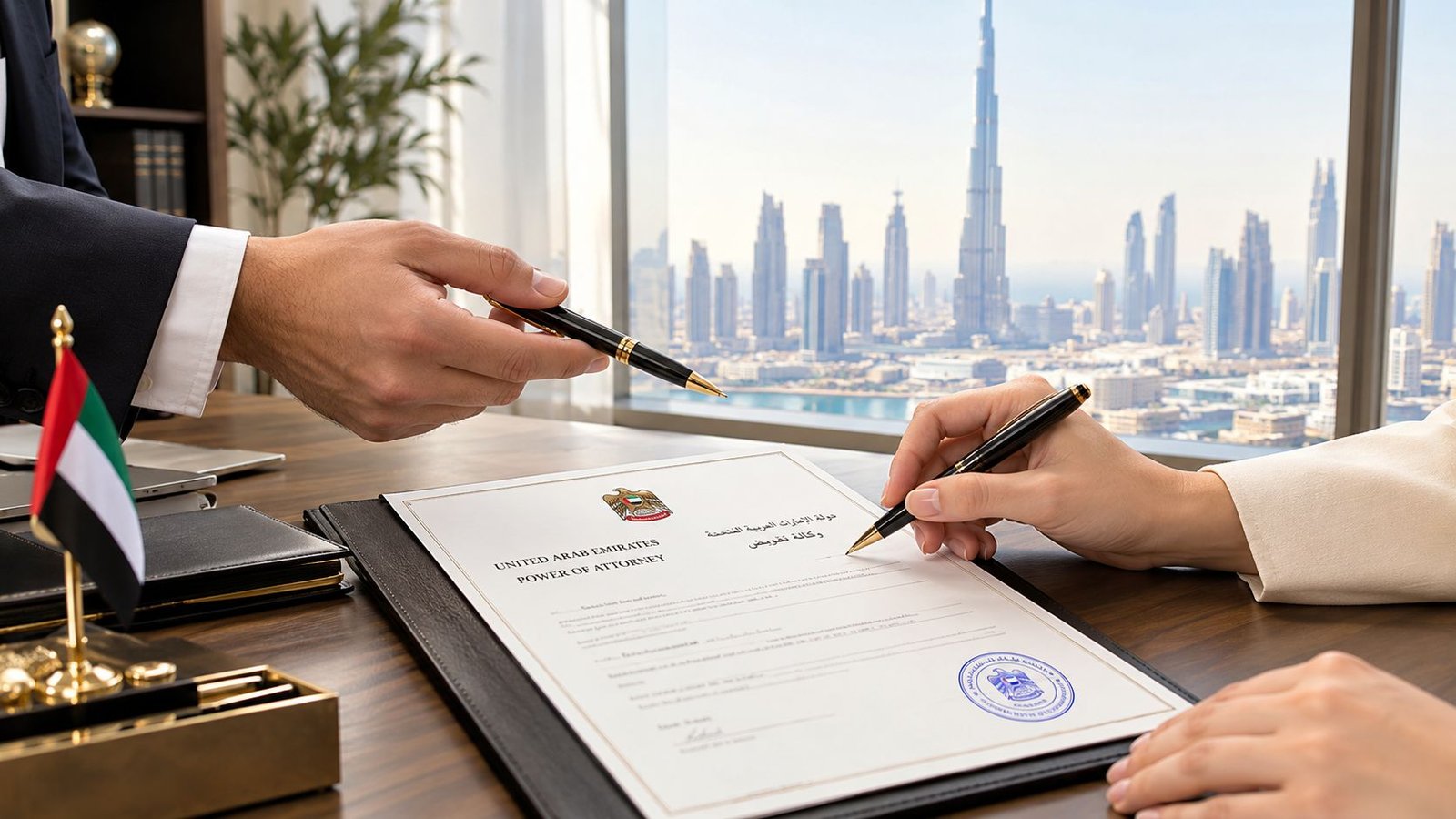
Does a notarised UAE power of attorney automatically work everywhere? No. The document is only one part of the process. The bank, court, licensing office, property department, or other receiving authority must also accept its wording, scope, format, and supporting documents.
Table of Contents
- What a UAE Power of Attorney Actually Is
- General vs Special Powers of Attorney
- Legal Foundations and Who Can Act
- Notarisation and Attestation in the UAE
- Common Use Cases for Founders and Visa Applicants
- Drafting Best Practices and a Pre-Submission Checklist
- Common Mistakes and How Inpro Helps
What a UAE Power of Attorney Actually Is
A founder living overseas may need someone in Dubai to sign tenancy papers, open a corporate bank account, or appear before the Department of Economy and Tourism, commonly called DET. A UAE power of attorney, or POA, gives that person written authority to act on the founder's behalf for defined matters in the United Arab Emirates.
The principal is the person or company giving the authority. The agent is the person appointed to act. For example, an overseas shareholder can appoint a UAE-based representative to sign incorporation documents, submit licensing forms, or communicate with a government office.
Under Federal Law No. 5 of 1985, the Civil Transactions Law, a contract may be concluded by a principal or an agent. The law recognises agency as contractual or statutory, and it requires contractual authority to identify what the agent may do. The principal must also be legally entitled to conduct the matter, the agent must not be legally prohibited from doing it, and the delegated subject must be identifiable and capable of being performed through representation. You can review the UAE Civil Transactions Law for the federal baseline.
Practical rule: A POA should tell the receiving authority exactly what the agent can sign, submit, collect, transfer, or discuss.
Notarisation confirms the execution of the document through an authorised notarial process. Attestation confirms the document's chain of authentication, which can involve authorities in the issuing country, a UAE embassy or consulate, and the UAE Ministry of Foreign Affairs. These are related but different steps.
The notary doesn't guarantee that a bank or government department will accept every power written in the document. That decision belongs to the authority receiving the POA. The next distinction matters because the difference between a general and special POA often determines whether the transaction proceeds or stops for a revised document.
General vs Special Powers of Attorney
A general POA gives an agent authority across a broader group of tasks. A special POA limits authority to one transaction, asset, filing, or defined purpose. The right choice depends less on the document's title and more on what the receiving authority needs to see.
| Feature | General POA | Special POA |
|---|---|---|
| Scope | Covers a wider set of related activities | Covers one named act or clearly limited transaction |
| UAE example | Managing routine company matters and appearing before government entities | Selling one identified property on Al Reem Island |
| Useful for | Overseas founders handling continuing operational tasks | Property transfers, litigation waivers, or one shareholder resolution |
| Main risk | The wording may be too broad or may not satisfy a specific authority | The agent may lack authority for an additional step not listed |
| Drafting focus | List the relevant business areas and limits | Identify the asset, transaction, counterparty-facing acts, and expiry |
A general POA might authorise an agent to manage routine company administration, sign ordinary contracts, submit licensing paperwork, and communicate with authorities. That doesn't mean the agent can automatically sell a property, create a mortgage, or transfer ownership. High-risk powers need precise wording.
A special POA could authorise an agent to sell one named plot in Abu Dhabi, sign one shareholder resolution, submit one visa application, or represent a person in a defined proceeding. The document should identify the asset or matter, its location, the acts permitted, and any limits on signing or receiving funds.
UAE guidance for ownership transfers and mortgages supports a transaction-specific approach. Abu Dhabi Judicial Department guidance says the POA should expressly identify the type and location of the transaction, and it sets a maximum validity period of three calendar years from notarisation. The Abu Dhabi Judicial Department notary and authentication guide also indicates that corporate matters may require a valid trade licence and documents proving the signatory's authority.
For a long-running business relationship, a carefully limited general POA may be practical. For a property transfer or a single legal act, a special POA usually gives the recipient a clearer basis for acceptance.
Legal Foundations and Who Can Act
The legal starting point for a UAE power of attorney is the Civil Transactions Law, the federal law that sets baseline principles for agency and representation. It doesn't turn every broad authorisation into unlimited authority. The document must connect the principal, the agent, and the delegated matter in a way that can be understood and performed.
A principal may be an individual or a company acting through an authorised signatory. A company's representative should be able to show the documents that establish the company's existence and the signatory's authority. The receiving authority may ask for a trade licence, board resolution, shareholder resolution, or other corporate evidence, depending on the transaction.
An agent must be legally able to perform the delegated act. That means the drafting team should check the recipient's rules before naming someone to sign, represent a company, handle a property file, or appear in a proceeding. A POA doesn't remove restrictions that apply to the agent or to the transaction itself.
Which UAE authority will receive the POA?
The receiving body shapes the practical requirements. MOHRE means the Ministry of Human Resources and Emiratisation, which handles many employment and labour administration matters. DED is a common shorthand for a Department of Economic Development, although Dubai's current authority is the Department of Economy and Tourism, or DET.
DIFC means the Dubai International Financial Centre, and ADGM means Abu Dhabi Global Market. These are financial free zones with their own administrative and court environments. A POA prepared for a federal UAE process may not meet the recognition or filing requirements of a DIFC or ADGM body, so the intended destination should be identified before drafting.
A useful first question is simple: Who will receive the document, and what exact action must the agent take? Once that is clear, the notarisation route becomes easier to organise.
Notarisation and Attestation in the UAE
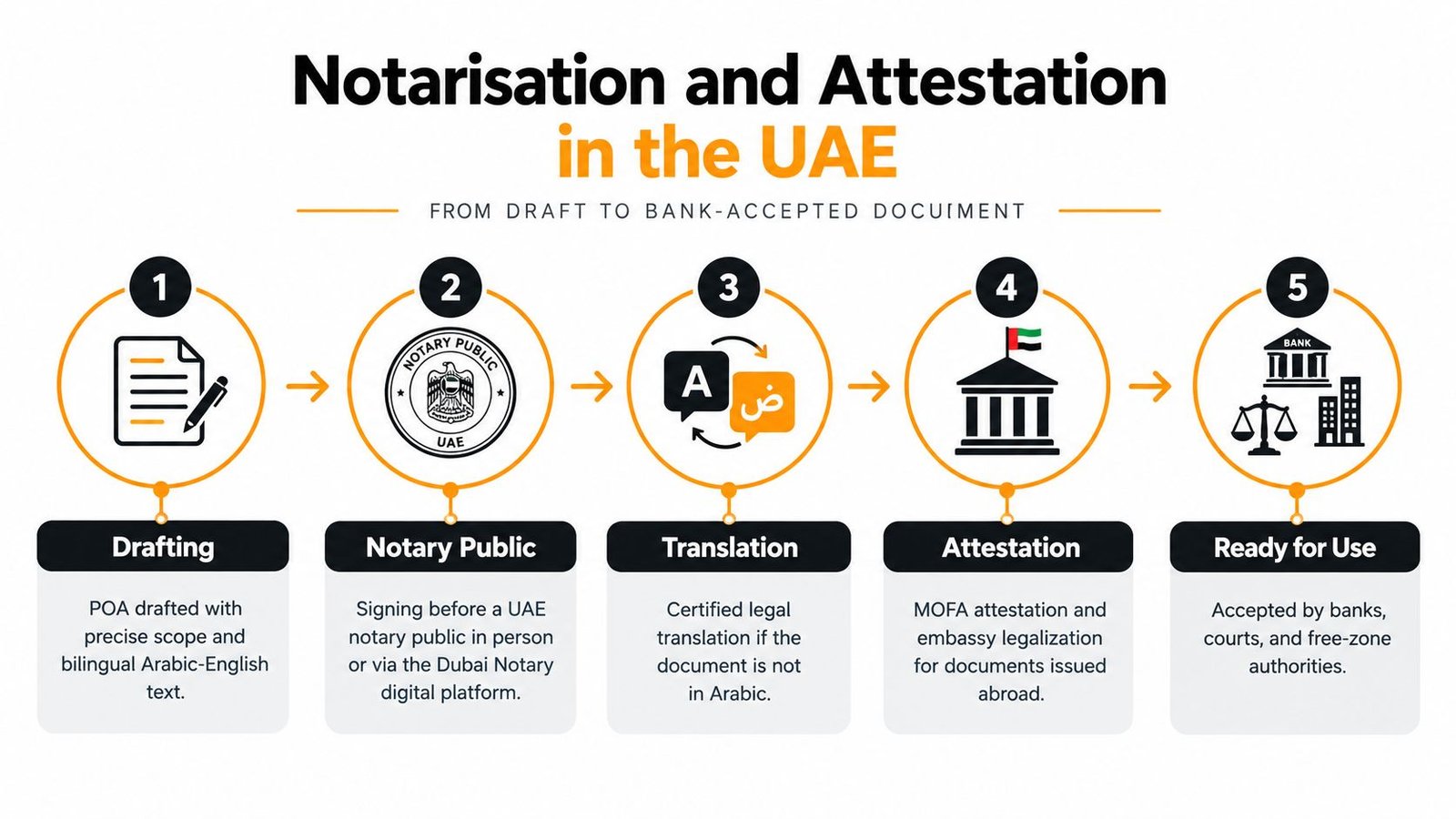
A POA should move through a controlled document process rather than being signed first and checked later. Start with the recipient's checklist, then draft the authority around the transaction.
Confirm the receiving authority. Ask the bank, court, licensing office, property department, free-zone authority, or other recipient which wording, identity documents, translations, and corporate papers it accepts.
Draft the scope. Name the principal, agent, purpose, permitted actions, restrictions, and duration. For company matters, state the company's legal name and the agent's capacity. For property or ownership acts, identify the asset and location rather than relying on general language.
Choose the signing route. A POA executed inside the UAE may go through a UAE notary public or an applicable court notarial service. The exact channel depends on the transaction and the authority receiving it. A digital route may be available for eligible users and documents.
Arrange translation. If the document isn't in Arabic, the recipient may require a UAE Ministry of Justice-certified legal translation. Dubai Courts guidance specifically refers to this requirement for documents not in Arabic.
Complete foreign authentication when needed. A POA signed outside the UAE generally follows a chain consisting of authentication by the competent authority in the issuing country, attestation by the UAE embassy or consulate there, and final attestation by the UAE Ministry of Foreign Affairs. Keep the original attested document and any legalised copies.
The UAE Ministry of Justice announced Phase 2 of its Digital Power of Attorney Issuance service on 21 June 2023. The service covered eight categories, including lawyer representation, legal cases, real estate, rental disputes, licensing, vehicles, stocks, and company management. The Ministry said users could generate a digitally ratified POA in less than 10 minutes, without visiting a notary public office, with secure storage through a blockchain system and digital wallet. The Ministry of Justice announcement on digital POA issuance also reported a 33% increase in the ratio of private notaries compared with public notaries since the beginning of 2023.
Digital issuance can reduce physical visits, but it doesn't remove the recipient's acceptance test. Dubai Courts also offers electronic POA processing, including submission, identity and capacity checks, payment, signing, and electronic receipt. Its published fee is AED 100 per party signature, as stated in the Dubai Courts POA service information.
For online attestation, the relevant parties generally need valid Emirates IDs. Dubai Courts guidance distinguishes age and appearance requirements by matter, including a minimum age of 21 lunar years for civil matters and 18 years for commercial matters. Passport-only parties may need to appear personally before the notary. Check the current recipient checklist before relying on a digital route.
Common Use Cases for Founders and Visa Applicants
A POA becomes useful when the principal cannot attend a UAE appointment, sign a document, or complete a government workflow personally. The document should be drafted around the receiving authority's task, not around a vague desire to “handle everything”.
| Transaction | POA Type | Receiving Authority |
|---|---|---|
| Company incorporation and licensing | General or special, depending on the filing | DET, a relevant emirate authority, or a free-zone registrar |
| Corporate bank account process | Usually special or carefully limited corporate authority | The chosen UAE bank |
| Free-zone company administration | Often special for defined filings | DMCC, IFZA, or RAKEZ |
| Employee labour administration | Special authority for named employee or filing tasks | MOHRE or the relevant free-zone employment office |
| Property transfer | Special POA naming the asset and location | Dubai Land Department or the relevant emirate property authority |
| Court representation | Special authority for the proceeding and representative | The relevant UAE court |
| Dependant or family application | Special authority for the named application | The relevant immigration or government service centre |
Company formation and banking
An overseas founder may appoint a representative to sign incorporation documents, submit licensing applications, deal with DET, and communicate with a free-zone registrar. A bank may ask for a separate corporate POA or its own wording before allowing an agent to open or manage an account. A document accepted by the licensing authority may still fail the bank's internal review.
For free zones such as DMCC, the Dubai Multi Commodities Centre, IFZA, the International Free Zone Authority, or RAKEZ, ask the registrar whether it wants a specific form, corporate resolution, or identification document. A special POA is safer where the authority needs authority for one filing rather than broad control over company affairs.
Visas and employment files
A representative may be asked to help with visa stamping, an employee file, a labour card update, or a dependant application. Golden Visa applicants should identify the exact immigration service and supporting documents before appointing an agent. A POA doesn't replace the applicant's identity, eligibility evidence, medical requirements, or other personal steps.
The receiving office may also distinguish between signing a form, submitting a file, collecting a document, and making a declaration. Put each permitted action into the wording instead of assuming one broad phrase covers all four.
Property, courts, and family matters
A property POA for a transfer through the Dubai Land Department, or DLD, should identify the property and the permitted act. A court POA should identify the proceeding and the representative's capacity. UAE procedural guidance specifically requires a corporate litigant's POA to identify the representative's job capacity and be duly notarised for each legal proceeding.
Marriage, school enrolment, and family administration can involve different forms and recipient rules. Treat each as its own file. The same agent may be suitable for several tasks, but one general document won't necessarily satisfy every authority.
Drafting Best Practices and a Pre-Submission Checklist
Good drafting begins with the transaction, not the template. Write down what the agent must do, what the agent must not do, and which office will review the document.
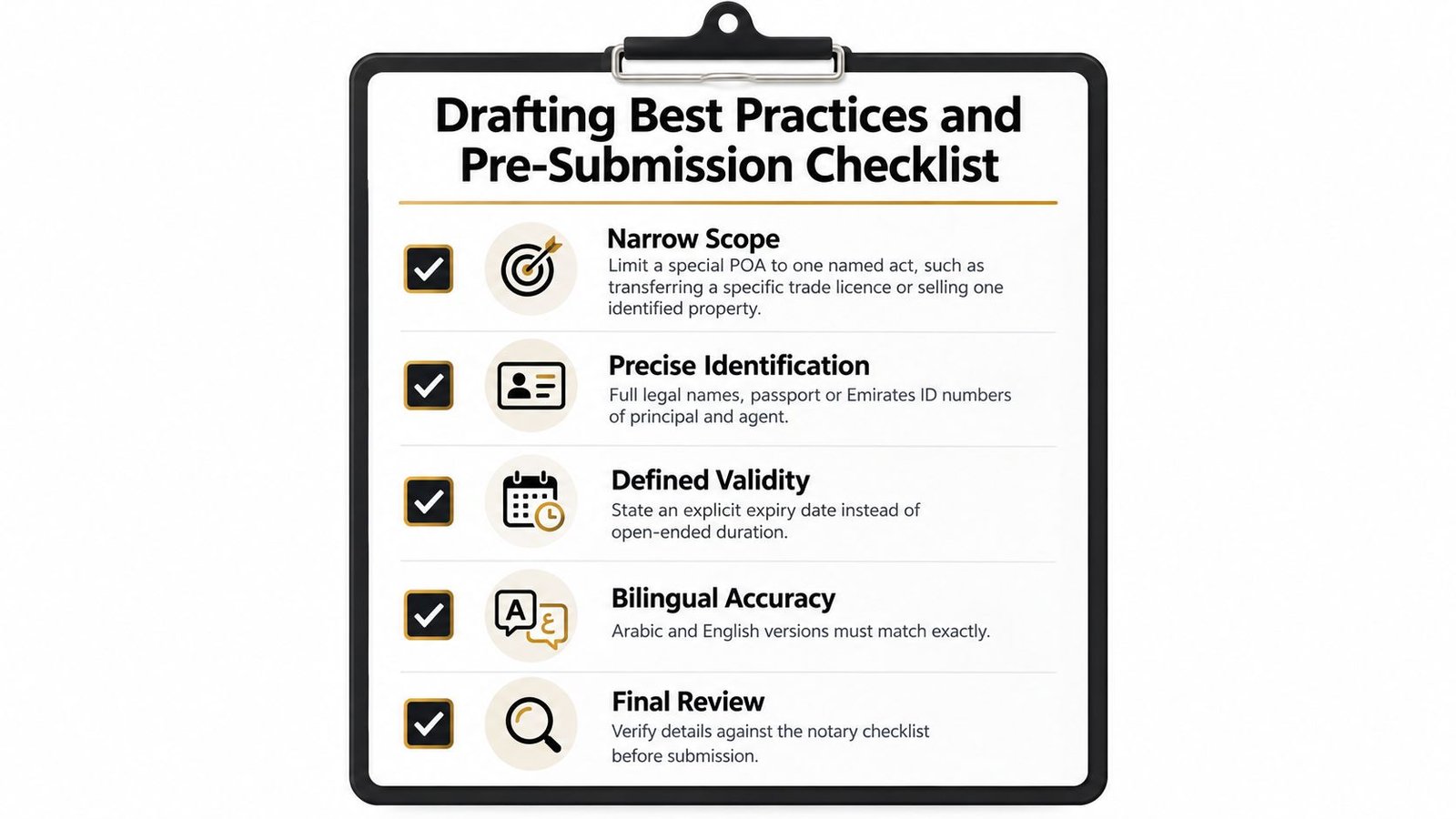
A special POA should normally name one defined act, such as transferring a specific trade licence or selling one identified property. A general POA may suit an overseas founder who needs continuing help with routine operations, but it should still list the business areas covered and exclude high-risk acts unless they're intentionally included.
What should the POA identify?
Use the principal's full legal name as shown on the passport or Emirates ID, together with the passport or Emirates ID number, nationality, and residence details where required. For a company, include the exact legal name, licence details, and the signatory's authority documents.
Describe the agent's powers in operational language. Say whether the agent may sign, submit, collect, receive notices, make declarations, pay fees, or appoint another representative. If sub-delegation isn't allowed, state that directly.
Set an expiry date or a defined duration. Include revocation arrangements and identify what happens when the named transaction is completed. If the POA concerns an ownership transfer or mortgage, follow the relevant authority's duration and transaction-specific requirements.
Governing law and forum clauses can be useful in a carefully drafted commercial instrument, but they don't override the recipient's filing rules. The receiving authority still decides whether the document can be used for its process.
Can you submit the document yet?
Use this checklist before sending the POA to a bank, court, licensing office, or free-zone authority:
- Scope: Confirm that every permitted act is listed and that prohibited acts or spending limits are clear.
- Identity: Match names, passport details, Emirates ID details, nationality, and company information across every document.
- Authority: Attach the trade licence, board or shareholder resolution, and other evidence showing who may sign for the company.
- Language: Check that the Arabic and English versions carry the same meaning, and obtain a UAE Ministry of Justice-certified translation where required.
- Execution: Confirm that the required signatures were witnessed or completed before the correct notary.
- Legalisation: For a POA issued abroad, confirm the foreign authentication, UAE embassy or consulate attestation, and UAE Ministry of Foreign Affairs attestation.
- Originals: Present or retain the original attested instrument if the recipient requires it.
- Annexures: Add recipient-specific forms, property details, licence copies, resolutions, or proceeding references.
- Renewal: Record the expiry date, revocation date, and the person responsible for checking whether the authority still accepts the document.
Store the original securely and give the agent only the copies needed for the specific task. Keep a register showing where the original is held, which authorities received copies, and when the mandate ends.
Common Mistakes and How Inpro Helps
Most POA failures are avoidable because the problem usually appears in the wording, identity records, attestation chain, or submission route. A document can look formally correct and still be unusable for the intended transaction.
Which errors cause the most delay?
- Vague scope: Broad wording may not satisfy DET or another licensing authority. Fix: name the filing, signature, company, asset, or proceeding.
- Expired or open-ended validity: An authority may reject a document that has lapsed or doesn't fit its duration rules. Fix: state a clear expiry date and check the recipient's limit.
- Missing consular attestation: A POA signed abroad may be missing a required embassy or Ministry of Foreign Affairs step. Fix: confirm the full authentication chain before sending the original to the UAE.
- Name mismatch: The POA may not match the passport, Emirates ID, or trade licence. Fix: compare every spelling, number, and company name before notarisation.
- Wrong filing point: The agent may submit the POA to an office that doesn't have jurisdiction for the matter. Fix: identify the receiving authority before drafting and ask for its current checklist.
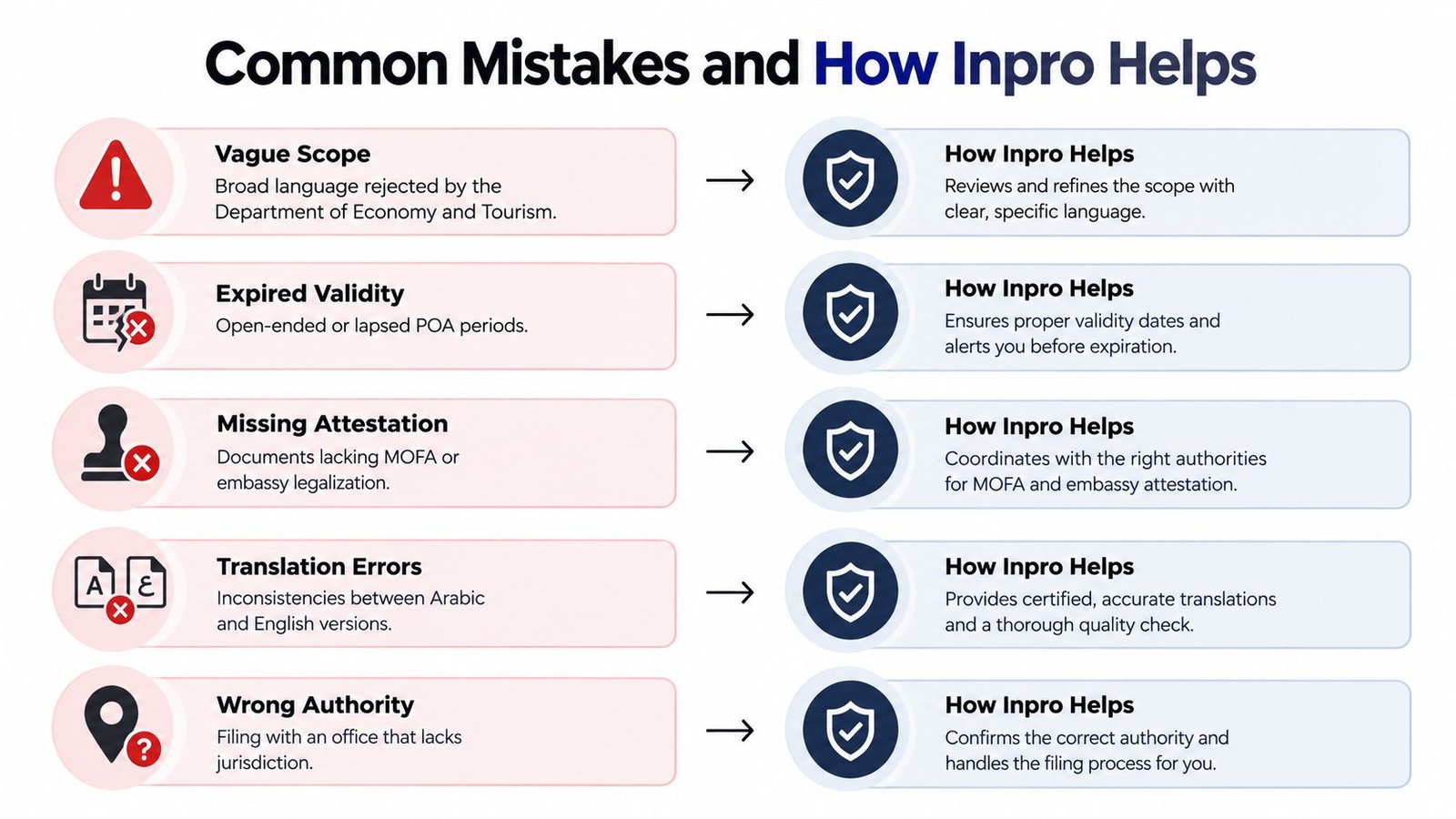
A document-attestation service can review commercial documents such as POAs, coordinate prerequisite stamps, arrange certified translation and courier handling, and prepare Ministry of Foreign Affairs submission and verification. The service can also coordinate notarisation in Dubai or Abu Dhabi and compare the draft against the receiving entity's current requirements.
For founders, shareholders, HR teams, freelancers, and Golden Visa applicants, that support is most useful when the POA crosses borders or involves several authorities. The final check should ask more than whether the document is notarised. It should ask whether the named recipient can use it for the exact transaction, on the date of submission, with the attached evidence.
Inpro helps founders and companies review UAE powers of attorney, arrange certified Arabic-English translation, coordinate notarisation and overseas attestation, and prepare document files for government, banking, licensing, and visa workflows. If you need a transaction-specific POA checked before submission, visit Inpro to discuss the document and the receiving authority.