


You've just received a Federal Tax Authority notification about a late VAT filing, while a free zone authority is asking for updated beneficial ownership records. Nothing dramatic changed in your business, yet two separate compliance obligations have suddenly become urgent. Continuous compliance monitoring helps you identify these changes earlier, assign the right action, and keep evidence that shows what your business did to remain compliant.
Table of Contents
- What Continuous Compliance Monitoring Means for UAE Businesses
- Why the UAE Regulatory Landscape Requires Continuous Monitoring
- Core Components of a UAE Compliance Monitoring System
- Implementation Approaches and Service Models
- Real-World Examples of Continuous Monitoring in Action
- Starting Your Continuous Compliance Monitoring Program
What Continuous Compliance Monitoring Means for UAE Businesses
What is continuous compliance monitoring?
Continuous compliance monitoring is an ongoing process that tracks your company's regulatory obligations, business activity, ownership information, deadlines, and supporting records. It uses regular data checks, alerts, assigned reviews, and documented decisions to identify compliance gaps before they become missed filings, registration problems, or enforcement issues.
It isn't a single software purchase or a one-time audit. A spreadsheet can form part of the process, but the system also needs clear responsibility, reliable information, escalation rules, and an organised record of what happened.
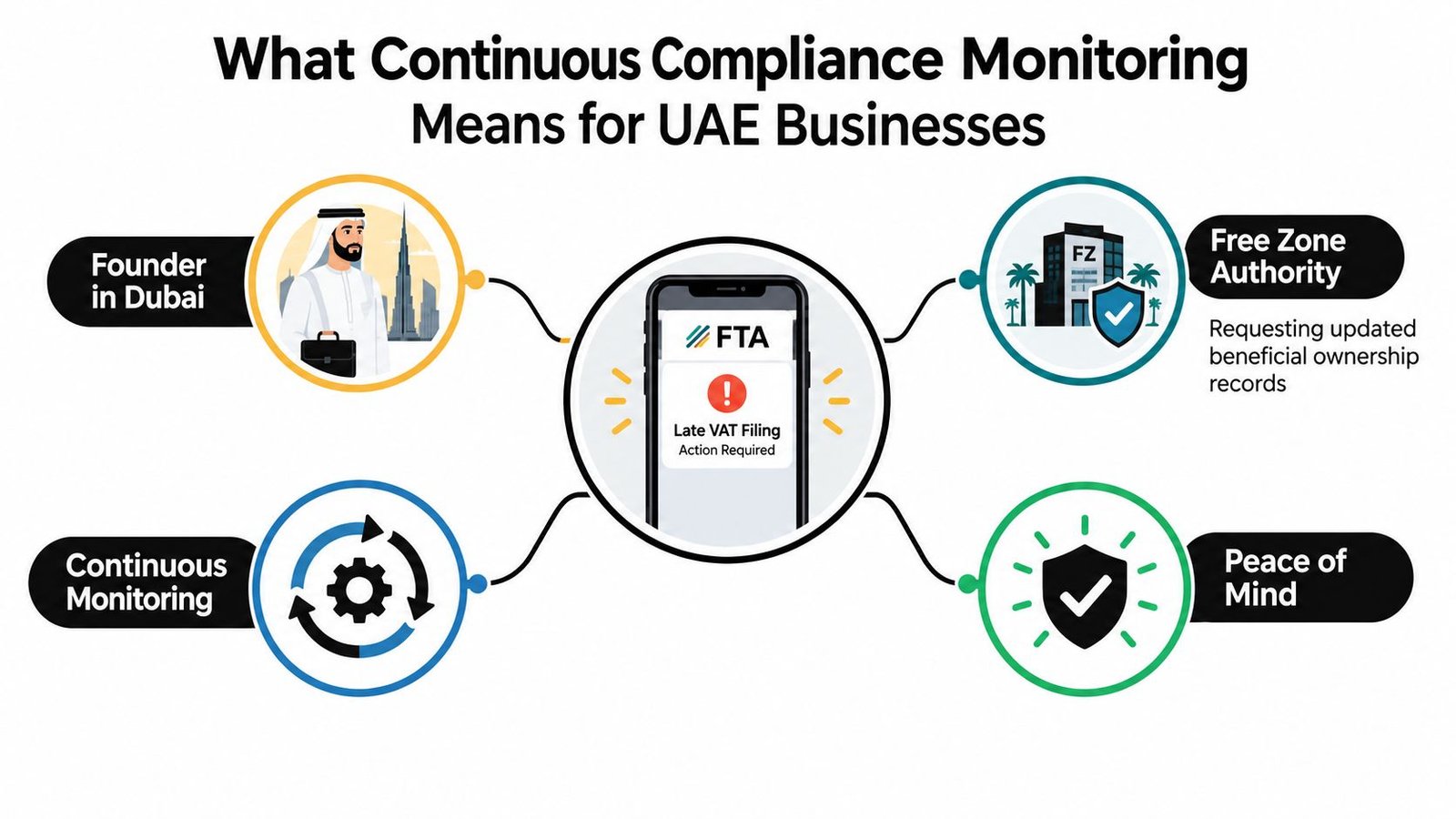
How is continuous monitoring different from periodic compliance?
Periodic compliance usually means reviewing obligations at set intervals, such as preparing a quarterly VAT return, renewing a trade licence when its expiry date approaches, or checking company records during an annual review. This approach can work when the business remains stable, but it may miss changes that happen between review dates.
Continuous monitoring watches for events that can change your obligations. Examples include:
- A threshold change: Rolling taxable supplies or imports move towards a VAT registration threshold.
- An ownership change: A shareholder or ultimate beneficial owner changes.
- A business activity change: The company begins offering a service that affects its licence, tax treatment, or AML risk.
- A document change: A tax registration certificate, trade licence, visa, or free zone record needs renewal or updating.
- A transaction change: Customer activity no longer matches the customer's stated business or risk profile.
The aim isn't to create alerts for every minor event. It's to identify which events need immediate action, which can wait for a monthly review, and which should be checked during a quarterly control review.
Practical rule: A deadline calendar tells you what is due. A monitoring system also asks whether something has changed that creates a new obligation.
Why does this matter across Mainland and Free Zone entities?
A UAE business may deal with several authorities at the same time. A Dubai Mainland company may have tax, licensing, immigration, and employment obligations, while a company in a Dubai, Abu Dhabi, or Sharjah free zone may also need to follow the procedures of its specific free zone authority. International founders and groups with several entities must keep the records connected rather than treating each company as an isolated folder.
The same principle applies to people as well as entities. HR teams handling employee visas, founders applying for a Golden Visa, and investors managing holding companies all need current documents, consistent ownership information, and clear responsibility for government-facing actions.
Continuous compliance monitoring creates a loop. The business collects current information, checks it against applicable requirements, sends an alert when a trigger appears, assigns an action, records the outcome, and updates the control when the rules or business change. That loop helps prevent a small administrative gap from becoming a last-minute crisis.
Why the UAE Regulatory Landscape Requires Continuous Monitoring
What do recent UAE figures show?
The scale of regulatory activity makes occasional checks less dependable. The Federal Tax Authority reviewed approximately 1.7 million tax-registration transactions in 2025, an increase of more than 20% from the previous year, including more than 245,000 Corporate Tax registration applications, 98,000 VAT registration applications, and 206 Excise Tax registration applications. The FTA also collected AED 46 billion in VAT and Excise Tax revenue in 2025, compared with AED 41 billion in 2024, an increase of roughly 12.2%, according to its 2025 annual report announcement.
These figures don't mean every founder needs a large compliance department. They do show that tax registration, reporting, and status changes are active areas of administration. A business that waits until year-end may discover that its revenue, imports, ownership, or records changed several months earlier.
How does AML enforcement affect ordinary businesses?
Anti-money-laundering, or AML, obligations apply beyond banks. Designated non-financial businesses and professions can include areas such as property brokerage and precious-metals trading. The Ministry of Economy reported 1,063 violations during inspections in the first half of 2025, with more than AED 42 million in fines, including AED 18.5 million against real-estate brokerages and AED 20 million against precious-metals and gemstones traders, as recorded in the Ministry's H1 2025 inspection results.
The lesson for founders is practical. AML controls should respond to changes in customers, ownership, geography, products, and transaction behaviour, rather than sitting in a policy document that nobody revisits.
What changed in the UAE tax penalty framework?
Cabinet Decision No. 129 of 2025, effective 14 April 2026, changes several parts of the tax-penalty framework. Late tax payment moves to an annualised 14% rate accrued monthly, voluntary-disclosure penalties become 1% per month on the tax difference, and certain incorrect-return penalties become AED 500 for a first violation and AED 2,000 for a repeat violation, as described by the Federal Tax Authority's announcement on the decision.
The practical effect is mixed. Some incorrect-return penalties may be lower, but delaying an unresolved tax discrepancy can still create a growing payment cost. Monitoring should therefore detect incomplete records, invoice timing issues, intercompany transactions, and registration-status changes before the next filing deadline.
The UAE regulatory environment now rewards businesses that can show an active control process. It isn't enough to say that someone intended to file, update a record, or investigate an alert. The company should be able to show what it monitored, who reviewed the issue, what decision was made, and when the record was updated.
Core Components of a UAE Compliance Monitoring System
What controls should a business establish?
A control is a defined check that prevents a problem or identifies one after it occurs. Preventive controls can stop a gap from developing, such as an alert when rolling taxable supplies approach a VAT threshold or a check that blocks an incomplete customer file from moving forward.
Detective controls identify an issue that has already appeared. A monthly exception review might find that a licence activity no longer matches the services being sold. An investigator might also discover that customer transactions no longer fit the customer's stated business or risk profile.
A useful programme combines both types. Preventive checks reduce avoidable errors, while detective reviews give a person the chance to assess unusual situations and record a reasoned decision.
Which data sources need monitoring?
Start with information that changes your legal or operational position. A UAE company may monitor:
- Licence information: Activities, issuing authority, status, expiry date, and renewal requirements.
- Ownership records: Shareholders, ultimate beneficial owners, authorised signatories, and ownership transfers.
- Tax information: VAT and Corporate Tax registration status, tax periods, returns, payments, and supporting records.
- Commercial activity: Invoices, imports, taxable supplies, customer relationships, and intercompany transactions.
- Government documents: Tax registration certificates, licence documents, immigration records, and free zone submissions.
- Risk information: Customer risk ratings, geographic exposure, product risk, and changes in expected activity.
The Central Bank of the United Arab Emirates, or CBUAE, recommends monitoring at the customer or relationship level, including across financial groups where practicable, rather than reviewing accounts in isolation. Its AML guidance on relationship-level monitoring explains why connected activity can be missed when each account is examined separately.
Which alerts should be automated?
The alert should connect a trigger to an owner and a deadline. For VAT, a resident business must register when taxable supplies and imports exceed AED 375,000 over the previous 12 months, or are expected to exceed that amount within the next 30 days. Voluntary registration may be available once the relevant value exceeds AED 187,500 over the previous 12 months or is expected to exceed it within the next 30 days. The mandatory application generally needs to be submitted within 30 days, and the FTA VAT registration guidance states that the AED 375,000 threshold doesn't apply to foreign businesses.
Other alerts may cover an ownership transfer, a high-risk-country connection, a change in customer behaviour, a licence mismatch, or an approaching free zone renewal. A small business can begin with email reminders and a shared dashboard. Larger groups may connect accounting, customer, ownership, and document systems so the alert is created without manual data entry.
What belongs in the audit trail?
An audit trail is the chronological record of the information checked, the alert created, the person who reviewed it, the decision made, and the evidence supporting that decision. Keep the original records, review notes, approvals, submitted forms, correspondence, and any change to a threshold or monitoring scenario.
For AML work, the record should also show the customer-risk profile, transactions reviewed, analysis performed, escalation decision, investigator action, and any report submitted. CBUAE expectations make record availability and control maintenance part of the process, not an afterthought.
Implementation Approaches and Service Models
Which monitoring model fits a UAE business?
There are three common approaches. The right choice depends on the number of entities, the complexity of activity, the frequency of ownership and staffing changes, and the level of internal expertise.
DIY monitoring uses spreadsheets, shared folders, and calendar reminders. It can suit a very small freelancer or founder with one licence, limited transactions, and a stable ownership structure. Its weakness is that a calendar won't automatically know that revenue has crossed a threshold or that a transaction pattern has changed.
Compliance software connects data sources and applies rules to create alerts, dashboards, and evidence records. This is useful for businesses with regular transactions, several users, or accounting systems that can feed tax information into a central view. The company still needs someone who understands the UAE obligation, investigates exceptions, and updates the rules when the business changes.
Managed compliance services place the coordination with an external provider. A PRO, or public relations officer, service provider can track government documents, renewals, submissions, and dependencies while the founder or finance team makes the required business decisions. Inpro, for example, combines PRO document management with ongoing support for licensing, immigration, and government-facing administration across Mainland, Free Zone, and Offshore structures.
| Approach | Feature coverage | Typical use case | Ideal business size |
|---|---|---|---|
| DIY spreadsheets and calendars | Basic deadlines, document lists, manual reviews | One entity with stable activity | Freelancer or very small company |
| Compliance software | Automated data checks, threshold alerts, dashboards, evidence logs | Regular transactions or several internal users | Growing SME or structured group |
| Managed compliance services | Document coordination, status tracking, renewals, government workflows, human review | Founder-led company without an internal compliance team | Start-up, expanding SME, or multi-entity group |
When should a company move beyond basic reminders?
Upgrade when missed handoffs start creating risk. Warning signs include several licences, Mainland and free zone entities, frequent employee visa changes, foreign shareholders, multiple bank accounts, cross-border transactions, or uncertainty about who owns each deadline.
A managed model can also make sense before the business becomes complex. An international founder relocating to Dubai may need formation, tax registration, visa, banking, and renewal actions to remain aligned. An HR team in Abu Dhabi may need a reliable process for employee documents and expiry dates. The point isn't to automate every task immediately. Start with the obligations that can cause the greatest disruption, then add data sources and workflows as the business grows.
Real-World Examples of Continuous Monitoring in Action
How can a Dubai e-commerce company monitor VAT exposure?
A Dubai-based e-commerce company records its taxable supplies and imports each month. Its monitoring process calculates the rolling position, checks whether the business is approaching the mandatory VAT registration threshold, and sends an alert to the founder and finance adviser when preparation should begin.
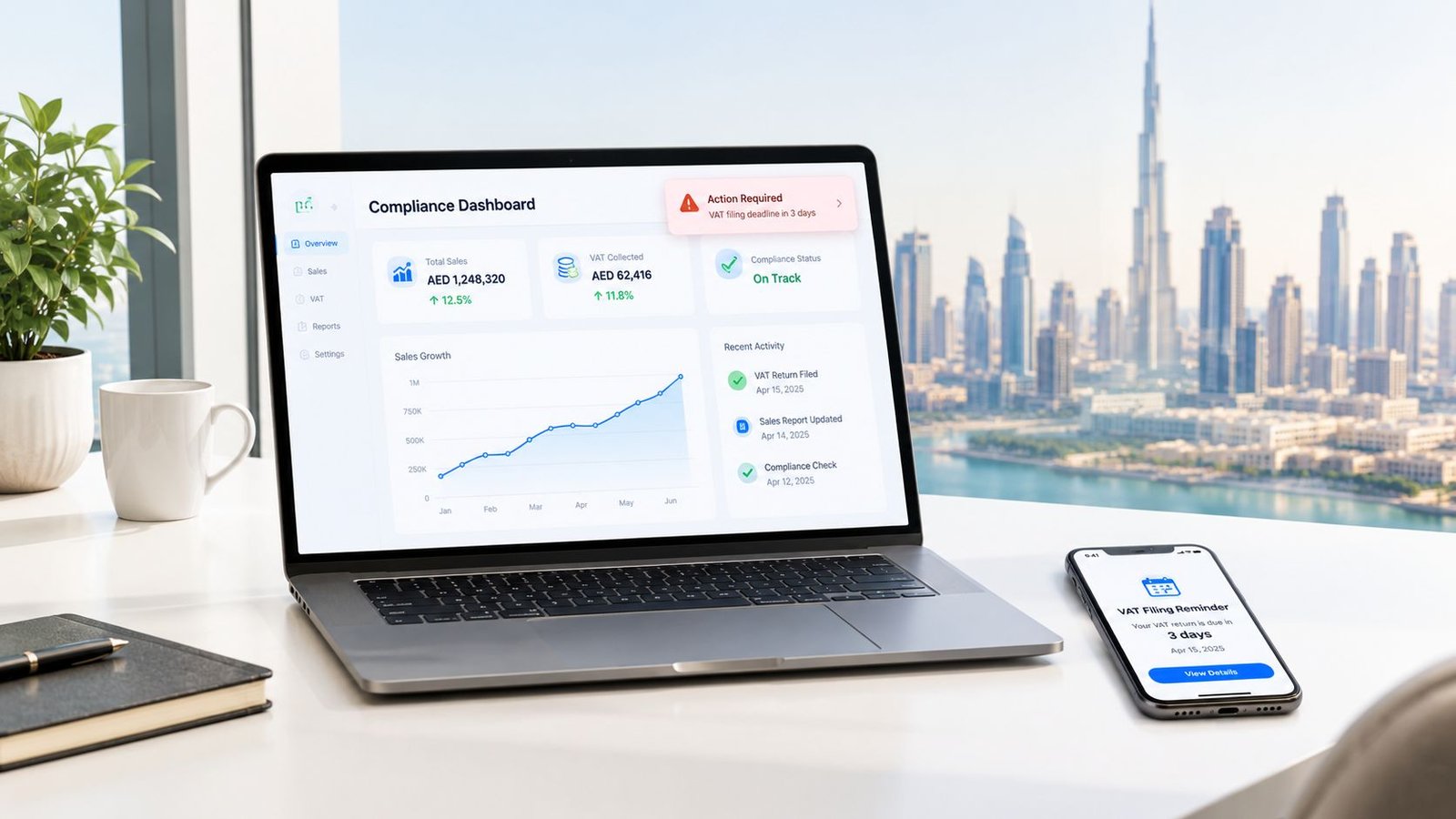
The alert doesn't submit the registration automatically. It creates a controlled workflow. The owner confirms which supplies are taxable, checks import information, gathers the required records, confirms the business details, and assigns responsibility for the application. If the registration obligation arises, the application is generally due within the applicable 30-day period.
This approach gives the business time to resolve missing invoices or unclear transaction classifications. It also creates evidence showing how the company identified the change and what it did next.
How can a Sharjah holding company respond to an ownership change?
A Sharjah freelance holding company monitors its corporate records and notices a change in ownership. The system creates an alert for a beneficial-owner review, rather than treating the change as a routine filing.
The responsible person checks the new ownership documents, updates the internal register, confirms whether the free zone authority needs a revised submission, and assesses whether the change affects tax records or customer risk. If the company is an obliged entity under AML rules, the reviewer also considers whether the ownership change alters the customer-risk profile or requires further due diligence.
A suspicious transaction isn't defined only by size. Licensed financial institutions must report a suspicious transaction, attempted transaction, or suspicious activity to the UAE Financial Intelligence Unit without delay when there are suspicions or reasonable grounds to suspect criminal proceeds or intended criminal use. There is no minimum transaction amount, and reports are submitted through the goAML platform, as stated in the Central Bank AML reporting guidance.
The ownership alert itself doesn't prove suspicious activity. It ensures that the right person reviews the change, updates records, and escalates concerns where the facts justify it.
The following media provides a visual example of how alerts and review actions can sit in one workflow.
Both scenarios use the same operating pattern: capture a change, compare it with the relevant obligation, assign a human review, complete the action, and retain evidence. That pattern works for tax, AML, licences, visas, and beneficial ownership records.
Starting Your Continuous Compliance Monitoring Program
What should a UAE company do first?
Begin with a map of obligations, not a technology purchase. List every entity, its primary authority, its activities, its tax registrations, its ownership records, its visa responsibilities, and its renewal dates. Include both Mainland and Free Zone requirements where the group operates in more than one jurisdiction.
Then identify the data needed to spot change. Finance may own invoice and import information. HR may own visa and employment records. A company secretary or founder may maintain ownership information. Assigning ownership to each data source prevents the monitoring process from becoming a shared responsibility that nobody manages.
A useful starting checklist looks like this:
- Identify the authority: Confirm whether the entity is registered with a Mainland authority, Dubai, Abu Dhabi, Sharjah, or a specific free zone.
- Confirm tax status: Check VAT and Corporate Tax registration details, filing periods, return history, and payment records.
- Review beneficial ownership: Compare current ownership and authorised-signatory records with the documents held by the relevant authority.
- List renewal dates: Record trade licence, tax document, visa, lease, and free zone renewal dates in one controlled calendar.
- Document current processes: Write down who prepares returns, who approves submissions, who reviews alerts, and where evidence is stored.
- Choose the first trigger: Start with VAT threshold monitoring, licence renewal tracking, ownership changes, or another risk that matters most to the business.
How can a small company keep the programme manageable?
Start with a focused scope. A freelancer doesn't need the same monitoring design as a group with several entities, employees, and cross-border transactions. A spreadsheet with protected fields, a shared document register, monthly finance checks, and named escalation owners may be a sensible first stage.
The process should still have discipline. Record the date of each review, the information checked, the person responsible, the issue found, and the action taken. Review the setup when the business opens a new bank account, changes its activities, hires staff, adds an owner, enters a new free zone, or begins serving a different type of customer.
How should the programme develop over time?
Add automation where manual work creates delay or error. Connect accounting data to tax reviews, link document expiry dates to reminders, centralise ownership records, and create an exception queue for issues that require judgement. For AML, keep risk scoring, relationship-wide transaction reviews, escalation rules, reporting actions, and evidence in a traceable workflow.
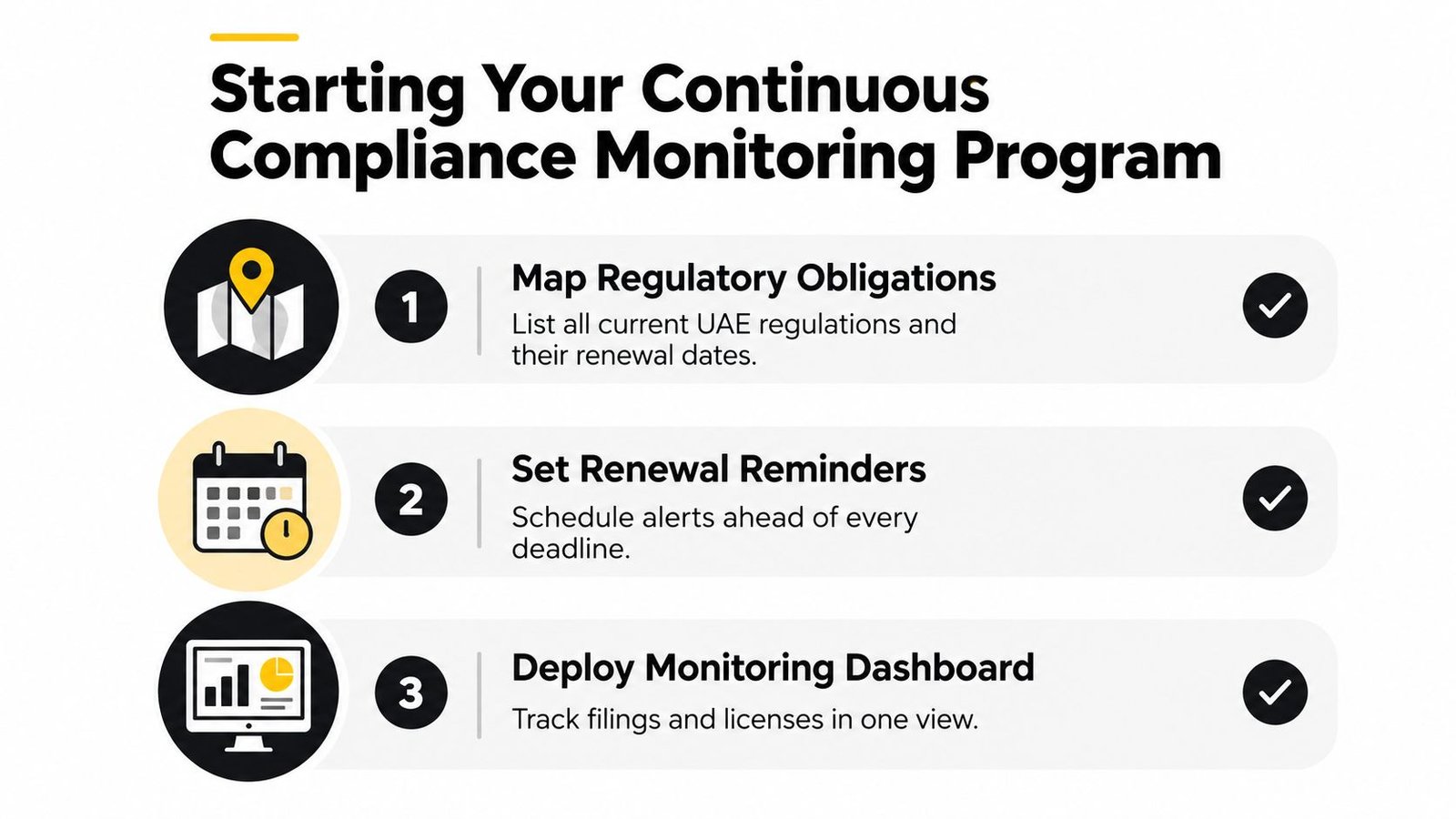
Continuous compliance monitoring doesn't mean watching every business event in real time. It means matching the review frequency to the risk, setting immediate escalation for serious changes, and using monthly or quarterly checks where that level is appropriate. A clear, focused system is safer than an ambitious project that nobody maintains.
Inpro helps UAE founders and companies coordinate company formation, licensing, visa workflows, tax and VAT support, renewals, and government-facing documents across Mainland and Free Zone structures. Visit Inpro to discuss a practical compliance monitoring approach or estimate the cost of setting up and managing your UAE business.