

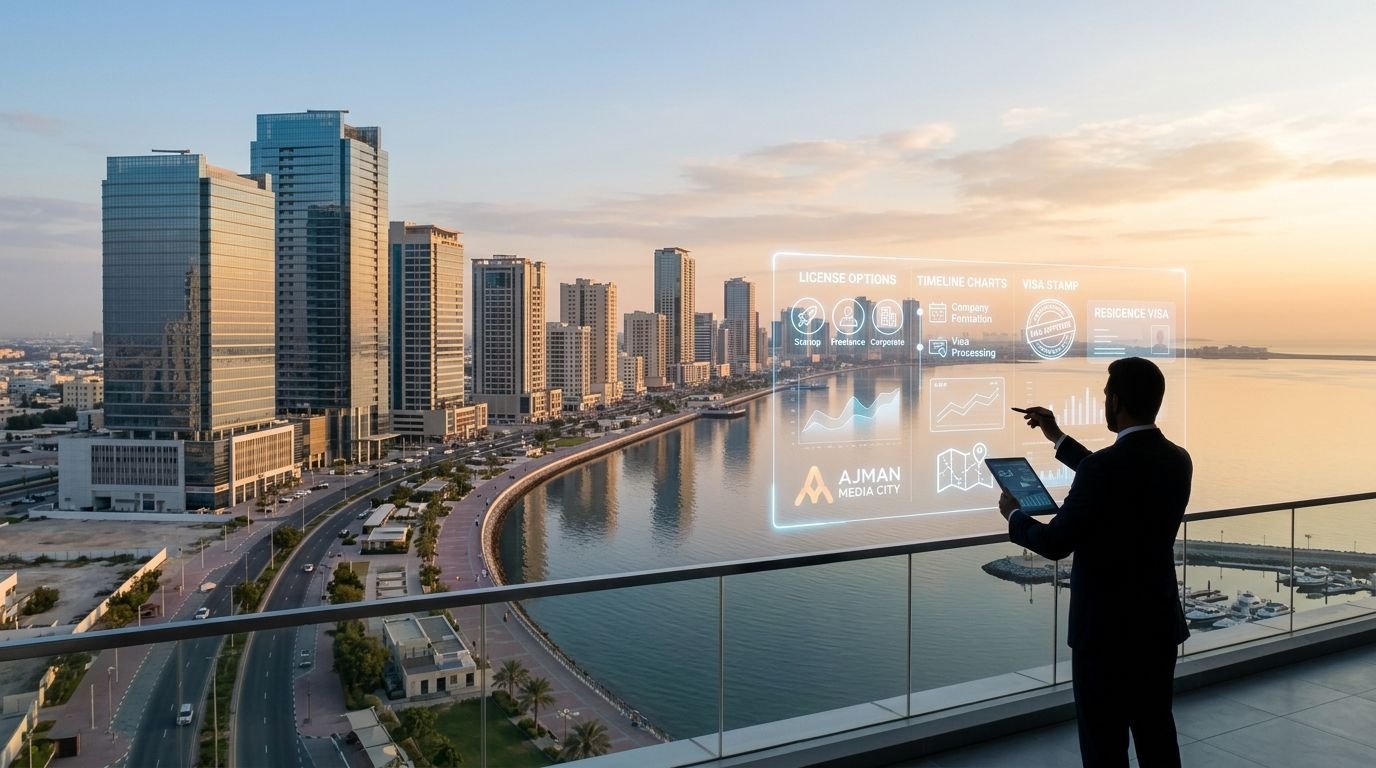
Ajman Media City is a cost-effective free zone for creative, media, and tech businesses, with licence packages starting at AED 8,600 and licence issuance typically taking 3 to 4 working days. Its real value depends on choosing the right package for your visa and operating needs, because the cheapest setup options don't work well for every founder.
A lot of founders come to Ajman Media City because they want a lower-cost UAE entry point than Dubai, Abu Dhabi, or some larger free zones. That instinct is often right. But the package choice matters more than the headline price, especially if you plan to relocate to the United Arab Emirates, sponsor staff, or open a corporate bank account without friction.
Table of Contents
- Your Guide to Ajman Media City Free Zone in 2026
- What Is Ajman Media City and Who Is It For
- Understanding License Packages and Permitted Activities
- The Company Formation Workflow and Timeline
- Decoding the Costs and Financial Requirements
- How AMCFZ Compares to Other UAE Free Zones
- Making Your Decision and Practical Next Steps
Your Guide to Ajman Media City Free Zone in 2026
Ajman Media City Free Zone is one of the cheapest UAE entry points for founders. That only makes sense if the package fits how the business will operate.
The practical appeal is straightforward. Setup is usually lighter than many Dubai free zones, package pricing is often lower, and the model suits remote-first service businesses that do not need a full office from day one. For a consultant, agency, freelancer, holding structure, or small online business, that can be enough.
The point many founders miss is the zero-visa package.
A low headline price looks good until the company needs a residence visa for the owner, a staff visa for a first hire, or extra support with banking and compliance. At that stage, the cheapest option can stop being the cheapest option. I have seen founders buy a zero-visa licence because it was the fastest quote on their shortlist, then pay again to adjust the structure once operations became real.
Practical rule: Choose the licence around your first 12 months of operations, not your first invoice.
Ajman Media City tends to work well for founders with a clear, lean plan. If you need a legal entity to sign contracts and invoice clients, it can be a sensible starting point. If you already know you need residency, multiple visas, frequent bank interaction, or stronger office substance, check those points before filing anything.
That is the real filter. The question is not whether Ajman Media City is cheap. The question is whether its package structure matches the business you will be running six months after setup.
What Is Ajman Media City and Who Is It For
What is Ajman Media City Free Zone
Ajman Media City Free Zone is not just a cheap licence option. It is a low-friction setup for founders who need a UAE company first and physical substance later.
In practical terms, it is a free zone company registry in Ajman with its own licensing process, package structure, and administrative rules, separate from mainland incorporation. The free zone was built with media, creative, digital, and service businesses in mind, but in day-to-day use it often attracts a much broader group than the name suggests.
That difference matters. A founder setting up a consultancy, agency, online education business, software support firm, or holding vehicle may never produce media in the narrow sense. What matters is whether the approved activity list, package terms, and operating model fit the business you plan to run.
Who tends to benefit most from it
Ajman Media City usually suits founders who want speed, lower setup cost, and a company that can invoice clients without committing to a full office on day one.
The best fit is usually a solo operator or small team with a service-led model. Typical examples include consultants, marketing agencies, designers, developers, content businesses, e-commerce support firms, and overseas founders who need a UAE entity for contracts or market entry. It can also suit founders testing a new line of business before building a larger local presence.
The weak point is operational planning. A zero-visa package can work perfectly for a non-resident owner who only needs a licence and corporate documents. It becomes restrictive fast if the founder later needs UAE residency, wants to sponsor staff, or expects banks and counterparties to ask for more substance. That is why Ajman Media City is usually a better fit for lean structures than for businesses hiring locally from month one.
Why does Ajman itself matter
Ajman gives founders a different operating environment from Dubai. Costs are often lower, the pace is calmer, and the jurisdiction still sits inside the wider UAE commercial system.
According to the UAE government's Ajman profile, Ajman is the smallest of the seven emirates by area, but it has continued to grow economically and demographically. That combination is part of the appeal. Founders get a base that is more practical than high-profile, which is often exactly the right trade-off for a first-year setup.
For some founders, that trade-off is easy to accept. A remote consultant living abroad may not care whether the licence was issued in Dubai or Ajman if the company can sign contracts, open the right accounts, and stay compliant.
For others, the location carries limits. If your clients expect frequent in-person meetings in central Dubai, if brand signalling matters, or if your team will need regular visa support and office use, Ajman Media City may still work, but it should be compared carefully against free zones with stronger on-the-ground infrastructure.
The short version is simple. Ajman Media City is for founders who value function over prestige and who understand exactly what a low-cost, zero-visa starting package does and does not give them.
Understanding License Packages and Permitted Activities
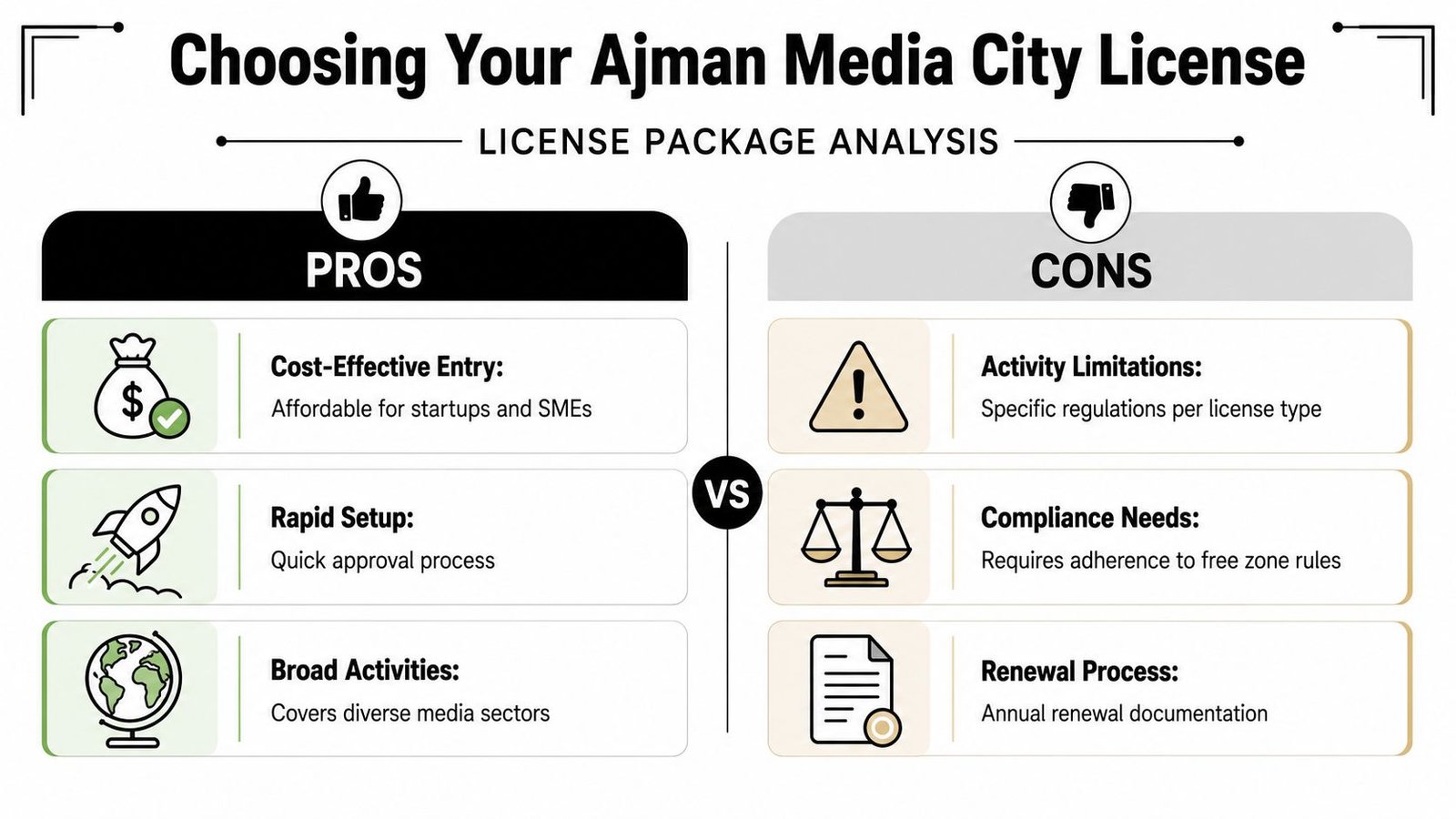
Package choice decides whether your licence stays cheap on paper or effectively supports the way you plan to operate. In Ajman Media City, the main issue is rarely the trade licence itself. It is whether your package includes the visa capacity, premises entitlement, and activity scope your business will need in the first six to twelve months.
What do the main package types actually mean
An Ajman Media City package combines several decisions into one purchase. You are selecting the legal licence, the form of workspace attached to it, and whether the company can support residence visas.
That matters because two packages can look similar in a brochure and behave very differently in practice. An entry-level option may suit a founder who only needs a UAE entity for contracts and invoicing. A Flexi Desk or office-based package is usually the better fit for a business that expects residency, hiring, or a more active operating presence.
Activity selection matters just as much. Ajman Media City is known for offering a wide range of permitted activities, and broader packages can cover many service-based models under one licence. That flexibility helps, but it does not remove the need to match the activity list to what the company will sell. If the invoicing activity, contract wording, and licence activity do not line up, banking and compliance questions tend to follow.
What is the zero-visa issue founders miss
The zero-visa package gets attention because it keeps the setup cost low. As noted by YUGA Accounting's Ajman Media City setup page, the entry package includes workspace but no visa eligibility.
That detail changes the operating model.
A zero-visa company can still be useful for a founder based outside the UAE who needs a legal entity and does not need residence, staff visas, or dependant sponsorship. For that use case, the package can make sense. For a founder relocating to the UAE, planning to employ someone locally, or expecting banks and counterparties to see an active resident shareholder structure, it is often the wrong starting point.
I have seen founders save money at incorporation, then spend more time and money fixing the structure a few months later. Package upgrades are possible, but they add admin, fresh approvals, and delay. If you already know you will need a residence visa, choose a visa-eligible package at the start and avoid the rework.
A low entry price only helps if your first-year operating plan truly does not need residency or staff visas.
How should you choose the right package
Start with the first-year plan, not the advertised fee.
- Solo founder living abroad: A no-visa package can work if the company will only sign contracts, issue invoices, and operate remotely.
- Founder relocating to the UAE: Choose a package with visa allocation from day one. That avoids an early amendment.
- Business expecting to hire or sponsor dependants: Build visa capacity into the original setup instead of treating it as a later fix.
- Agency or consultancy with multiple services: Check each intended activity carefully, even if the package allows a broad activity menu.
- Founder focused only on the cheapest option: Price the likely upgrade path as well. The lowest entry cost is not always the lowest first-year cost.
The practical test is simple. If the package does not support how the company will function after incorporation, it is the wrong package, even if the licence itself is issued quickly.
The Company Formation Workflow and Timeline
Ajman Media City is fast to set up on paper. A critical question is whether the package you chose supports what happens after the licence is issued.
That matters most with zero-visa packages. A founder can have a company licence in hand within days and still be unable to start the parts of the plan that depend on UAE residency, an immigration file, or staff sponsorship. That gap catches people who read the setup as one process. It is really two. Company incorporation first. Immigration steps after that, if the package allows them.
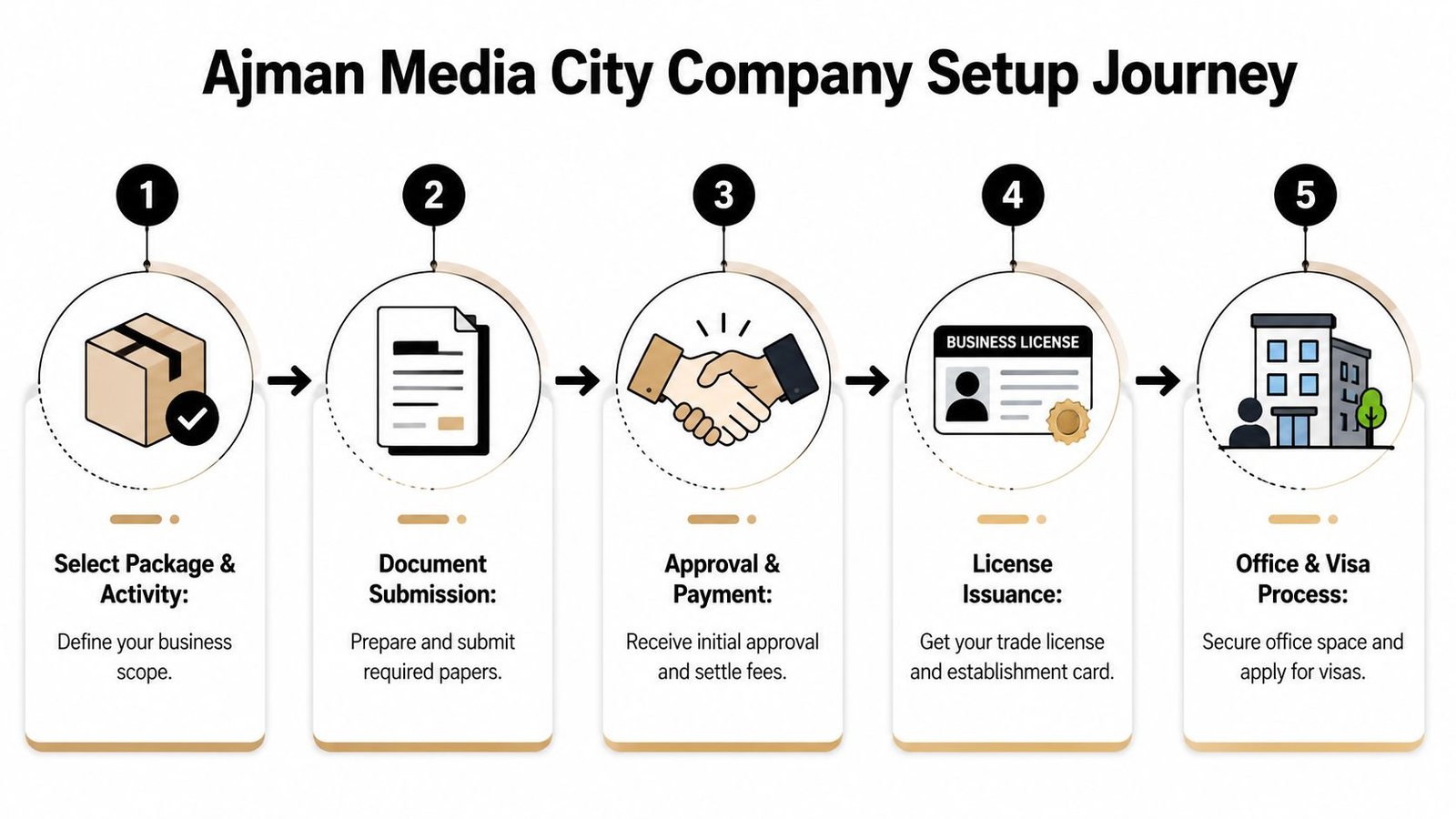
How does the setup process usually unfold
The workflow is usually straightforward.
First, confirm the activity and package. That includes checking whether the package is zero-visa or visa-eligible, because that choice affects more than residency. It affects whether you can proceed to immigration-related steps at all.
Second, submit the application documents and wait for the authority review. If the paperwork is clean and the activity choice is clear, the licence can be issued quickly.
Third, pay the approved fees and receive the licence documents.
Only after that does the path split. If you selected a visa-eligible package, the company can move into immigration file opening and then the residence visa process. If you selected a zero-visa package, the process stops at company formation. The business can still contract and invoice within the scope of the licence, but the founder should not assume that UAE relocation, employee visas, or dependant sponsorship can be added immediately without an amendment.
Later in the process, this overview video gives a useful additional sense of how founders approach the setup path in practice.
How long does each stage take
For a standard case, licence issuance is usually the quickest part and is often completed within a few working days. Immigration card processing and residence visa steps take longer and should be treated as separate stages with their own review cycle.
In practice, founders should budget in layers, not as a single promised deadline. Licence approval may be quick. Immigration processing depends on the package, the applicant's documents, and routine clearance checks. If a founder is working to a relocation date, staff joining date, or client launch date, the safer plan is to count the full sequence from application to visa completion, not just the licence issue date.
A zero-visa package changes that timeline completely. It shortens the initial setup because there is no visa track to run, but it also limits what the company can do operationally after incorporation. For some remote-first owners, that is fine. For a founder planning to move to the UAE within weeks, it often creates a second project almost immediately.
What usually slows things down
The free zone is rarely the main source of delay. The problems usually start earlier, with decisions made too quickly at the application stage.
Three issues come up often:
- Activity fit is unclear. The proposed service does not match the selected licence activity cleanly, so the file needs clarification or revision.
- The package does not match the operating plan. A founder picks a zero-visa option for cost reasons, then realises they need residency, staff visas, or family sponsorship soon after incorporation.
- Documents do not match across the file. Passport details, names, or supporting records are inconsistent, which slows review and can push the file back for correction.
The practical way to manage this is simple. Treat incorporation and visa processing as separate workstreams, and decide at the start whether the business needs both.
I usually tell founders to set two deadlines internally. One for getting the licence issued. Another for being fully operational in the UAE, if visas are part of the plan. That approach produces better launch plans and fewer rushed amendments.
Decoding the Costs and Financial Requirements
The cheapest Ajman Media City package is often the most misunderstood. A low entry price can work well for a remote founder who only needs a licence and no UAE residency. It becomes expensive fast if the business needs an investor visa, family sponsorship, staff visas, or a stronger office profile for banking and client due diligence.
What do you actually pay for
In practice, you are paying for three things at once. The licence itself, the workspace category tied to the package, and the visa capacity attached to that setup.
That distinction matters because the operating reality changes sharply between a zero-visa or low-visa package and one built for residency and hiring. Two founders can register in the same free zone and have very different first-year costs after visa deposits, medicals, Emirates ID fees, status changes, and office upgrades are added.
A zero-visa package can still be the right decision. I usually see it work best for owners who live outside the UAE, sell remotely, and do not need to sponsor themselves or anyone else in the first year. If the plan is to relocate soon, the lower setup fee often just postpones a second round of spending.
How do the package costs compare
Aurion's Ajman Media City package breakdown lists entry-level and higher-tier options that illustrate the spread well. A Bronze Office package starts at AED 8,600 with 1 visa. A Flexi Desk package is listed at AED 11,842 and highlights access to 1000+ business activities. A Silver Premium office starts at AED 26,545 with 4 visas and a 12 sq.m dedicated office.
| Package Tier | Indicative Cost (AED) | Visa Allocation | Premises |
|---|---|---|---|
| Bronze Office | 8,600 | 1 | Business Center premises |
| Flexi Desk | 11,842 | Not stated in the package name itself | Flexi Desk |
| Silver Premium | 26,545 | 4 | Dedicated office starting at 12 sq.m |
Use these figures as a budgeting baseline, not a final quote. Free zone pricing can change, and the package cost is only part of the first-year spend.
What financial thresholds should founders check early
The capital point needs careful reading because different providers describe different thresholds. Aurion states that eligibility for Owner, Investor, or Partner visas requires minimum share capital of AED 60,000, and family visa holders must maintain AED 75,000. Creation BC's Ajman Media City page separately states a minimum share capital of AED 100,000 for an AMCFZ company.
Those figures are not automatically contradictory. One may refer to visa eligibility, another to the company setup framework, and another to how providers handle practical filing requirements. Founders should ask one direct question before paying anything. Is this capital a stated requirement on paper, a visa condition, or an amount that must be deposited and evidenced?
A few checks save time and money later:
- Price the business, not just the licence. Include visa processing, ID costs, medicals, office upgrades, and any future amendment fees.
- Test the zero-visa package against your operating plan. If you need residency within months, start with the package that supports it.
- Confirm capital treatment in writing. Ask whether the amount must be shown in the MOA, deposited, or merely declared.
- Keep a buffer for banking and compliance. Even low-cost setups face post-incorporation costs that are easy to underestimate.
At this stage, founders usually make the better decision. They stop asking, "What is the cheapest package?" and start asking, "What will this company need to do in the next 12 months?" That question produces a more accurate budget.
How AMCFZ Compares to Other UAE Free Zones
Ajman Media City is often compared on headline price. That is too shallow. The better comparison is operational fit, especially around the zero-visa package, because that single choice can save money in year one or create avoidable rework a few months later.
When does Ajman Media City make more sense than Dubai
Dubai free zones suit founders who benefit from a Dubai address in sales conversations, expect frequent in-person meetings, or want a jurisdiction clients already recognise without explanation. That extra credibility can matter in consulting, agency work, and investor-facing businesses.
Ajman Media City fits a different brief. It works well for remote-first service businesses, solo founders, and small teams that want a UAE company without paying Dubai-level setup and renewal costs.
The zero-visa point matters here. A founder who chooses AMCFZ because the entry package is cheaper should be clear about what that package does not include. It gives you a low-cost company structure. It does not solve residency, employee visas, or dependant planning. If you know you will need a UAE residence visa soon, a Dubai package with visa allocation can be more efficient than starting cheap in Ajman and changing course later.
How does it compare with other budget-led free zones
Against other lower-cost free zones, AMCFZ is competitive because the setup is usually straightforward and the activity mix suits digital and service-led businesses. The trade-off is positioning. Ajman is usually bought for practicality, not prestige.
That distinction shows up in real decisions. Founders setting up an online marketing company, design studio, software support business, or small consultancy often care more about licence cost, renewal cost, and how quickly they can get incorporated. Founders pitching enterprise clients in Dubai or building a higher-status market image may place more weight on the jurisdiction name.
Banking also deserves a realistic comparison. A low-cost licence does not guarantee an easy bank account. Some founders assume any UAE free zone company will be treated the same by banks. In practice, the quality of your business model, client profile, documents, and residency status often matters more than the licence fee you paid.
Ajman Media City usually wins on cost and simplicity. It does not automatically win on visa flexibility, address perception, or banking comfort.
What kind of founder usually picks AMCFZ
AMCFZ is a sensible fit for three types of founder.
- The remote operator: Runs a service business online and does not need a premium-location office profile.
- The cost-sensitive founder: Wants a legal UAE entity now, while keeping first-year setup and renewal costs under control.
- The test-the-market entrant: Plans to start lean, validate demand, and only upgrade jurisdiction or office profile if the business justifies it.
It is a weaker fit for businesses that expect immediate residency processing, staff hiring, family sponsorship, heavy client visits, or a jurisdiction name that helps close deals on its own. In those cases, the zero-visa package can become a false economy.
The practical question is simple. Are you buying a company to hold contracts and invoice clients, or are you building an operating base that needs visas, banking depth, and a stronger market signal from day one? If it is the first case, Ajman Media City can be a smart buy. If it is the second, compare the full operating setup, not just the licence price.
Making Your Decision and Practical Next Steps
A good Ajman Media City decision usually comes down to fit, not hype. The free zone works best when the founder knows what the company needs to do in real life, not just what the setup page says it can do.
Which setup questions matter most
Start with the operating questions that affect everything else:
- Will you need UAE residency soon: If yes, don't choose a package that leaves you restructuring later.
- Will you hire staff or support dependants: If yes, visa allocation matters from the start.
- Will clients care where the company is registered: If yes, compare Ajman against Dubai free zones on market perception, not only cost.
- Are your activities simple and service-led: If yes, Ajman Media City is often easier to justify.
The cleanest setups are the ones where licence scope, visa plan, and banking expectations are all aligned before filing. That's what prevents most avoidable delays.
What final issues should you clear before filing
Two final checks usually save the most trouble.
First, confirm what your chosen package allows in practice. A licence, a desk entitlement, a visa quota, and a bank-friendly operating profile are related, but they aren't the same thing.
Second, ask how the company should scale if the first year goes well. A founder who expects to stay solo can choose differently from a founder who may need staff, family sponsorship, or a more formal office profile within months.
A short FAQ format helps at this stage:
Can I open a corporate bank account? Often yes, but the package structure and your residency position can affect how smooth that process is.
Do annual renewals matter? Yes. Renewal isn't just a payment event. It also means keeping your licence, premises arrangement, and immigration position in good order.
Is Ajman Media City right for every founder? No. It's strongest for lean, service-based, media, creative, and digital businesses that want a practical UAE base.
If your answer to the visa question is still uncertain, pause there before filing. That's usually the decision that shapes everything else.
Not sure which package fits your plan? Book a free strategy call with Inpro Corporate Services L.L.C. to get a clear recommendation on UAE company setup, visas, banking support, and the best path for your Ajman Media City application.